Dave 2000: Un Château Perpétuel -Interview Exclusive-

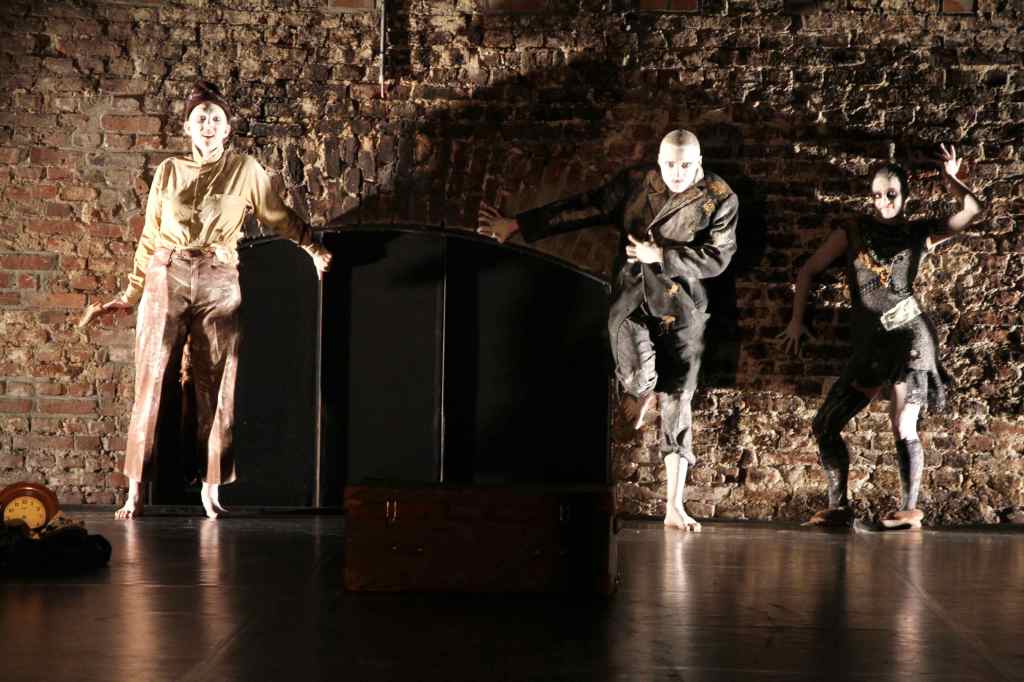
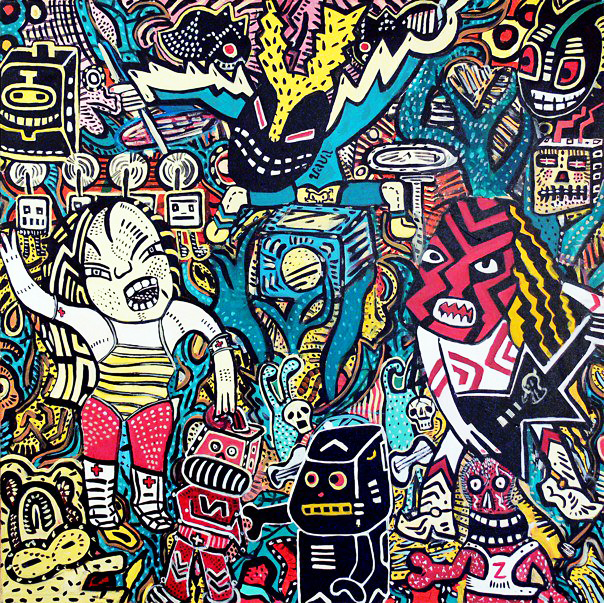
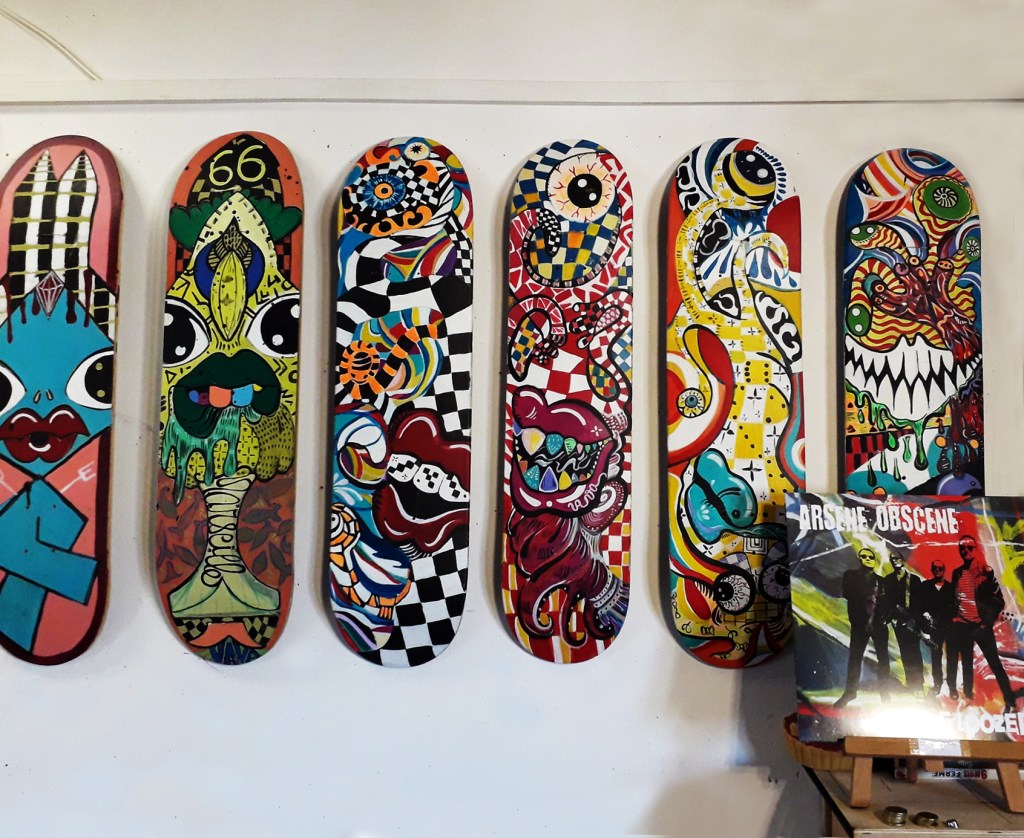
Vues d’ exposition ‘Un Château perpétuel’ Le Dernier cri, La friche belle de mai
Photographié par REAP, Marseille, Février 2022

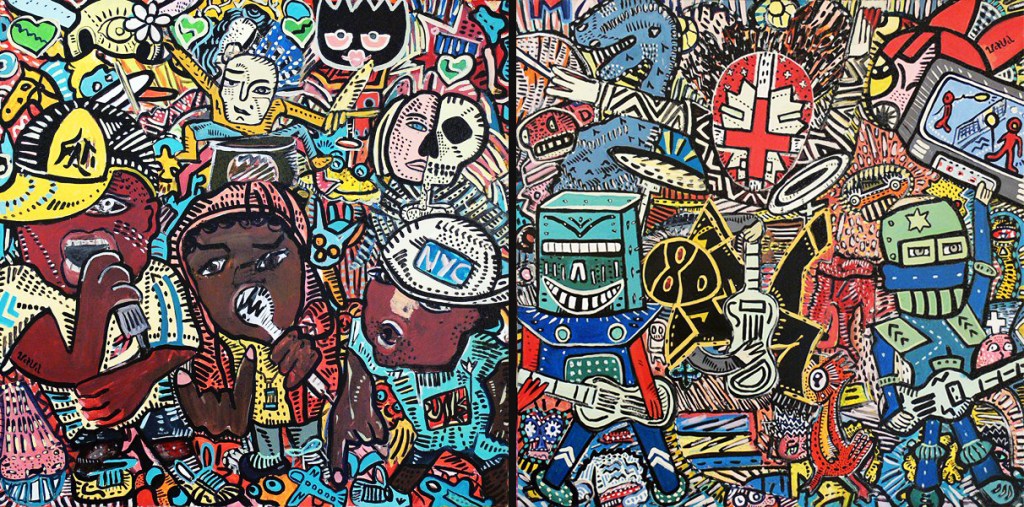
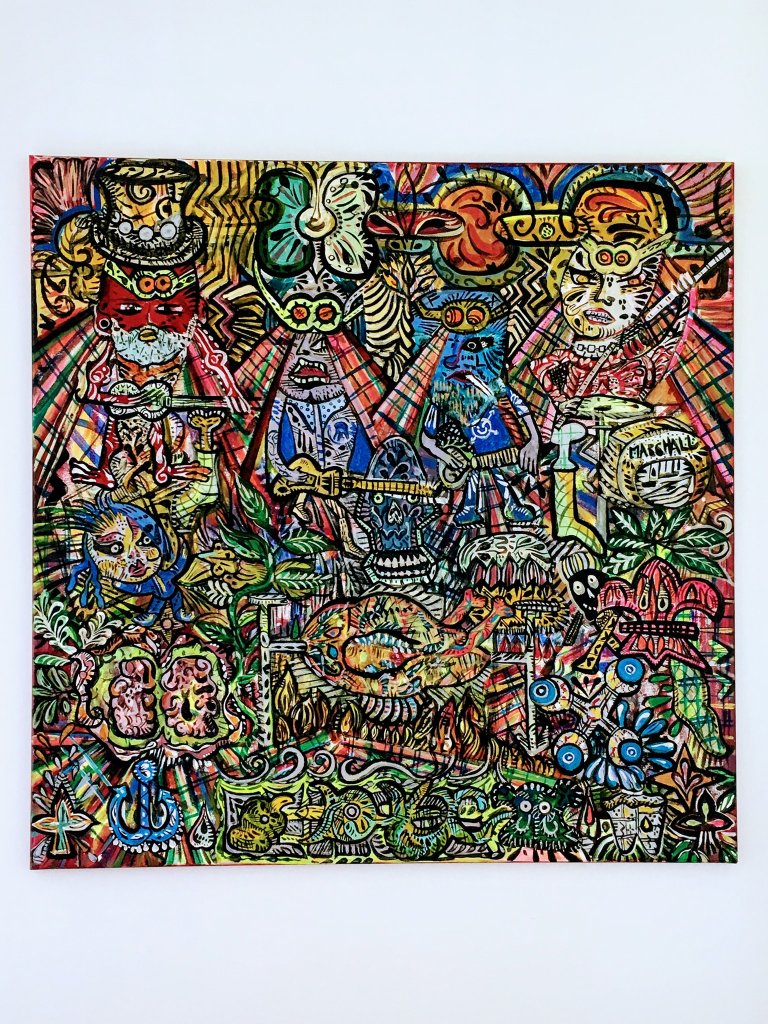
“Un château perpétuel est un vortex, une méta-peinture sans limites de dimensions ni de bords où l’ héritage dadaïste, expressionniste et médiéval se colisionnent avec d’ anciennes cultures et d’ autres plus modernes dans une vision fantastique.

Un château perpétuel est un fleuve de papiers peints puis découpés, un flux continu de peinture comme une fin en soi qui ne propose pas un résultat mais de multiples formes et combinaisons.Un château perpétuel se développe et étend son espace au gré des pinceaux et de leur fantaisie. Dans un chateau chaque élément fonctionne en lui même comme dans un tout fractal. Quant-au peintre d’ un château, il s’ y trouve comme Alice au pays des merveilles, il rêve et fabrique sa réalité en même temps qu’ il la traverse. Dans un château perpétuel, un peintre ne s’ autorise pas de s’accompagner de croquis préparatoires, pas plus qu’ il ne se permet une esquisse sur les supports.”

Vues d’ exposition ‘Un Château perpétuel’ Le Dernier cri, La friche belle de mai
Photographié par REAP, Marseille, Février 2022

Bonjour Dave, après une longue pause, j’espère que vous pourrez nous accorder un peu de temps pour avoir une petite conversation spécialement lorsque vous serez de retour dans le cyberespace avec vos aquarelles. Tout d’abord, merci beaucoup pour vos efforts et votre soutien pour notre exposition collective “Retina Decadence” il y a 2 ans. Malgré la faible participation due à la pandémie, l’exposition a été l’un des jalons de l’histoire de l’art souterrain d’Istanbul. Nous n’avons toujours pas réussi à nous débarrasser des effets des vidéo-animations d’Acid TV.

Malheureusement, la galerie a été bientôt fermée, mais les activités clandestines continuent à plein régime, et en tant que fanzine Löpçük, je fais de mon mieux pour créer une culture graphique critique anti-impérialiste.

Peut-on parler d’un vivre-underground computer culture aujourd’hui, où même le concept de « cyberpunk » s’est éloigné de son contexte et s’est transformé en une perception techno-fétichiste et s’est vidé ?

Il semble que la scène démo est toujours et contre toute attente encore extrêmement vivace. On peut y voir des choses artistiquement significtatives par exemple dans les compétitions de démos limitées à 4kb octets. Pour donner un ordre d’ idée un CV sauvegardé sous Word pèse entre 20 Kb et 30 Kb. Dans ces 4 Ko octets des orfèvres du code peuvent faire tourner : un moteur 3D et un contenu pour le moteur 3D. Ces démos sont de véritables performances, le code est au caractère près. C’ est de la pure poésie mathématique et syntaxique. Certains codeurs ont mis au point des moteurs 3D pour des ordinateurs “obsolètes” tels que des Commodore 64 ou même des ZX spectrum tandisqu’ il étaient considérés impossibles à programmer du temps où ces machines étaient utilisées dans les années 80/90. C’ est un point important ici et qui fait écho à l’ émergence des IA génératrices d’ images (Midjourney, DALL E 2 …). Ces IA sont proposées à qui le voudra pour jouer le rôle de “directeur artistique”; il s’ agit d’ écrire une simple phrase qui sera ensuite interprêtée par l’ IA qui produira une image faisant appel à des supercalculateurs dont l’ énergie nécessaire au fonctionnement est celle d’ un avion de ligne à sa vitesse de croisière.

Dreamdealers ‘Inner Vision’ Amiga demo (1991)

Pour en revenir à nos coders architectes des mathématiques ils ont le rôle inverse de ces IA dopées aux supercs aclculateurs en codant aujourd’ hui des programmes inconcevables dans les années 80, non pas car la technologie n’était pas assez avancée pour les concevoir – un Commodore 64 est aujourd’ hui le même qu’ en 1982 – mais bien par les progrès de la connaissance humaine en matière de programmation, non par un progrès technologique. Ces rétro demo makers sont les anges maudits des industriels du tout numérique leur philosophie n’ étant non pas le progrès en ligne droite de la technologie (et jusqu’ au mur s’ il le faut) mais la compréhension des technologies qui furent en place puis trop rapidement – progrès oblige – mises au rebus et sous exploitées.

Ces demo makers proposent le progrès de la connaissance et une certaine humilité dans le caractère dit “obsolète” du matériel employé tandis-que l’ industrie propose une course à l’ armement technologique explosive infinie dans un milieu fini. Choisis ton camp camarade, surtout si tu as des gosses : )

Vues d’ exposition ‘Un Château perpétuel’ Le Dernier cri, La friche belle de mai
Photographié par REAP, Marseille, Février 2022
Vues d’ exposition ‘Un Château perpétuel’ Le Dernier cri, La friche belle de mai
Photographié par REAP, Marseille, Février 2022

Call from the grave II, Group Exhibition, La Pop Galerie, 2020
Call from the Grave ll (Group Exhibition, 2020) Jurictus, Sam Rictus, Zven Balslev, Dave 2000, Andy Bolus, Le Dernier Cri

“Après, vous n’achèterez jamais plus le paquet de bandes dessi nées à la con que vous lisiez d’habitude” ,avait écrit Willem. illus­tre dessinateur et caricaturiste, notamment dans les colonnes de “Libé”, à propos du “Dernier Cri”.

Mondo Dernier Cri, Affiche 2020

Un “graphzine” à qui. à Sète, jamais à court d’idées quand il s’agit de mettre en relief les arts graphiques modernes (qu’ils oient brut ou rock’n’roll), Pascal Saumade a ouvert les portes de la “Pop Galerie”, quai du Pavois ‘Or. Et ce en marge de l’exposition “Mondo Dernier Cri, une Internationale Serigrafike” pré­sentée au Miam.

En tant qu’artiste de la vieille école, comment évaluez-vous les sous-cultures actuelles des jeunes par rapport aux années 90 ?

Les sous-cultures se numérisent, comme à peu près tout ce qui peut être convertie sous forme de “0” et de “1”. C’ est un constat factuel. Le numérique ne complète plus, il remplace. Les sous-cultures numérisées sont comme tout ce qui est numerisable et en conséquence révisionnable, censurable par ceux qui ont la main mise sur les serveurs. Alors maintenant que je suis barbu comme un gandalf je pense que la liberté et l’ énergie que j’ ai pu vivre dans les années pré-internet étaient bien entendu beaucoup plus riches de rencontres et de chocs artistiques intenses que ce qu’ il est encore possible de vivre aujourd’ hui. Il l’ étaient forcément d’ autant plus intenses que l’ accès à la culture – et encore plus aux sub-cultures – ne se faisait PAS par internet. Ce qui impliquait une durée, entre deux chocs esthétiques. Cette durée a été anéantie à l’ avènement des moteurs de recherche. Jusqu’ au milieu des années 90 nous n’ étions pas en fRance globalement équipés d’ internet, le monde n’ entamait alors que sa lente et exponentielle glissade vers l’ empire de la suggestion. Aujourd’ hui des algorithmes nous suggèrent de partout, nous manifestent ce que nous sommes censés aimer – ils le savent mieux que nous ou plutôt il ne le savent pas mais ont le pouvoir de nous imposer les opinions que nous sommes censés adopter. Les années 90 – 80 bien qu’ elles aussi numériques mais très peu connectée furent dispensées de cette machine à uniformiser les désirs et les comportements. Pour accéder aux sous-cultures il fallait par exemple envoyer de l’ argent et une lettre postale dans un pays lointain pour recevoir quelques semaines plus tard la démo de tel ou tel groupe. Ces groupes étaient référencés dans des fanzines papier eux même commendables de la même façon. Le façonnage d’ un goût artistique se faisait lentement, rythmé par les lenteurs de la poste, les limites des moyens financiers, les difficultés à contacter ces groupes obscurs et bien sûr le degré d’ ivenvestissement personnel (trouver des timbres étrangers, écrire une lettre et attendre un retour demandait un effort beaucoup plus conséquent que de cliquer des liens sur internet). Une démo se refilait de la main à la main entre amateurs locaux de la même musique générant du contact humain, de l’ échange verbal et un tissus culturel et social d’ initiés. Exactement le contraire du bazar illimité ultra suggestif d’ internet . La rareté et l’exception était le corolaire de l’ absence d’ un moyen de diffusion massive et nous étions suggérés et conseillés par des amis, des artistes, des amateurs forcenés, pas par des algorithmes appartenant à des entreprises cotée au premier marché.

Alors ce qu’ on peut penser de l’ état des subcultures c’ est qu’ elles survivent avec l’ élégance d’ une mauvaise herbe, du genre de celle qui sont matures à cinq mois et libère plus d’ oxygène que les tractopelles de l’ industrie et leur parterres de ronds-points.

Call from the Grave ll (Group Exhibition, 2020) Jurictus, Sam Rictus, Zven Balslev, Dave 2000, Andy Bolus, Le Dernier Cri

Synthèse & collage numérique (2018)
Dave 2000 ‘Phase 1’ Graff. 2020

Quand on regarde les réseaux sociaux, on voit tout le monde dans une attitude anticapitaliste et complaisante, mais que se passe-t-il réellement ? En tant qu’artiste, comment évaluez-vous ces extensions médiatiques qui nous sont présentées alors que « l’humanité » gémit de douleur dans la captivité des puissances impérialistes supranationales ?

Les populations sont sans défense devant des industriels, des banquiers, des militaires, des administrations et le contrôle inédit des GAFAM qui permettent de faire tourner le cirque. Mauvaise nouvelle, le monde a été kidnappé. Les medias sociaux sont des jeux vidéos dangereux, bien plus dangereux que le plus dégueulasse des FPS ou on pourrait torturer des petits chats au fer à souder. On attend Insta Kids avec une impatience à peine dissimulée. Victime de sa construction neurologique, le sapiens sapiens peut supporter sa vie vide de sens si il peut s’ en rêver une autre plus glamour sur Instagram.Echange paillettes virtuelles contre acceptation de soi même. Ca doit embaucher sec en psychiatrie en ce moment non ?

Dave 2000 ‘Phase 2’ Graff. 2020

Quatre entreprises (Twitter, Youtube, Instagram, Facebook) dominent le monde ; Si nous considérons la civilisation comme un processus qui progresse jusqu’à sa perte, que pensez-vous que la jeunesse actuelle et l’humanité sont en train de perdre ? Suis-je trop pessimiste, corrigez-moi si je le suis.

Au contraire, je te trouve même plutôt optimiste. Les populations vont perdre progressivement et par à-coups leurs libertés jusqu’ à l’ asservissement total car elles acceptent massivement (car suggérées en permanence et de plus en plus efficacement) de troquer leurs libertés contre du confort. Ce troc est rendu ludique, donc en quelque sorte distrayant (crédit social, évaluation permanente dans les écoles, permis à …,media sociaux et followers etc … ) et donc accepté sans mouvement sociaux massifs. On nous fourgue l’ objet de notre asservissement en nous ventant libertés et facilités (encore de la suggestion). Par exemple aujourd’ hui ne pas posséder de smartphone revient a accuser un déficit de connectivité aux autres, un handicap social. Ne pas posséder de smartphone est aussi un handicap lorsqu’ il faut présenter des QR codes à la chaine. Il faut se soumettre au geste de dégainer le smartphone sinon le prix à payer sera l’ inconfort d’ une exclusion d’ abord moindre et qui deviendra invivable.

J’ ai dessiné nombreuses personnes dans la rue cet été. Beaucoup avaient des smartphones, une sur deux, à la main ou nà l’ oreille … Lorsqu’ elles le regardent elles sont toutes les sourcils plus ou moins froncés et ont l’ air éberluées lorsqu qu’ elles relèvent la tête et se sortent la gueule de la matrice LCD. Ce n’ est pas drôle de dessiner ces gens, les mêmes poses, les mêmes trognes mollement accaparées, mais en même temps si moi aussi j’ étais happé par un téléphone je ne pourrais pas les dessiner. Comme eux qui ne me voient pas, je ne les verrai pas non plus et il ne se passerait rien d’ autre que le croisement de plusieurs corps en mouvement enregistrés par des caméra 360° à tous les coins de rue pour seuls témoins. Zéro conscience les uns des autres. Les zombies m’ ont toujours fascinés et lorsque je regarde cette population avec un regard curieux semblable, l’ humanité s’ ensevellissant elle même dans une matrice totalitaire parait être un spectacle grotesque qui ne manquerait pas de pépitos s’ il n’était pas aussi tragique. Le spectacle “des sidérés” même s’ il ne m’ inspire guère me fascine.

Dave’s sketchbook or Carnets ambulatoires, 2022

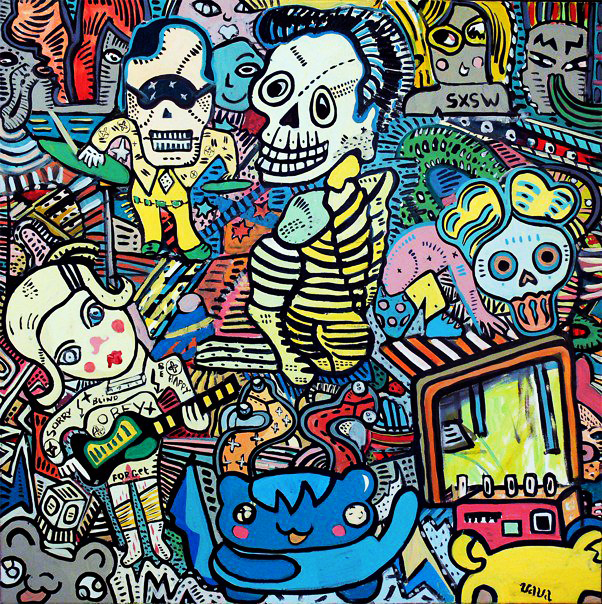
Le serment des voraces – 80x60cm – acrylique sur toile
France – acrylique et encres sur papier craft blanc – 97×205 cm

En tant qu’artiste, comment évaluez-vous la période à venir et le “Great Reset” ? Êtes-vous mondialiste ou nationaliste, de quel domaine vous sentez-vous le plus proche ?

Je suis une personne qui regarde le cirque du pouvoir devenir dingue et les populations du monde écrasées à tous les niveaux par une oligarchie discrète dans ses agissements et disposant de moyens de contrôles des masses inédits dans l’ histoire de l’ humanité. La position nationaliste est elle encore viable lorsque les nations ne sont plus que des parts de marché divisées par cette oligarchie?

Que voudriez-vous dire sur le fait que Banksy et des artistes similaires, qui ont développé des critiques politiques radicales du siècle avec leurs œuvres, poursuivent également leur carrière avec les valeurs bourgeoises auxquelles ils s’opposent et avec de riches collectionneurs ?

A mon sens Banksy n’ est pas un artiste mais un communicant habile doublé d’ un piètre graphiste. Je laisse la parole à ses sponsors et aux trépannés du bulbe qui voient en lui une sorte de demi dieu de la suverssion pour parler de son book a défaut de parler d’ une oeuvre.


“Le Dernier Cri”, c’est d’abord une aventure artistique lancée par un artiste-punk phocéen. Pakito Bolino. Aux confins de l’art brut, du fanzine (ces petits jour­naux artisanaux alternatifs épris de rock, de bande dessinée, de SF…) il est l’un des fers de lance internationaux de ce mouve­ment rebelle qui a tenu à se libé­rer du marketing, en favorisant et décuplant la créativité de bon nombre d’artistes “under­ground”, pour beaucoup fans de métal et musiques extrêmes.

La Pop Galerie ‘Call from the Grave ll’ 2020

Vous souhaitez parler de l’exposition ‘Call From the Grave’ qui se tient à La Pop Gallery ? Cela ressemble à une exposition impressionnante et fantastique qui réunit les grands noms de la culture Grafzine, je me demande si l’événement n’a pas été un peu éclipsé par la pandémie ?

C’ est très flatteur, je suis sûr que Sam Rictus et Jurictus qui y ont participé auront une érection telle en lisant tes mots qu’ espérons qu’ elle ne leur soit pas fatale. Andy Bolus et Zven Balslev ont aussi exposé des peintures, dessins et collages. Bien sûr l’ exposition fut rendue difficiles par les règles arbitraires sans cesse changeantes de notre gouvernement fantoche mais ce fut l’ occasion de rencontrer Pascal Saumade, curateur au Musée International des Arts Modestes et qui tient la Pop Galerie. Il se définit non pas comme un collectionneur (au sens de “qui voudrait tout” comme il le dit) mais un amateur de pièces singulières. Je m’ arrêterai vite ici sinon je me perdrais sur la rivière étoilée du souvenir : l’ alerte à la bombe en gare de Sète; le couvre feu déclaré à Montpellier qui empêche les habitants de venir jusqu’ à Sète, l’ imitation sonore du chanteur de Pantera par Sam Rictus avant le premier café … Le mime de la copulation du diable de Tazmanie par Judex qui nous avait rejoint et les truculents récits liégeois de Cha Kinon qui ont pour héros des sacs de sport, des étrons et des belges …

Zven Balslev, Call from the Grave ll (2020)
Call from the Grave ll (Group Exhibition, 2020) Jurictus, Sam Rictus, Zven Balslev, Dave 2000, Andy Bolus, Le Dernier Cri
Andy Bolus, Call from the Grave ll (2020)

Dave De Mille, Sam Rictus, Jurictus, Call from the Grave ll (2020)
l’exposition est une excuse, la conversation est merveilleuse

“A la Pop Galerie de Pascal Saumade, une rencontre du troisième type”

“La preuvre à travers le panel d’œuvres, pour la plupart dessi­nées à l’encre de chine, qui or­nent les cimaises de la Pop Ga­lerie. Elles sont signées Jurictus, Sam Rictus, Zven Balslev et Dave 2000. El elles envoient… grave.”
Citations d’Marc Caillaud
mcaillaud@midilibre.com

Call from the Grave ll (Group Exhibition, 2020) Jurictus, Sam Rictus, Zven Balslev, Dave 2000, Andy Bolus, Le Dernier Cri
Article de Marc Caillaud
Dave De Mille, Call from the Grave ll (2020)
Call from the Grave ll (Group Exhibition, 2020) Jurictus, Sam Rictus, Zven Balslev, Dave 2000, Andy Bolus, Le Dernier Cri
Sam Rictus, Call from the Grave ll (2020)

Comment trouvez-vous Zven Balslev et Cult Pump, êtes-vous intéressé par son travail ? Il semble très bien garder l’esprit Underground Comix vivant à Copenhague.

C’ est un des dessinateurs les plus drôle et les plus poétique de notre époque. Le Docteur Good a rendu son energy drink par le nez en tournant les pages de son livre YAMA HAHA . Tous les dessins se composent de figures qui évoquent plus qu’ elles explicitent, et quand elle le font on se demande bien des pourquoi ? Des mais ? Bref, on s’invente une histoire contrairement aux comics qui nous en raconte une. On se marre de la naiveté décidée de ces compos en forme de mini poèmes absurdes, énigmatiques comme des figures de tarots sous LSD. Ses dessins me renvoient à une enfance intérieure, de jeu, de décodage, de figurines en plastiques sorties des tirettes mystérieuses de fêtes foraines. C’ est généreux, sans complexe, faussement évident et enfantin, comme tout ce qui est génial.

For Zven Balslev & Andy Bolus LDC Editions:

zven-balslev > andy-bolus


A6 – technique mixte

Qu’as-tu fait depuis ‘Call From the Grave’, tu sembles être sérieusement dans l’aquarelle, l’acrylique, les dessins et tu n’hésites pas à porter l’aventure aux graffitis ; en même temps, compte tenu du Kaizer Satan 3 sorti de LDC, nous dirions que vous êtes dans une période très productive où vous avez beaucoup développé votre art.

Dans le parc d’ attractions qui me sert d’ esprit et d’ agenda j’ ai mis en place plusieurs manèges. Les aquarelles de mes carnets sont la résultante de mes errance dans la ville de Marseille ou ailleurs. L’ aquarelle est une technique fabuleuse à bien des égards. Elle est très nomade, une boite de couleurs de la taille d’ un paquet de cigarettes, un carnet , un pinceau à réserve et en route pour l’ aventure. J’ observe dans la rue, dessine parfois d’ après nature pour capturer des formes, des rythmes. Me sert globalement de l’ ambiance urbaine pour dessiner ce qui me passe par la tête durant ces immersions. Ca a pour effet de radicalement changer mon rapport à la ville et de rendre ludique la réalité sordide des zombies ultra-connectés, des arbress coupés pour être remplacés par des sucettes publicitaires automatisées etc … L’ épouvante normale devient un jeu et ce jeu m’ appartient.

Dave 2000
Dave 2000

“Un château perpétuel” est une des attraction phare de mon esprit. Il s’ agit d’ une méta-peinture sans limite de bord ou de format composée de grands papiers peints à l’ acrylique. Chaque élément étant indépendant des autres mais fonctionnant dans un tout. Un château perpétuel n’ a pas non plus de nombre d’ éléments définis. Ainsi un peintre se lève le matin et si il se trouve désoeuvré après sa deuxième cafetière il n’ a qu’ à se dire à lui même “un peintre va perpétuer un château perpétuel”. “Un château …” n’ est donc pas un Work in progress comme on dit dans la société globale car un WIP a un début et une fin mais une peinture sans fin si ce n’ est la mort du peintre ou la cessation de sa pratique. Cette idée de peinture sans fin, sans bords et sans cadre m’ est venue d’ un ras le bol des expositions montrant des formats A5/A6 diposés orthogonalement dans des cadres Ikea et parfois même avec le sur-cadre d’ une Marie-Louise. Je trouve à titre tout à fait personnel indigne d’ artistes qui se réclament d’ une expression brute, sans tabou de se fourvoyer avec ce genre d’ accrochage standardisé. Je veux montrer de la peinture brute, sans fards, sans ce dispositif de mise en exergue ridicule soumis aux codes des galeries. De la peinture qui dit au spectateur “regarde, je ne suis qu’ un bout de papier peint qui est beau en lui même et par lui même”. Cette nudité dans la scénographie permet aussi au spectateur grâce aux relatifs grands formats de s’ immerger dans une oeuvre qui sans apparats semble alors accessible dans le sens d’ un “moi aussi je peux le faire, ce n’ est que du papier, de la peinture, des brosses, le coeur, l’ esprit et la main” au contraire des cadres et sur-cadres qui signifient “c’ est encadré, c’ est précieux, c’ est expert, voila ce que tu dois admirer et ne pourras jamais faire pauvre spectateur”.

Dave 2000, drawing, 2021

J’ imagine en ce moment un nouveau manège urbain qui s’ intitulera “7074L GLO34L” et consistera à coller des peintures ironiques qui nieront ou détourneront les affiches de politiciens ou d’ annonceurs qui envahissent les panneaux d’ expression dites “libres”.

Pour finir et en prévision de l’hiver il me reste à terminer une animation 3D noir et blanc dans la lignée de “5 automates” et basée sur le roman “Le maître et Marguerite” de Mikhaïl Boulgakov.

Brown posca on paper – A4

Dans ce nouvel épisode, on pousse les portes du dernier cri, maison de micro-édition underground pilotée par le terroriste graphique Pakito Bolino. Basé à la Friche depuis 1995, cet atelier s’attache à promouvoir des auteur·trice·s en marge de l’industrie et de l’art contemporain.

Qu’aimeriez-vous dire à propos de l’exposition NAROK, je pense que cet événement était plus une exposition essayant de capturer l’atmosphère Asian Extreme. Comment trouvez-vous ces idées créatives de Pakito ; il synthétise les mouvements graphiques et d’illustration modernes avec des écoles excentriques qui ont germé dans des contrées lointaines (comme le japonais Heta-Uma), et il arrive toujours à nous surprendre ; Selon vous, qu’est-ce qui le rend si créatif comme ça, pensez-vous qu’il a un vrai côté malveillant et négatif ? Ou ne montre-t-il que cette facette de lui-même dans ses œuvres artistiques ?

Je pense que Pakito n’ a pas besoin de chercher d’ idées, les intermittents de l’ art “cherchent”, Pakito “trouve” sur son chemin artistique car pour lui l’ intermittence de l’ artiste n’ existe pas. Quand il n’ est pas à imprimer pour le DC, il est en vadrouille pour on ne sait quelle intervention, rencontre, ou salon d’ édition. Hors des heures ou il n’ est pas pris dans le courant des activités du DC il dessine quotidiennement ce dont il parle comme d’ un défouloir. Ce qui le rend si créatif est d’ avoir dédié sa vie à l’ art sans calcul, sans carrière et dans ce que l’ art a de plus humain, énergique, partageur, inventif, et résistant au formatage global. Avec Odile de La Platine (chargée des impressions en offset pour le Dernier cri et à la tête d’ une des dernières imprimerie artisanales de Marseille) le Dernier cri possède ses propres moyens de production autonomes ce qui est aussi une pièce maitresse de la créativité car ces moyens permettent la liberté, autant dans le propos que dans des choix techniques (nombre de couleurs, formats, pages si il s’ agit de livres).


Xavier-Gilles Néret「GRAPHZINE GRAPHZONE」

Il y a quelques années, grâce à Mavado Charon, il m’a envoyé le livre Graphzine Graphzone. Comme le livre est en français, je n’ai pas pu tout lire, mais il est évident que des études sérieuses ont été faites en France depuis les années 70, quand on regarde les artistes de l’ancienne génération comme Pascal Doury, Bruno Richard, Olivia Clavel , et des magazines de contre-culture comme Elles Sont de Sortie et Bazooka. En tant que l’un des artistes phares de ce domaine aujourd’hui, de quelle école vous sentez-vous plus proche ? Et de combien de générations peut-on parler ?

Je me trouve bien mal placé pour en parler car avant le début des années 90 je vivais dans un bled situé dans les montagnes vosgienne en fRance et ce que je connaissais de l’ underground se limitait à la musique, à la scène démo et au piratage informatique. Je ne connaissais presque rien aux sous mondes de l’ art si ce n’ est des jaquettes photocopiées de démos de metal ou de punk et des cracktros des jeux vidéos piratés avec leurs lettrage délirants. C’ était déjà très fort, d’ autant plus que ces choses difficiles à se procurer révelaient à mes oreilles et mes yeux l’ existence d’ un monde d’ autonomie et de liberté jusqu’ alors complètement absent de ma réalité colonisée par la télévision et les livres sur les vainqueurs (souvent post-mortem) de l’ histoire de l’ art. Lorsque je rencontrais le travail des artistes dont tu parles plus haut j’ avais déjà une culture sub-graphique construite sur ma pratique et aussi les rencontres faites à Strasbourg, notamment avec Vida Loco qui préparait alors son premier livre “8Pussy” qu’ il serigraphiait lui même. Pour en revenir aux artistes que tu évoques, même si leur travail n’ a pas eu d’ influence sur moi je sentais cette vivacité, cette volonté libertaire et ce refus des limites de l’ industrie. Tout ça m’ inspirait énormément et cette même énergie continue à porter ma pratique et définir mes choix actuellement.


Tranchée Racine Hebdomadaire – N°9

Quand on regarde Stéphane Blanquet et l’UDA, on voit une attitude surréaliste, élitiste qui vient surtout de l’école de Roland Topor ; Bien qu’il y ait aussi des artistes très talentueux chez LDC, c’est comme une équipe qui travaille plutôt dans une ambiance rock’n roll. Pakito a-t-il une attitude ou une position contre l’art élitiste dans un sens réel, dans un contexte idéologique, ou est-ce que tout le processus fonctionne comme ça à cause de son style de vie ou de celui des artistes collaborateurs ?

UDA et LDC ne proposent pas la même chose. UDA permet à des artistes underground de voir leurs oeuvres diffusées par exemple dans “La tranchée racine”, un hebdomadaire au format d’ un quotidien d’ information imprimé en quadrichromie par une entreprise en sous-traitance. Les moyens de productions sont ici ceux de n’ importe quel éditeur mainstream en somme. UDA organise aussi des expositions collectives dans des lieux prestigieux tels que la Halle Saint Pierre à Paris tournant autour de la personnalité de Stéphane Blanquet, CF : “Stéphane Blanquet et ses invités” à Aix en Provence.

LDC quant-à lui propose à des artistes de venir dans son atelier avec des originaux, de les scanner, les mettre en couleur si nécessaire, de choisir un papier, un format, des encres. Le DC permet aussi d’ apprendre à imprimer en sérigraphie si les artistes ne savent pas le faire eux même et pour finir de monter une exposition dans l’ espace dédié pour célébrer la sortie de leur livre. Tout comme UDA, les artistes se voient proposé de participer à des expositions collectives mais qui ne tournent pas autour du personnage d’ un leader mais de la structure elle même par exemple “Mondo DC” ou d’ une idée générique – “Heta Huma” ou “Narok”. De plus chaque année a lieu le festival de micro-édition Vendetta qui fait se converger de nombreux artistes, éditeurs et qui est organisé par le DC.

On a donc deux éditeurs/producteurs d’ artistes underground et deux moyens de production fondamentalement différents, l’ un va dans le sens d’ une production assistée relativement massive et impressionnante en terme de format, d’ exposition dans des lieux prestigieux, de technique quadri et de nombre de multiples permis par la sous-traitance. L’ autre avance dans le sens d’une auto suffisance de production, de liberté de choix d’ édition, de qualité et de savoir faire artisanal, d’ élévation et d’ émulsion artistique. Bon nombre de structures tendent vers cette autonomie salvatrice et cette liberté courageuse initiée et perpétuée par LDC, comme Epox et Botox, Le Garage Hell, Cult Pump, Meconium, Turbo Format, Papier Gachette etc … Ils sont légion car l’ intégrité fait des enfants.


UFOE ‘Exhibit’ 3D video animation by Dave 2000

Je demande cela parce que, cela me rend triste que de si bons artistes comme vous soient coincés uniquement dans le domaine de la bande dessinée. Quand on regarde l’art contemporain et les biennales exposées aujourd’hui dans le monde, on voit bien la crasse bourgeoise. Et je pense que vous avez essayé de peindre cette aliénation synthétique et cette dévaluation dans votre tournée d’exposition d’animation 3D que vous avez récemment publiée.

Cette animation dont tu parles montre une exposition virtuelle dans un futur assez proche et qui me met en scène (bien que j’ y sois invisible) en tant qu’ artiste inutile et donc à réhabiliter socialement Dans cette courte fiction animée les moyens de réhabilitation font l’objet d’ un vote du public – le travail forcé dans les mines de siliciums, la castration au laser, la lobotomie etc … exactement comme on vote pour le départ d’ un participant à une émission de télé-réalité. La visite virtuelle est faite par un guide, lui même en cours de réhabilitation et sérieusement alcoolique, chargé de montrer au public les oeuvres dégénérées d’ un artiste nuisible au bon fonctionnement sociétal selon le pouvoir en place. Je vois ce film comme une à peine parodie gentillette de ce que l’ oligarchie globalisée et son armada numérique nous préparent en termes de surveillance, de contrôle, d’ uniformisation, de formatage des esprits et bien entendu de violence.

Quant aux artistes conceptuels du milieu dit de “l’art contemporain” que tu évoques je vais faire court à leur sujet. A mon sens un artiste plastique est un pantin méprisable si il n’ est pas capable une fois jeté nu dans une cellule de tapisser de graffitis les murs de sa prison et de les transformer en une oeuvre merveilleuse à faire Michel Ange se lever de sa tombe pour aller repeindre les plafonds de la chapelle Sixtine avec l’ enthousiasme d’ une jeunesse retrouvée. Partant de ce postulat, ces fifrelets, ces remplisseurs de dossiers de demande de subventions, ces branles-verbe ne m’ intéressent guère, tu t’ en doutes et ce qu’ ils pourraient penser de mes activités artistiques n’ a pas la moindre importance en comparaison du rire d’ un enfant qui me regarde dessiner un “père noël qui fait caca”.

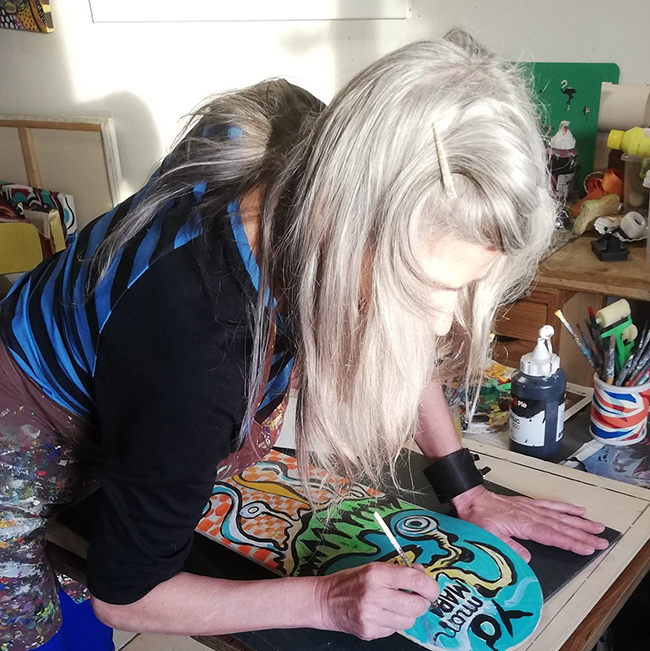
Dave de Mille à son atelier

Merci beaucoup Dave d’avoir pris le temps de parler, et merci de partager les dernières nouvelles de France ; nous suivons votre travail avec enthousiasme, au revoir pour l’instant, mon ami, prenez soin de vous !

Bon courage mon ami prends soin de toi !

Pour suivre les dernières évolutions de l’artiste :

> protopronx.free.fr

> pitpool.free.fr

Pour une conversation plus ancienne avec l’artiste :

Dave 2000: Pas un Artiste un Ninja (2016)


With Miron Zownir in the Days of War

Sewastopol 2013

“The world wasn’t as aggressively polarized since the late 30’s of the last century. It is ruled by bankers, ethical castrates, fanatics, megalomaniacs, hypocrites, opportunist, tyrants, technocrats & computer nerds. It’s getting gloomier by the minute.”

Miron Zownir Special Interview

Burak Bayülgen & Erman Akçay, March 2022

Istanbul, 2019

“Modern skyscrapers, multiple ethnic neighbourhoods, alternative cultural institutions and clubs, independent underground papers and galleries, street venders, transgender prostitutes, freaks, slums, seagulls, alley cats and its magic light, Istanbul is definitely one of the most exciting cities in the world.”

Hello Zownir, we’ve been surprised to see you in Istanbul again two years after your last visit in 2019. What has drawn you here again within these hard pandemic conditions?

After my first two visits to Istanbul in September and November 2019, it was clear to me that my visual output would amount to a photobook. But with the outbreak of corona and a new dimension of existential pressure on the health and economics of its citizens I decided to go back. It was December 2021, the city was blessed with a soft and pleasant glow of winter sunlight and on the surface, you couldn’t detect any changes of spirit. However, roaming around the city at night the increasing level of misery was more than apparent. It was shocking to see how many seemingly unattended children, were begging in the middle of overcrowded streets, facing for hours thousands of unanimous legs and feet. Beggars exposing their amputated limbs, homeless families sleeping in drifty doorways or cardboard boxes. Old women and men groaning and whining for a modest aid.

As you have worked in many capitals of Europe, what can you say about your visit in Istanbul as an artist in terms of Muslim geography and a cosmopolitan capital? What have you noticed in comparison with the West?

With its location at the Golden Horn and the Bosporus, many traces of its long history, impressive sacred and secular buildings, modern skyscrapers, multiple ethnic neighbourhoods, alternative cultural institutions and clubs, independent underground papers and galleries, street venders, transgender prostitutes, freaks, slums, seagulls, alley cats and its magic light, Istanbul is definitely one of the most exciting cities in the world. It may be too overcrowded, polluted, segregated between believers and non-believers, free spirited people and those believing in secular, holy and political authorities. The economic pressure to survive is immense and the division between people with very different outlooks, values and dreams is incredible. But I didn’t sense anywhere any hostility against me as a stranger. And I never witnessed any open hostility between people of different faith. In a way Istanbul surprised me as a reasonably tolerant, open minded and extremely lively, cosmopolitan and exciting city.

‘Istanbul Noir’ article by Georgia Hart, Zoo Magazine, 2022
İstanbul 2019

Have you found anything interesting in terms of daily and social life?

Of course, that would have been unavoidable. I lived in different areas on the European and the Asian side. Private accommodations and hotels. Safe and unsafe arias. I was always on the move and hardly slept a couple of hours a day. I was on a mission and high on adrenaline.

Just to mention some unusual incidents: Once a pimp attacked me. He hit me with his best shot on the chin while I was photographing two transgender prostitutes hustling for customers. He was a head smaller than me but a trained boxer. Probably a welterweight. But since he didn’t shake or impress me, he got scared and run away. One prostitute yelling after him, probably calling him a coward, the other one yelling at me, in English to erase my photo. Not knowing that I work analogue.

Another time a beggar threw his crotch at me, missed and wasn’t able to reach it anymore by himself. I picked it up and brought it back to him. He thanked me for it and tried to hit me again, just missing my legs.

Another time I got almost arrested for making a photo of a police officer, but I talked my way out of it, though he did not understand much of what I was saying. There were other incidents but most of the time it was reasonably relaxed and civilised.

Odessa 2013

“That level of state propaganda in Russia is exactly the same one that Trump used in the States to demonise people. Only taken to another extreme to rationalise a genocide…”

As a son of an Ukrainian father, what would you like to say about the war in Ukraine? You had serious studies in Odessa, Kiev and Majdan between 2012-2014. Have you ever noticed the signs of the current crisis in that period?

Yes, my father was Ukrainian and I still have many relatives and friends in the Ukraine…

To answer your question. Before Majdan there weren’t any detectible signs for an up rise or a revolt. But in late November 2013 Ukrainians took to the streets in peaceful protests after Viktor Yanukovych chose not to sign an agreement that would have connected the country more closely to the EU. The consequences was a brutal retaliation from the then government with more than a hundred lethal victims. After Yanukovych’s flight to Russia the situation in the Ukraine was very uncertain but most Ukrainians had a strong commitment to democracy and a potential integration into the EU. With the annexation of the Crimea and the increasing military involvement of the Russians in the Donbass, it should have been obvious that Putin was planning to punish, humiliate and defeat the Ukrainians for choosing their own fate.

As to this senseless slaughter in Ukraine, I’m totally outraged! Putin is lying, thieving and killing as if he was untouchable in his megalomaniac crusade against freedom and democracy. He is an imperialistic glutton who has to be stopped any way possible. But what about the Russians? Those openly outspoken against his monstrosities immigrated, are dead, or imprisoned. But much too many seem to support or tolerate him. That level of state propaganda in Russia is exactly the same one that Trump used in the States to demonise people. Only taken to another extreme to rationalise a genocide…

The pandemic, the war in Ukraine, famine and immigration based on global warming have all been discussed in Turkish media. How are the conditions in Europe? As an artist, how do you evaluate the upcoming period and “Big Reset”?

I’m no Nostradamus, but to be honest I’m not optimistic. The world wasn’t as aggressively polarized since the late 30’s of the last century. It is ruled by bankers, ethical castrates, fanatics, megalomaniacs, hypocrites, opportunist, tyrants, technocrats & computer nerds. It’s getting gloomier by the minute. Everything seems to collapse at once. We’re approaching a potentially darker age than we experienced in our lifetime. Nobody knows what’s ahead of us. Wars, famines, inflations, overpopulation, pollution, droughts, impoverishments, fires, storms, pandemics, unknown diseases and catastrophes. Certainly, the future looks bleak. But we only live once and as long as we have a choice to determine our own fate, it’s up to us what we give, take, wish, express, create or accept.

Simferopol 2012

“We only live once and as long as we have a choice to determine our own fate, it’s up to us what we give, take, wish, express, create or accept.”

How do you find the vision of Bene Taschen as a young entrepreneur and gallery owner? In the past few years, Hardhitta Gallery has exhibited the works of Jamel Shabazz, Joseph Rodriguez Gregory Bojorquez and you.

I have only the highest admiration for Bene Taschen. He is a great gallerist with a strong conviction, representing a wide range of world-class photographers. Having the strongest bonds to each of them, only showing images he is a hundred percent of convinced. Regardless of its commercial or controversial context.

Can we equate the portraits of famous people which appeal to the marginal collectors with the documental works? Which field do you feel more close? What does determine the photography scene in Europe in general?

Goya portrait rich, famous and powerful people as well as the freaks, the poor and the dammed. Some photographer choose still-life’s, landscapes, portraits, collages or whatever. I have no prejudice against any style, some I like more some I like less. Of course, I prefer hard-core street and documentary photography. I guess that’s obvious!

Miron Zownir – Absturz Trailer

“My movies are psychotic, raw, iconoclastic and anti-cinematic nightmares far of any mainstream enjoyment. You got to have a twisted mind or strange sense of humour to appreciate them.”

As an artist who reached at maturity period, do you think your literature, poetry, photography and cinema can say anything to the world? After all these years, how could you summarize the story you have manifested fearlessly throughout the all kinds of states and darkness which were immanent to be a human?

Well, it’s hard to judge the value of your own work, creative output or impact. My goal was never to please, become rich or famous. I was always expressing my personal viewpoint in any genre I was productive in, regardless of its potential consequences. Things that were important for me to show or express, whether others would appreciate, ignore or condemn it. I was never mainstream and are still controversial to this day. Even so, some of the great galleries and museums of this world exhibited me. I guess I’ve documented the Zeitgeist of the last 40 years in all its aspects, without glorifying or condemning the sometimes bitter truth I discovered. I might have influenced and encouraged quite a few younger photographers to ventures into the darker areas of our existence.

I wrote some novels, poems and short stories, which won’t be fully appreciated until they are translated into English and into many other languages. My movies are psychotic, raw, iconoclastic and anti-cinematic nightmares far of any mainstream enjoyment. You got to have a twisted mind or strange sense of humour to appreciate them. But everything I did is out there, will stay and grow in its attention.

Artist Portrait by Michele Corleone

Istanbul Noir

Georgia Hart, Zoo Magazine, 2022

Since President Erdogan’s election. Turkey has experienced severe restrictions on democratic freedoms and civil rights, causing growing tensions between the EU and Turkey. Since the mid-2010s Turkey has experienced severe stagflation – low rates of economic growth combined with inflation. These consequences on its economy and trade have led to Western tourists being rare, as well as Istanbul becoming a city non grata. Furthermore, coinciding with the devaluation of the Lira, collapsing construction industry, misinformation, women’s rights abuses, and many other factors have resulted in high percentages of unemployment and a high ranking in the world misery index. German photographer Miron Zownir wanted to explore more of this, and from his impressions from collaborating with alternative subcultural Istanbul magazines, assumed it would be reasonably safe to visit. This led to the beginning of the artist’s upcoming photobook “Istanbul Noir”. The focus of Zownir’s trip was primarily on the down and outs, homeless, transgender prostitutes, street vendors, and beggars but also on what he described as the energy and magic atmosphere of the city as well as the light and shadow over the Golden Horn and Bosporus. The imagery throughout depicts his multiple expenences during three different visits to Istanbul, where he lived in a variety of different areas on the European and Asian sides. After a few hours of sleep each night, the images are shot on a high of adrenaline. Various experiences prevail through these images, through discussions with artists, musicians, writers, poets, and publishers, all of whom Zownir describes as having a strong commitment to freedom and democracy. Many of these talents screened his films, published photos, and organized public events that in the West would be deemed radical. This conveys that in Istanbul there are still loopholes for alternative anti-establishment activities, but many of these could be discovered and classified as dangerous. Both “Istanbul Noir” and photos exhibited at the Gallery Bene Taschen will be presented in winter 2022/23.

A short clip from Zownir’s 2019 İstanbul reading.
Some Posters of Zownir’s events in 2019, İstanbul

Istanbul 2019

ISTANBUL NOIR

Georgia Hart, Zoo Magazine, 2022 / Türkçesi: Burak Bayülgen

Cumhurbaşkanı Erdoğan’ın seçilmesinden bu yana, Türkiye demokratik özgürlükler ve insan hakları açısından Avrupa Birliği ile gerilimin artmasına sebep olan katı kısıtlamalara maruz kaldı. 2010ların ortasından beri yoğun fiyat artışlarıyla boğuşan Türkiye’de ekonomik büyümedeki düşük oranlar enflasyonla birleşti. Bu ekonomik ve ticari sonuçlar Batılı turistlerin azalmasına ve aynı zamanda İstanbul’un istenmeyen bir şehir haline gelmesine sebep oldu. Daha da ötesinde, Türk lirasının değer kaybıyla birlikte çöken inşaat sektörü, dezenformasyon ve kadın hakları ihlali gibi pek çok etken işsizlik oranlarının yüksek oranda artmasına ve Türkiye’nin dünya sefalet endeksinde üst sıralarda yer almasına neden oldu. Alman fotoğrafçı Miron Zownir tam da bunu araştırmak üzere, alternatif alt-kültür dergileriyle yaptığı ortak çalışmalarından edindiği izlenimlere dayanarak İstanbul ziyaretinin makul ölçüde güvenli olacağını düşündü. Bu da sanatçının fotokitabı ‘Istanbul Noir’a başlamasını sağladı. Zownir’in ziyaretinin odak noktası kendi tabiriyle şehre Haliç ve Boğaz’ın gölge ve ışıkları kadar enerji ve büyülü bir atmosfer veren fakir fukaralar, evsizler, trans seks işçileri, seyyarlar ve dilencilerdi. İmgelemi İstanbul’a yaptığı üç farklı seyahati ve Asya ve Avrupa yakası gibi şehrin çeşitli bölgelerinde yaşarken edindiği tecrübeleri tasvir etmektedir. Fotoğraflar geceleri sadece birkaç saatlik uykunun ardından yüksek adrenalinle çekilmiştir. Zownir’in özgürlük ve demokrasiye sonuna dek bağlı kaldığını belirttiği sanatçılar, müzisyenler, yazarlar, şairler ve yayıncılarla yaptığı tartışmalar gibi pek çok deneyim bu fotoğraflarda baskın çıkmıştır. Bu yetenekli insanlar Zownir’in filmlerini göstermiş, fotoğraflarını çeşitli dergilerde yayınlamış ve Batı’ya göre bile oldukça radikal organizasyonlar düzenlemişlerdir. Bu da İstanbul’da hala düzen karşıtı eylemlerin olduğuna dair bir umut vadetmekte, ancak pek çoğu tehlikeli sayılmaktadır. Hem ‘Istanbul Noir’ hem de Bene Taschen Galerisi’ndeki fotoğrafları 2022-23 kışında sergilenecektir.


Odessa 2013

Savaş Günlerinde Zownir ile…

Erman Akçay & Burak Bayülgen
1 Mart 2022

Portrait by Nico Anfuso

“Putin yalan söylüyor, soyuyor ve öldürüyor; sanki bu özgürlük ve demokrasiye olan megaloman savaşında dokunulmazmış gibi. Putin emperyalist bir açgözlü ve bir şekilde durdurulması gerek.”

Ukraynalı bir babanın oğlu olarak yaşanan Ukrayna savaşına ilişkin neler söylemek istersin? 2012-2014 yılları arasında Odessa, Kiev, Majdan gibi Ukrayna’nın çeşitli bölgelerinde ciddi çalışmalar yaptın. Şu anki krizin sinyallerini o dönemden alıyor muydun?

Evet, babam Ukraynalıydı ve halen Ukrayna’da pek çok akrabam ve arkadaşım var… Soruna cevap vermem gerekirse, Majdan’dan önce bir isyan ve ayaklanmanın belirgin işaretleri ortada yoktu. Ama 2013 Kasım’ında Viktor Yanukovych ülkeyi AB’ye yakınlaştıracak anlaşmayı imzalamayı reddedince Ukraynalılar barışçıl bir protesto için sokaklara indi. Sonuç, o zamanki hükümet tarafından yüzden fazla kişinin öldüğü vahşi bir misillemeydi. Yanukovych Rusya’ya gittikten sonra durum oldukça belirsizdi ama çoğu Ukraynalı’nın demokrasiye büyük bir bağlılığı ve AB’ye potansiyel bir entegrasyonu söz konusuydu. Kırım’ın ilhakı ve Rusya’nın Donbass’taki askeri müdahalesiyle bariz bir biçimde görüldü ki Putin kendi kaderlerini seçtiği için Ukraynalıları cezalandırmayı, aşağılamayı ve yok etmeyi planlıyordu. Ukrayna’daki bu anlamsız katliama gelince, inanılmaz öfkeliyim. Putin yalan söylüyor, soyuyor ve öldürüyor; sanki bu özgürlük ve demokrasiye olan megaloman savaşında dokunulmazmış gibi. Putin emperyalist bir açgözlü ve bir şekilde durdurulması gerek. Peki Ruslara ne demeli? Putin’in gaddarlığını açıkça beyan edenler ya kovuldu ya öldürüldü ya da hapsedildi. Fakat pek çok kişi de onu destekliyor gibi görünüyor. Rusya’da devlet propagandası Trump’ın Amerika’da insanları şeytanlaştırmak için yaptığı propagandayla tıpatıp aynı. Sadece başka bir radikal tarafından soykırım rasyonel gösteriliyor.

Kiev, Majdan 2014

Fakat bu dünyaya bir kere geldik ve kendi kaderimize kendimiz karar verdiğimiz sürece ne alıp ne verdiğimiz, dilediğimiz, ifade ettiğimiz, yarattığımız ve kabullendiğimiz bize bağlı.

Türkiye medyasında pandemi, peşi sıra gelen Ukrayna savaşı, yakın dönemde küresel ısınmaya dayalı kıtlık ve bu durumun tetikleyeceği göçler tartışılıyor. Avrupa’da durum nasıl? Bir sanatçı olarak önümüzdeki süreci ve ‘Big Reset’i nasıl değerlendiriyorsun?

Ben bir Nostradamus değilim ama dürüst konuşmak gerekirse pek iyimser de değilim. Dünya geçen yüzyılın 30’lu yıllarından beri hiç bu kadar agresif bir biçimde kutuplaşmamıştı. Sarraflar, ahlak düşkünleri, fanatikler, megalomanlar, riyakarlar, fırsatçılar, tiranlar, teknokratlar ve bilgisayar uzmanları tarafından yönetiliyor. Her dakika daha da kasvetli bir hale bürünüyor. Sanki her şey, bir anda çökecekmiş gibi. Potansiyel olarak hayat boyu deneyimlediğimizden çok daha karanlık bir döneme giriyoruz. İleride ne olacağını kimse bilmiyor. Savaşlar, kıtlıklar, enflasyon, nüfus artışı, hava kirliliği, kuraklık, yoksulluk, yangınlar, fırtınalar, pandemi, bilinmeyen hastalıklar ve felaketler. Kesinlikle gelecek umutsuz görünüyor. Fakat bu dünyaya bir kere geldik ve kendi kaderimize kendimiz karar verdiğimiz sürece ne alıp ne verdiğimiz, dilediğimiz, ifade ettiğimiz, yarattığımız ve kabullendiğimiz bize bağlı.


Those Days Are Over · Mona Mur · Miron Zownir

O GÜNLER GEÇTİ ARTIK

Türkçesi: Burak Bayülgen

Eğer ölmezsen gencecik
Bir trafik kazasında
Boğularak küvetinde
Yahut bir zombiden görerek işkence
Yaramaz şiirlerin bir boka
Boğduğu sürece seni refaha
Kimseyi çekmez sıkıcı maceraların
Ve eğer bir sabıka kaydın yoksa
Sömüremezler seni bir diğer Tatort’ta*
Ve kitleleri büyüleyen bir karizman yoksa
Gönderirler geri Dönerci Dükkanına
Yahut güzellik salonuna
Ve bok gibi olduğunu anlarsın
Kapmak için bir pay pastadan
Haklısın
Bassalar keyfe keder Time’ın kapağına
Yahut kıyaslasalar seni Shakespeare’le
Kimse paylaşmaz zaferini, ününü ve talihini
Bundan böyle
Bu siktiğimin şairiyle
O günler geçti artık

* Tatort, Türkçe “Olay-Yeri” anlamına gelen, Almanya’da 1970’den beri kesintisiz olarak yayınlanan polisiye dizidir.


Istanbul, 2019 September

Sesin ve İmgelemin Radikalizmi

Songül Eski

Zownir’in poetikası, zihnimizde imgeler canlandıran bir müzikten farksızdır. Onun sanatındaki anlayış, şiirlerini okuduğumuzda daha da derinleşir ve çok boyutlu bir açıyla dönüp fotoğraflarına tekrar bakarız. Zownir’in şiirlerinde ampirik anlatımları güçlendiren biraz da empatik dilidir ki kullandığı temalarda her zaman ya birinci tekil ya ikinci tekil olan Zownir’in olayların içinde kendine yer açan bu anlatımı, ampirik olanı güçlendirirken bir o kadar da tinsel kılar ve okur kendini üçüncü tekil olarak çekim alanında, olaylara şahitlik ederken bulur. Bir başka deyişle yönetmen’liğinden şiirlerinde de kopmaz Zownir. Şehrin arka sokakları, izbe yerlerin geç saatlerde büründüğü buğulu atmosfer, kamerasından süzülen ışıkla gözlerimizin önüne serilirler. Onun fotoğraf karelerine baktığımızda dünyanın gürültüsünün bütünüyle kulağımıza çalınması ve bu durumun bizi rahatsız etmesi gayet doğaldır. Zownir’in sanatsal faaliyetlerindeki amaç da tam olarak budur zaten: Rahatsız etmek! Duyuları harekete geçirmenin kimine göre en keskin, kimine göre en acımasız yolu. Öyle ya da böyle insanca bir eylem, insanca bir tavır. Çektigi hardcore fotoğraf karelerinden bu tavrı kolaylıkla sezinliyoruz. Uyuşturucu bağımlıları, fuhuş sahneleri, suç mahalleri gibi çalışma sahası olarak seçtiği temalardaki estetik kaygı, şiirlerinde de göze çarpan bir unsurdur. Konuyu dize yerine bir bütünde anlatmayı tercih etmesini ve ses uyumundaki dikkatini buna örnek verebiliriz. Yeraltı söyleminin endüstriyel kasvetini ve hatta daha da uçlara giderek bu karanlığın uhrevi derinliğini ele alması, Zownir’in sanatını gözler önüne seren bir münacattır. İnsanı ruh ve madde olarak irdelemeyen Zownir için Cennet ve Cehennem denilen yer çok boyutlu olduğu gibi bazen de yoktur veya hiç olmamıştır. Şiirlerinde kullandığı evren, onun olaylara, olaylarla birlikte insana bakışını da yansıtır. Zownir, uçlarda bir sanat sergilese de aslında bütün uçlara karşı başkaldırıda bulunur, dolayısıyla para ve şöhret dahil bütün bağımlılıklara da. Tüm bu radikalizm, esasında insanı iyilik ve güzellikleriyle ön plana çıkartmayı amaçlar. Varetmeyi ve yoketmeyi haince Tanrıdan araklayan insanı suçlar; riyakârlığını yüzüne vurur ve karanlıkla beslenmiş bir tazelikte tıpkı fotoğraflarında olduğu gibi gözlerimizin önüne bir yapıt gibi diker.


İstanbul, 2019 September

2019 yılındaki ziyaretinden iki sene sonra seni tekrardan İstanbul’da görmek bizleri şaşırttı. Zorlu pandemi koşullarında seni tekrardan buraya çeken şey neydi?

2019 Eylül ve Kasım’ında İstanbul’a yaptığım iki ziyaretin ardından görsel birikimim bir photobook için oldukça zengindi. Fakat koronanın patlak vermesiyle, sağlık ve ekonomi üzerinden vatandaşlara kurulan varoluşsal baskının yeni bir biçim almasıyla geri dönmeye karar verdim. 2021 Aralık’ıydı. Şehir ılık ve tatlı bir kış güneşiyle kutsanmıştı ve görünürde herhangi bir değişiklik yoktu. Gel gör ki, geceleyin şehirde gezerken sefaletin artışı görünenin de ötesindeydi. Başıboş çocukları o tıklım tıklım sokaklarda binlerce bacağın ve ayağın arasında görmek şok ediciydi. Dilenciler sakat uzuvlarını teşhir ediyor, evsiz aileler kapı boşluklarında ve kolilerde uyuyor, yaşlı kadınlar ve erkekler bir lokma için sızlayıp inliyordu.

İstanbul, 2021 December

Avrupa’nın birçok kentinde çalışmış bir sanatçı olarak İstanbul ziyaretine ilişkin kabaca neler söylemek istersin? Müslüman bir coğrafya, kozmopolit bir kent, batıya kıyasla ne tip farklılıklar dikkatini çekti?

Haliç ve Boğaz’daki konumuyla, uzun tarihinin bir çok iziyle, o hem kutsal hem de seküler etkileyici mimarisiyle, modern gökdelenleri, çeşitli etnik mahalleleri, alternatif kültür kuruluşları ve kulüpleri, bağımsız yeraltı gazeteleri ve sergileri, işportacıları, trans seks işçileri, ucubeleri, gecekonduları, martıları, sokak kedileri ve o büyüleyici ışığıyla İstanbul kesinlikle dünyanın en muhteşem şehirlerinden biri. Çok kalabalık, havası kirli, inançlı ile inançsız, özgür ruhlu/seküler ile kutsal/politik otoriteye inananlar arasında bölünmüş de olsa ekonomik baskıya direnmesi ve çok farklı bakış açılarına, değerlere ve hayallere göre ayrışması muazzam. Aynı zamanda bir yabancı olarak hiçbir yerde bana karşı bir düşmanlık sezmedim. Ve farklı inançtan insanlar arasında hiçbir zaman açık bir düşmanlığa tanık olmadım. Kısacası İstanbul hoşgörüsü, açık fikirliliği, ziyadesiyle yaşanabilirliği, kozmopolitizmi ve heyecanıyla beni oldukça şaşırttı.

Istanbul, 2021 December

Gündelik hayat ve sosyal açıdan ilgini çeken farklı konular bulabildin mi?

Tabii ki, kaçınılmaz olarak. Asya ve Avrupa yakalarında çeşitli yerlerde yaşadım. Özel pansiyonlar ve oteller. Hem güvenli hem de güvensiz yerler. Hep hareket halindeydim ve zar zor bir kaç saat anca uyuyabiliyordum. Bir misyonum vardı ve adrenalin yüklüydüm. Bir kaç tuhaf olaya değinirsem: Pezevengin biri bana saldırdı. Müşteri peşinde koşan iki trans seks işçisini fotoğraflarken çeneme kuvvetli bir darbe indirdi. Benden kısaydı ama antremanlı bir boksçuydu. Sanırım ortasikletti. Fakat beni pek de korkutamadığından kaçtı. Bir seks işçisi arkasından haykırdı, muhtemelen “korkak” gibi bir şeyler dedi, diğeri de bana İngilizce fotoğrafı silmem için bağırdı. Halbuki ben analog çalışırım. Başka, bir dilenci bana çatalını fırlattı, ıskaladı ve uzanamadı. Çatalı yerden aldım ve geri verdim. Teşekkür etti ve tekrar bana saldırmaya çalıştı, bu sefer de bacaklarımı ıskaladı. Bir diğer sefer de az kalsın bir polisi fotoğrafladığım için tutuklanıyordum, fakat konuşarak yırttım, zaten ne dediğimi de anlamadı. Daha başka şeyler de oldu ama genellikle huzurlu ve rahattı.

King Kahn, Berlin 2013

Genç bir girişimci ve sanat adamı olarak Bene Taschen’nin vizyonunu nasıl değerlendirirsin? Hardhitta Galeri olarak geçtiğimiz yıllarda Jamel Shabazz, Joseph Rodriguez, Gregory Bojorquez gibi fotoğrafçıların işlerini sergilediler.

Bene Taschen’e çok büyük bir hayranlık duyuyorum. Derin fikirleri olan, geniş bir yelpazede birinci sınıf fotoğrafçıları sergileyen harika bir galerici. Bu saydığın isimlerle güçlü bağlar kuran, sergilediği sanatçıların ticari veya tartışmalı yönlerine önem vermeden yüzde yüz ikna olan biri.

Marjinal koleksiyonerlere hitap eden ünlü simaların portreleriyle belgesel nitelikli işleri aynı kefeye koyabiliriz miyiz? Sen kendini daha çok hangi alana yakın görüyorsun?

Goya ucube, fakir, lanetliler gibi zengin, ünlü ve güçlü insanları da resmetti. Bazı fotoğrafçılar natürmort, manzara, portre veya kolaj çalışmayı seçer. Hiçbir stile karşı bir ön yargım yok, bazılarını az bazılarını çok severim. Tabii ki esas olarak sokak ve belgesel fotoğrafçılığını tercih ediyorum. Zaten belli değil mi?

Zownir, Germany

Olgunluk dönemine yaklaşmış bir sanatçı olarak edebiyatın, fotoğrafların ve sinemanla dünyaya bir şeyler söyleyebildiğine inanıyor musun?

Tabii ki insanın kendi eserinin kalitesini, yaratıcı birikimini ve etkisini tartışması güç. Amacım hiçbir zaman memnun etmek, zengin ya da ünlü olmak değildi. Hangi türde çalıştıysam, her zaman bireysel bakış açımı potansiyel sonuçları kale almadan ifade ettim. Bana önemli gelen şeyleri başkalarının takdirine, hiçe saymasına ya da yargılamasına aldırmadan. Hiçbir zaman anaakım olmadım ve bu da halen tartışma konusu. Böyle olmasına rağmen, büyük galeriler ve müzeler benim eserlerimi sergiledi. Sanırım son kırk yılın ruhunu tüm çıplaklığıyla belgeledim ve o keşfettiğim acı gerçeği ne yücelttim ne de yargıladım. Bazı genç fotoğrafçıların varoluşumuzun karanlık taraflarına yönelmesine etki etmiş olabilirim. Romanlar, şiirler, kısa öyküler yazdım ve hiçbirinin değeri İngilizce veya başka dillere çevrilmeden bilinmeyecek. Filmlerim anaakım zevklere meydan okuyan psikotik, ham, put kırıcı ve anti-sinematik filmlerdir. Beğenmen için hasta bir ruha ya da garip bir mizah anlayışına sahip olman gerekiyor. Ama yaptığım her şey burada, kalıcı ve dikkat çekici olacaktır.

Miron Zownir’s second feature film ‘Back to Nothing’ teaser (2015)

Mariupol 2013

UKRAINIAN NIGHT

Zownir toured several parts of the Ukraine and met with a wide range of realities of urban life in different regions. Through close contact with local activists he obtained insights into the often abysmal social life of different marginalized groups, for example drug addicted homeless adolescents dwelling in run down houses and ruins in Odessa. In the course of their photographic journey Zownir, whose father was Ukrainian, photographed also TB patients, HIV-positive orphans or residents of various Roma camps, showing the fringe of society that has been invisible so far in the Ukrainian and foreign media. In his b/w photographs signs of the revolution are already perceptible. The images demand a social and political reflection of the now ubiquitous nationwide crisis. In 2014 Zownir again went to visit Kiev and documented the Majdan as the central square of the visible chaos of the post-revolution, as a place of desolation, great perplexity and silent grief about the people who lost their lives in the uprise.

Odessa 2013- Homeless juveniles
Kiev 2012- Celebration at Majdan
Kiev/ Majdan 2014 – Funeral rite for victim of Majdan uprise
Lemberg 2012– Nuns demonstrating for the preservation of their convent
Sewastopol 2013– Celebration of the WWII victory
Odessa 2012
Jalta 2013- Lenin memorial
Kiev /Majdan 2014

Not to Exist for a While

Listening to a sad symphony
Didn’t pick up my mood
I turned it off and listened
To the sound of the City
Not wanting to listen
To anything
Not to exist for a while
Not to eat breath or think
Is as good a vacation
As any
As long as you have your return-ticket
To your meaningless virtues
Countless secrets
Solitary petting orgies
And nine to five job
Once you have been
Where you should have never returned from
You know it doesn’t matter
If you lived your life with a hard on
Or a fist up your ass
And that’s as sad as it gets
Sadder than the saddest symphony
Or the birth of your offspring

Mona Mur & Miron Zownir – Live at Theater Metropolis, 2018

Bir Süre Var Olmamak

Türkçesi: Burak Bayülgen

Dinlerken hüzünlü bir senfoni
Getirmedi yerine keyfimi
Kapattım ve dinledim
Şehrin sesini
İstemiyor canım bir şey
Dinlemek
Bir süreliğine var olmak
Yememek, solumamak ve düşünmemek
Güzel herhangi bir tatil
Kadar
Gidiş-dönüş biletin olduğu sürece
Anlamsız erdemlere
Sayısız sırlara
Tek başına orjilere
Ve dokuz-beş işine
Oradaydın bir zamanlar
Hiç dönmemen gereken yerde
Ne fark eder ki, bilirsin
Hayatını yaşadıysan erekte
Yahut bir yumrukla kıçında
Ve bu da hüzünlüdür olabildiğince
En acıklı senfoniden
Yahut oğlunun doğumundan.


Erman Akçay, 2019 İstanbul

Source about the artist:


Banned, Censored But Not Dead: MICHAËL POTIER

Michaël Potier

Un maroilles d’inepties acrimonieuses plante une chimère dans mon oreille tandis que je chorégraphie nos asphyxies sur l’opacité d’épouvantables sonorités

Il y a ce hideux cheptel de suffocations et d’étranglements qui tord mon être en biais et je nous envoûte de perlimpinpin hystérique pour nous préserver de ces marais insondables de l’immobilité

Bientôt je surgirai de l’habitacle de nos vengeances comme une agression lardée d’extériorités naïves pour faire de nos apitoiements une amplification de brûlures taboues.


LeS GodeMicHés Du CieL / Création visuelle et musicale by Potier (2025)

J’eucuménise nos salissures de goujaterie en explorant toute la vaginité des pourritures ergonomiques qui nous fellationnent en morceaux d’inaptitude fluo-pop

Un blockhaus de passions impossibles a poussé dans les limbes de mon Satan abdominale et des larves partouzardes viennent se laver le ventre dans mon cerveau qui digère le Golgotha des utérus-cercueils qui nous ont projeté dans les nuits nécrophages de l’acte anatomique

Le seul oeil qui me reste se gonfle de petites apocalypses pour scruter l’évidence tranchante de ma disparition prochaine dans les chaos onctueux de l’atome.


Michaël Potier, collage, 2023

Michaël Potier, collage, 2023

Inépuisé par mes branlettes de chevalerie chinoise je m’insinue entre les craquèlements de mon cadavre empourpré de désobéissance bleue et d’aubades sacrificelles

Les sons fracturés d’un enspermement de cataclysme nous engraisse de ketchup lesbien et nous sommes tout crevés d’herpes géométrique, complètement agités par des sommeils déchaînés

Je veux jouir de la cruauté de mes théâtres d’infidélités ovoïdes et nous plonger dans les catéchismes pâtissiers de nos pensées tressées de sutures de tressaillements dialectiques

La pourriture des amourettes trépanées se répand sur nos ailes chiffonnées par le tempo bâtard des poésies vénériennes.


Michaël Potier, Peintures Portraits, 2022

Le Poète de la Folie: Michael Potier

Michaël Potier comes from the luminous forces of Jazz and he has played in many groups all over France. He relentlessly writes trashy-surreal poetry, paints, draws and uses his body as an object of Raw Art. He also likes the disturbing and the caustic humor and borrows the carcasses of art to invent a sound poetry without restrictions.


Potier-Urochrome Bruxelles (2025)

Potier est un artiste polymorphe, poète de l’absurde, musicien multi-instrumentiste et performer chevronné. Performance donnée dans une galerie d’art à Bruxelles.


Michaël Potier, Dessins Ornithorynque, 2022

Ornithorynque de l’art

Musicien Gonflable

Écriture Hallucinée

“Je viens des forces lumineuses du jazz et j’ai joué dans de nombreux groupes en peu partout en France J’écris avec acharnement de la poésie trashy-surréaliste Je peins et je dessine et je me sers de mon corps comme un objet d’art brut J’aime ce qui dérange et l’humour caustique J’emprunte les carcasses de l’art pour inventer une poésie sonore sans restrictions.”


Michaël Potier, Peintures Portraits, 2022

Nos coccyx de carton glacé se détraquent sur la clarté des amanites de la puberté psychotronique

L’haleine crayonnante que j’exhale sur la féminité des silences sodomites réapparaît subrepticement dans la cranule de mes poupées aux poumons géants

Mes clarines d’isolement sonnent l’heure de nos destins frôlés par l’araignée des fantasmagories déconstruites par la brise de l’endolorissement matinal et je jure sur la naissance de mes cochons métaboliques ne plus dire je t’aime aux sorcières de l’autodestruction

Tout est profondément nocturne dans les crevasses de nos hargnes illisibles et c’est Jésus qui m’encule quand j’assiste à mon propre enterrement.

Le Sang d’un poète

Michaël Potier Musique

> potierviolence


Adem Ekip Havva Biçerken, Efendi Kimdi?

Aboriginal man using newly installed phone for the first time in Arnhem Land, Australia. (1975)

Zamanın Başlangıcı, Zamanın Sonu

John Zerzan

Çeviren: Cemal Atila, Kaos Yayınları

Günümüzün en saplantılı kavramlarından biri nasıl ki zaman denen maddi gerçeklik ise, kendinden menkul zaman anlayışı da sosyal yaşamın ilk yalanı olmuştur. Başka türlü
söylemek gerekirse, insan doğadan kopmadan önce zaman diye bir şey yoktu. Bu can alıcı şeyleşme -zamanın başlangıcı- İlk Günah’ı; yani yabancılaşmanın ve tarihin başlangıcını teşkil eder.

Spengler bir kültürü başka bir kültürden ayıran özelliklerin zamana atfedilen sezgisel anlamlar olduğunu gözlemlerken, Canetti, zamanı düzenlemenin tüm yönetimlerin başlıca özelliği olduğunu belirtmiştir. Öte yandan, topluluktan yola çıkıp uygarlığa varan akışın kendisi de zamana dayandırılmaktadır. Zaman teknolojinin temel dili ve tahakkümün ruhudur.

Zamanın günümüzde kazandığı erişilmez hız ve buna ek olarak zamanı uzamsallaştırma doğrultusundaki “çözümlerin” uğradığı başarısızlık, baskıcı bir güç olan zaman ile ona
eşlik eden İlerleme ve Gelişmenin yapaylığını apaçık biçimde gözler önüne sermektedir. Daha somut konuşmak gerekirse, zamanın aleni boyunduruğunu, teknoloji ve çalışma çarpıcı bir biçimde ortaya koymaktadır. Nereden bakılırsa bakılsın, tarihi ve zaman düzenini ortadan kaldırma isteği Orta Çağlardan beri, hatta daha da önce, tarımı doğuran Neolitik devrimden beri, bugünkü kadar güçlü olmamıştır.

Teknoloji ile çalışmanın insancıllaştırılmasının kuşkulu bir önermeye dönüştüğü günümüzde, zamanın insancıllaştırılması da bizzatihi sorgulanmaktadır. En can alıcı sorulardan biri şudur; zamanın yarattığı temel baskı etkin bir şekilde nasıl kontrol altına alınabilir veya reforme edilebilir? Oysa bunu yapmak yerine, neden bu baskıyı tamamen ortadan kaldırmayalım?

Hegel’i onaylayarak ondan alıntı yapan Debord şöyle yazmıştı; “Varlığı bastırdığı ölçüde var olan negatif bir varlık olarak’ insan, zamanla özdeştir.” Artık reddedilen bu denklemi aydınlatmanın en iyi yolu belki de zamanın kökenine, evrimine ve mevcut konumuna bakmaktır.

Horkheimer ile Adorno’nun anlamlı bir şekilde dile getirdiği gibi, eğer “her türlü şeyleşme bir unutuş” ise, zamanın bulunmadığı kökenimizden kopuşumuz ve ebedi bir şekilde “zamana yenilmemiz” bağlamında her türlü “unutuşun” bir şeyleşme olduğu da bir o kadar doğrudur. Esasen tüm diğer şeyleşmeler buradan doğmaktadır.

Zaman denilen nesneleşme ve onun akışının şimdiye dek hiç kimse tarafından tatminkar bir şekilde tanımlanmaması, konunun bir hayli karmaşık olmasından kaynaklanıyor olmalı. Zamandan başlayarak tarihe, oradan ilerlemeye, ilerlemeden de ölümcül bir gelecek putperestliğine dönüşen bu akış günümüzde türleri, dilleri, kültürleri ve neredeyse tüm doğal dünyayı öldürmektedir. O nedenle, daha baştan niyet ve stratejiyi vurgulamak istiyorum; teknolojik toplum ancak zamanın ve tarihin ortadan kaldırılmasıyla tasfiye edilebilir (ve yeniden ortaya çıkması da ancak bu şekilde engellenebilir).

Spengler tarafından da belirtildiği gibi, “Tarih öncesiz sonrasız bir oluştur ve bu yüzden öncesiz sonrasız bir gelecektir; Doğa ise var olandır ve bu yüzden sonsuz bir geçmiştir.” “Tarih doğanın inkandır” diyen Marcuse, neredeyse insanı insan olmaktan çıkaran ve giderek daha da hızlanan bu ilerleyişi iyi yakalamıştır. Bu sürecin odak noktasını, ilk insanlarda var olmayan hükmedici bir zamansallık anlayışı oluşturur.

Levy-Bruhl konuya şöyle girer: “Zaman anlayışımız, insan aklının doğal bir niteliğiymiş gibi görünüyor. Oysa bu bir yanılgıdan ibarettir. Zira ilkel düşünüş tarzının söz konusu olduğu yerlerde, böyle bir anlayışa nadiren rastlarız…” Frankfurt okulunun mensupları ise şu sonuca varmıştı ; “eski çağların düşüncesi, zamanı tekdüze bir süreklilik veya nitel olarak farksız anlardan oluşan bir ardışıklık olarak ele almaz.” Bunun yerine ilk insanlar, “her an bir arada var olan ve böylece hem nicel hem de nitel bakımdan sürekli olarak değişen olaylar bütününü beraberinde getiren bir iç ve dış deneyim akışı içinde yaşamıştır.”

Ovalarda yaşamış olan avcı-toplayıcı kadın kafatasları üzerinde çalışan Jacquetta Hawks, “ovadaki tüm günlerin, tüm mevsimlerin direşimli bir birlik oluşturduğu öncesiz sonrasız bir şimdiyi” tasavvur etmiştir. Gerçekten de yaşam, sürekli bir şimdi içinde yaşanmaktaydı; bu ise, tarihsel zamanın gerçekliğe içkin olmadığı, tersine gerçeklik üzerinde bir dayatma olduğu anlamına gelmekte dir. Kendisi olaylardan bağımsız kalarak tüm olayları birbirine bağlayan o sonsuz ilerleme içinde açılan bir “yumağı” andıran böylesine soyut bir zaman anlayışına tümüyle yabancıydılar.

Henri-Charles Puesch’ün “eklemli zamandışılık” terimi, örneğin belirgin bir zaman anlayışının olmadığı dönemlerde, zaman aralığı bilincinin var olduğunu yansıtan yararlı bir terimdir. Açıktır ki, zamansal mesafe davetsiz bir misafir gibi insan aklına girmeden önce, özne ile nesne arasında tamamen farklı bir ilişki vardı. Algı dediğimiz şeyin, doğanın dışlanmasına ve tahakküm altına alınmasına yol açan uzaklaşmayı yaratan günümüzdeki tek boyutlu eylemle herhangi bir benzerliği yoktu.

Şüphesiz bu özgün durumun yansımalarını, varlıklarını hala sürdüren kabilelerde farklı derecelerde görebiliriz. Wax on dokuzuncu yüzyıl Pawnee Kızılderililerinden söz ederken şöyle der; “Yaşamlarında bir ritim var, ama ilerleme yok.” Hopi dili ne geçmişi ne şu anı ne de geleceği çağrıştıran hiçbir referans içermez. Tarih doğrultusunda biraz daha ilerlemiş olan Tivlerin düşüncesinde ve konuşmasında zaman öğesi göze çarpmakla birlikte ayn bir kategori oluşturmamaktadır; bir diğer Afrikalı grup olan Nuerler de bağımsız bir dü şünce olarak herhangi bir zaman anlayışına sahip değildir. Zamana yenilme aşamalı bir yenilgidir; tıpkı eski Mısırlıların, biri gün dönümlerini diğeri ise tekbiçimli “nesnel” zamanı ölçen iki ayrı saat geliştirmesi gibi, Balililerin takvimi de “zamanın birimini değil, daha ziyade ne tür bir zamanda olunduğunu gösterir.”

Yukarıda genel olarak değinilen ilk avcı-toplayıcı insanlık bağlamında birkaç şey daha söylemek yararlı olabilir; hele de 1960’lı yılların sonlarından beri “antropolojik ortodoksluğun neredeyse tamamen tersyüz edildiği” olgusu dikkate alındığında. Yaklaşık 10.000 yıl önce ortaya çıkan ilk tarım toplumları öncesindeki yaşam uzunca bir süre boyunca çirkin, kısa ve hayvani bir varoluş olarak görülmüştür, ancak Marshall Sahlins, Richard Lee ve diğer araştırmacıların yaptığı çalışmalar bu yaklaşımı kökünden değiştirdi. Asgari bir çabayla yaşamın idame edilmesini sağlayan ve çok çeşitli hazlar veren yiyecek toplayıcılığı artık özgün ve varlıklı bir toplumu temsil etmektedir; çalışma katı bir sosyal maliyet olarak değerlendiriliyor ve armağan etme ruhu ağır basıyordu.

İşte zaman dışı olma böyle bir yaşama dayanıyordu ki bu da akla Whitrow’un sözlerini getiriyor; “İlkel insanlar mevcut an içinde yaşarlar, tıpkı bizlerin de eğlenirken mevcut anda yaşaması gibi.”ıs Benzer bir yaklaşımı Nietzsche şöyle dile getirir; “Tüm zevkler sonsuzluğu arzular; derin, çok derin bir sonsuzluğu.”

Bir zamanlar zevklerin ve mükemmelliğin hüküm sürdüğü özgün bir yaşam olduğu düşüncesi oldukça eski ve neredeyse evrensel bir düşüncedir. Sadece birkaç örnek vermek gerekirse, “Kaybedilmiş Cennet” anılan, sonraki varoluşun yıkımını talep eden bir eskatologya* ile birlikte, Taocu Altın Çağ düşüncesinde, Roma’daki Kronia ve Saturnalia bayramlarında, Yunanlıların Elizyum’unda ve Hıristiyanlık’taki Cennet Bahçesi ile Cennetten Kovulma söylencesinde rahatlıkla görülebilir (ki muhtemelen bu düşünceler, efendisiz bir toplumdaki eski mutluluğun yitirilişini konu alan Sümer ağıtlarından kaynaklanmaktadır). Zamanın ortaya çıkışıyla birlikte yitirilen bu cennetvari varoluş, zamanın Cenneten Kovulma’nın getirdiği bir uğursuzluk, tarihin ise İlk Günah’ın sonuçlarından biri olduğunu göstermektedir. Norman O. Brown’a göre “Ayrılmışlık Cennetten Kovulma’ya, yani bölünmeye tekabül eder ve o ilk yalana yenik düşme anlamına gelir.” Walter Benjamin’e göre ise, “soyutlamanın kökeni… İlk Günah’ta aranmalıdır.” Buna karşılık, şaman faaliyetlerinde bir “cennet nostaljisi” keşfeden Eliade’a göre, “bir şamanın ancak kendisinden geçerek yapabildiği şey”, zamanın hegemonyasından önce, “tüm insanlar tarafından somut bir şekilde yapılabiliyordu.” Öyleyse Loren Eisely’nin “yüce bir zamansızlıkla, hiçbir değişimin olmadığı o mutlu ülkeyle bağdaşmayan her şeyi kararlı bir şekilde ortadan kaldırmak veya göz ardı etmek üzere yoğun ve etkin bir çaba gösteren” yerli halklardan bahsetmesinde şaşıracak bir şey yok. Hakeza, ilkel toplumların “kendi aralarında tarihi doğurabilecek her türlü yapısal değişikliğe karşı amansız bir direniş sergilediklerini” gören Levi-Strauss’un bu tespiti de pek şaşırtıcı olmasa gerek.

*Ölümden sonraki hayattan söz eden bir doktrin. Ç.n.

Eğer tüm bu anlatılanlar zaman gibi ciddi bir konu hakkında fazlaca sert görünüyorsa, bilgeliğin hangi noktada yitirildiğini göstermeleri bakımından, bazı modern klişeler bize soluk aldırabilir. “Zaman yaşantıyı düzenlemeye yarayan bir biçimdir” diyen John G. Gunnell, teknolojinin tarafsız olduğunu savunan mantık dışı yaklaşımla mutlak bir paralellik oluşturmaktadır. Zamana çok daha aşırı bir sadakat gösteren yaklaşımlardan biri de Clark ile Piggott’nun tuhaf iddiasıdır; “insan topluluklarını hayvan topluluklarından ayıran şey, son tahlilde, insanların sahip olduğu tarih bilincidir.” “İlkel halklar bireysellik duygusuna hemen hemen hiç sahip olmadıkları için, özel mülkiyetleri yoktur” diyen Erich Kahler’in bu düşüncesi de tıpkı Leslie Paul’un “İnsan doğanın dışına adım atmakla kendisini zaman boyutundan özgürleştirmektedir” biçimindeki sözleri gibi kökten yanlıştır. Şunu da eklemek gerekir ki, ilk insanın “kendi evrenine ve topluluğuna ilkel bir şekilde katılımının, zamanın devreye girmesiyle birlikte çatırdamaya başladığını” gören Kahler daha sağlam bir zemin üzerinde durmaktadır. Bu kaybediş Seidenberg’ in gözünden de kaçmamıştır; Seidenberg’e göre atamız “kendi içgüdüsel armonisinden tamamen koparak, istikrarsız sentezlerden oluşan tehlikeli bir yola sapmıştır. Tehlikelerle dolu olan bu yolun adı tarihtir.”

Mitik boyuta yeniden dönmek gerekirse, pratikte avcı-toplayıcı yaşama tekabül eden genelleşmiş antik bir Cennet Bahçesi’ne duyulan özlemlerde, tüm ırklarda ve tüm ilk toplumlarda izine rastlanılan büyü faaliyetleriyle karşılaşmaktayız. Zamana dayalı teknolojik tarzlarda olduğu gibi, bu faaliyetlerde de gözümüze çarpan şey, “doğanın olağan düzenliliğini yeniden sağlamayı” amaçlayan zaman karşıtı bir müdahaledir. Böylece asıl vurgulanması gereken olgu, doğanın süreçlerinin aşılması değil, bu süreçlerdeki düzenliliğe ilk insanlar tarafından gösterilen ilgidir. Büyünün bir diğer boyutu da, bütün canlı varlıklar arasındaki akrabalığı en yüce değer olarak gören totemciliktir; büyü ve onun totemsel çerçevesine göre, doğaya katılım her şeyin temelidir.

“Gerçek totemcilikte,” der Frazer, “… totem [ata, koruyucu] asla bir tanrı değildir ve ona hiçbir zaman tapılmamaktadır.” Katılımdan dine, doğa ile özdeşleşmeden dışsallaşmış tanrı tapıncına doğru atılan adım, zamanı doğuran yabancılaşma sürecini teşkil eder. Ratschow, büyünün çöküşünden ve onun yerine dinin geçirilmesinden, bu can alıcı ilişkiyi sağlayan tarihsel bilincin yükselişini sorumlu tutmuştur. Durkheim tam da böyle bir anlayıştan yola çıkarak zamanı “dinsel düşüncenin bir ürünü” olarak değerlendirmiştir. Eliade artık iyice su yüzüne çıkan bu ayrışmayı görmüş ve onu sosyal yaşamla ilişkilendirmiştir; “en mantıksız efsaneler ve ritüeller, Tanrı ve Tanrıçaların hemen hemen tüm çeşitleri, Atalar, maskeler, gizli topluluklar, tapınaklar, papazlıklar ve benzerleri; tüm bunlar, toplayıcılık ve oyun tarzı avcılık aşamasının ötesine geçen kültürlerde ortaya çıkmaktadır… “

Elman Service, avcı-toplayıcı dönemde gruplar halinde yaşayan toplulukların “şaşırtıcı ölçüde” eşitlikçi olduklarını fark etmiştir; bu eşitlikçiliğe damgasını vuran şey yalnızca otoriter şeflerin yokluğu değil, ama aynı zamanda, uzmanların, her türlü aracı unsurun, işbölümünün ve sınıfların bulunmayışıdır. Freud’un tekrar tekrar işaret ettiği gibi, özü yabancılaşma olan uygarlığın, ilk çağlardaki bu zaman dışı ve üretken olmayan mutluluğu ortadan kaldırması gerekiyordu.

Bu uzun ve bozulmamış çağda, yabancılaşma önce zaman biçiminde ortaya çıktı; ne var ki, zamanın mutlak zafere ulaşıp tarihe dönüşebilmesi için, on binlerce yıl süren bir direnişin kırılması gerekiyordu. Teknolojinin motoru olan uzamsallaştırmanın izi, zamanla birlikte ortaya çıkan ilk acı yoksullaşma deneyimlerine, zamana geçişi sağlamak üzere yaşam alanlarının genişletilmesini hedefleyen ilk çabalara dek sürülebilir. Eski Ahit’te geçen “Verimli ve üretici olun” emri Cioran tarafından bir “suç” olarak değerlendirilmiştir. Muhtemelen Cioran bu emirde ilk uzamsallaşmayı -bizzat insanların kendi kendilerini uzamsallaştırmalannı- görmüş olsa gerek; zira ilerlemeci bir müdahaleyle yıkılan avcı-toplayıcı yaşamdan sonra ortaya çıkan işbölümü ve onu takip eden diğer ayrışmaların, insan nüfusundaki hızlı artıştan kaynaklandığı söylenebilir. Bu yıkımı burjuva tarzda dile getiren klişeleşmiş söyleme göre, tahakküm (yani yöneticiler, şehirler, devletler vb.) “nüfus baskısının” doğal bir sonucudur.

Avcı-toplayıcılıktan göçebeliğe geçilirken, uzamsallaşma, yaklaşık olarak i.ö. 1200 dolaylarında, iki tekerlekli savaş arabası (ve yan insan yan at biçimindeki bir figür) olarak karşımıza çıkmaktadır. Zamanı kontrol altına almanın bir telafisi olarak, yayılmanın ve hızlanmanın getirdiği zafer sarhoşluğu artık belirgin bir şekilde varlığını hissettirmektedir. Bir tür gurur vesilesidir bu durum; zaman anlayışının yarattığı tedirgin edici enerji, en basitinden uzamsal tahakküme kanalize edilmiştir.

Göçebe yaşamın sona ermesiyle birlikte, toplumsal düzen, yeni bir uzamsallaştırma olan sabit mülkiyet üzerinde inşa edilmiştir. Tam da bu noktada Euclid sahneye çıkar; Euclid tarafından geliştirilen geometri, ilk tarım sistemlerinin ihtiyaçlarını yansıttığı gibi, yaşam alanlarının ölçülüp biçilmesini başlıca ilke olarak kabul etmekle, bilimi yanlış bir zemin üzerine oturtmuştur.

Eşitlikçi bir toplum portresi çizmeye çalışan Morton Fried, böylesi bir toplumun hiçbir şekilde düzenli bir işbölümü sergilemediğini (ve böylece politik bir iktidar için hiçbir temel yaratmadığını) belirtir; “Bu toplumların neredeyse tümü, avcılık ile toplayıcılığa dayanmaktadır ve büyük yiyecek rezervlerinin depolanmasını sağlayan önemli hasat dönemlerinden yoksundurlar.” Artı ürünü ve uzmanlaşmayı geliştirerek üretimi doğuran tarım uygarlığı her şeyi temelden değiştirdi. Kendisine sunulan artı ürün sayesinde, rahip zamanı ölçmeye, gökyüzü hareketlerini tanımlamaya ve gelecekteki olayları öngörmeye başladı. Güçlü bir elitin denetimi altında olan zaman, doğrudan, devasa sayılardaki erkek ve kadının yaşamlarının kontrol altına alınmasında kullanıldı. Lawrence Wright’a göre, ilk takvim ustaları ve onların bilgili yardımcıları “bağımsız bir rahip sınıfı haline geldi.” Bunun en çarpıcı örneklerinden biri, yoğun bir şekilde zaman saplantıları olan Mayalar’dı. G.J. Whitrow şöyle der; “tüm antik halklar arasında, en ayrıntılı ve en doğru astronomik takvimi geliştirenler ve böylece kitleler üzerinde muazzam bir denetim kuranlar Maya rahipleri olmuşlardır.”

Biçimsel zaman anlayışının tarımın gelişimiyle birlikte ortaya çıktığını söyleyen Henry Elmer Barnes haklı görünüyor. Eski Ahit’te, çalışmanın ve tahakkümün habercisi olan Cennetten Kovulma sahnesinde geçen ünlü tarım bedduasını hatırlamamak mümkün değil (Eski Ahit 3: 17-18). Çiftçilik kültürünün ilerlemesiyle birlikte, zaman düşüncesi daha ayrıntılı bir şekilde tanımlanıp algılanabilir hale geldi ve zamanın yorumlanmasında ortaya çıkan farklılıklar, doğa ile uygarlık, eğitimli sınıflar ile kitleler arasında kesin bir sınır çizgisi oluşturdu. Bu ayrım, yeni Neolitik olgunun tanımlayıcı niteliği olarak kabul edilir. Nilsson’a göre, “uygarlaşmış antik halklar, tam anlamıyla geliştirilmiş bir zaman hesaplama sistemiyle tarih sahnesine çıkarlar,” Thompson’a göre ise, “takvimin yapısı, uygarlığın yapısına temel teşkil eder.”

Babilliler günü 12 saate, İbraniler haftayı 7 güne böldü ve kısmen de olsa yeniden başlangıç noktasına dönme iddiasında olan eski döngüsel zaman anlayışı, adım adım, çizgisel doğrultuda ilerleyen bir zaman anlayışına boyun eğdi. Zaman ve doğanın evcilleştirilmesi, ağır bir bedel pahasına ilerledi. “Tarımın keşfedilmesi,” diye iddia eder Eliade, “modern aklın hiçbir şekilde algılayamayacağı muazzam alt üst oluşlara ve ruhsal çöküntülere yol açmıştır.” Bu zehir zemberek ortaklık koca bir dünyayı yıktı; tabii ki inanılmaz bir mücadeleyi yenilgiye uğrattıktan sonra. Öyleyse, Jacob Burckhardt’ın deyimiyle tarihe “sanki tarih bir patologmuş gibi” yaklaşmalıyız; Hölderlin’e göre ise, “Her şeyin nasıl başladığını, kötülüğün kim tarafından icat edildiğini” öğrenmek üzere çaba sarf etmeye devam edeceğiz.

Öykümüze tekrar devam etmek gerekirse, zamana yönelik direnişin izleri Yunan uygarlığına dek bile gitmektedir. Gerçekten de, Sokrates’te, Platon’da ve sistematik felsefenin öne çıktığı dönemde bile, zamanın dizginleri henüz tamamen serbest bırakılmamıştı; çünkü zaman dışı ilk çağların “unutuluşu” hala bilgeliğe ve kurtuluşa giden yolda önemli bir engel olarak değerlendiriliyordu. J.B. Bury’nin The Idea of Progress (İlerleme Düşüncesi) adlı klasik eseri, insan ırkının başlangıçtaki “yalın bir altın çağdan” kendi isteğiyle vazgeçerek yozlaştığını savunan ve ilerleme düşüncesinin ilerleyişi önünde uzun vadeli bir engel oluşturan inancın Yunan’da “son derece yaygın olduğuna” işaret eder. Christianson, ilerleme karşıtı tutumun daha sonraki önemlerde de sürdüğünü keşfetmiştir: “Romalılar da, Yunanlılardan ve Babillilerden daha az olmayacak ölçüde, zamandaki döngüsel tekrara işaret eden çeşitli anlayışları terk etmemişlerdir…”

Ne var ki, Yahudilik ve Hıristiyanlık’la birlikte, zaman son derece belirgin bir şekilde keskinleşerek çizgisel bir ilerlemeye dönüştü. Radikal bir kopuş söz konusuydu ve zamanın ivediliği insanlığı ele geçiriyordu. Bu kopuşun standart özellikleri, hiç de rastlantısal olmayacak biçimde, tarihin en feci anlarından birinde, yani antik dünya ile Roma’nın çöktüğü bir dönemde, Augustin tarafından özetlenmiştir. Geri dönülmez bir biçimde zaman içinde ilerleyen tekil bir insanlık tablosunu tasavvur eden Augustin, açıkça döngüsel zamana saldırmıştır; yaklaşık olarak İ.S. 400 yıllarında ortaya çıkan bu yaklaşım, kayda değer ilk tarih teorisidir.

Galip gelen çizgisel zamana damgasını vuran Hıristiyanlığın göstergelerinden biri olarak, kısa bir süre sonra feodal Avrupa’ da, katı bir zaman tarifesi altında yönetilen ilk günlük yaşam örneğiyle karşılaşıyoruz; bu örnek manastırdır. Adeta bir saat gibi işletilen, katı bir şekilde düzenli ve mutlak olan manastır, bireyi, tıpkı duvarlarıyla kuşatır gibi zaman içine hapsetmiştir. Kilise, zamanın ölçülmesine katılan ve zamana göre düzenlenmiş bir yaşam tarzını dayatan ilk güç olmuş ve bu projesini katı bir şekilde uygulamaya devam etmiştir. Bu yüzden, vurmalı ve yelkovanlı saatin Papa 11. Sylvester tarafından 1000 yılında icat edilmesi hiç de şaşırtıcı değildir. Özellikle Benediktin tarikatı, Coulton, Sombart, Mumford ve diğer tarihçiler tarafından, modern kapitalizmin ilk kurucusu olarak değerlendirilmiştir. İktidarlarının zirvesinde oldukları Ortaçağ’da yaklaşık olarak kırk bin manastırı yöneten Benediktin papazları, insanları “saatinde” çalışmaya zorlamakla, insan yaşamının bir makinanın doğal olmayan ritimlerinin boyunduruğu altına girmesine yardım etmişlerdir. Bu ise, saatin yalnızca zamanı gösteren basit bir araç olmadığım, ama aynı zamanda insan eylemini eşzamanlı hale getiren bir araç olduğunu göstermektedir.

Orta Çağlarda, özellikle de 14. yüzyılda, zamanın yürüyüşü, muhtemelen Neolitik tarım devriminden beri sürmekte olan benzersiz bir direnişle karşılaştı. Bu iddia, zaman ile toplumsal ayaklanmaların temel gelişimleri arasında yapılacak bir kıyaslamaya dayandırılabilir; böyle bir kıyaslama, zaman ile toplumsal ayaklanma arasındaki mutlak ve derin çatışmayı gözler önüne serecektir.

1300’lü yıllara gelindiğinde, niceliği artan resmi zaman, modern yaşamı tahakküm altına alma talebiyle gelip kapıya dayanmıştı; bu noktadan itibaren zaman tamamen soyutlanarak, anlardan ve bölümlerden oluşan tekdüze bir birimler silsilesine dönüşüyordu. Tüm kaçış yollarım tutan teknoloji tarafından, söz konusu yüz yılın başlarında üretilen ilk mekanik saat, nitel bakımdan yepyeni bir tutsaklık çağını temsil ediyor ve böylece zamansal öğeler doğadan tamamen kopuyordu. Avrupa çapında yayılan çeşitli kullanım tarzlarına ek olarak, 1345 yılı civarında kamusal zamanlama ortaya çıktı ve ardından bir saatin altmış dakikaya, bir dakikanın da altmış saniyeye bölünmesi yaygınlaştı. Evcilleştirmenin kazandığı yeni boyut için gerekli olan bu mutlaklaştırma, çok daha katı bir eşzamanlılığı da beraberinde getirdi. Zamanın elde ettiği yeni gücün “kişisel deneyimlerdeki şiirselliğin ve yakınlığın yitirilmesine” yol açtığını savunan Glasser’a göre, kendisini bu şekilde ortaya koyan zaman, gündeki akışın ve sevincin yerine geçerek, günü kullanılabilir zamansal bir birime indirgemiştir. Böylece günler, saatler ve dakikalar, birbirinin yerine geçebilen standart parçalara ve öncülük ettikleri çalışma süreçlerine dönüşmüş oluyordu.

Öte yandan bu tayin edici ve baskıcı değişimler, bizzat döneme denk düşen büyük toplumsal ayaklanmaların tam ortasında gerçekleşmiş olmalı. Sadece en çok bilinen üç örneği hatırlatmak gerekirse, 1323 ile 1328 yılları arasında Belçika’da, 1358 yılında Fransa’daki Jacquerie ayaklanmasında ve 1381 yılında İngiltere’de patlak veren ayaklanmalarda, tekstil işçileri, köylüler ve kent yoksulları, toplumun normlarını ve bariyerlerini yıkımın eşiğine getirecek ölçüde sarsmıştı. Bohemya ve Almanya’ da 16. yüzyılın başlarına kadar bile ısrarla süren bu dönemdeki devrimci başkaldırının binyılcı karakteri, şaşmaz bir zaman öğesine işaret etmekte ve dolaylanmamış özgün bir yaşama duyulan özlemin eski örneklerini çağrıştırmaktadır. Örneğin, İngiltere’deki Free Spirit’in mistik anarşizmi doğallığı arıyordu, aynen isyancı John Ball’ün ünlü sözünde vurgulandığı gibi; “Adem ekip Havva biçerken, efendi kimdi?” Oldukça öğretici olan örneklerden biri de, Kölnlü radikal mistik Suso’nun yaklaşık 1330’daki kurgusudur: “Nereden geldin sen?” Suso’ya görünen “Hiçbir yerden geliyorum” diye cevap verir. “Söyle bana, nesin sen?” “Ben yokum.” “Ne istiyorsun?” “Ben istemem.” “Bu bir mucize! Söyle bana, adın ne?” “Bana İsimsiz Vahşilik derler.” “Senin anlayışın nereye varır?” “Dizginsiz bir özgürlüğe.” “Söyle bana, dizginsiz özgürlük dediğin nedir?” “Bir insanın geriye ve ileriye bakmaksızın ve kendisi ile Tanrı arasında herhangi bir ayrım yapmaksızın geçici heveslerine göre yaşamasıdır…”

“Her şeyi olduğu gibi tutma,” sınıfları ve hiyerarşileri ortadan kaldırma arzusu, tıpkı Suso’nun açıkça zaman karşıtı olan sözcesinde olduğu gibi, 14. yüzyıl toplumsal ayaklanmasının en uç arzularını yansıtmakta ve bu toplumsal ayaklanmadaki zaman karşıtı öğeleri ortaya koymaktadır. Ortaçağın son dönemlerine denk gelen bu dönüm noktası, perspektifin ölçülen alanının saatlerin ölçülen zamanını takip ettiği sanat aracılığıyla da anlaşılabilir. 14. yüzyıldan önce herhangi bir perspektif girişiminde bulunulmamıştı. Çünkü ressam şeyleri göründükleri gibi değil, oldukları gibi resmetmeye çalışıyordu. Ancak 14. yüzyıldan sonra, güçlü bir zaman anlayışı sanata damgasını vurmaya başlar; Bronowski’nin tanımladığı gibi, “Tıpkı an gibi, hiçbir yer bizim için sabit değildir; ve anın hızlanması ile bakış açısının ortaya çıkması daha ziyade zaman içinde gerçekleşmektedir.” Benzer şekilde Yi-Fu Tuan, ancak 15. yüzyılda ortaya çıkan manzara resminin, hem zamanın hem de resmin perspektifinin tamamen yeniden düzenlenişini temsil ettiğine işaret etmiştir.

Alanlar arasındaki benzerliği zaman içinde cereyan eden bir olaya dönüştüren perspektif, devinimi baskı altına almaktadır; bu ise, uzamsallaştırma teması dikkate alındığında, zamanda ortaya çıkan “nitel sıçrayışı” gösteren bir başka örnektir. 14. yüzyılda zamana karşı sergilenen direnişin yenilgiye uğramasıyla birlikte, ileriye yönelik akış bir kez daha değerlerin çıkış noktası haline geliyordu; 15. yüzyılda ortaya çıkan modern haritadan ve onu takip eden büyük seferler çağından da rahatlıkla anlaşılacağı gibi, yeni bir uzamsallaştırma boyutu söz konusuydu. Bu veriler ışığında bakıldığında, Braudel tarafından kullanılan modern uygarlığın “boşluğa yönelik savaşı” biçimindeki terim yerli yerine oturmaktadır.

Kantorowicz, zamanın yeni ve güçlenmiş hegemonyasını şu sözlerle ifade etmiştir: “Artık iyice su yüzüne çıkan zamana atfedilen bu yeni değer, Batı düşüncesinin Orta Çağın sonunda dönüşüme uğratılmasını sağlayan en güçlü etmenlerden biri haline geldi.” Bu resmi, legal ve olgulara dayalı objektif aktif zamansal düzende yalnızca uzamsal zaman gerçek ifade olanağını yakalayacağına göre, her türlü düşünme tarzı zorunlu olarak biçim değiştirecek ve aynı zamanda yoksullaştırılacaktı. Bu yeni yönelimin özü, 15. yüzyılın ilk dönemIeri hakkında yalın bir değerlendirme yapan Le Goffun şu Hiizlerinden de anlaşılabilir; “hümanistin ilk erdemi bir zaman anlayışına sahip oluşudur.”

Öyle ya, zaman ile teknolojinin beraberce kazandığı yeni boyutlar olmaksızın, bu iki öğe arasındaki özel ve mükemmelleşmiş birleşme olmaksızın, moderniteye başka türlü nasıl varılacaktı? Lilley, “Orta Çağda üretilen en komplike makinaların mekanik saatler olduğunu” belirtirken, Mumford, “modern endüstriyel çağın kilit aletinin buhar makinası değil, saat olduğu” sonucuna varmıştır. Hakeza, Marx da makina sanayisinin ilk temelini burada görmüştür; “Saat, pratik amaçlara uygulanan ilk otomatik makinadır ve düzenli devinime dayalı üretim sisteminin genel teorisi saat üzerine inşa edilmiştir.” Bir başka şaşırtıcı çakışma da, 15. yüzyıl ortalarında, Gutenberg’in matbaa makinasında basılan takvimin bilinen ilk basılı belge olmasıdır (takvim İncil’den bile önce basılmıştır). Ayrıca, 15. yüzyılda Bohemya’da patlak veren Taborites ayaklanması ve 16. yüzyıl başlarında Münster’de gerçekleşen Anabaptist ayaklanması türünden binyılcı başkaldırıların, mekanik saatlerin yaygınlaşmasına ve mükemmelleşmesine denk düşmesi de dikkate değer bir olgudur. Peter Breughel’in The Triumph of Time (Zamanın Zaferi, 1574) adlı eserinde betimlenen pek çok nesne ve düşünceye modern saat figürü hakimdir.

Yukarıda değindiğimiz bu zafer, büyük bir uzamsal tutkuyu alevlendirerek, bazı ganimetleri de beraberinde getirdi; yerkürenin dört bir yanına düzenlenen seferler ve geniş kara parçalarının aniden keşfedilmesi bu ganimetin bir göstergesidir. Ancak en az bunun kadar gerçek olan bir diğer olgu da, Charles Newman’ın deyimiyle, söz konusu dönemden başlayarak “dünyanın ilerlemeci bir mantıkla gözden çıkarılması” olmuştur. İfadesini tahakkümde bulan ve modern tarihin şafağına tamı tamına uyan bu yayılmacı tutum, dünyadan yabancılaşmaya belirgin bir önem atfediyordu.

İnsanların birbirlerine söylediği her sözü filtresinden geçiren ve çarpıtan resmi zaman böylece hem gözle görülen hem de tüm çıkış noktalarını tutan bir engel haline geliyordu. Bu noktadan itibaren resmi zaman, şaşmaz bir şekilde, insanlar arasındaki ilişkilere yeni bir mesafe dayatarak duygusal tepkileri dizginlemeye başladı. Rönesansın zirvesinde, sıra dışı el yazmalarını ve klasik antikiteleri arayıp bulma çabası, bir bakıma, böylesine güçlenmiş bir zamana karşı koyma arzusunu ifade eder. Ne var ki bu savaşın sonu artık tayin edilmiş ve soyut zaman, yaşamın çehresi ve yeni çerçevesi haline gelmişti. Ellul, “varoluşun bir bütün olarak” artık “mekanik soyutlama ve değişmezlik” tarafından yönlendirildiğini söylerken, kesinlikle zaman boyutunu kastediyordu.

Tüm bu gelişmeler 1600’lü yıllarda kaydedildi; modernitenin doğa üzerindeki tahakkümünü ilk kez ilan eden Bacon ile; Descartes’ın, “doğa üzerindeki emperyalist denetimi öngören ve ifadesini modern bilimde bulan” maıtres et possesseurs de la nature (doğanın efendileri ve sahipleri) biçimindeki formülasyonuyla; ve de Galileo ve söz konusu yüzyılda gerçekleştirilen bilimsel devrimler silsilesi ile. Yaşamı ve doğa basit bir niceliğe dönüşmüş, biriciklik gücünü kaybetmiş ve bundan kısa bir süre sonra da, dünyayı saat gibi işleyen bir mekanizmaya benzeten Newtoncu imge galibiyetini ilan etmişti. Asıl modeli tek biçimli bir zaman olan eşdeğerlik, “benzersiz olanı soyut bir niceliğe indirgeyerek kıyaslanabilir hale getiren” bir dizi gelişmeyle beraber başlıca ilke oldu.

Şair Ciro di Pers, saatin zamanı azalttığını ve yaşamı kısalttığını fark etmişti. Pers’e göre saat, Kaçmakta olan yüzyılın akışını hızlandırır, Ve onun yolunu açmak için, Her saati mezara gömer. Daha sonra, 17. yüzyılda, Milton’ın Paradise Lost (Kayıp Cennet) adlı eseri, zamanın bulunmadığı ihtişamlı yaşantıya çamur atacak ölçüde, muzaffer zamanın tarafını tutar:

emekle kazanmalıyım
Ekmeğimi; ne acı değil mi?
Ama aylaklık daha kötüydü.

Öyleyse zaman, endüstriyel kapitalizmin ortaya çıkışından çok önce, yaşamı tamamen boyunduruk altına alıp eşzamanlaştırmıştı; bu açıdan bakıldığında, ilerlemekte olan teknolojinin, daha önce zaman tarafından yaşamda açılan gediklerden doğduğu söylenebilir. Octavio Paz şu sonuca varmıştır; “Teknolojinin hızını mümkün kılan şey, modern zamanın ortaya çıkışıydı.” E .P. Thompson’ın “Zaman, Çalışma Disiplini ve Endüstriyel Kapitalizm” adlı ünlü eserinde, zamanın endüstriyelleşmesi ele alınmaktadır, ancak bunun daha da ötesinde, endüstriyelleşmeyi sağlayan şey bizzat zamanın kendisiydi; tabii, 18. yüzyıl ile 19. yüzyıl başlarında fabrika sistemine karşı girişilen büyük günlük yaşam mücadelelerini de unutmamak gerekiyor.

Modern döneme geçmek gerekirse, her ne kadar yanın kalmış olsalar da, toplumsal ayaklanmalardaki aleni zaman karşıtlığı boyutu rahatlıkla ayırt edilebilir. Örneğin 18. yüzyıl sonlarında gerçekleşen iki devrimin çerçevesinin Kant’ı etkilediği düşünülebilir; zira Kant’a göre, uzam ile zaman ampirik dünyanın öğeleri değildir, tersine, edindiğimiz özneler arası yeteneklerden kaynaklanmaktadır. Bu açıdan bakıldığında, Fransız Devrimi’nin yeni ve kısa ömürlü bir takvim yaratmış olması, karşıdevrimci bir sapmadır; zamana karşı direnmek yerine, zaman yeni bir yönetim altında yeniden düzenlenmiş oluyordu! Çatışmanın ilk anlarında “saat kulelerindeki saatlere, Paris’in birkaç yerinden eşzamanlı ve bağımsız bir şekilde ateş edildiği” olgusuna dikkat çeken Walter Benjamin, 1830’daki Temmuz Devrimi’nde ortaya çıkan fiili zaman karşıtlığını kaleme almıştır. Benjamin’in canlı bir tanıktan yaptığı alıntı aşağıdaki mısraları içerir:

Buna kim inanırdı ki? Bize söylendiğine göre
her kulenin dibindeki yeni Yusuflar,
sanki zamanın kendisine öfkelenmiş gibi,
günü durdurmak üzere saat kadranlanna ateş ediyordu.

Üstelik zamanın tiranlığına karşı sergilenen duyarlılık bu kısacık ayaklanma anlarıyla da sınırlı değil. Poulet’ye göre hiç kimse, zamanın başkalaşarak aşağılayıcı bir olguya dönüşmesini, eserlerinde, “çalışmanın getireceği kurtuluşu reddeden” ve “Cenneti hemen şimdi, bu dünyada isteyen” doyumsuzları işleyen Baudelaire kadar derinden hissetmemiştir; bu doyumsuzları, “Zaman tarafından şehit edilen Köleler” olarak adlandıran Baudelaire’in bu görüşü, zaman içinde var olmanın bir skandal olduğunu savunan Rimbaud tarafından da tekrarlanmıştır. Bu iki şair, 19. yüzyılın ortasında ve sonunda şahlanan sermayenin uzun ve karanlık gecesinde bir hayli acı çekmiştir; öte yandan onların eriştiği zaman bilincinin, 1848 Devrimi’ne ve 1871 Komünü’ne aktif bir şekilde katılmaları sayesinde netleştiği söylenebilir.

Samuel Butler’ın Erewhon adlı ütopyası, makinalar kendilerini ortadan kaldırmasın diye, makinaları ortadan kaldıran işçileri betimler. Eserin giriş konusu bir saat takma olayından başlar, ardından bir ziyaretçinin saati zorla, geçmişteki kötülüklerin sergilendiği bir müzeye kaldırılır. Robert Louis Stevenson’un aynı ruhu fazlasıyla yansıtan aşağıdaki sözleri de yine aynı dönemde kaleme alınmıştır: Yolun kenarında istediğiniz kadar oyalanabilirsiniz. Sanki saatlerimizi çöplüğe atıp artık zamanı ve mevsimleri hatırlamayacağımız yeni bir bin yıl gelmiş gibi. Diyecektim ki, saatlerden ömür boyu vazgeçmek, sonsuza dek yaşamak anlamına gelir. Sadece açlıkla ölçülen ve uykunun çökmesiyle sona eren bir yaz gününün nasıl sonsuz bir şekilde uzun olduğunu denemeden anlayamazsınız.

Büyük siyasal olaylar gibi fenomenlerden söz eden Benjamin, “Mekanik Üretim Çağında Çalışma Sanatı” adlı eserinde şu sonuca varır; “Kitlesel üretim özellikle kitlelerin üretilmesinden destek almaktadır… “ Ancak bunun da ötesine geçerek, üretimin bizzat kitlelerin veya kitle insanının üretilmesi olduğunu söyleyebiliriz. Birbiri yerine geçen standart parçalardan oluşan ve değeri ücretli emek ile belirlenen kitlesel üretimin bizzat kendisi, Benjamin’in zihnini kurcalayan faşist gösterilerden çok daha önce, günlük yaşamdaki faşizmi yaratmıştır. Yukarıda da belirtildiği gibi, bu faşist gösterilerden birkaç yüzyıl önce, yaşamı düzenleyen tekdüze ama parçalı birimlerde ifadesini bulan kategorik kitlesel üretim paradigmasını yaratan şey, bizzat zamanın kendisi olmuştur.

Stewart Ewen’a göre, 19. yüzyılda ve 20. yüzyılın başında, “baş göstören toplumsal huzursuzluğun özünü, endüstriyel bir şekilde tanımlanan sosyal zaman ve uzam teşkil etmektedir,” ki bu kesinlikle doğrudur; ne var ki, modernitenin yarattığı kitle çağını iyi anlayabilmek için, zamanın genişliği ve uzam “sorununa” geniş bir tarihsel perspektiften bakmak gerekiyor.
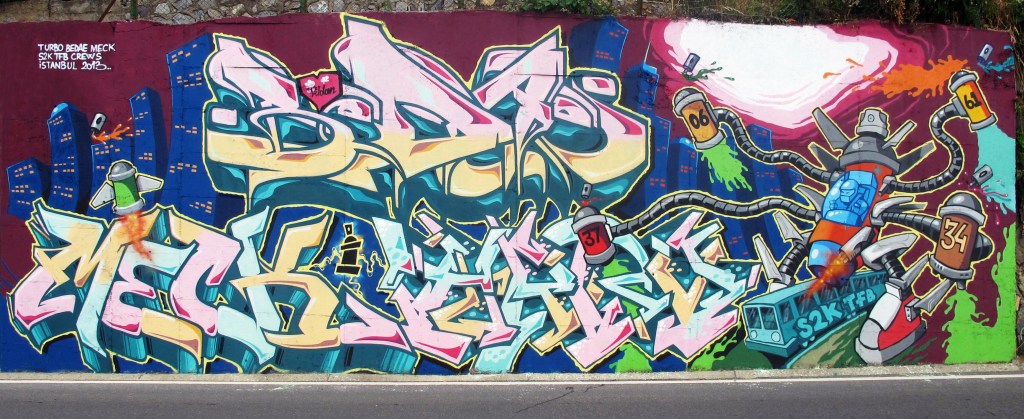
Başka bir çalışmamda savunduğum bir tezde de belirttiğim gibi, Birinci Dünya Savaşı’nın hemen öncesindeki yıllar, ancak ürkütücü bir savaşla gerçekleştirilebilecek katliamların saptırıp yok edeceği radikal bir meydan okuyuşu ifade ediyordu. Bu meydan okuyuşun derinliğini kavramanın en iyi yolu, ona zaman karşıtlığı açısından bakmaktır. Yaşam alanı ile zamanın alanı arasındaki çağdaş gerilim ilk defa, savaş öncesi dönemde, mekanik zamanın öğütücü ve baskıcı karakterine karşı çıkan Bergson tarafından dile getirilmiştir. Bilime itimat etmeyen Bergson, nitelikli bir zaman anlayışının, yaşanmış bir deneyim veya durée anlayışının, resmileştirilip uzamsallaştırılan zamana karşı direnmeyi gerektirdiğini savunmuştur. Bir parça sınırlı olsa da, Bergson’un bu yaklaşımı, esaretin pek çok öğesini doğurma noktasına gelen bir tiranlığa karşı sergilenecek muhalefetin önüne yeni bir çığır açıyordu.

Bu yüzyılda ortaya konulan zaman karşıtı istemlerin önemli bir kısmı, ifadesini en eksiksiz biçimde, savaşın hemen öncesinde gelişen hareketlerde buldu. Kübizmin görünümleri acilen yeniden incelemesi elbette bu hareketlere ilişkin bir olgudur; Kübistler, Rönesansın ilk önemlerinden itibaren hakimiyetini sürdüren görsel perspektifi ortadan kaldırmakla, gerçekliği, zamanın herhangi bir diliminde göründüğü gibi değil, olduğu gibi kavramaya çalışıyorlardı. Böyle bir kavrayış tarzı John Berger’ın şu yorumu yapmasına yol açmıştı; “Kübist formül tarihte ilk defa… doğadan yabancılaşmamış bir insanlığı öngördü.” Mutlak zamana ve uzama dayalı ünlü Newtoncu evren saçmalığı ile çatışan Einstein ve Minkowski de zaman karşıtı bir bağlamı savunmuştur. Müzik alanında ise, Arnold Schoenberg ahenksizliği, müziğe hakim olan yapay bir pozitivitenin baskılarından kurtarırken, Stravinsky, tıpkı aynı şeyi edebiyat alanında yapan Proust ve Joyce gibi, zamansal sınırlamalara karşı bir dizi yeni yöntemle cepheden saldırıya geçti. Donald Lowe’a göre, tüm bu ifade biçimleri, ” 1905 ile 1915 arasındaki o sarsıcı on yıl boyunca, çizgisel görsellik perspektifini ve Arşimendci aklı reddediyordu!”

1920’li yıllarda Heidegger, çağdaş metafiziğin odak noktasını oluşturan ve öznelliğin temel yapısını biçimlendiren faktörün zaman olduğunu vurguluyordu. Ancak savaşın doğurduğu yıkıcı sonuçlar, toplumsal gerçeklikteki olanaklara ilişkin anlayışı derinden değiştirmişti. Bu anlamda, Heidegger’ in Being and Time (Varlık ve Zaman, 1927) adlı eseri, zamanı sorgulamak şöyle dursun, varlığın anlaşılmasını sağlayacak yegane faktör olarak tamamen zamana teslim oluyordu. Benzer bir paralellik de Adorno tarafından kurulmuştur; “emirlere fiilimsi cümle kılıfı giydiren askeri komuta hilesi… ‘Ölüm vardır’ cümlesindeki yardımcı fiili italik olarak yazan Heidegger de kamçıyı şaklatmaktadır.”

Hakikaten de, Birinci Dünya Savaşı’ndan sonraki kırk yıl boyunca, zaman karşıtı ruh neredeyse tamamen bastırılmıştı. 1930’lu yıllara gelindiğinde, örneğin Sürrealist harekette ya da Aldous Huxley’in romanlarında88 hala bu ruhun izlerine rastlamak mümkündü, ancak döneme damgasını vuran asıl olgu, teknoloji ile tahakkümün yenilenen telaşıydı. Bunun yansımaları, Katayev’in Beş-Yıllık-Planı konu alan Time, Forward! (Zaman, İleri!) adlı romanında veya edebi bir binyılcı sembol olan Bin Yıllık Reich’ta ifade edilen acımasız deformasyonda görülebilir.

Sözü çağdaş durumumuza getirmek gerekirse, yeni bir mücadele evresine girilmesiyle birlikte, rahatsız edici bir zaman bilinci yeniden ortaya çıkmaya başladı. 1950’li yılların ortalarında bilim adamı N.J. Berrill, oldukça tarafsız bir kitapla, tartışmanın seyrini değiştirerek, topluma hakim olan “hiçbir çıkışı olmayan hiçbir yerden hiçbir yere gitme” arzusunu yorumluyor ve şöyle bir gözlemde bulunuyordu; ”Ve buna rağmen bir dakika sonsuzluğu kucaklayabiliyorken, bir ay tamamen anlamsız olabiliyor.” Berrill daha da ileri giderek ürkütücü bir çığlık atıyordu; “Uzun süre boyunca, tıpkı bir kaçış yolu bulmaya çalışan bir mahkum gibi, zaman tarafından kapana kıstınldığımı hissetmişimdir.” Bilim gibi beklenmedik bir alandan böylesine rahatça dile getirilen düşünceleri duymak şaşırtıcı olsa gerek, ancak Berrill’den kırk yıl önce başka bir bilim insanı, tam da Birinci Dünya Savaşı’nın onlarca yıllık başkaldınları ezdiği bir dönemde benzer bir açıklamada bulunmuştu. Şöyle diyordu Wittgenstein; “Zaman içinde değil, sadece mevcut an içinde yaşayan insan mutludur.”

Yalnızca mevcut anın bütün olabileceği düşüncesini ille de örneklendirmek gerekirse, çocukların mevcut an içinde yaşadıklarına ve mutluluğu hemen şimdi istediklerine şüphe yok. Zaman tarafından yabancılaştırılma, zamanın “yabancı” bir öğe olarak ortaya çıkışı, oldukça erken bir dönemde, annenin koruyuculuğu altındaki ilk bebeklik döneminde başlamaktadır. Öte yandan Joost Meerloo’nun şu sözleri de şüphesiz doğrudur; “Yaşamdaki her travmayla, her yeni ayrımla birlikte, zaman bilinci de artmaktadır.” Eğitimin işlevini mükemmel bir şekilde özetleyen Raoul Vaneigem, zaman bilincini yaratan öğeyi yakalamıştı: “Çocuğun günleri büyüklerin zamanından yakasını sıyırır; çocukların zamanı, düşsellikle, tutkuyla ve gerçeklik tarafından tutsak edilen düşlerle doludur. Dışarda ise, kolları saatli eğitimciler çocukları izlemekte ve onların gelip saatlerin devrine ayak uyduracakları anı beklemektedirler.” Şartlandırmanın eriştiği bu düzey, elbette, zamanın mevcut anı bizden tamamen çaldığı, son derece anlamsızlaştırılıp yabancılaştırılan bir dünyayı yansıtmaktadır. “Geçen her saniye beni, bir sonraki anın öncesi olan andan koparıyor. Her saniye ruhumu benden çekip alıyor; şimdi denilen an asla var olmuyor.”

Endüstriyel yaşamın tekrardan ibaret olan rutin doğası, zamanın ve teknolojinin en somut ürünlerinden biridir. Zaman dışı avcı-toplayıcı yaşamın önemli boyutlarından biri de, bu yaşamdaki etkinliklerin, tekrarı içermeyen biricik ve benzersiz niteliğiydi; kısacası, sayılar ve zaman, nitel olana değil, nicel olana uygulanabilen olgulardır. Bu noktaya dikkat çeken Richard Schlegel’e göre, eğer yaşantı hep bir romandaki gibi olsaydı, sadece düzen ve rutin imkansız hale gelmekle kalmayacak, ama aynı zamanda zaman nosyonu da ortadan kalkacaktır.

Couverture Kronik Komiks, 15 Jurg

Beckett’ın Godot’yu Beklerken adlı oyunundaki iki önemli karakter, bir ziyaretçiyi ağırladıktan sonra, karakterlerden biri şöyle iç çeker; “Eh, en azından zamanın geçmesine yardımcı oldu.” Diğer karakter şu cevabı verir; “Saçmalıyorsun, zaman zaten geçecekti.” Modern yaşamın ürkütücü dehşeti bu yavan diyalogdan bile anlaşılabilir. Artık bir metaya dönüşmüş olan zaman, günümüzde, esaret altına aldığı bireylerden gayet bağımsız bir şekilde var olan son derece baskıcı bir güç olarak karşımıza çıkmaktadır. George Morgan’ın şu yorumu her şeyi yerli yerine oturtuyor: “yenilikten yeniliğe koşan huzursuz bir hareketlilik ve ‘zaman öldürmek’ gibi sıkıntı dolu bir meşguliyet, dört bir yanı saran beyhudelik ve saçmalık duygusunu gizliyor. Modern insan bu sonsuz kazanımların göbeğinde, aslında insan yaşamının özünü kaybetmektedir.”

Bir zamanlar Loren Eisely, bir arkadaşıyla birlikte bir kafatasını incelerken, kendilerini adeta “her şeyi silip süpüren bir fırtınanın ortasında” bırakan “anlatılamaz bir terör duygusu”na kapıldığından söz etmişti. Eisely’nin bu duygusunu gayet iyi anlayan arkadaşı, onun durumunu şu sözlerle ifade eder; “zamanı bilmek zamandan korkmak anlamına gelir, uygar zamanı bilmek ise terör kurbanı olmak anlamına gelir.” Zamanın tarihi ve bizim bu tarih içindeki mevcut esaretimiz dikkate alındığında, bundan daha çarpıcı bir mesaj düşünmek hemen hemen imkansızdır.

Robert Lowell 1960’lı yıllarda, zamanın getirdiği yabancılaşmayı az ve öz bir şekilde ifade etmişti:

Tarih içinde yaşamayı öğreniyorum.
Tarih ne peki? Tarih kendisine dokunulamayandır.

Neyse ki, yine 60’lı yıllarda, kol saati ve keyif verici madde kullanmaktan vazgeçen pek çok kişi, tarih içinde nasıl yaşanılacağını öğrenmekten vazgeçmeye başlıyordu. Bu eğilimin belki de en paradoksal göstergelerinden biri de, Fransız isyancılar tarafından Mayıs 1968’de haykırılan tek kelimelik popüler slogandı; “Çabuk!” zaman karşıtı güçlü öğeler içeren 60’lı yılların başkaldınsı, zamanda ortaya çıkan yeni ve aşın uzamsallaştırmalarla çekişmesine rağmen, bu başkaldırının -aynen çalışmaya yönelik direniş gibi- giderek derinleştiğini gösteren pek çok işaret var. Marcuse’ün “zaman ile baskı düzeni arasındaki ittifak” hakkında yazdıklarından, Norman O. Brown’ın zaman veya tarih anlayışını baskının bir işlevi olarak tanımlamasından beri, bu ilişki etkin bir şekilde güçlenmiştir.

Christopher Lasch, 70’li yılların ortalarında şu gözlemde bulunur; “Zaman anlayışımızda meydana gelen köklü değişim, iş alışkanlıklarını, değerleri ve başarının tanımını önemli bir dönüşüme uğratmıştır.” Nasıl ki çalışma zamanın kilit bir bileşeni olarak reddediliyorsa, tüketimin zamanı nasıl diri diri yediği de aynı çıplaklıkla ortaya çıkmaya başlıyor. Tüketim tarafından yutulan zamanın günümüzdeki en mükemmel uzamsal sembollerinden biri, zamanı öldürmek üzere abartısız bir şekilde uzayı yiyen Pac-Man video oyunundaki figürdür.


Anarcho-primitivist author and host of Anarchy Radio.

Milyonlarca kişi, tıpkı Aldous Huxley’in romanındaki Bay Propter gibi, zamanı “özü gereği dehşet saçan bir şey”olarak görme noktasına geliyor. Lasch ve diğerleri tarafından da belirtildiği gibi, yaş saplantısı ve yaşam süresini uzatma çabaları, zamanın dayattığı esaretin yalnızca iki göstergesidir. Adorno bir zamanlar şöyle demişti: “Kullar daha az yaşadıkça, ölüm daha dayanılmaz, daha ürkütücü bir hale gelmektedir.” Giderek daha somut hale gelen zaman 60’lı yıllardan itibaren daha da hızlandığı için, neredeyse her üç-dört yılda bir, gençlik arasında yeni bir kuşağın ortaya çıktığı anlaşılıyor.

Bilim zamana karşı gösterilen direnişi en azından iki fenomenle popülerliğe kavuşturdu; şu veya bu ölçüde kara delikler, zaman eğrilikleri, uzay zamanının tuhaflıkları türünden fiziksel teorilerden doğan zaman karşıtı anlayışlara gösterilen yaygın rağbet ile; John McPhee’nin Basin and Range (Havza ve Menzil, 1981) adlı eserinde olduğu gibi, sözüm ona jeolojik öykülerdeki “derin zaman”a gösterilen rahatlatıcı rağbet.

Benjamin, “insanın tarihsel ilerleme ilkesinin, homojen bir zaman içinde ilerleme ilkesinden koparılamayacağını” belirtirken, hem zaman hem de ilerleme ilkesinin eleştirilmesi çağrısında bulunuyordu ve bu çağrısının bir gün ne kadar çok yankı bulacağının pek de farkında değildi. Hakeza, “Kendisi tarihi bizzat yaşamamış olan hiçbir insan tarihi sorgulayamaz”108 diyen Goethe de, bu öngörüsünün, zamanın en gerçek ve en ağır boyut olduğu günümüzde, nasıl böylesine toptan pazarlanacağını öngöremezdi. Bu yüzden zamanı ve tarihi ortadan kaldırma projesinin, insan özgürleşmesinin biricik umudu olarak geliştirilmesi gerekecektir. Zaman ve zamanın uzamsallaştırılması olmaksızın bilincin mümkün olamayacağını savunmaya devam eden ve insanlığın zaman dışında var olduğu uzun bir dönemi ellerinin tersiyle bir kenara iten bilgelerin kıt olması gibi bir sorunumuz şüphesiz yok. Böylesi tahakküm bilgelerine verilecek en iyi cevap, William Morris’in Hiçbiryerden Haberler adlı eserinden kısa bir alıntı yaparak sözü bağlamaktır: “Efendilik bir gün dostluğa dönüştüğünde, gününüzün tüm şaşmaz özdeyişlerine rağmen, yine de koca bir dünyaya yetecek kadar zaman kalacaktır geriye.”

Kitabın orijinali ve daha fazlası için:

> Gelecekteki İlkel

John ZerzanKaos Yayınları


Barbarları Beklerken: Hayal Gerçek Ya Sen?

Barbarları Beklerken sayı: 12, 2022

Sunu:

Dayanışma sözcüğünün en kirli olduğu alan hangisi deseler, edebiyat deriz. Dayanışma, kolektif mücadele/müdahale pratikleri çıkar ilişkisi, reklam ve iktidar dışında gelişen, birlikte paylaşarak büyüyen bir süreçtir. Edebiyatçıların dayanışmadan anladıkları nedir peki? Hangi kitap eki’nde arkadaşın var? Şu edebiyat sitesinde tanıdığın editör var mı? Senin twitter takipçin çokmuş, şu benim kitaba da mı bir el atsan? Çok güzel şiir okuruz biz fotoğrafları. Bakın biz hem şiir okur hem şarap içeriz fotoğrafları. Bizim dayanışmadan anladığımız nedir? Melih Cevdet Anday‘ın dediği gibi “suçumuz edebiyat”tır. Biz her yerde görünmeyen isimlerle ortak bir alan yaratarak büyük bir suç işliyoruz. Her şeyin bireyselleştiği, hayatlarımızın her anının politikaya döndüğü noktada politikadan kaçanlara inat hayatın politikasını savunuyoruz. Duyar kasmak konusunda özel bir yeteneğe sahip olan edebiyat ortamı Hikmet Sami Türk vakası karşısında dil kilitlenmesi yaşadı. Biz buna hayat kilitlenmesi de diyebiliriz. Hayata bu kadar kör kalanın gözü neden görsün ki? Ha bir de aydın budalalığını entelektüel şurupla karıştıranlar var. Normalde aydının topluma şifa olması gerekirken geriye dönüp baktığımızda hastalarla karşılaşıyoruz. Haliyle budala budala olarak kalıyor. Dayanışma sahte bir fotoğraf karesine dönüşüyor ve bu fotoğrafta en silik, en iki yüzlü renk edebiyatçılara ait. Fotoğrafın sahteliğine inat sormak istedik: Hayal Gerçek Ya sen? Barbarları Beklerken’in 12. sayısı sizlerle…

“suçumuz edebiyat”

Yayına Hazırlayan: Dolunay Aker

Yayın Ekibi: Ferit Sürmeli, Dilay Kababıyık, Ömer Burçin Özkişi, Hakan Kaya, Dolunay Aker

Kapak ve Dizgi: Hakan Kaya

Okuma Bağlantısı: Barbarları Beklerken #12


Biz Burada Yokken Sanat ve Politika #1: Avangart Sanat

Sosyalist kültür ve siyaset platformu Laborans ve Barbarları Beklerken Sanat Kolektifi’nin ortaklaşa hazırlayıp sunduğu “Biz Burada Yokken Sanat ve Politika” adlı programın ilk bölümünde Avangart sanat konuşuldu.


Laborans- Biz Burada Yokken Sanat ve Politika: Dadacılar, Sürrealistler ve Sanatın Özerkliğii

Sosyalist kültür ve siyaset platformu Laborans’ın Barbarları Beklerken Sanat Kolektifi ile ortaklaşa yaptığı “Biz Burada Yokken Sanat ve Politika” isimli programın ikinci bölümünde “Dadacılar, Sürrealistler ve Sanatın Özerkliği”ni konuşuluyor.

Barbarları Beklerken: “yeni olanı yap!”


PSYCHIC DRIVING. Les Techniques Decontrôle Mental et Leurdétournement Dans Lesmusiques Industrielles

FIG. 2. Beth B et Scott B, Black Box, 1978, film 8 mm, couleur, sonore, 25 minutes. Photographie argentique, 20 x 25 cm, collection particulière

Comment contrôler une population… par la PEUR, toujours
par la PEUR. La peur de l’augmentation des impôts, la
peur de l’inconnu, du différent, de l’extérieur, des autres
couleurs de peau, de la bizarrerie, de la provocation, de la
sainteté, de la nature. Il y a toujours une menace cachée
derrière la VIOLENCE, derrière l’intimidation pure. Tous les
gouvernements maintiennent le statu quo avec la menace de
la violence, de l’emprisonnement, du meurtre et de la torture.
[…] Nous devons à tout prix nous orienter vers la paix et
la sécurité : nous devons nous rappeler de notre amour et de
notre COMPASSION, avec passion1.

Genesis Breyer P-Orridge

Évoluant en marge du monde de l’art contemporain des années 1970, une nouvelle génération d’artistes apparaît dès le milieu de cette même décennie pour établir les fondements d’un mouvement artistique expérimental, celui des musiques industrielles. C’est à partir de solutions multimédias (graphisme, film, performance, vidéo) que certaines formations européennes et nord-américaines génèrent une culture visuelle globale, plaçant le détournement des technologies au centre de leurs pratiques. L’élaboration de synthétiseurs et la manipulation de sons enregistrés issus de bandes audio, recyclées ou conçues par les groupes emblématiques de la première vague industrielle viennent enrichir un panel de productions visuelles puisant une partie de ses sources dans l’avant-garde artistique de la première partie du xxe siècle2. L’armature esthétique et théorique des musiques industrielles formulée par le collectif anglais Throbbing Gristle examine sous ce prisme les évolutions de la société postindustrielle, présentée à l’époque par Daniel Bell dans son ouvrage The Coming of the Post-Industrial Society3 comme une société de connaissance.

Ces artistes retiendront en particulier les incidences du contrôle de l’information des médias de masse sur la vie psychique et physique des individus. C’est pour marquer leur dissidence face à de telles évolutions que les membres de Throbbing Gristle invitent leur audience à prendre part au concept de control process, qui, comme a pu l’écrire Frédéric Claisse, entend « retourner sur elles-mêmes, en les exposant, les stratégies par lesquelles l’“industrie de la musique” [et autres médias de masse] fonctionnent comme instruments de contrôle4 », à savoir révéler et critiquer les « techniques ordinaires de contrôle subies au quotidien par les consommateurs de biens culturels5 ». La formation britannique met ainsi en évidence une nouvelle forme d’exercice du pouvoir développée dans les manipulations technologiques des images et du son, et où la déprogrammation psychique s’obtient par un effort individuel, une discipline intellectuelle qui engage l’évolution d’un processus biologique. L’intention des membres de Throbbing Gristle est de rendre l’auditeur sensible à son environnement par l’emploi d’un nouveau « langage subversif » et expérimental : pour Stephen Mallinder, l’un des membres de Cabaret Voltaire, « le bruit lançait un défi à l’ordre et au contrôle. C’était un tabou musical. Une belligérance sonique. Une force de déstabilisation6. » Ces attaques acoustiques s’accompagnent de visuels surprenants issus de protocoles scientifiques, médicaux et paramilitaires détournés.

Cet usage n’est cependant pas dépourvu de nombreux paradoxes puisque le désir d’enrayer toute forme de manipulation psychique par le détournement d’expériences cliniques réelles produit à terme une fascination pour la violence qui aura des incidences sur le public créé de toutes pièces par les figures tutélaires de la scène industrielle7. Fascination qui est loin d’être insignifiante lorsque certains groupes détournent l’iconographie nazie, présentant en retour l’inconvénient d’échapper au contrôle du mouvement lorsque des groupuscules d’extrême droite instrumentalisent ces repères visuels à leur profit8. Si les discours, graphismes et sons produits à partir du thème du conditionnement mental diffèrent de ce dernier point, l’attrait que portent ces artistes pour l’emprise comportementale interroge naturellement l’émergence d’un pouvoir coercitif en milieu alternatif qu’il s’agira d’analyser tout au long de ce chapitre.

Cabaret Voltaire’s Stephen Mallinder – Industrial Soundtrack For The Urban Decay

Protocoles scientifiques expérimentaux et torture

Les nombreux articles publiés par les membres de Throbbing Gristle dans leur bulletin d’information Industrial News révèlent un intérêt pour l’actualité des recherches scientifiques militaires dans le contexte de la guerre froide. Les pages du bulletin présentent, sous la forme de collages, une dystopie apocalyptique où les individus sont devenus « la proie d’investigations médicales et policières visant à contrôler leur vie psychique, leurs émotions et leurs pensées9 ». Les thèmes de manipulation des foules, de lavage de cerveau et autres techniques de torture sont légion tout au long de ces publications10 destinées à interroger le rapport de domination exercé par les mass media et les gouvernements sur la population, rappelant, comme a pu le faire récemment Catherine Perret, combien « la torture enseigne au bourreau une technique à laquelle les politiques modernes continuent d’avoir recours, jusque dans leur passion douteuse pour l’altérité11 ».

L’un des articles, intitulé « Neutron Monkeys12 », traite d’expérimentations sur des singes contraints de courir sur des tapis de course avant et après avoir été exposés à des radiations mortelles. L’objectif de ces tests est de déterminer la façon dont les soldats peuvent réagir après avoir été irradiés par une bombe à neutrons. La description de ces opérations expérimentales à base de décharges électriques, illustrée de collages conçus notamment à partir d’une oeuvre d’Eduardo Luigi Paolozzi (Hollywood Wax Museum, 1970), renvoie à un autre article du bulletin13 consacré aux implants cérébraux élaborés par le scientifique José Delgado14, inventeur du Stimoceiver, un système radio commandé qui agit sur les points stratégiques du cerveau pouvant transmettre des impulsions électriques15. Le scientifique affirmait pouvoir stimuler, en activant un simple bouton, toute une gamme d’émotions telles que l’excitation sexuelle, l’anxiété et l’agressivité, et par là conditionner le sujet par l’action automatique d’un clavier de fréquences électromagnétiques sur lesquelles venait s’accorder l’activité du cerveau. Dans cette emprise technologique de la psyché, les sons peuvent être transmis très facilement par l’utilisation d’implants [FIG. 1] – une technique, adoptée dans certains interrogatoires de la Central Intelligence Agency (CIA), qui sera dévoilée seulement à partir de 1997 avec la publication du manuel Kubark Counterintelligence Interrogation16, destiné au contre-espionnage pendant la guerre froide et qui avait été rédigé en 1963. Les expériences de la CIA portaient notamment sur des domaines tels que la stimulation électrique, l’hypnose, les micro-ondes, les ultrasons et la bio-électricité.

FIG. 1. Throbbing Gristle, Industrial News, 2, juin 1979, p. 13-14

Dans la foulée du scandale lié à l’institut psychiatrique Allan Memorial de Montréal, où les témoignages de certains patients dévoilèrent au grand jour ces traitements de déprogrammation du cerveau développés par le projet MKULTRA – un programme gouvernemental secret, visant à étudier, à grande échelle, les techniques de conditionnement psychique –, les groupes Throbbing Gristle, Nocturnal Emissions et SPK17 détournent ces pratiques dans de multiples supports (clips vidéo, collages, films expérimentaux, photomontages). Sont visées en particulier les expériences de privation sensorielle commentées dans l’un des passages du manuel Kubark, cité par Michel Terestchenko dans son livre Du bon usage de la torture, ou comment les démocraties justifient l’injustifiable : « Plus l’endroit de détention éliminera les stimuli sensoriels, plus rapidement et plus profondément le détenu en sera affecté. Les résultats qui ne sont obtenus qu’après des semaines ou des mois d’emprisonnement dans une cellule ordinaire peuvent être décuplés en heures ou en jours seulement dans une cellule sans lumière, à l’abri de tout son, dans laquelle les odeurs sont éliminées18. » Ce conditionnement extrême, provenant d’expérimentations cognitives radicales menées par la CIA à partir des années 1950 – que l’on retrouve plus tardivement dans le domaine du cinéma mainstream19 –, caractérise le principe même de la torture selon Catherine Perret : « [Cette privation] ampute l’individu de ce qui lui permet de percevoir l’origine, interne ou externe, du danger, et de s’en défendre en se fiant à telle capacité physique ou psychique. La torture neutralise la capacité à inhiber la douleur qui est la condition pour résister à cette douleur20. » Cette technique privative – qui pouvait être complétée par des séances de bombardement d’informations, pour mieux exercer un contrôle total sur l’individu par l’image et le son21 – vient enrichir l’imaginaire des artistes dans l’élaboration d’une esthétique qui se manifeste jusque dans le courtmétrage Black Box (1978) [FIG. 2 ci-contre et PL. 7, voir le cahier couleur en fin de volume]. Les cinéastes Beth B et Scott B proposent de mettre en scène Lydia Lunch qui maltraite un otage (Bob Mason), interrogé et enfermé dans une boîte de torture psychologique :

FIG. 2. Beth B et Scott B, Black Box, 1978, film 8 mm, couleur, sonore, 25 minutes. Photographie argentique, 20 x 25 cm, collection particulière

The Black Box (1978) exposait les tribulations d’un minet blond cueilli au saut
du lit de sa petite amie par un gang de terroristes d’obédience inconnue.
Après avoir été battu, insulté et pendu la tête en bas par la puissante et
glapissante Lydia Lunch, il est soumis à la torture de la « boîte noire »,
telle que la décrivent les dossiers d’Amnesty International : une cellule où
l’on expose la victime à des stimuli sensoriels (lumière, température, son)
violemment opposés. Par un jeu de caméra subjective, le public prenait la
place du blondin « dans la boîte » et subissait dans le noir un crescendo
exacerbé de rock électronique et de lumière violente22.

Les sévices mentaux (et corporels) occasionnés sont renforcés par l’iconographie du conditionnement affichée par deux oeuvres visibles dans le film et conçues par John Ahearn. L’une de ces toiles reproduit l’image d’un homme nu cagoulé, les mains attachées dans le dos. Cette représentation – qui rappelle la théorie de l’enfermement formulée par Michel Foucault dans Surveiller et punir23 et qui est au centre de l’album Prehistoric Reject (1983) composé par le collectif français Déficit des années antérieures24 – apparaît également dans les performances de John Duncan lorsque ce dernier traite de privation sensorielle. Accompagné de sept autres performeurs, l’artiste américain se laisse enfermer nu dans une pièce vide et plongée dans l’obscurité lors de son intervention intitulée Maze et réalisée à Amsterdam en 1995. Son installation Stress Chamber envisageait deux ans plus tôt ce type de contrainte physique, dans le cadre du festival d’art contemporain Absolute Threshold Machine : « Chaque volontaire devait pénétrer dans un container industriel modifié, seul et nu, trois moteurs fixés sur les parois du caisson métallique amenant ce dernier à sa fréquence de résonance, donnant l’illusion d’un objet massif se déplaçant le long des parois, autour ou à travers le corps de la personne enfermée à l’intérieur (le sol sur lequel était posé le container quant à lui vibrait sur un rayon de 50 mètres)25. » Ce dispositif, qui exerce une contrainte physique sur les participants enfermés, détourne la façon dont de véritables séances de torture emploient le pouvoir oppressif du son pour confronter les victimes (réelles) de ces traitements à un environnement acoustique intolérable, ou à une répétition entêtante de messages suivant la technique du psychic driving.

Pilotée par le psychiatre Donald Ewen Cameron, et financée par le projet MKULTRA de la CIA, la procédure du psychic driving reprend en boucle des phrases suggestives afin d’étudier « les effets sur le comportement humain de la répétition de signaux verbaux26 ». Il s’agit ici de torture blanche, la « no-touch » torture, qui vise une « régression » de la personnalité afin de dissoudre toutes formes de résistance sans laisser de traces physiques. Tout comme le rappelle Suzanne Cusick, cet usage acoustique exerce un pouvoir totalisant, installant une « dystopie postfoucaldienne, où l’on est incapable de donner un nom, et encore moins de résister, au Pouvoir diffus et englobant qui est à l’extérieur de soi, mais également à l’intérieur de soi, et qui force la personne à obéir contre son gré, contre son intérêt, parce qu’il n’y a aucun moyen – pas même le retrait dans l’intériorité – d’échapper à la douleur27 ». Cet « instrument d’une domination totale du corps et de l’esprit28 » devient la cible privilégiée de performeurs industriels, soucieux de lutter contre les mécanismes de conditionnement contemporains qui s’appliquent jusque dans leur quotidien, quitte à exercer à leur tour une emprise physique sur leur propre corps et sur celui de leur audience.


« War of Nerves29 ».

Guerre acoustique et contrôle des foules

La réactivation des recherches scientifiques développées par la CIA via le prisme de la culture industrielle atteste aussi d’un phénomène d’infiltration du monde militaire au sein même des sociétés de consommation. L’« invasion » paramilitaire se manifeste notamment par le son, dans les armes employées par les forces policières jusque dans les foyers des individus. Le bulletin Industrial News offre un exemple de ce phénomène avec l’article « Sound-Lights Rays To Control Mobs30 », qui traite d’armes soniques convoquées dans une étude scientifique de l’époque. Les quelques lignes de l’article décrivent une arme utilisée par les forces de police pour disperser les groupes de manifestants. La Squawk Box (littéralement la « boîte à cris ») appartient à ce type d’armes : utilisée dès 1973 par l’armée britannique en Irlande du Nord, elle agit directement sur les masses en dispersant les foules31. Cet outil de contrôle est combiné au Photic Driver (« pilote photique »), décrit par Juliette Volcler comme « un stroboscope visant à produire des crises d’épilepsie, des nausées, des difficultés d’élocution ou des évanouissements au moyen de flashs lumineux intermittents32 ». L’auteur montre que ces armes se veulent « totalisantes », dans le sens où l’écoute est collective et vise à briser le groupe en renvoyant chacun à ses propres perceptions : l’individu est obligé de fuir. En considérant le son de la même manière que ces armes terrifiantes, sans pour autant chercher un traumatisme irréversible, l’équipe de Throbbing Gristle s’emploie à livrer une forme de guerre contre le contrôle des médias, comme si elle opérait sur un champ de bataille.

L’emploi de cet arsenal dans le monde civil trouve ses origines dans les expériences que les forces militaires avaient menées autour du son, profitant des avancées technologiques pour transformer les propriétés sonores en arme. L’armée allemande durant la Seconde Guerre mondiale, puis les forces américaines tout au long de la guerre du Vietnam ont investi le domaine de la recherche scientifique afin de créer des armes soniques létales, fonctionnant comme de puissants agents de contrôle33. C’est la raison pour laquelle de nombreux artistes industriels s’intéressent au conflit vietnamien et à la façon dont les troupes américaines conçoivent une guerre psychique par l’emploi de nouvelles armes soniques de contrôle. Les opérations psychologiques de l’armée américaine, ou PsyOps, mettent au point des « techniques de démoralisation et de harcèlement par le son34 » en équipant certains hélicoptères de haut parleurs qui diffusent de nuit des cassettes mélangeant des phrases en vietnamien à des effets visant à terrifier le peuple et les soldats ennemis. « The Wandering Soul » (« l’âme errante »), appelée aussi « Ghost Tape Number 10 », témoigne de cette méthode de persécution sonore : il s’agit d’une cassette audio sur laquelle un soldat mort revient hanter le pays en suppliant les Vietnamiens de rendre les armes, au risque de mourir loin de leur famille – la croyance populaire vietnamienne voulant qu’un corps doit être enterré sur sa terre natale et honoré par les siens pour que son âme puisse reposer en paix. Les PsyOps expérimentent également le People Repeller (« Le répulsif ») qui envoie un « sifflement extrêmement aigu à une très forte intensité35 ». Ces attaques sonores ne visent plus à tuer mais à neutraliser toute forme de dissidence par une mutation de la guerre qui investit le monde civil, notamment la sphère du divertissement.

Dans son ouvrage Grammophon, Film, Typewriter, le théoricien des médias Friedrich Kittler souligne que les recherches militaires affectent la culture populaire par contagion technologique, quand « l’industrie du divertissement abuse, dans tous les sens du terme, de matériel militaire36 ». De nombreux objets de consommation courante (cassettes audio, enceintes de salon, magnétophones portatifs) doivent leurs origines à l’armée et à la façon dont la sphère militaire a d’abord envisagé la musique pour son caractère coercitif. L’auteur James Kennaway rappelle ainsi combien « Kittler a fait valoir que toute technologie est essentiellement militaire, notant par exemple que la radio ne constituait qu’une extension des systèmes de communication militaires de la Première Guerre mondiale sans possibilité de prendre la parole37 ». L’archéologie des médias de l’auteur allemand met au jour un processus d’infiltration militaire qui a des incidences dans le monde civil. Tout comme « la musique rend la torture socialement plus acceptable38 », les armes soniques véhiculent une bonne image dans les médias, selon Juliette Volcler, et participent à aplanir le débat public concernant la maltraitance et le recours aux armes. L’emprise du son sur le corps est pourtant bien effective et largement étudiée à cette époque, comme a pu le montrer l’historien de l’art Branden W. Joseph dans son article consacré à la « Biomusic »39.

Les incidences du son sur « la surface du corps, les pores, les cellules et les vaisseaux sanguins40 » ouvrent la voie à des expériences sonores intenses conduites par les groupes de musique industrielle à partir d’un fantasme de déprogrammation ultime et dans le prolongement des problématiques soulevées par William Burroughs lorsqu’il évoque en 1975 une possible exploitation des basses fréquences par l’industrie culturelle41. L’auteur de la trilogie Nova42 représente en effet une influence majeure dans les modes opératoires adoptés par les artistes industriels, notamment lorsque ces derniers adaptent la technique du cut-up dans le champ du graphisme, de la musique expérimentale et de la performance en matérialisant les théories fictives de Burroughs dans leur propre réalité43. La Révolution électronique44 de l’écrivain incarne dès lors une solution alternative pour ces artistes qui engagent les limites biopolitiques du corps et du genre à travers des oeuvres jouant sur les seuils psychologiques et physiologiques du sujet, tout en étant tributaires des prescriptions radicales de Burroughs formulées initialement dans le domaine de la littérature expérimentale45.


« Neurological Engineering46 ».

Lavage de cerveau industriel

Les différents stades de conditionnement sonique déployés dans le domaine paramilitaire et le monde civil orientent les membres de Throbbing Gristle à mener de front une guerre totale sur l’ensemble des perceptions contemporaines de leurs auditeurs. Le titre « Nothing Short of a Total War47 » résume ce projet contestataire, prenant forme à partir de recherches scientifiques et d’expériences acoustiques militaires détournées. L’attrait pour les expérimentations gouvernementales atteste également d’une forme de paranoïa agissant au sein même du mouvement, notamment à travers la thématique du lavage de cerveau. Le brainwashing par bombardement d’informations mobilise ces artistes, et ce à partir d’une iconographie issue de la culture populaire : l’appareil à permanente présenté sur la pochette de l’album Permafrost (1988) de Brume renvoie ainsi de manière explicite à l’intérêt que ces groupes portent au conditionnement mental, de même que la pochette de Final Program (1991) éditée par Clock DVA [FIG. 3 ET 4].

FIG. 3. Brume, Permafrost, Brume Rec., 1988, cassette audio

Si les motifs populaires de l’époque avaient déjà été instrumentalisés par Richard Hamilton, Eduardo Luigi Paolozzi et Andy Warhol dès les années 1950 et 1960, les groupes de musique industrielle recyclent quant à eux des sources similaires dans leurs collages pour mieux aborder le thème du lavage de cerveau. Cette méthode apparaît jusque dans un genre cinématographique expérimental, lorsque Jean-Pierre Jeunet et Marc Caro consacrent Le bunker de la dernière rafale (1981) au thème de la paranoïa militaire. Dans ce court-métrage figure une séance de torture à partir d’implants cérébraux, parmi d’autres scènes avec Hervé Di Rosa, Bruno Richard et Zorïn [FIG. 5]. Le cinéma contemporain s’était déjà emparé de ces problématiques, avec l’adaptation du roman d’Anthony Burgess A Clockwork Orange (1962) par Stanley Kubrick en 1971, qui offre d’autres pistes visuelles au mouvement jusque dans l’inspiration du nom de la formation Clock DVA. Cette oeuvre fictionnelle met en scène un groupe ultraviolent dirigé par un individu qui sera la cible d’un lavage de cerveau radical sous couvert d’un traitement médical visant à tempérer ses excès de violence. Le cinéaste américain aborde l’emploi du bruit sonore et visuel dans des séances prolongées de contrainte psychologique, que l’on retrouve dans l’ensemble de l’histoire de la torture selon Darius Rejali : « Les hommes ont toujours eu recours au son pour se torturer. Les bourreaux utilisaient le son pour intimider et surprendre les prisonniers, pour compléter la privation de sommeil, pour étouffer les hurlements, et pour faire mal sans laisser de traces48. »

FIG. 4. Clock DVA, Final Program, Contempo Records, 1991, vinyle, LP
FIG. 5. Marc Caro et Jean-Pierre Jeunet, Le bunker de la dernière rafale, 1981, film 35 mm, couleur, sonore, 26 minutes

La grande différence serait ici l’emploi de compositions musicales et d’images pour transformer de manière intégrale les pensées du supplicié, une approche globalisante qui apparaît aussi dans une grande partie des collages conçus par Adi Newton, jusque dans l’un des premiers morceaux de son groupe Clock DVA, « Le Viol » (1978), lequel faisait l’objet d’un assemblage modifiant le portrait de Marilyn Monroe : « La première mouture de DVA était tellement dingue – came, violence et magnétos. Sexe et magie dans un cadre industriel… cette indécence était brillante49. » Dans Kinetic Engineering, composé de vidéos réalisées entre 1988 et 1993, Clock DVA reconduit la « guerre de l’information » des musiques industrielles, en particulier avec « The Hacker » (1989), dédié au hacker allemand Karl Koch. Les portraits des membres du groupe sont confrontés aux termes « brain », « c.i.a. », « control », « data », « terrorists », « erase » et « mathematic », dont l’apparition brutale et subliminale agit comme un bombardement d’informations propre aux techniques de brainwashing déjà évoquées [FIG. 6]. Adi Newton revient ici sur la façon dont l’individu n’a plus d’autre choix que d’assimiler l’information des mass media, le consommateur d’images ayant rejoint la « Troisième Vague » annoncée par les spéculations du futurologue Alvin Toffler dans son ouvrage éponyme : « Les gens de la Troisième Vague sont plus à l’aise sous un bombardement de spots – flash d’information de quatre-vingt dix secondes entrelardé de trente secondes de pub, extrait de chanson et de paroles, un générique, un dessin animé, un collage, un titre de journal, une sortie d’imprimante. Lecteurs insatiables de journaux jetables et de magazines spécialisés, ils ingurgitent un maximum d’informations en un minimum de temps50. »

FIG. 6. Clock DVA, The Hacker, 1989, vidéo, noir et blanc, sonore, 3,18 minutes

Si cette lecture du conditionnement peut faire sens au regard de certaines méthodes militaires, la façon dont les artistes industriels considèrent le sujet en fonction de leur propre réalité n’est pas épargnée du fantasme de conditionnement psychique. La comparaison entre l’expérience scientifique et les stratégies de consommation de masse ou de contrôle des foules paraît dès lors exagérée (mythe des infra et ultrasons) et relève bien souvent de la fiction, comparable au cinéma contemporain des années 1960-1980. La thématique du contrôle mental puise ainsi dans les imaginaires de certains films cultes de la guerre froide comme The Manchurian Candidate (1962) réalisé par John Frankenheimer à partir du roman de Richard Condon, ou The Terminal Man (1974) de Mike Hodges, qui adapte l’ouvrage de Michael Crichton, mais aussi Scanners (David Cronenberg, 1981) ou Brainstorm (Douglas Trumbull, 1983). Le long-métrage I… comme Icare (1979) du cinéaste français Henri Verneuil appartient à ce même corpus en mettant en scène des tests issus du champ de la psychologie expérimentale du début des années 1960, en l’occurrence l’expérience de Stanley Milgram, consistant à évaluer le degré d’obéissance d’un individu confronté à une autorité qu’il juge légitime. Ces recherches examinent le processus de soumission du patient à l’autorité et trouvent un écho dans l’intérêt que portent les musiciens industriels pour des effets de persuasion bien réels qu’ils testent en permanence par des solutions multimédias51.


« Persuasion52 ».

Limites d’un processus d’influence en marge

La propriété cathartique du choc en image, révélateur d’un art curatif, est ici convoquée par des artistes fascinés par le détournement de protocoles issus de la psychologie expérimentale et par le recyclage de documents cliniques53. La dissidence de ces groupes n’échappe cependant pas à une certaine binarité du propos, puisque l’effet de banalisation de la violence visuelle et sonore génère à terme de nouvelles normes propres à une communauté, certes en marge, mais fonctionnant selon des codes spécifiques. Les mécanismes du psychic driving semblent dès lors être au centre de la façon dont le genre industriel rassemble un public autour de la répétition de canons contre-culturels, et ce notamment par les uniformes et symboles utilisés par Throbbing Gristle à l’initiative de Genesis Breyer P-Orridge et de Laurence Dupré : « TG commençait à rassembler un certain nombre de fans, aussi intéressés par les idées que nous promulguions dans nos Nouvelles que par notre style “industriel” de musique. En tant que leader du groupe, mon style a rapidement pris de l’importance, nos fans ont commencé à porter des habits de surplus militaire, en les accessoirisant avec des insignes TG, des patches, des badges et autres variations qui rendaient l’uniformité non uniforme54. » Ces signes évidents d’affiliation révèlent l’une des limites du mouvement lorsque les groupes construisent des codes de reconnaissance pour lutter, de manière paradoxale, contre les standards de la culture mainstream.

Cet aspect interroge aussi la notion même d’autorité, réadaptée par des plasticiens qui perdent parfois le contrôle des images qu’ils diffusent auprès de leur public. La critique du conditionnement opéré par le système normatif des gouvernements est ici renversée par une nouvelle forme d’emprise générée cette fois-ci par les artistes : le détournement de recherches scientifiques dans le champ de l’art produit une esthétique reconnue et recherchée par les amateurs du genre industriel, qui accordent une autorité aux principaux acteurs du mouvement. En témoigne la façon dont Genesis Breyer P-Orridge se transforme de manière ironique en gourou électronique dès 1981 avec son second projet Psychic TV, accompagné de son versant ésotérique Thee Temple ov Psychick Youth (TOPY), à travers lequel il se transforme en véritable agent de contrôle. En s’appropriant les codes d’organisations sectaires sous la forme d’un groupe expérimental, Genesis Breyer P-Orridge déclenche, dans l’esprit de certains membres du TOPY, un désir de soumission à l’autorité. L’artiste Simon Norris rappelle en effet que « Genesis s’était mis lui-même en position de leader, mais tout autant que d’autres personnes l’avaient placé dans cette position. Ils souhaitaient et espéraient qu’il en soit ainsi et qu’il joue ce rôle, consciemment ou pas55 ». Les limites de l’expérience du Temple se manifestent par cette demande croissante d’autorité, identifiée par Joel Kramer et Diana Alstad dans leur ouvrage The Guru Papers : « Les exigences autoritaires du cadre classique de l’interaction entre gourou et disciple (soumission et obéissance totales) sont aussi absolues que toutes les autres contraintes autoritaires de la planète. Exhiber les mécanismes de contrôle et de la soumission sans la moindre ambiguïté permet de donner un exemple quintessentiel de l’autoritarisme mental dont le pouvoir consiste davantage à contrôler les esprits qu’à conduire à la coercition physique56. » La recherche d’un rapport de domination entre les membres du collectif et son leader obligera Genesis Breyer P-Orridge à prendre ses distances avec sa propre organisation dès 199157, en raison du modèle pyramidal qu’il avait luimême mis en place.

Certains artistes détiendraient ainsi un nouveau type de pouvoir dont la force provient de la réception même du public, témoin d’expériences comportementales et d’une surenchère de la transgression. L’affilié du genre industriel est dès lors pris dans un phénomène d’assujettissement, défini par Judith Butler dans son ouvrage La vie psychique du pouvoir à la fois comme « le processus par lequel on devient subordonné à un pouvoir et le processus par lequel on devient un sujet58 ». Cependant, si le pouvoir exercé par certains groupes sur leur audience participe à l’émergence de nouveaux « sujets », selon le terme employé par Judith Butler, l’intention première des artistes industriels vise avant tout à stimuler l’esprit de leurs auditeurs par des stratégies d’électrochoc, afin de lutter contre le pouvoir lobotomisant des technologies. Aspect qui anticipe très tôt les problématiques actuelles autour de l’emprise des nouveaux médias, tout en ayant des retombées directes sur l’innovation formelle et conceptuelle de récentes pratiques intermédiales59.

Nicolas Ballet

Art Historian, PhD
Thesis on industrial music
Associate Curator at the Centre Pompidou New Media Dpt.

Cet article est extrait de Histo.Art #11 MindControl

Download: HA11-08-Ballet.pdf


  1. « How do you control a population, by FEAR, always by FEAR. Fear of higher taxes, fear of the unknown, thee different, thee outside, thee other race, thee weird, thee challenging, thee holy, thee natural. And by VIOLENCE, by sheer bullying always a veiled threat behing it all. No governmeant on this planet maintains its status quo without thee threat of violence, imprisonment, murder and torture. […] At all cost we must embrace and hold each other, guide ourselves to peace and safety, we must remember and love our COUMPASSION, with passion. » (Lettre de Genesis Breyer P-Orridge à Andrew Weatherall, 20 mai 1992, fonds d’archives Genesis Breyer P-Orridge, TGA 200825, Tate Britain, Londres) Sauf mention contraire, toutes les traductions sont de l’auteur.
  2. Les noms de certaines formations renvoient de manière explicite à certains courants d’avant-garde et offrent en ce sens un véritable trésor de signifiants : Cabaret Voltaire en hommage au repaire dadaïste de Zurich, Die Form pour la revue éponyme du Bauhaus, Esplendor Geométrico en référence au texte « Lo splendore geometrico e meccanico e la sensibilità numerica » de Filippo Tommaso Marinetti, Étant Donnés pour l’installation de Marcel Duchamp, Merzbow qui réadapte le Merzbau de Kurt Schwitters et Prima Linea pour la notion même d’« avant-garde ».
  3. Voir Daniel Bell, Vers la société post-industrielle, Paris, Robert Laffont, 1976 [1973].
  4. Frédéric Claisse, « Contr(ôl)efiction : de l’Empire à l’Interzone », Multitudes, 48,
    printemps 2012, Contre-fictions, p. 106-117, ici p. 115.
  5. Ibid.
  6. « […] although most at the time were unaware of many of the readings into the inherent political and social power of noise, it was clearly a language of subversion. Noise defied order and control. It was a musical taboo. Sonic belligerence. It could destabilize. » (Stephen Mallinder, « Foreword » [2012], dans S. Alexander Reed [dir.], Assimilate: A Critical History of Industrial Music, New York, Oxford University Press, 2013, p. 11).
  7. « C’est le fait d’avoir des intentions très claires qui nous a donné de la force. […] Nous savions avec certitude quelle était la fonction d’un groupe symbolique et ce que cette fonction avait de fédérateur vis-à-vis des gens. » (Genesis Breyer P-Orridge dans David Keenan, England’s Hidden Reverse. Coil, Current 93, Nurse With Wound, Rosières-en-Haye, Camion Blanc, 2016 [2003], p. 46).
  8. L’extrême droite s’approprie dès la fin des années 1980 les provocations de certains artistes issus des musiques industrielles, dont les intentions initiales diffèrent de celles affichées par des projets identitaires constitués de véritables programmes politiques, à l’inverse du mouvement artistique abordé. Sur l’instrumentalisation politique de la scène industrielle, voir Nicolas Ballet, « Symphony for a Genocide. Musiques industrielles et totalitarisme », Marges, 26, 2018, p. 44-59
  9. Éric Duboys, Industrial Music for Industrial People, Rosières-en-Haye, Camion Blanc, 2007, p. 87-88.
  10. Ces thématiques se retrouvent autant dans les collages d’Industrial News, constitués d’images de soldats, de torture animale, d’actes de lobotomie et autres opérations chirurgicales portant les mentions « Control Agents Only » et « Terroristes Genetiques », que dans le contenu des articles publiés, aux titres évocateurs : « Riot Control: Materiel and Techniques », « A Chromosome Test for Speck – Results Secret », « Tailor-made to Survive a War », ou encore « Tales of Terror and Grisly Atrocities ».
  11. Catherine Perret, L’enseignement de la torture. Réflexions sur Jean Améry, Paris, Seuil, 2013, p. 127.
  12. Throbbing Gristle, « Neutron Monkeys », Industrial News, 2, juin 1979, p. 6-7.
  13. Throbbing Gristle, Industrial News, 2, juin 1979, p. 13-14.
  14. José Delgado est à l’époque impliqué dans le projet « Pandora », un programme développé à l’institut de recherche de l’armée américaine Walter-Reed à partir de 1973, visant à étudier les effets des ondes sur le corps.
  15. Voir José M. R. Delgado, Le conditionnement du cerveau et la liberté de l’esprit, Bruxelles, Charles Dessart, 1972 [1969].
  16. Voir Grégoire Chamayou (dir.), Kubark. Le manuel secret de manipulation mentale et de torture psychologique de la CIA, Paris, Zones, 2012.
  17. La formation australienne SPK condamne, sans équivoque, les formes répressives des conditions de vie des patients en milieu psychiatrique par l’emploi du choc en image. Le sentiment de répulsion visuelle agit dès lors sur le mode d’un memento mori destiné à parer la façon dont les médias occultent toutes représentations mortuaires, pour ne privilégier que la promotion du corps en bonne santé. Voir Nicolas Ballet, « Musique industrielle et esthétisation de l’horreur. Les tactiques de choc du groupe SPK », L’Autre musique, 4, 2016, en ligne.
  18. Michel Terestchenko, Du bon usage de la torture, ou comment les démocraties justifient l’injustifiable, Paris, La Découverte, 2008, p. 20.
  19. Le film Altered States (1980) de Ken Russell met en scène des caissons d’isolation sensorielle, dans un contexte opposé à celui des interrogatoires évoqués, puisque le personnage principal, Edward Jessup (interprété par William Hurt), chercheur en anthropologie à l’université de Cornell, tente d’atteindre des niveaux de conscience supérieurs par privation sensorielle, sous l’influence d’hallucinogènes. Le cinéaste français François-Jacques Ossang aborde dans son film L’affaire des divisions Morituri (1984) la question de la privation sensorielle qu’il confronte aux termes d’« isolement social » et de « psychologie légale ».
  20. Perret, L’enseignement de la torture, op. cit., p. 178.
  21. James Kennaway précise que « music has been systematically used in order to “break” detainees psychologically and control their behaviour and ensure cooperation, particularly in the “enhanced interrogation” techniques in the course of the so-called War on Terror » (James Kennaway, Bad Vibrations: The History of the Idea of Music as a Cause of Disease, Farnham, Ashgate, 2012, p. 132).
  22. Bérénice Reynaud, « Petit dictionnaire du cinéma indépendant new-yorkais », Les Cahiers du cinéma, 340, octobre 1982, p. 35-47.
  23. Voir Michel Foucault, Surveiller et punir. Naissance de la prison, Paris, Gallimard, 1975. Selon Jean-François Revel, « Foucault y décrit les sociétés libérales comme fondées sur le principe d’un enfermement généralisé : enfermement de l’enfant à l’école, du soldat dans la caserne, du délinquant, ou prétendu tel, dans les prisons ; du fou ou du pseudo-fou à l’hôpital psychiatrique » (Jean-François Revel, La connaissance inutile, Paris, Grasset, 1988, p. 385).
  24. La théorie de Foucault apparaît dans le travail de la formation qui entend « définir l’acte de plonger dans un trou pour chercher des strates : l’idée de s’enfermer dans des caves, dans un “souterrain scientifique” [nom du studio d’enregistrement du groupe] » (Jean-Luc André, entretien de l’auteur avec l’artiste, 3 août 2015, Paris).
  25. Éric Duboys, Industrial Musics. Volume 2, Rosières-en-Haye, Camion Blanc, 2012, p. 805.
  26. « The intensive repetition (16 hours a day for 6-7 days) of the prearranged verbal signal. » (Alfred W. McCoy, A Question of Torture: CIA Interrogation, from the Cold War to the War on Terror, New York, Henry Holt, 2006, p. 43).
  27. « Post-Foucauldian dystopia where one is unable quite to name, much less resist, the overwhelmingly diffuse Power that is outside one, but also is inside, and that operates by forcing one to comply against one’s will, against one’s interests, because there is no way – not even a retreat to interiority – to escape the pain. » (Suzanne G. Cusick, « Music As Torture / Music As Weapon », Trans. Revista Transcultural de Música, 10, décembre 2006, en ligne : http://www.sibetrans.com/trans/articulo/152/music-as-torturemusic-as-weapon (consulté le 16 juillet 2016).
  28. Juliette Volcler, Le son comme arme. Les usages policiers et militaires du son, Paris, La Découverte, 2011, p. 142.
  29. D’après le titre du morceau composé par Cabaret Voltaire en 1982 pour l’album 2×45. Le morceau « War of Nerves » documente l’histoire de Frank Terpil, un agent tortionnaire de la CIA, qui a révélé publiquement ses fonctions au sein de l’agence américaine – la voix de Turpel étant extraite d’un documentaire sur son parcours. Le recyclage du document d’archive sert à nouveau le propos engagé de la scène industrielle, constituant son propre mythe à travers celui d’un fait médiatisé, véhiculant des angoisses contemporainesautour de la torture et du contrôle.
  30. Throbbing Gristle, « Sound-Lights Rays To Control Mobs », Industrial News, 2, juin 1979, p. 15.
  31. Voir Robert Rodwell, « How Dangerous is the Army’s Squawk Box? », New Scientist, 59/865, 27 septembre 1973, p. 730.
  32. Volcler, Le son comme arme, op. cit., p. 35.
  33. Ce sujet est au centre du récent ouvrage de Juliette Volcler, Contrôle. Comment s’inventa l’art de la manipulation sonore, Paris, La Découverte, 2017.
  34. Juliette Volcler, « Le son comme arme : les fréquences moyennes et la musique », Article 11, 3 février 2010, en ligne : http://www.article11.info/?Le-son-comme-arme-2-4- les (consulté le 11 février 2017).
  35. Ibid.
  36. « The entertainment industry is, in any conceivable sense of the word, an abuse of army equipment. » (Friedrich Kittler, Grammophon, Film, Typewriter, Berlin/Palo Alto, Brinkman & Bose/Stanford University Press, 1999 [1986], p. 96-97).
  37. « Kittler argued that all technology is essentially military, noting for example that radio broadcasting was merely an extension of the military communication systems of the First World War without the ability to speak back. » (Kennaway, Bad Vibrations, op. cit., p. 144).
  38. Volcler, « Le son comme arme », art. cité.
  39. Voir Branden W. Joseph, « Biomusic », Grey Room, 45, 2011, On Brainwashing: Mind Control, Media, and Warfare, p. 128-150. Sur les réponses neurologiques du son et ses effets dans le champ de la culture populaire, voir Joost Meerloo, Mental Seduction and Menticide: The Psychology of Thought Control and Brainwashing, Londres, Jonathan Cape, 1957 ; id., Dance Craze and Sacred Dance, Londres, Peter Owen, 1961 ; William Sargant, The Battle of the Mind: A Physiology of Conversion and Brainwashing, Garden City, Doubleday, 1957 ; John Diamond, Your Body Doesn’t Lie, Sydney, Harper & Row, 1979 ; Linda Martin, Kerry Seagrave, Anti-Rock: The Opposition to Rock ‘n’ Roll, Hamden, Archon Books, 1988.
  40. Genesis Breyer P-Orridge cité par Simon Reynolds, Rip It Up and Start Again. Post-punk 1978-1984, trad. de l’anglais par Aude De Hesdin et Étienne Menu, Paris, Éditions Allia, 2007 [2005], p. 294.
  41. C’est à l’occasion d’un entretien mené par le guitariste Jimmy Page et publié dans le magazine musical Crawdaddy en 1975, que Burroughs évoque le « canon infrasonique » du scientifique français Vladimir Gavreau pour se demander « si une musique rythmée, poussée à la limite de l’infrason, pouvait être utilisée pour produire des rythmes dans le public – car, bien sûr, toute musique amplifiée provoquera ces vibrations » (« Well, what I was wondering was, whether rhythmical music at sort of the borderline of infrasound could be used to produce rhythms in the audience-because, of course, any music with volume will set up these vibrations. »), William S. Burroughs, « The Jimmy and Bill Show », Crawdaddy Magazine, juin 1975, cité dans Stuart Swezey (dir.), Amok Journal, Sensurround Edition. A Compendium of Psycho-Physiological Investigations, Los Angeles, Amok Books, 1995, p. 376.
  42. The Soft Machine (1961), The Ticket That Exploded (1962) et Nova Express (1964) composent cette trilogie pensée par Burroughs, adoptant ici la méthode du cut-up.
  43. Les groupes Throbbing Gristle, Coil, SPK ou encore Cabaret Voltaire croisent régulièrement le parcours de Burroughs dans les années 1970 et 1980. Les membres de Cabaret Voltaire jouent par exemple en première partie de la lecture que Burroughs donne avec Brion Gysin, le 16 octobre 1979, à partir de leur ouvrage The Third Mind. Cet événement multimédia – accompagné d’un concert de Joy Division – est organisé par la troupe de théâtre Plan K dans une ancienne raffinerie de sucre à Bruxelles. Genesis P-Orridge prolonge ce type d’initiative lorsqu’il convie Burroughs et Gysin à participer à l’événement « The Final Academy » en 1982 au Ritzy Cinema de Londres, dans le cadre d’une série de lectures et de concerts industriels.
  44. William Burroughs, Révolution électronique, trad. par Jean Chopin, Paris, Éditions Allia, 2017 [1974].
  45. Voir Nicolas Ballet, « Révolution bioélectronique. Les musiques industrielles sous influence burroughsienne », Les Cahiers du musée national d’art moderne, 140, été 2017, p. 74-95.
  46. D’après le titre du morceau composé par T.A.G.C. pour l’album Iso-Erotic Calibrations (1994).
  47. Le slogan prend une autre tournure avec la formation Psychic TV dès la fin des années 1980. Le groupe ajoute au terme « War », les notions de « Love » et « Riot », témoignant d’un désir de réenchantement du réel dans une tradition psychédélique héritée des contre-cultures des années 1960.
  48. « As long as human beings have tortured each other, they have used noise. Torturers have used noise to intimidate and surprise prisoners, to supplement sleep deprivation, to mask screams, and to cause pain without leaving traces. » (Darius Rejali, Torture and Democracy, Princeton, Princeton University Press, 2007, p. 360) L’auteur aborde de nombreuses formes de torture par le bruit, et donne une description détaillée de chaque situation : « Intimidating noise », « surprising noise », « masking sound », « irritating noise », « emotive noise », « vibrating noise » et « loud noise ».
  49. « The very first DVA was just so screwed up – junk and violence and tape recorders, big kicks. Sex and magic in an industrial setting, the whole incongruity was brillant. » (Adi Newton cité par Martin Lilleker, Beats Working for a Living: Sheffield Popular Music, 1973-1984, Sheffield, Juma, 2005, p. 125)
  50. « Third Wave people, by contrast, are more at ease in the midst of this bombardment of blips – the ninety-second news-clip intercut with a thirty-second commercial, a fragment of song and lyric, a headline, a cartoon, a collage, a newsletter item, a computer printout. Insatiable readers of disposable paperbacks and special-interest magazines, they gulp huge amounts of information in short takes. » (Alvin Toffler, The Third Wave, New York, Bantam Books, 1980, p. 182)
  51. Sur le contrôle mental, voir Stanley Milgram, Soumission à l’autorité. Un point de vue experimental, Paris, Calmann-Lévy, 1974, ainsi que les articles du numéro spécial de Grey Room, 45, 2011, On Brainwashing: Mind Control, Media, and Warfare : Timothy Melley, « Brain Warfare: The Covert Sphere, Terrorism, and the Legacy of the Cold War » (p. 19-41) ; Stefan Andriopoulos, « The Sleeper Effect: Hypnotism, Mind Control, Terrorism » (p. 88-105) ; Andreas Killen, « Homo pavlovius: Cinema, Conditioning, and the Cold War Subject » (p. 42-59) ; Alison Winter, « Manchurian Candidates: Forensic Hypnosis in the Cold War » (p. 106-127).
  52. D’après le titre du morceau composé par Throbbing Gristle pour l’album 20 Jazz Funk Greats (1979).
  53. Les membres de SPK, qui ne sont pas épargnés d’une certaine complaisance pour le morbide dans cet intérêt pour les sources cliniques, iront jusqu’à entrer par effraction dans une école de médecine pour mettre en scène des cadavres dans des situations inquiétantes.
  54. Genesis Breyer P-Orridge, « Camouflage et espionnage », dans Laurence Dupré, Camouflage, Cugnaux, Timeless Éditions, 2018, p. 78-80, ici p. 79.
  55. Simon Norris cité par David Keenan, England’s Hidden Reverse. Coil, Current 93, Nurse With Wound, trad. de l’anglais par Nathalie Vogl, Rosières-en-Haye, Camion Blanc, 2016 [2003], p. 401.
  56. « The traditional framework between guru and disciple is as absolute in authoritarian demands (total surrender and obedience) as any on the planet. By unambiguously exhibiting the mechanisms of control and surrender, it offers a quintessential example of mental authorianism, whose power lies in controlling minds rather than in overt physical coercion. » (Diana Alstad, Joel Kramer, The Guru Papers: Masks of Authoritarian Power, Berkeley, Frog Books, 1993, p. xiii)
  57. « While TOPY was founded at the same time as Psychic TV, as a parallel occult think-tank, it became both a fan community and an occult organization in its own right that has continued beyond P-Orridge’s departure in 1991. » (Christopher Partridge, « Esoterrorism and the Wrecking of Civilization: Genesis P-Orridge and the Rise of Industrial Paganism », dans Andy Bennett, Donna Weston [dir.], Pop Pagans: Paganism and Popular Music, New York, Routledge, 2014 [2013], p. 189-212, ici p. 202) Voir aussi Nicolas Ballet (dir.), Genesis Breyer P-Orridge: Nekrophile, vol. 1 : Archives and Documents, vol. 2 : Messages and Prophecies, Cugnaux, Timeless Éditions, 2018.
  58. Judith Butler, La vie psychique du pouvoir. L’assujettissement en théories, Paris, Éditions Léo Scheer, 2002, p. 23.
  59. C’est le cas de nombreuses formations bruitistes dont les oeuvres amplifient l’effet de fascination/répulsion pour la violence radicale : les projets Pharmakon (Margaret Chardiet), Puce Mary (Frederikke Hoffmeier), Prurient (Dominick Fernow) et Damien Dubrovnik (Christian Stadsgaard et Loke Rahbek) sont emblématiques de cette tendance.

The Aesthetics of Resistance in Türkiye

Şevket Kağan Şimşekalp x Erman Akçay ‘visual poem’ 2017

Now, angry young men publish revolutionary poems in xeroxed magazines.

Sometimes, when politics gets too chaotic, you need poetry to make sense of it.

Like the time when millions of Turks took to the streets and almost brought down the authoritarian regime but in the end they only rushed the descent into dictatorship.

“We felt powerful. We would change something. We thought we could win.” says Volkan, a young Turk who jumped in over his head in the Gezi Park protest of 2013. It was the happiest moment of my life. He lived in that park for a week. He built a free library for protesters and he carried away the wounded. Too many were injured, too many people died, too many lost their eyes. They screamed.

Poetry of Dictatorship

by Vlad Ursulean / casajurnalistului.ro

The government waited for a rainy day and then it attacked. It was early in the morning. We could only hold them back for a couple of hours. And then we ran. Hundreds of people killed. Hundreds of thousands of purges. Hundreds of newspapers crushed.

Silence. Now, angry young men publish revolutionary poems in xeroxed magazines. Don’t think that poetry is only a thing for fiery young men. Erdogan himself, before being supreme leader, went to jail for reciting a verse. This one:

The mosques are our barracks,
the domes our helmets,
the minarets our bayonets,
and the believers our soldiers.

Volkan Yalçın: Poet, film director and a zinester

Volkan is a big fan of Tristan Tzara and you can see it in his hairstyle, in his room, in his life, in the magazine he’s editing. He pours into it the hopes of his generation. It’s called VOID Zine.

He went to his first protest when he was three years old. His mother took him, she was a teacher in Adana. It was a demonstration for a journalist who was killed. For some time he wanted to be a journalist himself, but he chose life. He went to Istanbul to study film. He lived on Taksim, he worked in a bar there, that’s where he met his friends and that’s where he tried to make a revolution.


Hard to live in Istanbul after this. Police everywhere. The islamic society puts pressure on you. My mind always tried to hide. People don’t even want to go back there so they won’t remember. says James Hakan Dedeoğlu, a friend of Volkan, who edited a proper cultural magazine BANT Mag. for the last 15 years.

After the ‘80s, marked by a military coup, Turkish culture opened up in the ’90s to the West. Its core was Taksim. It was rough, chaotic. Everybody had a voice. When Erdogan came to power, he triggered an economic boom and an era of islamic capitalism. Everywhere they built malls and mosques. That’s how the Taksim revolution began, with protests against the demolition of a historic cinema. The police attacked film directors, sprayed them with tear gas.

Uyumsuzlar Fraksiyonu, Afiş 2014

Ağaçkakan, İskeletor, Rad Dar, “Umulmadık Topraklar” ARTİST 2016

Poetry made a jump!

Gezi was so strong, so powerful, but it ended in a bad way. It was a defeat. People retreated to their neighbourhoods. They started doing things locally.


Şevket Kağan Şimşekalp x Erman Akçay ‘visual poem’ 2017
Şevket Kağan Şimşekalp, photo. by Vlad U.

“Poetry made a jump!”

shouts poet Şevket Kağan Şimşekalp while listening to Metallica at full volume. In the underground there’s a very strong reaction to this dictatorship. He thinks the whole society suffers from some kind of mental illness and this is its chance to wake up. In the ‘80s, an apolitical generation was born. Sleeping people were created. They did not wake up until Gezi. The poet gets filled with enthusiasm, he claims the rebirth of poetry as computer programming, then falls into himself: Avant-garde poets in the East are either put in prison or hanged…


Efe Duyan, photo. by Vlad U.

“I try to resist. I write poetry. revolutions too like grand plans can’t be plotted in great detail.”

Political poetry is a local tradition. says Efe Duyan, poet and professor at the University of Arts. Poetry is political since the 19th Century. The elites were poets. They saw the French Revolution and came back with ideas of nationalism and modernism and futurism. Also a local tradition: sending poets to prison. Nâzım Hikmet, the most important poet, was sentenced to 28 years. Everything he was writing was a shock. In the ‘60s and ’70s, every demonstration had poets reading. Efe Duyan was himself arrested while attending demonstrations. 10 years ago I spent 10 days in prison. They took me in, beat me like crazy. That’s when you see what they really are. They don’t believe in this democracy bullshit.

Taksim changed Erdogan. He was so affraid of the revolution he quit the role of democrat. He became a proper dictator. I’m openly opposed, but I try to say it in a careful way. Even students could go to the police after the course. These things happen. Trying to stay hopeful trying to live drinking out wearing a skirt asking for some basic justice maybe less corruption… I always had this feeling that I have to change the world. I try to resist. I write poetry. revolutions too like grand plans can’t be plotted in great detail.


Sometimes, you don’t even have to write it yourself to get in trouble.

Doctor Altay Öktem was forced to resign from his hospital in Istanbul because he owned a collection of illegal magazines.

My colleagues saw I was collecting fanzines and asked me: Are you satanist?

“In those times they were on a satanist hunt. Police made list of rockers. They picked them up on the street if they had long hair or black shirts. He got away by resigning and ended up writing books about underground culture. When he was little, he didn’t like football. He liked to read. His father was an officer, so he sent him to a military highschool. I didn’t like militarism! I was depressed. When I had a bit of time, I read poetry. Poems helped me. Turkey was very chaotic. Lots of people were killed that year, In 1980 there was a military coup. They fired me because I was a socialist. I was 16 years old! I didn’t even know what socialism means. There was chaos. How could I earn money? I went to medicine, because I like to help people. My job was very bloody. Lots of dead people.”

Altay Öktem x Mert Kamiller ‘Duvar / the Wall” Music-poem

In the meantime, he read Ginsberg and Edgar Allan Poe.

He started to collect fanzines, informal xeroxed magazines passed around peer-to-peer. They had interesting ideas, but couldn’t write them in legal magazines. They had famlies, you know… The protest in Taksim was the moment when his passion took over his life. He went into the street with his family. In Turkey nobody felt freedom like this before. Only in Gezi park I feel myself free. They think we are terrorists Actually, we are the best side of Turkey. We live like Europeans. We drink beer, we have sex… We lost our utopia. We have lots of dystopias, but no utopia anymore. We have to fight with the government. The pencil is a weapon.


The Day that Erdogan won, 2019 Summer

Turkish songs about fighting eternal enemies.

I wake up late in the morning. OMG, it’s election day! While I was sleeping, millions of people already voted. My head is roaring with all the people I’ve been talking to. I don’t understand how they can live like this, between terror and exaltation. Last days I’ve been to an opposition march and I saw millions of Turks fluttering like flags and shouting like loudspeakers amplifying the contender, a mustached physics teacher who once wrote erotic poems. Did you ever hear millions of people shouting together one word at a time? The hills are trembling. The Marmara sea resounds. And it still resounds in my head, through last night’s beers and Turkish songs about fighting eternal enemies.

I go out into the streets, automatic rifles everywhere, like it was in the marches for Erdogan, who toured the country in a bus featuring his huge face, surrounded by a personal army, with helicopters buzzing around and snipers mumbling on rooftops. Armed soldiers were throwing toys to children hanging on fences. People animated by the thought that all the other places are not safe. This can’t go on, Volkan tells me. He used to think that all the parties are the same crap, but this time you just can’t stay on the side. It’s all or nothing. We go to a voting place filled with portraits of sultans and security cameras. Then we go to a funeral. I go out into the streets, automatic rifles everywhere, like it was in the marches for Erdogan, who toured the country in a bus featuring his huge face, surrounded by a personal army, with helicopters buzzing around and snipers mumbling on rooftops. Armed soldiers were throwing toys to children hanging on fences. People animated by the thought that all the other places are not safe. This can’t go on, Volkan tells me. He used to think that all the parties are the same crap, but this time you just can’t stay on the side. It’s all or nothing. We go to a voting place filled with portraits of sultans and security cameras. Then we go to a funeral.

A friend of his, an artist died in shady circumstances and is now covered in a green blanket with a verse from the Holy Quran “Every creature will taste death”. Young people with leather jackets and spikes are hugging each other while the imam is shouting: Allāhu akbar

then they shove him into a van, fasten him with a belt and leave, almost running over a cat missing the tip of its ear.


Photo by Vlad U.
Photo by Vlad U.

Good

Night

Turkey

Photo by Vlad U.

In the evening we hear gunshots. They’re celebrating. Others are protesting. People are running around chanting. Young men cheering for Erdogan and islamist girls from the allied party are snaking around the streets. Here and there a brawl. They brought water cannons in our neighbourhood.

Good

Night

The morning after. I wake up at noon, on the floor, with a swollen head – can’t even remember why. Ashes everywhere, chants of a muezzin creeping in through a broken window, waking up the others. They look at one another, confused, remember what happened and shrug in disbelief. They gather around a table, open a notebook and brainstorm: what now?

The paper stays blank.


Erman Akçay: Original Zinesta from 1982

Epilogue

Vlad Ursulean


I went to Turkey last year (2019 Summer) for the elections that democratically enshrined the authoritarian regime. All the people I knew there left the country when things got nasty.

Where could I go? Who should I talk to? I told my dilemma to a hardcore German photographer who I was hosting in The House of Journalists. He put me in touch with a guy named Erman who told me everything is fine in Istanbul then sent me his fanzine, which said ‘people not protest anymore, but commit suicide.’

Bucharest looked like a neighbourhood of Istanbul when I left in a bus full of thieves and smugglers thinking that I have the best chance of getting arrested. Erman picked me up in the Kadıköy harbour and put me in contacts with loads of people from the underground scene, then he vanished just like that.

He liked Emil Cioran and was depressed like many of the people I met in those horrible days for the free spirit. I was horrified myself because there was a similarity to the situation in Romania and other countries seduced by illiberalism. I took me a year to write this poem as a tribute fanzine.

Meanwhile, Romania cut the head of its ruling party Turkey voted against Erdogan for the first time and Volkan published a dystopian SF novel very popular on insta stories.

Erman Akçay ‘Dev Porn’ kolaj (2014)

Everything will be fine.‍

Everything will be fine.‍

Everything will be fine.

Everything will be fine.

From Dirt 2 Dust: Skateboarding as an Architectural Marker

Tengis Cinema Square, Ulaanbaatar

Ten years after, skateboarders, photographers and an architect return to Mongolia to marvel at its landscapes, cities, and drainage ditches. With skateboarding as an uncanny reading grid, the disorientated transplants experienced the creeping westernization of a once powerful Empire. 

Skateboarding the urban revolution in Mongolia

THREE SPOTS UNDER THE SCOPE

  • GINGGIS SQUARE
  • TENGIS CINEMA
  • 5TH SCHOOL

IDEAS AND PROCEDURE

By Nicola Delon, Tsolmon Sergelen

and the Mongolian University Science and Technology students

Does the City make the skateboarder, or does the skateboarder make the City? Through the protocol of a collective exploration in Ulaanbaatar, we tried to decode the relationship between public/urban space and its inhabitants, through the prism of skateboarding.

In order to draw “sensible portraits” of the three main places of skateboarding’s appropriation in town, we decided to lay on paper both space and time. By “space,” we mean the cartographic/aerial represen­tation of a terrain—a fascination we had developed from 2009 on, when we flew to Ulaanbaatar compare reality to what Google Maps seemed to clue us to. By “time,” we mean a drawing of paths, usages, fluxes coexisting on the same given spot over one July afternoon in the Mongolian capital.

Lead by a group of students from the MUST archi­tecture school (Ulaanbaatar University), this analysis is a tool that helps understanding what we had vaguely seen, but that we had perhaps failed to look at, so far.

To look at the act of skateboarding, from an archi­tect’s point of view, gives an angled pretext to discuss ground, its resistance, its grit, its potential of mini­mal friction. It’s a way to corner a specific space of action and analyze, in one sitting, movements, stairs, inclines, curves and formal accidents that all can turn into a potential encounter.

As a fisherman would do, the skateboarder reads his own river, its currents, its shaded patches, feeding off any available hint to achieve his fish-catching goal. Public space is the skateboarder’s river, the lieu de vie where he knows, familiar paths, favorite places.

To pin it all down, we picked three emblematic public spaces used by skateboarders in Ulaanbaatar, drawing their buildings (existing, or under construc­tion), their street furniture (lights, benches, shrubs, trash cans, etc.), as well as the paths taken by vehicles, pedestrians, bicycle users, skateboarders. Revealing differential densities and representing territorial occupations, these drawings ultimately offer an unique look at the unfolding mutation of Mongolia’s capi­tal, a City re-inventing itself through its discoveries, influences and cohabitations.

All of the three places chosen for our study each tell the tale, in their own way, of a City changing so fast that it’s barely recognizable from a stay to the next—even if they are only six months apart. These places also inform us about what’s happening on their grounds, what’s at stake, and what these few pioneers on their wooden boards, by creating their own collective and free playground, have to say about Ulaanbaatar.


Gingiss Square, Ulaanbaatar

GINGGIS SQUARE

Ginggis Square is symbolically and literally the City’s central plaza, the hub for power, festivities, not to forget any folkloric, commercial and political gathering.

Bordered by Peace Avenue and the Parliament, as well as a symbolic garden on its south end, Ginggis Square is Ulaanbaatar’s focal point. Initially named Sükhbaatar Square, it took in 2013 the moniker of the illustrious Mongolian Empire founder, as did dozens of beer companies, vodkas, cigarette brands and real estate complexes.

Covering over 7 hectares, this square hosts, at its center, a gigantic statue of one of the leaders of the 1921 revolution, Damdin Sükhbaatar.

Ginggis Square’ surface is made of smooth stone, with a giant grid drawing the four cardinal points. Skateboarders typically meet on its North-East end, at the bottom of the Parliament. A relatively unpractical gathering point (sitting on the official building’s steps is forbidden, and armed guards make sure to enforce this law), this specific area is favored by skate­boarders because of the tiny stone curb it hosts, where one can discreetly sit down on.

The lack of obstacles make Ginggis Square a monotonous space for skate­boarders, who limit their movements to East-West oscillations, and use it more as a meeting point than a “spot”. Not a true skateboarding hub per se, it would be comparable to a forest clearing from which skateboarders scope future summits to climb.

The portrait of this space sheds a light on Ulaanbaatar’s strong sense of centrality: forced out of their step­pes, nomads gather to a capital that’s growing at an unimaginable speed. In turn, the capital itself converges to Ginggis Square’s central statue— a metpahor of the city as a magnet, of its vertiginous economic growth and its attraction power that keeps creating inequity.

On the fringes of this symbolic black hole, young people gather to ride wooden boards, as the visible emer­gence of some sort of sense to imagine for the next steps of the Mongolian adventure. “Riding,” here, is the perfect word to synthetize the past and the pre­sent of the country: the word is shared by Genghis Khan on his horse, and the local crew’s sessions.


Tengis Cinema, Ulaanbaatar

TENGIS CINEMA

The Tengis Cinema spot lies between Ginggis Square and the hill of Gandan Temple, where Ulaanbaatar was founded. Over the years, this plaza has become the symbol of the post-Soviet mutation of the City.

Besides the Tengis Cinema giving it its name, it is bordered by a building celebrating Stalin (it hosts a giant bust of the Russian leader), currently in the process of becoming a museum dedicated to the T-Rex dinosaur.

A gathering place for families, a meeting point and a place for various festivities and games, Tengis is the quintessential skateboard spot. The plinth of its central statue consti­tutes the main influence zone of skateboarders, whose circular moves concentrate on the plaza’s upper deck, separated from its lower deck by a six-stair staircase.

As everywhere else in the City nowadays, cars’ presence is undeniable here—a mixture of neo-millionaires’ dark Hummers, 1960s’ Russian UAV vans and Japanese cars with the stee­ring wheel on the right-hand side.

An interesting fact from analyzing Tengis reveals a seasonal appropriation of the space: it changes according to the current weather and the time of the day. For instance, the shadow cast by a 25-fioor building (under construction for a few years) on its West end has modified how the public uses the place: in the Spring and in the Winter, the public escapes it, while seeking it during the hot summer days.

In fine, drawing a shadow amounts to drawing the vertical element that generated it, the same way an arrow symbolizes the axis of a movement, a gesture, a sound. A rapport to time and space that skateboarders jealously treasure as its unbeknownst sentinels.


5th School, Ulaanbaatar

Located at the North end of the circular Maga Toiruu boulevard, 5th School is more confidential of a spot than Tengis Cinema and Ginggis Square. Another specific: unlike both the other places, its public space is largely unused, save for North West-South West crossings. Yet, it still is local skateboarders’ favo­rite spot, because of the perfection of its smooth stone ground and its recently installed obstacles. Namely, contempo­rarily designed wooden benches, ending by an incline—the perfect “natural” spot, as exhibited by our drawings.

Another peripheral bench space, shadowed by pergolas, also offers a privileged space for rest and observation. Incidentally, this analysis reveals that a third parameter (besides the ground’s quality and the “urban accident” constituted by the skateboarder), is pivotal to generate -a good skateboard spot’s genetics: the relationship between action and inaction—effort vs. rest.

The distance between these two influence zones seems crucial, as skateboarding also exists because of who is watching it happen. In skateboarding, the actor perpetually becomes the spectator, and vice versa, creating a never-ending ballet where time disappears and even the wait is lived as an intense experience.

Resource: From dirt to dust / Skateboarding the urban revolution in Mongolia, 1980 Editions


São Paulo Pixação Underground Scene

Interview by Sergio Franco, Portrait and Photos by Choque Photos

I BECAME ACQUAINTED WITH PIXAÇAO DURING ADOLESCENCE DUE TO THE MANY PIXADORES IN MY NEIGHBORHOOD. I USED TO LIVE ON THE NORTH SIDE OF SAO PAULO, AND WHEN I STARTED GETTING CLOSE TO IT AROUND 2001 AND 2002 THE PIXAÇAO SCENE WAS PARTICULARLY STRONG THERE. I WAS ALWAYS IMPRESSED BY THEIR ORGANIZATION AND THEIR DARING ATTITUDE.

Choque Photos

INTERVIEW BY SERGIO FRANCO
PORTRAIT AND PHOTOS BY CHOQUE PHOTOS

Photography came long after that, by about 2006. I first came close to pixação by collect­ing the folhinhas (“leaflets,” the signatures they exchange among themselves) and ended up owning a whole collection of them. From the moment I got involved with photography I had an instant interest in capturing their actions and began studying this theme, because practically no material existed on the subject. Pixação in São Paulo isn’t new; it has been around for about 30 years but it hasn’t been studied thoroughly so I aim to pioneer material in the field of photography, because no one has ever photographed the pixadores in action. Society knows pixação on the walls, but the act itself, the backstage, no one has knowledge of because access is very restricted. It’s a tittle complicated being accepted among these guys. —Choque Photos

Sergio Franco: What elements do you consider make up pixação? How does pixação differ from graffiti, and what makes pixação different from other forms of intervention in the city?

Choque Photos: The aesthetical attitude, which broke away from the New York tag and graffiti sensibilities. São Paulo has created its own modality. For those who live outside São Paulo, it’s known as tag reto, “straight tag.” Pixação has also established a more strict relationship with the city’s architecture; it occupies the verticality of the urban landscape due to the great preponderance of buildings. For that matter, pixação occupies the space a lot more efficiently than any other form of street language. It has veiticalized itself as writing.

What I find impressive in pixacao is that it occupies every abandoned space, and not just the subway and trains as has occurred in NYC. You’re able to find pixação that has been there for 20 years through these abandoned spaces. Thus, they utilize space more efficiently, from the ground to the top. They’ll climb buildings and do the pixos on rappel. São Paulo is a giant calligraphy book: the pixadores will fill it in so nothing will be left blank. I believe that the spaces left blank in the city awaken in the pixadores the same feeling as a blank canvas to an artist. When the pixadores see these spaces, they’ll project in their minds how that place will look with their imprint on it.

Choque Photos, juxtapoz mag. 2009-07 pg.97
Choque Photos, juxtapoz mag. 2009-07 pg.98, 99

How is this search done for taking over the entire city with pixo interventions? What are the principles that move it? How do the pixadores mobilize themselves so that they will have an amplified circulation throughout the city?

There are three basic things that lead the guys to pixação; first is the social recognition; sec­ond is the entertainment and adrenaline; and third is the protest.

The vast majority of the kids are from the pe­riphery and what are their options for entertain­ment where they come from? A small soccer field, a bar in every corner, and a crack house. Those guys don’t have a lot of options; there isn’t a public policy of recreation aimed at this public. For this reason, pixação became a way of recreation for the periphery, or the outsiders; it’s the greatest option for these kids. Relating this to social knowledge, I would say that these guys, in their majority, have problems with their families. Parents are absent from their upbring­ing so they look for a second family in the streets. They refer to their pixo group as family. Since the guys don’t have recognition at home, they look for it in the street, and it’s the alterna­tive they find.

But such social acknowledgement is internal, because they are the only ones that understand the letters; the writings are so sophisticated that they are the only ones who can read them. To society it’s an indirect recognition, once it sees pixo as an aesthetic aggression against their bourgeoisie standards of beauty. They say that through their actions the bourgeoisie won’t be able to have the spotless white buildings as they wish. The guys are questioning the concept of private property with the act of pixação; they take the space symbolically, then. They are symbolically appropriating when they paint on the top of the building, making the building their own space.

Choque Photos, juxtapoz mag. 2009-07 pg.100

But what is the degree of protest in the manifestation?

It’s an indirect protest, not as it occurred during the dictatorship years. The pixação works as a symptom of a much larger social problem in São Paulo. It isn’t meant to be read or understood directly. It’s an aggression, not a form of communication for the society.

Pixação is a closed community and form of communication for the members of the manifestation, but it pops in the city as if it were a disease. When the guys are doing the pixo, destroying the city, they are digging out the insides of the city, all of its pressure cooker problems: drug traffic, criminality—everything helps create pixação. Each year the letters become more and more aggressive. From the beginnings of Pixação to today the letters became more illegible. There are letters that even the pixadores can’t read.

What’s your relationship with the people held responsible for the attacks to the University of Fine Arts, the Choque Cultural Gallery, and the Biennial of São Paulo?

I learned about it only a few hours beforehand; I don’t participate in the debates or confabulations to elaborate such attacks. I want to stand as an observer without interfering with their decisions, registering what I find relevant.

The matter of the Biennial is delicate because when the rumors about the attack were passed, Ana Paula Cohen, the curator, made a very polemical declaration, which was, “Those people from the periphery don’t know what they’ll find here.” Therefore it was seen as a comment charged with prejudice; it provoked the pixadores. Actually, the Biennial wanted the event to be occupied under the theme “in live contact” since they were searching for a public intervention and participation. But when the pixação came about—seen as the number one public enemy of this city—the Biennial couldn’t not react. If they let pixação be part of the Biennial they would be legitimizing the manifestation as art. But society isn’t prepared to receive pixação as legitimate art.

Choque Photos, juxtapoz mag. 2009-07 pg.102,103

Do you see the relevance of your work as construction of knowledge?

To speak of pixo as something unique is one of the key factors making pixação so interesting. It’s a marginalized form of urban language. Historically, it came out of people who didn’t possess a vast repertoire of knowledge.

The pressure cooker has exploded, and it’s the marginalized screaming, making themselves present in the entire city. You won’t see a single street of São Paulo that doesn’t have any pixação. It’s the entire city, and a city the size of a country; it’s 20 million people. It’s their city, but society hasn’t taken that into account yet. The pixadores already do the walls, roofs, and win­dows of the buildings; next thing you know they will be having breakfast with the property own­ers. Sometimes they will invade the apartments, do pixos everywhere and not steal a thing, only terrorize the psychology of the bourgeoisie.

PIXO: a film by João Wainer and Roberto T. Oliveira

THERE’S NO USE PUTTING A WALL UP;

THEY’LL DO AS THE RATS AND ENTER THROUGH THE CRACKS.

Knowing the procedures for subverting security systems in a society is valuable, isn’t it?

Certainly. The guys see each action as military tactic. They study, plan, and go for the action. It’s a matter of subverting the entire security system. In pixação, as in graffiti, it’s a matter of vandalism. They face it as a military mission because there’s a life at risk in the action. You have a goal and you may die on the way. Many guys have died. A kid falls and dies every month. I even stopped accompanying them.

Here in São Paulo, who reports this?

Last year I learned about five guys falling and dying. Many guys fall and no one even knows about it. Several have died, many permanently injured. I’m sure that each month one will fall. I’ve seen some data from the mayor’s office stating there are five thousand active pixa­dores in the city. Five thousand young people is a whole generation that’s abandoned on the streets. The guys are screaming out their existence every moment. They climb on top of buildings and no one gives them attention. It will come to a point where they will no longer be able to remain ignored.

Choque Photos, juxtapoz mag. 2009-07 pg.104,105

What does this knowledge of the procedures for subverting security systems show? What’s its utility?

It shows that everything is fragile. It reveals how we live under a false sense of security inside luxury condos. People pay exorbitant sums of money so they will have security guards,
vigilance cameras, and sophisticated locks. Along comes a kid, a bum, madness, and that kid can subvert everything with a screwdriver. Even if you try to stay behind the wall, they know how to break it. You aren’t completely safe in a city like São Paulo. So long as there are absurd social contrasts there will be no way of remaining safe. There’s no use putting a wall up; they’ll do as the rats and enter through the cracks.

When we discuss the graphic composition of pixação, we find plenty of sophistication.
The runes are the fruit of the first European alphabet; it’s very old calligraphy, probably over 12,000 years old. What’s interesting is that something so ancient came to surface in São Paulo, within a marginalized culture of people who didn’t possess any access to quality education that would offer such a reference. Society sees it as scribble, but it’s actually something quite sophisticated. And each pixação is unique. When the guys create their letters they seek originality, and still go head to head with other outdoor advertisements and graffiti, thus having to create something dramatically different. They need to stand out on the walls.

What have you got to say about graffiti photography today?

It’s much more like an aesthetical jerk off, which doesn’t contextualize with the city; it’s just a reproduction of the work. But there are photographers who stand out in the middle of it. The work of Martha Cooper and Henry Chalfant in the 1980s is also good, and they held the role of dispersing graffiti around the world. The history of any expression only reaches the world after it has official documentation.

Pixação in São Paulo grew independently and without any external reference because they didn’t have access to such material. There was no Internet, books didn’t arrive, and the films didn’t arrive, either. That’s why it grew apart from NYC. Only rock bands’ logos arrived. São Paulo has developed itself as if it were an island.

In Francois Chastenet’s book, Pixação: São Paulo Signature, I read that pixação is a trans­lation from the word “tag” in Portuguese. But it isn’t. It’s a movement that’s grown apart from all this. The term is Brazilian. And it’s the latest trend in the art world.

Choque Photos, juxtapoz mag. 2009-07 pg.106

My essay about the action of pixo took me two years. It was two years in the street, over­nighting and being in several critical situations, risking my life, running from bullets, and all the mishaps faced by pixadores. There were nights I couldn’t imagine coming back home.

Street art is the division in art history, because for the first time an entire generation of adoles­cents who have been forgotten and treated as outsiders have appropriated the city illegally to realize their work. On a global scale this has never happened before. The importance of pixação to São Paulo is equal to the import­ance of graffiti in NYC, and in my opinion, a much larger and more important phenomenon than anyone has yet to witness.

For more information about Choque Photos, contact Flickr.com/choquephotos.

Resource: Choque Photos, juxtapoz mag. 2009 #07


Marc Caro: Strapazin #18

Hätte Marc Caro im 19. Jahr­hundert gelebt, er wäre ein bombenwerfen­der russischer Nihilist gewor­den. Erfreulicherweise ist Marc Caro ein zeitgenössischer französischer Comiczeichner, wobei wir die Gegenwart aus gegebenem Anlaß 1976 beginnen lassen. Was sich 1976 andernorts in der Rockszene mani­festierte, veränderte in Frankreich das Aussehen der Comickunst nachhaltig.

1975 gründeten Olivia Clavel, Christian Chapiron, Loulou Picasso, Lulu Larsen und Bernard Vidal — größtenteils ehemalige Studenten der Kunstakademie — die Gruppe Bazooka. In einer Mischung aus teilweise gewolltem Dilet­tantismus und hochgradiger Perfektion zertrümmert Bazooka voll anarchistischer Freude die Selbstverständ­lichkeiten des klassischen Comic. Ihren ausgeprägten Gefallen am Schockierenden, Absei­tigen teilen sie mit vielen der gleichzeitig oder nach ihnen erscheinenden Comicschaffenden, die neben nervöser Grafik auch Fotos verwenden (Polizistenfotos, Leichenfo­tos, etc.).

“(Diese Richtung) ist gekennzeichnet durch einen schmutzigen, rohen, unfertigen Strich und durch die gewollte Obszönität einer mor­biden und/oder sexuellen Thematik.” Aus der nachfolgenden Genera­tion seien genannt: Matt Kon-ture, der gelegentlich an den frühen Caro erin­nert, La Casinie-re, Mokeit, J.C. Menu, der auch das her­vorragende LE LYNX (nach 7 Nummern leider eingegangen) herausgege­ben hat, Jocelin, der vor allem im eigenen AMTRAMDRAM seine kubo-expressionistischen Bilderserien ab­druckt. Hingewiesen sei noch auf SEDUCTION, hervorragende Fanzine-Zeitschrift, die in Troyes herauskommt. Hier, wie in den zahllosen Graphzines und 30-Exemplare-Produkten trifft man immer wieder auch Bruno Richard, Placid, Muzo, Marc Caro, gelegentlich auch Gotting und Loustal. Viele der Genannten ar­beiten zugleich auch in der Malerei, in der Musik (was man halt so nennt) und im Trickfilm.

Nach ersten Veröffentlichungen in Fanzines kam Marc Caro 1976 aus Avignon nach Paris und begann recht bald, einzelne Arbeiten und kurze Comics (eine Geschichte von Caro ist lang, wenn sie 4 bis 6 Seiten umfaßt) in Comiczeitschriften zu veröffentlichen. 1981 erschien TOT, eine Sammlung bis dahin veröffent­lichter Comics. Mit Jean-Pierre Jeunet, für dessen Anima­tionsfilme er bereits früher Trickfiguren gebaut hatte, drehte er 1981 den Kurzfilm Le Bunker de la derniere rafale. Er beginnt, die Möglichkeiten der Computergrafik zu benutzen, interessiert sich für das Video. Er produzier­te Musikvideos für Jean-Michel Jarre (Trickfiguren für Zoolook) und die erfolgreiche, aber nicht weiter bemer­kenswerte Popgruppe Indochine (Les Tsars). 1987 er­schien mit IN VITRO eine Sammlung seiner späteren, holz­schnittartigen Comics. Heute zeichnet er fast gar nicht mehr, produziert gelegentlich Musikvideos. Die frühen Sachen, in Fanzines wie FALATOFF, Keimzelle des Kleinverlags Artefact, und ab 1976 auch in Metal Hurlant, Char­lie, BD-Hebdo erschienen, erzäh­len von Selbstverstümmlern, Elektroschock-Rollkom­mandos, Kannibalis­mus im Bunker, von Rock­musikern, welche sich auf der Bühne Gliedma­ßen abschneiden. Es ist bereits die Zeit der Indu-strial-Tendenz, mit der Caro die Faszination für Gewaltsysteme, das Verstümmeln und sonstige Pathologien teilt.

Marc Caro and Jean-Pierre Jeunet “Bunker of the Last Gunshots” (1981)

Marc Caro sagt, seine früheren Sachen seien rea­listischer. Die Bildflächen sind mit verschiedenarti­gen Schraffuren und darüber hinaus mit dunkleren oder helleren Rastern fast vollständig bedeckt.

Die menschlichen Figuren sehen ungefähr menschlich aus, meist etwas deformiert. Etwa an George Grosz erinnernd, nur mit den Mitteln der realistischen Illusion dargestellt, die Zeichnung ist körperlicher. Ich kenne 27 Geschichten von Marc Caro, nur in dreien sind Sprechblasen mit erzähltechnischer Bedeutung, in den übrigen gibt es einen Text über dem Bild. Man dächte, daß der Text unter solchen Bedingungen eine doppelt gro­ße Erzähllast tragen muß, in der Tat erzählt uns der Text aber oft etwas anderes als das Bild. In TOT ist eine Ge­schichte, worin der Text die Briefe eines US-Soldaten aus Vietnam an seine ‘liebe Louisa” wiedergibt, er berichtet von der zweifelhaften Kampf­moral seines Mitsoldaten. Die Bilder sagen, daß er “verrückt” wird und vietnamesiche Leichen schän­det. Vielleicht ist dies auch eine der “anthropologi­schen” Geschich­ten, die Caro im Gespräch meint.

Die späteren Comic­geschichten, gesammelt in IN VITRO, verwenden häu­fig den Holz- oder Linolschnitt. Ein Übergang, der gröbere, eckige Li­nien, aber auch eine größere Klarheit des Bildes bringt. Diese Geschichten sind vierfar big, gelegentlich sogar ziemlich bunt, und vom In­halt auch fröhlicher: eine Sommer-Sonnen-Strand-Ge­schichte mit lustigen (der junge Mann klebt sich Toastbrot auf die Ohren um der jungen Frau zu gefallen) und kaf-kaesken Elementen (2 Meter große Fliege).

In diesen späteren Geschichten wird fast ausschließlich die Halbtotale benutzt, die filmischen Mittel der Bilddrama­turgie nur wenig verwendet. Die Geschichten sind daher weniger eindringlich, weniger “realistisch”. In den früheren Geschichten gibt es oft den acteur-narra-teur- einen, der erzählt oder sonstwie den Text liefert und zugleich die Hauptfigur ist. Diese Figur besitzt selten ein entwickeltes Innenleben, dafür sind die Geschichten auch zu kurz. Oft ist die Hauptfigur, am Ende der Handlung tot, denn er kann so ja eigentlich nicht mehr die Ge­schichte erzählen.

Ich glaube, es wäre falsch, das Schockieren­de in den Geschichten Caros übermäßig zu betonen. Er betreibt kein epater le bourgois, seine “Geschmak-klosigkeiten” sind nicht dazu da, moralisch empfindenden Menschen Alp-träu- me zu bereiten. Auch geben seine Ge­schichten, trotz düsterer Bunkerwelten, nur wenig zu einer emphatischen Apokalyp-sensentimentaliät her. Es ist geschrie­ben worden, Marc Caro betreibe Schwar­zen Humor. Vermutlich sind seine Comics hu­moristisch, schwarz sind sie sicher. Das Interview mit Marc Caro fand am 8. Mai 1989 in Paris statt, wir danken Thierry Groensteen für eine freund­liche Hilfeleistung.

Heinrich Raatschen


JP Dionnet interviews Eberoni, Max, Caro and Placid & Muzo

Wann hast du angefangen zu zeichen?

Als Junge, aber angefangen… ich mag das Wort Professionel­ler nicht, aber angefangen, in Zeitungen zu publizieren, 1976, 1977. Kleine Arbeiten, Zeichnungen…

Für die Zeit fällt mir als erstes Bazooka ein…

Das waren schon ein wenig die Vorreiter, aber eigentlich gab es eine ganze Bewegung, eine ganze neue Generation von Zeichnern. Neben Bazooka gab es “Elles sont de sortie”, mit denen ich mehr zu tun hatte… Das war eine ganze Strö­mung, die ein wenig vom Punk [sprich: pönk] her­kam. Es gab viele neue Leute, die in der Zeit her­ausgekommen sind.

Am Anfang eines Comic, steht da ein Bild, oder gibt es erst die Geschich­te, den Text?

Nun, zuerst gab es diese kleinen Texte, die ich geschrieben und dann illustriert habe. Die Ge­schichte mit Zeichnun­gen erzählen. Wie kann man eine Geschichte mit mög­lichst wenig Bildern erzählen. Für die späteren Geschichten in IN VITRO ist es die Geschichte, die dominiert. Die Bilder sind wichtig, und die Geschichte ist auch wichtig, es sind ja keine Gemälde.

Du gebrauchst, wie z.B. im chinesischen Comic, fast nie Sprechblasen.

Nein, ich habe nie Sprechblasen verwendet. Der Text ist immer oben drüber. Man kann das vergleichen mit dem, was im Film die Off-Stimme ist, so eine Erzählweise… Da sind diese kurzen Texte, Textfragmente und dann, tad, ein Schnappschuß. Was mich interessiert, ist so eine kleine Verschiebung, eine Diffe­renz zwischen dem Bild und dem Text. Die ist aber nicht unbedingt absichtlich hergestellt. Ich mag es, wenn das Bild etwas unbestimmt ist, damit ich hineinlegen kann, was ich Lust habe, darin zu sehen. Was ich den Leuten gebe, was die Leute sehen, wenn sie meine

Sachen anschauen, weiss ich nicht genau. Aber Comics, das ist für mich eigentlich ziemlich alt, das ist eine abgeschlossene Periode. Den größten Teil der Comics aus der Zeit habe ich irgendwann zerrissen, die gibt es nicht mehr.

Das war wichtig für die Zeit damals, aber heute interessieren mich andere Sachen. Wieviel hast du publiziert?

So viele Comics habe ich gar nicht gemacht, und fast alle sind in den bei­den Alben. Da fehlen vielleicht 4,5 Geschichten die nirgendwo veröffent­licht worden sind. Ich habe viele Zeichnungen gemacht, kleine Illustrationen, aber nie eine 60-Seiten Geschichte.

War es für dich einfach, deine Sachen in Zeit­schriften unterzubringen?

Ich glaube, im Comic ist das ziemlich einfach. Na ja, jetzt gibt es nicht mehr soviele Zeitschriften, wie vor 5,6 Jahren… Ich hatte Glück, eines Tages bin ich zu Metal gegangen und habe ihnen Zeichnungen gezeigt. Sie mochten es, dann wollten sie noch eine haben und später auch Comics-Geschichten.

Hast du auf Bestellung gearbeitet ?

Ja, sicher. Für die Sondernummern. Das meiste in TOT war für METAL Special Rock, METAL Special Guerre, METALSpecial Irgend­was. Ich mußte die dann, inner­halb eines Monats abliefern. Das hat mich ganz schön ins Schwitzen ge­bracht. Ich bin ein ziemlicher Fau­lenzer, eigentlich, he he…Nachdem Me­tal 36000 Mal den Besit­zer gewechselt hatte, habe ich das irgendwann fallen lassen, weil ich mich mehr zum Video etc. oriehtiert habe. Die Zeitschriften sind normaler ge­worden, das ist wirklich eine Rückkehr zum alten Comic.

Diese Katholiken, die jetzt all die Comicverlage aufkau­fen, findest du das beunruhigend?

Ach, das möchte ich so nicht sagen: Seit ich angefangen habe, selbst zu zeichnen, hat mich das alles nicht mehr so interes­siert. Ich weiß nicht…

Hast du viel in Fanzines veröffentlicht?

Nein, nein, ich habe überall veröffentlicht. Ich finde es gut, in Sachen wie Telerama zu arbeiten, Marie-Claire sogar, jetzt erscheine ich gerade in einem deutschen Blatt [Boxer no. 1 ], in Italien (FRIGIDAIRE)… Da erreiche ich ganz verschiedene Leute. Wenn du immer in den selben Graphzines erscheinst, dann erreichst du immer nur die selben Leute. Ich zeige das lieber Leuten, die darauf nicht gefaßt sind, die das noch nicht kennen.

Dann denkst du also an das Publikum?

Wenn ich an etwas arbeite, geht es mir nicht um das Publikum, sondern mehr um mich, daß ich sagen kann: Ah, da ist mir etwas gelungen, das mir gut gefällt, wofür ich mich nicht schämen muß.

Hinterher mögen es die Leute oder sie mögen es nicht, es erscheint oder es erscheint nicht. Findest du, daß man sich beim Comicmachen Beschränkungen auferlegen muss, weil man ja z. B. verständlich bleiben will?

Ich versuche natürlich, den Zusammenhang zu wahren. Aber man kann nicht unbedingt sagen, daß die Geschichten tatsäch­lich immer ganz verständlich sind, hebe… Das sind keine Schulaufsätze. Diese ganzen späteren Sachen in IN VITRO, das sind für mich eher so eine Art Aphorismen, so kleine Blödheiten. Viele kleine Bilder, und am Ende steht eine kleine Moral von der Geschichte.

Die früheren Geschichten sind da, glaube ich, anders. Die sind meist ziemlich grausam und bizarr…

Sicher, ich zeige ekelhafte Sachen, ich muß den Leuten aber nicht sagen: Schaut, wenn man dies oder das tut, das ist böse. Das ist mehr ein Art Anthropologie… Ich sage: Seht her, das existiert. Es gibt nichts in TOT, was es nicht wirklich gäbe. Gut, es ist ein wenig wahnhaft und phantastisch, es ist nicht dokumentarisch. Aber das alles gibt es ja, es ist nur in den Vordergrund gestellt. Trotz­dem, glaube ich, gibt es da keine Faszi­nation für das Morbide. Ich sage ja nicht: Schaut mal, wie lustig! Schaut, die schneiden sich in Stücke, wie lustig! Und nun gut, die netten kleinen Geschichten, wo alle glücklich und zu­frieden sind, ich meine, ich habe nichts dagegen, daß es das auch gibt.Den Vorwurf, den man mir vielleicht machen kann, ist, daß das ein wenig pessimistisch ist. Das ist keine sehr angenehme Beurteilung des mensch­lichen Wesens.

Machst du noch Musik?

Nein, ich mache keine mehr, nicht in der Gruppe. Was mich eigentlich interessiert, ist nicht die Musik allein, sondern eher eine Verbindung. Im Comic ist es eine Verbin­dung von Text und Bild, im Video ist es eine Verbindung der Wörter, des Textes mit dem Ton und dem Bild. Immer so eine Art Ganzes. Du mußt etwas herstellen, wo man weder die Musik, noch die Wörter, noch das Bild entfernen kann.

Glaubst du, du wirst irgendwann wieder Comics zeichnen?

Es interessiert mich, Sachen zu machen, die ich noch nicht gemacht habe. Eine Serigraphie? okay. Eine Serigraphie in Plexiglas mit einem Wecker drin? Oh ja, das wäre lustig. Oder ein Flaschenetikett für die Leute von Papiers Gras? Ist okay, obwohl ich eigentlich keinen Wein mag.

Ein Medium, eine Technik, die mir noch nicht vertraut sind, das interessiert mich. Auch als ich noch Comics gemacht habe, hat mich Animation schon sehr interessiert, ich habe Trickfiguren für Kurzfilme gebaut… Es ist eher so: Du schaust dich um, findest gute Ideen. Ob das Zeichnungen sind, oder etwas Filmisches… Für mich ist es ungefähr das gleiche, ob ich einen Film mache oder einen Comic. Aber beim Comiczeichnen fehlte mir immer etwas. Du sitzt da ein wenig allein in deiner Ecke, es fehlen die Eindrücke, die Bewegung. Beim Video bist du ausgefüllter, du mußt ein Story-board machen, du mußt zeichnen… Es gibt da viele unterschiedliche Aufgaben, das gefällt mir. Ich arbeite auch gerne mit Leuten zusammen. Und außerdem, mit Papier als Träger, wen erreichst du… Wenn du eine kleine Videosache machst, erreichst du 10 mal mehr Leute, als wenn du ein Album machst, das gut läuft.

Weißt du, wieviel Exemplare von deinen Alben gedruckt und verkauft wurden?

Gedruckt, weiß ich, aber verkauft, das war immer etwas matt, hebe… Also ich glaube, jedes Album ist in ungefähr 5 000 Exemplaren gedruckt worden. Das ist nicht viel. Es verkauft sich nicht besonders gut. Ich glaube, eine Zeitlang wurde ein Exemplar im Monat verkauft. Ah nein, eins pro Tag, immerhin, eins pro Tag, hebe… Das ist trotzdem nicht gerade viel. Aber, wenn es noch in 50 Jahren verkauft wird – das wäre doch nicht schlecht?


Strapazin No. 1, June 1984, Art work by Pierre Thomé

Strapazin is in Munich founded and today in Zurich sedentary comic – magazine . The quarterly magazine offers a platform primarily to independent artists.

In 1984, employees of the city newspaper Blatt founded the Strapazin in Munich. According to co-founders Herbert Meiler and Pierre Thomé, one of the role models was Art Spiegelman’s magazine RAW. Strapazin was “intended as a podium in a comics scene from the start”. The first number with contributions from, among others, Poussin , Muñoz – Sampayo and Ralf König appeared at the first comic parlor in Erlangen and was subtitled “Magazine for Durable”. After that there was nobody in Munich who could guarantee regular publication of the magazine, which is why the Swiss comic publisher and aficionado David Basler began to publish Strapazin from Zurich. In Zurich, illustrators from the so-called “Zurich School” such as Thomas Ott , Ursula Fürst, Andrea Caprez and Peter Bäder were associated with the magazine. From the 1990s onwards, many artists from the former GDR were there in Germany.

In 2010 the 100th edition appeared, with contributions from Chinese comic artists. At the same time, the Chinese publisher Special Comix published a strapazin special with contributions from many well-known Swiss illustrators and a cover photo by Kati Rickenbach . In the same year, according to David Basler, “almost half of the audience […] was female.”

In 2018, the City of Zurich awarded the Strapazin a cultural award in the field of literature : “Founded in 1984 by Swiss and German publishers, it has since had the wonderful variety of picture-narrative formats in large, lush, colorful, wild, and sometimes explosive formats demonstrated and pioneered the establishment of the ‘comic’ as the ‘ninth art’. “

In 2019 the Strapazin celebrated its 35th anniversary with the June issue. The edition is 2000 copies (also as of 2019).  The offices in Zurich and Munich still exist today.

Strapazin No. 2, September 1984

The Strapazin prints comics by, in some cases, little-known and often avant-garde comic artists. The aesthetics of the Strapazin comics are shaped by punk and Dadaism, among other things, the draftsmen have often studied at art schools. Ralf König , ATAK and Thomas Ott published here before their breakthrough.

From number 37 ( L’ASSOCIATION ) onwards, the editions were increasingly, later continuously, under a certain topic appearing in the title with a geographical allocation (e.g. Scandinavian comic world , comics from Tel Aviv ) or a common content (e.g. instructions for use , Comics without protagonists ). A number can also be dedicated to outstanding illustrators such as George Herriman (2002). Every time there are “interesting texts on the meta level” for the comics. 

www.strapazin.de