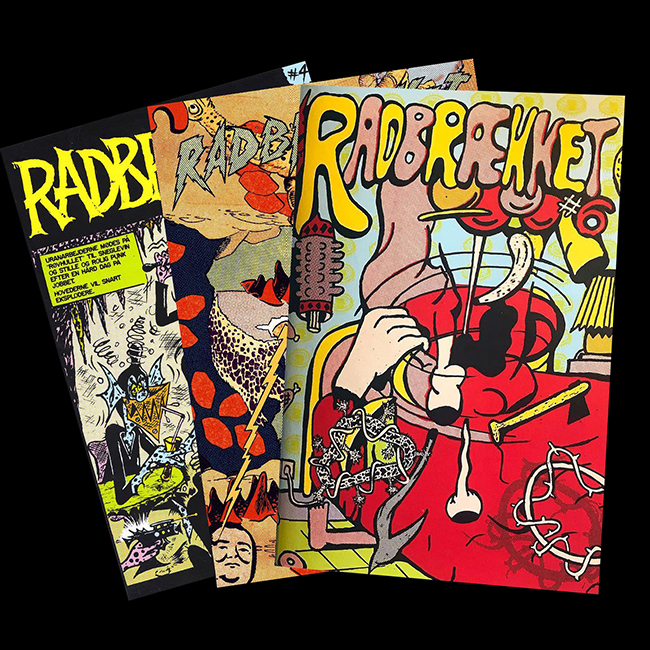
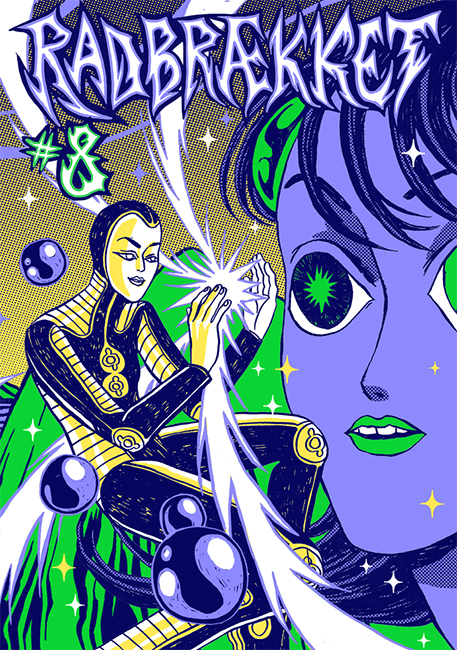
The Aesthetics of Resistance in Türkiye

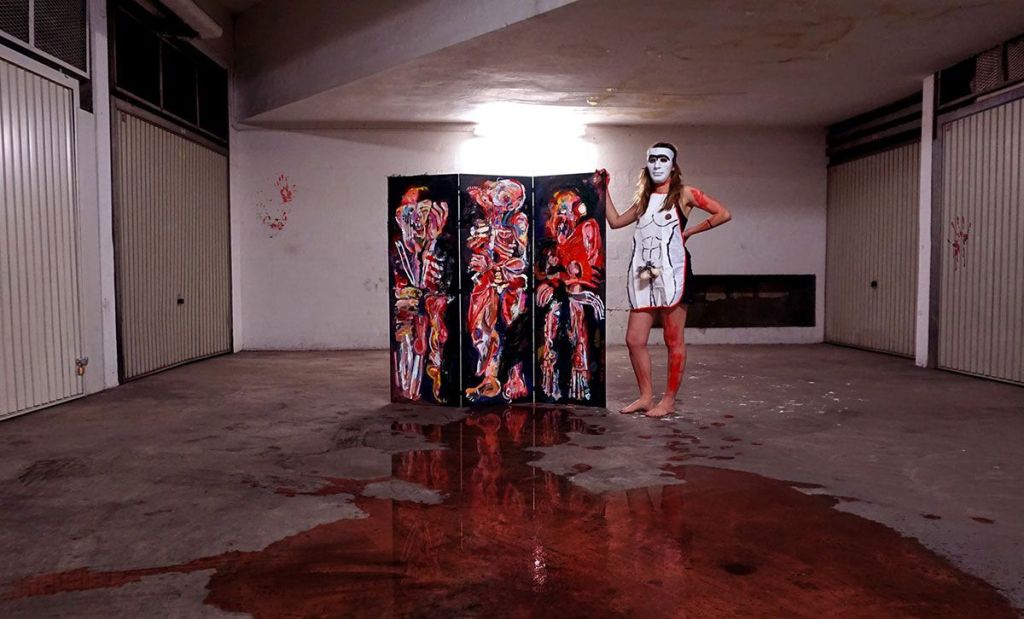
Şevket Kağan Şimşekalp x Erman Akçay ‘visual poem’ 2017

Now, angry young men publish revolutionary poems in xeroxed magazines.

Sometimes, when politics gets too chaotic, you need poetry to make sense of it.

Like the time when millions of Turks took to the streets and almost brought down the authoritarian regime but in the end they only rushed the descent into dictatorship.

“We felt powerful. We would change something. We thought we could win.” says Volkan, a young Turk who jumped in over his head in the Gezi Park protest of 2013. It was the happiest moment of my life. He lived in that park for a week. He built a free library for protesters and he carried away the wounded. Too many were injured, too many people died, too many lost their eyes. They screamed.

Poetry of Dictatorship

by Vlad Ursulean / casajurnalistului.ro

The government waited for a rainy day and then it attacked. It was early in the morning. We could only hold them back for a couple of hours. And then we ran. Hundreds of people killed. Hundreds of thousands of purges. Hundreds of newspapers crushed.

Silence. Now, angry young men publish revolutionary poems in xeroxed magazines. Don’t think that poetry is only a thing for fiery young men. Erdogan himself, before being supreme leader, went to jail for reciting a verse. This one:

The mosques are our barracks,
the domes our helmets,
the minarets our bayonets,
and the believers our soldiers.

Volkan Yalçın: Poet, film director and a zinester

Volkan is a big fan of Tristan Tzara and you can see it in his hairstyle, in his room, in his life, in the magazine he’s editing. He pours into it the hopes of his generation. It’s called VOID Zine.

He went to his first protest when he was three years old. His mother took him, she was a teacher in Adana. It was a demonstration for a journalist who was killed. For some time he wanted to be a journalist himself, but he chose life. He went to Istanbul to study film. He lived on Taksim, he worked in a bar there, that’s where he met his friends and that’s where he tried to make a revolution.


Hard to live in Istanbul after this. Police everywhere. The islamic society puts pressure on you. My mind always tried to hide. People don’t even want to go back there so they won’t remember. says James Hakan Dedeoğlu, a friend of Volkan, who edited a proper cultural magazine BANT Mag. for the last 15 years.

After the ‘80s, marked by a military coup, Turkish culture opened up in the ’90s to the West. Its core was Taksim. It was rough, chaotic. Everybody had a voice. When Erdogan came to power, he triggered an economic boom and an era of islamic capitalism. Everywhere they built malls and mosques. That’s how the Taksim revolution began, with protests against the demolition of a historic cinema. The police attacked film directors, sprayed them with tear gas.
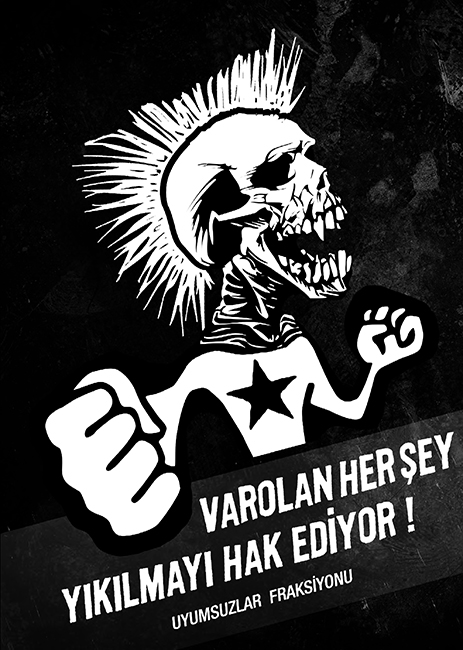
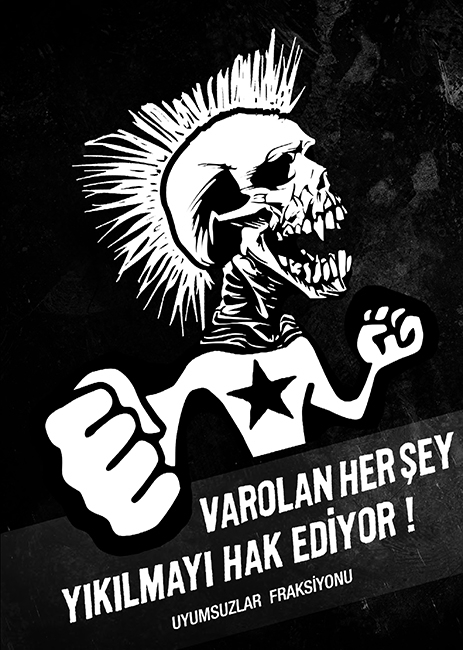
Uyumsuzlar Fraksiyonu, Afiş 2014

Ağaçkakan, İskeletor, Rad Dar, “Umulmadık Topraklar” ARTİST 2016

Poetry made a jump!

Gezi was so strong, so powerful, but it ended in a bad way. It was a defeat. People retreated to their neighbourhoods. They started doing things locally.

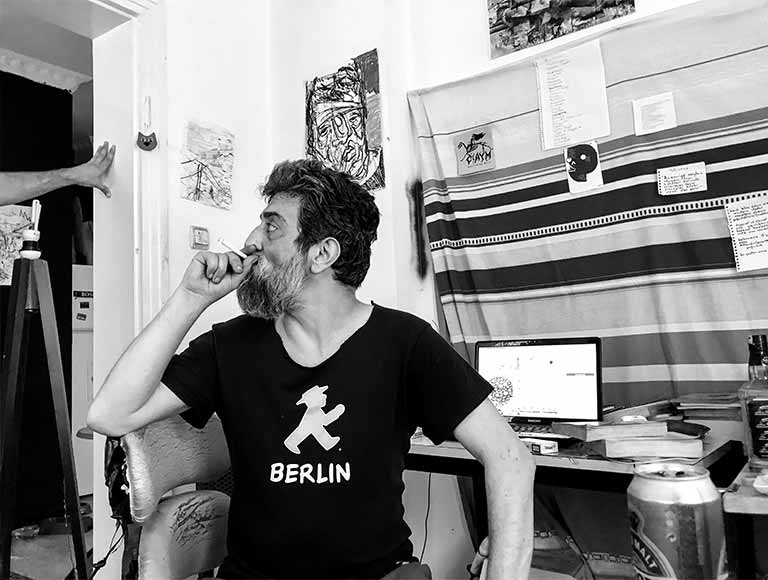
Şevket Kağan Şimşekalp x Erman Akçay ‘visual poem’ 2017
Şevket Kağan Şimşekalp, photo. by Vlad U.

“Poetry made a jump!”

shouts poet Şevket Kağan Şimşekalp while listening to Metallica at full volume. In the underground there’s a very strong reaction to this dictatorship. He thinks the whole society suffers from some kind of mental illness and this is its chance to wake up. In the ‘80s, an apolitical generation was born. Sleeping people were created. They did not wake up until Gezi. The poet gets filled with enthusiasm, he claims the rebirth of poetry as computer programming, then falls into himself: Avant-garde poets in the East are either put in prison or hanged…


Efe Duyan, photo. by Vlad U.

“I try to resist. I write poetry. revolutions too like grand plans can’t be plotted in great detail.”

Political poetry is a local tradition. says Efe Duyan, poet and professor at the University of Arts. Poetry is political since the 19th Century. The elites were poets. They saw the French Revolution and came back with ideas of nationalism and modernism and futurism. Also a local tradition: sending poets to prison. Nâzım Hikmet, the most important poet, was sentenced to 28 years. Everything he was writing was a shock. In the ‘60s and ’70s, every demonstration had poets reading. Efe Duyan was himself arrested while attending demonstrations. 10 years ago I spent 10 days in prison. They took me in, beat me like crazy. That’s when you see what they really are. They don’t believe in this democracy bullshit.

Taksim changed Erdogan. He was so affraid of the revolution he quit the role of democrat. He became a proper dictator. I’m openly opposed, but I try to say it in a careful way. Even students could go to the police after the course. These things happen. Trying to stay hopeful trying to live drinking out wearing a skirt asking for some basic justice maybe less corruption… I always had this feeling that I have to change the world. I try to resist. I write poetry. revolutions too like grand plans can’t be plotted in great detail.


Sometimes, you don’t even have to write it yourself to get in trouble.

Doctor Altay Öktem was forced to resign from his hospital in Istanbul because he owned a collection of illegal magazines.

My colleagues saw I was collecting fanzines and asked me: Are you satanist?

“In those times they were on a satanist hunt. Police made list of rockers. They picked them up on the street if they had long hair or black shirts. He got away by resigning and ended up writing books about underground culture. When he was little, he didn’t like football. He liked to read. His father was an officer, so he sent him to a military highschool. I didn’t like militarism! I was depressed. When I had a bit of time, I read poetry. Poems helped me. Turkey was very chaotic. Lots of people were killed that year, In 1980 there was a military coup. They fired me because I was a socialist. I was 16 years old! I didn’t even know what socialism means. There was chaos. How could I earn money? I went to medicine, because I like to help people. My job was very bloody. Lots of dead people.”

Altay Öktem x Mert Kamiller ‘Duvar / the Wall” Music-poem

In the meantime, he read Ginsberg and Edgar Allan Poe.

He started to collect fanzines, informal xeroxed magazines passed around peer-to-peer. They had interesting ideas, but couldn’t write them in legal magazines. They had famlies, you know… The protest in Taksim was the moment when his passion took over his life. He went into the street with his family. In Turkey nobody felt freedom like this before. Only in Gezi park I feel myself free. They think we are terrorists Actually, we are the best side of Turkey. We live like Europeans. We drink beer, we have sex… We lost our utopia. We have lots of dystopias, but no utopia anymore. We have to fight with the government. The pencil is a weapon.

The Day that Erdogan won, 2019 Summer

Turkish songs about fighting eternal enemies.

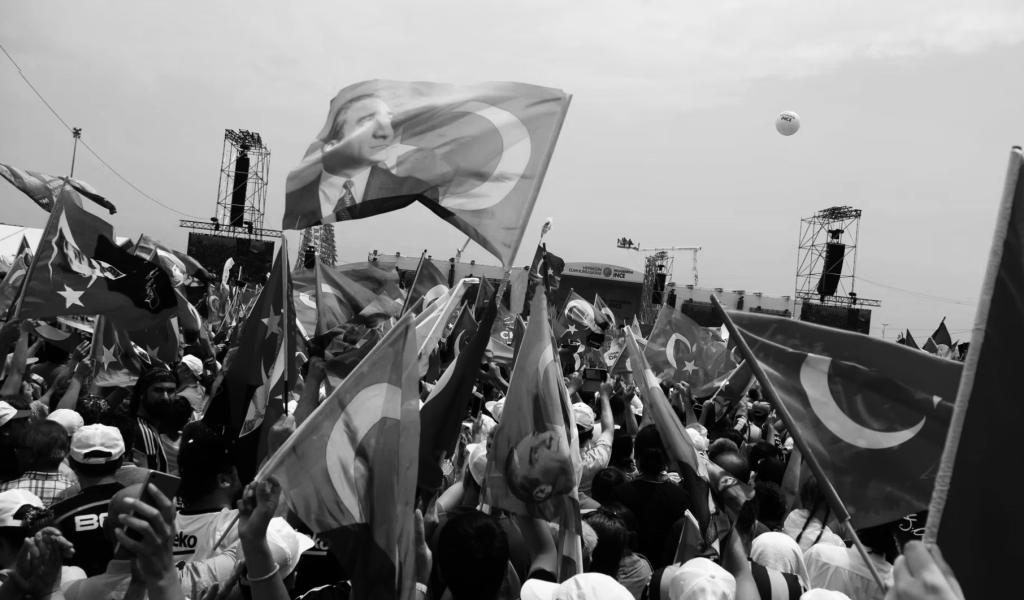
I wake up late in the morning. OMG, it’s election day! While I was sleeping, millions of people already voted. My head is roaring with all the people I’ve been talking to. I don’t understand how they can live like this, between terror and exaltation. Last days I’ve been to an opposition march and I saw millions of Turks fluttering like flags and shouting like loudspeakers amplifying the contender, a mustached physics teacher who once wrote erotic poems. Did you ever hear millions of people shouting together one word at a time? The hills are trembling. The Marmara sea resounds. And it still resounds in my head, through last night’s beers and Turkish songs about fighting eternal enemies.

I go out into the streets, automatic rifles everywhere, like it was in the marches for Erdogan, who toured the country in a bus featuring his huge face, surrounded by a personal army, with helicopters buzzing around and snipers mumbling on rooftops. Armed soldiers were throwing toys to children hanging on fences. People animated by the thought that all the other places are not safe. This can’t go on, Volkan tells me. He used to think that all the parties are the same crap, but this time you just can’t stay on the side. It’s all or nothing. We go to a voting place filled with portraits of sultans and security cameras. Then we go to a funeral. I go out into the streets, automatic rifles everywhere, like it was in the marches for Erdogan, who toured the country in a bus featuring his huge face, surrounded by a personal army, with helicopters buzzing around and snipers mumbling on rooftops. Armed soldiers were throwing toys to children hanging on fences. People animated by the thought that all the other places are not safe. This can’t go on, Volkan tells me. He used to think that all the parties are the same crap, but this time you just can’t stay on the side. It’s all or nothing. We go to a voting place filled with portraits of sultans and security cameras. Then we go to a funeral.

A friend of his, an artist died in shady circumstances and is now covered in a green blanket with a verse from the Holy Quran “Every creature will taste death”. Young people with leather jackets and spikes are hugging each other while the imam is shouting: Allāhu akbar

then they shove him into a van, fasten him with a belt and leave, almost running over a cat missing the tip of its ear.
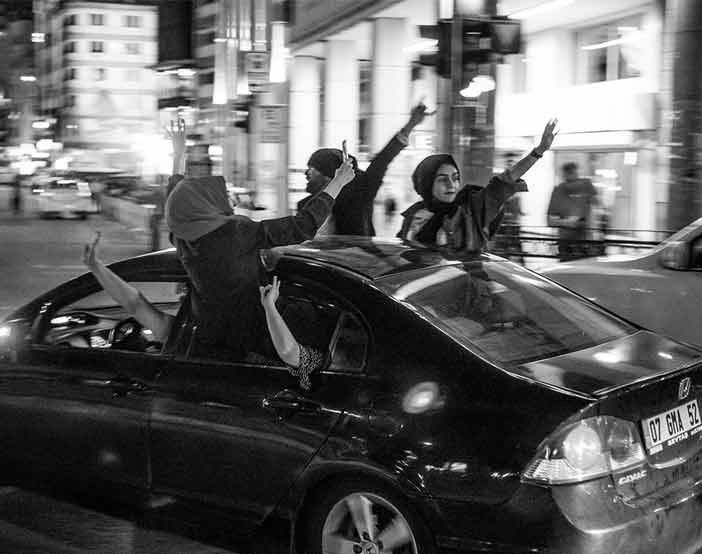

Photo by Vlad U.
Photo by Vlad U.

Good

Night

Turkey

Photo by Vlad U.

In the evening we hear gunshots. They’re celebrating. Others are protesting. People are running around chanting. Young men cheering for Erdogan and islamist girls from the allied party are snaking around the streets. Here and there a brawl. They brought water cannons in our neighbourhood.

Good

Night

The morning after. I wake up at noon, on the floor, with a swollen head – can’t even remember why. Ashes everywhere, chants of a muezzin creeping in through a broken window, waking up the others. They look at one another, confused, remember what happened and shrug in disbelief. They gather around a table, open a notebook and brainstorm: what now?

The paper stays blank.


Erman Akçay: Original Zinesta from 1982

Epilogue

Vlad Ursulean


I went to Turkey last year (2019 Summer) for the elections that democratically enshrined the authoritarian regime. All the people I knew there left the country when things got nasty.

Where could I go? Who should I talk to? I told my dilemma to a hardcore German photographer who I was hosting in The House of Journalists. He put me in touch with a guy named Erman who told me everything is fine in Istanbul then sent me his fanzine, which said ‘people not protest anymore, but commit suicide.’

Bucharest looked like a neighbourhood of Istanbul when I left in a bus full of thieves and smugglers thinking that I have the best chance of getting arrested. Erman picked me up in the Kadıköy harbour and put me in contacts with loads of people from the underground scene, then he vanished just like that.

He liked Emil Cioran and was depressed like many of the people I met in those horrible days for the free spirit. I was horrified myself because there was a similarity to the situation in Romania and other countries seduced by illiberalism. I took me a year to write this poem as a tribute fanzine.

Meanwhile, Romania cut the head of its ruling party Turkey voted against Erdogan for the first time and Volkan published a dystopian SF novel very popular on insta stories.

Erman Akçay ‘Dev Porn’ kolaj (2014)

Everything will be fine.‍

Everything will be fine.‍

Everything will be fine.

Everything will be fine.

São Paulo Pixação Underground Scene

Interview by Sergio Franco, Portrait and Photos by Choque Photos

I BECAME ACQUAINTED WITH PIXAÇAO DURING ADOLESCENCE DUE TO THE MANY PIXADORES IN MY NEIGHBORHOOD. I USED TO LIVE ON THE NORTH SIDE OF SAO PAULO, AND WHEN I STARTED GETTING CLOSE TO IT AROUND 2001 AND 2002 THE PIXAÇAO SCENE WAS PARTICULARLY STRONG THERE. I WAS ALWAYS IMPRESSED BY THEIR ORGANIZATION AND THEIR DARING ATTITUDE.

Choque Photos

INTERVIEW BY SERGIO FRANCO
PORTRAIT AND PHOTOS BY CHOQUE PHOTOS

Photography came long after that, by about 2006. I first came close to pixação by collect­ing the folhinhas (“leaflets,” the signatures they exchange among themselves) and ended up owning a whole collection of them. From the moment I got involved with photography I had an instant interest in capturing their actions and began studying this theme, because practically no material existed on the subject. Pixação in São Paulo isn’t new; it has been around for about 30 years but it hasn’t been studied thoroughly so I aim to pioneer material in the field of photography, because no one has ever photographed the pixadores in action. Society knows pixação on the walls, but the act itself, the backstage, no one has knowledge of because access is very restricted. It’s a tittle complicated being accepted among these guys. —Choque Photos

Sergio Franco: What elements do you consider make up pixação? How does pixação differ from graffiti, and what makes pixação different from other forms of intervention in the city?

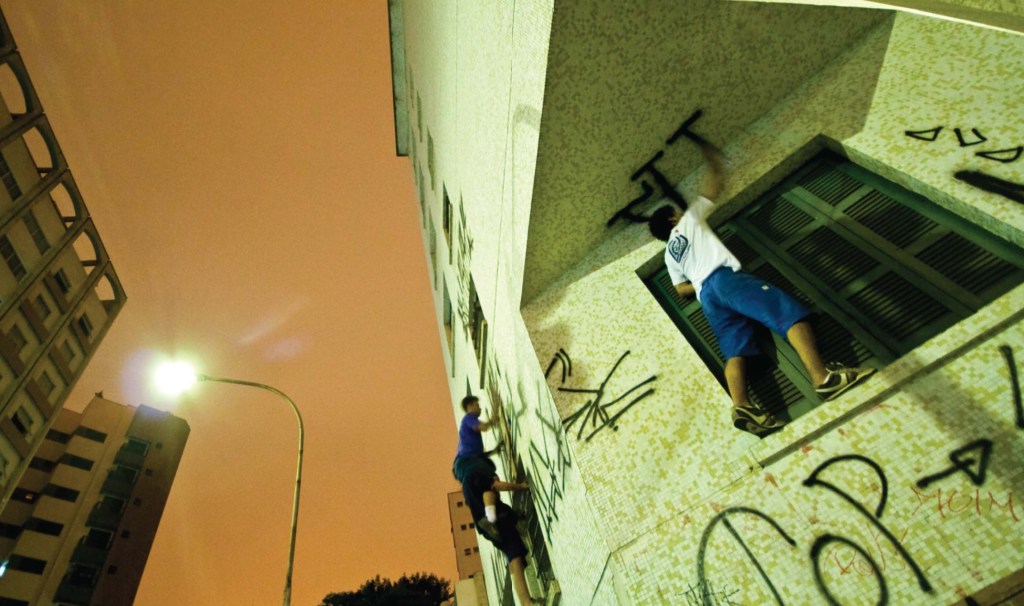
Choque Photos: The aesthetical attitude, which broke away from the New York tag and graffiti sensibilities. São Paulo has created its own modality. For those who live outside São Paulo, it’s known as tag reto, “straight tag.” Pixação has also established a more strict relationship with the city’s architecture; it occupies the verticality of the urban landscape due to the great preponderance of buildings. For that matter, pixação occupies the space a lot more efficiently than any other form of street language. It has veiticalized itself as writing.
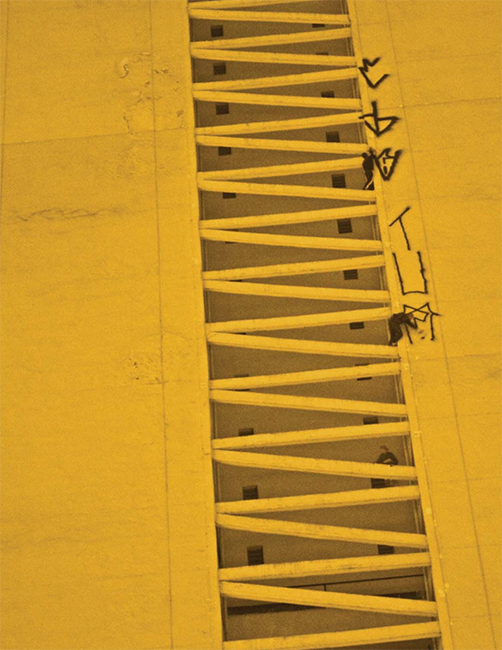
What I find impressive in pixacao is that it occupies every abandoned space, and not just the subway and trains as has occurred in NYC. You’re able to find pixação that has been there for 20 years through these abandoned spaces. Thus, they utilize space more efficiently, from the ground to the top. They’ll climb buildings and do the pixos on rappel. São Paulo is a giant calligraphy book: the pixadores will fill it in so nothing will be left blank. I believe that the spaces left blank in the city awaken in the pixadores the same feeling as a blank canvas to an artist. When the pixadores see these spaces, they’ll project in their minds how that place will look with their imprint on it.

Choque Photos, juxtapoz mag. 2009-07 pg.97
Choque Photos, juxtapoz mag. 2009-07 pg.98, 99

How is this search done for taking over the entire city with pixo interventions? What are the principles that move it? How do the pixadores mobilize themselves so that they will have an amplified circulation throughout the city?

There are three basic things that lead the guys to pixação; first is the social recognition; sec­ond is the entertainment and adrenaline; and third is the protest.

The vast majority of the kids are from the pe­riphery and what are their options for entertain­ment where they come from? A small soccer field, a bar in every corner, and a crack house. Those guys don’t have a lot of options; there isn’t a public policy of recreation aimed at this public. For this reason, pixação became a way of recreation for the periphery, or the outsiders; it’s the greatest option for these kids. Relating this to social knowledge, I would say that these guys, in their majority, have problems with their families. Parents are absent from their upbring­ing so they look for a second family in the streets. They refer to their pixo group as family. Since the guys don’t have recognition at home, they look for it in the street, and it’s the alterna­tive they find.
But such social acknowledgement is internal, because they are the only ones that understand the letters; the writings are so sophisticated that they are the only ones who can read them. To society it’s an indirect recognition, once it sees pixo as an aesthetic aggression against their bourgeoisie standards of beauty. They say that through their actions the bourgeoisie won’t be able to have the spotless white buildings as they wish. The guys are questioning the concept of private property with the act of pixação; they take the space symbolically, then. They are symbolically appropriating when they paint on the top of the building, making the building their own space.

Choque Photos, juxtapoz mag. 2009-07 pg.100

But what is the degree of protest in the manifestation?

It’s an indirect protest, not as it occurred during the dictatorship years. The pixação works as a symptom of a much larger social problem in São Paulo. It isn’t meant to be read or understood directly. It’s an aggression, not a form of communication for the society.

Pixação is a closed community and form of communication for the members of the manifestation, but it pops in the city as if it were a disease. When the guys are doing the pixo, destroying the city, they are digging out the insides of the city, all of its pressure cooker problems: drug traffic, criminality—everything helps create pixação. Each year the letters become more and more aggressive. From the beginnings of Pixação to today the letters became more illegible. There are letters that even the pixadores can’t read.

What’s your relationship with the people held responsible for the attacks to the University of Fine Arts, the Choque Cultural Gallery, and the Biennial of São Paulo?

I learned about it only a few hours beforehand; I don’t participate in the debates or confabulations to elaborate such attacks. I want to stand as an observer without interfering with their decisions, registering what I find relevant.

The matter of the Biennial is delicate because when the rumors about the attack were passed, Ana Paula Cohen, the curator, made a very polemical declaration, which was, “Those people from the periphery don’t know what they’ll find here.” Therefore it was seen as a comment charged with prejudice; it provoked the pixadores. Actually, the Biennial wanted the event to be occupied under the theme “in live contact” since they were searching for a public intervention and participation. But when the pixação came about—seen as the number one public enemy of this city—the Biennial couldn’t not react. If they let pixação be part of the Biennial they would be legitimizing the manifestation as art. But society isn’t prepared to receive pixação as legitimate art.

Choque Photos, juxtapoz mag. 2009-07 pg.102,103

Do you see the relevance of your work as construction of knowledge?

To speak of pixo as something unique is one of the key factors making pixação so interesting. It’s a marginalized form of urban language. Historically, it came out of people who didn’t possess a vast repertoire of knowledge.

The pressure cooker has exploded, and it’s the marginalized screaming, making themselves present in the entire city. You won’t see a single street of São Paulo that doesn’t have any pixação. It’s the entire city, and a city the size of a country; it’s 20 million people. It’s their city, but society hasn’t taken that into account yet. The pixadores already do the walls, roofs, and win­dows of the buildings; next thing you know they will be having breakfast with the property own­ers. Sometimes they will invade the apartments, do pixos everywhere and not steal a thing, only terrorize the psychology of the bourgeoisie.

PIXO: a film by João Wainer and Roberto T. Oliveira

THERE’S NO USE PUTTING A WALL UP;

THEY’LL DO AS THE RATS AND ENTER THROUGH THE CRACKS.

Knowing the procedures for subverting security systems in a society is valuable, isn’t it?

Certainly. The guys see each action as military tactic. They study, plan, and go for the action. It’s a matter of subverting the entire security system. In pixação, as in graffiti, it’s a matter of vandalism. They face it as a military mission because there’s a life at risk in the action. You have a goal and you may die on the way. Many guys have died. A kid falls and dies every month. I even stopped accompanying them.

Here in São Paulo, who reports this?

Last year I learned about five guys falling and dying. Many guys fall and no one even knows about it. Several have died, many permanently injured. I’m sure that each month one will fall. I’ve seen some data from the mayor’s office stating there are five thousand active pixa­dores in the city. Five thousand young people is a whole generation that’s abandoned on the streets. The guys are screaming out their existence every moment. They climb on top of buildings and no one gives them attention. It will come to a point where they will no longer be able to remain ignored.

Choque Photos, juxtapoz mag. 2009-07 pg.104,105

What does this knowledge of the procedures for subverting security systems show? What’s its utility?

It shows that everything is fragile. It reveals how we live under a false sense of security inside luxury condos. People pay exorbitant sums of money so they will have security guards,
vigilance cameras, and sophisticated locks. Along comes a kid, a bum, madness, and that kid can subvert everything with a screwdriver. Even if you try to stay behind the wall, they know how to break it. You aren’t completely safe in a city like São Paulo. So long as there are absurd social contrasts there will be no way of remaining safe. There’s no use putting a wall up; they’ll do as the rats and enter through the cracks.

When we discuss the graphic composition of pixação, we find plenty of sophistication.
The runes are the fruit of the first European alphabet; it’s very old calligraphy, probably over 12,000 years old. What’s interesting is that something so ancient came to surface in São Paulo, within a marginalized culture of people who didn’t possess any access to quality education that would offer such a reference. Society sees it as scribble, but it’s actually something quite sophisticated. And each pixação is unique. When the guys create their letters they seek originality, and still go head to head with other outdoor advertisements and graffiti, thus having to create something dramatically different. They need to stand out on the walls.

What have you got to say about graffiti photography today?

It’s much more like an aesthetical jerk off, which doesn’t contextualize with the city; it’s just a reproduction of the work. But there are photographers who stand out in the middle of it. The work of Martha Cooper and Henry Chalfant in the 1980s is also good, and they held the role of dispersing graffiti around the world. The history of any expression only reaches the world after it has official documentation.

Pixação in São Paulo grew independently and without any external reference because they didn’t have access to such material. There was no Internet, books didn’t arrive, and the films didn’t arrive, either. That’s why it grew apart from NYC. Only rock bands’ logos arrived. São Paulo has developed itself as if it were an island.

In Francois Chastenet’s book, Pixação: São Paulo Signature, I read that pixação is a trans­lation from the word “tag” in Portuguese. But it isn’t. It’s a movement that’s grown apart from all this. The term is Brazilian. And it’s the latest trend in the art world.

Choque Photos, juxtapoz mag. 2009-07 pg.106

My essay about the action of pixo took me two years. It was two years in the street, over­nighting and being in several critical situations, risking my life, running from bullets, and all the mishaps faced by pixadores. There were nights I couldn’t imagine coming back home.

Street art is the division in art history, because for the first time an entire generation of adoles­cents who have been forgotten and treated as outsiders have appropriated the city illegally to realize their work. On a global scale this has never happened before. The importance of pixação to São Paulo is equal to the import­ance of graffiti in NYC, and in my opinion, a much larger and more important phenomenon than anyone has yet to witness.

For more information about Choque Photos, contact Flickr.com/choquephotos.

Resource: Choque Photos, juxtapoz mag. 2009 #07


Marc Caro: Strapazin #18

Hätte Marc Caro im 19. Jahr­hundert gelebt, er wäre ein bombenwerfen­der russischer Nihilist gewor­den. Erfreulicherweise ist Marc Caro ein zeitgenössischer französischer Comiczeichner, wobei wir die Gegenwart aus gegebenem Anlaß 1976 beginnen lassen. Was sich 1976 andernorts in der Rockszene mani­festierte, veränderte in Frankreich das Aussehen der Comickunst nachhaltig.

1975 gründeten Olivia Clavel, Christian Chapiron, Loulou Picasso, Lulu Larsen und Bernard Vidal — größtenteils ehemalige Studenten der Kunstakademie — die Gruppe Bazooka. In einer Mischung aus teilweise gewolltem Dilet­tantismus und hochgradiger Perfektion zertrümmert Bazooka voll anarchistischer Freude die Selbstverständ­lichkeiten des klassischen Comic. Ihren ausgeprägten Gefallen am Schockierenden, Absei­tigen teilen sie mit vielen der gleichzeitig oder nach ihnen erscheinenden Comicschaffenden, die neben nervöser Grafik auch Fotos verwenden (Polizistenfotos, Leichenfo­tos, etc.).

“(Diese Richtung) ist gekennzeichnet durch einen schmutzigen, rohen, unfertigen Strich und durch die gewollte Obszönität einer mor­biden und/oder sexuellen Thematik.” Aus der nachfolgenden Genera­tion seien genannt: Matt Kon-ture, der gelegentlich an den frühen Caro erin­nert, La Casinie-re, Mokeit, J.C. Menu, der auch das her­vorragende LE LYNX (nach 7 Nummern leider eingegangen) herausgege­ben hat, Jocelin, der vor allem im eigenen AMTRAMDRAM seine kubo-expressionistischen Bilderserien ab­druckt. Hingewiesen sei noch auf SEDUCTION, hervorragende Fanzine-Zeitschrift, die in Troyes herauskommt. Hier, wie in den zahllosen Graphzines und 30-Exemplare-Produkten trifft man immer wieder auch Bruno Richard, Placid, Muzo, Marc Caro, gelegentlich auch Gotting und Loustal. Viele der Genannten ar­beiten zugleich auch in der Malerei, in der Musik (was man halt so nennt) und im Trickfilm.

Nach ersten Veröffentlichungen in Fanzines kam Marc Caro 1976 aus Avignon nach Paris und begann recht bald, einzelne Arbeiten und kurze Comics (eine Geschichte von Caro ist lang, wenn sie 4 bis 6 Seiten umfaßt) in Comiczeitschriften zu veröffentlichen. 1981 erschien TOT, eine Sammlung bis dahin veröffent­lichter Comics. Mit Jean-Pierre Jeunet, für dessen Anima­tionsfilme er bereits früher Trickfiguren gebaut hatte, drehte er 1981 den Kurzfilm Le Bunker de la derniere rafale. Er beginnt, die Möglichkeiten der Computergrafik zu benutzen, interessiert sich für das Video. Er produzier­te Musikvideos für Jean-Michel Jarre (Trickfiguren für Zoolook) und die erfolgreiche, aber nicht weiter bemer­kenswerte Popgruppe Indochine (Les Tsars). 1987 er­schien mit IN VITRO eine Sammlung seiner späteren, holz­schnittartigen Comics. Heute zeichnet er fast gar nicht mehr, produziert gelegentlich Musikvideos. Die frühen Sachen, in Fanzines wie FALATOFF, Keimzelle des Kleinverlags Artefact, und ab 1976 auch in Metal Hurlant, Char­lie, BD-Hebdo erschienen, erzäh­len von Selbstverstümmlern, Elektroschock-Rollkom­mandos, Kannibalis­mus im Bunker, von Rock­musikern, welche sich auf der Bühne Gliedma­ßen abschneiden. Es ist bereits die Zeit der Indu-strial-Tendenz, mit der Caro die Faszination für Gewaltsysteme, das Verstümmeln und sonstige Pathologien teilt.

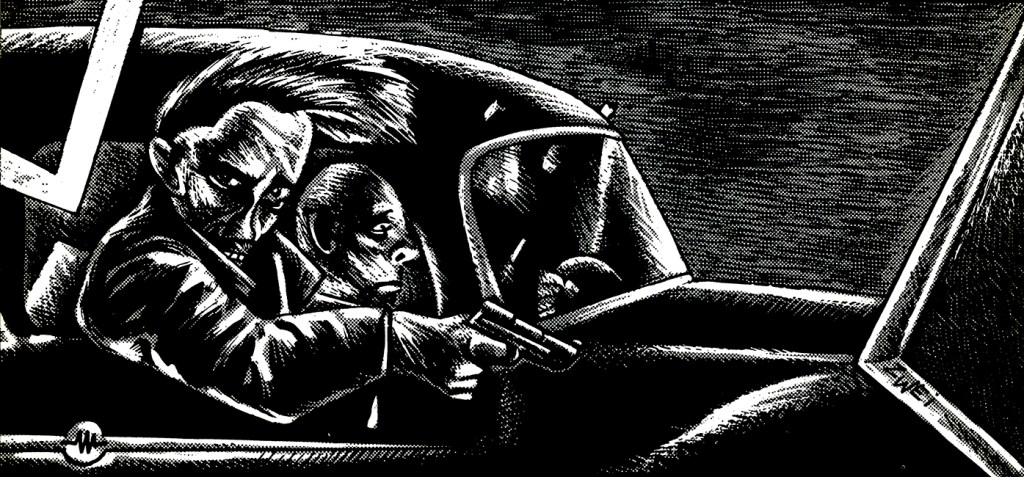
Marc Caro and Jean-Pierre Jeunet “Bunker of the Last Gunshots” (1981)

Marc Caro sagt, seine früheren Sachen seien rea­listischer. Die Bildflächen sind mit verschiedenarti­gen Schraffuren und darüber hinaus mit dunkleren oder helleren Rastern fast vollständig bedeckt.

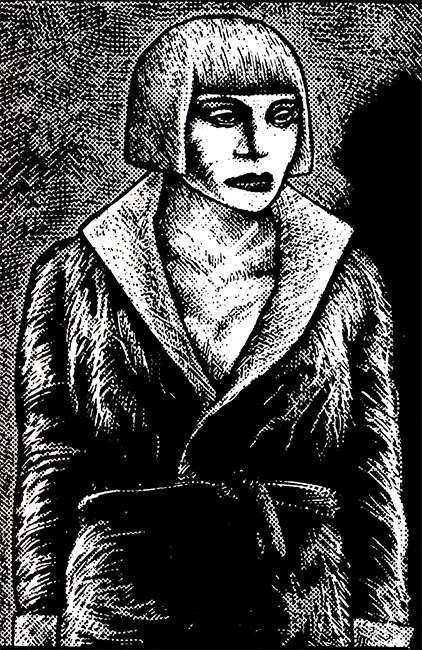
Die menschlichen Figuren sehen ungefähr menschlich aus, meist etwas deformiert. Etwa an George Grosz erinnernd, nur mit den Mitteln der realistischen Illusion dargestellt, die Zeichnung ist körperlicher. Ich kenne 27 Geschichten von Marc Caro, nur in dreien sind Sprechblasen mit erzähltechnischer Bedeutung, in den übrigen gibt es einen Text über dem Bild. Man dächte, daß der Text unter solchen Bedingungen eine doppelt gro­ße Erzähllast tragen muß, in der Tat erzählt uns der Text aber oft etwas anderes als das Bild. In TOT ist eine Ge­schichte, worin der Text die Briefe eines US-Soldaten aus Vietnam an seine ‘liebe Louisa” wiedergibt, er berichtet von der zweifelhaften Kampf­moral seines Mitsoldaten. Die Bilder sagen, daß er “verrückt” wird und vietnamesiche Leichen schän­det. Vielleicht ist dies auch eine der “anthropologi­schen” Geschich­ten, die Caro im Gespräch meint.

Die späteren Comic­geschichten, gesammelt in IN VITRO, verwenden häu­fig den Holz- oder Linolschnitt. Ein Übergang, der gröbere, eckige Li­nien, aber auch eine größere Klarheit des Bildes bringt. Diese Geschichten sind vierfar big, gelegentlich sogar ziemlich bunt, und vom In­halt auch fröhlicher: eine Sommer-Sonnen-Strand-Ge­schichte mit lustigen (der junge Mann klebt sich Toastbrot auf die Ohren um der jungen Frau zu gefallen) und kaf-kaesken Elementen (2 Meter große Fliege).

In diesen späteren Geschichten wird fast ausschließlich die Halbtotale benutzt, die filmischen Mittel der Bilddrama­turgie nur wenig verwendet. Die Geschichten sind daher weniger eindringlich, weniger “realistisch”. In den früheren Geschichten gibt es oft den acteur-narra-teur- einen, der erzählt oder sonstwie den Text liefert und zugleich die Hauptfigur ist. Diese Figur besitzt selten ein entwickeltes Innenleben, dafür sind die Geschichten auch zu kurz. Oft ist die Hauptfigur, am Ende der Handlung tot, denn er kann so ja eigentlich nicht mehr die Ge­schichte erzählen.

Ich glaube, es wäre falsch, das Schockieren­de in den Geschichten Caros übermäßig zu betonen. Er betreibt kein epater le bourgois, seine “Geschmak-klosigkeiten” sind nicht dazu da, moralisch empfindenden Menschen Alp-träu- me zu bereiten. Auch geben seine Ge­schichten, trotz düsterer Bunkerwelten, nur wenig zu einer emphatischen Apokalyp-sensentimentaliät her. Es ist geschrie­ben worden, Marc Caro betreibe Schwar­zen Humor. Vermutlich sind seine Comics hu­moristisch, schwarz sind sie sicher. Das Interview mit Marc Caro fand am 8. Mai 1989 in Paris statt, wir danken Thierry Groensteen für eine freund­liche Hilfeleistung.

Heinrich Raatschen


JP Dionnet interviews Eberoni, Max, Caro and Placid & Muzo

Wann hast du angefangen zu zeichen?

Als Junge, aber angefangen… ich mag das Wort Professionel­ler nicht, aber angefangen, in Zeitungen zu publizieren, 1976, 1977. Kleine Arbeiten, Zeichnungen…

Für die Zeit fällt mir als erstes Bazooka ein…

Das waren schon ein wenig die Vorreiter, aber eigentlich gab es eine ganze Bewegung, eine ganze neue Generation von Zeichnern. Neben Bazooka gab es “Elles sont de sortie”, mit denen ich mehr zu tun hatte… Das war eine ganze Strö­mung, die ein wenig vom Punk [sprich: pönk] her­kam. Es gab viele neue Leute, die in der Zeit her­ausgekommen sind.

Am Anfang eines Comic, steht da ein Bild, oder gibt es erst die Geschich­te, den Text?

Nun, zuerst gab es diese kleinen Texte, die ich geschrieben und dann illustriert habe. Die Ge­schichte mit Zeichnun­gen erzählen. Wie kann man eine Geschichte mit mög­lichst wenig Bildern erzählen. Für die späteren Geschichten in IN VITRO ist es die Geschichte, die dominiert. Die Bilder sind wichtig, und die Geschichte ist auch wichtig, es sind ja keine Gemälde.

Du gebrauchst, wie z.B. im chinesischen Comic, fast nie Sprechblasen.

Nein, ich habe nie Sprechblasen verwendet. Der Text ist immer oben drüber. Man kann das vergleichen mit dem, was im Film die Off-Stimme ist, so eine Erzählweise… Da sind diese kurzen Texte, Textfragmente und dann, tad, ein Schnappschuß. Was mich interessiert, ist so eine kleine Verschiebung, eine Diffe­renz zwischen dem Bild und dem Text. Die ist aber nicht unbedingt absichtlich hergestellt. Ich mag es, wenn das Bild etwas unbestimmt ist, damit ich hineinlegen kann, was ich Lust habe, darin zu sehen. Was ich den Leuten gebe, was die Leute sehen, wenn sie meine

Sachen anschauen, weiss ich nicht genau. Aber Comics, das ist für mich eigentlich ziemlich alt, das ist eine abgeschlossene Periode. Den größten Teil der Comics aus der Zeit habe ich irgendwann zerrissen, die gibt es nicht mehr.

Das war wichtig für die Zeit damals, aber heute interessieren mich andere Sachen. Wieviel hast du publiziert?

So viele Comics habe ich gar nicht gemacht, und fast alle sind in den bei­den Alben. Da fehlen vielleicht 4,5 Geschichten die nirgendwo veröffent­licht worden sind. Ich habe viele Zeichnungen gemacht, kleine Illustrationen, aber nie eine 60-Seiten Geschichte.

War es für dich einfach, deine Sachen in Zeit­schriften unterzubringen?

Ich glaube, im Comic ist das ziemlich einfach. Na ja, jetzt gibt es nicht mehr soviele Zeitschriften, wie vor 5,6 Jahren… Ich hatte Glück, eines Tages bin ich zu Metal gegangen und habe ihnen Zeichnungen gezeigt. Sie mochten es, dann wollten sie noch eine haben und später auch Comics-Geschichten.

Hast du auf Bestellung gearbeitet ?

Ja, sicher. Für die Sondernummern. Das meiste in TOT war für METAL Special Rock, METAL Special Guerre, METALSpecial Irgend­was. Ich mußte die dann, inner­halb eines Monats abliefern. Das hat mich ganz schön ins Schwitzen ge­bracht. Ich bin ein ziemlicher Fau­lenzer, eigentlich, he he…Nachdem Me­tal 36000 Mal den Besit­zer gewechselt hatte, habe ich das irgendwann fallen lassen, weil ich mich mehr zum Video etc. oriehtiert habe. Die Zeitschriften sind normaler ge­worden, das ist wirklich eine Rückkehr zum alten Comic.

Diese Katholiken, die jetzt all die Comicverlage aufkau­fen, findest du das beunruhigend?

Ach, das möchte ich so nicht sagen: Seit ich angefangen habe, selbst zu zeichnen, hat mich das alles nicht mehr so interes­siert. Ich weiß nicht…

Hast du viel in Fanzines veröffentlicht?

Nein, nein, ich habe überall veröffentlicht. Ich finde es gut, in Sachen wie Telerama zu arbeiten, Marie-Claire sogar, jetzt erscheine ich gerade in einem deutschen Blatt [Boxer no. 1 ], in Italien (FRIGIDAIRE)… Da erreiche ich ganz verschiedene Leute. Wenn du immer in den selben Graphzines erscheinst, dann erreichst du immer nur die selben Leute. Ich zeige das lieber Leuten, die darauf nicht gefaßt sind, die das noch nicht kennen.

Dann denkst du also an das Publikum?

Wenn ich an etwas arbeite, geht es mir nicht um das Publikum, sondern mehr um mich, daß ich sagen kann: Ah, da ist mir etwas gelungen, das mir gut gefällt, wofür ich mich nicht schämen muß.

Hinterher mögen es die Leute oder sie mögen es nicht, es erscheint oder es erscheint nicht. Findest du, daß man sich beim Comicmachen Beschränkungen auferlegen muss, weil man ja z. B. verständlich bleiben will?

Ich versuche natürlich, den Zusammenhang zu wahren. Aber man kann nicht unbedingt sagen, daß die Geschichten tatsäch­lich immer ganz verständlich sind, hebe… Das sind keine Schulaufsätze. Diese ganzen späteren Sachen in IN VITRO, das sind für mich eher so eine Art Aphorismen, so kleine Blödheiten. Viele kleine Bilder, und am Ende steht eine kleine Moral von der Geschichte.

Die früheren Geschichten sind da, glaube ich, anders. Die sind meist ziemlich grausam und bizarr…

Sicher, ich zeige ekelhafte Sachen, ich muß den Leuten aber nicht sagen: Schaut, wenn man dies oder das tut, das ist böse. Das ist mehr ein Art Anthropologie… Ich sage: Seht her, das existiert. Es gibt nichts in TOT, was es nicht wirklich gäbe. Gut, es ist ein wenig wahnhaft und phantastisch, es ist nicht dokumentarisch. Aber das alles gibt es ja, es ist nur in den Vordergrund gestellt. Trotz­dem, glaube ich, gibt es da keine Faszi­nation für das Morbide. Ich sage ja nicht: Schaut mal, wie lustig! Schaut, die schneiden sich in Stücke, wie lustig! Und nun gut, die netten kleinen Geschichten, wo alle glücklich und zu­frieden sind, ich meine, ich habe nichts dagegen, daß es das auch gibt.Den Vorwurf, den man mir vielleicht machen kann, ist, daß das ein wenig pessimistisch ist. Das ist keine sehr angenehme Beurteilung des mensch­lichen Wesens.

Machst du noch Musik?

Nein, ich mache keine mehr, nicht in der Gruppe. Was mich eigentlich interessiert, ist nicht die Musik allein, sondern eher eine Verbindung. Im Comic ist es eine Verbin­dung von Text und Bild, im Video ist es eine Verbindung der Wörter, des Textes mit dem Ton und dem Bild. Immer so eine Art Ganzes. Du mußt etwas herstellen, wo man weder die Musik, noch die Wörter, noch das Bild entfernen kann.

Glaubst du, du wirst irgendwann wieder Comics zeichnen?

Es interessiert mich, Sachen zu machen, die ich noch nicht gemacht habe. Eine Serigraphie? okay. Eine Serigraphie in Plexiglas mit einem Wecker drin? Oh ja, das wäre lustig. Oder ein Flaschenetikett für die Leute von Papiers Gras? Ist okay, obwohl ich eigentlich keinen Wein mag.

Ein Medium, eine Technik, die mir noch nicht vertraut sind, das interessiert mich. Auch als ich noch Comics gemacht habe, hat mich Animation schon sehr interessiert, ich habe Trickfiguren für Kurzfilme gebaut… Es ist eher so: Du schaust dich um, findest gute Ideen. Ob das Zeichnungen sind, oder etwas Filmisches… Für mich ist es ungefähr das gleiche, ob ich einen Film mache oder einen Comic. Aber beim Comiczeichnen fehlte mir immer etwas. Du sitzt da ein wenig allein in deiner Ecke, es fehlen die Eindrücke, die Bewegung. Beim Video bist du ausgefüllter, du mußt ein Story-board machen, du mußt zeichnen… Es gibt da viele unterschiedliche Aufgaben, das gefällt mir. Ich arbeite auch gerne mit Leuten zusammen. Und außerdem, mit Papier als Träger, wen erreichst du… Wenn du eine kleine Videosache machst, erreichst du 10 mal mehr Leute, als wenn du ein Album machst, das gut läuft.

Weißt du, wieviel Exemplare von deinen Alben gedruckt und verkauft wurden?

Gedruckt, weiß ich, aber verkauft, das war immer etwas matt, hebe… Also ich glaube, jedes Album ist in ungefähr 5 000 Exemplaren gedruckt worden. Das ist nicht viel. Es verkauft sich nicht besonders gut. Ich glaube, eine Zeitlang wurde ein Exemplar im Monat verkauft. Ah nein, eins pro Tag, immerhin, eins pro Tag, hebe… Das ist trotzdem nicht gerade viel. Aber, wenn es noch in 50 Jahren verkauft wird – das wäre doch nicht schlecht?


Strapazin No. 1, June 1984, Art work by Pierre Thomé

Strapazin is in Munich founded and today in Zurich sedentary comic – magazine . The quarterly magazine offers a platform primarily to independent artists.

In 1984, employees of the city newspaper Blatt founded the Strapazin in Munich. According to co-founders Herbert Meiler and Pierre Thomé, one of the role models was Art Spiegelman’s magazine RAW. Strapazin was “intended as a podium in a comics scene from the start”. The first number with contributions from, among others, Poussin , Muñoz – Sampayo and Ralf König appeared at the first comic parlor in Erlangen and was subtitled “Magazine for Durable”. After that there was nobody in Munich who could guarantee regular publication of the magazine, which is why the Swiss comic publisher and aficionado David Basler began to publish Strapazin from Zurich. In Zurich, illustrators from the so-called “Zurich School” such as Thomas Ott , Ursula Fürst, Andrea Caprez and Peter Bäder were associated with the magazine. From the 1990s onwards, many artists from the former GDR were there in Germany.

In 2010 the 100th edition appeared, with contributions from Chinese comic artists. At the same time, the Chinese publisher Special Comix published a strapazin special with contributions from many well-known Swiss illustrators and a cover photo by Kati Rickenbach . In the same year, according to David Basler, “almost half of the audience […] was female.”

In 2018, the City of Zurich awarded the Strapazin a cultural award in the field of literature : “Founded in 1984 by Swiss and German publishers, it has since had the wonderful variety of picture-narrative formats in large, lush, colorful, wild, and sometimes explosive formats demonstrated and pioneered the establishment of the ‘comic’ as the ‘ninth art’. “

In 2019 the Strapazin celebrated its 35th anniversary with the June issue. The edition is 2000 copies (also as of 2019).  The offices in Zurich and Munich still exist today.

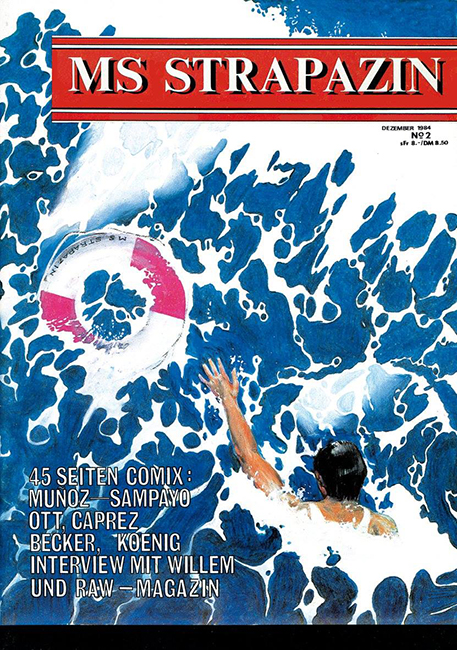
Strapazin No. 2, September 1984

The Strapazin prints comics by, in some cases, little-known and often avant-garde comic artists. The aesthetics of the Strapazin comics are shaped by punk and Dadaism, among other things, the draftsmen have often studied at art schools. Ralf König , ATAK and Thomas Ott published here before their breakthrough.

From number 37 ( L’ASSOCIATION ) onwards, the editions were increasingly, later continuously, under a certain topic appearing in the title with a geographical allocation (e.g. Scandinavian comic world , comics from Tel Aviv ) or a common content (e.g. instructions for use , Comics without protagonists ). A number can also be dedicated to outstanding illustrators such as George Herriman (2002). Every time there are “interesting texts on the meta level” for the comics. 

www.strapazin.de


Erman Akçay’s Delicious Disasters

Erman Akçay ‘Alien Fetus’ 42x30cm, Digital Painting, 2022

Çizgiler uyumsuza seslenir. Çizgi bir sınır talebidir. Uyumsuzluğun sınır kaldıraçları renkleri, duyumları karıştırır. Erman Akçay’ın işleri de bu uyumsuz çizginin sınırlarını yokluyor. Onun dünyasında nefessiz kalmak mübah. Çünkü dünyayla cebelleşirken, dünyaya sataşırken aynı nefesi bırakamayız. Akçay’ın çizimlerinde bir korku geleneği hakim. Çağın sesini bu korkudan alıyor. Korku yerleşik bir sonuç olarak değil Munch’un çığlığını güncelleyerek bugüne geliyor. Ölü sesler, iskeletler, kuru kafalar, yarılmış bedenler, metafizik ve maddenin içinde sürüklenen özne sesini imgelerin korkusuyla birleştiriyor.

Bir uçta kendi yarattığı dünyanın sınırlarına hapsolmuş bir özne, diğer yanda bütün kayboluşlara rağmen yaşamda ayak direten bir sesleniş.

Dolunay Aker


Erman Akçay, Alien Portrait, 42x30cm, Charcoal/ Digital Painting, 2022

Erman Akçay, 1982 İstanbul doğumlu, Marmara Üniversitesi Güzel Sanatlar Fakültesi mezunu (2004), birçok farklı disiplinde işler üretmiş grafik sanatçısı, okur-yazar, eleştirmen, artizan.

Erman Akçay, born 1982 in Istanbul, graduated from Marmara University Fine Arts Faculty (2004), lives and works in Istanbul. He is a multi-media visual artist making paintings, artist books, zines and art prints. Akçay’s continuous artistic output began in 1990s, making punk-rock zines and graphic art.


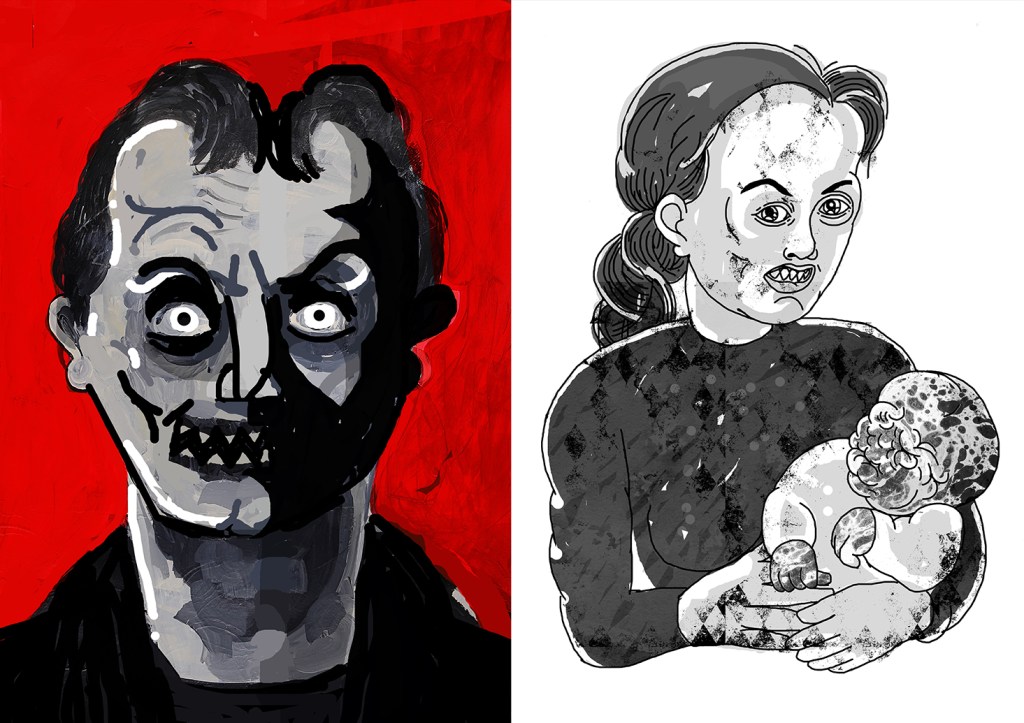
Erman Akçay ‘Yamyam’, ‘Anne ve Çocuk’ mixed media, 2017
Sketches: Erman Akçay, charcoal on paper, 2021

Erman Akçay’s Delicious Disasters

Cemal Akyüz

Erman was born twenty four years ago. It was 80s and Mae West was dead. 20th century art history adore to classify all the modernists as post war babies driven by optimism (their parents at least) and had an illusion of progress. Which war? I don’t know, there were so many.

Artists who were born in 80’s clearly belong to 21st century. Allen Ginsberg already said it : America after all it is you and I who are perfect not the next world! Be in love with your life and let’s welcome them as creative and self-conscious artists of Generation Y.

Kids create in a kaleidoscopic reality, their country and their world – be it real, be it virtual – which is coming apart. He can link with his surroundings comfortably to colour it up and with same ease can contribute to an idea which can be as far as Holland. They question.

Erman is involved in a surreal Istanbul/ Izmir fanzine called Düzensiz or Disordered. It stroke the attention of the latest Portuguese surreal movement and he is invited to bless the exhibition with his youth along with his gang in an exhibition in Estremoz, a posthumous homage to all time great Portuguese surrealist, none other than Mario Cesariny. Quickly reshaped and put all his act together to wave his goodbye with a selection of dadaist collages and subhuman portraits.

More than anything Erman is a street producer. Cooperative soul of the street combines with his formal art training. Constant craving for decorating the streets of anonymous ugly metropols, sole efforts to give dynamism to the city without asking anything back, street artist is a street hero.

Sketch by TURBO, 2006
Erman Akçay ‘Alien Syndrome’ 2016

His series of black and white hand made large collages, surprisingly against the nature of famous collages we all are used to, consists only his own original work. Minimalist details of texture breath. Repetitive points, strikes, cloudy blurry images which are cut into perfect rectangular shapes and montaged to dada perfection. Rare colour assemblages dares to camp it up. Mother and child series consist picture perfect water colours which dash a tang of surrealist incapability. His Mona Lisa series are Marilyn Manson meets Condoleeza Rice, how scary can one get? Porcelain doll like faces with flies and insects coming out from the eyes, or is it just imagination? From streets to grotesque, from dada to pointism he is the perfect collage of his own persona, a strong but sentimental representation of phantasmagoria.

His youth attacks all intellectual creativity, that young man can make dada look fresh 90 years after, streets can be enjoyable playgrounds, and the dull old world an open air exhibition, you are all invited to take a piece with you from his artistic dandy.


Reproduction: Erman Akçay ‘Night of the Living Dead’ 21x15cm, digital painting (2015)
Erman Akçay ‘Basketcase’, ‘Woman’ mixed media, 2017
Erman Akçay ‘Untitled’ Texture Works (Dokubilim) 2015

“Bir elinin hala çocukluğunun kalbinde olması seni diğerlerinden ayıran nokta. Löpçük bana, asansör müziği eşliğinde çirkin bir çocuğun aynaya bakarak işlediği cinayetleri itiraf ettiği bir yayın organı gibi geliyor…” -Tan Tolga Demirci


Retina Decadence, Group Exhibition curated by Erman Akçay in İstanbul, 2020 (Poster Art by Zigendemonic) Right Wall by Cins

“Bu gece tesadüfen okudum çok başarılı buldum. Tabii ki sivri yanları var tartışılır yanları var provokatör dili var ama çok başarılı.” Bedri Baykam

Erman Akçay ‘Cemetery Flowers’, bitmap graphic (14,8x21cm) – ‘Anxiety’ ink on paper (50x70cm) 2016

Evolution of Consciousness

The ways of seeing and perception in Art are various and imply vast imaginativeness and hallucination of humankind as well as reality. All opens its door to creativity, freedom, soul and mind etc. under society until Universe’s expansion become universal under minor and major entities and identities. Therefore I would say herein Retina Decadence Exhibition which is curated by Erman Akçay gathering international and Turkish artists all around world to take public attention differently on one of those vision of our times called Graphic Art. It is enigmatic, bizzare, sluggish, histeric and evilsake mixed in all and more under(upper)world which underlines/ minds/ pins the artificial being of human soul, its bizzare, absurd and discordant existance and sub-concious inbetween pain and passion meanwhile trying to find an exit through its striving illumination. This is what we should expect and except as well as include and tolarate and finally put into our mosaic of art-world in İstanbul or elsewhere in World to broaden our view of conciousness as implied by ist name Decadence is on continue in this World now and then Retina observes it by narrow and wide blinked mind and eye side from dark to light and from light to dark but in the end openness is everything in Contemporary World and its Art. Retina Decadence keeps this secret to whisper your perception by its sickness inside to be healed asif in effect of dark hole after Big-Bang occured out of scattered scene of existance.

Erkut Tokman, October 2020
Osmanağa, Kadıköy – İstanbul


Sketch by TURBO, 2006

KHAS VCD – OCULUS VCD Talks – Erman Akçay ile Sokak Sanatı ve Fanzinler (Moderatör: Yunus Emre Öztaş)

instagram > lopcuk


Karikatür: Yiğit Özgür

Evil on the Street: Bizon Murat & Siya Siyabend

Siyasiyabend sahnede, 2013

“Sokak müziği yoktur,

müzik sokakta olmalıdır”

Bizon Murat, Devrim Ck. ile beraber 1995 ilkbaharında bir proje olarak Siya Siyabend’i kurmuş, sonraları Murat, Ahmet, Memduh, Okan, Pascal, Garbis, Orçun, Ferhat, Hakan ve diğer pek çok müzik adamıyla çalışmışlardır.

Siyasiyabend 90’larda başlayan, çeşitli enstrumanlardan ses çıkarmayı seven ve bunu birlikte yapmaktan hoşlanan bir grup insanın uzun, derin ve badireli bir yol arkadaşlığının; temelde köklü bir müzik sevgisine ve insanlığın bilgi-kültür mirasını özümseme ve yaşama arzusuna dayalı bir yolculuğun ürünü olarak ortaya çıktı.

Birçok farklı stüdyoda farklı sound denemelerine girişip değişik tarzlarda ürünler verdiler. Bunun yanında kısa filmler için müzik yaptılar. Fatih Akın’ın yönetmenliğini yaptığı Sound of İstanbul / Crossing The Bridge, köprüyü geçmek adlı belgeselde yer aldılar.

SSB ayrıca sokağı da önemli bir sahne olarak gördü. Türkiye’de sokaktaki müziğinin öncülerinden oldu. Bu konuda şu söylemleri ilgi çekicidir: “Sokak müziği yoktur, müzik sokakta olmalıdır”

SSB 2008’den beridir Erdem Göymen, Hakan Özboz, Murat Toktaş ve Devrim Ck, 2010’da Cansun Küçüktürk’ün katılımıyla oluşan çekirdek kadrosuyla, diğer müzisyenler ve görsel sanatçılarla ortaklaşarak, kayıtlar yapmaya konserler vermeye devam ediyorlar.

Burak Abatay / birgun.net

> Siya Siyabend


Yaşamın İzinde programı: Bizon Murat (Nûve Medya) 2021

“There is no street music,

the music should be on the street”

Bizon Murat, Devrim Ck. together with Siya Siyabend as a project in the spring of 1995, they later worked with Murat, Ahmet, Memduh, Okan, Pascal, Garbis, Orçun, Ferhat, Hakan and many other musicians.

Political friendship of a group of people who started in the 90’s, likes to make sounds from various instruments and likes to do it together; basically emerged as the product of a journey based on a deep-rooted love of music and the desire to absorb and live the knowledge-cultural heritage of humanity.

They experimented with different sounds in many different studios and produced products in different styles. Besides, they made music for short films. They took part in the documentary Sound of Istanbul / Crossing The Bridge, directed by Fatih Akın.


Recorded in Kadikoy Sahne, Murat Bizon With wonderful band.

The SSB also saw the street as an important stage. Murat Serhaşi Toktaş became one of the pioneers of street music in Turkey. The following statements on this subject are interesting: “There is no street music, music should be on the street”

Since 2008, SSB has been continuing to record and give concerts in partnership with other musicians and visual artists, with its core staff formed with the participation of Erdem Göymen, Hakan Özboz, Murat Toktaş and Devrim Ck, and Cansun Küçüktürk in 2010.

> Siya Siyabend

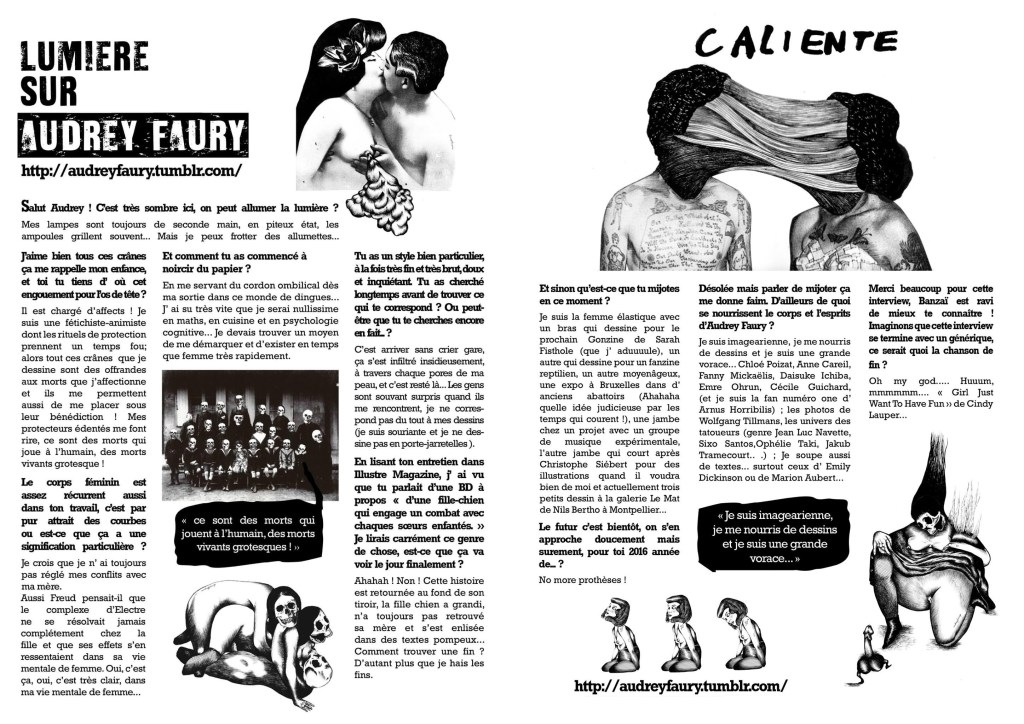
Lumiere Sur : Audrey Faury

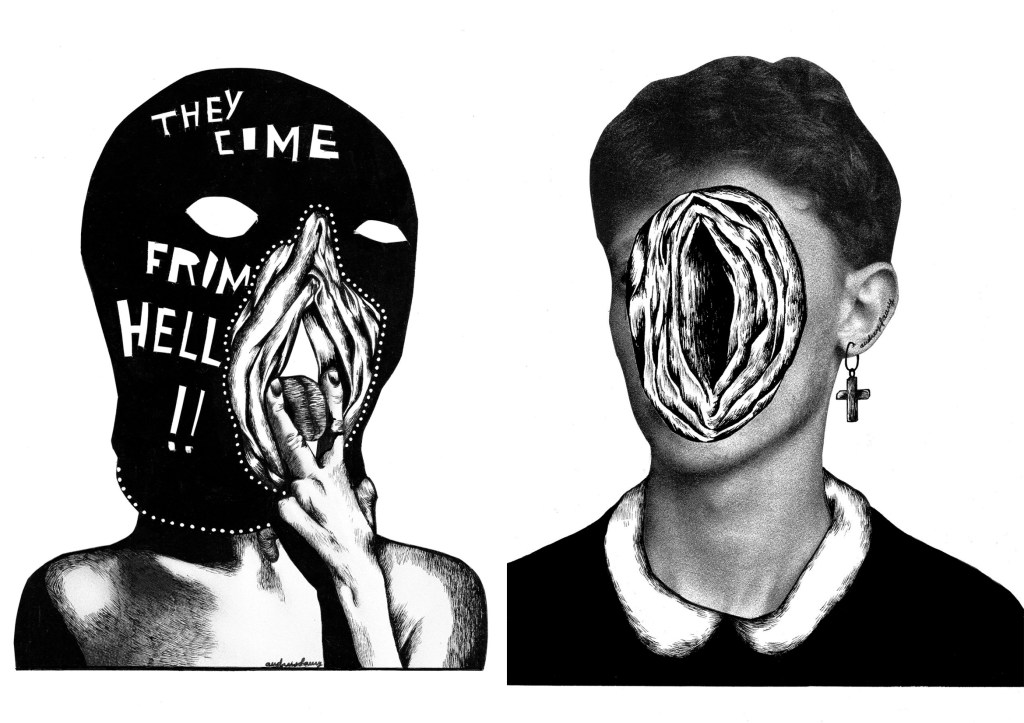
Audrey Fawry, Dessins encre noire / stylo, collages (2018)

« ce sont des morts qui jouent à l’humain, des morts vivants grotesques ! »

Salut Audrey ! Cest très sombre ici, on peut allumer la lumière ?

Mes lampes sont toujours de seconde main, en piteux état, les ampoules grillent souvent… Mais je peux frotter des allumettes…

J’aime bien tous ces crânes ça me rappelle mon enfance, et toi tu tiens d’ où cet engouement pour l’os de tête ?

Il est chargé d’affects ! Je suis une fétichiste-animiste dont les rituels de protection prennent un temps fou; alors tout ces crânes que je dessine sont des offrandes aux morts que j’affectionne et ils me permettent aussi de me placer sous leur bénédiction ! Mes protecteurs édentés me font rire, ce sont des morts qui joue à l’humain, des morts vivants grotesque !

Le corps féminin est assez récurrent aussi dans ton travail, c’est par pur attrait des courbes ou est-ce que ça a une signification particulière ?

Je crois que je n’ ai toujours pas réglé mes conflits avec ma mère.

Aussi Freud pensait-il que le complexe d’Electre ne se résolvait jamais complètement chez la fille et que ses effets s’en ressentaient dans sa vie mentale de femme. Oui, c’est ça, oui, c’est très clair, dans ma vie mentale de femme…

Audrey Fawry, Dessins encre noire / stylo, collages (2019, 2018)
Audrey Fawry, ‘L’Amour au premier regard / Dessins et autres Romantismes à retrouver à la Galerie Le Mât chez Mr Nils Bertho pour l’expo Rifuel Fanglant 2015! Dessins encre noire / stylo, collages (2015, 2018)

Et comment tu as commencé à noircir du papier ?

En me servant du cordon ombilical dès ma sortie dans ce monde de dingues… Y ai su très vite que je serai nullissime en maths, en cuisine et en psychologie cognitive… Je devais trouver un moyen de me démarquer et d’exister en temps que femme très rapidement.

Tu as un style bien particulier, à la fais très fin et très brut, doux et inquiétant Tu as cherché longtemps avant de trouver ce qui te correspond ? Ou peut-être que tu te cherches encore en fait..?

C’est arriver sans crier gare, ça s’est infiltré insidieusement, à travers chaque pores de ma peau, et c’est resté là… Les gens sont souvant surpris quand ils me rencontrent, je ne corres­pond pas du tout à mes dessins (je suis souriante et je ne des­sine pas en porte-jarretelles).

En lisant ton entretien dans Illustre Magazine, f ai vu que tu parlait d’une BD à propos « d’une fille-chien qui engage un combat avec chaques sœurs enfantés. » Je lirais carrément ce genre de chose, est-ce que ça va voir le jour finalement ?

Ahahah ! Non ! Cette histoire est retournée au fond de son tiroir, la fille chien a grandi, n’a toujours pas retrouvé sa mère et s’est enlisée dans des textes pompeux… Comment trouver une fin ? D’autant plus que je hais les fins.

Audrey Fawry, Dessins encre noire / stylo, collages (2019, 2018)
Audrey Faury ‘Photo de classe’ collage 2015

« Je suis imagearienne, je me nourris de dessins et je suis une grande vorace… »

Et sinon qu’est-ce que tu mijotés en ce moment ?

Je suis la femme élastique avec un bras qui dessine pour le prochain Gonzine de Sarah Fisthole (que j’ aduuuule), un autre qui dessine pour un fanzine reptilien, un autre moyenâgeux, une expo à Bruxelles dans d’ anciens abattoirs (Ahahaha quelle idée judicieuse par les temps qui courent !), une jambe chez un projet avec un groupe de musique expérimentale, l’autre jambe qui court après Christophe Siébert pour des illustrations quand il voudra bien de moi et actuellement trois petits dessin à la galerie Le Mat de Nils Bertho à Montpellier…

Audrey Fawry ‘Old Fuckers Never Die’ Dessins encre noire / stylo, collages (2014)

Le futur c’est bientôt, on s’en approche doucement mais surement, pour toi 2016 année de..?

No more prothèses !

Désolée mais parler de mijoter ça me donne faim D’ailleurs de quoi se nourrissent le corps et l’esprits d’Audrey Faury ?

Je suis imagearienne, je me nourris de dessins et je suis une grande vorace… Chloé Poizat, Anne Careil, Fanny Mickaëlis, Daisuke Ichiba, Emre Orhun, Céline Guichard, (et je suis la fan numéro one d’ Arnus Horribilis) ; les photos de Wolfgang Tillmans, les univers des tatoueurs (genre Jean Luc Navette, Sixo Santos, Ophélie Taki, Jakub Tramecourt…); Je soupe aussi de textes… surtout ceux d’ Emily Dickinson ou de Marion Aubert…

Merci beaucoup pour cette interview, Banzaï est ravi de mieux te connaître ! Imaginons que cette interview se termine avec un générique, ce serait quoi la chanson de fin?

Oh my god Huuum, mmmmmm…. « Girl Just Want To Have Fun » de Cindy Lauper…

> audreyfaury.tumblr.com


Cette interview est tirée du magazine Banzaï (2016)

> banzai-editions.com


Noirceur en Couleur: Jaky La Brune

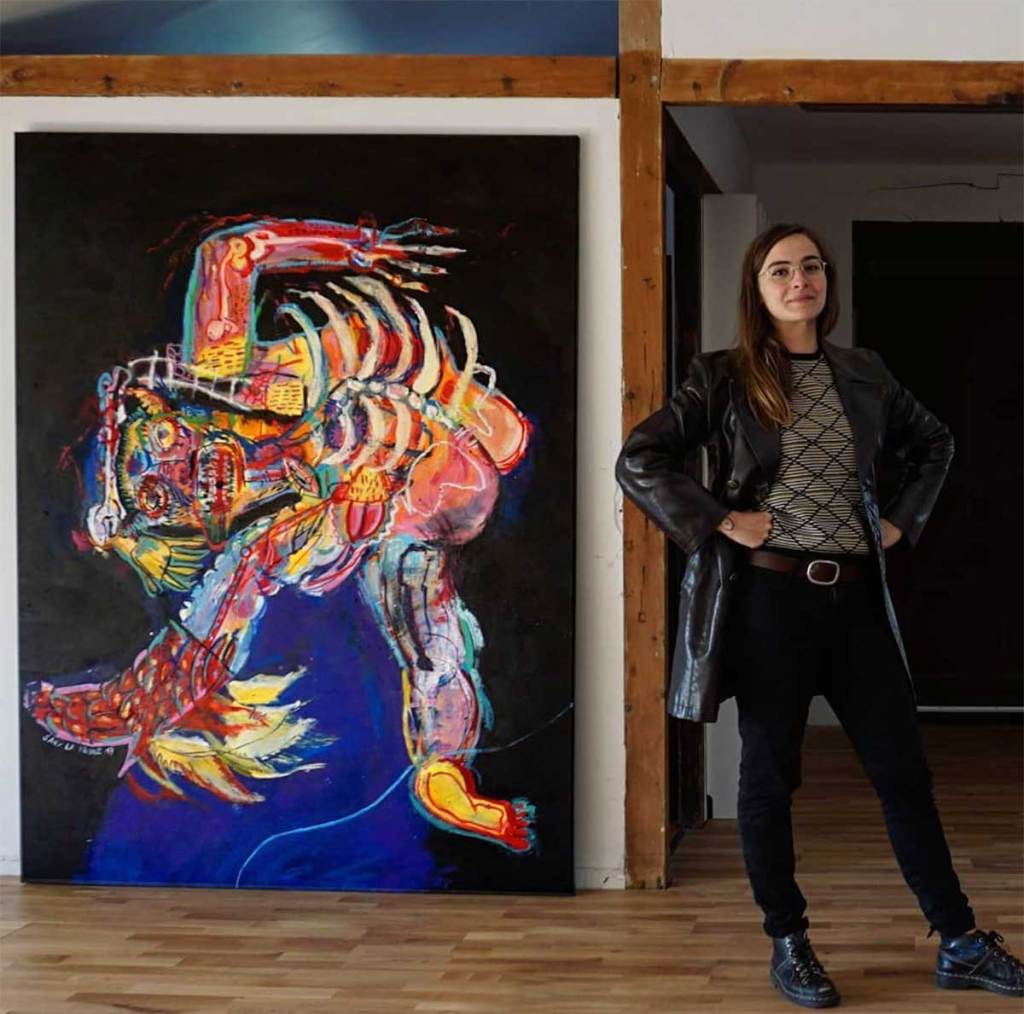
Jaky La Brune

Jaky La Brune est une plasticienne normande vivant et travaillant à Paris depuis 2012. C’est en réalisant des pochettes d’albums qu’elle découvre la peinture. Celle-ci ne la quittera plus. Ses principaux thèmes tournent autour du questionnement sur l’identité et des émotions humaines. Ses peintures naissent d’histoires inspirées de ses tourments, une sorte de psychanalyse à travers les formes et les couleurs. La toile continue à vivre à travers l’imagination et l’interprétation libres de l’observateur. C’est à ce moment-là que son travail artistique prend tout son sens.

Découvert et proposé par Bernard Laurent-Zopf


Jaky La Brune is a visual artist from Normandy living and working in Paris since 2012. It was while making album covers that she discovered painting. This will never leave her. Her main themes revolve around the questioning of identity and human emotions. Her paintings are born from stories inspired by her torments, a kind of psychoanalysis through shapes and colors. The canvas lives on through the free imagination and interpretation of the viewer. This is when her artistic work takes on its full meaning.

Shamatic Power : Jaky la Brune

Blackness in Color

Written and Prepared by Bernard Laurent-Zopf

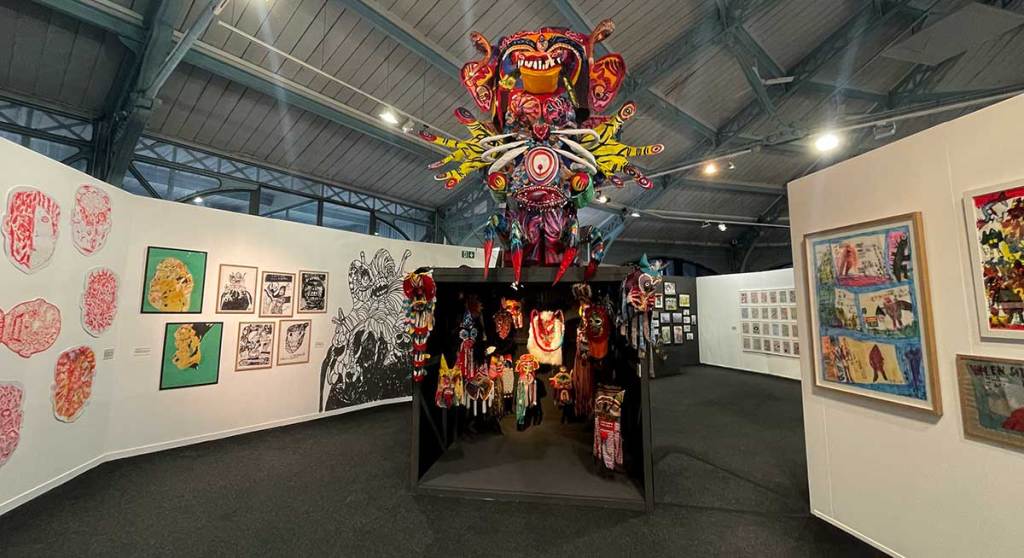
If we suddenly decide to go for a walk in the head of Stéphane Blanquet, we can come across a doorway to the multiple heads of Jaky La Brune. To be more clear and understandable, if we are going to pay a visit to the current exhibition devoted to the artist/painter/illustrator Stéphane Blanquet “Dans les Têtes de Stéphane Blanquet” at the Halle Saint-Pierre in Paris, we must meet the masks and painted characters of the painter Jaky la Brune.

This painter is part of “Tranchée Racine” which is an artistic manifesto initiated by Stéphane Blanquet. Originally a publication of graphic images bringing together an international group of artists, it is transformed into an exhibition from May 19, 2021 to January 2, 2022, to accompany Stéphane Blanquet‘s monograph. “Tranchée Racine” which is therefore also a publication, a giant graphic tabloid (47.5 x 66 cm) of 12 pages, is sold at the sweet price of 5 euros. It presents, over its 42 issues, more than 500 works and brought together.


“Artistes viscéraux, généreux, hypnotiques, obsessionnels, ils viennent de tous les courants et contre-courants. Agitateurs rebelles, bruyants, cruels, généreux, non-conformistes”. 
Ils sont du monde entier.

Si on décide tout d’un coup d’aller faire un tour dans la tête de stéphane blanquet, on peut tomber au détour d’une porte sur les multiples têtes de Jaky La Brune. Pour être plus clair et compréhensible, si on va faire une visite à l’exposition actuelle consacrée à l’artiste/peintre/Illustrateur Stéphane Blanquet “dans les têtes de stéphane blanquet” à la Halle Saint-Pierre à Paris, on se doit de rencontrer les masques et personnages peints de la peintre Jaky la Brune.

Cette peintre fait partie de “Tranchée Racine” qui est un manifeste artistique initié par Stéphane Blanquet. A l’origine édition d’images graphiques fédérant une internationale de dessinateurs, elle se transforme en exposition du 19 mai 2021 au 2 janvier 2022, pour accompagner la monographie de Stéphane Blanquet. La tranchée racine qui est donc aussi une publication, un tabloïd graphique géant (47,5 x 66 cm) de 12 pages, est vendu au doux prix de 5 euros. Il présente, au fil de ses 42 numéros, plus de 500 œuvres et rassemble des “Artistes viscéraux, généreux, hypnotiques, obsessionnels, ils viennent de tous les courants et contre-courants. Agitateurs rebelles, bruyants, cruels, généreux, non-conformistes”. Ils sont du monde entier.

“Cet esprit rebelle et libertaire est le lien entre tous ces artistes, une racine démultipliée, qui interroge notre rapport à la sexualité, à la mort, à la nature, à l’animal, au végétal, à la politique, à l’image ….  Leurs créations sont autant de possibles, de devenirs qui tissent leur relation dans un imaginaire ouvert”. 

Outre Jaky La Brune, il vous reste donc nombre d’artistes à découvrir.


“Visceral, generous, hypnotic, obsessive artists, they come from all currents and counter-cultures. Rebellious, noisy, cruel, generous, non-conformist agitators”. They are from all over the world.

Peınture Murale Réalısée Pendant Le Vernıssage De L’exposıtıon “La Tranchée Racine” À Parıs. (2021)

“This rebellious and libertarian spirit is the link between all these artists, a multiplied root, which questions our relationship to sexuality, death, nature, animals, plants, politics, images… Their creations are as many possibilities, becomings that weave their relationship in an open imagination”.


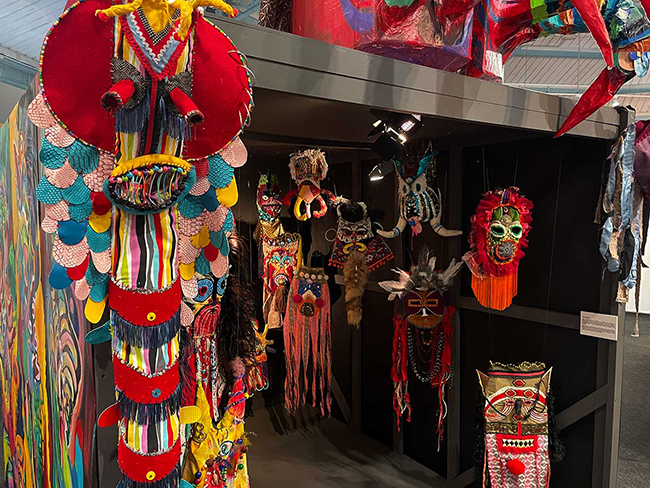
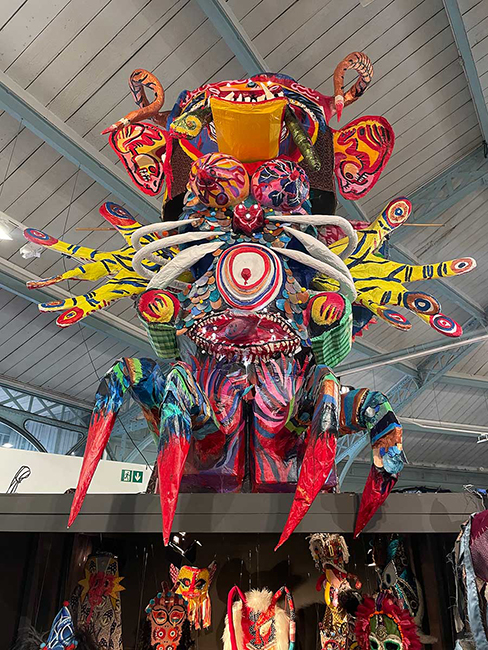
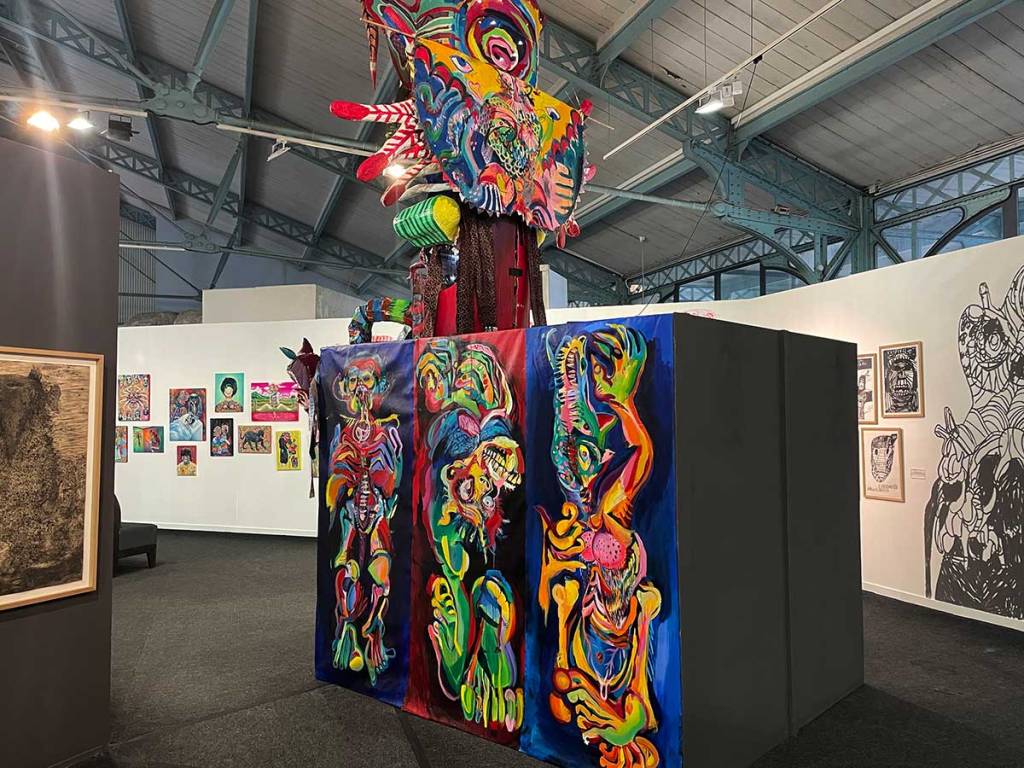
Jaky la Brune ‘Dans Les Tetes’ totem installation (2021-2022)

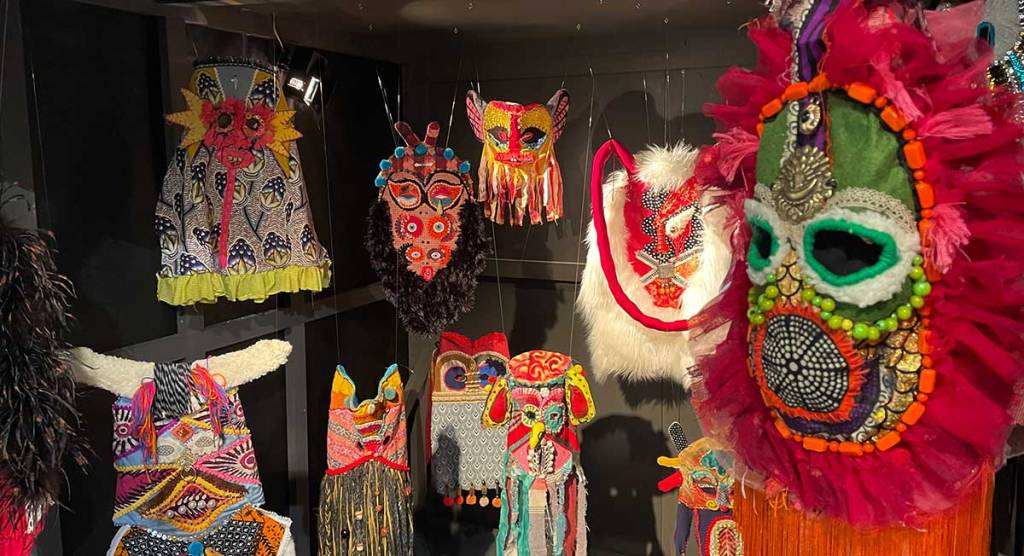
Et donc, au milieu de cette exposition collective rassemblant quelques-uns des artistes de “Tranchée Racine”, votre route risque de croiser celle de Jaky. En vérité, on ne peut pas l’éviter tant ses masques suspendus dans leur container/chambre s’adressent à vous avec agressivité et joie en même temps. Ils sont surmontés d’un totem haut en couleur qui vous attirera immanquablement. De plus, les murs extérieurs de leur maison/boite sont ornés de personnages peints qui assurent la garde avec la même violence et gaité. La troupe de ces créatures hybrides provient de la même tête, celle d’une plasticienne normande vivant et travaillant à Paris depuis 2012 répondant au nom parfait de Jaky La Brune. Sa grande force particulière est ce mélange de la souffrance sombre de ses personnages et de l’allégresse des couleurs très vives par laquelle ils émergent. C’est l’occasion idéale d’entrevoir le reste de son travail, et du coup, on a eu envie de lui demander ce qu’elle avait dans sa tête de brune.

“J’ai découvert la peinture en réalisant des pochettes d’album et des clips de musique. Les logiciels sur les ordinateurs ont dû à un moment me faire mal au crâne alors j’ai trouvé refuge dans les pinceaux et la peinture. Être en contact direct avec la peinture a été révélateur pour moi et je suis restée bloquée dedans comme une junkie“.


Jaky la Brune ‘Dans Les Tetes’ totem installation (2021-2022)

Besides Jaky La Brune, you still have a number of artists to discover.

And so, in the middle of this collective exhibition bringing together some of the artists of “Tranchée Racine”, your path may cross that of Jaky. In truth, we cannot avoid it as its masks suspended in their container/room address you with aggression and joy at the same time. They are surmounted by a colorful totem that will inevitably attract you. In addition, the exterior walls of their house/box are adorned with painted figures who stand guard with the same violence and gaiety. The troop of these hybrid creatures comes from the same head, that of a Norman visual artist living and working in Paris since 2012, answering to the perfect name of Jaky La Brune. Her great particular strength is this mixture of the dark suffering of his characters and the joy of the very bright colors through which they emerge. This is the perfect opportunity to glimpse the rest of her work, and suddenly, we wanted to ask her what she had in her dark head.

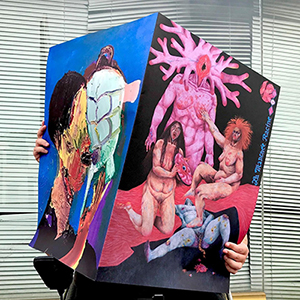
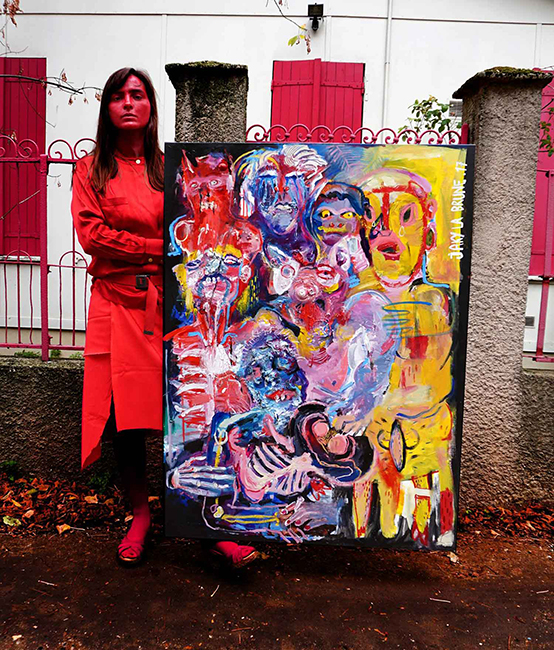
Jaky la Brune with one of her paintings

“I discovered painting by making album covers and music videos. Computer softwares must have given me a headache at one point, so I found refuge in brushes and paint. Being in direct contact with the paint was eye-opening for me and I got stuck in it like a junkie.”

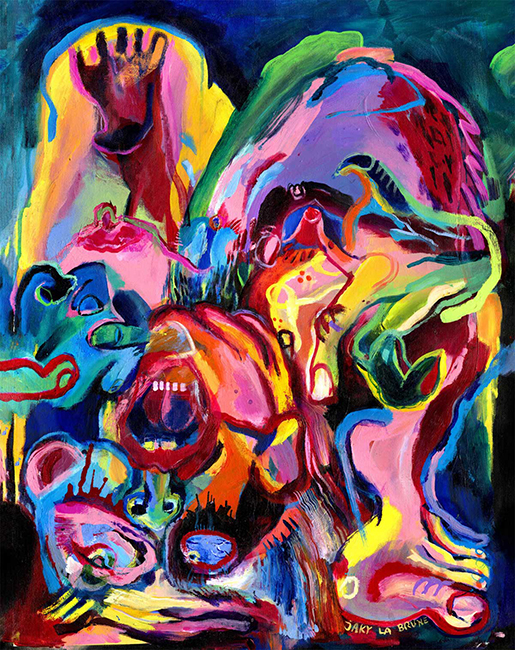
Jaky la Brune ‘Dans Les Tetes’ paintings (2021-2022)
Jaky la Brune ‘Dans Les Tetes’masks (2021-2022)

Jaky: “The creation of masks came later, but I find the same power as in painting: the mixture of materials, colors and the primitive aspect. It’s great to be able to decline your pictorial universe on other media, it enriches the spirit a lot! And then, my sister brings me fabrics from her travels, my mother gives me the jewelry she no longer wants and my grandmother sends me lace… I had to let me do something with all this mess! Sometimes communication is difficult in the family so it allows me to bond with my blood somewhere. (Hahaha) “.


Installation créée par Jaky La Brune dans l’exposition collection “Tranchée Racine” qui accompagne la monographie “Dans Les Têtes de Stéphane Blanquet”

Jaky : “La création de masques est venue après, mais je retrouve la même puissance que dans la peinture : le mélange des matières, les couleurs et l’aspect primitif. C’est super de pouvoir décliner son univers pictural sur d’autres supports, ça enrichit beaucoup l’esprit ! Et puis, ma sœur me ramène des tissus de ses voyages, ma mère me donne les bijoux qu’elle ne veut plus et ma grand-mère m’envoie de la dentelle… il fallait bien que je fasse quelque chose de tout ce bazar ! Parfois la communication est difficile dans la famille alors ça me permet de me lier à mon sang quelque part. (Hahaha)”.

“Généralement, je travaille la nuit avec un verre de porto dans une main et un pinceau dans l’autre. Et avec des documentaires sur des tueurs en série en fond pour m’enfermer dans une atmosphère sombre”.

Jaky la Brune

“Usually I work at night with a glass of port in one hand and a paintbrush in the other. And with serial killer documentaries in the background to lock me in a dark atmosphere.”

Jaky la Brune in her killer mood

“L’identité et les émotions sont mes thèmes principaux. On peut aussi retrouver des sujets tels que le sexe, la violence et la passion amoureuse dans mes peintures”. 

Jaky : “Une idée naît lorsque que ma sensibilité est touchée (en bien ou en mal) et que je n’arrive pas à expliquer avec des mots ce que je ressens. Parfois, j’ai l’impression d’exorciser ma tristesse ou ma colère. Créer et peindre me permettent de canaliser mes émotions et d’apprendre à vivre dans ce monde de brutes”.

Jaky : “J’aime me retrouver seule pour peindre mais j’adore aussi l’idée de pouvoir travailler avec d’autres artistes. On m’a proposé récemment de coudre des masques pour un spectacle de théâtre, on verra vers quoi ça me mène ! Je n’ai pas vraiment de projet d’avenir, je ne regarde pas aussi loin devant moi”.

On a demandé à Jaky de partager avec nous un/une artiste qu’elle aimait. Jaky : “tschabalala self est une artiste très inspirante. J’adore son travail sur les corps humains et sa façon de mixer les textiles sur toiles”.

Et on n’a pas résisté à lui poser cette question ultime : D’où vient ce nom génial ? Jaky : “Je suis heureuse de savoir que mon nom trouve des admirateurs mais je ne sais pas d’où ça vient… Je demanderai à ma maman”.

Alors, bien sûr, si vous pouvez passer dans le coin de la Halle Saint-Pierre, ne vous privez surtout pas du pur plaisir d’aller voir les masques et peintures de cette brune Jaky et d’entrer un peu dans sa tête. Parce que, comme de bien entendu, c’est toujours mieux en vrai.


Jaky La Brune ‘Gorge Diable’

“Identity and emotions are my main themes. You can also find subjects such as sex, violence and love passion in my paintings”.

Jaky: “An idea is born when my sensitivity is touched (for good or bad) and I can’t explain in words what I feel. Sometimes, I feel like I’m exorcising my sadness or my anger creating and painting allow me to channel my emotions and learn to live in this world of brutes”.

Jaky: “I like being alone to paint but I also love the idea of ​​being able to work with other artists. I was recently asked to sew masks for a theater show, we’ll see what that leads me to. lead! I don’t really have a plan for the future, I don’t look that far ahead of me”.

We asked Jaky to share with us an artist she loved.

Jaky: tschabalala self is a very inspiring artist. I love her work on human bodies and her way of mixing textiles on canvas”.

And we couldn’t resist asking her this ultimate question: Where does this awesome name come from?

Jaky: “I’m happy to know that my name finds admirers but I don’t know where it comes from… I’ll ask my mum”.

So, of course, if you can pass by the corner of the Halle Saint-Pierre, do not deprive yourself of the pure pleasure of going to see the masks and paintings of Jaky Brune and getting into her head a little. Because, of course, it’s always better in real life.

Artist Portrait : Jaky La Brune

Original Article by Bernard Laurent-Zopf / brainto.com

Translated for general reader from French to English by Lopcuk webzine

jaky-la-brune.com


Söyleşi: Gökhan Gençay ‘Benim Kanım’

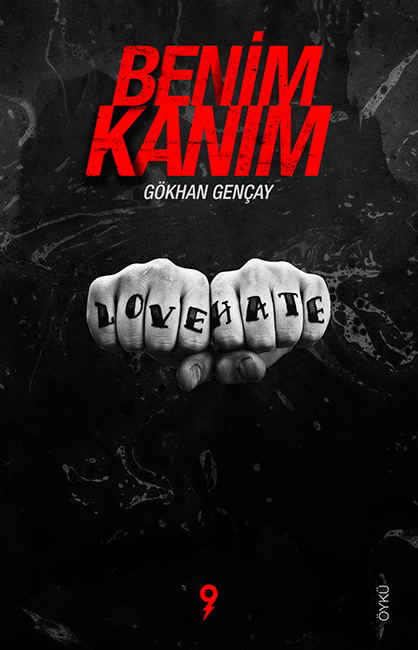
Gökhan Gençay ‘Benim Kanım’ 2021

Dünyayı Güzellik Kurtarmayacak!

Uzun bir zaman boyunca adına yeraltı denen edebi tür hakkında çalışmalar ve okumalar yaptım. Dünyada ve Türkiye’de bu türün gelişimini seyre koyuldum. Bu akımın motivasyon kaynaklarını kavramaya çalıştım ve bazen bunun kaynaklarına kendi hayatımda rastladığım da oldu. Yeraltının ana hatlarından bahsetmek zor olsa da ortak bir tavrı sahiplendiği apaçık ortada bence. Türkiye’de yeraltı edebiyatının çıkışı romanlarla oldu, dersem yanlış olmaz, fakat bu edebi dünya kavrayışına şiir ve öykü türlerinde rastlamak da mümkün.

Yaşadığımız coğrafyada bu seçenekler çok az tabii ve bu alana yatkın olanların Benim Kanım’la çarpışmaması olanaksız. Bu rastlantının bir zorunluluk olduğuna inanıyorum. Sizleri de rızanızı almadan bu rastlantı sıçramasına davet ediyorum. Şişirilmiş üfürükten edebiyat oyunlarının karşısında duran yazarlara hayranlık duymayı kozmik bir borç sayıyorum. Hâkim Bey’in dediği gibi “Yaşam tarzı değil yaşam edinin!’ Başlayalım o halde, Gökhan Gençay anlatsın.

Taylan Onur: Merhaba Gökhan Gençay. Okurlar sizi Benim Kanım isimli kitabınızla tanıdı, lakin bunun dışında yıllardır altkültürlerle ilgili olduğunuzu, bu konuda pek çok metin kaleme aldığınızı da biliyoruz. Benim Kanım’ı çıkar çıkmaz okudum. Eseriniz bende teke tek bir kavgada dayak yemenin neden olduğu gurur kırılmasına yakın bir his yarattı. Türkçede yazılmış bundan daha sert bir eser olduğunu düşünmüyorum. Kitabınız sizin için ne anlam taşıyor? Topluma atılan bir yumruk diyebilir miyiz?

Pozitif yorumlar için teşekkür ederim. Bana sorarsan, Benim Kanım, tam manasıyla sert bir kitap değil. Aksine, çok daha sert ve yıkıcı vurgularla işlenebilecek konulara mümkün mertebe yalın ve “ılımlı” yaklaşmaya çalıştım. Yazar sıfatıyla altını çizmem gerekirse, kitaptaki karakterleri ve karşılaştıkları durumlara verdikleri tepkilerin çoğunu desteklemiyorum. Zayıflıkları, çaresizlikleriyle var oluyorlar Benim Kanım’daki karakterler. Bu arada söz konusu karakterlerin hepsinin erkek olması ve benzer sorunlardan mustarip olmaları öyküler arasında bir paslaşma hali de yaratıyor. Hepsi maddiyata takıntılı bir kültürden kaçmak istese de aldıkları tavırlar manasında çoğunun pozisyonunu onaylamıyorum, attıkları adımları yanlış buluyorum. Yegâne empati kurduğum karakter, yaşadığı varoluşsal bunaltıya eylem yoluyla müdahale etmesi hasebiyle “Hiç”in kahramanı, zaten kitapta en sevdiğim öykü de o açıkçası.

Ters Adam Gökhan Gençay

Dostoyevski olsanız iktidar odaklarının kıçını yalamadan sesinizi duyuramazsınız bu coğrafyada.

Şunu da belirteyim ki, Benim Kanım rahatta, evde veya ofiste kıçını devirip otururken ortaya çıkmadı. Sokaklarda işsiz güçsüz flanörlükle iştigal ederken, çaresizce saatlerimi geçirmek zorunda kaldığım kafelerde okumaktan usanıp bilgisayarı önüme açıp yazmaya başlayınca kafamda belirdi öykü ve karakterler. Alışıldık profesyonel hazırlık aşamaları da söz konusu değil, metnin ruhunu korumayı önemsediğim için üzerinde oynama yapmayı da reddettim; hepsi neyse odur, eksiğiyle gediğiyle yazarken ne hissediyorsam onu yansıtıyorlar. Beni sorarsan, hâlâ o sınırda yaşıyorum, daha doğrusu soluk alıp vermeye devam ediyorum, çünkü bu mahkûm kılındığımıza hayat denmez.

Kitap yayımlandığında, “Nedir bu?” diye soranlara kısaca şöyle tanıtmıştık, onu sizinle de paylaşayım:

Benim Kanım, kalbi kırıklara, kaçıklara, dünyaya karşı öfke biriktirenlere, var olana uymayanlara, her yeni güne “Acaba şimdi kahve mi içsem, yoksa intihar mı etsem?” seçeneklerini ciddi ciddi değerlendirerek başlayanlara, deli olarak kodlananlara, değerlerini hiçlikten çıkaranlara hitap eder. Yalnızlıktan hamamböceğiyle arkadaşlık edenlerin, iş denen kölelik çukurunda ruhunu yitirenlerin, “dost kazığı” yiyenlerin, kendini kaybederek kendini bulmaya başlayanların, oyuncak tabancayla bankaya dalanların öykülerini içerir.

Diğer yandan, evet, kitap benim açımdan hayatı yaşanmaz kılanlara, varoluşumuzu değersizleştirenlere, emir ve talimatnamelerle hayatı şekillendirmeye yeltenen otoritelere, birilerinin sistemin çarklarının güzelce dönmeye devam etmesi için koyduğu kariyer, toplumsal saygınlık ve kurumsal uyum gibi “adam olma” kriterlerinin şekillendirdiği hâkim kültüre kelimeler aracılığıyla atılmış bir yumruktur. Bu yumruk içine hapsedildiğimiz çirkin dünyanın sahiplerini nakavt etmeye yeter mi? Hiç sanmıyorum! Ama şundan eminim ki, tarihin en güzel sayfaları mağlup olarak kodlananların muazzam jest ve eylemlerini içerir. Tek başına kaldığı barikatı terk etmeyenler, idam sehpasını kendisi tekmeleyenler, kalabalıklar tarafından linç edilirken son gücüyle ayağa kalkanlar unutulmaz; en çok parası olanların, en güzel evlerde yaşayanların adları ise kimsenin aklında kalmaz.

Sık sık tekrarlıyorum, Benim Kanım, metin olarak politik manifesto işlevi üstlenmez, yol ve yöntem önermez, çare sunmaz. Benim Kanım’da yer alan öykülerde tekno-endüstriyel sistemin izolasyon boyutuna varan bir yalnızlığa, çaresizliğe ve yabancılaşmaya mahkûm ettiği alt orta sınıf erkeklerin yaşadıkları, hayal ve gerçeklikleri mevcut. Onların -dolayısıyla bizim-sürüklendiği/sürüklendiğimiz büyük çöküşün ruhsal dışavurumlarına odaklanmaya gayret ettim. Taklidin taklidinin altın çağını yaşadığı bu dünyada, yalandan ibaret bir söylem düzeninde varoluşa içkin anlam arayışının nafileliğine işaret ettim gücüm yettiğince. Tabii, özel olarak vurgulamalıyım ki, kitap sadizm, şiddet, intihar girişimi ve had safhada depresyon içeriyor, dolayısıyla siyaseten doğruculuğu ilke bellemiş cici çocukların bünyesine hiç uygun değil.

Benim açımdan yegâne önemli kriter, gerçek hislerle, gerçek düşüncelerle ve gerçek acılarla dolu olup olmaması. Bu konuda sınıfı geçtiyse gerisini umursamıyorum.


Cleon Peterson ‘Med City’ 2014

Bildiğini bilmezden, gördüğünü görmezden gelmek bana göre en büyük yavşaklıktır ve yaşadığımız topraklarda yayın dünyası büyük bir çoğunlukla yavşakların elindedir!

Yayımlandığından günümüze kitaba nasıl tepkiler geldi?

Benim Kanım’ın herhangi bir tanıtımının, reklamının, hatta çıktığını haber veren bir duyurusunun yapılmadığını biliyorsun zaten. Anaakım yayınevlerinin bazılarının metnin akışına müdahale etmek istemesi ve seçtiğim estetik formu kabul etmemeleri üzerine bu konuda herhangi bir zorluk çıkarmayacak butik bir yayınevi bastı kitabı. Kitaba destek veren uluslararası underground illüstratör kardeşlerimizin çizimleri bu sayede karşınıza gelebildi. Erman Akçay’ın hazırladığı muhteşem kapakla basılması da bu seçimin bir diğer kazancı. Kayıplara gelirsek, demin de dediğim gibi, yayınevi cephesinde kitabın herhangi bir duyurusunun bile yapılmaması, Benim Kanım’ı bir çeşit “korsan kitap” havasına büründürdü. Şu ana kadar beğenen, ilgi duyan insanların kulaktan kulağa birbirine aktarmasıyla kitabın adı duyuruluyor, bundan başka bir kanalımız yok açıkçası.

Buna rağmen punkların, skateboarderların, üniversiteli gençlerin beğeni dolu mesajlarını alıyorum; okunsun diye kitabı metro vagonunda bırakanları, alıntılar paylaşanları, elinde kitapla fotoğraf çektirip sosyal medyada paylaşanları görüyorum. Geçen gün Kadıköy’de kitap kapağının stencil olarak duvara işlendiğini de gördüm ve çok şaşırdım. Velhasıl, Benim Kanım, kitapla içerik ve biçim açısından bağ kuranlar tarafından içtenlikle sahipleniliyor. Diğer yandan, yıllarca çalıştığım dergi ve gazetelerde tanıştığım, hukukum olan yazarlar, editörler ve “tanınmış simalar” tarafından bilinçli biçimde görmezden geliniyor! Kendi camialarına mensup birileri Cin Ali seviyesinde bir metin kaleme alsa yere göğe sığdıramama yarışına giren bu zat-ı muhteremler Benim Kanım’ın adını bile anmıyor. Hani tek satır eleştiri bile yazsalar, hatta beğenmedik deseler, samimiyetlerine inanacağım da, bildiğini bilmezden, gördüğünü görmezden gelmek bana göre en büyük yavşaklıktır ve yaşadığımız topraklarda yayın dünyası büyük bir çoğunlukla yavşakların elindedir! Dostoyevski olsanız iktidar odaklarının kıçını yalamadan sesinizi duyuramazsınız bu coğrafyada. Yani, bizim yaptığımız aslında akıntıya karşı kürek çekmeye denk düşüyor.

“Güzel ve yalnız ülkemizde” herkes işini biliyor aslında. İşi bilmek, iş bitirici olmak sadece kapitalistlere ve patronlara mahsus bir ayrıcalık değil artık. Yazdığı kitaplarla üne kavuşan ihtiyar ve çirkin erkek yazarlar, kazandıkları bu şöhreti yazdıklarına hayran genç kadınlardan cinsel açıdan faydalanmak için kullanmayı biliyor. Şöhrete kavuşmak isteyen kadın yazarlar, kitaplarını bastırmak için popüler ve yaşlı erkek yazarların evlerine gitmeleri gerektiğini, orada kurulan bağlantıların yayınevlerine dosya gönderilerek kesinlikle kurulmayacağını biliyor. Yayınevlerinde editör olarak işe girmek isteyenler derebeyi misali koltuklara kurulmuş yayın sorumlularına yaltaklanmadan o kapılardan içeri adım dahi atamayacaklarını biliyor. Hasbelkader entelektüel alanda söz sahibi olmayı başarmış bütün erkekler, genelde çirkin ve vasıfsız olmaları nedeniyle, yanlarında çalışan olarak sadece kadınları görmek istiyor; kadın editörlerden, kadın asistanlardan bir ordu kuruyorlar. Çünkü koltuklarının onlara verdiği gücü kullanmadan herhangi bir kadınla ilişki kurma şansları olmayan zavallılardan mürekkep hepsi! Lakin onlarla çalışan kadınlar da ulaştıkları mevkilere mesleki becerilerinden ziyade kadın oldukları için ulaştıkları gerçeğini itiraf etmiyorlar. Yayın dünyasında erkeklerin çoğuna kapanan kapıların niye kendilerine sonuna kadar açıldığını sorgulamıyorlar. Velhasıl, alanın da, verenin de razı olduğu bir oyun oynanıyor yıllardır. Olan bizim gibi “işini bilmeyenlere” oluyor sadece!

Hem kendi deneyimlerim hem de bilfiil içinde yer aldığım dönemde yaptığım gözlemler neticesinde şunu net biçimde anladım ki, Türkiye yayın dünyası istisnasız olarak yaratıcılık ve zekâdan yoksun, esnaf zihniyetinin, ahbap çavuş dengelerinin hâkim olduğu bir çukurdur. Bu dünyadaki en temel kural, “Sen benim kıçımı yala, ben de seninkini yalayayım,”dır. Onun için bu topraklarda hakiki, özü ve sözüyle bir yazarlara rastlanmıyor artık.


Brutus – War (live in Ghent)

Lakin mülksüzler mülk sahiplerinden nefret etmediği sürece dünyada tek bir taşın yerinden oynamayacağı da bir diğer gerçek! Sonuçta kimse kendini kandırmasın, dünyayı güzellik kurtarmayacak!

Kolayca sevmek varken neden nefret kuşanıyorsunuz dünyaya karşı? Topluma uyum sağlamakta kötü olan ne var?

Topluma uyum sağlamak, başlı başına özgürlük ve özerklik hedefinden vazgeçmektir. Toplum adını verdiğimiz ilişkiler sisteminin temeli iktidar arzusuna dayanır, bireylere sosyal roller ve kurallar dayatılmadan da toplum var olamaz. Nitekim özgürlük ruhunun serpilip gelişmesinin önündeki en büyük engel bu kurallardır. Dolayısıyla toplumla, toplumun sürekliliğini garanti altına alan değer ve geleneklerle mücadele etmeden bir adım yol alamayız.

Valla, açıkça söylemem gerekirse, dünyada sevecek çok az şey kaldı. Zaten sevdiği şeyleri araştırmaya girişen herkesin nefret ettiği şeylerle karşılaşacağına ve birinin diğerine ulaşmayı engelleyeceğine inanıyorum. Yaşadığımız dünya herkesin herkesten nefret etmesi üzerine kurulu. Kadınlar erkeklerden, erkekler kadınlardan; çocuklar ebeveynlerinden, ebeveynler çocuklarından; yoksullar zenginlerden, zenginler yoksullardan; güzeller çirkinlerden, çirkinler güzellerden; akıllılar aptallardan, aptallar akıllılardan ölesiye nefret ediyor ve işin kötüsü herkes haklı.

Ayrıca şu hayatta bir insan sevdiklerinden, dostundan, yoldaşından, sevgilisinden (hepsinin önüne eski sıfatını koymayı unutmayalım) benim kadar kazık yediğinde motorunun çalışmaya devam etmesi için kullanabileceği tek yakıt olarak nefret kalıyor geriye. Benim Kanım’ın kapağında Love and Hate (Sevgi ve Nefret) dövmesinin mevcut olduğu yumrukları kullandık ama gerçekte-metafor değil hakikaten- benim her iki elimin parmaklarında da Hate (Nefret) dövmesi var.

Geçenlerde yazmıştım: Beyaz solculara göre nefretten sadece faşizm türeyebilir. Öyle bir ihtimal mevcut, tabii ki. Lakin mülksüzler mülk sahiplerinden nefret etmediği sürece dünyada tek bir taşın yerinden oynamayacağı da bir diğer gerçek! Sonuçta kimse kendini kandırmasın, dünyayı güzellik kurtarmayacak!


Jeremy Profit ‘Darty Cheval Eventré’ 2005

Kendi acısının mimarı olabilen, gerekçe dillendirme zorunluluğundan kurtulmuş, kaleminde mürekkep olarak kanını kullananlara yazar, diyorum ben. Gerisi bokuyla oynamaktan öteye gitmeyen pazarlamacılardan ibaret.

Altkültürün tüketim aracı olması hakkında neler diyebilirsiniz? Yani bir altkültürün tanınır olması iyi mi, kötü mü?

Guy Debord’un ustalıkla tarif ettiği Gösteri Toplumu, bir dönem egemen kültürün karşısına dikilmiş, ona meydan okumuş alternatif kültürel akımların zamanla sisteme içkin kılınması, hatta tüketim nesnesi haline getirilmesi üzerine kurulu. Bu nedenle yıkıcı ruhu sürekli teyakkuz halinde tutmayan her altkültür, bir aşamadan sonra gevşemeye, sistemin normlarına dahil edilmeye mahkûm. Punk’ı düşünelim mesela. 80’lerin başlarında sokağın, uyumsuzluğun, var olanı reddedişin şiirsel estetiğini yansıtan punk, büyüyüp geliştikçe Sex, Drugs and Rock’n Roll dejenerasyonunun bir parçası haline geldi ve hedonizme, uyuşturucu kültürüne teslim oldu. Onun içinin boşaltılmasına isyan edenler hardcore altkültürüyle direniş fitilini ateşledi. Yani, demem o ki, herhangi bir altkültürün sonsuza kadar sistem karşıtı bir misyon üstlenmesi imkânsız. Hepsinin bir son kullanma tarihi var ve ayakta kalanların nostaljik duygularla oyalanmayı bir tarafa bırakıp yeni olanın, eskinin zaaflarını ve çürümüşlüğünü aşanların yanında saf tutması gerekiyor. Bitmeyen bir bayrak yarışı olarak tarif edebiliriz bu durumu.

Bir öykünüzün sinemaya uyarlanması istense hangisini seçerdiniz? Bence hepsi oldukça sinematografik ve kültürel sabotaj içeriyor.

Teşekkür ederim. Şu ana kadar okurlar tarafından en çok ilgi gören, “Keşke devam etseydin, roman formunda ilerleseydin,” denilenler “Şövalye” ve “Barok Seven Hamamböceği”. Fakat en başta da belirttiğim gibi, benim için “Hiç”in yeri ayrı, onun peliküle aktarılmasından memnun olurdum.


‘Gerçeklik Bir Hayaldir’ détournement by Gökhan Gençay x Erman Akçay / İst.Fest 2014, İstanbul

Okunmasını önerdiğiniz yazarlar var mı? Benim Kanım’ı okumamış birinin dayak yemeden önce antrenman yapması gerekir, diye düşünüyorum.

Kendi acısının mimarı olabilen, gerekçe dillendirme zorunluluğundan kurtulmuş, kaleminde mürekkep olarak kanını kullananlara yazar, diyorum ben. Gerisi bokuyla oynamaktan öteye gitmeyen pazarlamacılardan ibaret.

Chuck Palahniuk’u, Irvine Welsh’i, Bret Easton Ellis’i, Tibor Fischer’ı saymama gerek yok sanırım, eserleri üzerine defalarca yazdım çünkü. Boris Vian’a, Amy Hempel’a, Albert Camus’ye, Henry Miller’a, J.D. Salinger’a, Paul Nizan’a, Jack Kerouac’a, J.G. Ballard’a hayranım. Philippe Djian’ı, Erlend Loe’yü, Linda Boström Knausgaard’ı, Elfriede Jelinek’i ve Tim Winton’ı da seviyorum. Metni belagat ve tasvire boğup olay örgüsünü umursamayanları, “büyük büyük” yazmaya çalışıp okurun ağzına sıçanları, eylemsiz karakterler yaratanları sevmiyorum. Anlatabilmişimdir umarım.

Müzik, sinema, edebiyat alanlarında yıllardır itinayla en aykırıları, uyumsuzları ve yıkanmak istemeyen çocukları bulup tanıtmaya çalıştığınızı görüyorum. Bu hususta edindiğiniz bilgi ve deneyimleriniz nelere mal oldu?

Esasında özel bir çaba gerekmiyor bunun için. Herkes kendine yakın olanı, kendini ait hissettiklerini öne çıkarır, sevdiklerinin sevilmesini ister. Üzerine söz söylediğim isimlerle aynı kaderi sahipleniyor, aynı rotada yürüyorum, onun için onlar bana dışarıdan birileri gibi gelmiyor, ait olduğumuz kabilenin asli özneleri hepsi. Sınıfsal ve kültürel yönlerden de ortaklığımız söz konusu. Benzer acıları çekiyor, aynı sorunlarla boğuşuyoruz.

Bu rotadan ilerlemenin bir faydasını gördüm mü? Tabii ki, hayır! Sefalet, sıkıntı, yokluk… Gelen her günün bir öncekinden daha kötü gelişmelere gebe olmasına alıştırıyorlar insanı. Onuruna, değerlerine sahip çıkmak ve bir çeşit Bushido (Samurayın Yolu) ahlakıyla var olmaya çalışmak kolay değil. Üstelik çevreniz kendini satmayı marifet bilen, -miş gibi yapıp rol keserek parsa toplamaya çalışan aşağılık insanlarla doluyken daha da zor. Velhasıl, bizim gibilere sadece istediğimiz gibi ölme serbestliğini tanıyorlar. Nihayetinde biz hayata küsmüyoruz ama hayatla aramızdaki ilişki bir noktadan sonra tek taraflı aşka dönüşüyor, onun da mutlu bir finale evrilmeyeceği açık.

Matrix esprisinden yürürsek, kırmızı hap yerine maviyi tercih edenlerin kazandığı, mutlu olduğu bir dünyadayız. Öyle ki, hakikati, onuru tercih etmek en büyük günah sayılıyor ve kimse günahkârları çevresinde görmek istemiyor! Şöyle bir etrafıma bakıyorum da, soyumuzun giderek tükendiği net biçimde görülüyor.


Uyumsuzlar Fraksiyonu Flyer ‘Exploited’ (2014)

Teke tek dövüşme şansınız olsaydı rakip olarak ilk beşte kimleri seçerdiniz? Nedenleriyle birlikte öğrenebilir miyiz?

Bu dövüşlerin dayak atma motivasyonuyla örgütlenmediğini belirteyim önce. Fight Club misali birbirimizi özgürleştireceğimiz, attığımız ve yediğimiz yumruklardan gocunmayacağımız, finalde birbirimize sarılacağımız onurlu rakipler seçeceğim onun için.

Boks ve muay-thai gibi dövüş sporlarıyla aktif olarak ilgilenen bir insan olarak, ilk dövüşümün uyumsuzların önderi, alter-egom Arthur Cravan’la olmasını isterdim. Biliyorsun, kendisi zamanın dünya ağır sıklet boks şampiyonuyla maça çıkabilecek cesarete sahipti ve ringte ona altı round dayanabilen, “boksu edebiyata yeğlediğini” açıkça ifade eden bir avangarttı. İki metreye yakın boyu (ben de 1.90’ım) ve çevikliğiyle zorlu bir rakip olurdu, diye düşünüyorum.

İkinci rakibim de tabii ki Ernst Hemingway. Yumruklarını kullanmaktan imtina etmeyen, özü sözü bir, karakter sahibi bir yazardı kendisi. Alkol bağımlılığı ve fazla kiloları ringte onu zorlar ve maça hızlı başlayarak beni hemen indirmeye çalışır, sonra da yorulup savunmaya geçerdi muhtemelen. İlk iki round onun ofansif tarzına direnebilirsem galip geleceğime inanıyorum.

Üçüncü maçım yaşayan yazarlar arasında en çok sevdiğim, hayranlığımı defalarca dillendirdiğim Chuck Palahniuk’la olsun. Chuck, düzenli olarak fitness yaptığı için formunu koruyor lakin yumruklarını kullanmakta ciddi sorunları olduğunu düşünüyorum. Nitekim Fight Club romanına esin veren de sokakta sarhoş bir grup genç tarafından ağır biçimde dövülmesiydi. Her ne kadar ona kıyamayacağımı düşünsem de, en kolay galibiyete bu maçta ulaşırım gibi geliyor.

Dördüncü rakibim Japon yazar Yukio Mishima. Dürüst olmam gerekirse, beni en çok endişelendiren kapışma da bu olurdu. Yıllarca ağır idmanlar yaparak bedenini güçlendiren, karate ve judoda usta seviyesindeki Mishima’yı yenme şansım olacağını sanmıyorum ama elimden geldiğince ayakta kalmaya çalışırdım karşısına çıkma olanağım olsaydı.

Beşinci ve son maç için de Bertrand Cantat’ı seçiyorum. Dağılan Noir Desir’in solisti, müzik tarihinin en duygulu ve öfkeli seslerinden, şiir olarak nitelenebilecek şarkılar besteleyen Bertrand’ın fiziği yeterince sağlam olsa da, çektiği acıların ruhunda ağır hasarlar bıraktığı malûm. Dolayısıyla onunla ringe çıktığımızda birbirimize yumruk atmaktansa sımsıkı sarılıp birlikte gözyaşı dökeceğimizi tahmin etmek için kâhin olmaya lüzum yok.

“Üzgün Olmaktansa Öfkeli Olmayı Yeğlerim”

Ulrike Meinhof

karaisyan


Woman with a Manifest: Matilde Digmann

Matilde Digmann, Copenhagen, 2022

Jeg er her for frihed, ærlighed, sårbar­hed, gender-fluidity, for kærlighed.

Det var usansynligt at jeg skulle blive en kanal for lyset. Det jeg kommer fra er så mudret, så mørkt – men jeg skulle igennem de dybeste lag for at forstå, at jeg er lys. Hver gang jeg har ramt bunden, er jeg blevet vist at jeg kan gå højere – at vi alle har et valg. At vi kan give slip på frygt og være i tillid til at alt udfolder sig præcis som det skal. Og vide at dét at være i overgivelse – i nuet – er lig med at være i vort højeste selv.

Skyggearbejde handler om at bevidstgøre sig skyggen (de sider af os selv vi ikke kan eller vil se og anerkende) – ikke at skubbe dem væk, løbe fra dem eller lade som om de ikke eksisterer – men i stedet vende os om og integrere mørket. Og dermed erkende at vi er begge dele: både lys og skygge. Jeg kaster min skygge ud i rampelyset for at integrere den i os alle, for at hjælpe os til at forstå at vi ikke behøver at gøre vores skygge forkert og udskamme den – men at vi kan se den for hvad den er – et bange dyr, en ego-skal bygget for at beskytte os. Se at vi er født uskyldige – som ren kærlighed.

Jeg arbejder for at kaste lys ind i den kollektive skygge – for at blotlægge mis­forhold i den dominerende kultur. For at frisætte os fra den programmering og radikalisering vi er blevet udsat for gen­nem en opvækst i et kapitalistisk patriar­kat. Når jeg ser på kønnene, og mine egne oplevelser som biologisk kvinde – ser jeg en dyb diskrepans. Jeg ser en enorm for­skel på begrænsningerne af den ydre og indre frihed der er for kønnene hver især. Jeg er nødt til at pege på dobbeltmoralen og hykleriet i et samfund der systematisk seksualiserer kvinder og som så – når kvin­der agerer åbenlyst seksuelt – vender sig om og udskammer dem for det. Et sam­fund hvor mænd programmeres til at un­dertrykke følelser, til at lukke ned. Dette systemiske svigt kommer til udtryk som konstante indviduelle kampe om at få det godt, som enten kæmpes eller fortrænges, og som vi ikke kan vinde på et individu­elt niveau. Det er et system der fratager os vores evne til at elske frit, og det er på tide vi bliver fri af det.

Jeg er her for frihed, ærlighed, sårbar­hed, gender-fluidity, for kærlighed.

matildedigmann.dk


Miinto Meets: Matilde Digmann

Does ceramics and fashion have anything in common? It certainly does for artist and author Matilde Digmann who uses their creativity as a safe space of self expression.

Matilde Digmann (Mat) is a gender fluid artist and author. Mat’s artistic practice is multi-faceted but rooted in two main principles: Work evolving around outing shadow and exposing things we usually try to keep in the dark, thereby calling out biased structures in society and discrepancies in dominant morality. Mat is working on outing shadow (in a Jungian sense) on a personal as well as on a societal level. The second focus of Mat’s artistic practice is in working towards a betterment of the artistic community – in service to particularly blocked artists via the podcast Shadow Work Podcast and in pursuit of healing a generation of men and women who have been radicalised by growing up in capitalist patriarchy – via the graphic novels Pseudo and the upcoming Bad Boys.

As their unique artwork and ceramics, Mat – who’s based in the vibrant neighbourhood of Nørrebro in Copenhagen – primarily uses bright and bold colours in their wardrobe – matched with loads of gold and glitter. Meet the Copenhagen-bases artist here, and get a preview of their unique and personal art as well as their take on personal and great style.


Matilde Digmann ‘Pseudo’ Graphisk Roman. Basilisk 2021

Matilde Digmann (Mat) Bir sanatçı ve yazar olarak çok yönlü sanat pratiğini iki temel ilkeye dayandırmaktadır: Gölgeyi aşmak ve genellikle karanlıkta tutmaya özen gösterdiğimiz yönlerimizi açığa çıkarmak; böylece çizgi-roman dili, çeşitli afişler ve grafik hyper-text’lerden de faydalanarak sanatçı toplumdaki önyargıları ve baskın ahlakın tutarsızlıklarını gözler önüne sermeyi hedefler.

Mat, hem kişisel hem de toplumsal düzeyde gölgeyi (Jungcu anlamda) aşmak için çalışıyor. Onun sanat pratiğinin odaklandığı ikinci alan ise Shadow Work Podcast aracılığıyla özellikle amatör sanatçılara yardım etmek ve kapitalist ataerkil bir ortamda büyüyerek radikalleşmiş günümüz erkek ve kadın nesline şifa olmak amacıyla sanat camiasının iyileştirilmesine yönelik çalışmalar yapmaktır.


Matilde Digmann ‘Pseudo’ Graphisk Roman. Basilisk 2021

“Pseudo” by Matilde Digmann

Resorce : Gabriele Di Fazio / Just Indie Comics

Anthropomorphic animals, online dating, drugs, sex, shame, inability to relate to others. In short, the usual old story. Indeed no. Pseudo by Matilde Digmann fits into a genre that is now highly exploited, that of problematic animals that do bad things, but manages to have her say. Mat – this is his stage name, given that he defines himself “a non-binary multidisciplinary artist and author” – first of all he paints and sculpts. He has a studio in Copenhagen full of his creations. Enter the world of comics as an outsider and in this Pseudo, a volume of 366 pages in English with a beautiful mirror cover published by the Danish Forlaget Basilisk, this is evident. The story continues in small episodes, almost by accumulation. There is no great sense of rhythm. The drawings are raw, dark, not at all cute and in any case far from the dominant aesthetic, dropped in a black and white that cannot be blacker. All this allows Mat to get out of the sowing of today’s alternative comics, avoiding ending up in the long list of Simon Hanselmann’s emulators.

The story written by Mat talks about the almost homonymous Cat, an anthropomorphic cat who after 9 years breaks up with her boyfriend and begins a “crazy year” made up of new acquaintances, transgressive evenings and – inevitably – self-harm. Pseudo begins with the protagonist signing up for a dating site, while she spends her days indoors with Ted, a traditional four-legged cat. The first pages of the volume are the weakest and most obvious, with many situations that they already know. Then after a while things take off. Meeting after meeting we witness a gallery of men who are idiots at best, manipulative bastards at worst. In front of them the protagonist is unable to react, on the contrary, most of the time she is satisfied or even submits. The story stops being banal and becomes a psychological crescendo that plumbs Cat’s unconscious search for unhappiness.

Nomineret til Pingprisen 2022: Matilde Digmann – PSEUDO

The plot is inspired by the personal stories of Matilde Digmann, who after nine years of marriage has changed her life in a radical way. For more details, I refer you to this article / interview, which rightly frames Pseudo as a feminist parable. But there is more, for us who are lovers of the strange. For example, there is a talking spider that turns from a threat into the protagonist’s shoulder. In a chapter entitled Bad Trip, the spider enters Cat’s brain to find a wasteland populated only by giant cocks. Towards the end, a flashback shows us the encounter with a sort of “cat god” with a third eye: the same third eye that appears every now and then on Cat’s forehead before a few encounters, making her even more ashamed – if any needed – of his body.

“Pseudo” by Matilde Digmann

The finale sees the final confrontation between Cat and her latest boyfriend, even worse than the former historian. Turns out the guy is married and the father of a little girl, who he hasn’t been able to see since he hit his wife with a metal pipe. Unfortunately the last pages are broom with the initial ones, because – even taking into account that the volume is presented as the first of a trilogy – they close the story in an all too hasty way. Pseudo works fine from p. 70 on p. 341, and in any case 272 pages, so they are enough and advance. What then in these times, when novice authors tend to always look for the “round” comic with all the right ingredients and the graphic novel is a genre rather than a format, making a comic a little wrong can also be a positive thing.

The main merit of Pseudo remains its being an original feminist parable. Mat does not indulge in easy theses or didactic dissertations. With the technique of accumulating characters and situations, he rather tells the tendency to submission of the main character and the pettiness of the male gender, so much so that in some passages he reaches pure misanthropy. Beyond this, the book would be worth the cover price only for the drawings, which in their tarry black and white bring us back to less colorful and certainly more glorious times than today.

In conclusion, here are some useful links, namely Mat’s site, the Instagram page and finally his online shop where you can buy the volume.

matildedigmann.dk

matildedigmann (instagram)

Pseudo


It was unlikely that I would become a channel for the light. What I come from is so muddy, so dark – but I had to go through the deepest layers to understand that I am light. Every time I have hit rock bottom, I have It was unlikely that I would become a channel for the light. What I come from is so muddy, so dark – but I had to go through the deepest layers to understand that I am light. Every time I have hit rock bottom, I have been shown that I can go higher – that we all have a choice. That we can let go of fear and be confident that everything unfolds exactly as it should. And knowing that being in surrender – in the now – is equal to being in our highest self.

Shadow work is about becoming aware of the shadow (the sides of ourselves we cannot or will not see and acknowledge) – not pushing them away, running away from them or pretending they do not exist – but instead turning around and integrating the darkness. And thus recognize that we are both: both light and shadow. I cast my shadow into the limelight to integrate it into all of us, to help us understand that we do not have to make our shadow wrong and shame it – but that we can see it for what it is – a scared animal, an ego shell must be built to protect us. See that we are born innocent – as pure love.

A society where men are programmed to suppress emotions, to shut down.

I work to shed light on the collective shadow – to expose disparities in the dominant culture. To free ourselves from the programming and radicalization we have been subjected to through growing up in a capitalist patriarchy. When I look at the sexes, and my own experiences as a biological woman – I see a deep discrepancy. I see a huge difference in the limitations of the outer and inner freedom that exist for the sexes each. I have to point to the double standards and hypocrisy of a society that systematically sexualises women and who then – when women act openly sexually – turns around and shames them for it. A society where men are programmed to suppress emotions, to shut down. This systemic failure manifests itself as constant individual struggles to get the good that is either fought or repressed and that we cannot win on an individual level. It is a system that deprives us of our ability to love freely, and it is time we become free from it.

I am here for freedom, honesty, vulnerability,

gender-fluidity, for love

Shadow Work Podcast

matildedigmann.dk


Graphzines Over Copenhagen: Zven Balslev & Cult Pump

Cult Pump Books at the Chart Art Fair

there´s more and more zinefest being organized in Copenhagen though, and the tables are very diverse. I see it as a sign of people being fed up with mainstream culture.

Hello Zven, would you tell us a little bit about Cult Pump and what you do? I guess you are also distributing different labels besides print limited editions and art-zines.

I am a little of everything, painter, cartoonist, printmaker, editor. I started the Cult Pump label in 2010, but before that I was also making zine and publishing books. At some point I decided only to publish my own stuff but then you meet artists and their art is great and you think: “if I dont publish this, no one else will!” So its a duty, but also a pleasure, and a way of evolving as an artist, by getting input from other artists, learning other approaches. I share my studio with other artists, some of whom I work with, but I manage the label on my own, except for “Radbrækket” a comix anthology that I am editing with Tue Sprogø. I also do a bit of distribution, mostly books related to the ones I publish.

the process of doing stuff together without knowing the final result is just as important as the actual products.

Would you like to talk about your acquaintance with Hilal Can, you worked together at the Cult Pump studio recently, what kind of artist is she, were you satisfied with the work that emerged?

Hilal Can is a bit like myself, a restless soul, working with multiple medias. We met a few times before, and this time there was time to invite her to do prints here! She made a mini-zine/ poster here which turned out really cool. The Cult Pump is a meeting place for artists, as I said, so the process of doing stuff together without knowing the final result is just as important as the actual products.

We see that the graphzine scene is very developed across Europe, especially in France and Germany. What would you say if we asked you to summarize the independent publishing and similar counterculture movements for Denmark ?

Denmark hasn’t got a lot of counterculture movements. I guess you can say that people in Scandinavia are generally satisfied with their government. There use to be a strong squat/ autonomous movement in Copenhagen, particularly in my neighborhood, but I’m not sure where it went. It’s the gentrification, like everywhere else. So historically, the zine culture is mostly tied to those very political, anarchist movements. Recently there´s more and more zinefest being organized in Copenhagen though, and the tables are very diverse. I see it as a sign of people being fed up with mainstream culture.

Contemporary Scandinavian art and design is very plain, gray and boring, and I think I do respond to that by doing the opposite.

Northern Europe has always had a plain graphic world in terms of humor and cartoons, I think you managed to break this atmosphere as Cult Pump. Is there a school or graphic discipline that you take as an example, or are you developing your own style?

We do have very good (and fun) cartoonists in Denmark ! Lesser known (and not translated) cartoonists like Storm P. and Claus Deleuran to name a few. Back when Christianity came to Northern Europe and church were built, locals were asked to decorate the churches with images from the Bible. Some of those paintings still exist, and they are super raw and weird, and very humorous too… Contemporary Scandinavian art and design is very plain, gray and boring, and I think I do respond to that by doing the opposite. And its no secret that I’m strongly influenced by American Underground Comics, French Graph´zines (Dernier Cri, etc.) but also tons of other things like Pulp Art, B-Movies, Manga, Art Brut, etc… Obviously! But also the more conventional and canonized art history is interesting to me. I just came back from the post office, I bought this second hand book by Bonnard, I think his paintings are awesome.

What type of artists do you mostly work with?

I try to keep Cult Pump open by not “curating” it to strict. My taste can be a restriction. I hope that other people can shape it. That said, most people I work with are working with drawings and graphic art one way or the other. And I publish artists or book projects that other publishers would’nt touch, even with a ten foot pole!

GUNK – ANDY BOLUS

The Cold Fact ft. Zven Balslev, 2018

GUNK – ANDY BOLUS

Re-issue of GUNK

‘GUNK was originally a self-published photocopied zine by Andy Bolus released in 1994 and reissued once in 2008 on the french label Kaugummi books. Some of the stuff from GUNK has been printed in the anthology “Hopital Brut”, in “Deathneyland” and “Group Sex Explosion” from Le Dernier Cri. GUNK is the ultimate punk/situationist comix zine. You get hilarious, defaced romance stories, fake ads, weird collages, and Bolus´ trademark oozing drawing style: If HR Giger was working for Lucio Fulci this might be close to the result. Somehow the visual equivalent of the Boredoms loud, bizarro and abrasive noiserock.’

Zven Balslev at the book fair 

the response by the public in general is very positive I must say !

You attended Chart Art Fair recently, how was the fair for Cult Pump, how was the interest in books and the serigraphy examples ? Do limited editions produced in recent years reach qualified collectors or do they appeal to a certain sub-culture?

“Chart” is this commercial art fair, organized by the Copenhagen art galleries with big money. I’ve been avoiding it ever since it started 10 years ago. But this year, they extended with a book fair, and they invited me to take part. I like books, prints, multiples, art books, I like the fact that its popular and affordable – compared to the art market. It won’t cost a gazillion euros just because some rich scumbags needs somewhere to place their blood money. The stuff I am publishing, including the limited edition prints, do not appeal to rich art collectors. But the response by the public in general is very positive I must say! At the art fair, as well as at the comic-con.

Is there a new project you are working on right now?

Right now we are working on the number eight issue of Radbrækket, for the first time we are trying to raise money via kickstarter. There’s also more books to come, one “Leporello” with the Danish artist Anna Stahn. Then I have to take a break from book publishing and work with paintings for an exhibition in January 22.

Thank you very much for the interview Zven, Good Luck !!

Radbrækket #8

Don’t forget to support :

Støt radbrækket 8 !!


Join the Army !

Publisher, Distro & Printing House

CULT PUMP