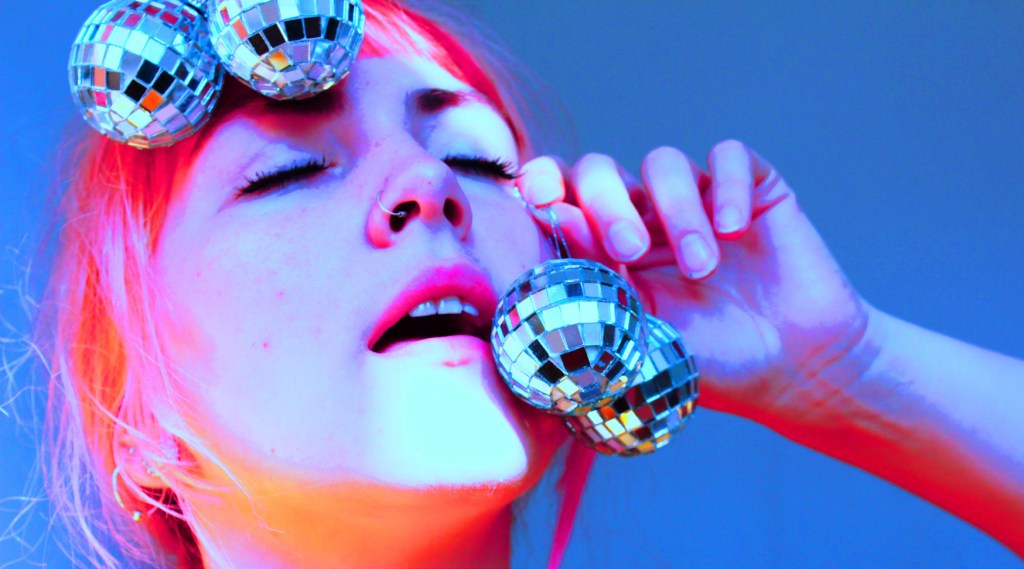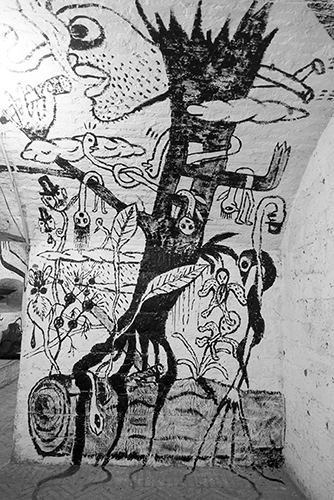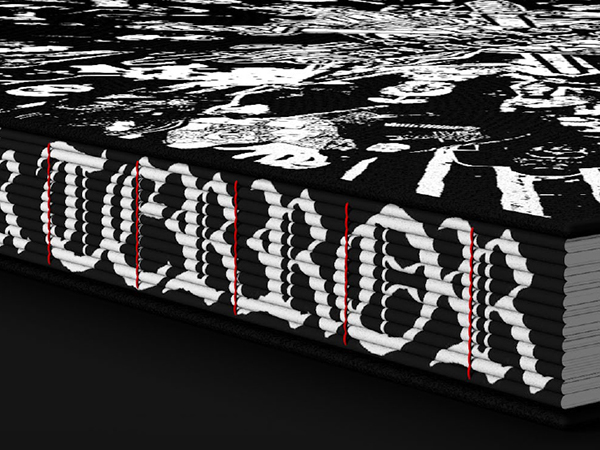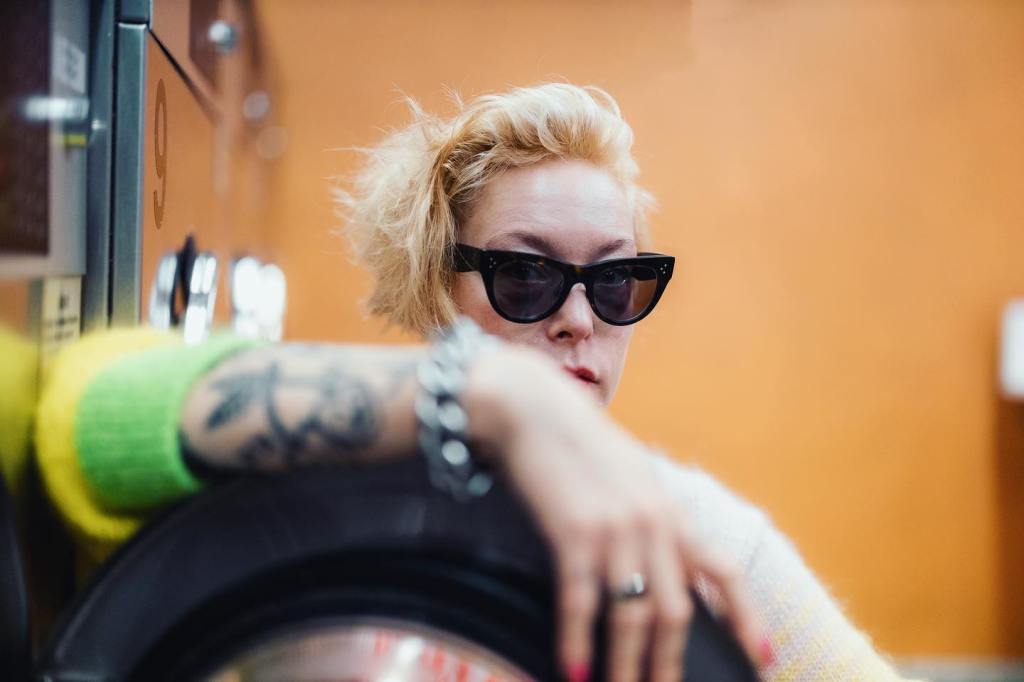
Woman With -A- Manifest: Matilde Digmann

Matilde Digmann, Copenhagen, 2022

Jeg er her for frihed, ærlighed, sårbar­hed, gender-fluidity, for kærlighed.

Det var usansynligt at jeg skulle blive en kanal for lyset. Det jeg kommer fra er så mudret, så mørkt – men jeg skulle igennem de dybeste lag for at forstå, at jeg er lys. Hver gang jeg har ramt bunden, er jeg blevet vist at jeg kan gå højere – at vi alle har et valg. At vi kan give slip på frygt og være i tillid til at alt udfolder sig præcis som det skal. Og vide at dét at være i overgivelse – i nuet – er lig med at være i vort højeste selv.

Skyggearbejde handler om at bevidstgøre sig skyggen (de sider af os selv vi ikke kan eller vil se og anerkende) – ikke at skubbe dem væk, løbe fra dem eller lade som om de ikke eksisterer – men i stedet vende os om og integrere mørket. Og dermed erkende at vi er begge dele: både lys og skygge. Jeg kaster min skygge ud i rampelyset for at integrere den i os alle, for at hjælpe os til at forstå at vi ikke behøver at gøre vores skygge forkert og udskamme den – men at vi kan se den for hvad den er – et bange dyr, en ego-skal bygget for at beskytte os. Se at vi er født uskyldige – som ren kærlighed.

Jeg arbejder for at kaste lys ind i den kollektive skygge – for at blotlægge mis­forhold i den dominerende kultur. For at frisætte os fra den programmering og radikalisering vi er blevet udsat for gen­nem en opvækst i et kapitalistisk patriar­kat. Når jeg ser på kønnene, og mine egne oplevelser som biologisk kvinde – ser jeg en dyb diskrepans. Jeg ser en enorm for­skel på begrænsningerne af den ydre og indre frihed der er for kønnene hver især. Jeg er nødt til at pege på dobbeltmoralen og hykleriet i et samfund der systematisk seksualiserer kvinder og som så – når kvin­der agerer åbenlyst seksuelt – vender sig om og udskammer dem for det. Et sam­fund hvor mænd programmeres til at un­dertrykke følelser, til at lukke ned. Dette systemiske svigt kommer til udtryk som konstante indviduelle kampe om at få det godt, som enten kæmpes eller fortrænges, og som vi ikke kan vinde på et individu­elt niveau. Det er et system der fratager os vores evne til at elske frit, og det er på tide vi bliver fri af det.

Jeg er her for frihed, ærlighed, sårbar­hed, gender-fluidity, for kærlighed.

matildedigmann.dk


Miinto Meets: Matilde Digmann

Does ceramics and fashion have anything in common? It certainly does for artist and author Matilde Digmann who uses their creativity as a safe space of self expression.

Matilde Digmann (Mat) is a gender fluid artist and author. Mat’s artistic practice is multi-faceted but rooted in two main principles: Work evolving around outing shadow and exposing things we usually try to keep in the dark, thereby calling out biased structures in society and discrepancies in dominant morality. Mat is working on outing shadow (in a Jungian sense) on a personal as well as on a societal level. The second focus of Mat’s artistic practice is in working towards a betterment of the artistic community – in service to particularly blocked artists via the podcast Shadow Work Podcast and in pursuit of healing a generation of men and women who have been radicalised by growing up in capitalist patriarchy – via the graphic novels Pseudo and the upcoming Bad Boys.

As their unique artwork and ceramics, Mat – who’s based in the vibrant neighbourhood of Nørrebro in Copenhagen – primarily uses bright and bold colours in their wardrobe – matched with loads of gold and glitter. Meet the Copenhagen-bases artist here, and get a preview of their unique and personal art as well as their take on personal and great style.


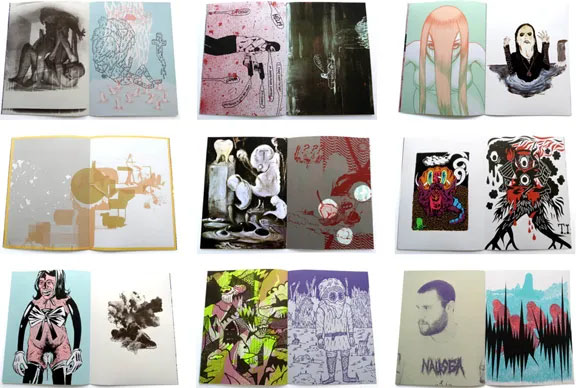
Matilde Digmann ‘Pseudo’ Graphisk Roman. Basilisk 2021

Matilde Digmann (Mat) Bir sanatçı ve yazar olarak çok yönlü sanat pratiğini iki temel ilkeye dayandırmaktadır: Gölgeyi aşmak ve genellikle karanlıkta tutmaya özen gösterdiğimiz yönlerimizi açığa çıkarmak; böylece çizgi-roman dili, çeşitli afişler ve grafik hyper-text’lerden de faydalanarak sanatçı toplumdaki önyargıları ve baskın ahlakın tutarsızlıklarını gözler önüne sermeyi hedefler.

Mat, hem kişisel hem de toplumsal düzeyde gölgeyi (Jungcu anlamda) aşmak için çalışıyor. Onun sanat pratiğinin odaklandığı ikinci alan ise Shadow Work Podcast aracılığıyla özellikle amatör sanatçılara yardım etmek ve kapitalist ataerkil bir ortamda büyüyerek radikalleşmiş günümüz erkek ve kadın nesline şifa olmak amacıyla sanat camiasının iyileştirilmesine yönelik çalışmalar yapmaktır.
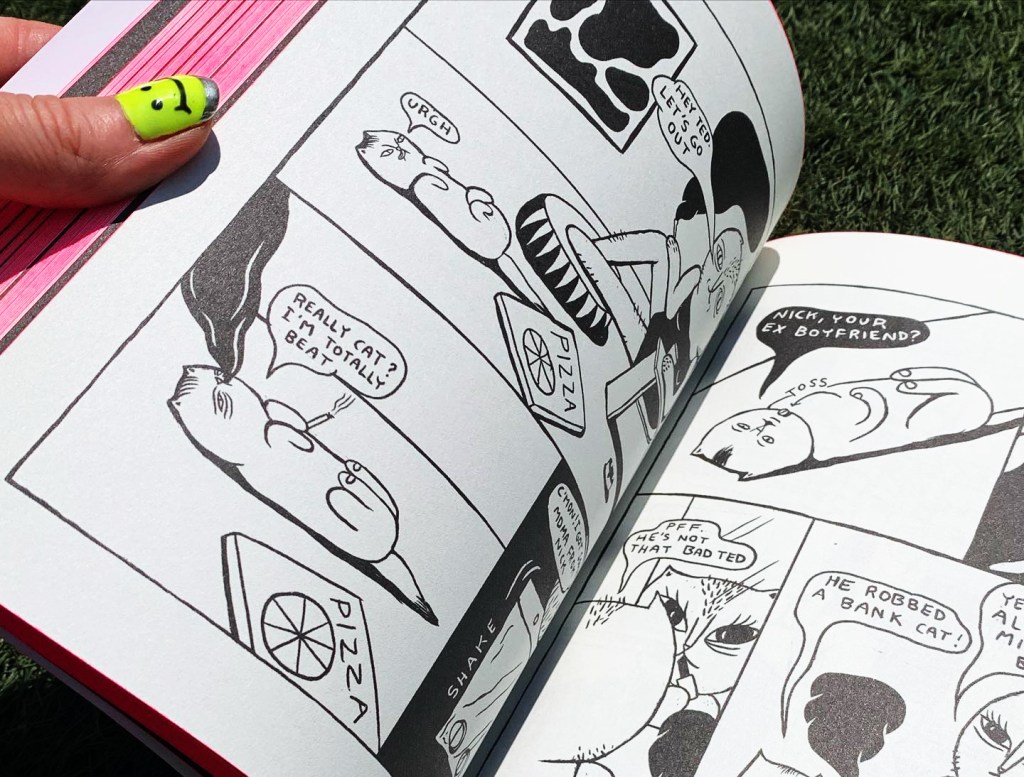

Matilde Digmann ‘Pseudo’ Graphisk Roman. Basilisk 2021

“Pseudo” by Matilde Digmann

Resorce : Gabriele Di Fazio / Just Indie Comics

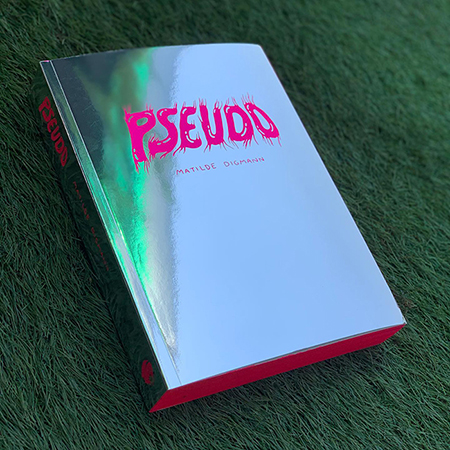
Anthropomorphic animals, online dating, drugs, sex, shame, inability to relate to others. In short, the usual old story. Indeed no. Pseudo by Matilde Digmann fits into a genre that is now highly exploited, that of problematic animals that do bad things, but manages to have her say. Mat – this is his stage name, given that he defines himself “a non-binary multidisciplinary artist and author” – first of all he paints and sculpts. He has a studio in Copenhagen full of his creations. Enter the world of comics as an outsider and in this Pseudo, a volume of 366 pages in English with a beautiful mirror cover published by the Danish Forlaget Basilisk, this is evident. The story continues in small episodes, almost by accumulation. There is no great sense of rhythm. The drawings are raw, dark, not at all cute and in any case far from the dominant aesthetic, dropped in a black and white that cannot be blacker. All this allows Mat to get out of the sowing of today’s alternative comics, avoiding ending up in the long list of Simon Hanselmann’s emulators.

The story written by Mat talks about the almost homonymous Cat, an anthropomorphic cat who after 9 years breaks up with her boyfriend and begins a “crazy year” made up of new acquaintances, transgressive evenings and – inevitably – self-harm. Pseudo begins with the protagonist signing up for a dating site, while she spends her days indoors with Ted, a traditional four-legged cat. The first pages of the volume are the weakest and most obvious, with many situations that they already know. Then after a while things take off. Meeting after meeting we witness a gallery of men who are idiots at best, manipulative bastards at worst. In front of them the protagonist is unable to react, on the contrary, most of the time she is satisfied or even submits. The story stops being banal and becomes a psychological crescendo that plumbs Cat’s unconscious search for unhappiness.


Nomineret til Pingprisen 2022: Matilde Digmann – PSEUDO

The plot is inspired by the personal stories of Matilde Digmann, who after nine years of marriage has changed her life in a radical way. For more details, I refer you to this article / interview, which rightly frames Pseudo as a feminist parable. But there is more, for us who are lovers of the strange. For example, there is a talking spider that turns from a threat into the protagonist’s shoulder. In a chapter entitled Bad Trip, the spider enters Cat’s brain to find a wasteland populated only by giant cocks. Towards the end, a flashback shows us the encounter with a sort of “cat god” with a third eye: the same third eye that appears every now and then on Cat’s forehead before a few encounters, making her even more ashamed – if any needed – of his body.
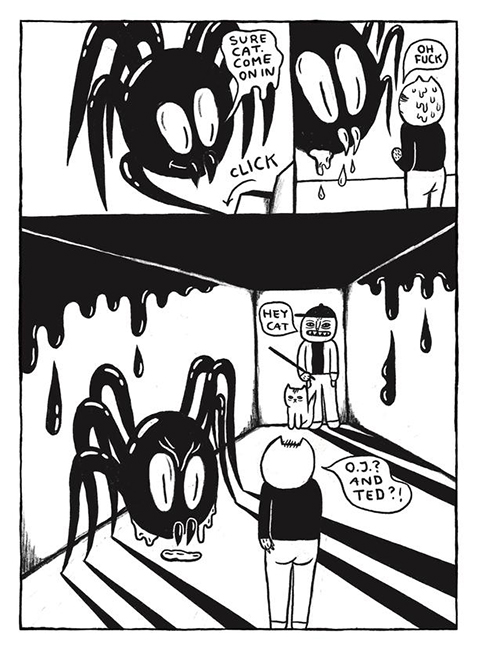
“Pseudo” by Matilde Digmann

The finale sees the final confrontation between Cat and her latest boyfriend, even worse than the former historian. Turns out the guy is married and the father of a little girl, who he hasn’t been able to see since he hit his wife with a metal pipe. Unfortunately the last pages are broom with the initial ones, because – even taking into account that the volume is presented as the first of a trilogy – they close the story in an all too hasty way. Pseudo works fine from p. 70 on p. 341, and in any case 272 pages, so they are enough and advance. What then in these times, when novice authors tend to always look for the “round” comic with all the right ingredients and the graphic novel is a genre rather than a format, making a comic a little wrong can also be a positive thing.

The main merit of Pseudo remains its being an original feminist parable. Mat does not indulge in easy theses or didactic dissertations. With the technique of accumulating characters and situations, he rather tells the tendency to submission of the main character and the pettiness of the male gender, so much so that in some passages he reaches pure misanthropy. Beyond this, the book would be worth the cover price only for the drawings, which in their tarry black and white bring us back to less colorful and certainly more glorious times than today.

In conclusion, here are some useful links, namely Mat’s site, the Instagram page and finally his online shop where you can buy the volume.

matildedigmann.dk

Pseudo
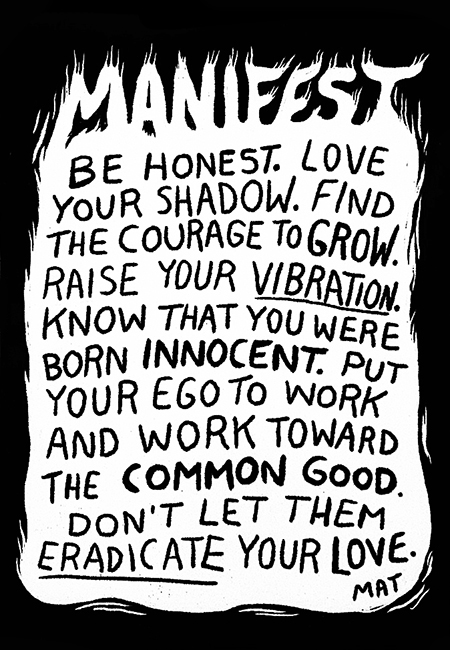

It was unlikely that I would become a channel for the light. What I come from is so muddy, so dark – but I had to go through the deepest layers to understand that I am light. Every time I have hit rock bottom, I have It was unlikely that I would become a channel for the light. What I come from is so muddy, so dark – but I had to go through the deepest layers to understand that I am light. Every time I have hit rock bottom, I have been shown that I can go higher – that we all have a choice. That we can let go of fear and be confident that everything unfolds exactly as it should. And knowing that being in surrender – in the now – is equal to being in our highest self.

Shadow work is about becoming aware of the shadow (the sides of ourselves we cannot or will not see and acknowledge) – not pushing them away, running away from them or pretending they do not exist – but instead turning around and integrating the darkness. And thus recognize that we are both: both light and shadow. I cast my shadow into the limelight to integrate it into all of us, to help us understand that we do not have to make our shadow wrong and shame it – but that we can see it for what it is – a scared animal, an ego shell must be built to protect us. See that we are born innocent – as pure love.
A society where men are programmed to suppress emotions, to shut down.

I work to shed light on the collective shadow – to expose disparities in the dominant culture. To free ourselves from the programming and radicalization we have been subjected to through growing up in a capitalist patriarchy. When I look at the sexes, and my own experiences as a biological woman – I see a deep discrepancy. I see a huge difference in the limitations of the outer and inner freedom that exist for the sexes each. I have to point to the double standards and hypocrisy of a society that systematically sexualises women and who then – when women act openly sexually – turns around and shames them for it. A society where men are programmed to suppress emotions, to shut down. This systemic failure manifests itself as constant individual struggles to get the good that is either fought or repressed and that we cannot win on an individual level. It is a system that deprives us of our ability to love freely, and it is time we become free from it.

I am here for freedom, honesty, vulnerability,

gender-fluidity, for love
Shadow Work Podcast

matildedigmann.dk


Graphzines Over Copenhagen: Zven Balslev & Cult Pump

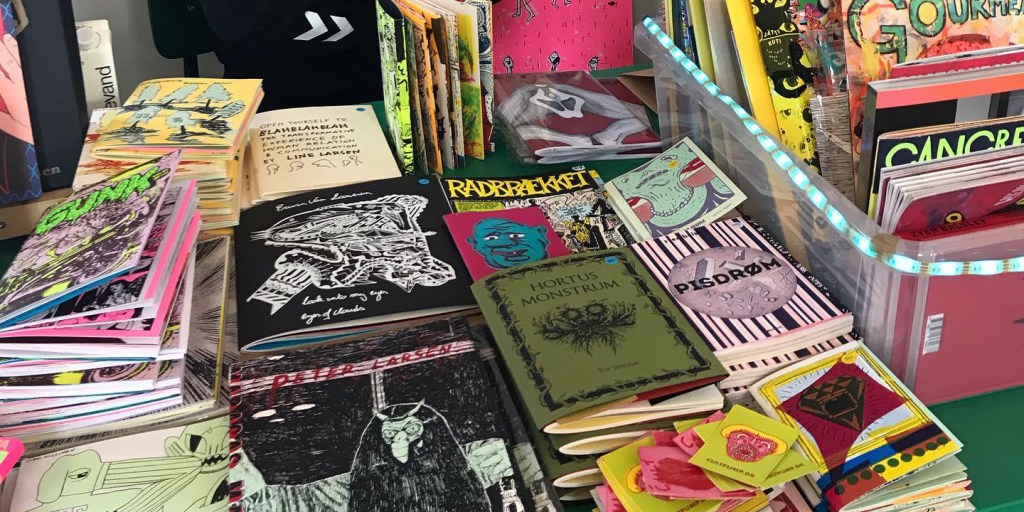
Cult Pump Books at the Chart Art Fair

there´s more and more zinefest being organized in Copenhagen though, and the tables are very diverse. I see it as a sign of people being fed up with mainstream culture.

Hello Zven, would you tell us a little bit about Cult Pump and what you do? I guess you are also distributing different labels besides print limited editions and art-zines.

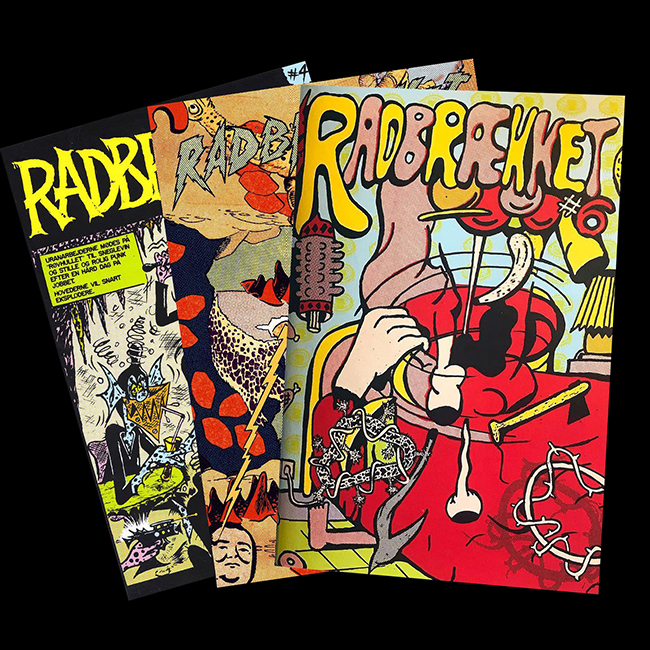
I am a little of everything, painter, cartoonist, printmaker, editor. I started the Cult Pump label in 2010, but before that I was also making zine and publishing books. At some point I decided only to publish my own stuff but then you meet artists and their art is great and you think: “if I dont publish this, no one else will!” So its a duty, but also a pleasure, and a way of evolving as an artist, by getting input from other artists, learning other approaches. I share my studio with other artists, some of whom I work with, but I manage the label on my own, except for “Radbrækket” a comix anthology that I am editing with Tue Sprogø. I also do a bit of distribution, mostly books related to the ones I publish.

the process of doing stuff together without knowing the final result is just as important as the actual products.

Would you like to talk about your acquaintance with Hilal Can, you worked together at the Cult Pump studio recently, what kind of artist is she, were you satisfied with the work that emerged?

Hilal Can is a bit like myself, a restless soul, working with multiple medias. We met a few times before, and this time there was time to invite her to do prints here! She made a mini-zine/ poster here which turned out really cool. The Cult Pump is a meeting place for artists, as I said, so the process of doing stuff together without knowing the final result is just as important as the actual products.

We see that the graphzine scene is very developed across Europe, especially in France and Germany. What would you say if we asked you to summarize the independent publishing and similar counterculture movements for Denmark ?

Denmark hasn’t got a lot of counterculture movements. I guess you can say that people in Scandinavia are generally satisfied with their government. There use to be a strong squat/ autonomous movement in Copenhagen, particularly in my neighborhood, but I’m not sure where it went. It’s the gentrification, like everywhere else. So historically, the zine culture is mostly tied to those very political, anarchist movements. Recently there´s more and more zinefest being organized in Copenhagen though, and the tables are very diverse. I see it as a sign of people being fed up with mainstream culture.

Contemporary Scandinavian art and design is very plain, gray and boring, and I think I do respond to that by doing the opposite.

Northern Europe has always had a plain graphic world in terms of humor and cartoons, I think you managed to break this atmosphere as Cult Pump. Is there a school or graphic discipline that you take as an example, or are you developing your own style?

We do have very good (and fun) cartoonists in Denmark ! Lesser known (and not translated) cartoonists like Storm P. and Claus Deleuran to name a few. Back when Christianity came to Northern Europe and church were built, locals were asked to decorate the churches with images from the Bible. Some of those paintings still exist, and they are super raw and weird, and very humorous too… Contemporary Scandinavian art and design is very plain, gray and boring, and I think I do respond to that by doing the opposite. And its no secret that I’m strongly influenced by American Underground Comics, French Graph´zines (Dernier Cri, etc.) but also tons of other things like Pulp Art, B-Movies, Manga, Art Brut, etc… Obviously! But also the more conventional and canonized art history is interesting to me. I just came back from the post office, I bought this second hand book by Bonnard, I think his paintings are awesome.

What type of artists do you mostly work with?

I try to keep Cult Pump open by not “curating” it to strict. My taste can be a restriction. I hope that other people can shape it. That said, most people I work with are working with drawings and graphic art one way or the other. And I publish artists or book projects that other publishers would’nt touch, even with a ten foot pole!

GUNK – ANDY BOLUS

The Cold Fact ft. Zven Balslev, 2018

GUNK – ANDY BOLUS

Re-issue of GUNK

‘GUNK was originally a self-published photocopied zine by Andy Bolus released in 1994 and reissued once in 2008 on the french label Kaugummi books. Some of the stuff from GUNK has been printed in the anthology “Hopital Brut”, in “Deathneyland” and “Group Sex Explosion” from Le Dernier Cri. GUNK is the ultimate punk/situationist comix zine. You get hilarious, defaced romance stories, fake ads, weird collages, and Bolus´ trademark oozing drawing style: If HR Giger was working for Lucio Fulci this might be close to the result. Somehow the visual equivalent of the Boredoms loud, bizarro and abrasive noiserock.’

Zven Balslev at the book fair 

the response by the public in general is very positive I must say !

You attended Chart Art Fair recently, how was the fair for Cult Pump, how was the interest in books and the serigraphy examples ? Do limited editions produced in recent years reach qualified collectors or do they appeal to a certain sub-culture?

“Chart” is this commercial art fair, organized by the Copenhagen art galleries with big money. I’ve been avoiding it ever since it started 10 years ago. But this year, they extended with a book fair, and they invited me to take part. I like books, prints, multiples, art books, I like the fact that its popular and affordable – compared to the art market. It won’t cost a gazillion euros just because some rich scumbags needs somewhere to place their blood money. The stuff I am publishing, including the limited edition prints, do not appeal to rich art collectors. But the response by the public in general is very positive I must say! At the art fair, as well as at the comic-con.

Is there a new project you are working on right now?

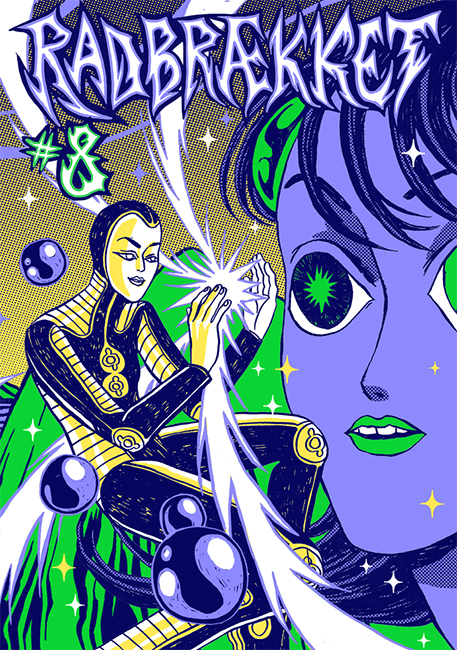
Right now we are working on the number eight issue of Radbrækket, for the first time we are trying to raise money via kickstarter. There’s also more books to come, one “Leporello” with the Danish artist Anna Stahn. Then I have to take a break from book publishing and work with paintings for an exhibition in January 22.

Thank you very much for the interview Zven, Good Luck !!

Radbrækket #8

Don’t forget to support :

Støt radbrækket 8 !!


Join the Army !

Publisher, Distro & Printing House

CULT PUMP


Filles Derrière Les Livres: Joie Panique Èditions

Filles derrière les livres…

“Nous ne manquons d’idées, ni d’envies et comptons bien rebondir bientôt et continuer à propager la Joie Panique à travers le monde.”

L’ Interview avec Joie Panique Éditions vol.2

Bonjour Célia, l’interview que nous avons eue il y a deux ans a vraiment attiré beaucoup d’attention et elle m’a fait très plaisir. Bien que vous soyez une jeune publication, de quoi dépendez-vous pour avoir déjà un public aussi large que celui-là ?

Merci Erman ! Nous n’avons pas l’impression d’avoir un public très large… Nos publications restent encore confidentielles. Bien sûr, nous essayons d’utiliser les réseaux sociaux pour faire connaître nos livres, et nous comptons aussi beaucoup sur les libraires que nous démarchons seules !

Nous vivons en quarantaine depuis environ un an. Comment le processus de pandémie auquel les activités ont été suspendues a affecté la scène culturelle et artistique parisienne; Comment avez-vous affecté le processus en tant que JP ?

Comme tout le monde, les restrictions sanitaires nous ont durement touchées. Nous avons été freinées dans notre élan : d’abord par la fermeture des librairies, puis par la difficulté sociale qui a touché tout le monde, et enfin l’impossibilité d’organiser les événements (dédicaces, rencontres, salons, festivals) que nous avions prévus. Nous ne manquons cependant ni d’idées, ni d’envies et comptons bien rebondir bientôt et continuer à propager la Joie Panique à travers le monde. ; )

Stéphane Blanquet pour FEU (2019)

Quel genre de relation entretenez vous avec Blanquet et UDA en que JP ? Je ne savais pas que vous travailliez ensemble.

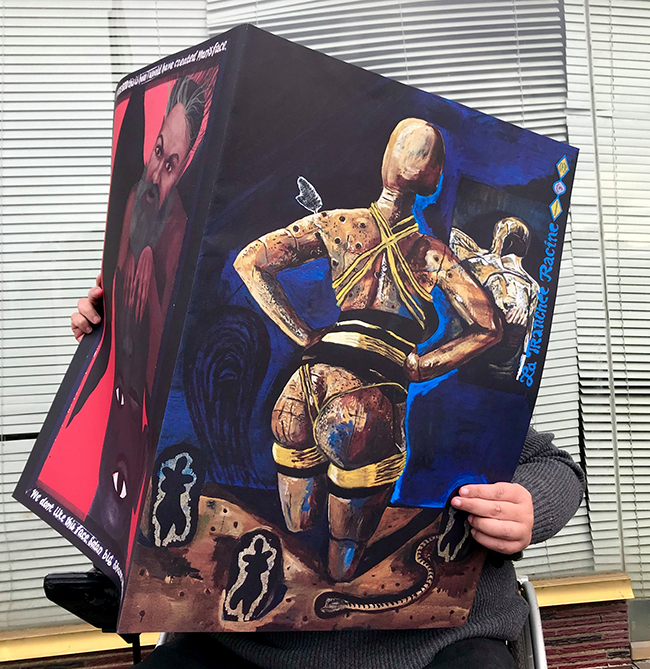
Blanquet est un artiste que l’on admire depuis toujours. Il est présent dans tous les livres Joie Panique. Et les éditions United Dead Artists sont bien sûr une référence et une source d’inspiration pour nous. Le fait que l’une d’entre nous (Célia) travaille avec lui sur la Tranchée Racine hebdomadaire est juste une ramification sans lien direct si ce n’est la curiosité insatiable, l’amour pour les belles images et le plaisir de le soutenir dans son projet fou !

Joie Panique exhibition au Bar à Bulles à Paris, 2019

Nous pensons que les émotions, fantasmes et pensées seront toujours plus forts que le medium par lequel ils sont exposés.

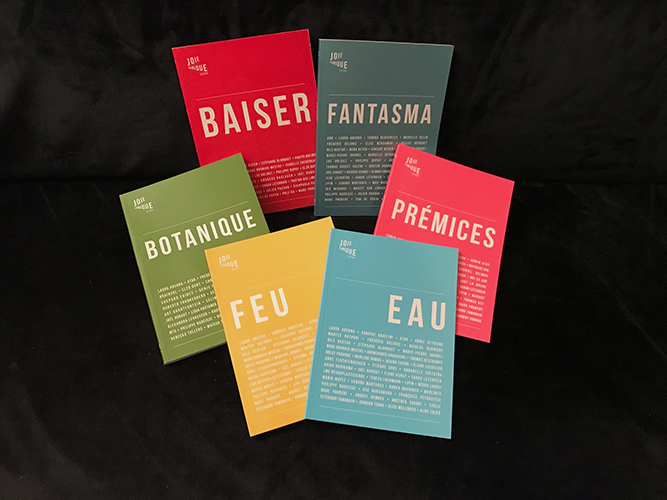
Souhaitez vous parler des développements depuis 2019 ? Je pense que vous avez organisé une soirée de lancement pour Prèmices et une exposition pour EAU & FEU. Quelle ligne comptez-vous continuer dans la période à venir ?

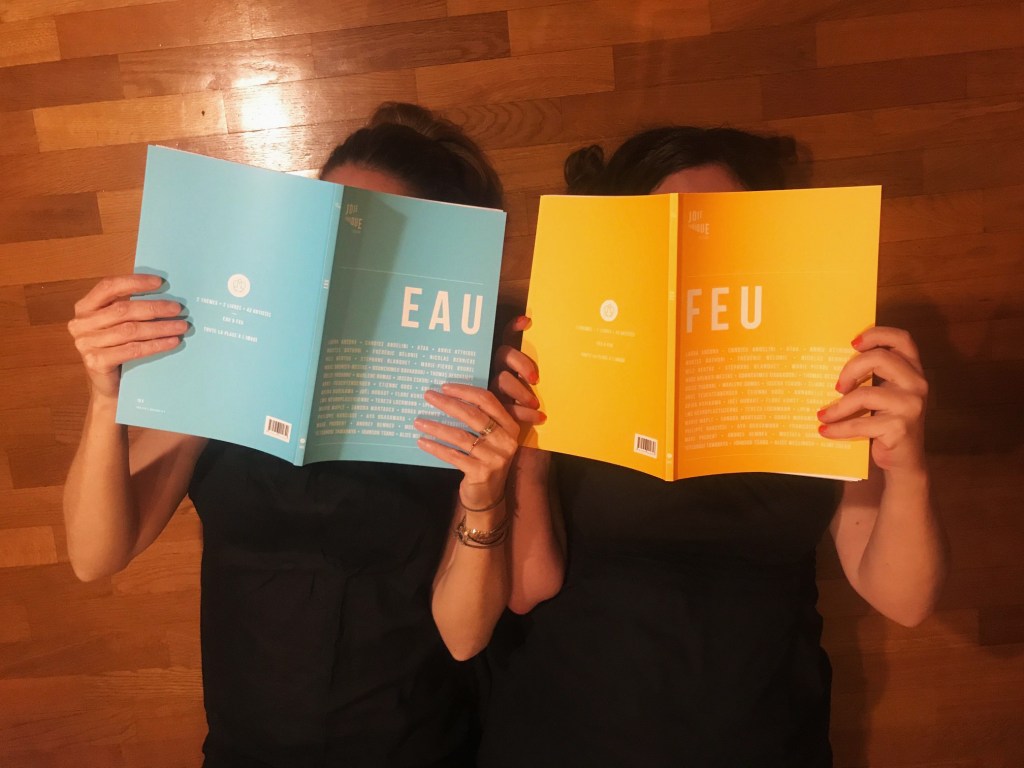
Depuis 2019, après PRÉMICES, nous avons publié deux nouveaux recueils qui se répondent en réunissant les mêmes artistes sur deux thèmes complémentaires : FEU et EAU. Nous avons effectivement fait une belle soirée de lancement à cette occasion, avec une exposition de toutes les images JOIE PANIQUE, au Bar à Bulles à Paris ! Depuis, nous réfléchissons à de nouveaux projets, sans doute hors recueils thématiques (pour lesquels nous souhaitons faire une petite pause) : peut-être des monographies d’artistes ou des duos textes-images… Le Covid nous a certes ralenties, mais nous n’avons pas dit notre dernier mot !

Feuilletage panique du recueil artistique collectif de Joie Panique Éditions : FANTASMA !

Au final, il revient à chacun de saisir la beauté, la singularité, ce qui le touche, et de laisser le reste de côté.

Dans une géographie où de nombreux artistes, éditeurs et galeristes travaillent notamment dans les grandes villes comme Paris et Marseille en France, cette situation alimente-t-elle un certain environnement concurrentiel ? Si “oui”, où vous voyez-vous dans cette atmosphère ?

Nous sommes conscientes qu’il existe une offre plurielle voire pléthorique dans l’édition indépendante de nos jours (ce qui rend plus difficile de nous faire connaître vraiment), mais nous pensons sincèrement que nous pouvons tous être complémentaires et qu’il devrait y avoir de la place pour tout le monde. Et cette profusion peut aussi être une émulation.

Qu’aimeriez-vous dire sur des écrivains comme Lydia Lunch et Kathy Acker? Qu’est-ce qui rend ces vieux artistes si spéciaux pour vous ?

Oui. À titre personnel, ces artistes font partie de nous, de nos références, depuis notre adolescence, et nous semblent parfois bien plus audacieuses et transgressives que de nombreux artistes actuels. Elles restent essentielles pour nous, et on retrouve leur empreinte dans nombre de mouvements d’aujourd’hui.

Markus Åkesson ‘Psychopomp Club’ 2014

Nous vivons à une époque où la «visibilité» à travers les médias sociaux est au premier plan; Pensez-vous que cette roue de production-consommation d’image rapide et les réseaux de partage nuisent et déprécient l’Art et l’artistique?

Oui et non. Nous pensons que les émotions, fantasmes et pensées seront toujours plus forts que le medium par lequel ils sont exposés. Mais il est vrai que les réseaux sociaux peuvent induire une surconsommation voire une surenchère qui pose question… Au final, il revient à chacun de saisir la beauté, la singularité, ce qui le touche, et de laisser le reste de côté.

Merci d’avoir pris le temps de parler, nous sommes impatients de voir les nouvelles éditions de Joie Panique, si vous avez quelque chose à ajouter pour les lecteurs, soyez les bienvenus.

Merci à toi Erman, pour ton soutien indéfectible et ton enthousiasme ! À très vite pour la suite, stay tuned !!

Confinez dans la beauté avec les livres Joie Panique !!!

Carole & Célia

Joie Panique Editions


Hebdomadaire Manifeste Impact: La Tranchée Racine

Denis grrr in La Tranchee Racine 35

Fransız sanatçı Stéphane Blanquet 1980’lerden bu yana çağdaş sanat dünyasındaki en üretken figürlerden biridir. İllüstrasyon, çizgi film, tiyatro, yayıncılık, sanat yönetmenliği gibi bir çok farklı dalda çalışan Blanquet, çocukken izlediği ‘Creature from the Black Lagoon’ filminden çok etkilenir ve bu deneyim onun mitoloji ve popüler kültür kodları arasında güçlü bir bağ kurmasına yol açar: Çizgi romanlar, şaka oyuncakları, sihirbazlık ve lunaparklar.

Hem sanatçı hem de yayıncı olarak üretken bir pozisyonda olan Blanquet çok geçmeden 1990’ların başında yeraltı sanat dünyasının liderlerinden biri haline gelir. Eserleri 1993’te Paris Regard Moderne‘de, 1996’da ise Amerika ve Kanada’da sergilenir. Çalışmaları Blab!, AX gibi çizgiroman antolojilerine girer. 1996 yılında Angoulême International Comics Festivali’nde yayıncılık alanında prestigious Alph Art du fanzine ödülüne layık görülür.

Blanquet 2007 yılından bu yana United Dead Artists isimli yayınevi işletmektedir. Roland Topor, Gary Panter, Tanaami Keiichi gibi büyük sanatçıların kitaplarının yanısıra Tendon Revolver, Muscle Carabine, Tranchée Racine gibi çeşitli dergi ve özel edisyonlar da yayımlamaktadır.

Tranchée Racine Hebdomadaire – N°10, UDA, vidéo by Célia Döring 2020

La Tranchée Racine Hebdomadaire N°10

This is the 10th of 42 issues. It features artworks by the following artists: Natsuko Tanihara, Arnaud Loumeau, Pascal Doury & Bruno Richard, Zven Balslev, Tommaso Buldini, NEHAMA, Orsten Groom, Gea Philes, JJ Cromer, Thomas Ott, Laurent Benaïm, Tony Fitzpatrick.


Stéphane Blanquet & the Tranchée Racine team

‘Stéphane Blanquet is a prolific figure in the contemporary art scene since the end of the 1980s. He creates and is involved in the graphzine scene, art installations, artwork, urban art, animation movies, theater, books, publishing, art direction. He has been strongly interested by the myths and codes of popular culture: illustrated magazines, joke shops, magic tricks, optical illusions and fairground art.

In the 1990s, Blanquet was very active both as an artist and a publisher and became one of the leaders of the underground art scene. His art was exhibited at the “Regard Moderne” gallery/library (Paris, France) in 1993 and 1996, in the USA and in Canada. It has been published in Blab! (USA), AX (Japan) and in Europe. In 1996, he received the prestigious Alph Art du fanzine prize at the Angoulême International Comics Festival for his work as a publisher…


Tranchée Racine Hebdomadaire – N°9, 2020

La Tranchée Racine Hebdomadaire N°9

This is the 9th of 42 issues. It features artworks by the following artists: Damien Deroubaix, Alice Hualice, Jeremy Boulard Le Fur, Margaret Curtis, Aleksandra Waliszewska, Olivier de Sagazan, Gonzalo Garcia, Nazanin Pouyandeh, Erik Thor Sandberg, Les Krims, Ion Birch, Kwame Akoto.


Tranchée Racine Hebdomadaire – N°8, UDA, vidéo by Célia Döring 2020

La Tranchée Racine Hebdomadaire N°8

This is the 8th of 42 issues. It features artworks by the following artists: Ryan Heshka (cover), Julia Wernig, Féebrile, Francis Deschodt, Nicolas Pegon, Paul Henderson, Hermann Josef Hack, Jon Todd, Marc Brunier-Mestas, Betty Tompkins, Philipp Kremer, Matthew Barney.


magazine de proximite

Buy it at the Halle Saint Pierre, in all the good bookstores or on blanquet.com

– you can also subscribe for the whole collection !! –

l’ensemble de la collection est disponible (pour un prix réduit) lors de la souscription

instagram: latrancheeracine / facebook: latrancheeracine

Hebdomadaire Manifeste Impact !!

> blanquet.com


Le Plaisir, Ou La Question Centrale

Dessin : Nils Bertho

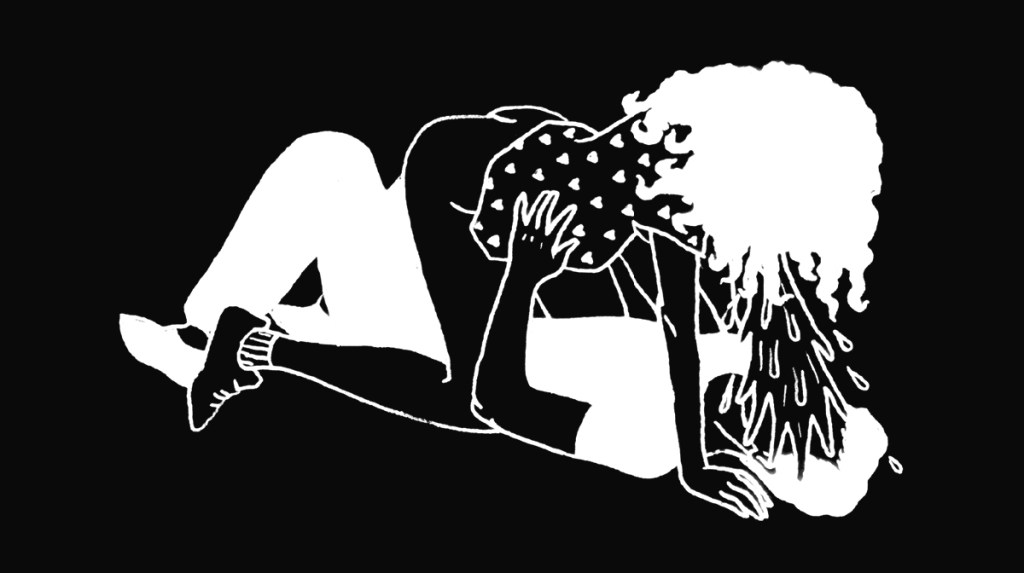
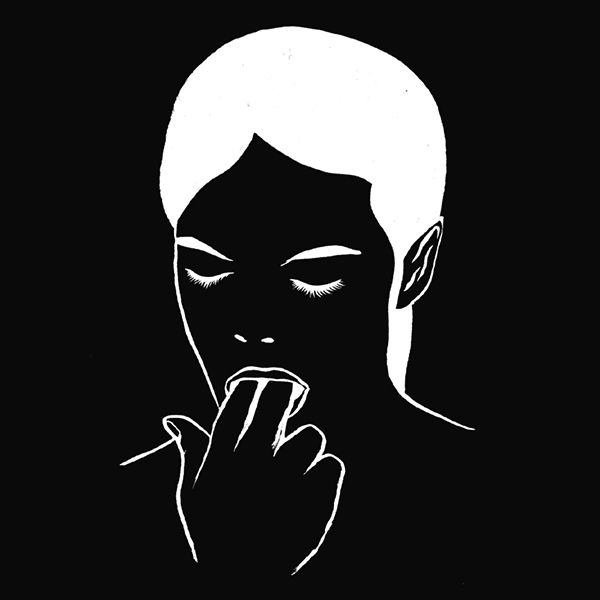
Purquoi est-iel si difficile d’aborder la question du porno ? Tant de personnes concer­nées qu’il paraît absurde de taire ce sujet. Pourtant, beaucoup d’autres problématiques dans le registre des luttes sociales semblent plus faciles à aborder, à clamer, voire à dénoncer. Mais le porno fait rougir, il met mal à l’aise. Pourquoi cette gêne ? Viendrait-elle du simple fait qu’on culpabilise de prendre du plaisir ? Souvent seule, parfois à plusieurs, en contemplant ces images qui nous font frétiller comme peu d’autres le peuvent. D me paraît juste, alors, d’associer le porno à cette prise de plaisir en solitaire (ou accompagné.e).

Dessin : Nils Bertho

La Masturbation

Masturbation évidente et revendiquée chez les hommes cis-genres. plus taboue voire complètement tue pour tou.x les autres.

Masturbation pour le plaisir, mais plaisir honteux.

Une question est alors centrale : comment est-il encore possible de pouvoir prendre du plaisir en se masturbant sur du contenu qui ne représente en rien qui nous sommes, ni même ce que nous véhiculons dans nos sphères publiques ? Et donc, d’une certaine manière, notre plaisir est-il encore abordable ?

Je repense à toutes les fois où, avant de connaître l’existence des pornos alternatifs, féministes et bienveillants, à l’âge où le porno se vêt du rôle de guide sexuel, j’ai été déçue, seule devant mon écran, à choisir des vidéos peu glorieuses par dépit. A tous ces visionnages qui ne m’ont pas ouverte sur le champ des possibles, qui ne m’ont pas montré des modèles de sexualités variés, d’orientations diverses auxquelles j’aurais pu m’identifier mais qui au contraire, de par leur monotonie et leurs stigmates, ont tenté de me formater aux pra­tiques consensuelles d’une culture hétéro-patriarcale blanche comme neige.

Par ailleurs, il est un phénomène de production d’images diminuant toujours plus la frontière entre érotisme et pornographie. Une projection/captation photographique de vulve ou de pénis n’est souvent plus pornographique, à la limite de l’érotisme, aux grands bienfaits de l’émancipation des corps et des représentations et expressions de genre, bien entendu.

Dafno Distraite ‘Dans ta gueule zine’ (2020)

Alors nous cherchons d’autres moyens, puisque la sexualisation des corps a aussi pris d’assaut toute notre culture de l’image. On tombe dans le trash, l’hy­per violent, cette culture du viol perpétuelle qui fait en sorte que nos yeux y soient habitués et en redemandent toujours plus, errant d’images en images, de scènes en scènes d’une rudesse comparable à un Salô ou les 120 journées de Sodome sauce 2020 pour combler cette avarice de douceur et de romantisme.

Est-ce alors ça, une pornographie alternative ? La conséquence de tout ce ramassis de hardcore qui nous fait saigner la cornée rien que d’y penser ? Son enjeu principal serait-il de recouvrer une douceur initiale et redécouvrir les plaisirs d’un coït sans violence ? Ou est-ce justement de ramener de la réalité à ce que l’on a toujours considéré comme de la fiction pour se déculpabiliser, par exemple, d’un fantasme du viol couvé par cette culture ultra violente, mais d’une manière déjouée et peut-être plus subtile ?

En intégrant de l’art à la pornographie, nous entrons dans ce type de contenus que l’on devrait appeler post-pont, et c’est peut-être ainsi que ce texte aurait dû commencer, mais c’est là où nous en arrivons après ces cheminements de pen­sées balbutiants. Le post-porn, c’est très certainement Annie Sprinkle qui nous l’introduit en 1990 avec ses performances The public cervix announcment qui avaient pour but de « démystifier le corps féminin » et d’amorcer une scission entre sphère publique et sphère privée des sexualités, en invitant le public à venir ausculter l’intérieur du vagin de l’artiste à l’aide d’un spéculum (événement avec lesquels Rachele Borghi nous introduit son éminent article « Post-porn » en accès libre à la fin de ce fanzine, que je vous invite chaleu­reusement à dévorer).

Le post-porn nous permet de nous réapproprier nos corps et nos images, afin de transformer nos sexualités en des actions non plus privées mais publiques et politiques et d’en parler librement, sans tabou, sans honte ni gêne et surtout avec beaucoup de paillettes et d’amour.

Pour une pornographie émancipée, qui nous veut du bien et nous fait du bien !

Dafno Distraite, Dans ta gueule fanzine #02, Juin 2020

Dans ta gueule est une publication collaborative rassemblant divers formes de participations autour des thème liés aux violences intégrées, organisant des évènements visant à créer du lien social .

contact : dtgfanzine @ protonmail.com


Another Language, Another Berlin: Re:Surgo!

Christian “Meeloo” Gfeller while showing the Truth of Life

“Being independent and able to decide to do whatever project we feel like is a crucial freedom. I guess it’s the most important for us. We would not want to be artists forced to produce for one or several gallerists in order to feed the market. We’ve seen that happen to people and it’s pretty sad. Our freedom is in our flexibility.”


Du langage.

La faculté du langage est la capacité de créer à l’infini des phrases et des pensées à partir d´un petit nombre d’éléments. Plus globalement, le langage est un système de communication.

Le langage, chez Gfeller+Hellsgård, a pour base sémantique le procédé d’impression sérigraphie. Ce médium que le duo s´applique à repenser, se construit et déconstruit au gré des expérimentations. Sa syntaxe se transforme lentement, elle se ramifie et se complexifie en intégrant des signes issue d´autres idiomes tels que la peinture, en toute évidence, mais aussi la reliure, le bricolage ou la poésie. Comme tout langage, il est fondamentalement arbitraire et pour survivre se doit de dépasser ses propres frontières.

Le cryptolecte graphique et plastique que pratiquent Gfeller+Hellsgård plante ses racines dans un environnement trans-national et à forte densité urbaine, Berlin en l’occurrence. C’est une langue vivante, contemporaine, qui se nourrit de minimalisme, d’abstractionisme et de culture underground.


Christian Gfeller talks about Re:Surgo! to Artzines video channel (antoine lefebvre editions) 2017

On Language.

The language faculty is the ability to create to the infinite, phrases and thoughts from of a small number of elements. More generally, the language is a communication system.

Gfeller+Hellsgård’s language founds it’s semantic basis in the silkscreen printing process. The duo commits to rethink, deconstruct and reconstruct the medium through experimentations. Its syntax is slowly changing, it branches out and becomes more complex by incorporating other languages ​​such as painting, obviously, but also binding, DIY or poetry. Like any language, it is inherently arbitrary and to survive must go beyond its own borders. This graphic and plastic cryptolect that practices Gfeller+Hellsgård plants it’s roots in a trans-national environment of highly urban density, Berlin in this case. It is a contemporary living language, that feeds on minimalism, abstractionism and underground culture.


Another Language from Contemporary Art

to Underground Comics:

Re:Surgo!

Christian “Meeloo” Gfeller and Anna Hellsgård work as an artist duo under the Bongoût name to make prints, artist books and illustrations, often in collaboration with other notable artists. To date there are over 110 artist books printed in silkscreen under the name Bongoût. Bongoût is based in Berlin, Germany. Their artists books are in numerous prestigious museums and collections; after 17 years, Gfeller & Hellsgård closed the Bongoût chapter in 2012. And the publishing part of Bongoût was renamed Re:Surgo!, while the distribution Beuys On Sale.


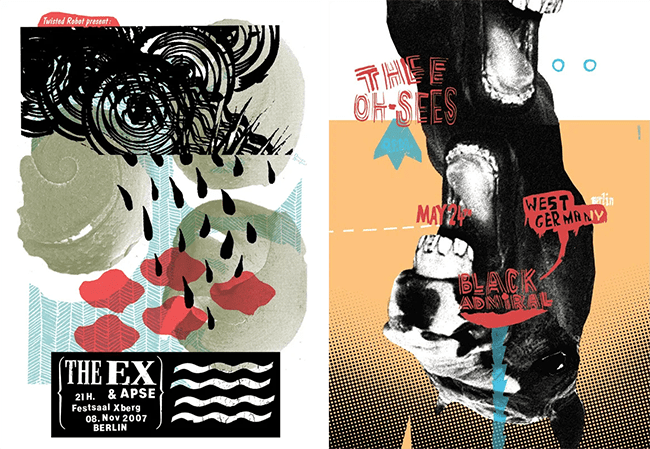
Band Posters by Re:surgo!

All of the selected work above is by Re:Surgo! which is Bongoût’s creative twin. It comprises the graphic design studio and the silkscreen atelier in which Anna Hellsgård & Christian Gfeller are creating artist books, prints and design works.

Interview by peopleofprint.com, 2011

Did anyone have an impact on you and your career choice?

Christian: When I was a teenager, I had an art teacher, Isabelle, who was Antoine Bernhart’s girlfriend. She showed me a lot of artists silkscreen books and punk graphic zines. I instantly knew “this is what I want to do !”. 

Anna: In terms of creativity, we try to keep our influences as open as possible. From contemporary art to underground comics, experimental films or outsider art. In the field of graphic design, we especially like Polish and Cuban posters from the 70’s –  graphic designers such as like Roman Cieslewicz, Henryk Tomaszewski…

Christian: We also really like the young contemporary art scene, artists like Thomas Zipp, Sterling Ruby, Dan Colen, Urs Fisher, Andreas Hofer or Christopher Wool, to name but a few.

Did you have a specific goal to achieve in your career? Have you achieved it yet?

Being independent and able to decide to do whatever project we feel like is a crucial freedom. I guess it’s the most important for us. We would not want to be artists forced to produce for one or several gallerists in order to feed the market. We’ve seen that happen to people and it’s pretty sad. Our freedom is in our flexibility.

Band Posters by Re:surgo!

“We start off from a graphic thinking, and push the figurative elements to the edge of abstraction.”

Can you take us through the evolution of your work and style.

Christian: I started pretty punk. My first silkscreen atelier was in a huge alternative warehouse project that was hosting rehearsal spaces, recording studios and event spaces. I was publishing silkscreen hand-printed artist books in a very DIY matter. Some of my friends started a small garage punk & noise label, so I would design and print the record covers. Meanwhile we organised concerts, exhibitions, raves and parties. I was in charge of doing the design and print to advertise the events. When I met Anna in 2001, we started collaborating and eventually our work became more structured and sharp. 

What is it about the process of screen print that you love? Tell us how you developed this love.

Christian: Well, each project has a different concept and we like to set up different rules. For some of the books we recycled film that was destined for the bin. We draw directly on the film with gouache or spray paint, use tape or stamps or whatever we can think of. I have even used some of my hair and glued it onto the film. For some colour layers, we partially remove the emulsion from the previous print with the high pressure water cleaner and then use it as the base for the next print.  

Anna: For the improvised books, we print on leftover printed offset paper we collected at an offset print shop. Making these books is very physical work, and often we are in a trance-like creative state.  We do use computers though. For example, we wouldn’t do any colour selection by hand if we could obtain the same result with a  computer. We are not interested in crafty, laborious challenges for their own sake, but for some works it is crucial to do the colour separation by hand. Sharpie marks and X-acto knife traces are not simulated however, they are always real traces. Computers wouldn’t be able to render that hand-drawn feeling — they are just another tool. I believe you shouldn’t let the tool direct and dictate the process and results of your works. It is also very important for us to combine different media: hand-drawn fonts, photocopied drawings, patterns, stamps, etc.

Tell us about your workspace. Are you clean and tidy or do you like a creative mess?

It’s a tidy mess. Growing older we need a more ordered and a clean space to be creative, but it is still a working space.

Is this your first studio / shop space? How have you developed the area you work in?

The first Bongoût studio was in a warehouse in Kehl (Germany), across the Rhine. I was living in Strasbourg-France back then. On the other side of the border. When I met Anna we re-located in Bordeaux for a year and a half. We quickly moved to Berlin. In Berlin we’ve had three different locations, and we’ve been in the space on Torstrasse since early 2008.

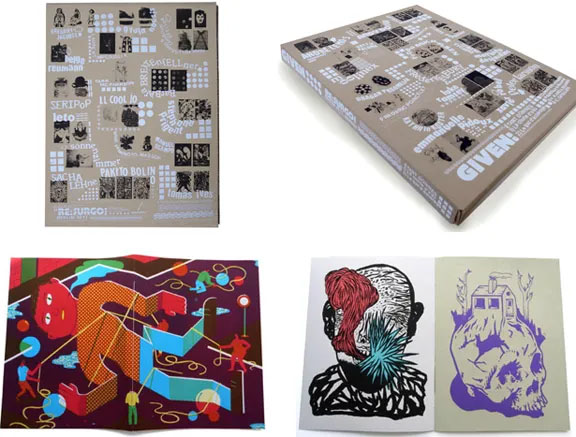
Given, 72 pages silkscreen book, 93 colours, 40 x 30 cm

How would you describe your style?

It’s not easy for us to describe, but I would we start off from a graphic thinking, and push the figurative elements to the edge of abstraction. 

Have you done much collaborative work with other artists? Tell us about this process.

We have very often worked with other artists – in fact, collaborations are an essential part of our practice and inspiration. Each project defines a new set of rules and in general we have a very good chemistry with our project partners. It’s comparable to making music with different people. It creates a good balance and challenges between our different projects.

Given, 72 pages silkscreen book, 93 colours, 40 x 30 cm

What are you working on at the moment?

Christian: We just finished Given, a massive collective silkscreen book. It’s 30 x 40 cm, 72 pages, and comes in a cardboard box. We asked 35 artists (Seripop, Tara Mc Pherson, Pakito Bolino, Gregory Jacobsen, Manuel Ocampo….) to submit images and we printed the whole project this summer. We used 93 screens. Beside this, we just released 3 little silkscreen books (Helge Reumann, Leto & Franziska Schaum), are currently  working on two big offset monographs: a painting book by ATAK and a photo book with Natacha Merritt.

Anna:  And we just started a 7″ series in collaboration with Le Petit Mignon/Staalplaat (Berlin-based record shop and noise label). It will be a series of 7″ vinyls for which we do the artwork. For the first record, by Norwegian band MoHa!, we did a 12 -page silkscreen experimental booklet that comes with the record. We are now working on the second one, a 7″ compilation of 41 bands, with each song being 15 seconds at most. We are excited to continue working on that series! 

Screen printing is having a massive resurgence since the 60’s, where do you see screen print in the next three years?

In the past five years there has been a huge resurgence of interest in hand-made things: things that cannot be duplicated or digitalised. When I started in 1995, you could really count on one hand the number of people doing hand-printed silkscreen books, especially in Europe. In the US there where just a few artist following the 60’s psychedelic rock poster path. Nowadays, I can’t even follow who is doing what. But in time, only the ones that are persevering and doing good work will stick around. 


Rencontres de l’illustration : une interview de très Bongoût

A l’occasion de l’exposition “Bongoût / Re:Surgo!” et des Rencontres de l’illustration, nous avons rencontré Christian Gfeller et Anna Hellsgård, éditeurs de Bongoût (1995-2011) et Re:Surgo! (2011-…). « Bongoût / Re:Surgo! – De Strasbourg à Berlin, une histoire de l’underground graphique » marque l’entrée des archives éditoriales de fanzines et livres d’artistes édités entre 1995 et 2015 par Bongoût puis Re:Surgo!, dans la collection permanente du Centre de l’illustration de la médiathèque André Malraux de Strasbourg.


*Another interesting interview at cheapandplastique.wordpress.com


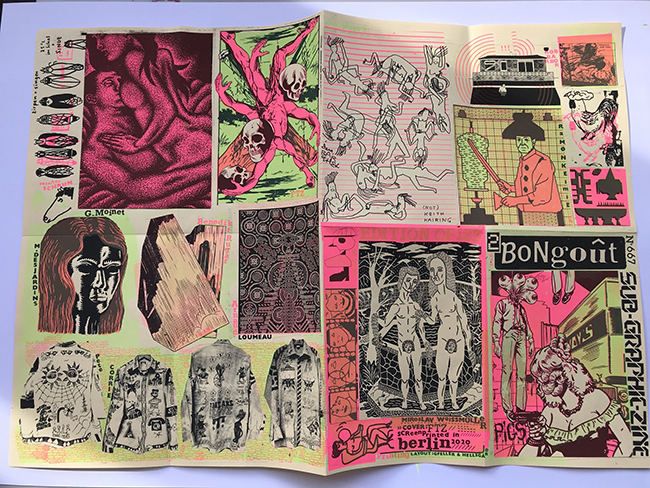
Gfeller & Hellsgård ‘Bongoût 667’ fold out poster zine (2020)

Re:Surgo! Strikes Back with a ‘Bongoût’ than Ever

Erman Akçay, İstanbul

Legendary print artists Re:Surgo! started to print some old style Bongoût grafzines again as we miss, if you want to join the adventure, you would get in contact with them via email: christian@resurgo-berlin.com. First experiment ‘Bongoût 667‘ is featuring Guillaume Moinet, Jana Barthel, Mathieu Desjardins, Arnaud Loumeau, Rob Barber, FTZ, Franziska Schaum, Raimon Keimig, Pete Corrie, Benedikt Rugar & Miroslav Weissmüller and it tastes Bongoût than ever !

Berlin-based duo Bongoût talks about applying their unique approach to screen printing to everything from wallpaper to album covers.
Latest graphic productions by Re:Surgo!

When new issues are on the way, don’t forget to visit Re:Surgo! web store for ‘Beuys on Sale’ collection also for possible screen-printed artist books, riso & graph’zines, gigposters and prints,

Bongoût rules forever!

beuysonsale.com


Dark Matter: Yves Hänggi

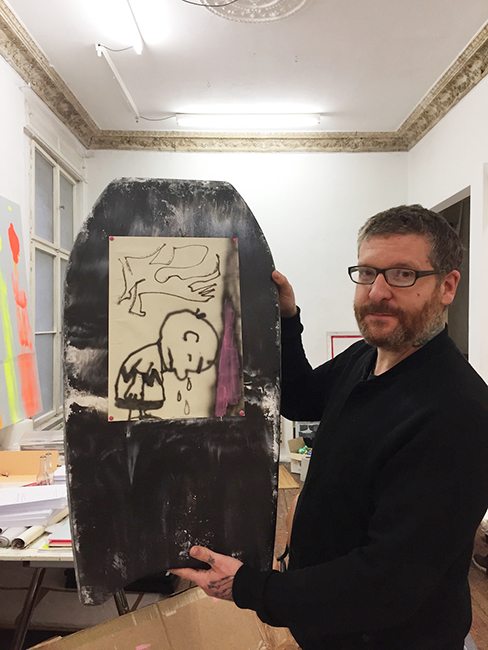
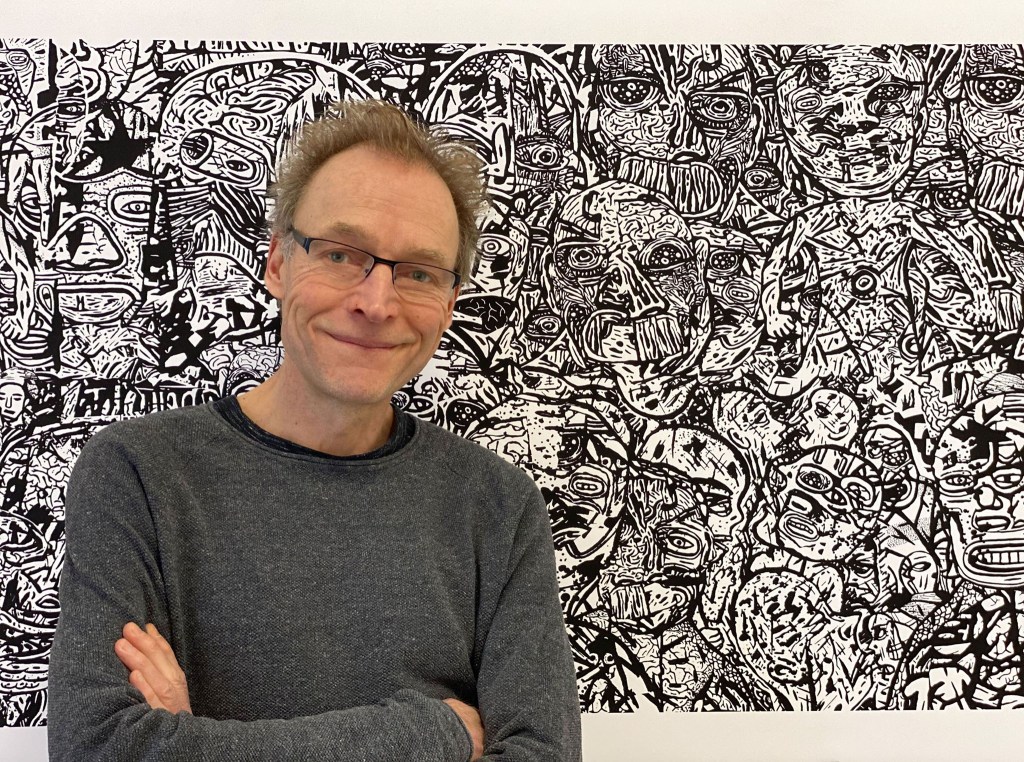
Yves Hänggi with his painting

His artistic universe is nourished by contemporary comics, independent comics, free figuration, pop art, popular arts and brute art. Born in 1966 in Porrentruy, Switzerland, a graduate of the Bienne School of Visual Arts and a member of the Swiss Association of Visual Artists Visarte, he is an illustrator, painter, graphic artist and organizer of cultural events. Passionate about travel, he love to travel the world with his feet and carnets, as for example during a tour of the world in 2015. His work is the subject of exhibitions in Switzerland, France, Belgium, USA and Madagascar and has been published by several Swiss and French publishers. I reside and work in Porrentruy.
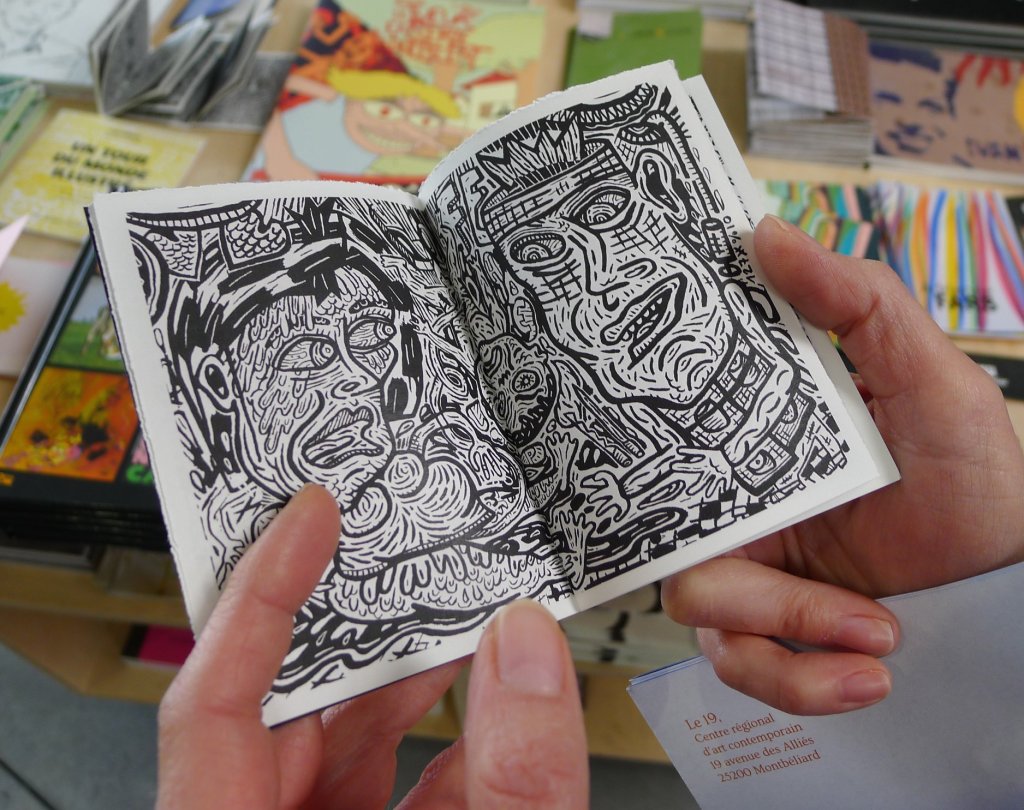
Yves Hänggi (2020)

Né en 1966, Yves Hanggi est peintre et illustrateur, diplômé de l’Ecole cantonale d’arts visuels de Bienne en Suisse. Son univers artistique se nourrit de comics underground, de bande dessinée indépendante, de figuration libre, de street art, d’art brut, d’art singulier et d’arts populaires, influences qu’il mêle à travers des formats, des supports et des techniques variés (peinture acrylique, encre, craie, collage). Son travail a été exposé en Suisse, France, Belgique, Allemagne, Pays-Bas, Etats-Unis et Madagascar, et publié chez plusieurs éditeurs suisses et français.

À travers cette série d’illustrations de grands formats mêlant encre, peinture et collage d’éléments récupérés dans la rue, Yves Hànggi poursuit un processus d’exploration débuté en fin d’année 2020 à l’occasion d’une résidence artistique à Berlin, qu’il poursuit actuellement à Paris : l’intégration à ses techniques picturales habituelles d’éléments tels que des lambeaux d’affiches, des signes typographiques ou des images déchirées issues de magazines. Par cette technique, Yves Hanggi amène une nouvelle dimension dans ses illustrations, en jouant avec les déchirures, les textures et les superpositions, ainsi qu’avec le hasard et la spontanéité. L’artiste explore également les liens qu’il peut tisser entre la rue, source d’influence et de ressources, et le travail en atelier, lieu dans lequel les œuvres se façonnent et se recomposent.


Interview with resident artist Yves Hänggi, Winter 2021, GlogauAIR

His artistic world finds inspiration in underground comix and independent comic books, free figuration, street art, different movements that can be described as outsider art (including art singulier) and folk art. These different influences are combined and expressed in a variety of mediums (acrylic, ink, chalk, collage) and formats. His work has been exhibited in Switzerland, France, Belgium, Germany the Netherlands, the USA and Madagascar and published in Switzerland and France.

With this series of large format illustrations combining ink, paint and a collage of found objects, Yves Hanggi continues to explore in Paris a practice that began at the end of 2020 during a residency in Berlin: integrating elements such as pieces of posters, typographic symbols and images torn from magazines into his usual pictorial techniques. By playing with tears, textures, superimpositions, chance and spontaneity, Yves Hanggi adds a new dimension to his illustrations and explores the connections he makes between the street (a source both of inspiration and raw materials) and the studio, where his creations are fashioned and composed.

Yves Hänggi (13)
Yves Hänggi (2018)
Yves Hänggi (33)
Yves Hänggi (2019)

As a cultural organizer, he manage several associations and cultural centers, showrooms, artist tours, contemporary art exhibitions, artistic events and festivals in Switzerland and Belgium, in the fields of current music, theater, and comic strip and the cinema. He also worked in communication, journalism and the humanitarian. He was awarded the 2019 Culture Prize of the City of Porrentruy. He is available for illustration and graphic design projects and for any exciting exhibition and publication proposal.

Yves Hänggi (29)
Yves Hänggi with his micro-edition (2018)

> yveshanggi.ch


Diego Lazzarin: Aminoacid Boy and the Chaos Order

Diego Lazzarin, Galerie Le Dernier Cri, 2019

“Blend in with them, embrace their customs and experience as they do! And I recommend you… behave properly, always!”

DIEGO LAZZARIN

Aminoacid Boy and the Chaos Order

Daniele Fermerò

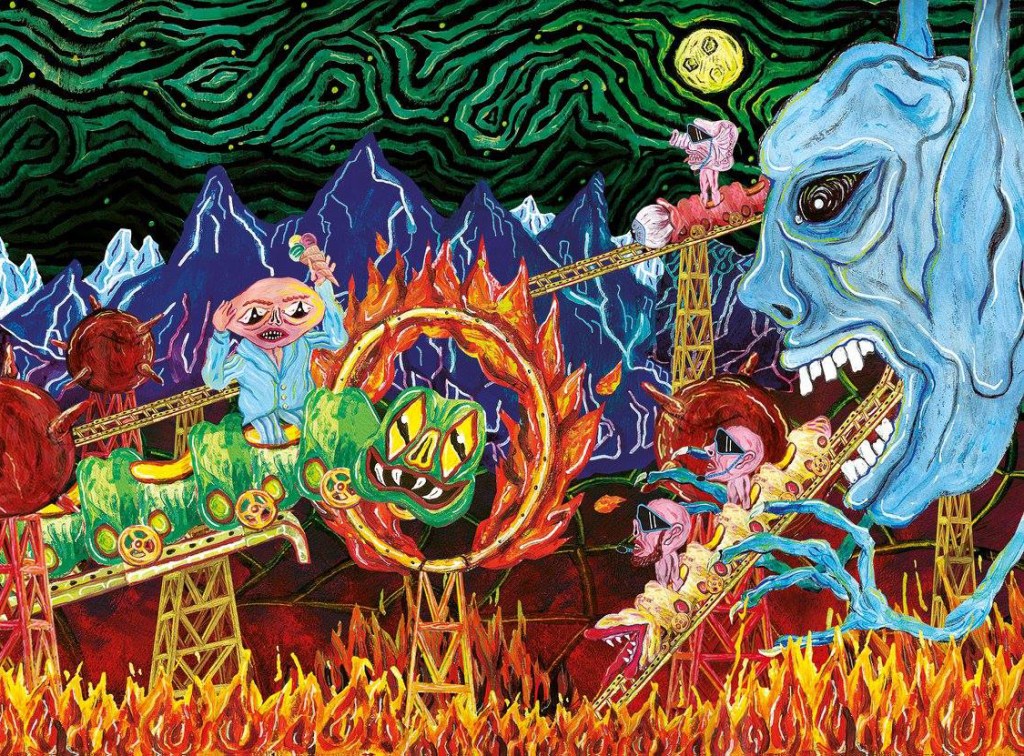
Lazzarin ha compiuto un piccolo miracolo. Non pago di una visione scintillante e meditata, ricca, vitale e carica di suggestioni, è riuscito a metterla in atto con coerenza e concretezza. Facendo ricorso alle risorse del crowfunding, con sommo stile e serietà, l’autore ha avuto modo di stampare una “copia conforme” al suo ideale, celebrato a furia di inventiva e personalità. Già diviso fra animazione, video e pittura, Lazzarin in questo volume rilancia un’idea di intrattenimento che annulla alla sorgente le divisioni tra cultura “alta” e lowbrow. Aminoacid Boy… deve infatti la sua riuscita tanto all’apparentemente lineare, ma ricchissimo e peculiare, comparto grafico e visivo, quanto alle vere e proprie derive narrative e “linguistiche” che porta nel cuore. Cronaca dell’alieno, dell’altro, del diverso che s’affaccia sul nostro mondo, più che mostrare un percorso di formazione o iniziazione il volume assomiglia a un conte philosophique per immagini, dove (s)ragionare a dovere sull’essere umano e quanto lo definisce. Per farlo, l’autore sceglie di frullare Chagall a furia di acidi e DMT, infilandoci a viva forza Francis Bacon, E. Munch, H. Bosch, il pop surrealista, la felice e caotica spinta creativa di un autore controcorrente quale Tom Bunk, cover di dischi, le visioni di Ed Wood e chissà cos’altro. Al di fuori dell’azzardo di paragoni discutìbili, l’impronta visiva, fantastica nella resa dei colori e del risultato, si rivela funzionale al risultato: un pastiche bizzarro in grado di rimandare al lettore l’assurdità grottesca della civiltà umana. Che tutto questo sia il frutto di un’opera prima, con le singole tavole dipinte a mano in tecnica mista (acrilico, acquerelli, chine, colori ad olio), pare un invito spicciolo al piacere e all’attesa del prossimo parto. Da supportare con tutto il cuore, in omaggio alla libertà creativa e all’indipendenza editoriale.
Amino Acid Boy and the Chaos Order

Lazzarin performed a small miracle. Not satisfied with a sparkling and meditated vision, rich, vital and full of suggestions, he managed to implement it with coherence and concreteness. Using the resources of crowdfunding, with great style and seriousness, the author was able to print a “compliant copy” of his ideal, celebrated by dint of inventiveness and personality. Already divided between animation, video and painting, Lazzarin in this volume relaunches an idea of ​​entertainment that cancels the divisions between “high” and lowbrow culture at its source. In fact, Aminoacid Boy… owes its success as much to the apparently linear, but very rich and peculiar, graphic and visual sector, as to the real narrative and “linguistic” drifts that it carries in its heart. Chronicle of the alien, of the other, of the different that faces our world, rather than showing a path of training or initiation, the volume resembles a conte philosophique for images, where (s)reason properly about the human being and what defines it. To do this, the author chooses to blend Chagall with acids and DMT, forcefully inserting Francis Bacon, E. Munch, H. Bosch, surrealist pop, the happy and chaotic creative drive of a counter-current author such as Tom Bunk, record covers, visions of Ed Wood and who knows what else. Apart from the risk of questionable comparisons, the visual imprint, fantastic in the rendering of the colors and the result, proves to be functional to the result: a bizarre pastiche able to remind the reader of the grotesque absurdity of human civilization. That all of this is the result of a first work, with the single panels painted by hand in mixed techniques (acrylic, watercolours, inks, oil colours), seems like a small invitation to pleasure and to wait for the next birth. To be supported wholeheartedly, in homage to creative freedom and editorial independence.
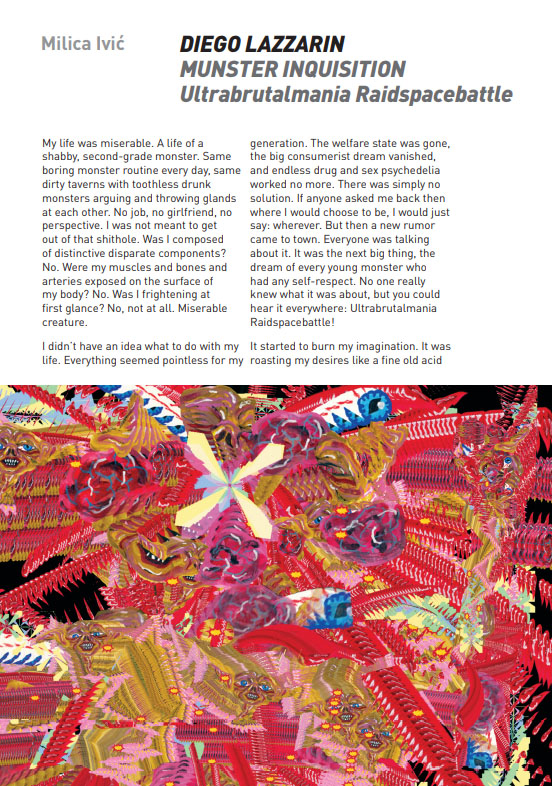

Article by Milica Ivic on Diego Lazzarin for the NOVO DOBA FESTIVAL catalog, 2022

DIEGO LAZZARIN
MUNSTER INQUISITION
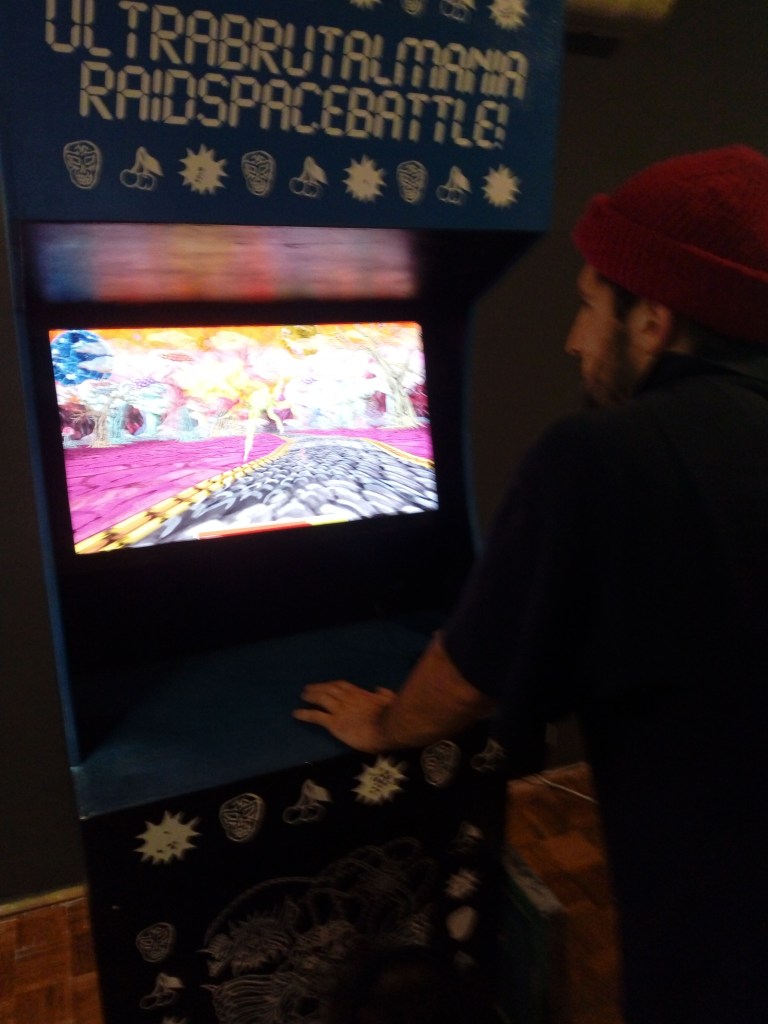
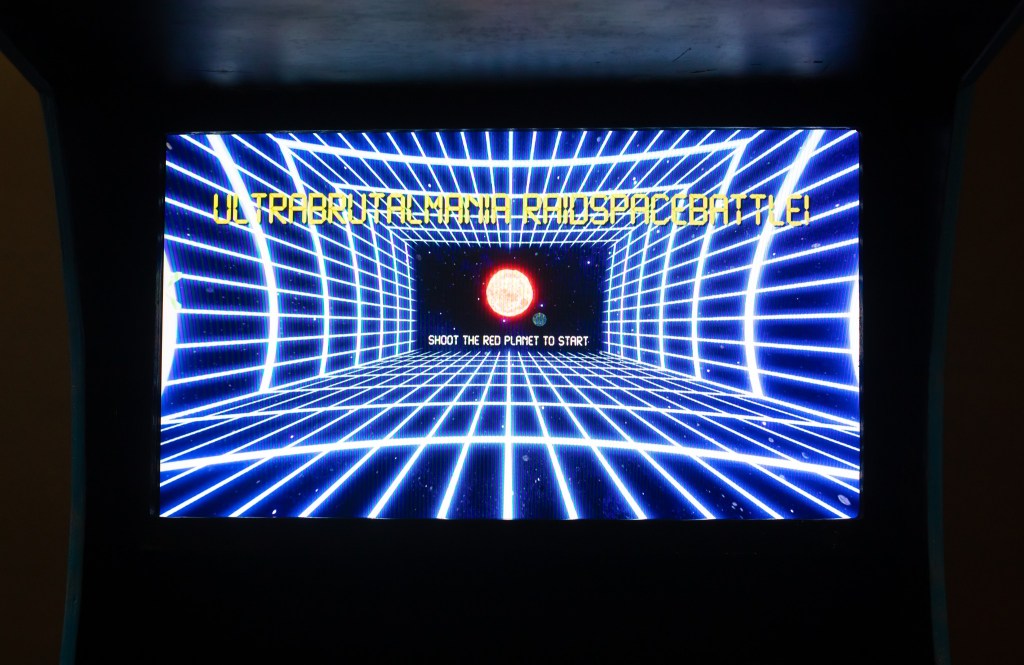
Ultrabrutalmania Raidspacebattle

Milica Ivić

My life was miserable. A life of a shabby, second-grade monster. Same boring monster routine every day, same dirty taverns with toothless drunk monsters arguing and throwing glands at each other. No job. no girlfriend, no perspective. I was not meant to get out of that shiihole. Was I composed of distinctive disparate components? No. Were my muscles and bones and arteries exposed on the surface of my body? No. Was I frightening at first glance? No, not at all. Miserable creature.

I didn’t have an idea what to do with my life. Everything seemed pointless for my generation. The welfare state was gone, the big consumerist dream vanished, and endless drug and sex psychedelia worked no more. There was simply no solution. If anyone asked me back then where I would choose to be. I would just say: wherever. But then a new rumor came to town. Everyone was talking about it. It was the next big thing, the dream of every young monster who had any self-respect. No one really knew what it was about, but you could hear it everywhere: Ultrabrutalmania Raidspacebattle!

It started to burn my imagination. It was roasting my desires like a fine old acid on exposed membranes. Apparently, it was a monster heaven, placed in between volcanoes and deserts, where mutants could show oft and go into a real battle.
That was my chance! I had no idea how to get there, but I was about to find out. I was obsessed, but focused! I was going mad, but determined to succeed. I was asking around and was listening to every conversation in the city just to get lo know who was behind this project.

And there it was. a legend, a myth, a shady figure of a guy called Diego.

Munster Inquisition – Exhibition in Belgrade. Photos by Jahvo Joža

Diego was good at hiding, but his activities were tracked. His movements appeared on the market. Information about him could be exchanged for some valuable goods. I paid a dozen of tzantzas for a chance to see him. I was given coordinates for his meeting with come Serbian “gallerists” who were willing to host Diego and the monster flock and use them for their dubious purposes.

Munster Inquisition – Exhibition in Belgrade. Photos by Jahvo Joža

He became known as the Monster Daddy. The monsters loved Diego and he loved them back. They became a loyal flock, well-trained, well-organized and ready to kill. But everyone knew that his monsters were so damn handsome. Well built, well dressed, with finest accessories, with a killing attitude. I was never meant to be a part of that good-looking crowd. I just did not have that appeal! The rumor went that he used knowledge of dental radiology and manipulation of x-rays to adapt the monsters he chose for the battle. He was picking ihem up at dirty bars, dark alleys and suburbs and transforming them into stars of Ultrabrutalmania! I was hoping I could get through his makeover treatment.

I knew I was The One for the Raidspacebattle. I was training myself to win any arcade battle with those ignorant fucks, splitting their asses on comfortable chairs while holding joysticks and pretending to kill monsters. Hold on you fart-catchers! I am about to show you the real battle! I was practicing levitation and shooting, appearing from the far right and lower left corner. I was multiplying my skills every day – improving side vision by avoiding vehicles on the highway while zigzagging in opposite directions, counting backwards while reciting the Catalog of ships from Homer’s Iliad and mixing highly saturated acids.

Preview of the game Ultrabrutalmania Raidspacebattle! Munster Inquisition – Exhibition in Belgrade. Photos by Jahvo Joža

I was strong and fit and I just had to find Diego first and get his attention. It was hard to get to him. No one knew him. He was not part of the comic publishing establishment, he could not be found in underground communities. He played by his own rules, surrounded by his monster friends.

Diego was good at hiding, but his activities were tracked. His movements appeared on the market. Information about him could be exchanged for some valuable goods. I paid a dozen of tzantzas for a chance to see him. I was given coordinates for his meeting with come Serbian “gallerists” who were willing to host Diego and the monster flock and use them for their dubious purposes.

Exhibition in Belgrade. Photos by Jahvo Joža

I really didn’t like that guy Diego at first glance. His face looked suspicious. He seemed kind, but everything I know about him was telling me I should be careful. He was not easily tricked.

I went to the designated location, disguised, hidden, listening into Diego talking:


Diego Lazzarin: Alien-Interview at LDC Ateliers (2019)

Person 1: Diego, it is too hard to survive. Couple of people tried and they could hardly get to the hippies.

Person 2: Yes. life just goes on shrinking and nothing is helping it out! Situation is desperate.

Person 1: Something like real life.

Person 2: We are all doomed! With larvae or without them.

Diego: Oooooh… OK. I will figure it out next week… maybe I will make it easier with less enemies

Person 2: Let us live longer!

Diego: OK… maybe I witl make the enemies cause less damage… I will think of a solution!

Person 1: How many places are there? Monsters, larvae, hippies, how many like this?

Diego: I think u more and then a final Boss. But you can recharge energy while you go.

Person 2: How?

Diego: There are some sort of pink meatballs. You shoot them and recharge.

Person 1: OK. let us know when you have some changes done!

SHOOT THE RED PLANET TO START

OK! The game has not still reached its final phase. It was still in the process! I could still get in! As I knew we were made for each other. I was determined to use the moment. I was waiting for Diego to start leaving the place and I threw mysell in from of him. Imitating ultracerebralmania to the point I was starting to really feel it. I was shaking and my body was decomposing like a boiled gum. Diego, weak as he was on monster suffering, ran to me to soothe the attack.

Diego said gently: Hey shorty, what’s up? This day is quite fine, isn’t it?

I screamed: I’m dead. I think I am dead!

Diego had a comforting look and I saw understanding in his eyes: What makes you think you are dead? Is it me?

I screamed even harder: Nooo! It’s not you! It is about my lungs. I am breathing backwards. The process is completely reversed! The air is being squeezed out of the alveoli when it should be there feeding the blood with oxygen. I am doomed!

Diego asked: Did it ever happen to you before? What can I do to help?

I was getting some ideas, but continued to scream loudly: No, this is the first time ever. Normally. I am fit and fixed. I am strong and in good shape. I can win a battle! (I partly calmed) There might be one thing that you can do to help?

Diego was curious: What would that be?

People that gathered around us were already continuing on their way, as it was clear that the attack I was having was over.

I whispered: You could take me with you and make me your monster! I can be part of your unbeatable squad in Ultrabrutalmania! I can fight them all.

Diego was smiling: OK, I have a proposition. I take you on a mission with me to see what you are made of? It would be a special mission. Hard, but exciting. We are going to Belgrade to fight the Old Wave that wants to take people to the New Era. Ewwww. Disgusting!

My eyes were radiating and my heart was beating in the rhythm of Tibetan drums: Carry me. lead me! The Old Wave has no chance against us. We will not be soaked in the retrograde shit soup of that wave.

Diego nodded: Promise!

And we were already on our way to 44.8125° N. 20.4612″ E.


Munster Inquisition – Exhibition in Belgrade, Matrijaršija, Remont Gallery (2022) Photo by Jahvo Joža

remont.net


Diego Lazzarin
Diego Lazzarin ‘Disaster’ 2015

Diego Lazzarin is one of the artists I have grown familiar with recently. Clicking my way onto his website I was immediately struck by the raw application of paint’s that created images that looked like the harlequin child of a Marc Chagall painting for the illustrations in his debut Graphic Novel ‘Amino Acid Boy and The Chaos Order’. Lazzarin gives a brief outline of the book which follows Amino Acid Boy a creature sent to earth by his lord a Bio-Architectural-Metal-Meat-Machine that lives in a dark cave in outer space. Whilst on earth Amino Acid Boy’s aim is to understand individual human desires by assimilating in himself the DNA of humans in order to understand their way of thinking outside of basic biological survival instincts which the lord finds incredibly illogical. With this transition of understanding inAmino Acid Boy various interesting scenarios promise to unfold.

Stephen Morton


MicrowavewerewolveS – LA VIOLENZA E’ KATTIVA !

Digging further through the website I came across Lazzarin’s animated videos. The videos stuck firmly in my head as an odd sickly coloured dew biologically infused cyber reality reminiscent of early mid-90’s video game cutscenes but in no way pastiche of retro style graphics but more so a progressive affirmation of this kind of aesthetic that he occupies very well, a world seemingly steeped in a sticky energy drink formula. One of my favourite of his video pieces though is for Lazzarin’s electronic music project Microwavewerewolves, the video and song Hagiography of Porn infuses a hot and frantic piece of electro music with a warped out and rehashed 70’s porno flick watched with bangers and mash, the result is both equally disturbing and hilarious.

Another video for a song Voglio Amore is a short and sweet horror chase involving a young terrified woman being tracked through a forest by a giant flying insect creature that then persists to dismember the women with venomous flames before defecating maggots into her pulped out stubs.


Aminoacid Boy and the Chaos Order on Indiegogo

With the 160 page ‘Amino Acid Boy and The Chaos Order’ Graphic Novel almost complete after three years of work and the aim for a crowd funding in May it would be worth while subscribing for updates on Lazzarin’s website to get involved in the realisation of this project. Also while your there check out his videos, music and other work on instagram.com/diego__lazzarin

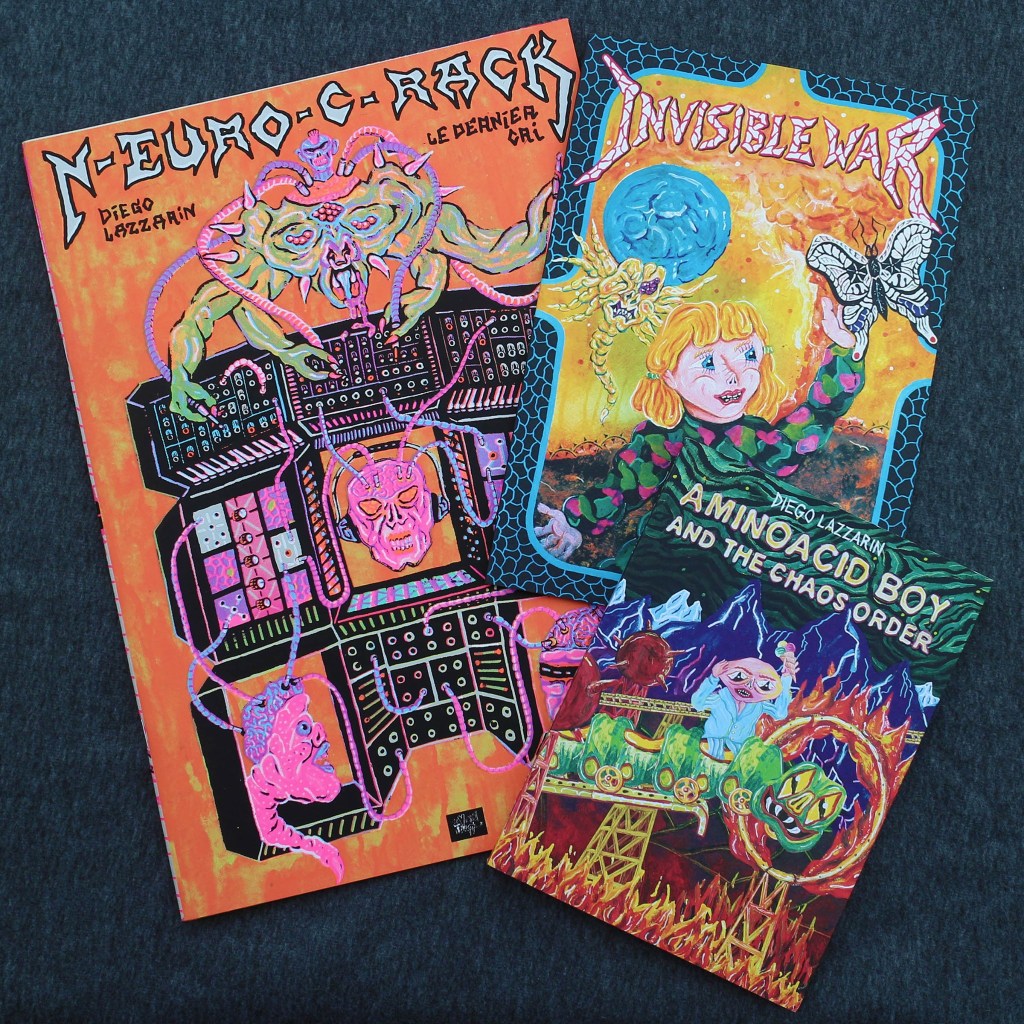
‘Aminoacid Boy’, ‘Invisible War’ & ‘N-euro C-rack’

LDC Editions: Diego Lazzarin

diegolazzarin.storenvy.com


Caroline Sury: Illustratrice, Éditrice, Auteure de Bandes Dessinées

Crack Festival 2017 (1)
Caroline Sury / Crack Festival (2017)
pain-labelledemai
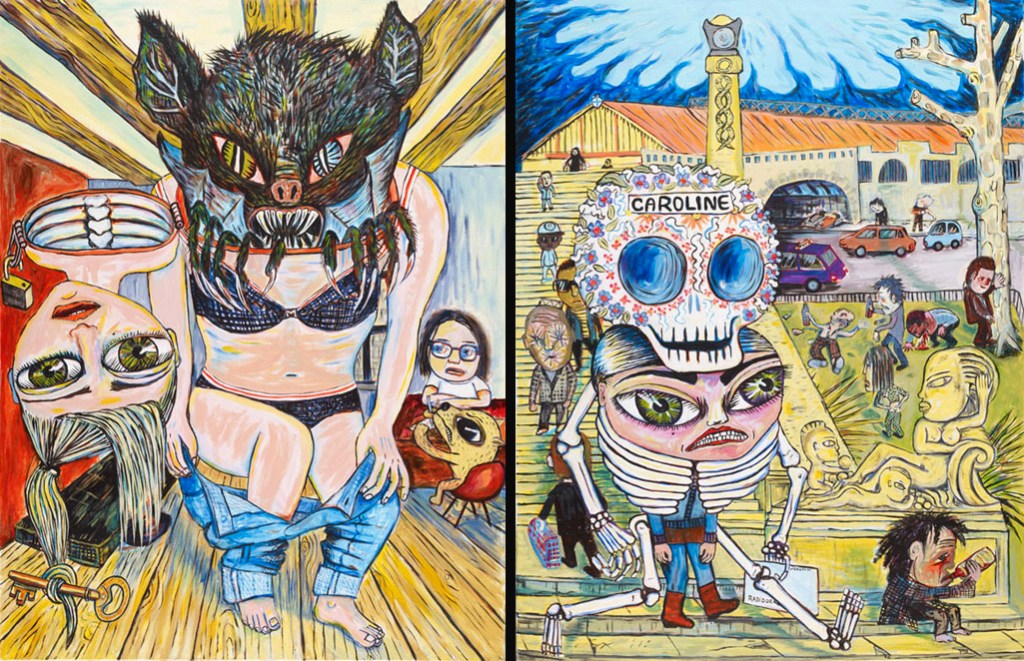
Caroline Sury ‘La belle de mai’ 110 x 96cm, acrylic on canvas (2011)

Marseille est un Théâtre Vivant

Elle le dit elle-même : « Je suis une spectatrice. » Alors qui, mieux que Caroline Sury, qui passe du regard au dessin « presque automatiquement », pouvait donner de Mar­seille et des Marseillais une vision plus intime et précise ?

Certes elle n’est pas d’ici. Née en 1964 à Laval, c’est une Mayennaise au pays de l’aïoli. Mais voilà plus de vingt ans que son regard s’aiguise au contact de la ville qu’elle s’est choisie, et aujourd’hui, si elle ne se sent pas forcément mar­seillaise, elle n’a plus envie de changer de décor.

« Je ne me vois pas vivre ailleurs », confie-t-elle, comme si c’était une révélation. « Marseille va très bien avec mon état d’esprit, qui est toujours un peu fébrile. Je suis toujours en train de me poser des questions, je veux toujours autre chose. Marseille est comme ça, un peu fébrile. Il y a du pus, de la cloque, du bubon. C’est le beau paysage bien tourmenté de ma vie tourmentée ! »

Là où d’autres artistes aspirent à la sérénité, à la quiétude, elle a besoin d’une forme de mouvement perpétuel, qu’elle trouve dans son atelier situé entre la Canebière et la Plaine. Mais aussi et surtout dans la rue. « J’aime la campagne, la nature, voir des mésanges, mais au bout d’un moment, c’est un peu chiant. »

Les petites villes n’ont pas plus d’attrait pour elle. Elle sait de quoi elle parle, ayant grandi dans le chef-lieu de la Mayenne avant d’étudier aux Beaux-Arts d’Angers. « Les villes moyennes, c’est juste affreux. Marseille, c’est énorme. Il y a plein de choses différentes, plein de choses bordéli-ques qui se passent. C’est ça qui est intéressant. Dans les petites villes, tout est lissé. Il y a une forme de standardi­sation », dit-elle.

pain-lecturedorganes
Caroline Sury ‘Souvenir d’organes’ 110 x 96 cm, acrylic on canvas (2011)

Il lui suffit de se rendre de chez elle à son atelier – et ee n’est pas très loin — pour trouver matière à observer, à des­siner. Marseille est un théâtre vivant.

« Dans ma rue, tu as un coiffeur, Lorenzo, où tous les footeux viennent se faire couper les cheveux. Ils viennent et se garent en double file, tu as toujours des embouteillages et tous ces garçons dehors avec des coupes de cheveux pas pos­sibles et leur shampooing, ils sortent dehors avec ça. »

Ce spectacle authentiquement vivant lui donne envie de se promener sans cesse avec un carnet, pour croquer ces tranches de vie qu’elle saisit au bond, chez le boulanger ou au supermarché. « J’essaie souvent de ne pas oublier un per­sonnage, de le reproduire quand je rentre à la maison. Et comme je fais de la BD, j’ai toujours un petit scénario qui se met en place. »

Aussi quand elle part, et elle le fait souvent comme nombre d’artistes marseillais qui réhabilitent le côté port d’attache de la ville pour exposer ailleurs, en province, à l’étranger, ce bouillonnement la rappelle. « Au bout d’un moment, ça me manque, l’effervescence, le côté malade ici, où les choses les plus laides côtoient les choses les plus belles. L’écart qui existe entre les choses, c’est nourrissant, c’est la vie. Marseille est une ville pauvre. Mais c’est pour ça qu’elle est riche. »

pain-monstreinterieur
Caroline Sury ‘Monstre intérieur’ & ‘gare Saint-Charles’ 110 x 96 cm, acrylic on canvas (2011)
Mademoiselle_la_Tarte-9
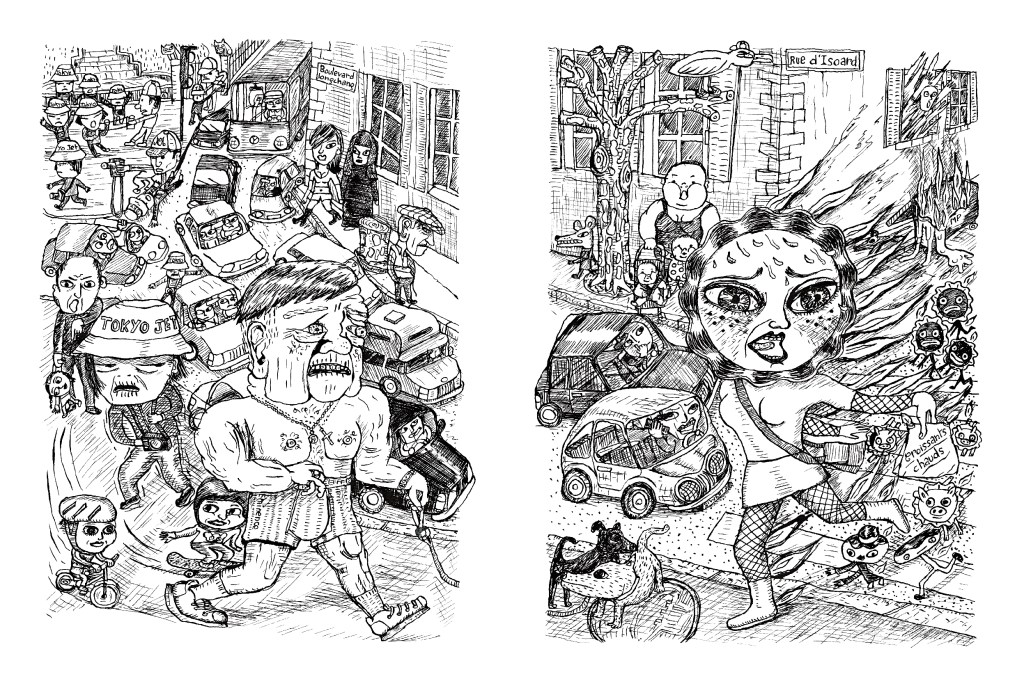
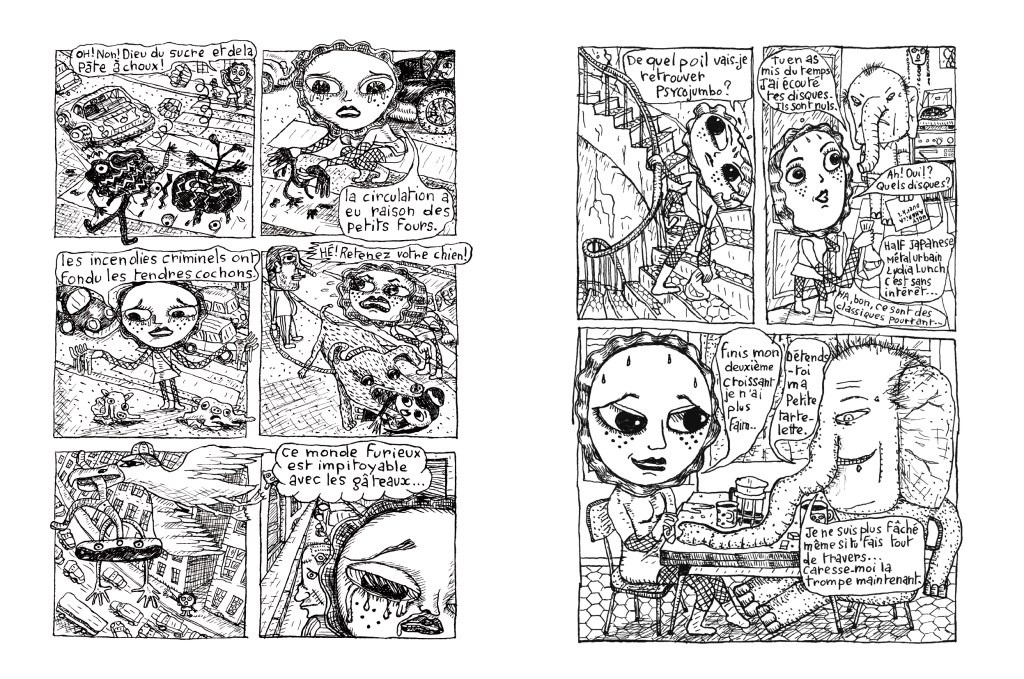
Un Matin avec Mlle Latarte © Caroline Sury / Le Monte-en-l’air 2019

Caroline Sury évoque le Marseille du début du xixe siècle, celui de Victor Gelu, qu’elle a lu récemment, ses rues sales où l’on jetait les ordures par la fenêtre, ces quartiers populaires à la lame facile. Elle se demande si la ville a tant changé que ça. Mais c’est ce qui lui plaît.

Son périple a été un peu long pour échouer jusqu’ici. Après Angers, elle s’installe à Bordeaux pendant huit ans et monte enfin à Paris, pour y développer la maison d’édition artistique Le Dernier Cri avec son compagnon d’alors, Pakito Bolino, qui la dirige toujours aujourd’hui. Mais si Paris bouillonne aussi, si le milieu du graphisme et du dessin y est extrêmement vivace, il faut vivre. Le couple descend à Marseille en 1995, autant pour son niveau de vie plus abordable que pour s’ou­vrir des horizons nouveaux.
« A Paris, quand je travaillais au Dernier Cri, j’étais comme à la cave. Je ne sortais jamais ! »… Marseille va lui apporter de la lumière, de l’espace, un heu de travail aussi. Par chance, Pakito et Caroline, également musiciens, retrouvent, à la Friche la Belle-de-Mai, Ferdinand Richard, un ami croisé sur les scènes musicales. Ils lui montrent leur travail et se voient offrir un atelier dans ce heu culturel encore… en friche. Avec d’autres, ils en essuieront les plâtres.

Résidence de Caroline Sury et Ameline Ludovic à La gangue pour la préparation de l’exposition de Spéléographie à Rennes Aux Atelier du vent en (La Gangue) 2020
Mademoiselle_la_Tarte-10
Un Matin avec Mlle Latarte © Caroline Sury / Le Monte-en-l’air 2019
Caroline Sury ‘Happy Fire Year’ 2017

« Quand nous sommes arrivés, il n’y avait presque rien. Nous avons eu nos machines de sérigraphie avant d’avoir un local. On a construit les cloisons autour des machines ! » À la Friche, qui a ouvert seulement trois ans plus tôt, les deux jeunes trentenaires se dépensent sans compter et éditent à tour de bras ce qu’ils aiment, leurs travaux mais aussi ceux d’autres dessinateurs et illustrateurs inspirés comme eux de l’art brut, de Jean Dubuffet ou du peintre dadaïste allemand Georges Grosz, influences revendiquées par Caroline.

L’installation n’est pas toujours évidente et le contact avec les décideurs locaux parfois surprenant. Un jour, un respon­sable culturel de la ville débarque dans leur atelier, en man­teau de cuir et écharpe blanche, et se félicite de les voir travailler en couple « comme la boulangère et le boulanger ». Et sort sans plus de cérémonie. Un peu plus tard, c’est un article sur Caroline dans le magazine Marseille L’Hebdo qui pousse le patron de la direction générale des affaires culturelles de la ville, Jean Mangion, à leur accorder une subvention.

Caroline Sury devient peu à peu une référence marseillaise. Ses dessins un peu trash, aux traits gras, dégoulinants d’hu­manité, s’imposent dans les colonnes de Marseille L’Hebdo, où elle officie pendant six ans entre 2000 et 2006 avant de pour­suivre cette activité de dessinatrice de presse pour CQFD, après avoir également collaboré à Libération, Et elle admet que la ville où elle vit a certainement influencé sa manière de voir et donc sa façon de dessiner.

Crack Festival 2017 (2)
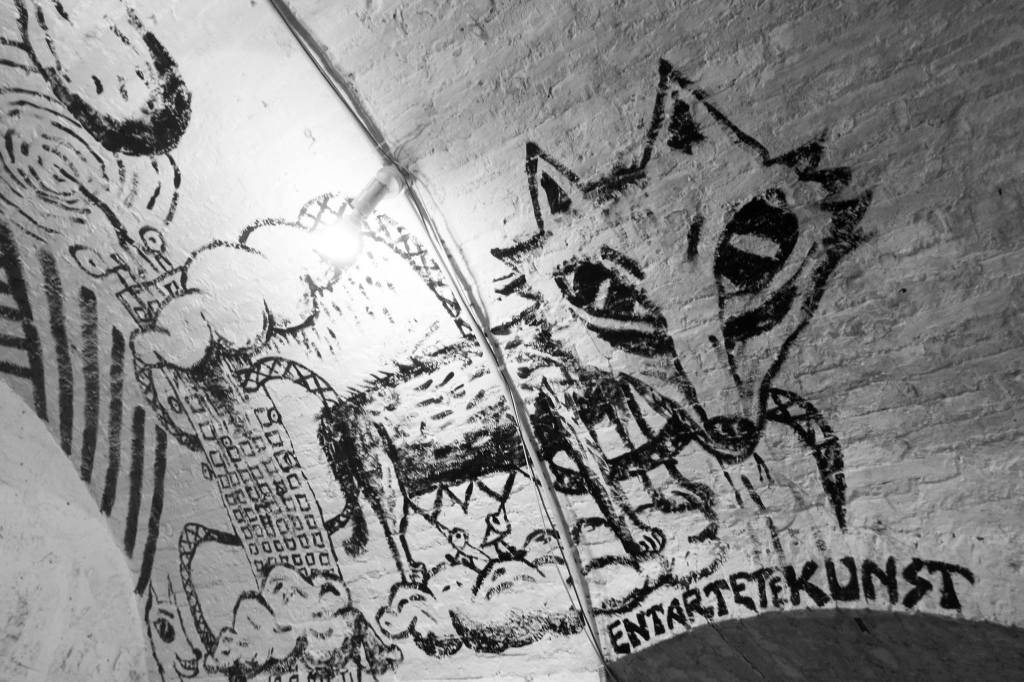
Mural art by Caroline Sury / Crack Festival (2017)
Crack Festival 2017 (3)

« Il y a ici des gueules qu’on ne voit pas ailleurs. C’est unique. Même à Naples, les gens sont plus distingués, ils ont ce côté italien, tu croises toujours des têtes de madones. Ici, c’est n’importe quoi, on a tous les milieux populaires du monde entier qui viennent ici. Il y a des rictus, des manières de faire. Je suis toujours choquée et amusée. C’est du théâtre et j’adore ça. » Mieux encore, pour elle Marseille, « ça grouille » et c’est tant mieux… « J’adore dessiner des foules. C’est ma spécialité, les foules avec des individus qui se dé­tachent. Pour ça, ici, je suis servie. »

La ville, elle l’a aussi découverte autrement, dans ses es­paces, son urbanité, son architecture et ses quartiers en par­ticipant aux Promenades urbaines initiées par l’artiste-marcheur Nicolas Mérnain. « Ça m’a bien plu, ces promenades, parce que c’est moi qui conduisais. J’adore conduire à Marseille, c’est speed et j’aime le speed, je suis quelqu’un d’énervé, j’aime bien freiner, accélérer, découvrir d’autres quartiers, d’autres architectures. »

Alors, est-elle devenue marseillaise pour autant au bout de vingt-trois ans ? Elle n’en est pas sûre, parce qu’elle fréquente « des réseaux underground très structurés », beaucoup de néo-arrivants accourus à Marseille après l’arrivée du TGV, parce qu’elle a ses adresses, son microcosme, à L’Embobineuse et La Machine à coudre pour les concerts, au Bar à Pain pour la bouffe. Bref, elle se mélange peu. Mais n’est-ce pas très marseillais, justement, ce confinement ?

Elle admet cependant aimer le Gambetta, cette boisson à la figue typiquement d’ici, et aller nager de Malmousque jusqu’aux îles. « La mer, c’est sublime. La côte ici, la côte Bleue, il n’y a rien de plus beau. Ça y est, je deviens chauvine… »

Crack Festival 2017 (12)
Mural art by Caroline Sury / Crack Festival (2017)
Crack Festival 2017 (5)
Mural art by Caroline Sury / Crack Festival (2017)
Caroline Sury ‘Drawing as Language’ Talk (2016)
Mural art by Caroline Sury / Crack Festival (2017)

Et celle qui se définit comme « la plus mauvaise des négo­ciatrices », qui n’a jamais sollicité subventions ou faveurs, qui comme la plupart des artistes locaux est « passée complète­ment à coté de Marseille-Provence 2013 », qui a plus connu le RSA que les allocations chômage, s’inquiète de voir dispa­raître ce Marseille populaire qu’elle a appris à aimer.

« Je suis un peu inquiète quand je vois ce que devient Eu-roméditerranée, quand j’entends qu’on veut déplacer les pe­tits commerçants du marché de Belsunce ou de la rue Longue-des-Capucins pour les remplacer par des choses qui seront forcément de mauvais goût, quand on veut interdire les marchands à la sauvette de la Plaine chez qui se fournissent les gens qui n’ont pas beaucoup de moyens, sous prétexte qu’ils font de la concurrence aux grandes enseignes du centre-ville. Ce n’est pas à cause d’eux que le centre-ville se paupé­rise, mais plutôt à cause des grands centres commerciaux comme Les Terrasses du Port. »

En attendant, Caroline Sury déborde de projets que, comme souvent, elle n’a pas sollicités. En mai 2018, elle fournira d’immenses silhouettes pout un spectacle dans les rues de Marseille, où elle pourra enfin décliner son goût pour les jeux d’ombres et de lumières, les formes totémiques, et un penchant encore inassouvi pour l’Asie, Bah, le Cambodge, le Japon, qu’elle rêve de découvrir bientôt.
Avant de regagner son port d’attache.

Extrait du livre Les Marseillais

Les Marseillais de Patrick Coulomb et François Thomazeau
Nouveau titre de la collection « Lignes de vie d’un peuple »,
aux ateliers henry dougier.


Discussion de Marie-Pierre Brunel et Caroline Sury & Ameline Ludovic (La Gangue)

facebook: Caroline Sury / instagram: Caroline Sury


A Visual History of Black Metal Demotapes Radicalism: Analogue Black Terror

release-3
Detail: Analogue Black Terror by Nuclear War Now !

‘Between the late 80’s and 2000 , a fringe of the extreme heavy metal youth culture decided to secede from the contemporary scenes to express their deep disgust and hostility towards  organized religions, democracies, human rights, the modern world, and humankind in general. Driven by hatred, misanthropy and Satanism, fueled by juvenile passion, and with very limited means, they produced myriads of home made Black Metal recordings which left no room whatsoever to tolerance, mercy, or any kind of positive energy. Some were spoiled brats in search for a reason to rebel, some were convicted murderers, arsonists, grave desecrators or rapists, others were merely incredibly talented artists with a sincere will to put their work in the service of a greater evil.’

disscetion1
Dissection ‘The Somberlain’ Promo demo tape 1992
release-5
Hard cloth-bound book, 260 pages, 13″x13″
release-4

‘Over the last several years, accomplished graphic designer and visual artist Jean Simoulin (also known as “Valnoir”) has painstakingly amassed more than 450 demo covers representing the most influential works of the Black Metal underground during the 1980s and 1990s. The purpose of this compendium is principally aesthetic; the graphic presentation and imagery depicted here is a manifestation of the spiritual rebellion of the era in all its nihilistic fervor and antisocial praxis. This was a time just before the ascent of a tyrannical array of silicon gods, before the ushering in of a new hegemonic system of secular mores, before the atomization of the social order. Black Metal was menacing, an oppositional force ripping away at the last threads of the social fabric and the religious and moral dogmas holding it together. The young men (and, occasionally, women) living at the margins of society found within this scene an exaltation of misanthropy and vehement disdain for the repugnant values of mainstream society, either through a return to a more virtuous pre-Christian past, or by accelerating the total dissolution of contemporary institutions and customs, heralding in a new Satanic eon. More than any other format, demo tapes showcase the elemental virtues of the scene’s early adherents. These were the most passionate products made by the artists, usually at a time before the bands achieved any recognition, when they strove to stand apart from their peers. The homemade covers, cut and folded by hand and adorned with photocopied images and type or handwritten text, are the purest distillation of the aesthetic core of the scene. These tapes moved around the world through the underground mail circuit, advertised in small zines and sold by the bands directly, or dubbed and traded among devotees of the genre. To assemble this book, Valnoir meticulously collected high resolution scans from primary sources of some of the most crucial and elusive demos created. The impact of the book comes not from the mere collection of images—many of which can be found online, though some cannot—but from the manner which they’ve been aggregated, correlated, and juxtaposed. There is also the reverent act of committing ink to paper, a permanence that is lost when images are merely set adrift on the ephemeral sea of the internet amid the whipping winds of informational entropy. This is an unparalleled presentation for a book of this sort. “Analogue Black Terror” is a cloth-bound 13” x 13” book containing 260 pages of high quality images, as well as essays by Valnoir, Nicolas Ballet, and YK Insulter of NWN! Productions.’

J. Campbell

emperor2
Emperor ‘Wrath of the Tyrant’ 1992

Bleu Blanc Satan : Documentary retraces the birth of the black metal scene in France through unpublished archives and interviews of the main pioneers of this movement.

for more info & order:

metastazis.com

ANALOGUE BLACK TERROR