Un maroilles d’inepties acrimonieuses plante une chimère dans mon oreille tandis que je chorégraphie nos asphyxies sur l’opacité d’épouvantables sonorités
Il y a ce hideux cheptel de suffocations et d’étranglements qui tord mon être en biais et je nous envoûte de perlimpinpin hystérique pour nous préserver de ces marais insondables de l’immobilité
Bientôt je surgirai de l’habitacle de nos vengeances comme une agression lardée d’extériorités naïves pour faire de nos apitoiements une amplification de brûlures taboues.
Art Rock/Variété Sombre (2025)
J’eucuménise nos salissures de goujaterie en explorant toute la vaginité des pourritures ergonomiques qui nous fellationnent en morceaux d’inaptitude fluo-pop
Un blockhaus de passions impossibles a poussé dans les limbes de mon Satan abdominale et des larves partouzardes viennent se laver le ventre dans mon cerveau qui digère le Golgotha des utérus-cercueils qui nous ont projeté dans les nuits nécrophages de l’acte anatomique
Le seul oeil qui me reste se gonfle de petites apocalypses pour scruter l’évidence tranchante de ma disparition prochaine dans les chaos onctueux de l’atome.
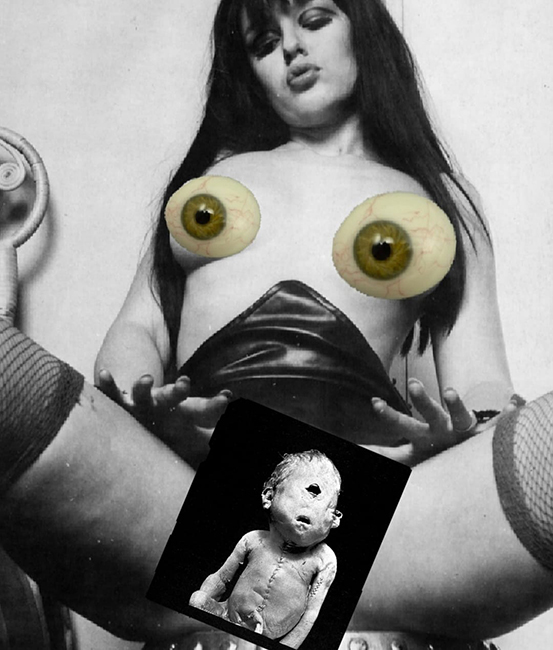
Michaël Potier, collage, 2023
Michaël Potier, collage, 2023
Inépuisé par mes branlettes de chevalerie chinoise je m’insinue entre les craquèlements de mon cadavre empourpré de désobéissance bleue et d’aubades sacrificelles
Les sons fracturés d’un enspermement de cataclysme nous engraisse de ketchup lesbien et nous sommes tout crevés d’herpes géométrique, complètement agités par des sommeils déchaînés
Je veux jouir de la cruauté de mes théâtres d’infidélités ovoïdes et nous plonger dans les catéchismes pâtissiers de nos pensées tressées de sutures de tressaillements dialectiques
La pourriture des amourettes trépanées se répand sur nos ailes chiffonnées par le tempo bâtard des poésies vénériennes.
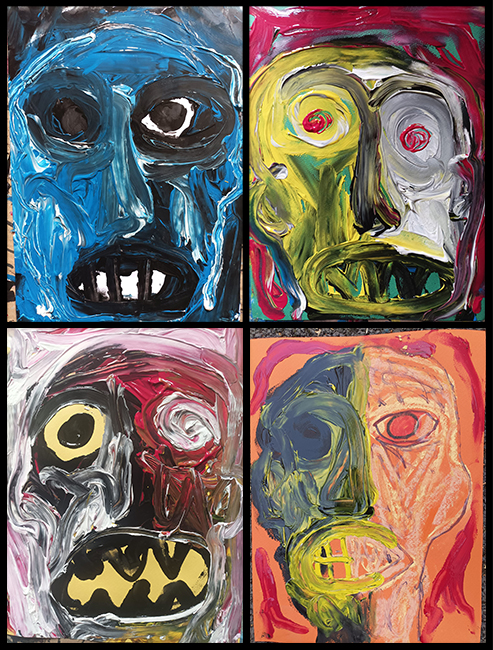
Michaël Potier, Peintures Portraits, 2022
Le Poète de la Folie: Michael Potier
Michaël Potier comes from the luminous forces of Jazz and he has played in many groups all over France. He relentlessly writes trashy-surreal poetry, paints, draws and uses his body as an object of Raw Art. He also likes the disturbing and the caustic humor and borrows the carcasses of art to invent a sound poetry without restrictions.
Live cru by Potier (2026)
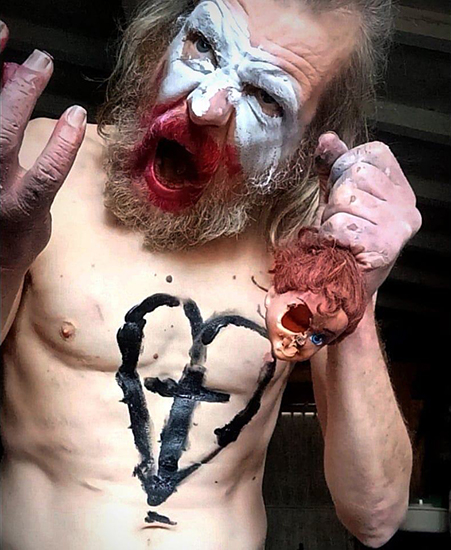
Potier est un artiste polymorphe, poète de l’absurde, musicien multi-instrumentiste et performer chevronné. Performance donnée dans une galerie d’art à Bruxelles.
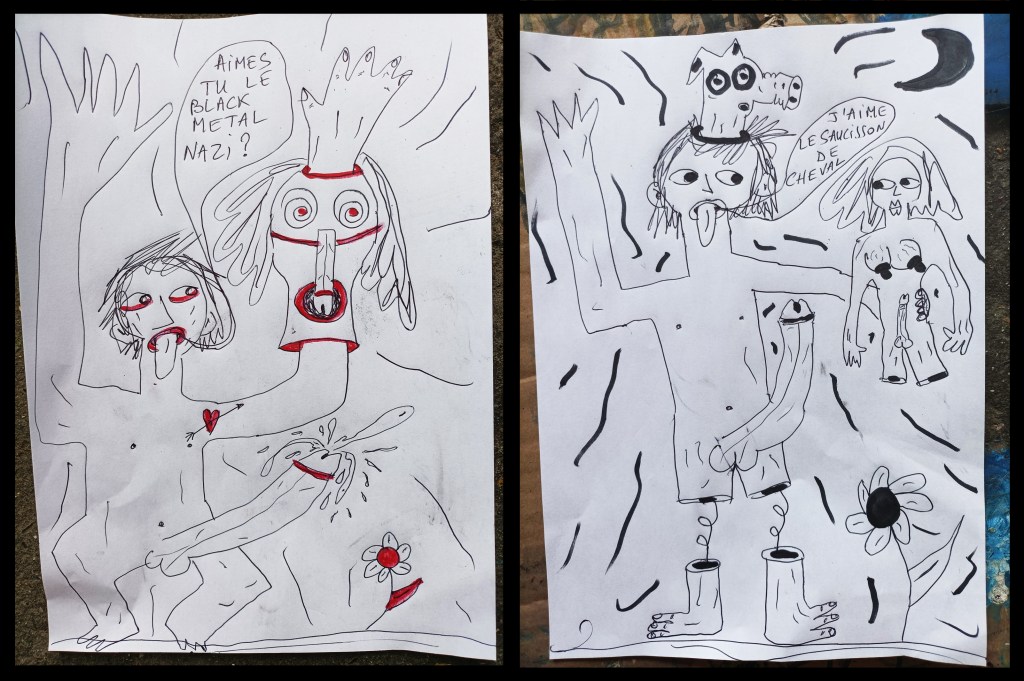
Michaël Potier, Dessins Ornithorynque, 2022
Ornithorynque de l’art
Musicien Gonflable
Écriture Hallucinée
“Je viens des forces lumineuses du jazz et j’ai joué dans de nombreux groupes en peu partout en France J’écris avec acharnement de la poésie trashy-surréaliste Je peins et je dessine et je me sers de mon corps comme un objet d’art brut J’aime ce qui dérange et l’humour caustique J’emprunte les carcasses de l’art pour inventer une poésie sonore sans restrictions.”
Michaël Potier, Peintures Portraits, 2022
Nos coccyx de carton glacé se détraquent sur la clarté des amanites de la puberté psychotronique
L’haleine crayonnante que j’exhale sur la féminité des silences sodomites réapparaît subrepticement dans la cranule de mes poupées aux poumons géants
Mes clarines d’isolement sonnent l’heure de nos destins frôlés par l’araignée des fantasmagories déconstruites par la brise de l’endolorissement matinal et je jure sur la naissance de mes cochons métaboliques ne plus dire je t’aime aux sorcières de l’autodestruction
Tout est profondément nocturne dans les crevasses de nos hargnes illisibles et c’est Jésus qui m’encule quand j’assiste à mon propre enterrement.
Hätte Marc Caro im 19. Jahrhundert gelebt, er wäre ein bombenwerfender russischer Nihilist geworden. Erfreulicherweise ist Marc Caro ein zeitgenössischer französischer Comiczeichner, wobei wir die Gegenwart aus gegebenem Anlaß 1976 beginnen lassen. Was sich 1976 andernorts in der Rockszene manifestierte, veränderte in Frankreich das Aussehen der Comickunst nachhaltig.
1975 gründeten Olivia Clavel, Christian Chapiron, Loulou Picasso, Lulu Larsen und Bernard Vidal — größtenteils ehemalige Studenten der Kunstakademie — die Gruppe Bazooka. In einer Mischung aus teilweise gewolltem Dilettantismus und hochgradiger Perfektion zertrümmert Bazooka voll anarchistischer Freude die Selbstverständlichkeiten des klassischen Comic. Ihren ausgeprägten Gefallen am Schockierenden, Abseitigen teilen sie mit vielen der gleichzeitig oder nach ihnen erscheinenden Comicschaffenden, die neben nervöser Grafik auch Fotos verwenden (Polizistenfotos, Leichenfotos, etc.).
“(Diese Richtung) ist gekennzeichnet durch einen schmutzigen, rohen, unfertigen Strich und durch die gewollte Obszönität einer morbiden und/oder sexuellen Thematik.” Aus der nachfolgenden Generation seien genannt: Matt Kon-ture, der gelegentlich an den frühen Caro erinnert, La Casinie-re, Mokeit, J.C. Menu, der auch das hervorragende LE LYNX (nach 7 Nummern leider eingegangen) herausgegeben hat, Jocelin, der vor allem im eigenen AMTRAMDRAM seine kubo-expressionistischen Bilderserien abdruckt. Hingewiesen sei noch auf SEDUCTION, hervorragende Fanzine-Zeitschrift, die in Troyes herauskommt. Hier, wie in den zahllosen Graphzines und 30-Exemplare-Produkten trifft man immer wieder auch Bruno Richard, Placid, Muzo, Marc Caro, gelegentlich auch Gotting und Loustal. Viele der Genannten arbeiten zugleich auch in der Malerei, in der Musik (was man halt so nennt) und im Trickfilm.
Nach ersten Veröffentlichungen in Fanzines kam Marc Caro 1976 aus Avignon nach Paris und begann recht bald, einzelne Arbeiten und kurze Comics (eine Geschichte von Caro ist lang, wenn sie 4 bis 6 Seiten umfaßt) in Comiczeitschriften zu veröffentlichen. 1981 erschien TOT, eine Sammlung bis dahin veröffentlichter Comics. Mit Jean-Pierre Jeunet, für dessen Animationsfilme er bereits früher Trickfiguren gebaut hatte, drehte er 1981 den Kurzfilm Le Bunker de la derniere rafale. Er beginnt, die Möglichkeiten der Computergrafik zu benutzen, interessiert sich für das Video. Er produzierte Musikvideos für Jean-Michel Jarre (Trickfiguren für Zoolook) und die erfolgreiche, aber nicht weiter bemerkenswerte Popgruppe Indochine (Les Tsars). 1987 erschien mit IN VITRO eine Sammlung seiner späteren, holzschnittartigen Comics. Heute zeichnet er fast gar nicht mehr, produziert gelegentlich Musikvideos. Die frühen Sachen, in Fanzines wie FALATOFF, Keimzelle des Kleinverlags Artefact, und ab 1976 auch in Metal Hurlant, Charlie, BD-Hebdo erschienen, erzählen von Selbstverstümmlern, Elektroschock-Rollkommandos, Kannibalismus im Bunker, von Rockmusikern, welche sich auf der Bühne Gliedmaßen abschneiden. Es ist bereits die Zeit der Indu-strial-Tendenz, mit der Caro die Faszination für Gewaltsysteme, das Verstümmeln und sonstige Pathologien teilt.
Marc Caro and Jean-Pierre Jeunet “Bunker of the Last Gunshots” (1981)
Marc Caro sagt, seine früheren Sachen seien realistischer. Die Bildflächen sind mit verschiedenartigen Schraffuren und darüber hinaus mit dunkleren oder helleren Rastern fast vollständig bedeckt.
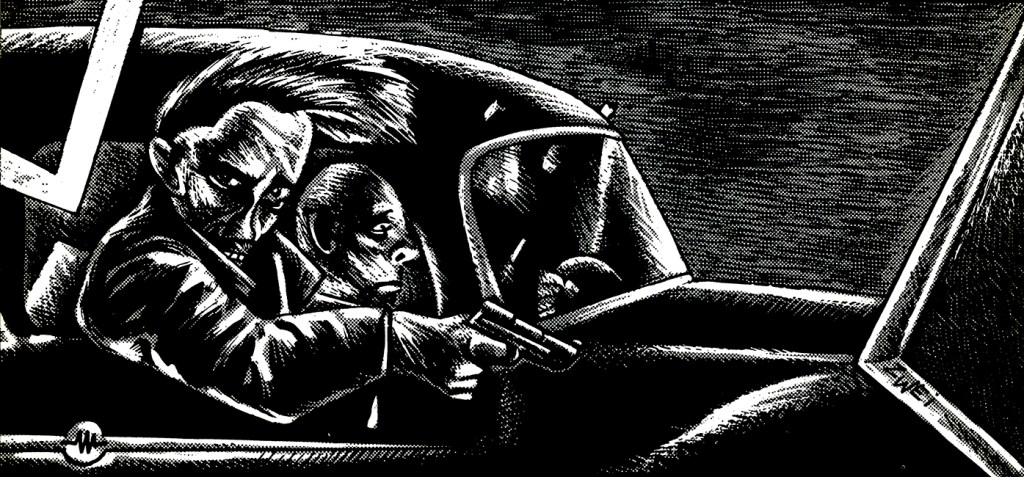
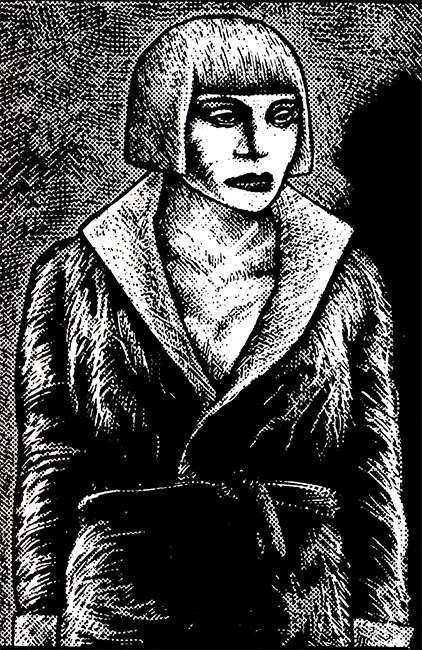
Die menschlichen Figuren sehen ungefähr menschlich aus, meist etwas deformiert. Etwa an George Grosz erinnernd, nur mit den Mitteln der realistischen Illusion dargestellt, die Zeichnung ist körperlicher. Ich kenne 27 Geschichten von Marc Caro, nur in dreien sind Sprechblasen mit erzähltechnischer Bedeutung, in den übrigen gibt es einen Text über dem Bild. Man dächte, daß der Text unter solchen Bedingungen eine doppelt große Erzähllast tragen muß, in der Tat erzählt uns der Text aber oft etwas anderes als das Bild. In TOT ist eine Geschichte, worin der Text die Briefe eines US-Soldaten aus Vietnam an seine ‘liebe Louisa” wiedergibt, er berichtet von der zweifelhaften Kampfmoral seines Mitsoldaten. Die Bilder sagen, daß er “verrückt” wird und vietnamesiche Leichen schändet. Vielleicht ist dies auch eine der “anthropologischen” Geschichten, die Caro im Gespräch meint.
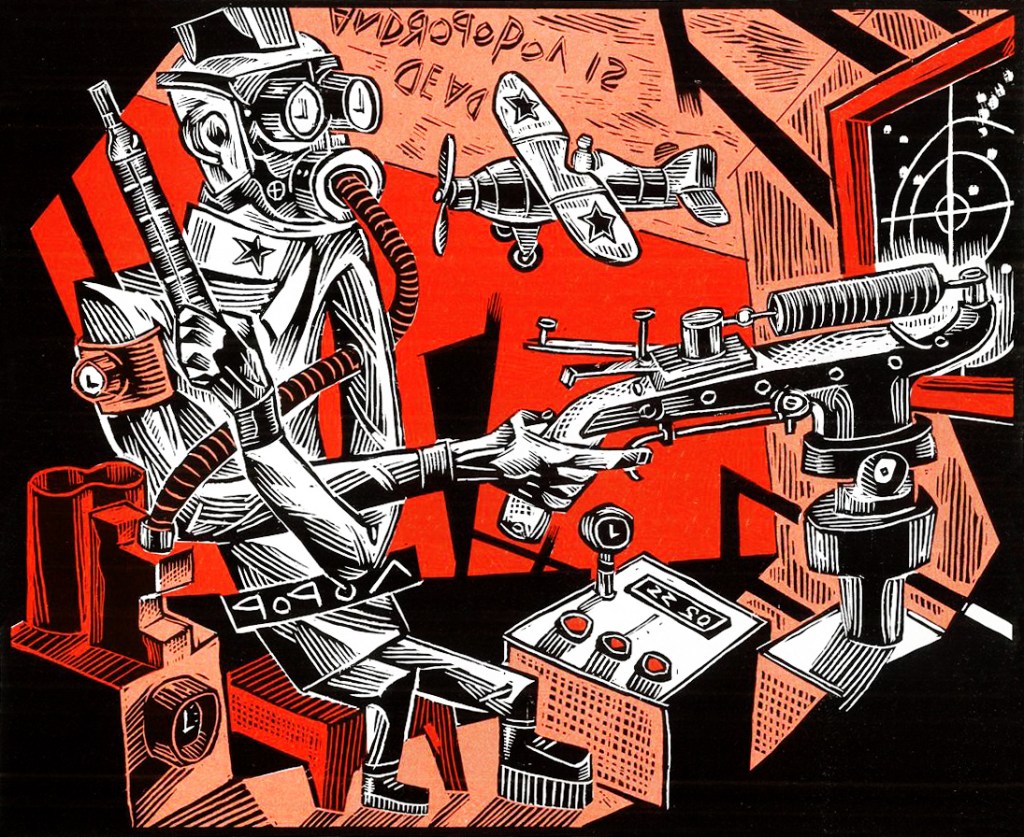
Die späteren Comicgeschichten, gesammelt in IN VITRO, verwenden häufig den Holz- oder Linolschnitt. Ein Übergang, der gröbere, eckige Linien, aber auch eine größere Klarheit des Bildes bringt. Diese Geschichten sind vierfar big, gelegentlich sogar ziemlich bunt, und vom Inhalt auch fröhlicher: eine Sommer-Sonnen-Strand-Geschichte mit lustigen (der junge Mann klebt sich Toastbrot auf die Ohren um der jungen Frau zu gefallen) und kaf-kaesken Elementen (2 Meter große Fliege).
In diesen späteren Geschichten wird fast ausschließlich die Halbtotale benutzt, die filmischen Mittel der Bilddramaturgie nur wenig verwendet. Die Geschichten sind daher weniger eindringlich, weniger “realistisch”. In den früheren Geschichten gibt es oft den acteur-narra-teur- einen, der erzählt oder sonstwie den Text liefert und zugleich die Hauptfigur ist. Diese Figur besitzt selten ein entwickeltes Innenleben, dafür sind die Geschichten auch zu kurz. Oft ist die Hauptfigur, am Ende der Handlung tot, denn er kann so ja eigentlich nicht mehr die Geschichte erzählen.
Ich glaube, es wäre falsch, das Schockierende in den Geschichten Caros übermäßig zu betonen. Er betreibt kein epater le bourgois, seine “Geschmak-klosigkeiten” sind nicht dazu da, moralisch empfindenden Menschen Alp-träu- me zu bereiten. Auch geben seine Geschichten, trotz düsterer Bunkerwelten, nur wenig zu einer emphatischen Apokalyp-sensentimentaliät her. Es ist geschrieben worden, Marc Caro betreibe Schwarzen Humor. Vermutlich sind seine Comics humoristisch, schwarz sind sie sicher. Das Interview mit Marc Caro fand am 8. Mai 1989 in Paris statt, wir danken Thierry Groensteen für eine freundliche Hilfeleistung.
Heinrich Raatschen
JP Dionnet interviews Eberoni, Max, Caro and Placid & Muzo
Wann hast du angefangen zu zeichen?
Als Junge, aber angefangen… ich mag das Wort Professioneller nicht, aber angefangen, in Zeitungen zu publizieren, 1976, 1977. Kleine Arbeiten, Zeichnungen…
Für die Zeit fällt mir als erstes Bazooka ein…
Das waren schon ein wenig die Vorreiter, aber eigentlich gab es eine ganze Bewegung, eine ganze neue Generation von Zeichnern. Neben Bazooka gab es “Elles sont de sortie”, mit denen ich mehr zu tun hatte… Das war eine ganze Strömung, die ein wenig vom Punk [sprich: pönk] herkam. Es gab viele neue Leute, die in der Zeit herausgekommen sind.
Am Anfang eines Comic, steht da ein Bild, oder gibt es erst die Geschichte, den Text?
Nun, zuerst gab es diese kleinen Texte, die ich geschrieben und dann illustriert habe. Die Geschichte mit Zeichnungen erzählen. Wie kann man eine Geschichte mit möglichst wenig Bildern erzählen. Für die späteren Geschichten in IN VITRO ist es die Geschichte, die dominiert. Die Bilder sind wichtig, und die Geschichte ist auch wichtig, es sind ja keine Gemälde.
Du gebrauchst, wie z.B. im chinesischen Comic, fast nie Sprechblasen.
Nein, ich habe nie Sprechblasen verwendet. Der Text ist immer oben drüber. Man kann das vergleichen mit dem, was im Film die Off-Stimme ist, so eine Erzählweise… Da sind diese kurzen Texte, Textfragmente und dann, tad, ein Schnappschuß. Was mich interessiert, ist so eine kleine Verschiebung, eine Differenz zwischen dem Bild und dem Text. Die ist aber nicht unbedingt absichtlich hergestellt. Ich mag es, wenn das Bild etwas unbestimmt ist, damit ich hineinlegen kann, was ich Lust habe, darin zu sehen. Was ich den Leuten gebe, was die Leute sehen, wenn sie meine
Sachen anschauen, weiss ich nicht genau. Aber Comics, das ist für mich eigentlich ziemlich alt, das ist eine abgeschlossene Periode. Den größten Teil der Comics aus der Zeit habe ich irgendwann zerrissen, die gibt es nicht mehr.
Das war wichtig für die Zeit damals, aber heute interessieren mich andere Sachen. Wieviel hast du publiziert?
So viele Comics habe ich gar nicht gemacht, und fast alle sind in den beiden Alben. Da fehlen vielleicht 4,5 Geschichten die nirgendwo veröffentlicht worden sind. Ich habe viele Zeichnungen gemacht, kleine Illustrationen, aber nie eine 60-Seiten Geschichte.
War es für dich einfach, deine Sachen in Zeitschriften unterzubringen?
Ich glaube, im Comic ist das ziemlich einfach. Na ja, jetzt gibt es nicht mehr soviele Zeitschriften, wie vor 5,6 Jahren… Ich hatte Glück, eines Tages bin ich zu Metal gegangen und habe ihnen Zeichnungen gezeigt. Sie mochten es, dann wollten sie noch eine haben und später auch Comics-Geschichten.
Hast du auf Bestellung gearbeitet ?
Ja, sicher. Für die Sondernummern. Das meiste in TOT war für METAL Special Rock, METAL Special Guerre, METALSpecial Irgendwas. Ich mußte die dann, innerhalb eines Monats abliefern. Das hat mich ganz schön ins Schwitzen gebracht. Ich bin ein ziemlicher Faulenzer, eigentlich, he he…Nachdem Metal 36000 Mal den Besitzer gewechselt hatte, habe ich das irgendwann fallen lassen, weil ich mich mehr zum Video etc. oriehtiert habe. Die Zeitschriften sind normaler geworden, das ist wirklich eine Rückkehr zum alten Comic.
Diese Katholiken, die jetzt all die Comicverlage aufkaufen, findest du das beunruhigend?
Ach, das möchte ich so nicht sagen: Seit ich angefangen habe, selbst zu zeichnen, hat mich das alles nicht mehr so interessiert. Ich weiß nicht…
Hast du viel in Fanzines veröffentlicht?
Nein, nein, ich habe überall veröffentlicht. Ich finde es gut, in Sachen wie Telerama zu arbeiten, Marie-Claire sogar, jetzt erscheine ich gerade in einem deutschen Blatt [Boxer no. 1 ], in Italien (FRIGIDAIRE)… Da erreiche ich ganz verschiedene Leute. Wenn du immer in den selben Graphzines erscheinst, dann erreichst du immer nur die selben Leute. Ich zeige das lieber Leuten, die darauf nicht gefaßt sind, die das noch nicht kennen.
Dann denkst du also an das Publikum?
Wenn ich an etwas arbeite, geht es mir nicht um das Publikum, sondern mehr um mich, daß ich sagen kann: Ah, da ist mir etwas gelungen, das mir gut gefällt, wofür ich mich nicht schämen muß.
Hinterher mögen es die Leute oder sie mögen es nicht, es erscheint oder es erscheint nicht. Findest du, daß man sich beim Comicmachen Beschränkungen auferlegen muss, weil man ja z. B. verständlich bleiben will?
Ich versuche natürlich, den Zusammenhang zu wahren. Aber man kann nicht unbedingt sagen, daß die Geschichten tatsächlich immer ganz verständlich sind, hebe… Das sind keine Schulaufsätze. Diese ganzen späteren Sachen in IN VITRO, das sind für mich eher so eine Art Aphorismen, so kleine Blödheiten. Viele kleine Bilder, und am Ende steht eine kleine Moral von der Geschichte.
Die früheren Geschichten sind da, glaube ich, anders. Die sind meist ziemlich grausam und bizarr…
Sicher, ich zeige ekelhafte Sachen, ich muß den Leuten aber nicht sagen: Schaut, wenn man dies oder das tut, das ist böse. Das ist mehr ein Art Anthropologie… Ich sage: Seht her, das existiert. Es gibt nichts in TOT, was es nicht wirklich gäbe. Gut, es ist ein wenig wahnhaft und phantastisch, es ist nicht dokumentarisch. Aber das alles gibt es ja, es ist nur in den Vordergrund gestellt. Trotzdem, glaube ich, gibt es da keine Faszination für das Morbide. Ich sage ja nicht: Schaut mal, wie lustig! Schaut, die schneiden sich in Stücke, wie lustig! Und nun gut, die netten kleinen Geschichten, wo alle glücklich und zufrieden sind, ich meine, ich habe nichts dagegen, daß es das auch gibt.Den Vorwurf, den man mir vielleicht machen kann, ist, daß das ein wenig pessimistisch ist. Das ist keine sehr angenehme Beurteilung des menschlichen Wesens.
Machst du noch Musik?
Nein, ich mache keine mehr, nicht in der Gruppe. Was mich eigentlich interessiert, ist nicht die Musik allein, sondern eher eine Verbindung. Im Comic ist es eine Verbindung von Text und Bild, im Video ist es eine Verbindung der Wörter, des Textes mit dem Ton und dem Bild. Immer so eine Art Ganzes. Du mußt etwas herstellen, wo man weder die Musik, noch die Wörter, noch das Bild entfernen kann.
Glaubst du, du wirst irgendwann wieder Comics zeichnen?
Es interessiert mich, Sachen zu machen, die ich noch nicht gemacht habe. Eine Serigraphie? okay. Eine Serigraphie in Plexiglas mit einem Wecker drin? Oh ja, das wäre lustig. Oder ein Flaschenetikett für die Leute von Papiers Gras? Ist okay, obwohl ich eigentlich keinen Wein mag.
Ein Medium, eine Technik, die mir noch nicht vertraut sind, das interessiert mich. Auch als ich noch Comics gemacht habe, hat mich Animation schon sehr interessiert, ich habe Trickfiguren für Kurzfilme gebaut… Es ist eher so: Du schaust dich um, findest gute Ideen. Ob das Zeichnungen sind, oder etwas Filmisches… Für mich ist es ungefähr das gleiche, ob ich einen Film mache oder einen Comic. Aber beim Comiczeichnen fehlte mir immer etwas. Du sitzt da ein wenig allein in deiner Ecke, es fehlen die Eindrücke, die Bewegung. Beim Video bist du ausgefüllter, du mußt ein Story-board machen, du mußt zeichnen… Es gibt da viele unterschiedliche Aufgaben, das gefällt mir. Ich arbeite auch gerne mit Leuten zusammen. Und außerdem, mit Papier als Träger, wen erreichst du… Wenn du eine kleine Videosache machst, erreichst du 10 mal mehr Leute, als wenn du ein Album machst, das gut läuft.
Weißt du, wieviel Exemplare von deinen Alben gedruckt und verkauft wurden?
Gedruckt, weiß ich, aber verkauft, das war immer etwas matt, hebe… Also ich glaube, jedes Album ist in ungefähr 5 000 Exemplaren gedruckt worden. Das ist nicht viel. Es verkauft sich nicht besonders gut. Ich glaube, eine Zeitlang wurde ein Exemplar im Monat verkauft. Ah nein, eins pro Tag, immerhin, eins pro Tag, hebe… Das ist trotzdem nicht gerade viel. Aber, wenn es noch in 50 Jahren verkauft wird – das wäre doch nicht schlecht?
Strapazin No. 1, June 1984, Art work by Pierre Thomé
Strapazin is in Munich founded and today in Zurich sedentary comic – magazine . The quarterly magazine offers a platform primarily to independent artists.
In 1984, employees of the city newspaper Blatt founded the Strapazin in Munich. According to co-founders Herbert Meiler and Pierre Thomé, one of the role models was Art Spiegelman’s magazine RAW. Strapazin was “intended as a podium in a comics scene from the start”. The first number with contributions from, among others, Poussin , Muñoz – Sampayo and Ralf König appeared at the first comic parlor in Erlangen and was subtitled “Magazine for Durable”. After that there was nobody in Munich who could guarantee regular publication of the magazine, which is why the Swiss comic publisher and aficionado David Basler began to publish Strapazin from Zurich. In Zurich, illustrators from the so-called “Zurich School” such as Thomas Ott , Ursula Fürst, Andrea Caprez and Peter Bäder were associated with the magazine. From the 1990s onwards, many artists from the former GDR were there in Germany.
In 2010 the 100th edition appeared, with contributions from Chinese comic artists. At the same time, the Chinese publisher Special Comix published a strapazin special with contributions from many well-known Swiss illustrators and a cover photo by Kati Rickenbach . In the same year, according to David Basler, “almost half of the audience […] was female.”
In 2018, the City of Zurich awarded the Strapazin a cultural award in the field of literature : “Founded in 1984 by Swiss and German publishers, it has since had the wonderful variety of picture-narrative formats in large, lush, colorful, wild, and sometimes explosive formats demonstrated and pioneered the establishment of the ‘comic’ as the ‘ninth art’. “
In 2019 the Strapazin celebrated its 35th anniversary with the June issue. The edition is 2000 copies (also as of 2019). The offices in Zurich and Munich still exist today.
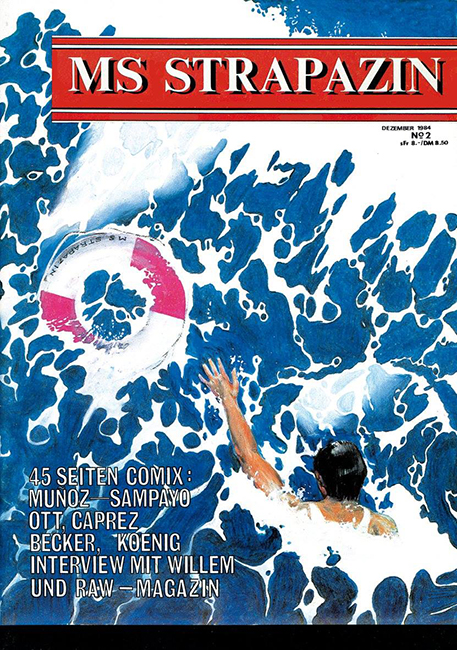
Strapazin No. 2, September 1984
The Strapazin prints comics by, in some cases, little-known and often avant-garde comic artists. The aesthetics of the Strapazin comics are shaped by punk and Dadaism, among other things, the draftsmen have often studied at art schools. Ralf König , ATAK and Thomas Ott published here before their breakthrough.
From number 37 ( L’ASSOCIATION ) onwards, the editions were increasingly, later continuously, under a certain topic appearing in the title with a geographical allocation (e.g. Scandinavian comic world , comics from Tel Aviv ) or a common content (e.g. instructions for use , Comics without protagonists ). A number can also be dedicated to outstanding illustrators such as George Herriman (2002). Every time there are “interesting texts on the meta level” for the comics.
LA SCIENCE-FICTION RUSSE N’A PAS TOUJOURS ETE CHIANTE. AU DEPART, MEME, ELLE ETAIT REVOLUTIONNAIRE, REVOLTANTE ET INCROYABLEMENT FOLLE… C’EST CE QUE L’ON DECOUVRE AVEC LE LIVRE D’OR DE LA SCIENCE-FICTION SOVIETIQUE, EN PRESSE-POCKET.
DANS CETTE ANTHOLOGIE DE LEONID HELLER, IL Y A SURTOUT MOT SOUS PRESSE D’ALEXEI GASTEV QUI NOUS RACONTE EN VRAI REVOLUTIONNAIRE COMMENT ON PEUT FAIRE DE LA BEAUTE EN EMBRASANT DES VILLES. CARO, CE VIEUX FUTURISTES IMAGE LE TOUT. JOE STALINE
P.S. : HIER SOIR, A LA TELEVISION, SERGE GAINSBOURG PARLAIT DE LA RUSSIE ET IL NE DISAIT PAS QUE DES CONNERIES. APPELE A COMMENTER LE REPORTAGE HABITUEL SUR : «DIEU QUE LES RUSSES SONT BETES ET DIEU COMME ILS MANQUENT DE LIBERTE », IL RE-PONDiT QUE NOUS AVIONS ETE AUSSI GRANDS QUE LES RUSSES AU TEMPS DE NAPOLEON MAIS QUE MAINTENANT NOUS RESSEMBLIONS A UN ROQUET QUI MORD LES CHEVILLES D’UN GRAND ETAT IMPERIALISTE QUI PENSE A SES ENFANTS ET A L’AN 2000. DONT ACTE.
Marc Caro, dans Metal Hurlant n°98
Mode d’ emploi
« La liasse des ordres » doit se lire en extraits d’égale longueur comme si on en alimentait un appareil.
Faire cette lecture sans manifester la moindre expression ni le moindre sentiment, sans hausser ni baisser le ton, de manière pseudo-classique ou pathétique. Mots et phrases doivent se succéder à un rythme égal.
Acte pesant, la « liasse » doit se présenter à l’auditeur comme le livret des événements matériels.
L’ordre 05 pourra être lu par un second récitant, parallèlement aux autres ordres ; ses phrases, entrecoupées de longues pauses, couvriront le temps de lecture des ordres 01 à 09.
L’ordre 10 sera lu en guise de conclusion par le premier récitant.
L’Auteur
LIASSES D’ORDRES
ordre 01
Quarante mille, sur un rang ! Repos. Les yeux fixés sur le manomètre : souder. Regards fixes alignés. Vérification de la ligne : salve. Tir le long de la ligne. Obus à dix millimètres des fronts. Trente fronts effleurés : au rebut. Régiment A à l’Est. Colonne 10 à l’Ouest. Vingt-neuf mille : sur place.
ordre 02
Chronomètres en marche Aux métiers ! Debout. Pause. Attention maxima. Présentation. Branchement. Automoteur. Stop. Trente secondes de pause. Commutateur. Opération B. Procédé deux, procédé quatre. Six. Série 20, au travail.
Marc Caro, dans Metal Hurlant n°98
ordre 03
Médecins, auprès des rangs. Augmenter la température. L’élever de neuf dixièmes. A la première dizaine Petite pause. Augmenter à cent. Grande pause. A mille E. Aux métiers, aux truelles, aux microscopes ! Augmenter encore. A cinq dizièmes. Au million C. A trente villes. A vingt gouvernements. Agit-canonnade. Attaque-travail-extra.
ordre 04
Immeubles-prismes. Liasse de vingt appartements. Mise sous presse. Écraser en parallélogrammes. Serrer de trente degrés. Roues et vis. Quartier-tank. Mouvement en diagonale. Couper les rues sans dévier. Mille calories supplémentaires aux ouvriers.
Marc Caro, dans Metal Hurlant n°98
ordre 05
Office des morts dans le cimetière des planètes. Clameur dans les catacombes des mondes. Par millions, dans les trappes du futur. Par milliards, renforcez vos armes. Bagne de l’esprit. Cœur dans les fers. Ingénieurisez les bourgeois. Enfoncez la géométrie dans leurs crânes. Les logarithmes dans leurs gestes. Gâtez leur romantisme. Des tonnes de mécontentement. Normalisation des mots d’un pôle â l’autre. Phrases selon le système décimal. Salle des machines des discours. Détruisez la littérature. Gutturalisez les tunnels. Contraignez-les à parler. Ciel peint en rouge pour créer l’excitation. Roues dentelées : vitesse supérieure. Cerveau-machine : changement. Œil-caméra : mise au point. Nerfs-électricité : travail. Artères-pompes : pompez.
ordre 06
Asie : entièrement en ré. Amérique : un accord au-dessus. Afrique : en si bémol. Radio-maître-de-chapelle. Violoncelle-cyclone en solo. Sur quarante tours : archet en mouvement. Orchestre le long de l’Equateur. Symphonie le long du septième parallèle. Chœurs le long du sixième méridien. Cordes électroniques au centre de la terre. Maintenir le globe terrestre dans la musique pendant les quatre saisons. Quatre mois de jeu pianissimo sur orbite. Quatre minutes de volcan-fortissimo. Interrompre une semaine. Éclater en volcan-fortissimo-crescendo. Maintenir six mois sur volcan. Atténuer jusqu’au zéro. Terminer le concert.
ordre 07
Bureau de répartition sur le Mont-Blanc. Commutateur Washington commandant l’Amérique. Radio-Calcutta pour le continent oriental. Télégraphistes : dormir pendant deux heures. Réveiller les opératrices pour cinq heures. Réhausser les plates-formes aériennes tous les dix mille kilomètres. Réparer vingt millions de culs-de-jatte. Chevaliser les habitants de l’Australie. Rajeunir de trente ans les Canadiens.
Erman Akçay ‘Alien Fetus’ 42x30cm, Digital Painting, 2022
Çizgiler uyumsuza seslenir. Çizgi bir sınır talebidir. Uyumsuzluğun sınır kaldıraçları renkleri, duyumları karıştırır. Erman Akçay’ın işleri de bu uyumsuz çizginin sınırlarını yokluyor. Onun dünyasında nefessiz kalmak mübah. Çünkü dünyayla cebelleşirken, dünyaya sataşırken aynı nefesi bırakamayız. Akçay’ın çizimlerinde bir korku geleneği hakim. Çağın sesini bu korkudan alıyor. Korku yerleşik bir sonuç olarak değil Munch’un çığlığını güncelleyerek bugüne geliyor. Ölü sesler, iskeletler, kuru kafalar, yarılmış bedenler, metafizik ve maddenin içinde sürüklenen özne sesini imgelerin korkusuyla birleştiriyor.
Bir uçta kendi yarattığı dünyanın sınırlarına hapsolmuş bir özne, diğer yanda bütün kayboluşlara rağmen yaşamda ayak direten bir sesleniş.
Dolunay Aker
Erman Akçay, Alien Portrait, 42x30cm, Charcoal/ Digital Painting, 2022
Erman Akçay, 1982 İstanbul doğumlu, Marmara Üniversitesi Güzel Sanatlar Fakültesi mezunu (2004), birçok farklı disiplinde işler üretmiş grafik sanatçısı, okur-yazar, eleştirmen, artizan.
Erman Akçay, born 1982 in Istanbul, graduated from Marmara University Fine Arts Faculty (2004), lives and works in Istanbul. He is a multi-media visual artist making paintings, artist books, zines and art prints. Akçay’s continuous artistic output began in 1990s, making punk-rock zines and graphic art.
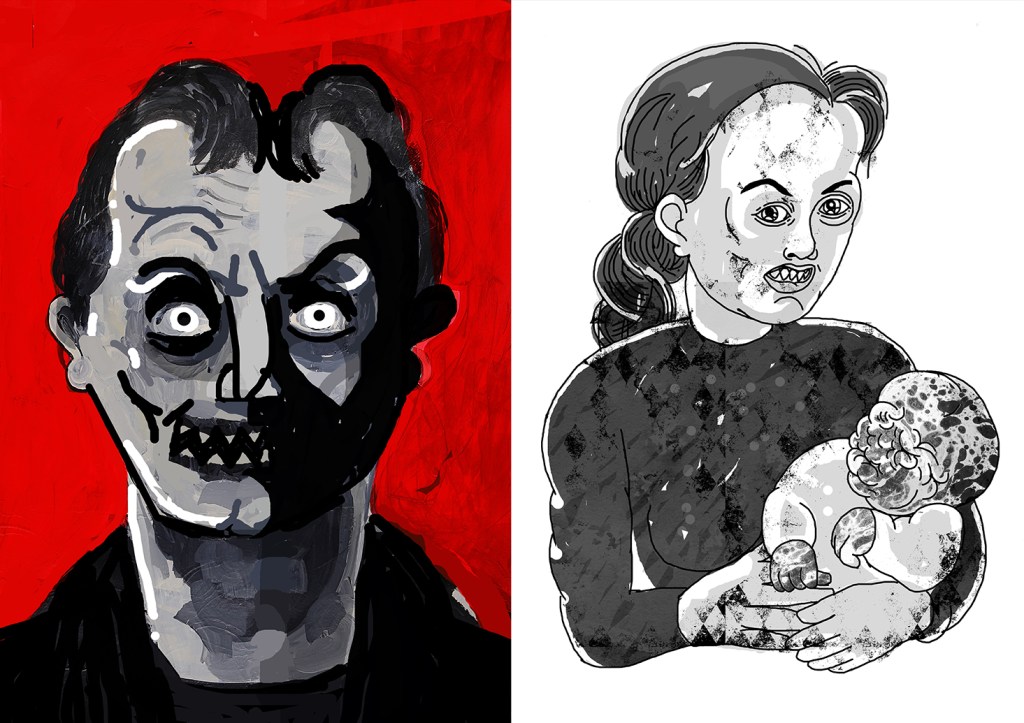
Erman Akçay ‘Yamyam’, ‘Anne ve Çocuk’ mixed media, 2017Sketches: Erman Akçay, charcoal on paper, 2021
Erman Akçay’s Delicious Disasters
Cemal Akyüz
Erman was born twenty four years ago. It was 80s and Mae West was dead. 20th century art history adore to classify all the modernists as post war babies driven by optimism (their parents at least) and had an illusion of progress. Which war? I don’t know, there were so many.
Artists who were born in 80’s clearly belong to 21st century. Allen Ginsberg already said it : America after all it is you and I who are perfect not the next world! Be in love with your life and let’s welcome them as creative and self-conscious artists of Generation Y.
Kids create in a kaleidoscopic reality, their country and their world – be it real, be it virtual – which is coming apart. He can link with his surroundings comfortably to colour it up and with same ease can contribute to an idea which can be as far as Holland. They question.
Erman is involved in a surreal Istanbul/ Izmir fanzine called Düzensiz or Disordered. It stroke the attention of the latest Portuguese surreal movement and he is invited to bless the exhibition with his youth along with his gang in an exhibition in Estremoz, a posthumous homage to all time great Portuguese surrealist, none other than Mario Cesariny. Quickly reshaped and put all his act together to wave his goodbye with a selection of dadaist collages and subhuman portraits.
More than anything Erman is a street producer. Cooperative soul of the street combines with his formal art training. Constant craving for decorating the streets of anonymous ugly metropols, sole efforts to give dynamism to the city without asking anything back, street artist is a street hero.
Sketch by TURBO, 2006
Erman Akçay ‘Alien Syndrome’ 2016
His series of black and white hand made large collages, surprisingly against the nature of famous collages we all are used to, consists only his own original work. Minimalist details of texture breath. Repetitive points, strikes, cloudy blurry images which are cut into perfect rectangular shapes and montaged to dada perfection. Rare colour assemblages dares to camp it up. Mother and child series consist picture perfect water colours which dash a tang of surrealist incapability. His Mona Lisa series are Marilyn Manson meets Condoleeza Rice, how scary can one get? Porcelain doll like faces with flies and insects coming out from the eyes, or is it just imagination? From streets to grotesque, from dada to pointism he is the perfect collage of his own persona, a strong but sentimental representation of phantasmagoria.
His youth attacks all intellectual creativity, that young man can make dada look fresh 90 years after, streets can be enjoyable playgrounds, and the dull old world an open air exhibition, you are all invited to take a piece with you from his artistic dandy.
Reproduction: Erman Akçay ‘Night of the Living Dead’ 21x15cm, digital painting (2015)
“Bir elinin hala çocukluğunun kalbinde olması seni diğerlerinden ayıran nokta. Löpçük bana, asansör müziği eşliğinde çirkin bir çocuğun aynaya bakarak işlediği cinayetleri itiraf ettiği bir yayın organı gibi geliyor…” -Tan Tolga Demirci
Retina Decadence, Group Exhibition curated by Erman Akçay in İstanbul, 2020 (Poster Art by Zigendemonic) Right Wall by Cins
“Bu gece tesadüfen okudum çok başarılı buldum. Tabii ki sivri yanları var tartışılır yanları var provokatör dili var ama çok başarılı.” Bedri Baykam
Erman Akçay ‘Cemetery Flowers’, bitmap graphic (14,8x21cm) – ‘Anxiety’ ink on paper (50x70cm) 2016
Evolution of Consciousness
The ways of seeing and perception in Art are various and imply vast imaginativeness and hallucination of humankind as well as reality. All opens its door to creativity, freedom, soul and mind etc. under society until Universe’s expansion become universal under minor and major entities and identities. Therefore I would say herein Retina Decadence Exhibition which is curated by Erman Akçay gathering international and Turkish artists all around world to take public attention differently on one of those vision of our times called Graphic Art. It is enigmatic, bizzare, sluggish, histeric and evilsake mixed in all and more under(upper)world which underlines/ minds/ pins the artificial being of human soul, its bizzare, absurd and discordant existance and sub-concious inbetween pain and passion meanwhile trying to find an exit through its striving illumination. This is what we should expect and except as well as include and tolarate and finally put into our mosaic of art-world in İstanbul or elsewhere in World to broaden our view of conciousness as implied by ist name Decadence is on continue in this World now and then Retina observes it by narrow and wide blinked mind and eye side from dark to light and from light to dark but in the end openness is everything in Contemporary World and its Art. Retina Decadence keeps this secret to whisper your perception by its sickness inside to be healed asif in effect of dark hole after Big-Bang occured out of scattered scene of existance.
Erkut Tokman, October 2020 Osmanağa, Kadıköy – İstanbul
Sketch by TURBO, 2006
KHAS VCD – OCULUS VCD Talks – Erman Akçay ile Sokak Sanatı ve Fanzinler (Moderatör: Yunus Emre Öztaş)
İstanbul’un en turistik yerlerinden biri olan Galata Kulesi ve çevresindeki eğlence mekânları, özellikle yaz aylarında cıvıl cıvıldır. İstanbul’a gelip de Galata’da eğlenmeyen yoktur herhalde. En azından arkasına Galata Kulesi’ni alıp fotoğraf çektirmeyen yoktur.
Galata’ya yolu düşenlerin son günlerde uğrak bir mekânı var. Çünkü yaklaşık iki aydır Galata’daki Barnathan Oteli’nin lobisinden çok özel bir sesin şarkıları, Beyoğlu’nun ışıkları arasından müzikseverlerin kalbine işliyor.
İşte o sesin sahibi, 9 yaşından beri solist olarak sahneye çıkan ve müzik deneyimini Sorbonne Paris 3 Tiyatro Bölümü’ne kadar taşıyan, ardından da lisans ve yüksek lisans programından yazar ve yönetmen olarak mezun olan Ezgi İrem Mutlu.
2007 yılından beri kendi bestelerini de seslendirmeye başlayan ve ses tasarımında kendi melodilerini yaratırken vokallerde synthesizer, akustik piyano ve yarı dijital ve analog enstrümanlara ses kaydı yapan Ezgi İrem, Sorbonne’daki eğitimini tamamladıktan sonra 2016 yılında davet aldığı İstanbul Devlet Tiyatrosu’nda yeteneklerini sergilemeye başlamış. İki yıl boyunca “Çehov Makinesi” ve “Narnia Günlükleri”nde oyunculuk, Tiyatro 9 tarafından sahneye konulan “Eksiği Var Fazlası Yok” oyununun ise solistliğini yapmış. Çeşitli dizi, film ve reklam filmlerinde oyunculuğunu sergileyen Ezgi İrem, halen birçok farklı projede şarkıcı, söz yazarı, oyuncu ve dansçı olarak çalışıyor.
Ezgi İrem Mutlu ‘Darağacında Eldivenler’ One woman project
Haziran ayında Fête de la Musique’in 40. yıl dönümü Edith Piaf, France Gall, Gainsbourg, Boris Vian, Charles Aznavour ve Enrico Macias’ın Fransızca şarkılarını seslendiren Ezgi İrem Mutlu, salgın döneminde de boş durmamış. Pandemi nedeniyle çevrimiçi olarak yapılan Akbank Kısa Film Yarışması’nda jüri, “Birbirinden farklı sinemasal anlatıların gücünü başarıyla harmanlayarak sadece ama sadece bugüne ait bir film ortaya koyması sebebiyle” değerlendirmesini yaparak 429 eser arasından Ezgi İrem Mutlu’nun “Darağacında Eldivenler” adlı kısa film çalışmasını ödüle layık bulmuş.
Global Chillers (küresel üşütenler/bir sanat ve sanatçı eleştirisi)
Saint Joseph’e giderken tiyatro kulübünde Antigone sahneleyip aynı zamanda dans ederken, yarı zamanlı müzikal eğitimine başlayan Ezgi İrem Mutlu, Haldun (Dormen) ustanın “Amphitryon” oyunu ile profesyonel olarak sahneye adım atmış. Fransa’da tiyatro yazarlık ve yönetmenlik okurken, le Trac Café de “Cabaret Barré” isimli bir oyun ile kabare de yapan genç sanatçı, aynı oyunu Sorbonne’daki sınıf arkadaşlarıyla birlikte yazıp sahnelemiş. Oyunculuğun yanı sıra canlı müzik ve çeşitli elektronik müzik performanslarında sahne alan Ezgi İrem, 2019 senesinde elektronik müzik üzerine mod synth çalıp ve üstüne söz yazıp şarkı da söylemiş.
Genç sanatçının o kadar anlatılası yeteneği var ki, hani gerçek anlamda “10 parmağında 10 marifet” derler ya, işte öyle. Tiyatro, resim, fotoğraf, sinema filmleri, sosyoloji ve tıpla ilgilenen ve bu alanlarda kendini geliştirmeyi hayat felsefesi haline getiren Ezgi İrem, Barnathan Oteli’nin lobisinde müzikseverlere muhteşem bir müzik şöleni sunuyor.
Fransızca, Türkçe, İspanyolca ve Yunanca şarkılar seslendirirken aldığı tiyatro ve oyunculuk eğitimiyle de kendisini dinlemeye gelenlerle müthiş bir bağ kuruyor. Müziğin ritmiyle dansçılığını da birleştiren genç sanatçı, Galata Kulesi görüntüsüyle süslenen sahnesini müzikal bir kabareye çeviriyor. Sahne aldığı iki saat boyunca izleyicilerine bir yaz gecesi rüyası yaşatıp Galata’dan Dünya turuna çıkarıyor.
Ezgi İrem Mutlu ‘Hey Woman!’ 2011
Şu sıralar da “Baraka” adlı yabancı bir filmde savaş muhabiri rolünü canlandırıyor Ezgi İrem.
Böylesi eşsiz bir sesi ve yeteneği izleme fırsatını kaçırmayın derim.
Bizon Murat, Devrim Ck. ile beraber 1995 ilkbaharında bir proje olarak Siya Siyabend’i kurmuş, sonraları Murat, Ahmet, Memduh, Okan, Pascal, Garbis, Orçun, Ferhat, Hakan ve diğer pek çok müzik adamıyla çalışmışlardır.
Siyasiyabend 90’larda başlayan, çeşitli enstrumanlardan ses çıkarmayı seven ve bunu birlikte yapmaktan hoşlanan bir grup insanın uzun, derin ve badireli bir yol arkadaşlığının; temelde köklü bir müzik sevgisine ve insanlığın bilgi-kültür mirasını özümseme ve yaşama arzusuna dayalı bir yolculuğun ürünü olarak ortaya çıktı.
Birçok farklı stüdyoda farklı sound denemelerine girişip değişik tarzlarda ürünler verdiler. Bunun yanında kısa filmler için müzik yaptılar. Fatih Akın’ın yönetmenliğini yaptığı Sound of İstanbul / Crossing The Bridge, köprüyü geçmek adlı belgeselde yer aldılar.
SSB ayrıca sokağı da önemli bir sahne olarak gördü. Türkiye’de sokaktaki müziğinin öncülerinden oldu. Bu konuda şu söylemleri ilgi çekicidir: “Sokak müziği yoktur, müzik sokakta olmalıdır”
SSB 2008’den beridir Erdem Göymen, Hakan Özboz, Murat Toktaş ve Devrim Ck, 2010’da Cansun Küçüktürk’ün katılımıyla oluşan çekirdek kadrosuyla, diğer müzisyenler ve görsel sanatçılarla ortaklaşarak, kayıtlar yapmaya konserler vermeye devam ediyorlar.
Yaşamın İzinde programı: Bizon Murat (Nûve Medya) 2021
“There is no street music,
the music should be on the street”
Bizon Murat, Devrim Ck. together with Siya Siyabend as a project in the spring of 1995, they later worked with Murat, Ahmet, Memduh, Okan, Pascal, Garbis, Orçun, Ferhat, Hakan and many other musicians.
Political friendship of a group of people who started in the 90’s, likes to make sounds from various instruments and likes to do it together; basically emerged as the product of a journey based on a deep-rooted love of music and the desire to absorb and live the knowledge-cultural heritage of humanity.
They experimented with different sounds in many different studios and produced products in different styles. Besides, they made music for short films. They took part in the documentary Sound of Istanbul / Crossing The Bridge, directed by Fatih Akın.
Recorded in Kadikoy Sahne, Murat Bizon With wonderful band.
The SSB also saw the street as an important stage. Murat Serhaşi Toktaş became one of the pioneers of street music in Turkey. The following statements on this subject are interesting: “There is no street music, music should be on the street”
Since 2008, SSB has been continuing to record and give concerts in partnership with other musicians and visual artists, with its core staff formed with the participation of Erdem Göymen, Hakan Özboz, Murat Toktaş and Devrim Ck, and Cansun Küçüktürk in 2010.
Batuhan Dedde, yeni kitabıyla farklı bir dil deneyimini sunuyor hepimize. Kitabın akışı adeta bir ruhun pusulasını da okuruna sunuyor. Şairin, yazarın üzerinde durduğu benliği, cinneti, karanlığı, rüyaları adeta onun bir taraftan ruhsal fırtınalara diğer yandan tarihin derinliğe ve mitolojik göndermelere de zemin hazırlıyor. Antik dünyada karanlığın yaratılıştan önce geldiğine inanıyorlardı. Modern zamanlarda “gece” sözcüğü ağırlığını hissettiriyor, sanki bireyselliğe ulaşmak için karanlığın ve de gecenin dünyasıyla yüzleşmek zorundadır günümüz insanı.
Batuhan Dedde- Beykent Üniversitesi RTS Öğrencileri ile Röportaj (2014)
‘Down the lengths of the Bosphorus runs two currents: One on the surface and the the other deep below They run in opposite directions. And here in the strait which divides the city into two lies the perfecf metaphor for the city. For its residents too push and pull each other in different directions, seemingly contradictorily but vital for tha other’s survival.’
Batuhan Dedde was born in Istanbul in 1987. He has published several books, including the poetry collection Morfinsiz Çekilen Düş Sancıları, in 2013. His work brings together the sensibilities of the American Beats and the Turkish Second New.
‘Boğazin dibinden iki akıntı geçer ilki yüzeye yakın, diğeri çok daha derinden, birbirlerine zıt yönde akıp gider. Şehri ikiye ayıran bu boğaz ona en cok yakışan mecazın ta kendisidir. Zira bu şehrin sakinleri de birbirlerini farklı yönlere iter ve çeker. Tutarsız bir gayret gibi gözükse de hayatta kalmalarını sağlayan bu cekişmedir.’
Recluse
Batuhan Dedde
translated by Donny Smith
I come from a patriarchal solitude
I am the last hero remaining from a tribe whose reclusiveness extinguished it.
I run like a street dog after a dream that went too far
While all the conjurers are jumping off the tightrope I stretched across my heart.
God’s suffering drips on my face from the grayest of heavens
While a high-decibel symphony of separation claws at my ears:
The idiots call it rain.
I loved you in a way no human being should
I loved you with inhuman clarity and purity
I was so unrealistic I could have painted all the bloody tanks left over from the cold face of
war with pink dreams
Leaving all this step-eroticism at the door of an orphanage;
Looking right into the eyes of the greatest sufferings, and those sufferings’ good credit;
With the apprehension of an excommunicated Catholic;
Against all religious duties and the Prophet’s teachings, I loved you.
Saltuk Erginer & Seni Görmem İmkansız ‘Yalnız’ca’ 2013
‘Hep sevmekten kaybettim ben, Hep severek kaybettim. İçimi eze eze, avuçlarımı tutuştururcasına… Eğer şahitse şu kentin asfaltlarına düşen yağmur damlaları, Suyun intihar ettiğini düşündün mü hiç? Ben bu kente ne zaman ayak bassam bir başıma, Ağaçlar, yapraklar bile yalnızlığı öğretiyor, Yalnızlığın lisanını konuşuyor; “Yalnızca.” Yalnızca, salınıyor dallar Yapraklar yalnızlık kanamış, ölüyorlar, Sonbahar bahane…‘
Blood of a Poet: Batuhan on instagram live
Münzevi
Batuhan Dedde
Ataerkil bir yalnızlıktan geliyorum
Münzevilikten helak olmuş bir kavmin
Kalan son kahramanıyım.
Çığırından çıkmış bir hayalin arkasında koşarken
sokak kopekleri gibi
Kalbimde gerdiğim telden aşağı atlıyor bütün hokkabazlar
Tanrının acısı damlarken yüzüme göğün en grisinden
Yüksek desibelli bir ayrılık senfonisi kulaklarımı tırmalıyor;
Aptallar yağmur diyorlar.
Bir insana yakışmayacak şekilde sevdim ben seni
Bir insana yakışmayacak kadar duru ve net
Savaşın soğuk yüzünden kalan kanlı tankları
Pembe düşlere boyayabilecek kadar idealisttim
Bütün üvey erotizmleri bir yetimhanenin kapısına bırakarak
Tahsili yüksek acıların gözünün içine baka baka
Aforoz edilmiş bir Katolik kaygısıyla
Farzlara, sünnetlere aykırı sevdim ben seni.
Sanatçılar, şairler, yazarlar, yaratıcı süreçler için kolektif bilinç dışında kök salmış zihinsel ve yaratıcı formları kullanırlar. Sanatsal yaratım sürecinde bu zihinsel imgeler zihnin bilinçli katmanlarına ulaşır ve yapıtı ortaya çıkartır.
“Yazık Yenilenlere” kitabı çok zor bir yaşam deneyiminden süzülerek biçim bulmuş. “Corona” ve “karantina” günlerinin şiire, sanata, edebiyata nasıl yansıdı sorusunun da bir nebze yanıtıdır bu kitap. Tüm zorluklara rağmen “umut” sözcüğünün örtülü biçimde de olsa şairlerin yüreğinden yükselmesi önemlidir. Özellikle günümüzün kritik dünya koşullarında ve insanlık tarihinde eşi benzeri olmayan Corona denen bir olguyla yüzleşmede umudun yeri, insanı ve insanlığı kurtarabilecek tek ışık penceresidir. Umut ise, şiirin, öykünün, sanat yapıtlarımızdan başka bir şey değil. Batuhan Dedde’nin zengin dili, bakış açısı ve şaşırtıcı derecedeki yaratıcılığı okuruna yol fenerdir.
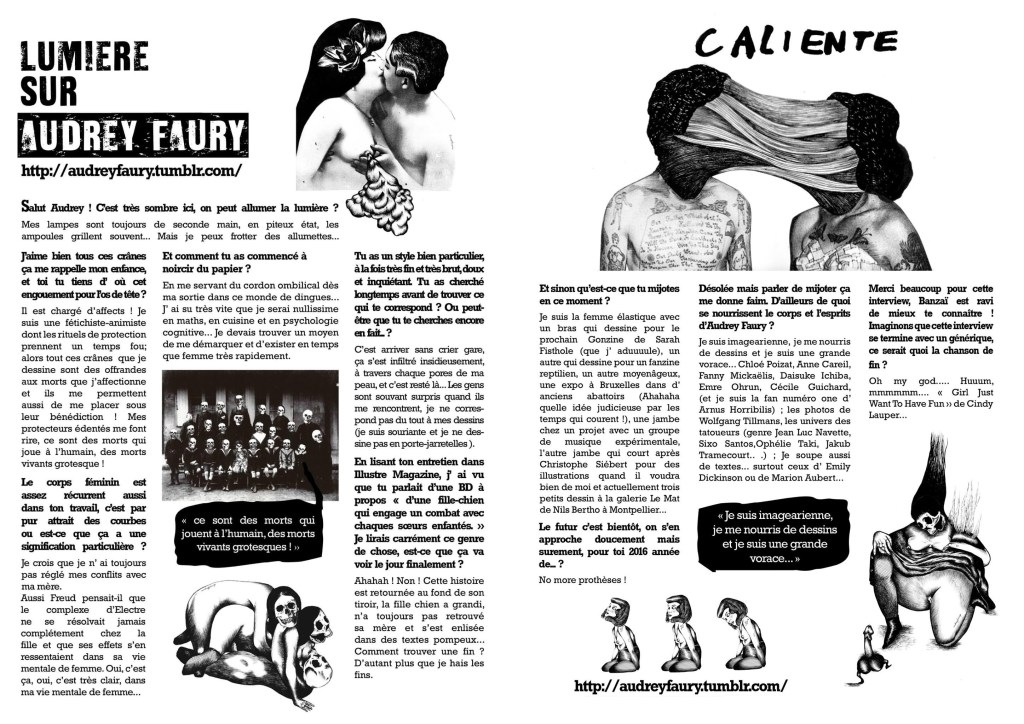
« ce sont des morts qui jouent à l’humain, des morts vivants grotesques ! »
Salut Audrey ! Cest très sombre ici, on peut allumer la lumière ?
Mes lampes sont toujours de seconde main, en piteux état, les ampoules grillent souvent… Mais je peux frotter des allumettes…
J’aime bien tous ces crânes ça me rappelle mon enfance, et toi tu tiens d’ où cet engouement pour l’os de tête ?
Il est chargé d’affects ! Je suis une fétichiste-animiste dont les rituels de protection prennent un temps fou; alors tout ces crânes que je dessine sont des offrandes aux morts que j’affectionne et ils me permettent aussi de me placer sous leur bénédiction ! Mes protecteurs édentés me font rire, ce sont des morts qui joue à l’humain, des morts vivants grotesque !
Le corps féminin est assez récurrent aussi dans ton travail, c’est par pur attrait des courbes ou est-ce que ça a une signification particulière ?
Je crois que je n’ ai toujours pas réglé mes conflits avec ma mère.
Aussi Freud pensait-il que le complexe d’Electre ne se résolvait jamais complètement chez la fille et que ses effets s’en ressentaient dans sa vie mentale de femme. Oui, c’est ça, oui, c’est très clair, dans ma vie mentale de femme…
Audrey Fawry, ‘L’Amour au premier regard / Dessins et autres Romantismes à retrouver à la Galerie Le Mât chez Mr Nils Bertho pour l’expo Rifuel Fanglant 2015! Dessins encre noire / stylo, collages (2015, 2018)
Et comment tu as commencé à noircir du papier ?
En me servant du cordon ombilical dès ma sortie dans ce monde de dingues… Y ai su très vite que je serai nullissime en maths, en cuisine et en psychologie cognitive… Je devais trouver un moyen de me démarquer et d’exister en temps que femme très rapidement.
Tu as un style bien particulier, à la fais très fin et très brut, doux et inquiétant Tu as cherché longtemps avant de trouver ce qui te correspond ? Ou peut-être que tu te cherches encore en fait..?
C’est arriver sans crier gare, ça s’est infiltré insidieusement, à travers chaque pores de ma peau, et c’est resté là… Les gens sont souvant surpris quand ils me rencontrent, je ne correspond pas du tout à mes dessins (je suis souriante et je ne dessine pas en porte-jarretelles).
En lisant ton entretien dans Illustre Magazine, f ai vu que tu parlait d’une BD à propos « d’une fille-chien qui engage un combat avec chaques sœurs enfantés. » Je lirais carrément ce genre de chose, est-ce que ça va voir le jour finalement ?
Ahahah ! Non ! Cette histoire est retournée au fond de son tiroir, la fille chien a grandi, n’a toujours pas retrouvé sa mère et s’est enlisée dans des textes pompeux… Comment trouver une fin ? D’autant plus que je hais les fins.
« Je suis imagearienne, je me nourris de dessins et je suis une grande vorace… »
Et sinon qu’est-ce que tu mijotés en ce moment ?
Je suis la femme élastique avec un bras qui dessine pour le prochain Gonzine de Sarah Fisthole (que j’ aduuuule), un autre qui dessine pour un fanzine reptilien, un autre moyenâgeux, une expo à Bruxelles dans d’ anciens abattoirs (Ahahaha quelle idée judicieuse par les temps qui courent !), une jambe chez un projet avec un groupe de musique expérimentale, l’autre jambe qui court après Christophe Siébert pour des illustrations quand il voudra bien de moi et actuellement trois petits dessin à la galerie Le Mat de Nils Bertho à Montpellier…
Le futur c’est bientôt, on s’en approche doucement mais surement, pour toi 2016 année de..?
No more prothèses !
Désolée mais parler de mijoter ça me donne faim D’ailleurs de quoi se nourrissent le corps et l’esprits d’Audrey Faury ?
Je suis imagearienne, je me nourris de dessins et je suis une grande vorace… Chloé Poizat, Anne Careil, Fanny Mickaëlis, Daisuke Ichiba, Emre Orhun, Céline Guichard, (et je suis la fan numéro one d’ Arnus Horribilis) ; les photos de Wolfgang Tillmans, les univers des tatoueurs (genre Jean Luc Navette, Sixo Santos, Ophélie Taki, Jakub Tramecourt…); Je soupe aussi de textes… surtout ceux d’ Emily Dickinson ou de Marion Aubert…
Merci beaucoup pour cette interview, Banzaï est ravi de mieux te connaître ! Imaginons que cette interview se termine avec un générique, ce serait quoi la chanson de fin?
Oh my god Huuum, mmmmmm…. « Girl Just Want To Have Fun » de Cindy Lauper…
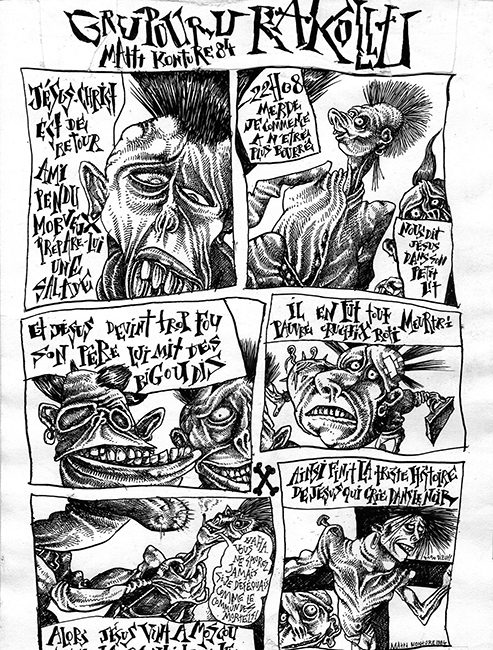
Mattt Konture is a French underground comics author and musician. He is one of the founders of the French publishing house L’Association and is a forerunner of the French autobiographical comics movement. Konture grew up in Lozère, where his influences included Métal Hurlant artists like Marc Caro, Doury, Rita Mercedes, and Moebius.
Konture published his first comics in 1983 (at the age of 18) in magazines such as Viper (“L’ajeun”) and Le Lynx (“Les Exploits de Ted” with Jean-Christophe Menu). When Konture went to Paris he published his first comics, Nerf, on an old Xerox machine. L’Association later reprinted this first book. His first comic book was Ruga Zébo Violent, first volume of the “Pattes de Mouche” collection published by L’ANAAL, to become L’Association.
At this time, Konture’s drawings were very dark and full of strokes and looked like the growing American underground style. Konture later discovered 1960s American underground cartoonists such as R. Crumb and Gilbert Shelton, who inspired him to create psychedelic and autobiographical comics. In 1988, Konture started autobiographical comics such as Krokrodile Comix 1, or Galopu, that was a forerunner of the French underground movement.
Mattt Konture, 1984
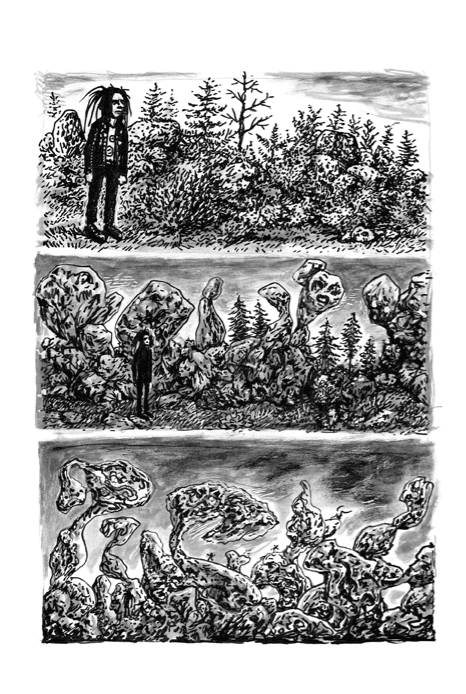
In 1989 Konture returned to Lozère. There he drew a few comics and continued Ivan Morve (a pun on “Mort-vivant,” “living dead”). Ivan Morve is a series of half-autobiographical stories published in the pages of Psykopat.
During the same period Konture started “Jambon blindé,” an improvised comix commissioned by his friend Stéphane Blanquet. This new way of telling stories drove Konture to draw a series of “comix” edited by L’Association in the collection Mimolette. “Autopsie d’un mort vivant” (“Autopsy of a living dead”) is a dark retelling of Konture’s life. In these books all his characters reappear: Galopu, Mister VrO, and Ivan Morve — each of them represents the author’s mood.
Mattt often draws with artist friends, publishing works such as Galopinot (L’Association) drawn with Lewis Trondheim, and, more recently, L’Abbé Noir (Arbitraire) drawn with Lilas and Willy Ténia, La Comète à 4 pattes (L’Association), drawn with Lilas, Willy Ténia and Freaky Nasa, and Borrut Popotte (Marseilles based silkscreen and publishing house Le Dernier Cri), drawn with Lilas.
For a long period of his life, Konture worked at home. Now he’s part of a collective artist’s space (workshop, gallery and boutique) En Traits Libres, which is open to the public.
Vidéo réalisée par Sébastien Casino pour l’exposition de Mattt Konture à La Jetée (Janvier 2017)
Konture has also played in many musical groups (Les Tordus, Pumpkin Guts, Cosmogol, Rhinoplastic Démodex…), including his original one-man group Courge, which later changed its name to Lucky and the Courges, and which produces CDs and plays concerts in the Montpellier area where he lives.
Mattt Konture, L’Éthique du souterrain (2012)
attt Konture, L’Éthique du souterrain
Documentaire de 64 minutes réalisé par Francis Vadillo, qui a suivi Mattt Konture pendant plus de deux ans, chez lui, dans différents festivals, et lui offre enfin le portrait qu’il mérite. C’est l’occasion de le voir au travail, dessinant dans ses carnets et réalisant des fanzines, ou jouant sur scène avec son groupe Courge. On pénètre dans son quotidien en l’accompagnant dans sa pratique compulsive du dessin, seul ou entouré de ses nombreux amis fanzineux, mais aussi par l’évocation de la maladie qui l’affecte, la sclérose en plaques. C’est enfin un portrait d’une scène underground musicale et graphique vivace et festive, que Mattt Konture n’a de cesse de parcourir pour apporter sa contribution.
On y croise J.-C. Menu, Pacôme Thiellement et Killoffer, qui se souviennent de leurs rencontres, au début des années 80, et reviennent sur l’importance de son œuvre autobiographique.
Mattt Konture : l’éthique du souterrain 2018
Mattt Konture auteur incontournable de la bande dessinée contemporaine se distingue notamment par ses albums autobiographiques introspectifs et sans concession qu’il écrit et dessine depuis vingt ans. On y croise ses amis son plaisir à dessiner son groupe Courge son univers underground libertaire où l’on se soucie peu du marché de l’art et de l’édition où l’on fait tout soi-même. Ce film est aussi l’histoire d’un homme d’un artiste qui affronte le mal dont il est atteint la sclérose en plaque. Une maladie qui parfois s’exprime par un graphisme sombre et torturé quand elle prend le dessus. Mais ce que l’on retient de cette expérience de vie c’est la capacité de Mattt Konture à répandre autour de lui une forte dose.
Mattt Konture, L’Éthique du souterrain (2012)
64-minutes documentary directed by Francis Vadillo, who followed Mattt Konture for more than two years, at home, in various festivals, and finally offers him the portrait he deserves. This is an opportunity to see him at work, drawing in his notebooks and making fanzines or playing on stage with his group Courge. We enter his daily life by accompanying him in his compulsive practice of drawing, alone or surrounded by his many zinester friends, but also by evoking the disease that affects him, multiple sclerosis. Finally, it is a portrait of a vivacious and festive musical and graphic underground scene which Mattt Konture constantly explores to make his contribution.
We meet J.-C. Menu, Pacôme Thiellement and Killoffer, who remember their meetings in the early 80s, and discuss the importance of his autobiographical work.
Mattt Konture, L’Éthique du souterrain (2012) L’association
During filming, Mattt Konture produced a new “comixture” which accompanies the DVD. This new comix, without possible comparison with a simple making-of, opens a dialogue with the documentary, offers it unexpected extensions and gives all its coherence to the whole.
Animation paréidolique par Mattt Konture et Janko pour le film Mondo DC / production Le Dernier Cri Musique Janko & Mattt Konture, montage Pakito Bolino
« La sous-culture est plus pernicieuse, plus virulente, plus vicieuse que l’art. L’art on sait où le trouver, il est au chaud, même s’il se dit violent ou anarchiste, il restera bien au chaud sous ses dorures. La sous-culture, elle, ne fait pas semblant, ne se donne pas de médailles, ou alors en chocolat. La sous-culture est toujours en danger, cachée dans la jungle, entre un paquet de lessive et des jouets en plastique bon marché. Même si parfois je flirte avec le milieu chaud et confortable, même si j’y glisse un doigt ou bien même un bras, le reste de mon corps est dans les intempéries des sous-sols ».
Dans La Têtes de Stéphane Blanquet
Par Martine Lusardy, directrice de la Halle Saint Pierre, 2020
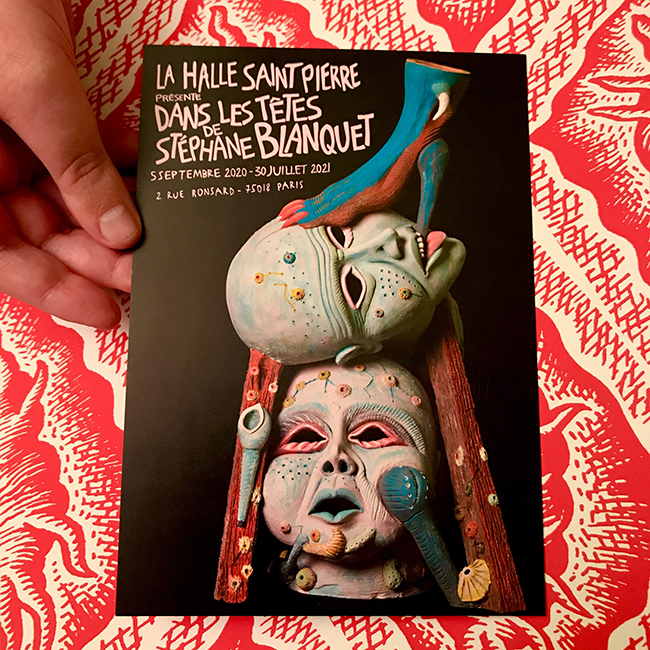
Présenté à la Halle Saint Pierre en 2011/2012 dans le cadre de l’exposition HEY! modern art & pop culture par Anne et Julien, Stéphane Blanquet y conçut spécialement une installation. Celle-ci portait très haut l’enjeu de l’exposition : affirmer la vitalité de ces expressions artistiques individuelles et autonomes qui rompent avec les conventions et les codes dominants et renversent les valeurs établies du “beau” et du “laid”, du bon” et du “mauvais” goût. L’artiste revient aujourd’hui en nos murs déployer son imaginaire tentaculaire : une carte blanche qui sera également pour lui l’occasion d’inviter des artistes avec qui il partage le même goût pour notre humanité souterraine.
Dessinateur, plasticien, metteur en scène, réalisateur, Stéphane Blanquet a derrière lui un long parcours dans le milieu de l’édition où il a fondé en 1990 le mythique Chacal Puant, primé au festival de la BD d’Angoulême en 1996 pour le graphzine La Monstrueuse puis les United Dead Artists. Considéré comme l’une des figures majeures de la scène artistique underground, son univers tourmenté déborde largement du cadre de sa production graphique. Installations, spectacle vivant, scénographie, cinéma d’animation, costumes et décors de théâtre, jouets, poupées et autres objets atypiques et subversifs, ombres chinoises, sont autant d’espace de création où Stéphane Blanquet signifie son parti pris : « La sous-culture est plus pernicieuse, plus virulente, plus vicieuse que l’art. L’art on sait où le trouver, il est au chaud, même s’il se dit violent ou anarchiste, il restera bien au chaud sous ses dorures. La sous-culture, elle, ne fait pas semblant, ne se donne pas de médailles, ou alors en chocolat. La sous-culture est toujours en danger, cachée dans la jungle, entre un paquet de lessive et des jouets en plastique bon marché. Même si parfois je flirte avec le milieu chaud et confortable, même si j’y glisse un doigt ou bien même un bras, le reste de mon corps est dans les intempéries des sous-sols ».
Les sous-sols seraient donc l’univers matriciel de Blanquet, un underground culturel réel où naissent ses images abrasives, mais aussi le lieu symbolique d’où provient la voix qui les anime. Ses influences seraient à chercher du côté de la bande dessinée érotique bon marché des années 70 à 90, notamment celle du sulfureux éditeur français Elvifrance. Cette littérature de gare licencieuse, au sexe explicite et à l’horreur débridée, aura été une inspiration directe.
Blanquet, Halle Saint Pierre, 2020
« Si on regarde bien, je dessine une brindille comme si c’était un organe, de l’herbe comme des poils, c’est une vision organique de tout, tout transpire plus ou moins, et tout est vivant… Et puis, il est bien plus passionnant de dessiner, de faire vivre des morceaux, cela devient comme des paysages, falaises de gorges, forêt de vulves, ça devient plus intéressant qu’une petite balade dans la campagne ».
L’exploration artistique de nos mondes psychiques et mythiques selon Stéphane Blanquet met à découvert ce que nous pensions connaître : le monde des pulsions, du sexe et de l’organique « Si on regarde bien, je dessine une brindille comme si c’était un organe, de l’herbe comme des poils, c’est une vision organique de tout, tout transpire plus ou moins, et tout est vivant… Et puis, il est bien plus passionnant de dessiner, de faire vivre des morceaux, cela devient comme des paysages, falaises de gorges, forêt de vulves, ça devient plus intéressant qu’une petite balade dans la campagne ». Ce langage issu des profondeurs du corps humain est à même de rendre accessibles l’indicible, l’impensabl e, l’inavoué. Mais si Éros est ici généreux, s’il sécrète dans une joyeuse abondance, sa force vitale et créatrice n’en est pas moins inquiétante dans son engendrement jusqu’à l’obscène, dans sa prolifération jusqu’à la monstruosité. « Vomir sa propre œuvre, face au vide, face à l’encre épaisse, face à son propre dégoût, soi- même, c’est là qu’est l’impact. Face à face. Être seul et vomir sa propre mélasse, son propre jus, noir ou rouge, pourvu qu’il ne soit pas transparent ». Le corps, pour Blanquet, est instauré en une réserve de vitalité inépuisable, une véritable usine où chaque organe ne s’arrête pas à une fonction biologique mais prend alors un statut expressif, dévidant sur le monde environnant ses sécrétions symboliques. Le désir s’impose-t-il avec trop de force ? Il doit alors faire exploser les têtes, les sexes, les faire cascades de liquides.
Le monde selon Stéphane Blanquet est un monde réduit à ses soubassements pulsionnels et organiques. Mais l’artiste en établit sa propre topographie, créant dans un style exubérant, presque effrayant, de nouvelles relations entre les mots, les images et les corps. Il les dévoile autant qu’il les recouvre par leur étrangeté cruelle, grotesque, excessive. Un extrême que l’on retrouve déjà dans nombre de ses titres : Goudron Pressage – Sillon Tympan, Vide point . rose trou, Mâchoires noires, Blanquet gangrène Tokyo, Blanquet s’ouvre la panse, Labyrinthique intestin, Chambre avec vue sur mes cauchemars, Rendez-vous Moi en Toi, La Vénéneuse aux deux éperons, Chocottes au sous-sol !, La nouvelle aux pis, Viande froide et Cie, Le Fantôme des autres, Mon méchant moi, Monographie lacrymale.
Blanquet choque, provoque, trouble, aime créer le malaise en manipulant nos frustrations et ses propres obsessions. Son univers torturé, angoissé est peuplé d’hommes, de femmes et d’enfants que nous voyons habités par le démon de la perversité. Mais cette tension entre innocence et cruauté, entre jubilation sexuelle et pulsion de mort n’est pas désespérance sans issue. Blanquet fait la peau au refoulé, ressuscite la chair, les corps délivrés de la culpabilité et de la peur de mourir.
Art News V4005: Stéphane Blanquet
« S’user jusqu’à la corde, raide, raide et rouge. La radicalité d’une œuvre n’est pas collective, elle ne peut l’être, elle est avec soi-même, sans posture, à poil devant la mort ».
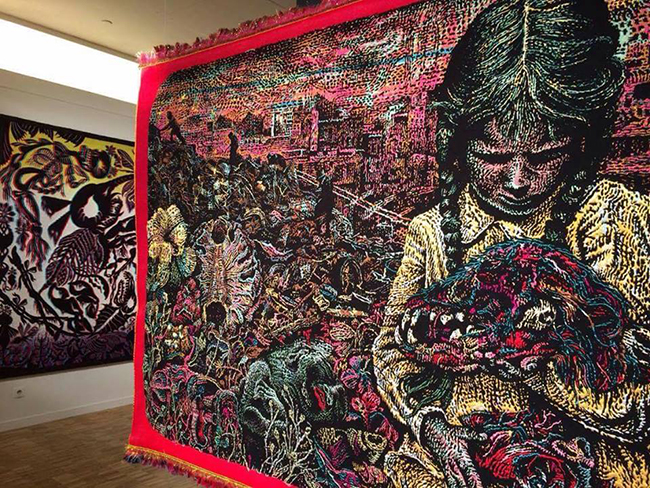
Artiste plasticien, dessinateur, créateur multimédia… Stéphane Blanquet (1973) développe un foisonnement d’images, de formes et de sons depuis la fin des années 1980 : œuvres d’art, installations, spectacle vivant et scénographie, édition indépendante, art urbain, cinéma d’animation, musique… Il enrichit son travail en explorant avec passion les technologies et techniques les plus variées, des plus traditionnelles aux plus avant-gardistes : dessin à la plume, lithographie, tapisserie numérique, outils informatiques…
En 1993, Blanquet, invité par Jacques Noël pour une première exposition solo, présente « Exposition Posthume » au Regard Moderne à Paris. Depuis, son travail est régulièrement montré: MAC Lyon, Singapore Art Museum, Musée des Arts Décoratifs (Paris), Hayward Gallery (Londres), Halle Saint-Pierre (Paris), Museum of Fine Arts Boston (USA)… Récemment, il a présenté des expositions personnelles au Centre Georges Pompidou à Paris en 2016, au Fürstenfeldbruck Kunsthaus (Allemagne) en 2017 et à l’Abbaye d’Auberive en 2018.
Présentation de l’exposition par Stéphane BLANQUET
Il est très rare que l’on vous donne les clefs d’un lieu pour l’investir entièrement, sur une longue période, en vous laissant libre de s’y déployer de bas en haut, sur tous les murs, dans tous les espaces, de l’investir avec des images, des dessins, des sculptures, des expérimentations visuelles, des couleurs et lumières rouges vives, des nouvelles pièces rêvées pour le lieu. Il faut l’investir, se répandre, s’ouvrir soi-même et aller chercher sa propre matière. C’est à l’intérieur de soi que ça se passe, à l’intérieur de moi que sont mes images, mon univers, mes univers. Une tête ne suffit pas à contenir toutes mes envies, il m’en faut toujours plus, comme à mon habitude, plus de tout, plus de couleurs, plus d’espace, et évidemment plus de têtes. Plus d’univers nécessite / appelle / exige / signifie plus de têtes.
Dans les têtes de Stéphane Blanquet – dans mes têtes.
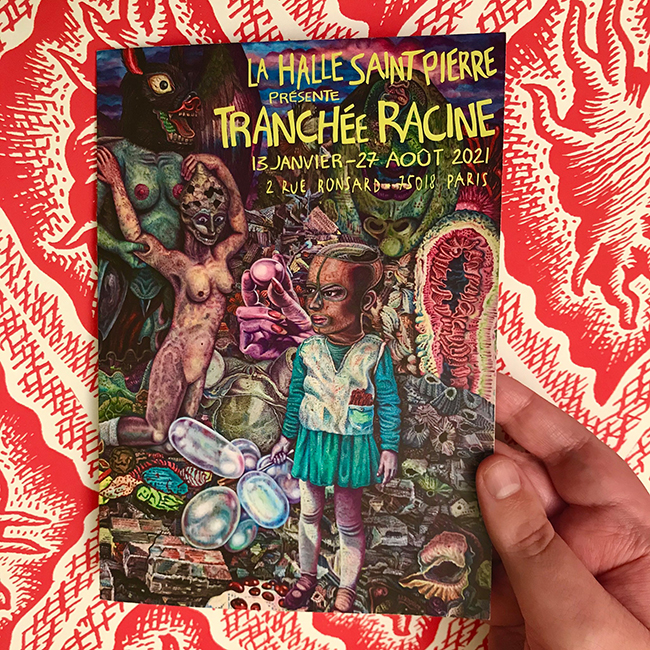
Une exposition d’un an ne peut pas rester statique, je suis trop agité pour la laisser dormir confortablement. Il me faut de l’inconfort et mon inconfort sera généreux. Diviser un an en trois temps, exposition évolutive en trois moments, tous les quatre mois réinvestir l’espace, le faire évoluer avec de nouvelles images, de nouvelles installations, des œuvres peu vues, des nouvelles tapisseries, des nouveaux totems, de nouvelles têtes. Pourquoi s’arrêter là ? Ce n’est pas suffisant, ce n’est jamais assez, alors déployons. Au-dessus de moi, à l’étage, au-dessus de mes têtes, je veux montrer d’autres univers, des univers frères, des univers sœurs. Des invités du monde entier. Des peintres, des collagistes, des dessinateurs, des artistes du monde entier, en deux expositions successives, une cinquantaine d’artistes. Il faut se déployer dans la générosité. Donc, en même temps que les murs, lancer un journal, un hebdomadaire, La Tranchée Racine. Chaque semaine, sur toute la durée de l’exposition, une excroissance graphique, en couleurs, imprimée sur un beau papier. 40 numéros, 500 artistes du monde entier. Il faut au moins ça, c’est un minimum. Il faut le maximum. Dans mes têtes, c’est comme ça.
“Subculture is more pernicious, more virulent, more vicious than art. Art you know where to find, it’s warm, even if it calls itself violent or anarchist, it’ll stay warm under its gilding. Subculture, on the other hand, doesn’t pretend, doesn’t give itself medals, or even chocolate ones. The subculture is always in danger, hidden in the jungle between a packet of washing powder and cheap plastic toys. Even if I sometimes flirt with the warm and comfortable environment, even if I slip a finger or even an arm in there, the rest of my body is in the bad weather of basements”.
Presented at Halle Saint Pierre in 2011/2012 as part of Anne and Julien’s HEY! modern art & pop culture exhibition, Stéphane Blanquet designed a special installation. This installation reflected the very essence of the exhibition: to affirm the vitality of these individual, autonomous artistic expressions that break with dominant conventions and codes, and overturn established values of “beautiful” and “ugly”, of “good” and “bad” taste. Today, the artist returns to our walls to deploy his tentacular imagination: a carte blanche that will also be an opportunity for him to invite artists with whom he shares the same taste for our subterranean humanity.
Blanquet, Halle Saint Pierre, 2020
Dans La Têtes de Stéphane Blanquet
By Martine Lusardy,director of the Halle Saint Pierre
Stéphane Blanquet is a draughtsman, visual artist, director and filmmaker with a long career in the publishing world, where he founded the legendary Chacal Puant in 1990, won an award at the Angoulême Comics Festival in 1996 for the graphzine La Monstrueuse, and then the United Dead Artists. Considered one of the leading figures on the underground art scene, his tormented universe extends far beyond his graphic work. Installations, live shows, set design, animated films, costumes and theater sets, toys, dolls and other atypical, subversive objects, shadow puppets – these are just some of the creative spaces in which Stéphane Blanquet expresses his bias: “Subculture is more pernicious, more virulent, more vicious than art. Art you know where to find, it’s warm, even if it calls itself violent or anarchist, it’ll stay warm under its gilding. Subculture, on the other hand, doesn’t pretend, doesn’t give itself medals, or even chocolate ones. The subculture is always in danger, hidden in the jungle between a packet of washing powder and cheap plastic toys. Even if I sometimes flirt with the warm and comfortable environment, even if I slip a finger or even an arm in there, the rest of my body is in the bad weather of basements”.
Blanquet, Halle Saint Pierre, 2020
“If you look closely, I draw a twig as if it were an organ, grass as if it were hair, it’s an organic vision of everything, everything transpires more or less, and everything is alive… And then, it’s much more exciting to draw, to bring pieces to life, it becomes like landscapes, cliffs of gorges, forest of vulvas, it becomes more interesting than a little stroll in the countryside.”
Basements are thus Blanquet’s matrix universe, a real cultural underground where his abrasive images are born, but also the symbolic place where the voice that animates them comes from. Blanquet’s influences are to be found in the cheap erotic comics of the 70s and 90s, notably those of the sulphurous French publisher Elvifrance. This licentious station literature, with its explicit sex and unbridled horror, was a direct inspiration.
Stéphane Blanquet’s artistic exploration of our psychic and mythical worlds uncovers what we thought we knew: the world of impulses, sex and the organic “If you look closely, I draw a twig as if it were an organ, grass as if it were hair, it’s an organic vision of everything, everything transpires more or less, and everything is alive… And then, it’s much more exciting to draw, to bring pieces to life, it becomes like landscapes, cliffs of gorges, forest of vulvas, it becomes more interesting than a little stroll in the countryside”. This language from the depths of the human body is capable of making accessible the unspeakable, the unthinkable, the unacknowledged. But if Eros is generous here, if it secretes in joyous abundance, its vital and creative force is no less disturbing in its engendering to the point of obscenity, in its proliferation to the point of monstrosity. “Vomiting one’s own work, in the face of emptiness, in the face of thick ink, in the face of one’s own self-loathing, that’s where the impact lies. Face to face. To be alone and vomit your own molasses, your own juice, black or red, as long as it’s not transparent. For Blanquet, the body is an inexhaustible reserve of vitality, a veritable factory where each organ is not limited to a biological function, but takes on an expressive status, reeling out its symbolic secretions onto the surrounding world. Does desire impose itself too forcefully? Then it must explode heads, sexes and cascades of liquids.
Blanquet, Halle Saint Pierre, 2020
Stéphane Blanquet’s world is reduced to its impulsive, organic underpinnings. But the artist establishes his own topography, creating new relationships between words, images and bodies in an exuberant, almost frightening style. He reveals them as much as he covers them with their cruel, grotesque, excessive strangeness. An extremity already present in many of his titles: Goudron Pressage – Sillon Tympan, Vide point . rose trou, Mâchoires noires, Blanquet gangrène Tokyo, Blanquet s’ouvre la panse, Labyrinthique intestin, Chambre avec vue sur mes cauchemars, Rendez-vous Moi en Toi, La Vénéneuse aux deux éperons, Chocottes au sous-sol !, La nouvelle aux ud, Viande froide et Cie, Le Fantôme des autres, Mon méchant moi, Monographie lacrymale.
Blanquet shocks, provokes, unsettles, likes to create unease by manipulating our frustrations and his own obsessions. His tortured, anguished universe is populated by men, women and children we see inhabited by the demon of perversity. But this tension between innocence and cruelty, between sexual jubilation and the death drive, is not hopeless despair. Blanquet strips away the repressed, resurrects flesh and bodies freed from guilt and the fear of death.
Smarty ‘Dans les têtes de Stéphane Blanquet’ 2021
“Wear yourself down to the bone, stiff, stiff and red. The radicality of a work is not collective, it cannot be, it is with oneself, without posture, naked in front of death”.
Presentation of the exhibition by Stéphane BLANQUET
It’s very rare that you’re given the keys to a place to invest it entirely, over a long period of time, leaving you free to spread out from bottom to top, on all the walls, in all the spaces, to invest it with images, drawings, sculptures, visual experiments, bright red colors and lights, new pieces dreamed up for the place. You have to invest it, spread out, open yourself up and fetch your own material. It’s all happening inside myself, inside my images, my universe, my worlds. One head is not enough to contain all my desires, I always need more, as usual, more of everything, more colors, more space, and of course more heads. More universes require / call / demand / mean more heads.
In the mind of Stéphane Blanquet – in my minds.
A one-year-old exhibition can’t stay static; I’m too restless to let her sleep comfortably. I need discomfort, and my discomfort will be generous. Dividing a year into three phases, an evolving exhibition in three moments, every four months reinvesting the space, evolving it with new images, new installations, little-seen works, new tapestries, new totems, new heads. Why stop there? It’s not enough, it’s never enough, so let’s expand. Above me, upstairs, above my heads, I want to show other universes, brother universes, sister universes. Guests from all over the world. Painters, collagists, draughtsmen, artists from all over the world, in two successive exhibitions, some fifty artists. It’s all about generosity. So, at the same time as the walls, we launched a newspaper, a weekly, La Tranchée Racine. Every week, for the duration of the exhibition, a graphic excrescence, in color, printed on beautiful paper. 40 issues, 500 artists from all over the world. That’s the minimum. You need the maximum. In my mind, it’s like that.
Stéphane Blanquet (1973) is a visual artist, draughtsman and multimedia designer who has been developing an abundance of images, forms and sounds since the late 1980s: works of art, installations, live performance and scenography, independent publishing, urban art, animated film, music, etc. He enriches his work by passionately exploring a wide range of technologies and techniques, from the most traditional to the most avant-garde: pen-and-ink drawing, lithography, digital tapestry, computer tools, etc.
The world according to Stéphane Blanquet is a world reduced to its impulsive and organic underpinnings. But the artist establishes his own topography, creating in an exuberant, almost frightening style, new relations between words, images and bodies. He reveals them as much as he covers them by their cruel, grotesque, excessive strangeness. An extreme that we already find in many of his titles.
Blanquet shocks, provokes, troubles, likes to create uneasiness by manipulating our frustrations and his own obsessions. His tortured, anguished universe is populated by men, women and children that we see inhabited by the demon of perversity. But this tension between innocence and cruelty, between sexual jubilation and death drive is not hopelessness without a way out. Blanquet makes the skin with the repressed, resuscitates the flesh, the bodies delivered of the culpability and the fear to die. “To wear oneself out to the bone, stiff, stiff and red. The radicality of a work is not collective, it cannot be, it is with oneself, without posture, naked in front of death “.
Installation de Stéphane Blanquet / à l’Abbaye d’Auberive , lors de son exposition personnelle Par Les Masques Écornés, 2018
In 1993, invited by Jacques Noël for his first solo exhibition, Blanquet presented ‘Exposition Posthume’ at the Regard Moderne in Paris. Since then, his work has been shown regularly: MAC Lyon, Singapore Art Museum, Musée des Arts Décoratifs (Paris), Hayward Gallery (London), Halle Saint-Pierre (Paris), Museum of Fine Arts Boston (USA), etc. He recently had solo exhibitions at the Centre Georges Pompidou in Paris in 2016, the Fürstenfeldbruck Kunsthaus (Germany) in 2017 and the Abbaye d’Auberive in 2018.
magasin de proximité
Buy it at the Halle Saint Pierre, in all the good bookstores or on blanquet.com
– you can also subscribe for the whole collection !! –
l’ensemble de la collection est disponible (pour un prix réduit) lors de la souscription































 LÖPÇÜK