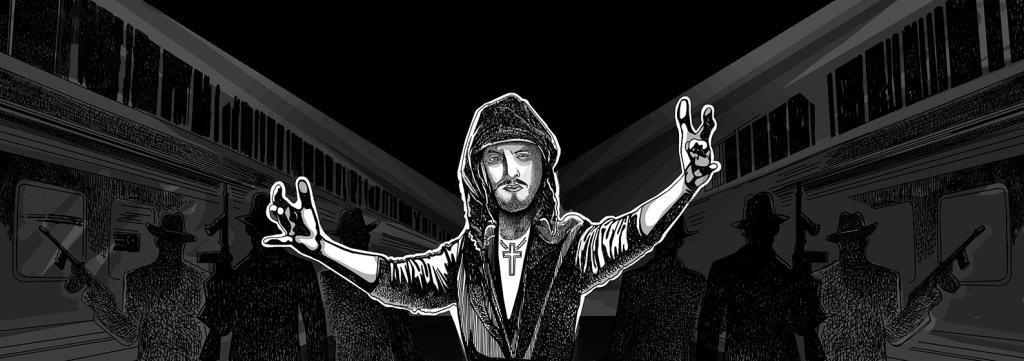
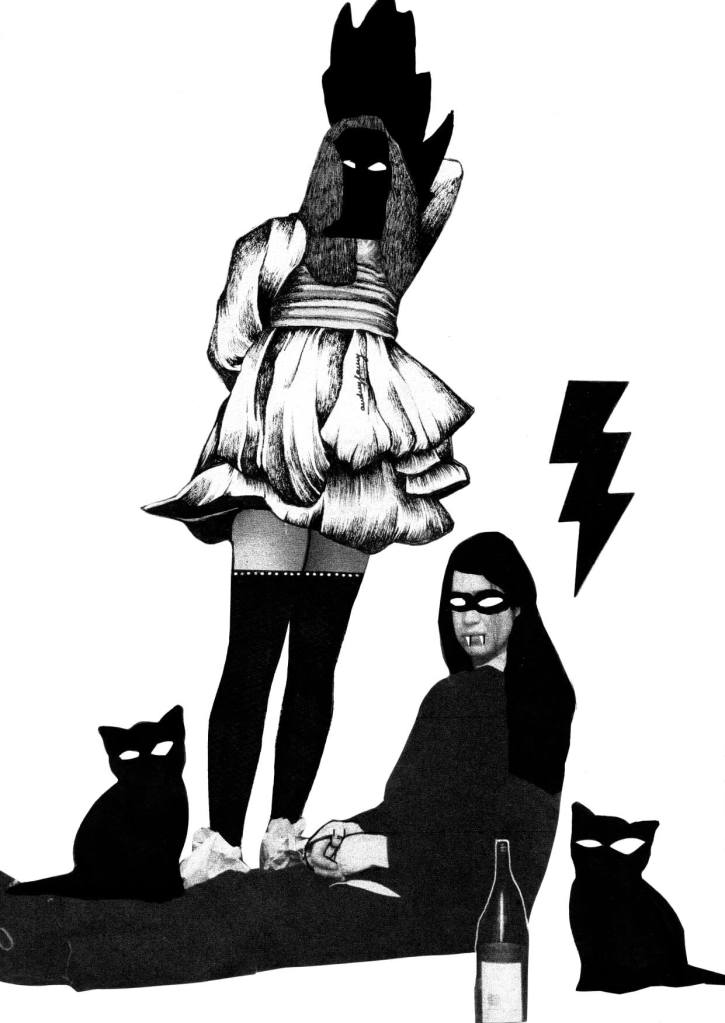
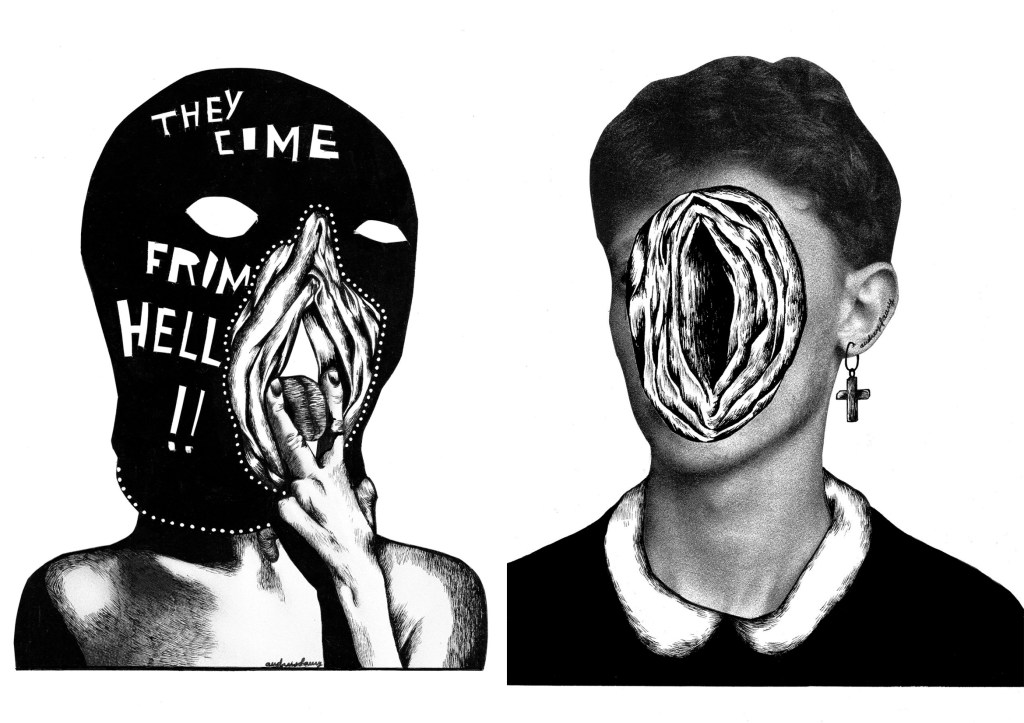
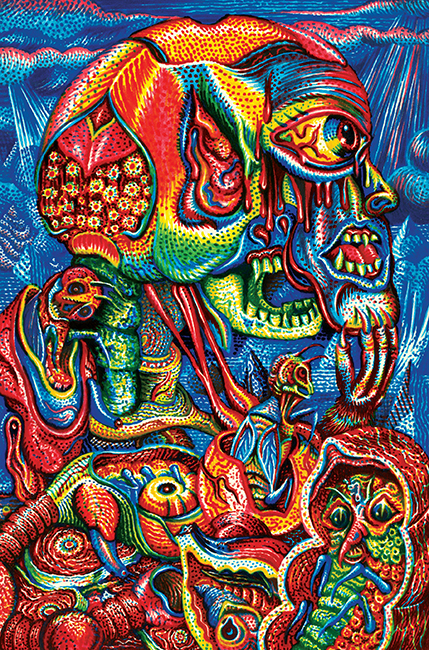
Batuhan Dedde, yeni kitabıyla farklı bir dil deneyimini sunuyor hepimize. Kitabın akışı adeta bir ruhun pusulasını da okuruna sunuyor. Şairin, yazarın üzerinde durduğu benliği, cinneti, karanlığı, rüyaları adeta onun bir taraftan ruhsal fırtınalara diğer yandan tarihin derinliğe ve mitolojik göndermelere de zemin hazırlıyor. Antik dünyada karanlığın yaratılıştan önce geldiğine inanıyorlardı. Modern zamanlarda “gece” sözcüğü ağırlığını hissettiriyor, sanki bireyselliğe ulaşmak için karanlığın ve de gecenin dünyasıyla yüzleşmek zorundadır günümüz insanı.
Batuhan Dedde- Beykent Üniversitesi RTS Öğrencileri ile Röportaj (2014)
‘Down the lengths of the Bosphorus runs two currents: One on the surface and the the other deep below They run in opposite directions. And here in the strait which divides the city into two lies the perfecf metaphor for the city. For its residents too push and pull each other in different directions, seemingly contradictorily but vital for tha other’s survival.’
Batuhan Dedde was born in Istanbul in 1987. He has published several books, including the poetry collection Morfinsiz Çekilen Düş Sancıları, in 2013. His work brings together the sensibilities of the American Beats and the Turkish Second New.
‘Boğazin dibinden iki akıntı geçer ilki yüzeye yakın, diğeri çok daha derinden, birbirlerine zıt yönde akıp gider. Şehri ikiye ayıran bu boğaz ona en cok yakışan mecazın ta kendisidir. Zira bu şehrin sakinleri de birbirlerini farklı yönlere iter ve çeker. Tutarsız bir gayret gibi gözükse de hayatta kalmalarını sağlayan bu cekişmedir.’
Recluse
Batuhan Dedde
translated by Donny Smith
I come from a patriarchal solitude
I am the last hero remaining from a tribe whose reclusiveness extinguished it.
I run like a street dog after a dream that went too far
While all the conjurers are jumping off the tightrope I stretched across my heart.
God’s suffering drips on my face from the grayest of heavens
While a high-decibel symphony of separation claws at my ears:
The idiots call it rain.
I loved you in a way no human being should
I loved you with inhuman clarity and purity
I was so unrealistic I could have painted all the bloody tanks left over from the cold face of
war with pink dreams
Leaving all this step-eroticism at the door of an orphanage;
Looking right into the eyes of the greatest sufferings, and those sufferings’ good credit;
With the apprehension of an excommunicated Catholic;
Against all religious duties and the Prophet’s teachings, I loved you.
Saltuk Erginer & Seni Görmem İmkansız ‘Yalnız’ca’ 2013
‘Hep sevmekten kaybettim ben, Hep severek kaybettim. İçimi eze eze, avuçlarımı tutuştururcasına… Eğer şahitse şu kentin asfaltlarına düşen yağmur damlaları, Suyun intihar ettiğini düşündün mü hiç? Ben bu kente ne zaman ayak bassam bir başıma, Ağaçlar, yapraklar bile yalnızlığı öğretiyor, Yalnızlığın lisanını konuşuyor; “Yalnızca.” Yalnızca, salınıyor dallar Yapraklar yalnızlık kanamış, ölüyorlar, Sonbahar bahane…‘
Blood of a Poet: Batuhan on instagram live
Münzevi
Batuhan Dedde
Ataerkil bir yalnızlıktan geliyorum
Münzevilikten helak olmuş bir kavmin
Kalan son kahramanıyım.
Çığırından çıkmış bir hayalin arkasında koşarken
sokak kopekleri gibi
Kalbimde gerdiğim telden aşağı atlıyor bütün hokkabazlar
Tanrının acısı damlarken yüzüme göğün en grisinden
Yüksek desibelli bir ayrılık senfonisi kulaklarımı tırmalıyor;
Aptallar yağmur diyorlar.
Bir insana yakışmayacak şekilde sevdim ben seni
Bir insana yakışmayacak kadar duru ve net
Savaşın soğuk yüzünden kalan kanlı tankları
Pembe düşlere boyayabilecek kadar idealisttim
Bütün üvey erotizmleri bir yetimhanenin kapısına bırakarak
Tahsili yüksek acıların gözünün içine baka baka
Aforoz edilmiş bir Katolik kaygısıyla
Farzlara, sünnetlere aykırı sevdim ben seni.
Sanatçılar, şairler, yazarlar, yaratıcı süreçler için kolektif bilinç dışında kök salmış zihinsel ve yaratıcı formları kullanırlar. Sanatsal yaratım sürecinde bu zihinsel imgeler zihnin bilinçli katmanlarına ulaşır ve yapıtı ortaya çıkartır.
“Yazık Yenilenlere” kitabı çok zor bir yaşam deneyiminden süzülerek biçim bulmuş. “Corona” ve “karantina” günlerinin şiire, sanata, edebiyata nasıl yansıdı sorusunun da bir nebze yanıtıdır bu kitap. Tüm zorluklara rağmen “umut” sözcüğünün örtülü biçimde de olsa şairlerin yüreğinden yükselmesi önemlidir. Özellikle günümüzün kritik dünya koşullarında ve insanlık tarihinde eşi benzeri olmayan Corona denen bir olguyla yüzleşmede umudun yeri, insanı ve insanlığı kurtarabilecek tek ışık penceresidir. Umut ise, şiirin, öykünün, sanat yapıtlarımızdan başka bir şey değil. Batuhan Dedde’nin zengin dili, bakış açısı ve şaşırtıcı derecedeki yaratıcılığı okuruna yol fenerdir.
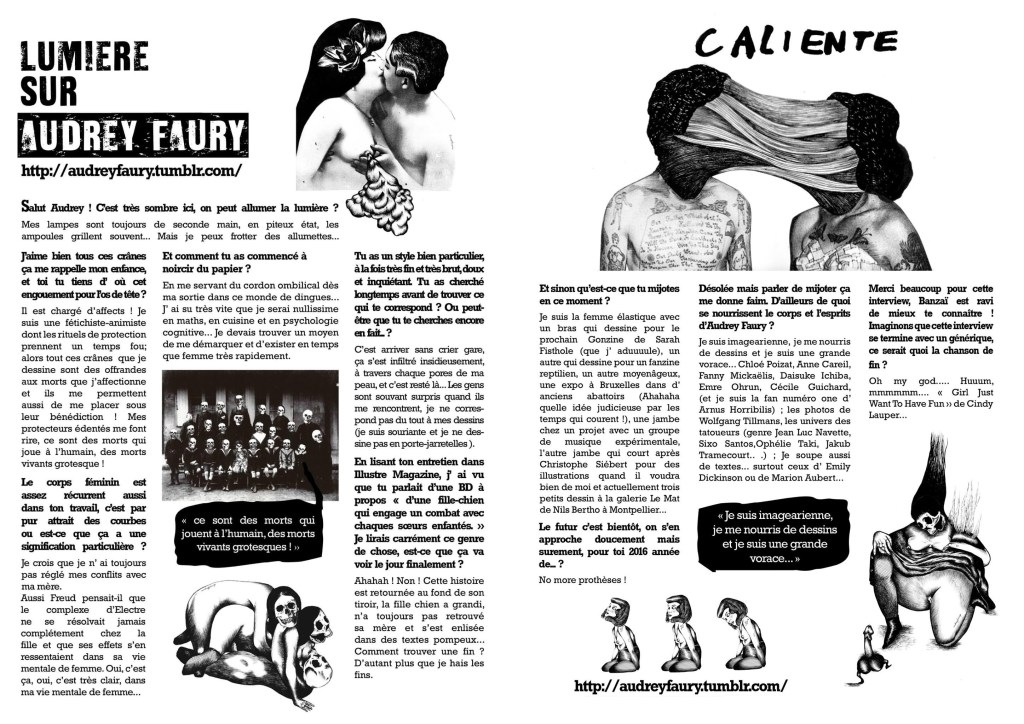
« ce sont des morts qui jouent à l’humain, des morts vivants grotesques ! »
Salut Audrey ! Cest très sombre ici, on peut allumer la lumière ?
Mes lampes sont toujours de seconde main, en piteux état, les ampoules grillent souvent… Mais je peux frotter des allumettes…
J’aime bien tous ces crânes ça me rappelle mon enfance, et toi tu tiens d’ où cet engouement pour l’os de tête ?
Il est chargé d’affects ! Je suis une fétichiste-animiste dont les rituels de protection prennent un temps fou; alors tout ces crânes que je dessine sont des offrandes aux morts que j’affectionne et ils me permettent aussi de me placer sous leur bénédiction ! Mes protecteurs édentés me font rire, ce sont des morts qui joue à l’humain, des morts vivants grotesque !
Le corps féminin est assez récurrent aussi dans ton travail, c’est par pur attrait des courbes ou est-ce que ça a une signification particulière ?
Je crois que je n’ ai toujours pas réglé mes conflits avec ma mère.
Aussi Freud pensait-il que le complexe d’Electre ne se résolvait jamais complètement chez la fille et que ses effets s’en ressentaient dans sa vie mentale de femme. Oui, c’est ça, oui, c’est très clair, dans ma vie mentale de femme…
Audrey Fawry, ‘L’Amour au premier regard / Dessins et autres Romantismes à retrouver à la Galerie Le Mât chez Mr Nils Bertho pour l’expo Rifuel Fanglant 2015! Dessins encre noire / stylo, collages (2015, 2018)
Et comment tu as commencé à noircir du papier ?
En me servant du cordon ombilical dès ma sortie dans ce monde de dingues… Y ai su très vite que je serai nullissime en maths, en cuisine et en psychologie cognitive… Je devais trouver un moyen de me démarquer et d’exister en temps que femme très rapidement.
Tu as un style bien particulier, à la fais très fin et très brut, doux et inquiétant Tu as cherché longtemps avant de trouver ce qui te correspond ? Ou peut-être que tu te cherches encore en fait..?
C’est arriver sans crier gare, ça s’est infiltré insidieusement, à travers chaque pores de ma peau, et c’est resté là… Les gens sont souvant surpris quand ils me rencontrent, je ne correspond pas du tout à mes dessins (je suis souriante et je ne dessine pas en porte-jarretelles).
En lisant ton entretien dans Illustre Magazine, f ai vu que tu parlait d’une BD à propos « d’une fille-chien qui engage un combat avec chaques sœurs enfantés. » Je lirais carrément ce genre de chose, est-ce que ça va voir le jour finalement ?
Ahahah ! Non ! Cette histoire est retournée au fond de son tiroir, la fille chien a grandi, n’a toujours pas retrouvé sa mère et s’est enlisée dans des textes pompeux… Comment trouver une fin ? D’autant plus que je hais les fins.
« Je suis imagearienne, je me nourris de dessins et je suis une grande vorace… »
Et sinon qu’est-ce que tu mijotés en ce moment ?
Je suis la femme élastique avec un bras qui dessine pour le prochain Gonzine de Sarah Fisthole (que j’ aduuuule), un autre qui dessine pour un fanzine reptilien, un autre moyenâgeux, une expo à Bruxelles dans d’ anciens abattoirs (Ahahaha quelle idée judicieuse par les temps qui courent !), une jambe chez un projet avec un groupe de musique expérimentale, l’autre jambe qui court après Christophe Siébert pour des illustrations quand il voudra bien de moi et actuellement trois petits dessin à la galerie Le Mat de Nils Bertho à Montpellier…
Le futur c’est bientôt, on s’en approche doucement mais surement, pour toi 2016 année de..?
No more prothèses !
Désolée mais parler de mijoter ça me donne faim D’ailleurs de quoi se nourrissent le corps et l’esprits d’Audrey Faury ?
Je suis imagearienne, je me nourris de dessins et je suis une grande vorace… Chloé Poizat, Anne Careil, Fanny Mickaëlis, Daisuke Ichiba, Emre Orhun, Céline Guichard, (et je suis la fan numéro one d’ Arnus Horribilis) ; les photos de Wolfgang Tillmans, les univers des tatoueurs (genre Jean Luc Navette, Sixo Santos, Ophélie Taki, Jakub Tramecourt…); Je soupe aussi de textes… surtout ceux d’ Emily Dickinson ou de Marion Aubert…
Merci beaucoup pour cette interview, Banzaï est ravi de mieux te connaître ! Imaginons que cette interview se termine avec un générique, ce serait quoi la chanson de fin?
Oh my god Huuum, mmmmmm…. « Girl Just Want To Have Fun » de Cindy Lauper…
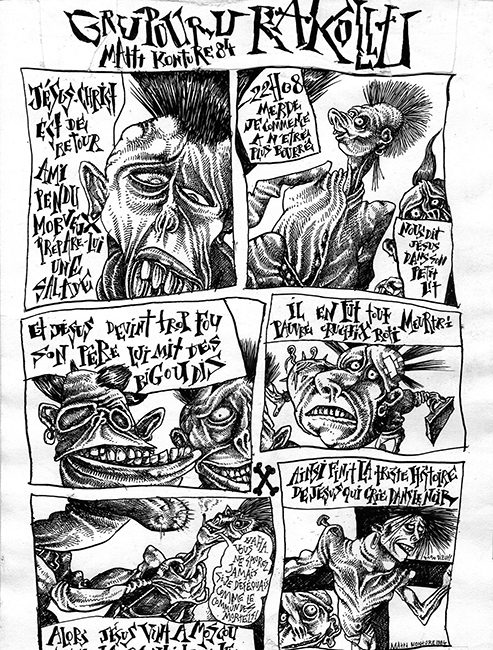
Mattt Konture is a French underground comics author and musician. He is one of the founders of the French publishing house L’Association and is a forerunner of the French autobiographical comics movement. Konture grew up in Lozère, where his influences included Métal Hurlant artists like Marc Caro, Doury, Rita Mercedes, and Moebius.
Konture published his first comics in 1983 (at the age of 18) in magazines such as Viper (“L’ajeun”) and Le Lynx (“Les Exploits de Ted” with Jean-Christophe Menu). When Konture went to Paris he published his first comics, Nerf, on an old Xerox machine. L’Association later reprinted this first book. His first comic book was Ruga Zébo Violent, first volume of the “Pattes de Mouche” collection published by L’ANAAL, to become L’Association.
At this time, Konture’s drawings were very dark and full of strokes and looked like the growing American underground style. Konture later discovered 1960s American underground cartoonists such as R. Crumb and Gilbert Shelton, who inspired him to create psychedelic and autobiographical comics. In 1988, Konture started autobiographical comics such as Krokrodile Comix 1, or Galopu, that was a forerunner of the French underground movement.
Mattt Konture, 1984
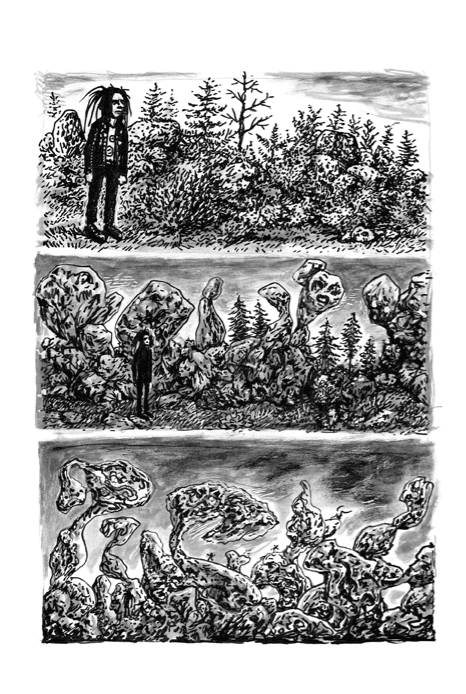
In 1989 Konture returned to Lozère. There he drew a few comics and continued Ivan Morve (a pun on “Mort-vivant,” “living dead”). Ivan Morve is a series of half-autobiographical stories published in the pages of Psykopat.
During the same period Konture started “Jambon blindé,” an improvised comix commissioned by his friend Stéphane Blanquet. This new way of telling stories drove Konture to draw a series of “comix” edited by L’Association in the collection Mimolette. “Autopsie d’un mort vivant” (“Autopsy of a living dead”) is a dark retelling of Konture’s life. In these books all his characters reappear: Galopu, Mister VrO, and Ivan Morve — each of them represents the author’s mood.
Mattt often draws with artist friends, publishing works such as Galopinot (L’Association) drawn with Lewis Trondheim, and, more recently, L’Abbé Noir (Arbitraire) drawn with Lilas and Willy Ténia, La Comète à 4 pattes (L’Association), drawn with Lilas, Willy Ténia and Freaky Nasa, and Borrut Popotte (Marseilles based silkscreen and publishing house Le Dernier Cri), drawn with Lilas.
For a long period of his life, Konture worked at home. Now he’s part of a collective artist’s space (workshop, gallery and boutique) En Traits Libres, which is open to the public.
Vidéo réalisée par Sébastien Casino pour l’exposition de Mattt Konture à La Jetée (Janvier 2017)
Konture has also played in many musical groups (Les Tordus, Pumpkin Guts, Cosmogol, Rhinoplastic Démodex…), including his original one-man group Courge, which later changed its name to Lucky and the Courges, and which produces CDs and plays concerts in the Montpellier area where he lives.
Mattt Konture, L’Éthique du souterrain (2012)
attt Konture, L’Éthique du souterrain
Documentaire de 64 minutes réalisé par Francis Vadillo, qui a suivi Mattt Konture pendant plus de deux ans, chez lui, dans différents festivals, et lui offre enfin le portrait qu’il mérite. C’est l’occasion de le voir au travail, dessinant dans ses carnets et réalisant des fanzines, ou jouant sur scène avec son groupe Courge. On pénètre dans son quotidien en l’accompagnant dans sa pratique compulsive du dessin, seul ou entouré de ses nombreux amis fanzineux, mais aussi par l’évocation de la maladie qui l’affecte, la sclérose en plaques. C’est enfin un portrait d’une scène underground musicale et graphique vivace et festive, que Mattt Konture n’a de cesse de parcourir pour apporter sa contribution.
On y croise J.-C. Menu, Pacôme Thiellement et Killoffer, qui se souviennent de leurs rencontres, au début des années 80, et reviennent sur l’importance de son œuvre autobiographique.
Mattt Konture : l’éthique du souterrain 2018
Mattt Konture auteur incontournable de la bande dessinée contemporaine se distingue notamment par ses albums autobiographiques introspectifs et sans concession qu’il écrit et dessine depuis vingt ans. On y croise ses amis son plaisir à dessiner son groupe Courge son univers underground libertaire où l’on se soucie peu du marché de l’art et de l’édition où l’on fait tout soi-même. Ce film est aussi l’histoire d’un homme d’un artiste qui affronte le mal dont il est atteint la sclérose en plaque. Une maladie qui parfois s’exprime par un graphisme sombre et torturé quand elle prend le dessus. Mais ce que l’on retient de cette expérience de vie c’est la capacité de Mattt Konture à répandre autour de lui une forte dose.
Mattt Konture, L’Éthique du souterrain (2012)
64-minutes documentary directed by Francis Vadillo, who followed Mattt Konture for more than two years, at home, in various festivals, and finally offers him the portrait he deserves. This is an opportunity to see him at work, drawing in his notebooks and making fanzines or playing on stage with his group Courge. We enter his daily life by accompanying him in his compulsive practice of drawing, alone or surrounded by his many zinester friends, but also by evoking the disease that affects him, multiple sclerosis. Finally, it is a portrait of a vivacious and festive musical and graphic underground scene which Mattt Konture constantly explores to make his contribution.
We meet J.-C. Menu, Pacôme Thiellement and Killoffer, who remember their meetings in the early 80s, and discuss the importance of his autobiographical work.
Mattt Konture, L’Éthique du souterrain (2012) L’association
During filming, Mattt Konture produced a new “comixture” which accompanies the DVD. This new comix, without possible comparison with a simple making-of, opens a dialogue with the documentary, offers it unexpected extensions and gives all its coherence to the whole.
Animation paréidolique par Mattt Konture et Janko pour le film Mondo DC / production Le Dernier Cri Musique Janko & Mattt Konture, montage Pakito Bolino
« La sous-culture est plus pernicieuse, plus virulente, plus vicieuse que l’art. L’art on sait où le trouver, il est au chaud, même s’il se dit violent ou anarchiste, il restera bien au chaud sous ses dorures. La sous-culture, elle, ne fait pas semblant, ne se donne pas de médailles, ou alors en chocolat. La sous-culture est toujours en danger, cachée dans la jungle, entre un paquet de lessive et des jouets en plastique bon marché. Même si parfois je flirte avec le milieu chaud et confortable, même si j’y glisse un doigt ou bien même un bras, le reste de mon corps est dans les intempéries des sous-sols ».
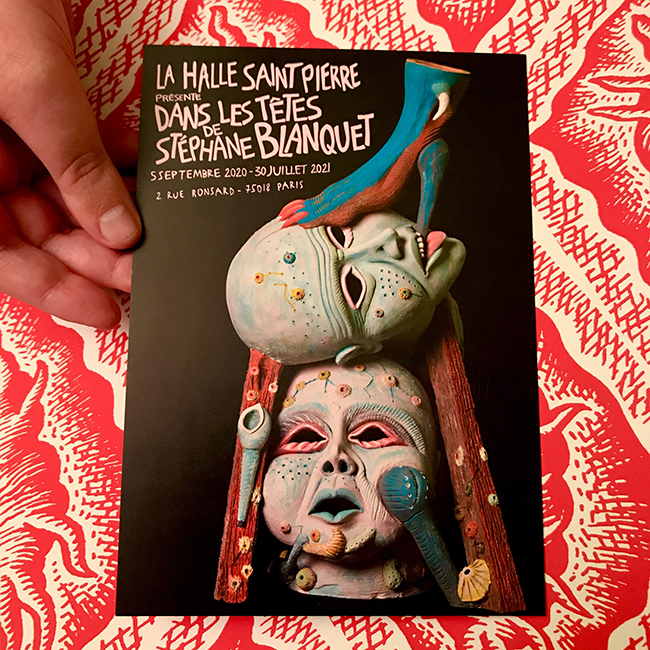
Dans La Têtes de Stéphane Blanquet
Par Martine Lusardy, directrice de la Halle Saint Pierre, 2020
Présenté à la Halle Saint Pierre en 2011/2012 dans le cadre de l’exposition HEY! modern art & pop culture par Anne et Julien, Stéphane Blanquet y conçut spécialement une installation. Celle-ci portait très haut l’enjeu de l’exposition : affirmer la vitalité de ces expressions artistiques individuelles et autonomes qui rompent avec les conventions et les codes dominants et renversent les valeurs établies du “beau” et du “laid”, du bon” et du “mauvais” goût. L’artiste revient aujourd’hui en nos murs déployer son imaginaire tentaculaire : une carte blanche qui sera également pour lui l’occasion d’inviter des artistes avec qui il partage le même goût pour notre humanité souterraine.
Dessinateur, plasticien, metteur en scène, réalisateur, Stéphane Blanquet a derrière lui un long parcours dans le milieu de l’édition où il a fondé en 1990 le mythique Chacal Puant, primé au festival de la BD d’Angoulême en 1996 pour le graphzine La Monstrueuse puis les United Dead Artists. Considéré comme l’une des figures majeures de la scène artistique underground, son univers tourmenté déborde largement du cadre de sa production graphique. Installations, spectacle vivant, scénographie, cinéma d’animation, costumes et décors de théâtre, jouets, poupées et autres objets atypiques et subversifs, ombres chinoises, sont autant d’espace de création où Stéphane Blanquet signifie son parti pris : « La sous-culture est plus pernicieuse, plus virulente, plus vicieuse que l’art. L’art on sait où le trouver, il est au chaud, même s’il se dit violent ou anarchiste, il restera bien au chaud sous ses dorures. La sous-culture, elle, ne fait pas semblant, ne se donne pas de médailles, ou alors en chocolat. La sous-culture est toujours en danger, cachée dans la jungle, entre un paquet de lessive et des jouets en plastique bon marché. Même si parfois je flirte avec le milieu chaud et confortable, même si j’y glisse un doigt ou bien même un bras, le reste de mon corps est dans les intempéries des sous-sols ».
Les sous-sols seraient donc l’univers matriciel de Blanquet, un underground culturel réel où naissent ses images abrasives, mais aussi le lieu symbolique d’où provient la voix qui les anime. Ses influences seraient à chercher du côté de la bande dessinée érotique bon marché des années 70 à 90, notamment celle du sulfureux éditeur français Elvifrance. Cette littérature de gare licencieuse, au sexe explicite et à l’horreur débridée, aura été une inspiration directe.
Blanquet, Halle Saint Pierre, 2020
« Si on regarde bien, je dessine une brindille comme si c’était un organe, de l’herbe comme des poils, c’est une vision organique de tout, tout transpire plus ou moins, et tout est vivant… Et puis, il est bien plus passionnant de dessiner, de faire vivre des morceaux, cela devient comme des paysages, falaises de gorges, forêt de vulves, ça devient plus intéressant qu’une petite balade dans la campagne ».
L’exploration artistique de nos mondes psychiques et mythiques selon Stéphane Blanquet met à découvert ce que nous pensions connaître : le monde des pulsions, du sexe et de l’organique « Si on regarde bien, je dessine une brindille comme si c’était un organe, de l’herbe comme des poils, c’est une vision organique de tout, tout transpire plus ou moins, et tout est vivant… Et puis, il est bien plus passionnant de dessiner, de faire vivre des morceaux, cela devient comme des paysages, falaises de gorges, forêt de vulves, ça devient plus intéressant qu’une petite balade dans la campagne ». Ce langage issu des profondeurs du corps humain est à même de rendre accessibles l’indicible, l’impensabl e, l’inavoué. Mais si Éros est ici généreux, s’il sécrète dans une joyeuse abondance, sa force vitale et créatrice n’en est pas moins inquiétante dans son engendrement jusqu’à l’obscène, dans sa prolifération jusqu’à la monstruosité. « Vomir sa propre œuvre, face au vide, face à l’encre épaisse, face à son propre dégoût, soi- même, c’est là qu’est l’impact. Face à face. Être seul et vomir sa propre mélasse, son propre jus, noir ou rouge, pourvu qu’il ne soit pas transparent ». Le corps, pour Blanquet, est instauré en une réserve de vitalité inépuisable, une véritable usine où chaque organe ne s’arrête pas à une fonction biologique mais prend alors un statut expressif, dévidant sur le monde environnant ses sécrétions symboliques. Le désir s’impose-t-il avec trop de force ? Il doit alors faire exploser les têtes, les sexes, les faire cascades de liquides.
Le monde selon Stéphane Blanquet est un monde réduit à ses soubassements pulsionnels et organiques. Mais l’artiste en établit sa propre topographie, créant dans un style exubérant, presque effrayant, de nouvelles relations entre les mots, les images et les corps. Il les dévoile autant qu’il les recouvre par leur étrangeté cruelle, grotesque, excessive. Un extrême que l’on retrouve déjà dans nombre de ses titres : Goudron Pressage – Sillon Tympan, Vide point . rose trou, Mâchoires noires, Blanquet gangrène Tokyo, Blanquet s’ouvre la panse, Labyrinthique intestin, Chambre avec vue sur mes cauchemars, Rendez-vous Moi en Toi, La Vénéneuse aux deux éperons, Chocottes au sous-sol !, La nouvelle aux pis, Viande froide et Cie, Le Fantôme des autres, Mon méchant moi, Monographie lacrymale.
Blanquet choque, provoque, trouble, aime créer le malaise en manipulant nos frustrations et ses propres obsessions. Son univers torturé, angoissé est peuplé d’hommes, de femmes et d’enfants que nous voyons habités par le démon de la perversité. Mais cette tension entre innocence et cruauté, entre jubilation sexuelle et pulsion de mort n’est pas désespérance sans issue. Blanquet fait la peau au refoulé, ressuscite la chair, les corps délivrés de la culpabilité et de la peur de mourir.
Art News V4005: Stéphane Blanquet
« S’user jusqu’à la corde, raide, raide et rouge. La radicalité d’une œuvre n’est pas collective, elle ne peut l’être, elle est avec soi-même, sans posture, à poil devant la mort ».
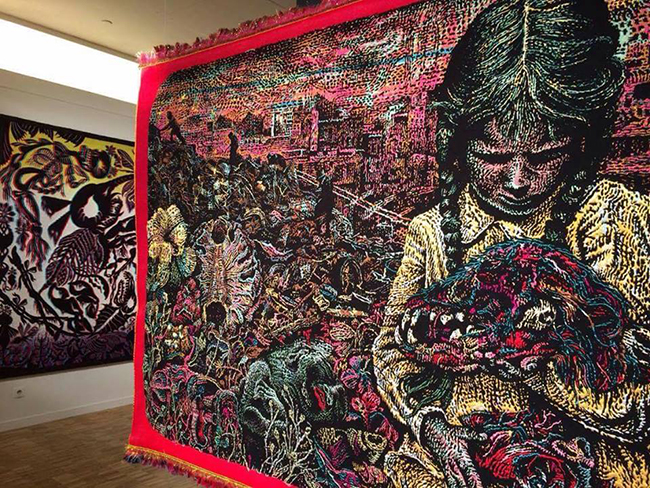
Artiste plasticien, dessinateur, créateur multimédia… Stéphane Blanquet (1973) développe un foisonnement d’images, de formes et de sons depuis la fin des années 1980 : œuvres d’art, installations, spectacle vivant et scénographie, édition indépendante, art urbain, cinéma d’animation, musique… Il enrichit son travail en explorant avec passion les technologies et techniques les plus variées, des plus traditionnelles aux plus avant-gardistes : dessin à la plume, lithographie, tapisserie numérique, outils informatiques…
En 1993, Blanquet, invité par Jacques Noël pour une première exposition solo, présente « Exposition Posthume » au Regard Moderne à Paris. Depuis, son travail est régulièrement montré: MAC Lyon, Singapore Art Museum, Musée des Arts Décoratifs (Paris), Hayward Gallery (Londres), Halle Saint-Pierre (Paris), Museum of Fine Arts Boston (USA)… Récemment, il a présenté des expositions personnelles au Centre Georges Pompidou à Paris en 2016, au Fürstenfeldbruck Kunsthaus (Allemagne) en 2017 et à l’Abbaye d’Auberive en 2018.
Présentation de l’exposition par Stéphane BLANQUET
Il est très rare que l’on vous donne les clefs d’un lieu pour l’investir entièrement, sur une longue période, en vous laissant libre de s’y déployer de bas en haut, sur tous les murs, dans tous les espaces, de l’investir avec des images, des dessins, des sculptures, des expérimentations visuelles, des couleurs et lumières rouges vives, des nouvelles pièces rêvées pour le lieu. Il faut l’investir, se répandre, s’ouvrir soi-même et aller chercher sa propre matière. C’est à l’intérieur de soi que ça se passe, à l’intérieur de moi que sont mes images, mon univers, mes univers. Une tête ne suffit pas à contenir toutes mes envies, il m’en faut toujours plus, comme à mon habitude, plus de tout, plus de couleurs, plus d’espace, et évidemment plus de têtes. Plus d’univers nécessite / appelle / exige / signifie plus de têtes.
Dans les têtes de Stéphane Blanquet – dans mes têtes.
Une exposition d’un an ne peut pas rester statique, je suis trop agité pour la laisser dormir confortablement. Il me faut de l’inconfort et mon inconfort sera généreux. Diviser un an en trois temps, exposition évolutive en trois moments, tous les quatre mois réinvestir l’espace, le faire évoluer avec de nouvelles images, de nouvelles installations, des œuvres peu vues, des nouvelles tapisseries, des nouveaux totems, de nouvelles têtes. Pourquoi s’arrêter là ? Ce n’est pas suffisant, ce n’est jamais assez, alors déployons. Au-dessus de moi, à l’étage, au-dessus de mes têtes, je veux montrer d’autres univers, des univers frères, des univers sœurs. Des invités du monde entier. Des peintres, des collagistes, des dessinateurs, des artistes du monde entier, en deux expositions successives, une cinquantaine d’artistes. Il faut se déployer dans la générosité. Donc, en même temps que les murs, lancer un journal, un hebdomadaire, La Tranchée Racine. Chaque semaine, sur toute la durée de l’exposition, une excroissance graphique, en couleurs, imprimée sur un beau papier. 40 numéros, 500 artistes du monde entier. Il faut au moins ça, c’est un minimum. Il faut le maximum. Dans mes têtes, c’est comme ça.
“Subculture is more pernicious, more virulent, more vicious than art. Art you know where to find, it’s warm, even if it calls itself violent or anarchist, it’ll stay warm under its gilding. Subculture, on the other hand, doesn’t pretend, doesn’t give itself medals, or even chocolate ones. The subculture is always in danger, hidden in the jungle between a packet of washing powder and cheap plastic toys. Even if I sometimes flirt with the warm and comfortable environment, even if I slip a finger or even an arm in there, the rest of my body is in the bad weather of basements”.
Presented at Halle Saint Pierre in 2011/2012 as part of Anne and Julien’s HEY! modern art & pop culture exhibition, Stéphane Blanquet designed a special installation. This installation reflected the very essence of the exhibition: to affirm the vitality of these individual, autonomous artistic expressions that break with dominant conventions and codes, and overturn established values of “beautiful” and “ugly”, of “good” and “bad” taste. Today, the artist returns to our walls to deploy his tentacular imagination: a carte blanche that will also be an opportunity for him to invite artists with whom he shares the same taste for our subterranean humanity.
Blanquet, Halle Saint Pierre, 2020
Dans La Têtes de Stéphane Blanquet
By Martine Lusardy,director of the Halle Saint Pierre
Stéphane Blanquet is a draughtsman, visual artist, director and filmmaker with a long career in the publishing world, where he founded the legendary Chacal Puant in 1990, won an award at the Angoulême Comics Festival in 1996 for the graphzine La Monstrueuse, and then the United Dead Artists. Considered one of the leading figures on the underground art scene, his tormented universe extends far beyond his graphic work. Installations, live shows, set design, animated films, costumes and theater sets, toys, dolls and other atypical, subversive objects, shadow puppets – these are just some of the creative spaces in which Stéphane Blanquet expresses his bias: “Subculture is more pernicious, more virulent, more vicious than art. Art you know where to find, it’s warm, even if it calls itself violent or anarchist, it’ll stay warm under its gilding. Subculture, on the other hand, doesn’t pretend, doesn’t give itself medals, or even chocolate ones. The subculture is always in danger, hidden in the jungle between a packet of washing powder and cheap plastic toys. Even if I sometimes flirt with the warm and comfortable environment, even if I slip a finger or even an arm in there, the rest of my body is in the bad weather of basements”.
Blanquet, Halle Saint Pierre, 2020
“If you look closely, I draw a twig as if it were an organ, grass as if it were hair, it’s an organic vision of everything, everything transpires more or less, and everything is alive… And then, it’s much more exciting to draw, to bring pieces to life, it becomes like landscapes, cliffs of gorges, forest of vulvas, it becomes more interesting than a little stroll in the countryside.”
Basements are thus Blanquet’s matrix universe, a real cultural underground where his abrasive images are born, but also the symbolic place where the voice that animates them comes from. Blanquet’s influences are to be found in the cheap erotic comics of the 70s and 90s, notably those of the sulphurous French publisher Elvifrance. This licentious station literature, with its explicit sex and unbridled horror, was a direct inspiration.
Stéphane Blanquet’s artistic exploration of our psychic and mythical worlds uncovers what we thought we knew: the world of impulses, sex and the organic “If you look closely, I draw a twig as if it were an organ, grass as if it were hair, it’s an organic vision of everything, everything transpires more or less, and everything is alive… And then, it’s much more exciting to draw, to bring pieces to life, it becomes like landscapes, cliffs of gorges, forest of vulvas, it becomes more interesting than a little stroll in the countryside”. This language from the depths of the human body is capable of making accessible the unspeakable, the unthinkable, the unacknowledged. But if Eros is generous here, if it secretes in joyous abundance, its vital and creative force is no less disturbing in its engendering to the point of obscenity, in its proliferation to the point of monstrosity. “Vomiting one’s own work, in the face of emptiness, in the face of thick ink, in the face of one’s own self-loathing, that’s where the impact lies. Face to face. To be alone and vomit your own molasses, your own juice, black or red, as long as it’s not transparent. For Blanquet, the body is an inexhaustible reserve of vitality, a veritable factory where each organ is not limited to a biological function, but takes on an expressive status, reeling out its symbolic secretions onto the surrounding world. Does desire impose itself too forcefully? Then it must explode heads, sexes and cascades of liquids.
Blanquet, Halle Saint Pierre, 2020
Stéphane Blanquet’s world is reduced to its impulsive, organic underpinnings. But the artist establishes his own topography, creating new relationships between words, images and bodies in an exuberant, almost frightening style. He reveals them as much as he covers them with their cruel, grotesque, excessive strangeness. An extremity already present in many of his titles: Goudron Pressage – Sillon Tympan, Vide point . rose trou, Mâchoires noires, Blanquet gangrène Tokyo, Blanquet s’ouvre la panse, Labyrinthique intestin, Chambre avec vue sur mes cauchemars, Rendez-vous Moi en Toi, La Vénéneuse aux deux éperons, Chocottes au sous-sol !, La nouvelle aux ud, Viande froide et Cie, Le Fantôme des autres, Mon méchant moi, Monographie lacrymale.
Blanquet shocks, provokes, unsettles, likes to create unease by manipulating our frustrations and his own obsessions. His tortured, anguished universe is populated by men, women and children we see inhabited by the demon of perversity. But this tension between innocence and cruelty, between sexual jubilation and the death drive, is not hopeless despair. Blanquet strips away the repressed, resurrects flesh and bodies freed from guilt and the fear of death.
Smarty ‘Dans les têtes de Stéphane Blanquet’ 2021
“Wear yourself down to the bone, stiff, stiff and red. The radicality of a work is not collective, it cannot be, it is with oneself, without posture, naked in front of death”.
Presentation of the exhibition by Stéphane BLANQUET
It’s very rare that you’re given the keys to a place to invest it entirely, over a long period of time, leaving you free to spread out from bottom to top, on all the walls, in all the spaces, to invest it with images, drawings, sculptures, visual experiments, bright red colors and lights, new pieces dreamed up for the place. You have to invest it, spread out, open yourself up and fetch your own material. It’s all happening inside myself, inside my images, my universe, my worlds. One head is not enough to contain all my desires, I always need more, as usual, more of everything, more colors, more space, and of course more heads. More universes require / call / demand / mean more heads.
In the mind of Stéphane Blanquet – in my minds.
A one-year-old exhibition can’t stay static; I’m too restless to let her sleep comfortably. I need discomfort, and my discomfort will be generous. Dividing a year into three phases, an evolving exhibition in three moments, every four months reinvesting the space, evolving it with new images, new installations, little-seen works, new tapestries, new totems, new heads. Why stop there? It’s not enough, it’s never enough, so let’s expand. Above me, upstairs, above my heads, I want to show other universes, brother universes, sister universes. Guests from all over the world. Painters, collagists, draughtsmen, artists from all over the world, in two successive exhibitions, some fifty artists. It’s all about generosity. So, at the same time as the walls, we launched a newspaper, a weekly, La Tranchée Racine. Every week, for the duration of the exhibition, a graphic excrescence, in color, printed on beautiful paper. 40 issues, 500 artists from all over the world. That’s the minimum. You need the maximum. In my mind, it’s like that.
Stéphane Blanquet (1973) is a visual artist, draughtsman and multimedia designer who has been developing an abundance of images, forms and sounds since the late 1980s: works of art, installations, live performance and scenography, independent publishing, urban art, animated film, music, etc. He enriches his work by passionately exploring a wide range of technologies and techniques, from the most traditional to the most avant-garde: pen-and-ink drawing, lithography, digital tapestry, computer tools, etc.
The world according to Stéphane Blanquet is a world reduced to its impulsive and organic underpinnings. But the artist establishes his own topography, creating in an exuberant, almost frightening style, new relations between words, images and bodies. He reveals them as much as he covers them by their cruel, grotesque, excessive strangeness. An extreme that we already find in many of his titles.
Blanquet shocks, provokes, troubles, likes to create uneasiness by manipulating our frustrations and his own obsessions. His tortured, anguished universe is populated by men, women and children that we see inhabited by the demon of perversity. But this tension between innocence and cruelty, between sexual jubilation and death drive is not hopelessness without a way out. Blanquet makes the skin with the repressed, resuscitates the flesh, the bodies delivered of the culpability and the fear to die. “To wear oneself out to the bone, stiff, stiff and red. The radicality of a work is not collective, it cannot be, it is with oneself, without posture, naked in front of death “.
Installation de Stéphane Blanquet / à l’Abbaye d’Auberive , lors de son exposition personnelle Par Les Masques Écornés, 2018
In 1993, invited by Jacques Noël for his first solo exhibition, Blanquet presented ‘Exposition Posthume’ at the Regard Moderne in Paris. Since then, his work has been shown regularly: MAC Lyon, Singapore Art Museum, Musée des Arts Décoratifs (Paris), Hayward Gallery (London), Halle Saint-Pierre (Paris), Museum of Fine Arts Boston (USA), etc. He recently had solo exhibitions at the Centre Georges Pompidou in Paris in 2016, the Fürstenfeldbruck Kunsthaus (Germany) in 2017 and the Abbaye d’Auberive in 2018.
magasin de proximité
Buy it at the Halle Saint Pierre, in all the good bookstores or on blanquet.com
– you can also subscribe for the whole collection !! –
l’ensemble de la collection est disponible (pour un prix réduit) lors de la souscription
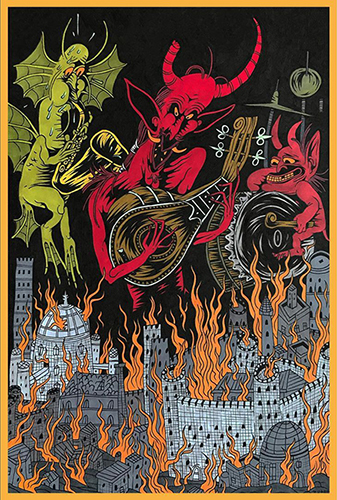
Gün geçmiyor ki genç çizerlerle karşılaşmayalım, son zamanlarda Cehennem tasvirleriyle dikkat çeken yeteneklerden biri de Mutaf. Kendini en iyi çizgilerle ifade ettiğini dile getiren sanatçı daha çok illüstratif grafik işleriyle biliniyor. Hayal dünyasından yarattığı fantastik karakterler kimi zaman ürkünç, kimi zaman sempatik halleriyle şimdiden kendine seçkin bir kitle oluşturmuş durumda. Karmaşık kompozisyonlarına eşlik eden grotesk hikayeler, bizleri karanlık diyarlara götürüyor. Huzursuz çizgilerle betimlenmiş bu hikayeler, içinde yaşadığımız dijital-çağın tüm kasvetini ve hastlalıklarını gözlerimizin önüne sererler, aşırı uyarılmadan sinirleri aşınmış bir pişmiş kelle bilgisayar odasında ruhunu teslim etmektedir, üzerinde madalyalar üniformalı bir figür ise kaybettiği insanlığını tabiatta aramaktadır; kaza, yaralanma, çarpışma ve felaketler sanatçının bolca kullandığı temalardan. İnsana içkin envayi çeşit deliliği tüm çıplaklığıyla resmetmekten çekinmeyen Mutaf aynı zamanda müzik sahnesinin de ilgisini çekmişe benziyor. Make Mama Proud gibi Rock’n Roll grupları için hazırladığı illüstrasyon işlerinde becerisini tüm incelikleriyle gözler önüne seriyor. Sanatçı aynı zamanda 2020 yılında İstanbul’da ‘Neşeli Günler’ isimli ilk kişisel sergisini açmıştır.
Mutaf ‘Neşeli Günler’ Big Baboli Sergi Afişi, 2020 İstanbul
Mutaf ‘Deadly Notes & End of a City’ serigraphy (2020)
Not a day goes by that we don’t meet young talents. Mutaf is one of the artists who have recently attracted attention with his portrayals of Hell. He says that he expresses himself best in drawings, the artist is mostly known for his illustrative graphic works. The fantastic characters he created from his imagination have already created a distinguished audience for themselves, with their sometimes frightening and sometimes sympathetic states. The grotesque stories accompanying his complex compositions take us to dark lands. These stories, depicted in restless lines, reveal the sickness of the digital-age we live in, a baked head whose senses have been corroded from overstimulation is about to surrender its soul in the computer room, while a human in uniform with his medals on is searching for his innocence in nature; accidents, injuries, collisions and disasters are among the themes that the artist uses profusely. Mutaf, who does not hesitate to draw all kinds of madness inherent in human being, is also an artist who has attracted the attention of the music scene. His illustration works for rock’n’roll bands such as Make Mama Proud reveal all the subtleties of his art. At the same time, the artist opened his first personal exhibition titled ‘Happy Days’ in Istanbul in 2020.
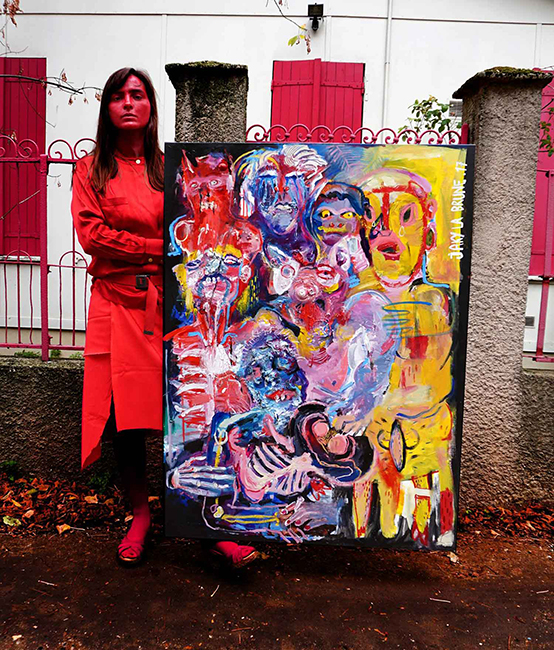
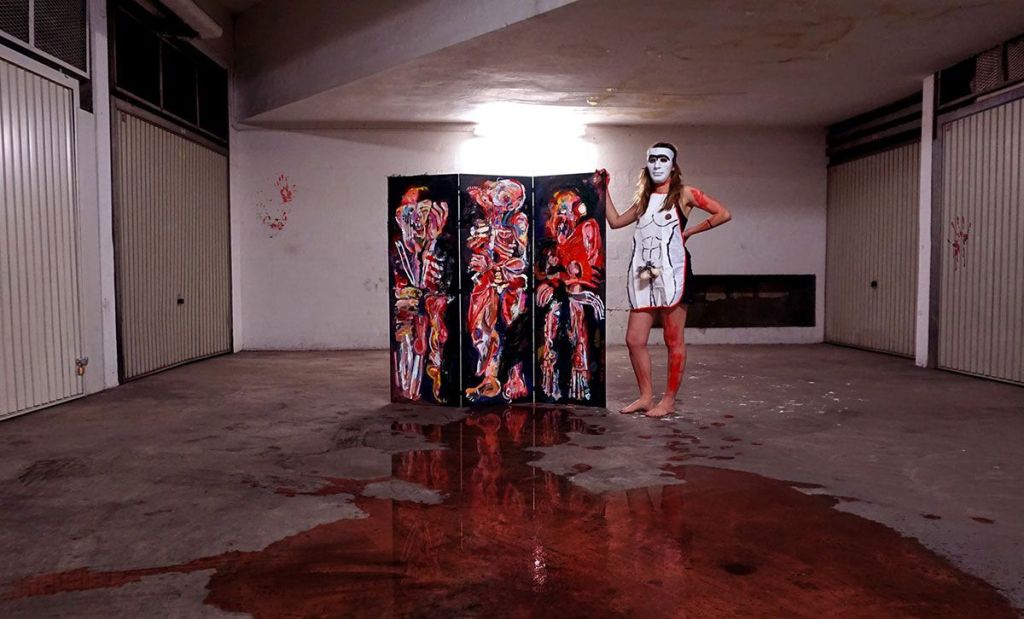
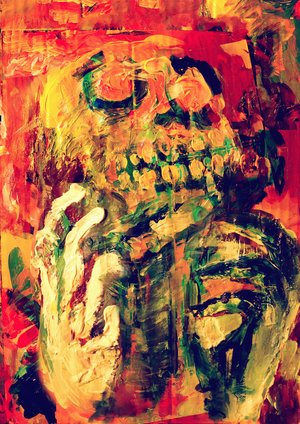
Jaky La Brune est une plasticienne normande vivant et travaillant à Paris depuis 2012. C’est en réalisant des pochettes d’albums qu’elle découvre la peinture. Celle-ci ne la quittera plus. Ses principaux thèmes tournent autour du questionnement sur l’identité et des émotions humaines. Ses peintures naissent d’histoires inspirées de ses tourments, une sorte de psychanalyse à travers les formes et les couleurs. La toile continue à vivre à travers l’imagination et l’interprétation libres de l’observateur. C’est à ce moment-là que son travail artistique prend tout son sens.
Découvert et proposé par Bernard Laurent-Zopf
Jaky La Brune is a visual artist from Normandy living and working in Paris since 2012. It was while making album covers that she discovered painting. This will never leave her. Her main themes revolve around the questioning of identity and human emotions. Her paintings are born from stories inspired by her torments, a kind of psychoanalysis through shapes and colors. The canvas lives on through the free imagination and interpretation of the viewer. This is when her artistic work takes on its full meaning.
Shamatic Power : Jaky la Brune
Blackness in Color
Written and Prepared by Bernard Laurent-Zopf
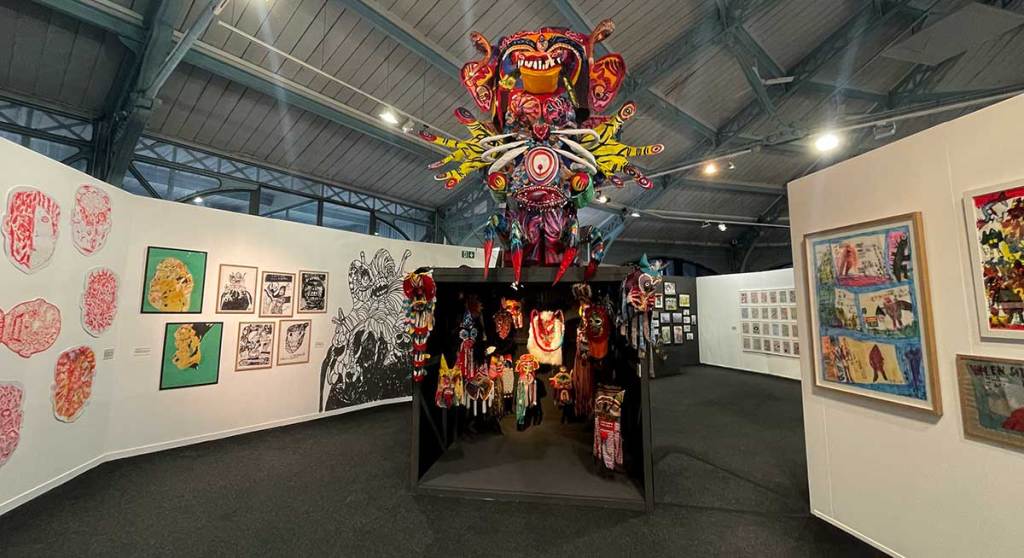
If we suddenly decide to go for a walk in the head of Stéphane Blanquet, we can come across a doorway to the multiple heads of Jaky La Brune. To be more clear and understandable, if we are going to pay a visit to the current exhibition devoted to the artist/painter/illustrator Stéphane Blanquet “Dans les Têtes de Stéphane Blanquet” at the Halle Saint-Pierre in Paris, we must meet the masks and painted characters of the painter Jaky la Brune.
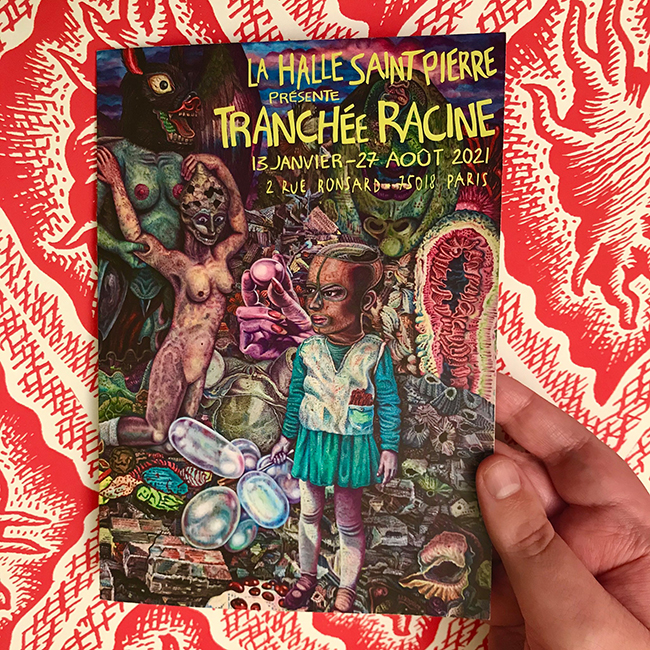
This painter is part of “Tranchée Racine” which is an artistic manifesto initiated by Stéphane Blanquet. Originally a publication of graphic images bringing together an international group of artists, it is transformed into an exhibition from May 19, 2021 to January 2, 2022, to accompany Stéphane Blanquet‘s monograph. “Tranchée Racine” which is therefore also a publication, a giant graphic tabloid (47.5 x 66 cm) of 12 pages, is sold at the sweet price of 5 euros. It presents, over its 42 issues, more than 500 works and brought together.
“Artistes viscéraux, généreux, hypnotiques, obsessionnels, ils viennent de tous les courants etcontre-courants. Agitateursrebelles, bruyants, cruels, généreux, non-conformistes”. Ils sont du monde entier.
Si on décide tout d’un coup d’aller faire un tour dans la tête de stéphane blanquet, on peut tomber au détour d’une porte sur les multiples têtes de Jaky La Brune. Pour être plus clair et compréhensible, si on va faire une visite à l’exposition actuelle consacrée à l’artiste/peintre/Illustrateur Stéphane Blanquet “dans les têtes de stéphane blanquet” à la Halle Saint-Pierre à Paris, on se doit de rencontrer les masques et personnages peints de la peintre Jaky la Brune.
Cette peintre fait partie de “Tranchée Racine” qui est un manifeste artistique initié par Stéphane Blanquet. A l’origine édition d’images graphiques fédérant une internationale de dessinateurs, elle se transforme en exposition du 19 mai 2021 au 2 janvier 2022, pour accompagner la monographie de Stéphane Blanquet. La tranchée racine qui est donc aussi une publication, un tabloïd graphique géant (47,5 x 66 cm) de 12 pages, est vendu au doux prix de 5 euros. Il présente, au fil de ses 42 numéros, plus de 500 œuvres et rassemble des “Artistes viscéraux, généreux, hypnotiques, obsessionnels, ils viennent de tous les courants et contre-courants. Agitateurs rebelles, bruyants, cruels, généreux, non-conformistes”. Ils sont du monde entier.
“Cet esprit rebelle et libertaire est le lien entre tous ces artistes, une racine démultipliée, qui interroge notre rapport à la sexualité, à la mort, à la nature, à l’animal, au végétal, à la politique, à l’image …. Leurs créations sont autant de possibles, de devenirs qui tissent leur relation dans un imaginaire ouvert”.
Outre Jaky La Brune, il vous reste donc nombre d’artistes à découvrir.
“Visceral, generous, hypnotic, obsessive artists, they come from all currents and counter-cultures. Rebellious, noisy, cruel, generous, non-conformist agitators”. They are from all over the world.
Peınture Murale Réalısée Pendant Le Vernıssage De L’exposıtıon “La Tranchée Racine” À Parıs. (2021)
“This rebellious and libertarian spirit is the link between all these artists, a multiplied root, which questions our relationship to sexuality, death, nature, animals, plants, politics, images… Their creations are as many possibilities, becomings that weave their relationship in an open imagination”.
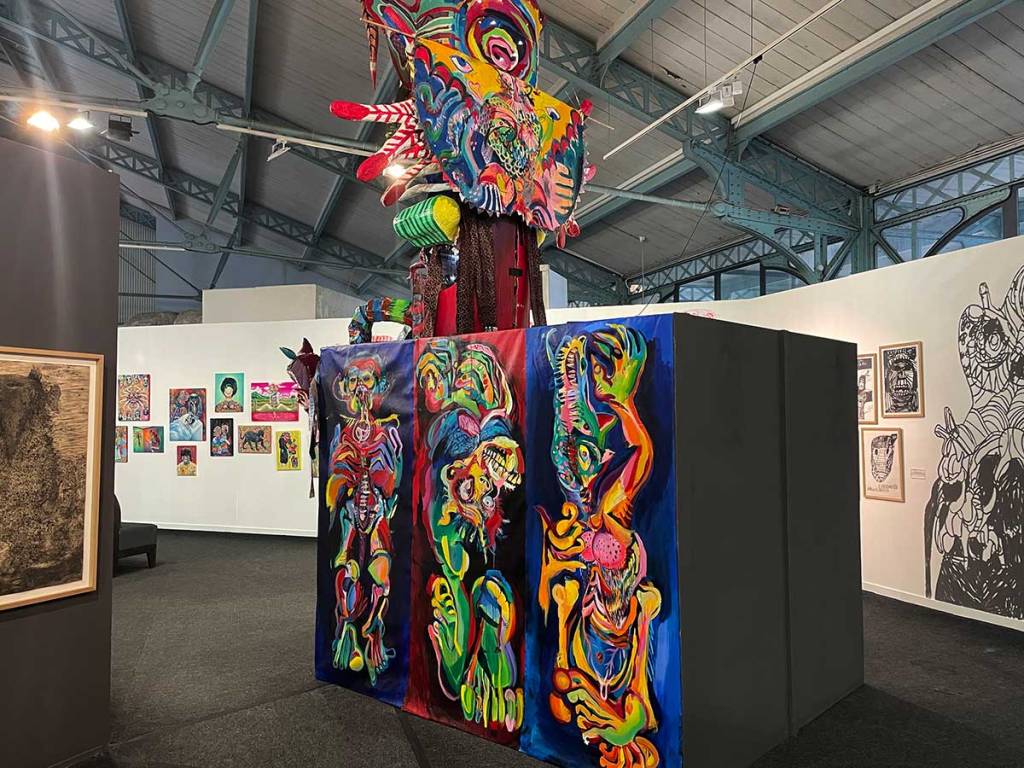
Jaky la Brune ‘Dans Les Tetes’ totem installation (2021-2022)
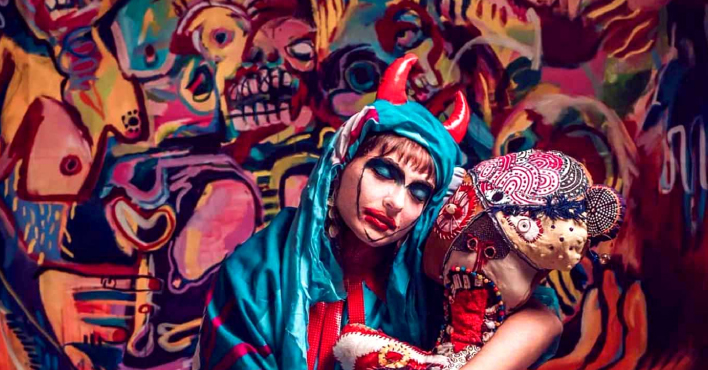
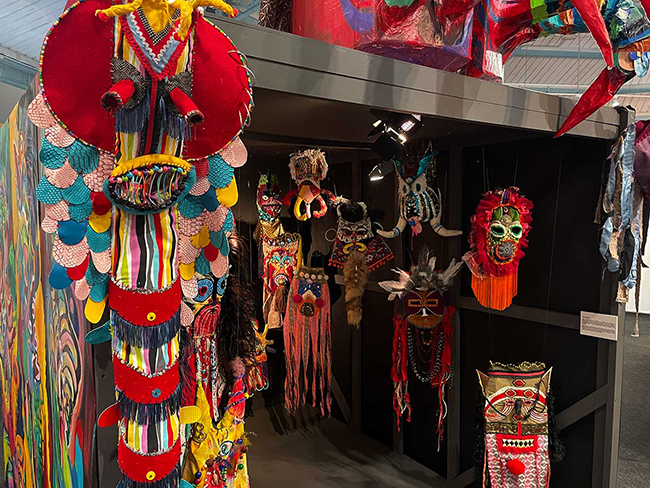
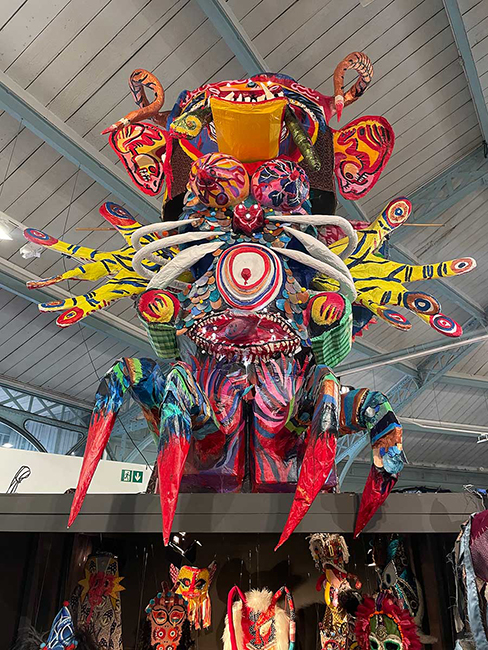
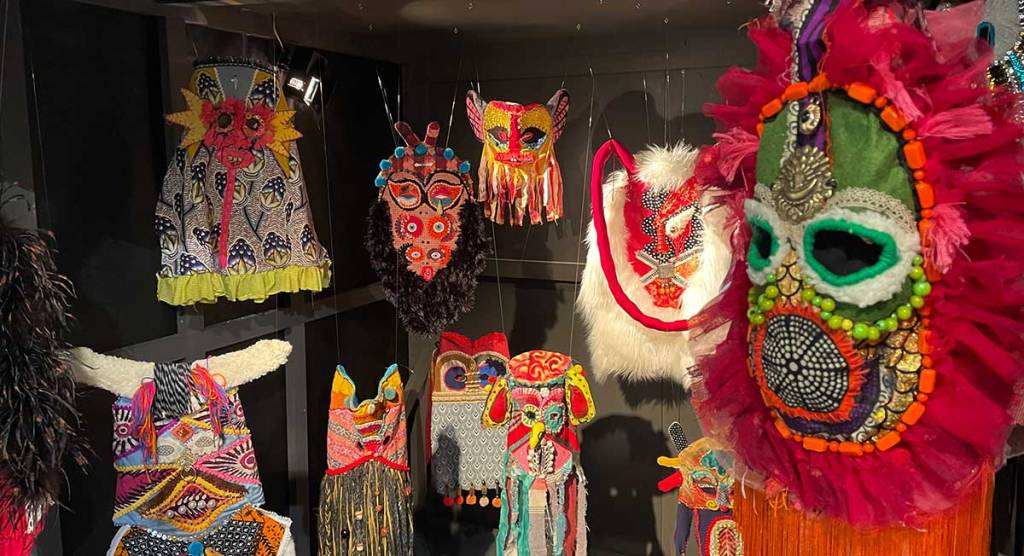
Et donc, au milieu de cette exposition collective rassemblant quelques-uns des artistes de “Tranchée Racine”, votre route risque de croiser celle de Jaky. En vérité, on ne peut pas l’éviter tant ses masques suspendus dans leur container/chambre s’adressent à vous avec agressivité et joie en même temps. Ils sont surmontés d’un totem haut en couleur qui vous attirera immanquablement. De plus, les murs extérieurs de leur maison/boite sont ornés de personnages peints qui assurent la garde avec la même violence et gaité. La troupe de ces créatures hybrides provient de la même tête, celle d’une plasticienne normande vivant et travaillant à Paris depuis 2012 répondant au nom parfait de Jaky La Brune. Sa grande force particulière est ce mélange de la souffrance sombre de ses personnages et de l’allégresse des couleurs très vives par laquelle ils émergent. C’est l’occasion idéale d’entrevoir le reste de son travail, et du coup, on a eu envie de lui demander ce qu’elle avait dans sa tête de brune.
“J’ai découvert la peinture en réalisant des pochettes d’album et des clips de musique. Les logiciels sur les ordinateurs ont dû à un moment me faire mal au crâne alors j’ai trouvé refuge dans les pinceaux et la peinture. Être encontact direct avec la peinture a été révélateur pour moi et je suis restée bloquée dedans comme une junkie“.
Jaky la Brune ‘Dans Les Tetes’ totem installation (2021-2022)
Besides Jaky La Brune, you still have a number of artists to discover.
And so, in the middle of this collective exhibition bringing together some of the artists of “Tranchée Racine”, your path may cross that of Jaky. In truth, we cannot avoid it as its masks suspended in their container/room address you with aggression and joy at the same time. They are surmounted by a colorful totem that will inevitably attract you. In addition, the exterior walls of their house/box are adorned with painted figures who stand guard with the same violence and gaiety. The troop of these hybrid creatures comes from the same head, that of a Norman visual artist living and working in Paris since 2012, answering to the perfect name of Jaky La Brune. Her great particular strength is this mixture of the dark suffering of his characters and the joy of the very bright colors through which they emerge. This is the perfect opportunity to glimpse the rest of her work, and suddenly, we wanted to ask her what she had in her dark head.
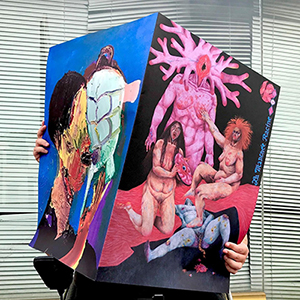
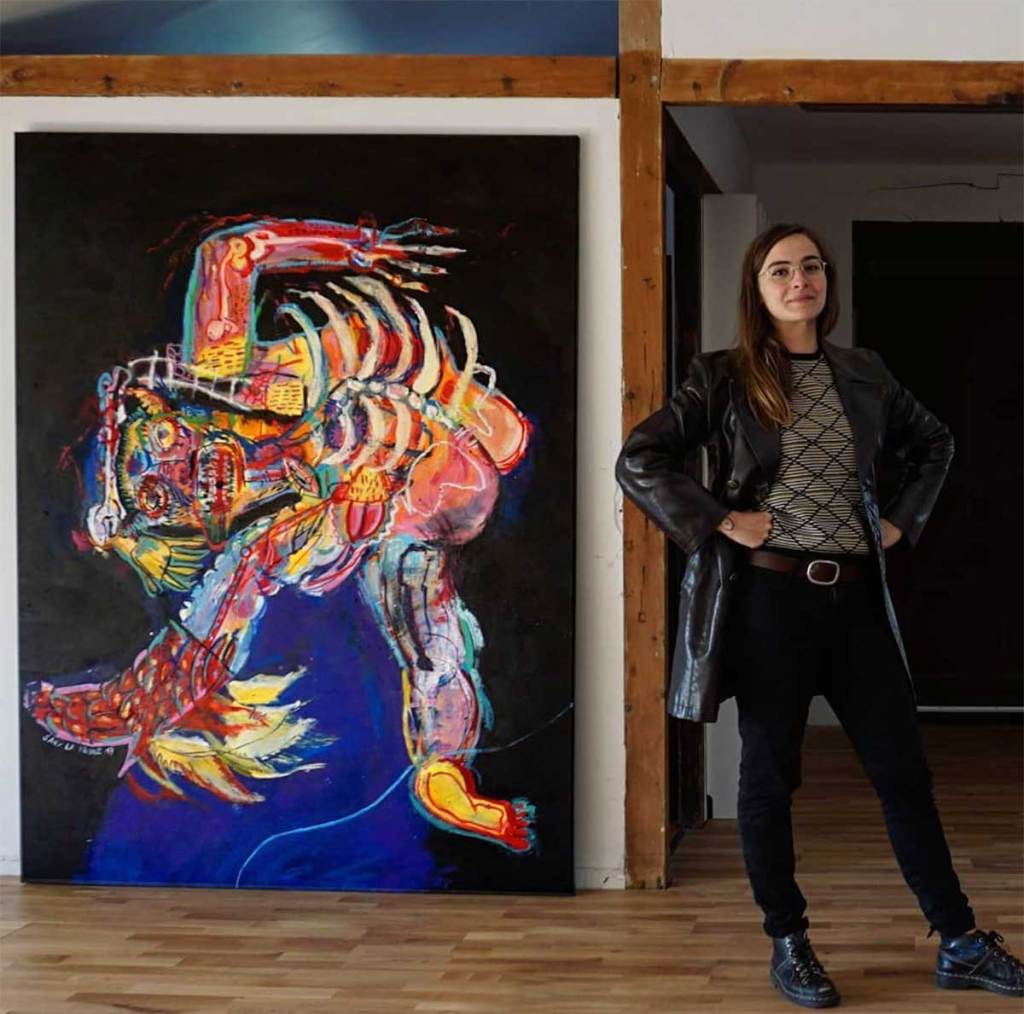
Jaky la Brune with one of her paintings
“I discovered painting by making album covers and music videos. Computer softwares must have given me a headache at one point, so I found refuge in brushes and paint. Being in direct contact with the paint was eye-opening for me and I got stuck in it like a junkie.”
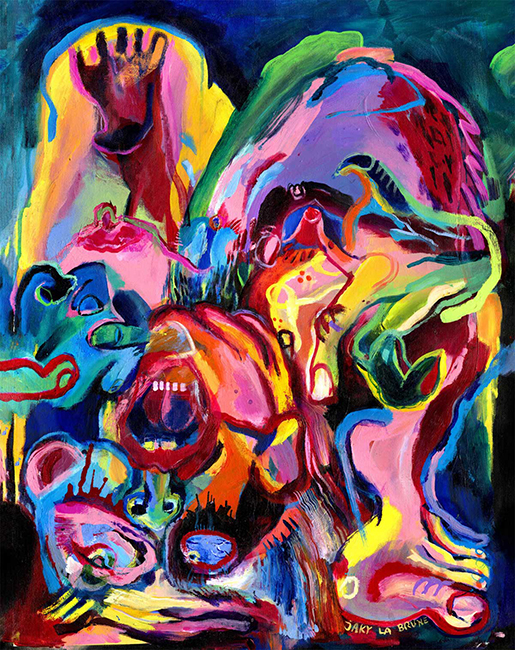
Jaky la Brune ‘Dans Les Tetes’ paintings (2021-2022)
Jaky la Brune ‘Dans Les Tetes’masks (2021-2022)
Jaky:“The creation of masks came later, but I find the same power as in painting: the mixture of materials, colors and the primitive aspect. It’s great to be able to decline your pictorial universe on other media, it enriches the spirit a lot! And then, my sister brings me fabrics from her travels, my mother gives me the jewelry she no longer wants and my grandmother sends me lace… I had to let me do something with all this mess! Sometimes communication is difficult in the family so it allows me to bond with my blood somewhere. (Hahaha) “.
Installation créée par Jaky La Brune dans l’exposition collection “Tranchée Racine” qui accompagne la monographie “Dans Les Têtes de Stéphane Blanquet”
Jaky : “La création de masques est venue après, mais je retrouve la même puissance que dans la peinture : le mélange des matières, les couleurs et l’aspect primitif. C’est super de pouvoir décliner son univers pictural sur d’autres supports, ça enrichit beaucoup l’esprit ! Et puis, ma sœur me ramène des tissus de ses voyages, ma mère me donne les bijoux qu’elle ne veut plus et ma grand-mère m’envoie de la dentelle… il fallait bien que je fasse quelque chose de tout ce bazar ! Parfois la communication est difficile dans la famille alors ça me permet de me lier à mon sang quelque part. (Hahaha)”.
“Généralement, je travaille la nuit avec un verre de porto dans une main et un pinceau dans l’autre. Et avec des documentaires sur des tueurs en série en fond pour m’enfermer dans une atmosphère sombre”.
Jaky la Brune
“Usually I work at night with a glass of port in one hand and a paintbrush in the other. And with serial killer documentaries in the background to lock me in a dark atmosphere.”
Jaky la Brune in her killer mood
“L’identité et les émotions sont mes thèmes principaux. On peut aussi retrouver des sujets tels que le sexe, la violence et la passion amoureuse dans mes peintures”.
Jaky : “Une idée naît lorsque que ma sensibilité est touchée (en bien ou en mal) et que je n’arrive pas à expliquer avec des mots ce que je ressens. Parfois, j’ai l’impression d’exorciser ma tristesse ou ma colère. Créer et peindre me permettent de canaliser mes émotions et d’apprendre à vivre dans ce monde de brutes”.
Jaky : “J’aime me retrouver seule pour peindre mais j’adore aussi l’idée de pouvoir travailler avec d’autres artistes. On m’a proposé récemment de coudre des masques pour un spectacle de théâtre, on verra vers quoi ça me mène ! Je n’ai pas vraiment de projet d’avenir, je ne regarde pas aussi loin devant moi”.
On a demandé à Jaky de partager avec nous un/une artiste qu’elle aimait. Jaky : “tschabalala self est une artiste très inspirante. J’adore son travail sur les corps humains et sa façon de mixer les textiles sur toiles”.
Et on n’a pas résisté à lui poser cette question ultime : D’où vient ce nom génial ? Jaky : “Je suis heureuse de savoir que mon nom trouve des admirateurs mais je ne sais pas d’où ça vient… Je demanderai à ma maman”.
Alors, bien sûr, si vous pouvez passer dans le coin de la Halle Saint-Pierre, ne vous privez surtout pas du pur plaisir d’aller voir les masques et peintures de cette brune Jaky et d’entrer un peu dans sa tête. Parce que, comme de bien entendu, c’est toujours mieux en vrai.
Jaky La Brune ‘Gorge Diable’
“Identity and emotions are my main themes. You can also find subjects such as sex, violence and love passion in my paintings”.
Jaky: “An idea is born when my sensitivity is touched (for good or bad) and I can’t explain in words what I feel. Sometimes, I feel like I’m exorcising my sadness or my anger creating and painting allow me to channel my emotions and learn to live in this world of brutes”.
Jaky: “I like being alone to paint but I also love the idea of being able to work with other artists. I was recently asked to sew masks for a theater show, we’ll see what that leads me to. lead! I don’t really have a plan for the future, I don’t look that far ahead of me”.
We asked Jaky to share with us an artist she loved.
Jaky: “tschabalala self is a very inspiring artist. I love her work on human bodies and her way of mixing textiles on canvas”.
And we couldn’t resist asking her this ultimate question: Where does this awesome name come from?
Jaky: “I’m happy to know that my name finds admirers but I don’t know where it comes from… I’ll ask my mum”.
So, of course, if you can pass by the corner of the Halle Saint-Pierre, do not deprive yourself of the pure pleasure of going to see the masks and paintings of Jaky Brune and getting into her head a little. Because, of course, it’s always better in real life.
Artist Portrait : Jaky La Brune
Original Article by Bernard Laurent-Zopf / brainto.com
Translated for general reader from French to English by Lopcuk webzine
Uzun bir zaman boyunca adına yeraltı denen edebi tür hakkında çalışmalar ve okumalar yaptım. Dünyada ve Türkiye’de bu türün gelişimini seyre koyuldum. Bu akımın motivasyon kaynaklarını kavramaya çalıştım ve bazen bunun kaynaklarına kendi hayatımda rastladığım da oldu. Yeraltının ana hatlarından bahsetmek zor olsa da ortak bir tavrı sahiplendiği apaçık ortada bence. Türkiye’de yeraltı edebiyatının çıkışı romanlarla oldu, dersem yanlış olmaz, fakat bu edebi dünya kavrayışına şiir ve öykü türlerinde rastlamak da mümkün.
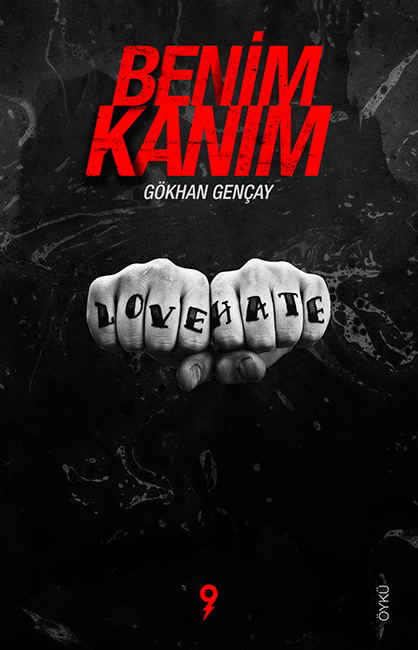
Yaşadığımız coğrafyada bu seçenekler çok az tabii ve bu alana yatkın olanların Benim Kanım’la çarpışmaması olanaksız. Bu rastlantının bir zorunluluk olduğuna inanıyorum. Sizleri de rızanızı almadan bu rastlantı sıçramasına davet ediyorum. Şişirilmiş üfürükten edebiyat oyunlarının karşısında duran yazarlara hayranlık duymayı kozmik bir borç sayıyorum. Hâkim Bey’in dediği gibi “Yaşam tarzı değil yaşam edinin!’ Başlayalım o halde, Gökhan Gençay anlatsın.
Taylan Onur: Merhaba Gökhan Gençay. Okurlar sizi Benim Kanım isimli kitabınızla tanıdı, lakin bunun dışında yıllardır altkültürlerle ilgili olduğunuzu, bu konuda pek çok metin kaleme aldığınızı da biliyoruz. Benim Kanım’ı çıkar çıkmaz okudum. Eseriniz bende teke tek bir kavgada dayak yemenin neden olduğu gurur kırılmasına yakın bir his yarattı. Türkçede yazılmış bundan daha sert bir eser olduğunu düşünmüyorum. Kitabınız sizin için ne anlam taşıyor? Topluma atılan bir yumruk diyebilir miyiz?
Pozitif yorumlar için teşekkür ederim. Bana sorarsan, Benim Kanım, tam manasıyla sert bir kitap değil. Aksine, çok daha sert ve yıkıcı vurgularla işlenebilecek konulara mümkün mertebe yalın ve “ılımlı” yaklaşmaya çalıştım. Yazar sıfatıyla altını çizmem gerekirse, kitaptaki karakterleri ve karşılaştıkları durumlara verdikleri tepkilerin çoğunu desteklemiyorum. Zayıflıkları, çaresizlikleriyle var oluyorlar Benim Kanım’daki karakterler. Bu arada söz konusu karakterlerin hepsinin erkek olması ve benzer sorunlardan mustarip olmaları öyküler arasında bir paslaşma hali de yaratıyor. Hepsi maddiyata takıntılı bir kültürden kaçmak istese de aldıkları tavırlar manasında çoğunun pozisyonunu onaylamıyorum, attıkları adımları yanlış buluyorum. Yegâne empati kurduğum karakter, yaşadığı varoluşsal bunaltıya eylem yoluyla müdahale etmesi hasebiyle “Hiç”in kahramanı, zaten kitapta en sevdiğim öykü de o açıkçası.
Ters Adam Gökhan Gençay
Dostoyevski olsanız iktidar odaklarının kıçını yalamadan sesinizi duyuramazsınız bu coğrafyada.
Şunu da belirteyim ki, Benim Kanım rahatta, evde veya ofiste kıçını devirip otururken ortaya çıkmadı. Sokaklarda işsiz güçsüz flanörlükle iştigal ederken, çaresizce saatlerimi geçirmek zorunda kaldığım kafelerde okumaktan usanıp bilgisayarı önüme açıp yazmaya başlayınca kafamda belirdi öykü ve karakterler. Alışıldık profesyonel hazırlık aşamaları da söz konusu değil, metnin ruhunu korumayı önemsediğim için üzerinde oynama yapmayı da reddettim; hepsi neyse odur, eksiğiyle gediğiyle yazarken ne hissediyorsam onu yansıtıyorlar. Beni sorarsan, hâlâ o sınırda yaşıyorum, daha doğrusu soluk alıp vermeye devam ediyorum, çünkü bu mahkûm kılındığımıza hayat denmez.
Kitap yayımlandığında, “Nedir bu?” diye soranlara kısaca şöyle tanıtmıştık, onu sizinle de paylaşayım:
Benim Kanım, kalbi kırıklara, kaçıklara, dünyaya karşı öfke biriktirenlere, var olana uymayanlara, her yeni güne “Acaba şimdi kahve mi içsem, yoksa intihar mı etsem?” seçeneklerini ciddi ciddi değerlendirerek başlayanlara, deli olarak kodlananlara, değerlerini hiçlikten çıkaranlara hitap eder. Yalnızlıktan hamamböceğiyle arkadaşlık edenlerin, iş denen kölelik çukurunda ruhunu yitirenlerin, “dost kazığı” yiyenlerin, kendini kaybederek kendini bulmaya başlayanların, oyuncak tabancayla bankaya dalanların öykülerini içerir.
Diğer yandan, evet, kitap benim açımdan hayatı yaşanmaz kılanlara, varoluşumuzu değersizleştirenlere, emir ve talimatnamelerle hayatı şekillendirmeye yeltenen otoritelere, birilerinin sistemin çarklarının güzelce dönmeye devam etmesi için koyduğu kariyer, toplumsal saygınlık ve kurumsal uyum gibi “adam olma” kriterlerinin şekillendirdiği hâkim kültüre kelimeler aracılığıyla atılmış bir yumruktur. Bu yumruk içine hapsedildiğimiz çirkin dünyanın sahiplerini nakavt etmeye yeter mi? Hiç sanmıyorum! Ama şundan eminim ki, tarihin en güzel sayfaları mağlup olarak kodlananların muazzam jest ve eylemlerini içerir. Tek başına kaldığı barikatı terk etmeyenler, idam sehpasını kendisi tekmeleyenler, kalabalıklar tarafından linç edilirken son gücüyle ayağa kalkanlar unutulmaz; en çok parası olanların, en güzel evlerde yaşayanların adları ise kimsenin aklında kalmaz.
Sık sık tekrarlıyorum, Benim Kanım, metin olarak politik manifesto işlevi üstlenmez, yol ve yöntem önermez, çare sunmaz. Benim Kanım’da yer alan öykülerde tekno-endüstriyel sistemin izolasyon boyutuna varan bir yalnızlığa, çaresizliğe ve yabancılaşmaya mahkûm ettiği alt orta sınıf erkeklerin yaşadıkları, hayal ve gerçeklikleri mevcut. Onların -dolayısıyla bizim-sürüklendiği/sürüklendiğimiz büyük çöküşün ruhsal dışavurumlarına odaklanmaya gayret ettim. Taklidin taklidinin altın çağını yaşadığı bu dünyada, yalandan ibaret bir söylem düzeninde varoluşa içkin anlam arayışının nafileliğine işaret ettim gücüm yettiğince. Tabii, özel olarak vurgulamalıyım ki, kitap sadizm, şiddet, intihar girişimi ve had safhada depresyon içeriyor, dolayısıyla siyaseten doğruculuğu ilke bellemiş cici çocukların bünyesine hiç uygun değil.
Benim açımdan yegâne önemli kriter, gerçek hislerle, gerçek düşüncelerle ve gerçek acılarla dolu olup olmaması. Bu konuda sınıfı geçtiyse gerisini umursamıyorum.
Cleon Peterson ‘Med City’ 2014
Bildiğini bilmezden, gördüğünü görmezden gelmek bana göre en büyük yavşaklıktır ve yaşadığımız topraklarda yayın dünyası büyük bir çoğunlukla yavşakların elindedir!
Yayımlandığından günümüze kitaba nasıl tepkiler geldi?
Benim Kanım’ın herhangi bir tanıtımının, reklamının, hatta çıktığını haber veren bir duyurusunun yapılmadığını biliyorsun zaten. Anaakım yayınevlerinin bazılarının metnin akışına müdahale etmek istemesi ve seçtiğim estetik formu kabul etmemeleri üzerine bu konuda herhangi bir zorluk çıkarmayacak butik bir yayınevi bastı kitabı. Kitaba destek veren uluslararası underground illüstratör kardeşlerimizin çizimleri bu sayede karşınıza gelebildi. Erman Akçay’ın hazırladığı muhteşem kapakla basılması da bu seçimin bir diğer kazancı. Kayıplara gelirsek, demin de dediğim gibi, yayınevi cephesinde kitabın herhangi bir duyurusunun bile yapılmaması, Benim Kanım’ı bir çeşit “korsan kitap” havasına büründürdü. Şu ana kadar beğenen, ilgi duyan insanların kulaktan kulağa birbirine aktarmasıyla kitabın adı duyuruluyor, bundan başka bir kanalımız yok açıkçası.
Buna rağmen punkların, skateboarderların, üniversiteli gençlerin beğeni dolu mesajlarını alıyorum; okunsun diye kitabı metro vagonunda bırakanları, alıntılar paylaşanları, elinde kitapla fotoğraf çektirip sosyal medyada paylaşanları görüyorum. Geçen gün Kadıköy’de kitap kapağının stencil olarak duvara işlendiğini de gördüm ve çok şaşırdım. Velhasıl, Benim Kanım, kitapla içerik ve biçim açısından bağ kuranlar tarafından içtenlikle sahipleniliyor. Diğer yandan, yıllarca çalıştığım dergi ve gazetelerde tanıştığım, hukukum olan yazarlar, editörler ve “tanınmış simalar” tarafından bilinçli biçimde görmezden geliniyor! Kendi camialarına mensup birileri Cin Ali seviyesinde bir metin kaleme alsa yere göğe sığdıramama yarışına giren bu zat-ı muhteremler Benim Kanım’ın adını bile anmıyor. Hani tek satır eleştiri bile yazsalar, hatta beğenmedik deseler, samimiyetlerine inanacağım da, bildiğini bilmezden, gördüğünü görmezden gelmek bana göre en büyük yavşaklıktır ve yaşadığımız topraklarda yayın dünyası büyük bir çoğunlukla yavşakların elindedir! Dostoyevski olsanız iktidar odaklarının kıçını yalamadan sesinizi duyuramazsınız bu coğrafyada. Yani, bizim yaptığımız aslında akıntıya karşı kürek çekmeye denk düşüyor.
“Güzel ve yalnız ülkemizde” herkes işini biliyor aslında. İşi bilmek, iş bitirici olmak sadece kapitalistlere ve patronlara mahsus bir ayrıcalık değil artık. Yazdığı kitaplarla üne kavuşan ihtiyar ve çirkin erkek yazarlar, kazandıkları bu şöhreti yazdıklarına hayran genç kadınlardan cinsel açıdan faydalanmak için kullanmayı biliyor. Şöhrete kavuşmak isteyen kadın yazarlar, kitaplarını bastırmak için popüler ve yaşlı erkek yazarların evlerine gitmeleri gerektiğini, orada kurulan bağlantıların yayınevlerine dosya gönderilerek kesinlikle kurulmayacağını biliyor. Yayınevlerinde editör olarak işe girmek isteyenler derebeyi misali koltuklara kurulmuş yayın sorumlularına yaltaklanmadan o kapılardan içeri adım dahi atamayacaklarını biliyor. Hasbelkader entelektüel alanda söz sahibi olmayı başarmış bütün erkekler, genelde çirkin ve vasıfsız olmaları nedeniyle, yanlarında çalışan olarak sadece kadınları görmek istiyor; kadın editörlerden, kadın asistanlardan bir ordu kuruyorlar. Çünkü koltuklarının onlara verdiği gücü kullanmadan herhangi bir kadınla ilişki kurma şansları olmayan zavallılardan mürekkep hepsi! Lakin onlarla çalışan kadınlar da ulaştıkları mevkilere mesleki becerilerinden ziyade kadın oldukları için ulaştıkları gerçeğini itiraf etmiyorlar. Yayın dünyasında erkeklerin çoğuna kapanan kapıların niye kendilerine sonuna kadar açıldığını sorgulamıyorlar. Velhasıl, alanın da, verenin de razı olduğu bir oyun oynanıyor yıllardır. Olan bizim gibi “işini bilmeyenlere” oluyor sadece!
Hem kendi deneyimlerim hem de bilfiil içinde yer aldığım dönemde yaptığım gözlemler neticesinde şunu net biçimde anladım ki, Türkiye yayın dünyası istisnasız olarak yaratıcılık ve zekâdan yoksun, esnaf zihniyetinin, ahbap çavuş dengelerinin hâkim olduğu bir çukurdur. Bu dünyadaki en temel kural, “Sen benim kıçımı yala, ben de seninkini yalayayım,”dır. Onun için bu topraklarda hakiki, özü ve sözüyle bir yazarlara rastlanmıyor artık.
Brutus – War (live in Ghent)
Lakin mülksüzler mülk sahiplerinden nefret etmediği sürece dünyada tek bir taşın yerinden oynamayacağı da bir diğer gerçek! Sonuçta kimse kendini kandırmasın, dünyayı güzellik kurtarmayacak!
Kolayca sevmek varken neden nefret kuşanıyorsunuz dünyaya karşı? Topluma uyum sağlamakta kötü olan ne var?
Topluma uyum sağlamak, başlı başına özgürlük ve özerklik hedefinden vazgeçmektir. Toplum adını verdiğimiz ilişkiler sisteminin temeli iktidar arzusuna dayanır, bireylere sosyal roller ve kurallar dayatılmadan da toplum var olamaz. Nitekim özgürlük ruhunun serpilip gelişmesinin önündeki en büyük engel bu kurallardır. Dolayısıyla toplumla, toplumun sürekliliğini garanti altına alan değer ve geleneklerle mücadele etmeden bir adım yol alamayız.
Valla, açıkça söylemem gerekirse, dünyada sevecek çok az şey kaldı. Zaten sevdiği şeyleri araştırmaya girişen herkesin nefret ettiği şeylerle karşılaşacağına ve birinin diğerine ulaşmayı engelleyeceğine inanıyorum. Yaşadığımız dünya herkesin herkesten nefret etmesi üzerine kurulu. Kadınlar erkeklerden, erkekler kadınlardan; çocuklar ebeveynlerinden, ebeveynler çocuklarından; yoksullar zenginlerden, zenginler yoksullardan; güzeller çirkinlerden, çirkinler güzellerden; akıllılar aptallardan, aptallar akıllılardan ölesiye nefret ediyor ve işin kötüsü herkes haklı.
Ayrıca şu hayatta bir insan sevdiklerinden, dostundan, yoldaşından, sevgilisinden (hepsinin önüne eski sıfatını koymayı unutmayalım) benim kadar kazık yediğinde motorunun çalışmaya devam etmesi için kullanabileceği tek yakıt olarak nefret kalıyor geriye. Benim Kanım’ın kapağında Love and Hate (Sevgi ve Nefret) dövmesinin mevcut olduğu yumrukları kullandık ama gerçekte-metafor değil hakikaten- benim her iki elimin parmaklarında da Hate (Nefret) dövmesi var.
Geçenlerde yazmıştım: Beyaz solculara göre nefretten sadece faşizm türeyebilir. Öyle bir ihtimal mevcut, tabii ki. Lakin mülksüzler mülk sahiplerinden nefret etmediği sürece dünyada tek bir taşın yerinden oynamayacağı da bir diğer gerçek! Sonuçta kimse kendini kandırmasın, dünyayı güzellik kurtarmayacak!
Jeremy Profit ‘Darty Cheval Eventré’ 2005
Kendi acısının mimarı olabilen, gerekçe dillendirme zorunluluğundan kurtulmuş, kaleminde mürekkep olarak kanını kullananlara yazar, diyorum ben. Gerisi bokuyla oynamaktan öteye gitmeyen pazarlamacılardan ibaret.
Altkültürün tüketim aracı olması hakkında neler diyebilirsiniz? Yani bir altkültürün tanınır olması iyi mi, kötü mü?
Guy Debord’un ustalıkla tarif ettiği Gösteri Toplumu, bir dönem egemen kültürün karşısına dikilmiş, ona meydan okumuş alternatif kültürel akımların zamanla sisteme içkin kılınması, hatta tüketim nesnesi haline getirilmesi üzerine kurulu. Bu nedenle yıkıcı ruhu sürekli teyakkuz halinde tutmayan her altkültür, bir aşamadan sonra gevşemeye, sistemin normlarına dahil edilmeye mahkûm. Punk’ı düşünelim mesela. 80’lerin başlarında sokağın, uyumsuzluğun, var olanı reddedişin şiirsel estetiğini yansıtan punk, büyüyüp geliştikçe Sex, Drugs and Rock’n Roll dejenerasyonunun bir parçası haline geldi ve hedonizme, uyuşturucu kültürüne teslim oldu. Onun içinin boşaltılmasına isyan edenler hardcore altkültürüyle direniş fitilini ateşledi. Yani, demem o ki, herhangi bir altkültürün sonsuza kadar sistem karşıtı bir misyon üstlenmesi imkânsız. Hepsinin bir son kullanma tarihi var ve ayakta kalanların nostaljik duygularla oyalanmayı bir tarafa bırakıp yeni olanın, eskinin zaaflarını ve çürümüşlüğünü aşanların yanında saf tutması gerekiyor. Bitmeyen bir bayrak yarışı olarak tarif edebiliriz bu durumu.
Bir öykünüzün sinemaya uyarlanması istense hangisini seçerdiniz? Bence hepsi oldukça sinematografik ve kültürel sabotaj içeriyor.
Teşekkür ederim. Şu ana kadar okurlar tarafından en çok ilgi gören, “Keşke devam etseydin, roman formunda ilerleseydin,” denilenler “Şövalye” ve “Barok Seven Hamamböceği”. Fakat en başta da belirttiğim gibi, benim için “Hiç”in yeri ayrı, onun peliküle aktarılmasından memnun olurdum.
‘Gerçeklik Bir Hayaldir’ détournement by Gökhan Gençay x Erman Akçay / İst.Fest 2014, İstanbul
Okunmasını önerdiğiniz yazarlar var mı? Benim Kanım’ı okumamış birinin dayak yemeden önce antrenman yapması gerekir, diye düşünüyorum.
Kendi acısının mimarı olabilen, gerekçe dillendirme zorunluluğundan kurtulmuş, kaleminde mürekkep olarak kanını kullananlara yazar, diyorum ben. Gerisi bokuyla oynamaktan öteye gitmeyen pazarlamacılardan ibaret.
Chuck Palahniuk’u, Irvine Welsh’i, Bret Easton Ellis’i, Tibor Fischer’ı saymama gerek yok sanırım, eserleri üzerine defalarca yazdım çünkü. Boris Vian’a, Amy Hempel’a, Albert Camus’ye, Henry Miller’a, J.D. Salinger’a, Paul Nizan’a, Jack Kerouac’a, J.G. Ballard’a hayranım. Philippe Djian’ı, Erlend Loe’yü, Linda Boström Knausgaard’ı, Elfriede Jelinek’i ve Tim Winton’ı da seviyorum. Metni belagat ve tasvire boğup olay örgüsünü umursamayanları, “büyük büyük” yazmaya çalışıp okurun ağzına sıçanları, eylemsiz karakterler yaratanları sevmiyorum. Anlatabilmişimdir umarım.
Müzik, sinema, edebiyat alanlarında yıllardır itinayla en aykırıları, uyumsuzları ve yıkanmak istemeyen çocukları bulup tanıtmaya çalıştığınızı görüyorum. Bu hususta edindiğiniz bilgi ve deneyimleriniz nelere mal oldu?
Esasında özel bir çaba gerekmiyor bunun için. Herkes kendine yakın olanı, kendini ait hissettiklerini öne çıkarır, sevdiklerinin sevilmesini ister. Üzerine söz söylediğim isimlerle aynı kaderi sahipleniyor, aynı rotada yürüyorum, onun için onlar bana dışarıdan birileri gibi gelmiyor, ait olduğumuz kabilenin asli özneleri hepsi. Sınıfsal ve kültürel yönlerden de ortaklığımız söz konusu. Benzer acıları çekiyor, aynı sorunlarla boğuşuyoruz.
Bu rotadan ilerlemenin bir faydasını gördüm mü? Tabii ki, hayır! Sefalet, sıkıntı, yokluk… Gelen her günün bir öncekinden daha kötü gelişmelere gebe olmasına alıştırıyorlar insanı. Onuruna, değerlerine sahip çıkmak ve bir çeşit Bushido (Samurayın Yolu) ahlakıyla var olmaya çalışmak kolay değil. Üstelik çevreniz kendini satmayı marifet bilen, -miş gibi yapıp rol keserek parsa toplamaya çalışan aşağılık insanlarla doluyken daha da zor. Velhasıl, bizim gibilere sadece istediğimiz gibi ölme serbestliğini tanıyorlar. Nihayetinde biz hayata küsmüyoruz ama hayatla aramızdaki ilişki bir noktadan sonra tek taraflı aşka dönüşüyor, onun da mutlu bir finale evrilmeyeceği açık.
Matrix esprisinden yürürsek, kırmızı hap yerine maviyi tercih edenlerin kazandığı, mutlu olduğu bir dünyadayız. Öyle ki, hakikati, onuru tercih etmek en büyük günah sayılıyor ve kimse günahkârları çevresinde görmek istemiyor! Şöyle bir etrafıma bakıyorum da, soyumuzun giderek tükendiği net biçimde görülüyor.
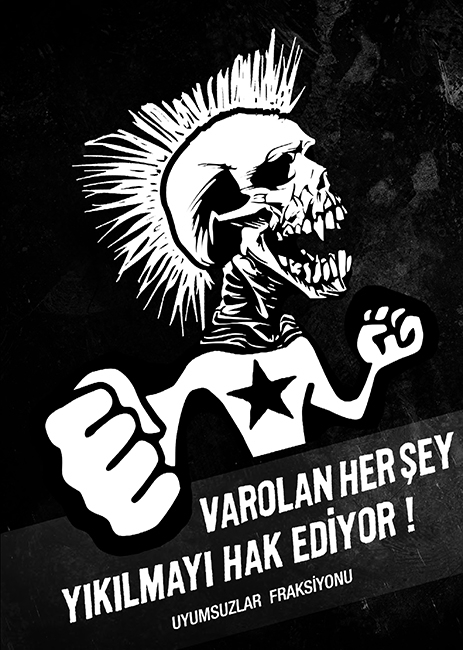
Uyumsuzlar Fraksiyonu Flyer ‘Exploited’ (2014)
Teke tek dövüşme şansınız olsaydı rakip olarak ilk beşte kimleri seçerdiniz? Nedenleriyle birlikte öğrenebilir miyiz?
Bu dövüşlerin dayak atma motivasyonuyla örgütlenmediğini belirteyim önce. Fight Club misali birbirimizi özgürleştireceğimiz, attığımız ve yediğimiz yumruklardan gocunmayacağımız, finalde birbirimize sarılacağımız onurlu rakipler seçeceğim onun için.
Boks ve muay-thai gibi dövüş sporlarıyla aktif olarak ilgilenen bir insan olarak, ilk dövüşümün uyumsuzların önderi, alter-egom Arthur Cravan’la olmasını isterdim. Biliyorsun, kendisi zamanın dünya ağır sıklet boks şampiyonuyla maça çıkabilecek cesarete sahipti ve ringte ona altı round dayanabilen, “boksu edebiyata yeğlediğini” açıkça ifade eden bir avangarttı. İki metreye yakın boyu (ben de 1.90’ım) ve çevikliğiyle zorlu bir rakip olurdu, diye düşünüyorum.
İkinci rakibim de tabii ki Ernst Hemingway. Yumruklarını kullanmaktan imtina etmeyen, özü sözü bir, karakter sahibi bir yazardı kendisi. Alkol bağımlılığı ve fazla kiloları ringte onu zorlar ve maça hızlı başlayarak beni hemen indirmeye çalışır, sonra da yorulup savunmaya geçerdi muhtemelen. İlk iki round onun ofansif tarzına direnebilirsem galip geleceğime inanıyorum.
Üçüncü maçım yaşayan yazarlar arasında en çok sevdiğim, hayranlığımı defalarca dillendirdiğim Chuck Palahniuk’la olsun. Chuck, düzenli olarak fitness yaptığı için formunu koruyor lakin yumruklarını kullanmakta ciddi sorunları olduğunu düşünüyorum. Nitekim Fight Club romanına esin veren de sokakta sarhoş bir grup genç tarafından ağır biçimde dövülmesiydi. Her ne kadar ona kıyamayacağımı düşünsem de, en kolay galibiyete bu maçta ulaşırım gibi geliyor.
Dördüncü rakibim Japon yazar Yukio Mishima. Dürüst olmam gerekirse, beni en çok endişelendiren kapışma da bu olurdu. Yıllarca ağır idmanlar yaparak bedenini güçlendiren, karate ve judoda usta seviyesindeki Mishima’yı yenme şansım olacağını sanmıyorum ama elimden geldiğince ayakta kalmaya çalışırdım karşısına çıkma olanağım olsaydı.
Beşinci ve son maç için de Bertrand Cantat’ı seçiyorum. Dağılan Noir Desir’in solisti, müzik tarihinin en duygulu ve öfkeli seslerinden, şiir olarak nitelenebilecek şarkılar besteleyen Bertrand’ın fiziği yeterince sağlam olsa da, çektiği acıların ruhunda ağır hasarlar bıraktığı malûm. Dolayısıyla onunla ringe çıktığımızda birbirimize yumruk atmaktansa sımsıkı sarılıp birlikte gözyaşı dökeceğimizi tahmin etmek için kâhin olmaya lüzum yok.
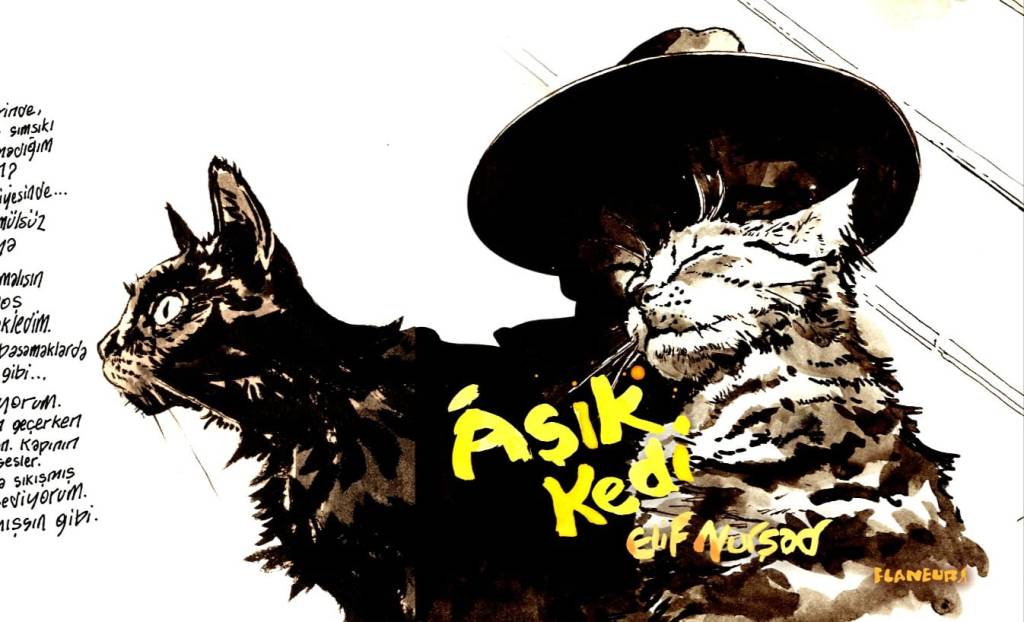
Elif Nurşad ‘Aşık Kedi’ Grafik roman, Flaneur Books (2021)
Elime “Âşık Kedi” diye bir kitap geçmişse ondan size bahsetmemem mümkün müdür? Kitabın çizer ve yazarı “Vahşi Kedi” kod adlı Elif Nurşad Atalay. Elif bence çok yetenekli bir ressam. İyi bir illüstratör ve masal anlatıcı. Kalın ve kuşe baskı kitap, bir tasarım ustalığı içeriyor ki sadece sayfa numaralarını unuttukları için eleştirebilirim, size şu kadar sayfa diyemiyorum! Âşık Kedi’de 2015-2021 arasında çizdiği resimlerle anlattığı bir masal-öykü yer alıyor. Şöyle: kedi var, kediler var. Köpek var, köpekler var. Galata, Karaköy, Bodrum, Göztepe Parkı, akvaryumdaki balıklar var. Caddebostan sahili, deniz, ahtapotlar var! Vahşi Kedi’nin umutları, korkuları, aşkı, kâbusları, rüyaları, hayalleri var.
Yazar çizerimiz Bayan Yanı dergisinde 2015-16 yıllarında “İstanbul’un Vahşi Kedisi” başlıklı bir çizgi roman yayımlamış, sonnra bunun bir bölümünü İstanbul ve İtalya’da sergilemiş, ama hikâyeyi bitirmemiş. Ondan kısa episodlar da var bu kitapta.
Elif Nurşad, Suluboya desen, 2019
Kitabı çok sevmemin nedeni, kavuşulamayan bir aşk hikâyesi dışında, sürekli deniz, tekne, bir kedi ve bir köpek olması, bir de yakışıklı !
Sonra aklına esiyor, kuşlar çiziyor. Papağanlar! Kedilerden vazgeçti, tekneyi ziyaret eden değişik kuşlar çiziyor! Onun sevdiği her kediyi çizmek isteyip çizemediklerine hayıflanıyor. Aslında sadece kedileri değil, kadınları da çok güzel, ama çok az var bu kitapta. “En sevdiğim dostluk: Az konuşma çok iletişim. 6 yıldır aynı kayığa gelen leylek ile balıkçının arkadaşlığı…”
Senin içine süzüldüm ben, bir kapı aralığından, omurgasızlığımdan. Seni kopyaladım, bütün hücrelerimle, sen hiç dokunmasan da seninle gizlice seviştim ben! Hâlâ Seni, seni bekliyorum. Hâlâ kapıdaymışsın gibi. Öyle hissediyorum!
Kaynak : Yazgülü Aldoğan, Cumhuriyet Gazetesi (10 Aralık 2021)
Jeg er her for frihed,ærlighed, sårbarhed, gender-fluidity, for kærlighed.
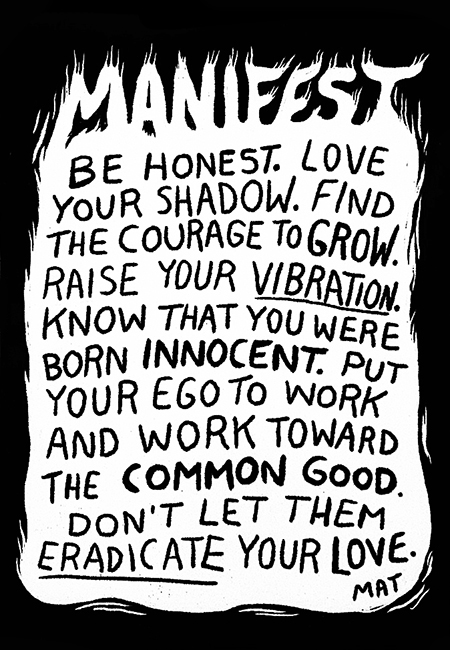
Det var usansynligt at jeg skulle blive en kanal for lyset. Det jeg kommer fra er så mudret, så mørkt – men jeg skulle igennem de dybeste lag for at forstå, at jeg er lys. Hver gang jeg har ramt bunden, er jeg blevet vist at jeg kan gå højere – at vi alle har et valg. At vi kan give slip på frygt og være i tillid til at alt udfolder sig præcis som det skal. Og vide at dét at være i overgivelse – i nuet – er lig med at være i vort højeste selv.
Skyggearbejde handler om at bevidstgøre sig skyggen (de sider af os selv vi ikke kan eller vil se og anerkende) – ikke at skubbe dem væk, løbe fra dem eller lade som om de ikke eksisterer – men i stedet vende os om og integrere mørket. Og dermed erkende at vi er begge dele: både lys og skygge. Jeg kaster min skygge ud i rampelyset for at integrere den i os alle, for at hjælpe os til at forstå at vi ikke behøver at gøre vores skygge forkert og udskamme den – men at vi kan se den for hvad den er – et bange dyr, en ego-skal bygget for at beskytte os. Se at vi er født uskyldige – som ren kærlighed.
Jeg arbejder for at kaste lys ind i den kollektive skygge – for at blotlægge misforhold i den dominerende kultur. For at frisætte os fra den programmering og radikalisering vi er blevet udsat for gennem en opvækst i et kapitalistisk patriarkat. Når jeg ser på kønnene, og mine egne oplevelser som biologisk kvinde – ser jeg en dyb diskrepans. Jeg ser en enorm forskel på begrænsningerne af den ydre og indre frihed der er for kønnene hver især. Jeg er nødt til at pege på dobbeltmoralen og hykleriet i et samfund der systematisk seksualiserer kvinder og som så – når kvinder agerer åbenlyst seksuelt – vender sig om og udskammer dem for det. Et samfund hvor mænd programmeres til at undertrykke følelser, til at lukke ned. Dette systemiske svigt kommer til udtryk som konstante indviduelle kampe om at få det godt, som enten kæmpes eller fortrænges, og som vi ikke kan vinde på et individuelt niveau. Det er et system der fratager os vores evne til at elske frit, og det er på tide vi bliver fri af det.
Jeg er her for frihed, ærlighed, sårbarhed, gender-fluidity, for kærlighed.
Does ceramics and fashion have anything in common? It certainly does for artist and author Matilde Digmann who uses their creativity as a safe space of self expression.
Matilde Digmann (Mat) is a gender fluid artist and author. Mat’s artistic practice is multi-faceted but rooted in two main principles: Work evolving around outing shadow and exposing things we usually try to keep in the dark, thereby calling out biased structures in society and discrepancies in dominant morality. Mat is working on outing shadow (in a Jungian sense) on a personal as well as on a societal level. The second focus of Mat’s artistic practice is in working towards a betterment of the artistic community – in service to particularly blocked artists via the podcast Shadow Work Podcast and in pursuit of healing a generation of men and women who have been radicalised by growing up in capitalist patriarchy – via the graphic novels Pseudo and the upcoming Bad Boys.
As their unique artwork and ceramics, Mat – who’s based in the vibrant neighbourhood of Nørrebro in Copenhagen – primarily uses bright and bold colours in their wardrobe – matched with loads of gold and glitter. Meet the Copenhagen-bases artist here, and get a preview of their unique and personal art as well as their take on personal and great style.
Matilde Digmann (Mat) Bir sanatçı ve yazar olarak çok yönlü sanat pratiğini iki temel ilkeye dayandırmaktadır: Gölgeyi aşmak ve genellikle karanlıkta tutmaya özen gösterdiğimiz yönlerimizi açığa çıkarmak; böylece çizgi-roman dili, çeşitli afişler ve grafik hyper-text’lerden de faydalanarak sanatçı toplumdaki önyargıları ve baskın ahlakın tutarsızlıklarını gözler önüne sermeyi hedefler.
Mat, hem kişisel hem de toplumsal düzeyde gölgeyi (Jungcu anlamda) aşmak için çalışıyor. Onun sanat pratiğinin odaklandığı ikinci alan ise Shadow Work Podcast aracılığıyla özellikle amatör sanatçılara yardım etmek ve kapitalist ataerkil bir ortamda büyüyerek radikalleşmiş günümüz erkek ve kadın nesline şifa olmak amacıyla sanat camiasının iyileştirilmesine yönelik çalışmalar yapmaktır.
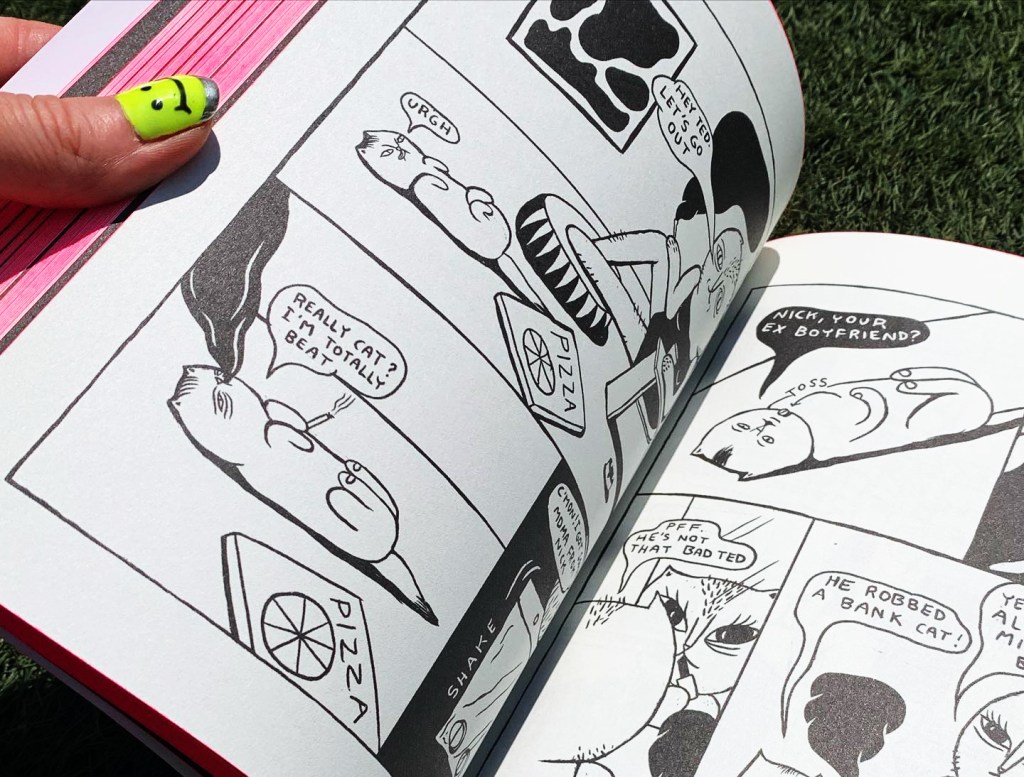
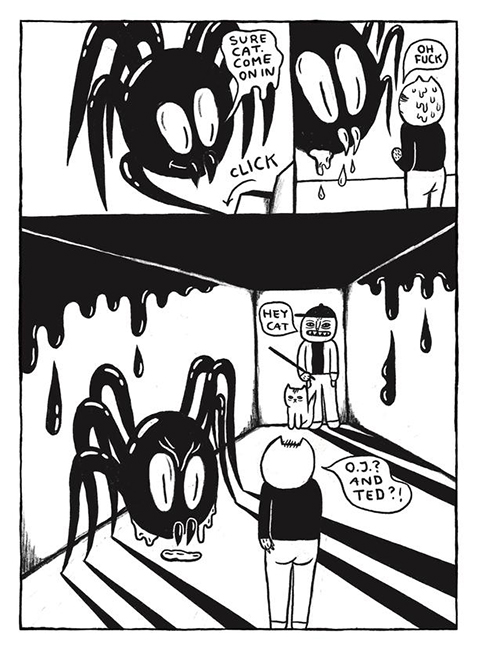
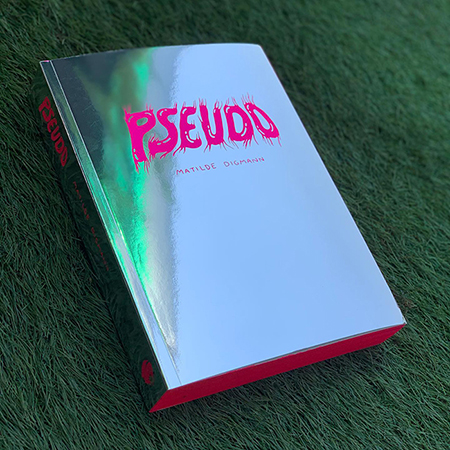
Anthropomorphic animals, online dating, drugs, sex, shame, inability to relate to others. In short, the usual old story. Indeed no. Pseudo by Matilde Digmann fits into a genre that is now highly exploited, that of problematic animals that do bad things, but manages to have her say. Mat – this is his stage name, given that he defines himself “a non-binary multidisciplinary artist and author” – first of all he paints and sculpts. He has a studio in Copenhagen full of his creations. Enter the world of comics as an outsider and in this Pseudo, a volume of 366 pages in English with a beautiful mirror cover published by the Danish Forlaget Basilisk, this is evident. The story continues in small episodes, almost by accumulation. There is no great sense of rhythm. The drawings are raw, dark, not at all cute and in any case far from the dominant aesthetic, dropped in a black and white that cannot be blacker. All this allows Mat to get out of the sowing of today’s alternative comics, avoiding ending up in the long list of Simon Hanselmann’s emulators.
The story written by Mat talks about the almost homonymous Cat, an anthropomorphic cat who after 9 years breaks up with her boyfriend and begins a “crazy year” made up of new acquaintances, transgressive evenings and – inevitably – self-harm. Pseudo begins with the protagonist signing up for a dating site, while she spends her days indoors with Ted, a traditional four-legged cat. The first pages of the volume are the weakest and most obvious, with many situations that they already know. Then after a while things take off. Meeting after meeting we witness a gallery of men who are idiots at best, manipulative bastards at worst. In front of them the protagonist is unable to react, on the contrary, most of the time she is satisfied or even submits. The story stops being banal and becomes a psychological crescendo that plumbs Cat’s unconscious search for unhappiness.
Nomineret til Pingprisen 2022: Matilde Digmann – PSEUDO
The plot is inspired by the personal stories of Matilde Digmann, who after nine years of marriage has changed her life in a radical way. For more details, I refer you to this article / interview, which rightly frames Pseudo as a feminist parable. But there is more, for us who are lovers of the strange. For example, there is a talking spider that turns from a threat into the protagonist’s shoulder. In a chapter entitled Bad Trip, the spider enters Cat’s brain to find a wasteland populated only by giant cocks. Towards the end, a flashback shows us the encounter with a sort of “cat god” with a third eye: the same third eye that appears every now and then on Cat’s forehead before a few encounters, making her even more ashamed – if any needed – of his body.
“Pseudo” by Matilde Digmann
The finale sees the final confrontation between Cat and her latest boyfriend, even worse than the former historian. Turns out the guy is married and the father of a little girl, who he hasn’t been able to see since he hit his wife with a metal pipe. Unfortunately the last pages are broom with the initial ones, because – even taking into account that the volume is presented as the first of a trilogy – they close the story in an all too hasty way. Pseudo works fine from p. 70 on p. 341, and in any case 272 pages, so they are enough and advance. What then in these times, when novice authors tend to always look for the “round” comic with all the right ingredients and the graphic novel is a genre rather than a format, making a comic a little wrong can also be a positive thing.
The main merit of Pseudo remains its being an original feminist parable. Mat does not indulge in easy theses or didactic dissertations. With the technique of accumulating characters and situations, he rather tells the tendency to submission of the main character and the pettiness of the male gender, so much so that in some passages he reaches pure misanthropy. Beyond this, the book would be worth the cover price only for the drawings, which in their tarry black and white bring us back to less colorful and certainly more glorious times than today.
In conclusion, here are some useful links, namely Mat’s site, the Instagram page and finally his online shop where you can buy the volume.
It was unlikely that I would become a channel for the light. What I come from is so muddy, so dark – but I had to go through the deepest layers to understand that I am light. Every time I have hit rock bottom, I have It was unlikely that I would become a channel for the light. What I come from is so muddy, so dark – but I had to go through the deepest layers to understand that I am light. Every time I have hit rock bottom, I have been shown that I can go higher – that we all have a choice. That we can let go of fear and be confident that everything unfolds exactly as it should. And knowing that being in surrender – in the now – is equal to being in our highest self.
Shadow work is about becoming aware of the shadow (the sides of ourselves we cannot or will not see and acknowledge) – not pushing them away, running away from them or pretending they do not exist – but instead turning around and integrating the darkness. And thus recognize that we are both: both light and shadow. I cast my shadow into the limelight to integrate it into all of us, to help us understand that we do not have to make our shadow wrong and shame it – but that we can see it for what it is – a scared animal, an ego shell must be built to protect us. See that we are born innocent – as pure love.
A society where men are programmed to suppress emotions, to shut down.
I work to shed light on the collective shadow – to expose disparities in the dominant culture. To free ourselves from the programming and radicalization we have been subjected to through growing up in a capitalist patriarchy. When I look at the sexes, and my own experiences as a biological woman – I see a deep discrepancy. I see a huge difference in the limitations of the outer and inner freedom that exist for the sexes each. I have to point to the double standards and hypocrisy of a society that systematically sexualises women and who then – when women act openly sexually – turns around and shames them for it. A society where men are programmed to suppress emotions, to shut down. This systemic failure manifests itself as constant individual struggles to get the good that is either fought or repressed and that we cannot win on an individual level. It is a system that deprives us of our ability to love freely, and it is time we become free from it.
Çünkü hayat boktan, insanlar kötü, tanrılar yok ve Grindcore çok güzel!
Klinik Şefi Anlatıyor:Demo’muz sound olarak biraz goregrind, kafa olarak grindcore ama her grind alt türüne göz kırpıyor. Demo‘yu az buçuk evirip çevirenlerden aldığımız geribildirimler de bu yöndeydi zaten. Her yönüyle çeşni güzel tutmuştu; hala demo‘daki parçaları çalıyoruz.
Rektal Tuşe düstur olarak Sapık İnek ve Kuaför Cengiz ekolünün günümüz yansımasıdır; şu da var ki bizim icra ettiğimiz gürültü, komik bir şeyler bulalım, altına dayayalım geçelim şeklinde olmadı hiçbir zaman. Adı geçen grupları da bu şekilde lanse etmek haksızlık olur, onların yeri her zaman ayrıdır, bunun dışında biz yaptığımız işin Grind’ı tam anlamıyla temsil etmesini de çok önemsiyoruz. İcra anlamında ve içerik anlamında. Özellikle son dönemde saf‘humour’ takılmadığımızı az çok takip edenler farketmişlerdir.
Bahsettiğin gruplarla kişisel olarak herhangi bir ilişkimiz yok. Ama Sapık İnek elemanları, Ankara sahnesinden tanıdığımız, saygı duyduğumuz adamlar. En son 6-7 Aralık’taki (2014) Heavy Stage konserinde gördüm Sapık İnek elemanlarını, işten güçten ve hayat sikkoluklarından sıyrılıp eski günleri ve konserleri yad edercesine orada olmaları bence güzeldi. Konser bu anlamda zaten başlı başına güzeldi.
Rektal Tuşe Live in İstanbul, Turkey 2016 – Peyote Nevizade
Bazı şeylerin cılkı çıkabiliyor ama bu demek değil ki her gün yeni, orijinal, öyle olmasa da işini çok iyi yapan onlarca grup keşfetmeyelim.
Uluslararası Yeraltı Buluşması nasıl geçti?
O konser Ankara’da yapılmış bu alandaki en iyi etkinlik olabilir. Kafasıyla, ortamıyla, katılımıyla, eğlencesiyle, her şeyiyle tam anlamıyla bombaydı. İlgi desen, beklenmedik derecede fazlaydı; metal punk grind tayfası tek bir amaçla oradaydı: Eğlenmek! Çok azıldı, içildi, eğlenildi, güzel bir dayanışma örneği olarak tarihe geçti diyebilirim. Warfuck çok iyi bir ikili, ne yaptıklarını kesinlikle iyi biliyorlar. Konser esnasında ve sonrasında internet üzerinden yaptıkları paylaşımları baz alırsak onlar da hallerinden memnundular. Merch. sattılar, samimi bir ortamda azılı bir kitleye çaldılar, içtiler vs. Ayrıca çok mütevazı herifler. Zaten tarzın duruşu gereği olması gereken de bu.
Grupların eskisi kadar ciddi olmadığını hissettim. Bazı şeylerin cılkı çıkmış gibi, sen neler söylemek istersin?
Bazı şeylerin cılkı çıkabiliyor ama bu demek değil ki her gün yeni, orijinal, öyle olmasa da işini çok iyi yapan onlarca grup keşfetmeyelim. Biraz işin içinde olmak lazım. Ben keşfedilmeyi bekleyen yüzlerce grup olduğunu biliyor, elimden geldiğince kafama uyan bir şeyler bulmaya çalışıyor ve aynı zamanda feyz alarak –her anlamda– bu işi devam ettirmeye çalışıyorum. Rektal Tuşe kesinlikle yeni işlerle sahnede olacak, az çok şu ana kadar yaptıklarımızı beğenen varsa takipte kalsınlar.
“a-politik-a” albümünü yeni dinledim. Mükemmel bir grindcore sound’u yakalamışsınız, tebrik ederim.
“a-politik-a” aslında bir mini albüm, EP yani. Kısa zamanlı albüm de diyebiliriz, nasıl adlandırırsan ama bir albüm değil. Tam zamanlı (full-lenght) bir albüm yapmak bu aralar üzerinde yoğun olarak düşündüğümüz şeylerden birisi zaten.
Teşekkürler bu arada, beğenmene sevindik. Aslında özellikle gitarlar bazında daha yüksek distortion’lı osurtucu bir ton hayal ediyorduk ama öyle ya da böyle ortaya bu çıktı. Ama iyi oldu, kayıttan, sunumdan vs. her şeyden memnunuz “a-politik-a”da. Daha da iyisini yapmak için uğraşacağız…
Söyleşiye için çok teşekkürler Klinik Şefi, Ankara’dan aktarmak istediğiniz haberler varsa lütfen!
Biz teşekkür ederiz yer verdiğiniz için. Yaptığınız iş çok iyi. Ufak bir parçası olmak bizim için zevkti. Klişe bir son yapalım: bize ulaşmak isteyenler info @ rektaltuse.tk / rektaltuse @ yahoo.com.tr ya da rektaltuse @ hotmail.com adreslerinden mail sallayabilir ya da Facebook sayfamızRektalTuse‘den mesaj atabilirler.
Ankara her zaman olduğu gibi ekstrem metal ve grindcore üretmeye devam edecek. Yeni işler için bu tarzın dinleyicileri takipte kalsın. Çünkü hayat boktan, insanlar kötü, Tanrılar yok ve Grindcore çok güzel !