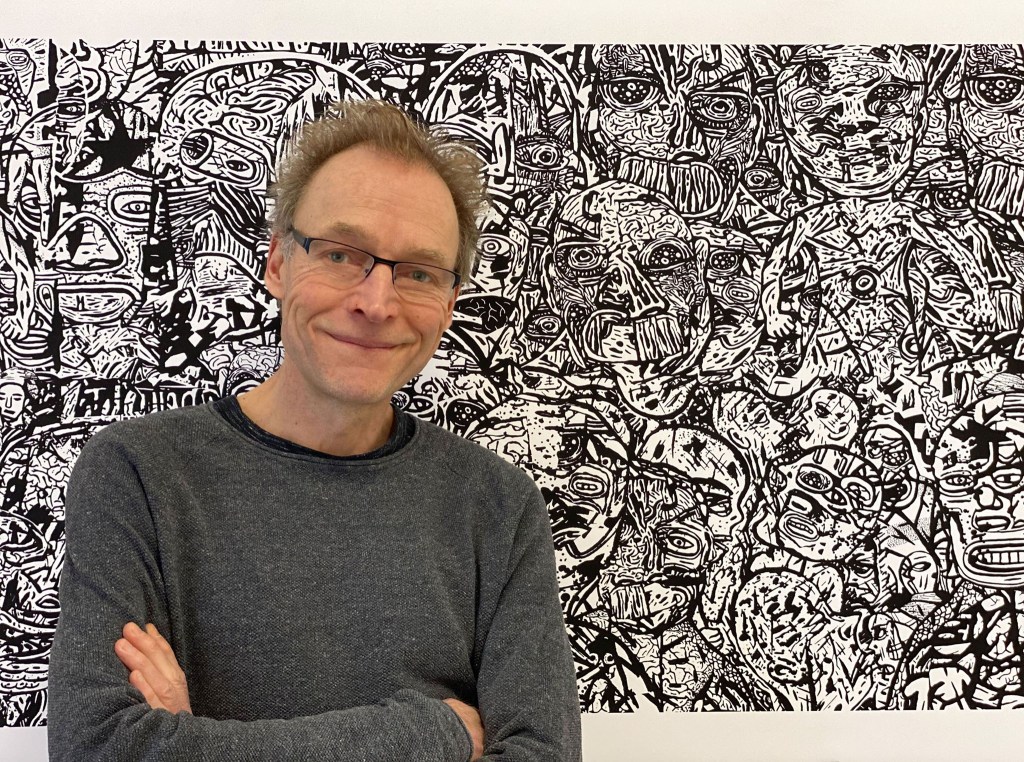
His artistic universe is nourished by contemporary comics, independent comics, free figuration, pop art, popular arts and brute art. Born in 1966 in Porrentruy, Switzerland, a graduate of the Bienne School of Visual Arts and a member of the Swiss Association of Visual Artists Visarte, he is an illustrator, painter, graphic artist and organizer of cultural events. Passionate about travel, he love to travel the world with his feet and carnets, as for example during a tour of the world in 2015. His work is the subject of exhibitions in Switzerland, France, Belgium, USA and Madagascar and has been published by several Swiss and French publishers. I reside and work in Porrentruy.
Yves Hänggi (2020)
Né en 1966, Yves Hanggi est peintre et illustrateur, diplômé de l’Ecole cantonale d’arts visuels de Bienne en Suisse. Son univers artistique se nourrit de comics underground, de bande dessinée indépendante, de figuration libre, de street art, d’art brut, d’art singulier et d’arts populaires, influences qu’il mêle à travers des formats, des supports et des techniques variés (peinture acrylique, encre, craie, collage). Son travail a été exposé en Suisse, France, Belgique, Allemagne, Pays-Bas, Etats-Unis et Madagascar, et publié chez plusieurs éditeurs suisses et français.
À travers cette série d’illustrations de grands formats mêlant encre, peinture et collage d’éléments récupérés dans la rue, Yves Hànggi poursuit un processus d’exploration débuté en fin d’année 2020 à l’occasion d’une résidence artistique à Berlin, qu’il poursuit actuellement à Paris : l’intégration à ses techniques picturales habituelles d’éléments tels que des lambeaux d’affiches, des signes typographiques ou des images déchirées issues de magazines. Par cette technique, Yves Hanggi amène une nouvelle dimension dans ses illustrations, en jouant avec les déchirures, les textures et les superpositions, ainsi qu’avec le hasard et la spontanéité. L’artiste explore également les liens qu’il peut tisser entre la rue, source d’influence et de ressources, et le travail en atelier, lieu dans lequel les œuvres se façonnent et se recomposent.
Interview with resident artist Yves Hänggi, Winter 2021, GlogauAIR
His artistic world finds inspiration in underground comix and independent comic books, free figuration, street art, different movements that can be described as outsider art (including art singulier) and folk art. These different influences are combined and expressed in a variety of mediums (acrylic, ink, chalk, collage) and formats. His work has been exhibited in Switzerland, France, Belgium, Germany the Netherlands, the USA and Madagascar and published in Switzerland and France.
With this series of large format illustrations combining ink, paint and a collage of found objects, Yves Hanggi continues to explore in Paris a practice that began at the end of 2020 during a residency in Berlin: integrating elements such as pieces of posters, typographic symbols and images torn from magazines into his usual pictorial techniques. By playing with tears, textures, superimpositions, chance and spontaneity, Yves Hanggi adds a new dimension to his illustrations and explores the connections he makes between the street (a source both of inspiration and raw materials) and the studio, where his creations are fashioned and composed.
Yves Hänggi (2018)
Yves Hänggi (2019)
As a cultural organizer, he manage several associations and cultural centers, showrooms, artist tours, contemporary art exhibitions, artistic events and festivals in Switzerland and Belgium, in the fields of current music, theater, and comic strip and the cinema. He also worked in communication, journalism and the humanitarian. He was awarded the 2019 Culture Prize of the City of Porrentruy. He is available for illustration and graphic design projects and for any exciting exhibition and publication proposal.
TinyStar is a english version of chilean fanzine displaying the most exciting of today’s artistic expressions. Each issue is filled with original art, illustration, photography, interviews, pop music, poetry going on at the fringes of culture.
Since Estrellita Mía’s appearance, our first fanzine (in July 2016), our trip has been incredible, not only have we fulfilled the dream of publishing artists who had been doing tremendous graphic work, but we have also met great creators from different latitudes. One of our 2020 goals is to be able to offer our catalog in downloadable versions for our readers, although we love the magazine / book format, we are aware of how far we are sometimes from our readers and collaborators and how important is to offer in real time the delivering of our editorial project. In order to make it easier for our readers in other countries to approach our publications, we are happy to announce that TINYSTAR e-zine will be the Estrellita Mía International forum.
Tiny Star is Estrellita Mía and Estrellita Mía is Tiny Star. Symbolically and redolent with these times of change, we think it would be a way of energize our brand, integrate more readers and open up the possibility of new editorial projects. In this edition we include three interviews with three very interesting individuals, who display a strong desire to create an autonomous artistic world : In 2013, Feral House – one of the bravest publishers in the spreading of cutting-edge culture of the last 30 years – published “Ye Ye Girls”, a volume dedicated to the analysis and presentation of the wide and powerful world of French female vocalists from the 1960s. Its author JEAN-EMMANUEL DELUXE, has written for magazines such as Lui, Rock and Folk, among others, as well as he is responsible for take to the French public fruition’s artists like April March. In this interview he tells us about his latest work, this time as a composer and arranger, “Rouen Dreams”, a collaborative project that takes several steps ahead of our time. Along this same visionary and radical line, from another perspective, we have included the interview that Australian author Josh M. Griffiths conducted with the artist, filmmaker and cultural eso-terrorist, TOBY ZOATES. Toby spoke to Mr. Griffiths about his life, point of views, anecdotes, and future projects. Finally, we have something that many readers of Estrellita Mía have been asking us for: an extensive interview with the legendary IGOR RUZ, conducted by the journalist @adriano_queer. We have had published a few works by Igor Ruz in some past issues of Estrellita Mía, and for this interview we have included some unpublished drawings on our pages. We checked it out Igor’s “Inhumanities 2016 -19” a edition from Italy’s Peer Pressure Press, of which we also talk about in this edition. Another publication that we wanted to introduce to you is “Placenta” by Maryline from Paris. “Placenta” is a small anthology composed of self-portraits and snapshots that go beyond the bounds of intimacy, but made with a shrewd, poetic and an always attentive gaze.
During March of this year the E2 gallery –based in Belgium and directed by Emilie Ouvrand – has opened “Divine”, a bipersonal exhibition dedicated to the work of the artists GEA (Chile /USA) and Stu Mead (USA). “Divine” has been an excellent opportunity to know the work of two artists who, from their respective frames and references, develop an art where sex and innocence are always on the edge of good and evil. We think totally in the vibe of our times. We transcribe the presentation text written by the gallery to present the show. We have the great pleasure to present a photographic essay by Chilean based Andy Spark. Kitsch, the beauty of the inanimate and saturated colors appears as a constant in Andy’s work. We present you a very special “equine” series. Finally we want to offer you a preview of one of our upcoming editions, “Mike Kelley (Aproximately)”.
By far, Mike Kelley was a figure who ventured into multiples media and endeavours developing some subjects that are still as current as at their peak: everyday dynamics distorted by cultural traumas, adolescent culture on the verge, lost memory syndrome, footprint childhood, and a long etcetera of neglected and forbidden forms of domestic expressions. We present some of the highlights of the call for artworks we made during 2019 to put together the project: Catalina Schliebener (Chile), Ilaria Novelli (Italy), Jorge Who (Argentina), Yoresucker (Japan), Limón Camilo, Rodrigo Leufuman Alvaro Córdova and Gaz Fel (Chile). In this first issue we are happy: all the material featured here is brand new and in-edit. Besides, Tiny Star’s digital format has also allowed us to explore full color and include more content. We want send a big THANK YOU to all the artists and creators who liked our project and today are displayed in these pages!
Estrellita Mia zine (2016)
Opinions expressed herein are those of the authors and do not necessarily represent those of the publisher. The graphic content displayed is responsabillity of its respective creators. Editor:Leonardo Casas Art Director:Clem D’Cantel Advertising: Eliana García 2020. All rights retained by respective artists.
Sales, Submissions, subscription inquires and other Estrellita Mía editions contact: Estrellita Mía Editions Challacollo 107-A apt. 304 Ñuñoa – R.M. Santiago de Chile Printed & Edited in Santiago de Chile email: editorestrellitamia@gmail.com
“Blend in with them, embrace their customs and experience as they do! And I recommend you… behave properly, always!”
DIEGO LAZZARIN
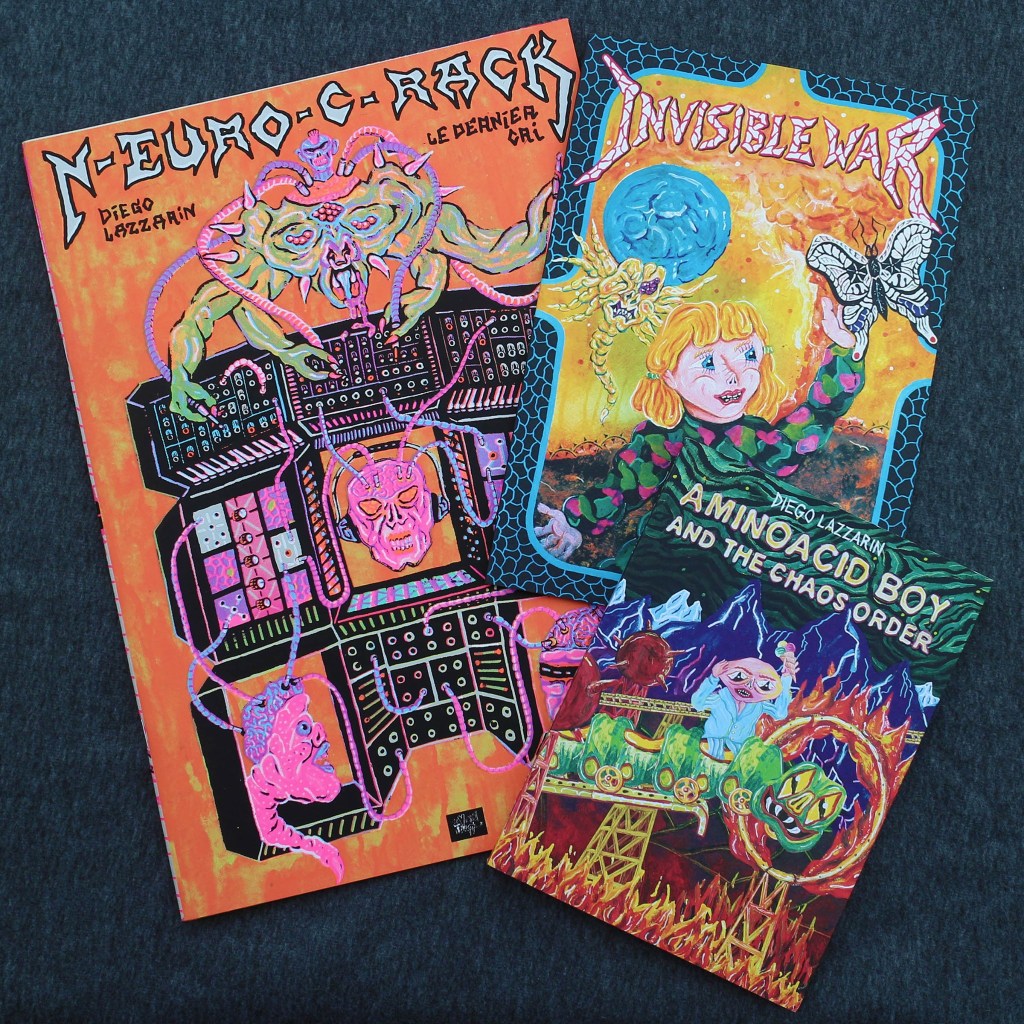
Aminoacid Boy and the Chaos Order
Daniele Fermerò
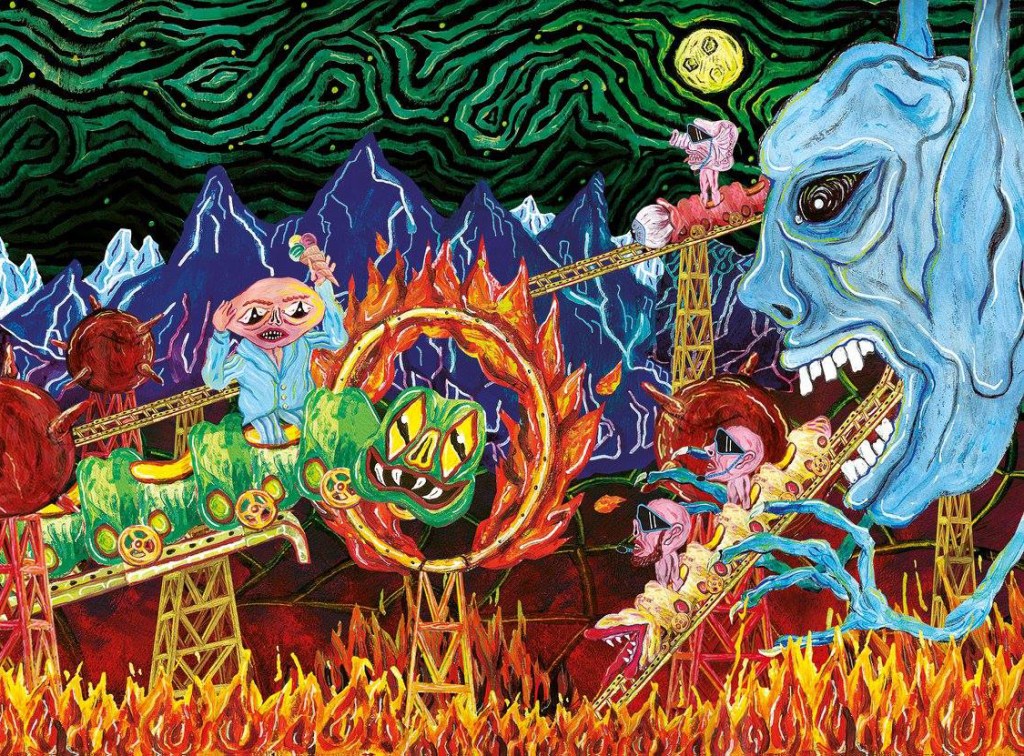
Lazzarin ha compiuto un piccolo miracolo. Non pago di una visione scintillante e meditata, ricca, vitale e carica di suggestioni, è riuscito a metterla in atto con coerenza e concretezza. Facendo ricorso alle risorse del crowfunding, con sommo stile e serietà, l’autore ha avuto modo di stampare una “copia conforme” al suo ideale, celebrato a furia di inventiva e personalità. Già diviso fra animazione, video e pittura, Lazzarin in questo volume rilancia un’idea di intrattenimento che annulla alla sorgente le divisioni tra cultura “alta” e lowbrow. Aminoacid Boy… deve infatti la sua riuscita tanto all’apparentemente lineare, ma ricchissimo e peculiare, comparto grafico e visivo, quanto alle vere e proprie derive narrative e “linguistiche” che porta nel cuore. Cronaca dell’alieno, dell’altro, del diverso che s’affaccia sul nostro mondo, più che mostrare un percorso di formazione o iniziazione il volume assomiglia a un conte philosophique per immagini, dove (s)ragionare a dovere sull’essere umano e quanto lo definisce. Per farlo, l’autore sceglie di frullare Chagall a furia di acidi e DMT, infilandoci a viva forza Francis Bacon, E. Munch, H. Bosch, il pop surrealista, la felice e caotica spinta creativa di un autore controcorrente quale Tom Bunk, cover di dischi, le visioni di Ed Wood e chissà cos’altro. Al di fuori dell’azzardo di paragoni discutìbili, l’impronta visiva, fantastica nella resa dei colori e del risultato, si rivela funzionale al risultato: un pastiche bizzarro in grado di rimandare al lettore l’assurdità grottesca della civiltà umana. Che tutto questo sia il frutto di un’opera prima, con le singole tavole dipinte a mano in tecnica mista (acrilico, acquerelli, chine, colori ad olio), pare un invito spicciolo al piacere e all’attesa del prossimo parto. Da supportare con tutto il cuore, in omaggio alla libertà creativa e all’indipendenza editoriale.
Amino Acid Boy and the Chaos Order
Lazzarin performed a small miracle. Not satisfied with a sparkling and meditated vision, rich, vital and full of suggestions, he managed to implement it with coherence and concreteness. Using the resources of crowdfunding, with great style and seriousness, the author was able to print a “compliant copy” of his ideal, celebrated by dint of inventiveness and personality. Already divided between animation, video and painting, Lazzarin in this volume relaunches an idea of entertainment that cancels the divisions between “high” and lowbrow culture at its source. In fact, Aminoacid Boy… owes its success as much to the apparently linear, but very rich and peculiar, graphic and visual sector, as to the real narrative and “linguistic” drifts that it carries in its heart. Chronicle of the alien, of the other, of the different that faces our world, rather than showing a path of training or initiation, the volume resembles a conte philosophique for images, where (s)reason properly about the human being and what defines it. To do this, the author chooses to blend Chagall with acids and DMT, forcefully inserting Francis Bacon, E. Munch, H. Bosch, surrealist pop, the happy and chaotic creative drive of a counter-current author such as Tom Bunk, record covers, visions of Ed Wood and who knows what else. Apart from the risk of questionable comparisons, the visual imprint, fantastic in the rendering of the colors and the result, proves to be functional to the result: a bizarre pastiche able to remind the reader of the grotesque absurdity of human civilization. That all of this is the result of a first work, with the single panels painted by hand in mixed techniques (acrylic, watercolours, inks, oil colours), seems like a small invitation to pleasure and to wait for the next birth. To be supported wholeheartedly, in homage to creative freedom and editorial independence.
Article by Milica Ivic on Diego Lazzarin for the NOVO DOBA FESTIVAL catalog, 2022
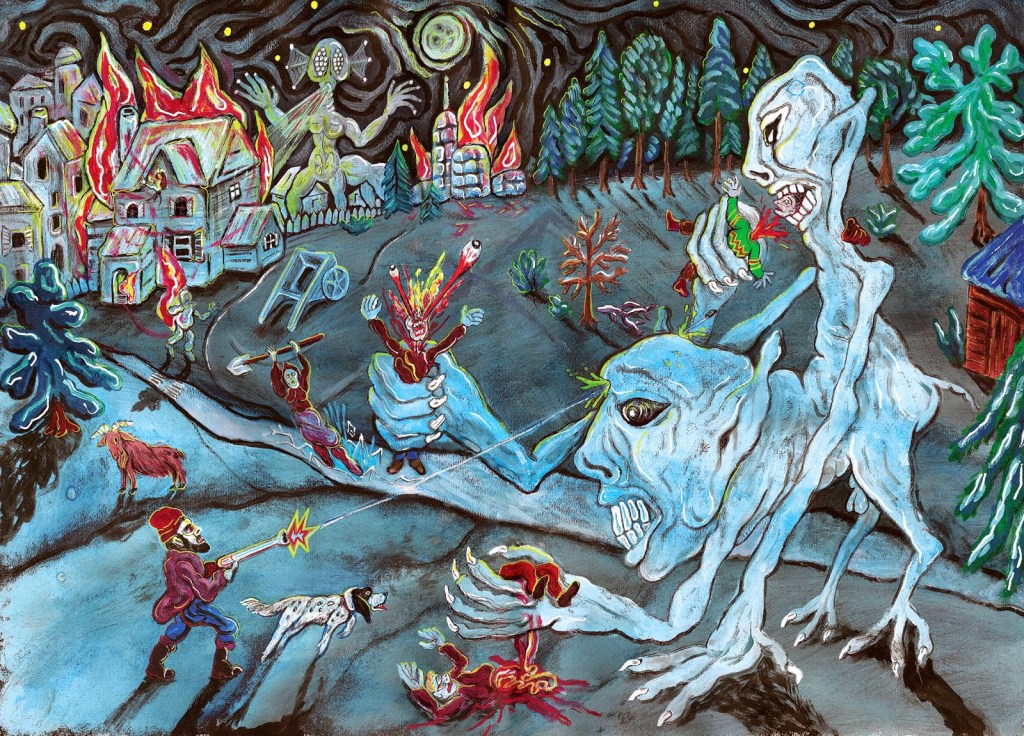
DIEGO LAZZARIN MUNSTER INQUISITION Ultrabrutalmania Raidspacebattle
Milica Ivić
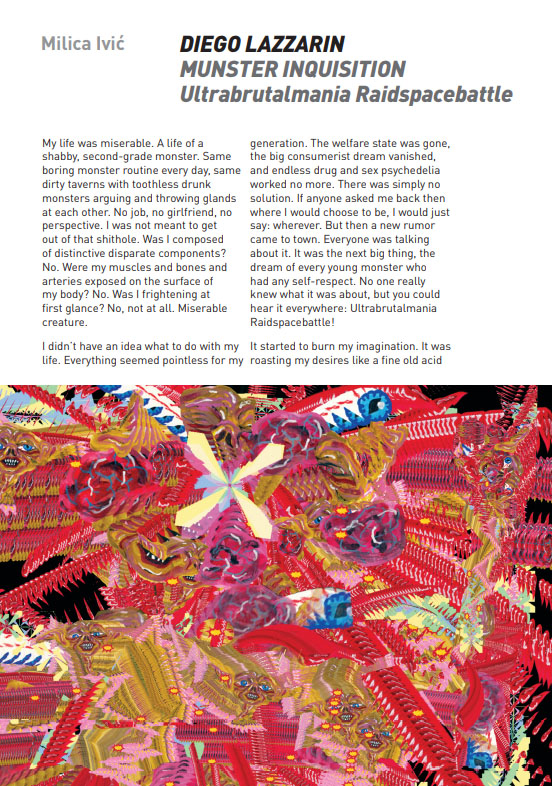
My life was miserable. A life of a shabby, second-grade monster. Same boring monster routine every day, same dirty taverns with toothless drunk monsters arguing and throwing glands at each other. No job. no girlfriend, no perspective. I was not meant to get out of that shiihole. Was I composed of distinctive disparate components? No. Were my muscles and bones and arteries exposed on the surface of my body? No. Was I frightening at first glance? No, not at all. Miserable creature.
I didn’t have an idea what to do with my life. Everything seemed pointless for my generation. The welfare state was gone, the big consumerist dream vanished, and endless drug and sex psychedelia worked no more. There was simply no solution. If anyone asked me back then where I would choose to be. I would just say: wherever. But then a new rumor came to town. Everyone was talking about it. It was the next big thing, the dream of every young monster who had any self-respect. No one really knew what it was about, but you could hear it everywhere: Ultrabrutalmania Raidspacebattle!
It started to burn my imagination. It was roasting my desires like a fine old acid on exposed membranes. Apparently, it was a monster heaven, placed in between volcanoes and deserts, where mutants could show oft and go into a real battle. That was my chance! I had no idea how to get there, but I was about to find out. I was obsessed, but focused! I was going mad, but determined to succeed. I was asking around and was listening to every conversation in the city just to get lo know who was behind this project.
And there it was. a legend, a myth, a shady figure of a guy called Diego.
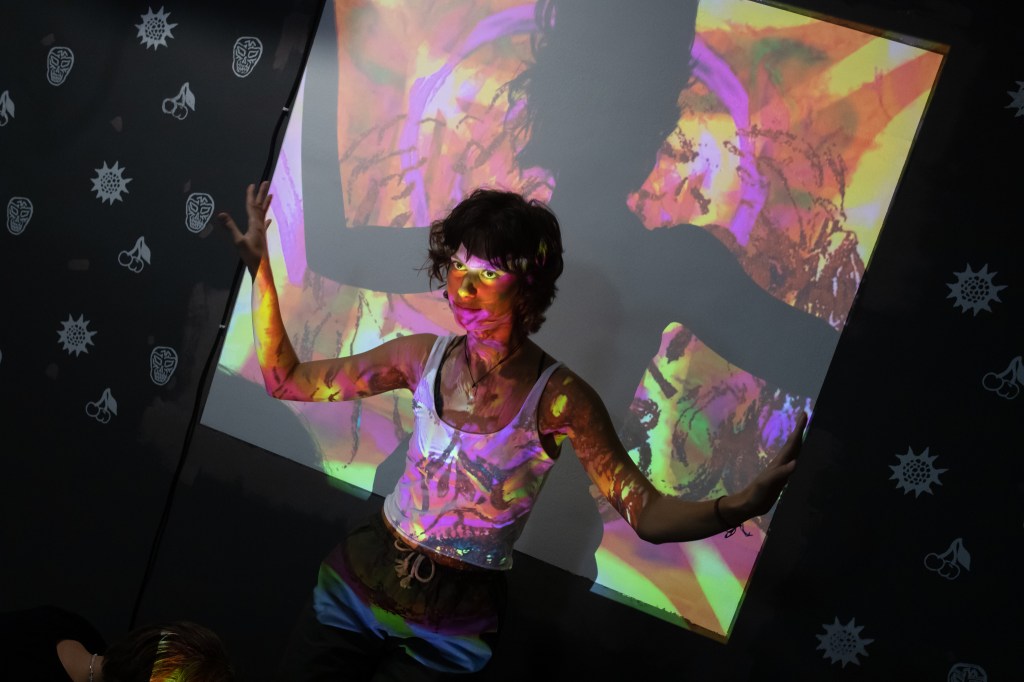
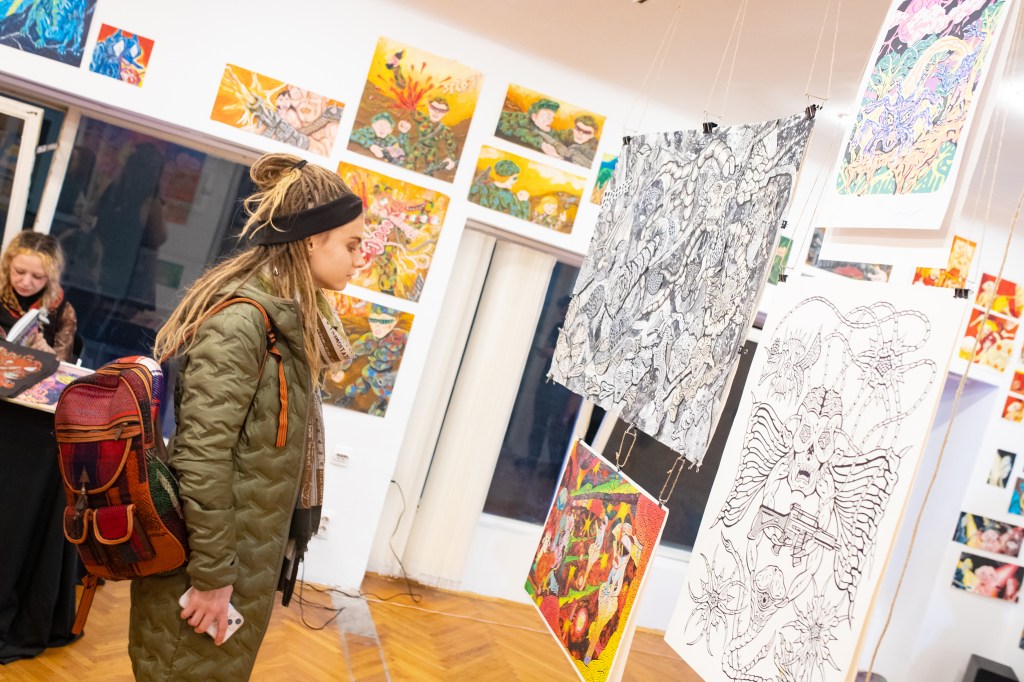
Munster Inquisition – Exhibition in Belgrade. Photos by Jahvo Joža
Diego was good at hiding, but his activities were tracked. His movements appeared on the market. Information about him could be exchanged for some valuable goods. I paid a dozen of tzantzas for a chance to see him. I was given coordinates for his meeting with come Serbian “gallerists” who were willing to host Diego and the monster flock and use them for their dubious purposes.
Munster Inquisition – Exhibition in Belgrade. Photos by Jahvo Joža
He became known as the Monster Daddy. The monsters loved Diego and he loved them back. They became a loyal flock, well-trained, well-organized and ready to kill. But everyone knew that his monsters were so damn handsome. Well built, well dressed, with finest accessories, with a killing attitude. I was never meant to be a part of that good-looking crowd. I just did not have that appeal! The rumor went that he used knowledge of dental radiology and manipulation of x-rays to adapt the monsters he chose for the battle. He was picking ihem up at dirty bars, dark alleys and suburbs and transforming them into stars of Ultrabrutalmania! I was hoping I could get through his makeover treatment.
I knew I was The One for the Raidspacebattle. I was training myself to win any arcade battle with those ignorant fucks, splitting their asses on comfortable chairs while holding joysticks and pretending to kill monsters. Hold on you fart-catchers! I am about to show you the real battle! I was practicing levitation and shooting, appearing from the far right and lower left corner. I was multiplying my skills every day – improving side vision by avoiding vehicles on the highway while zigzagging in opposite directions, counting backwards while reciting the Catalog of ships from Homer’s Iliad and mixing highly saturated acids.
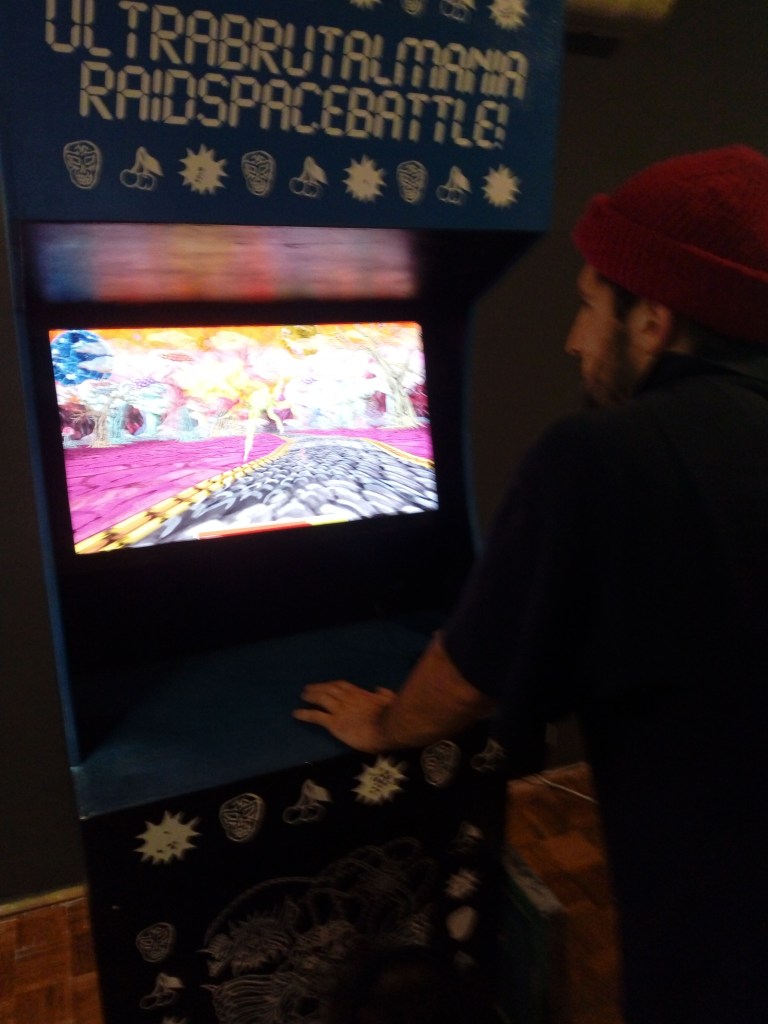
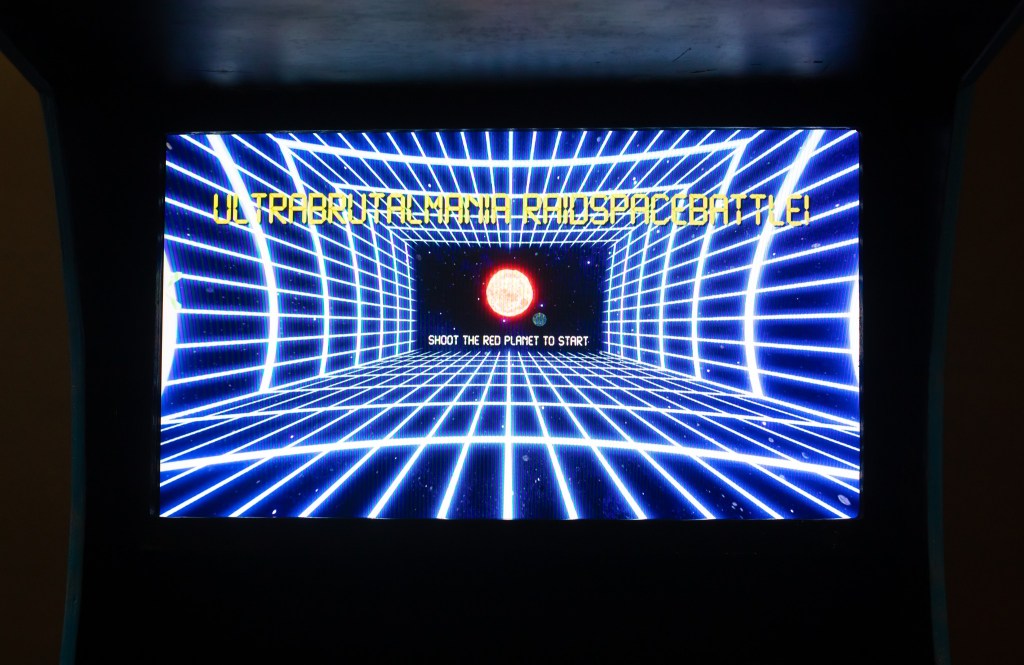
Preview of the game Ultrabrutalmania Raidspacebattle! Munster Inquisition – Exhibition in Belgrade. Photos by Jahvo Joža
I was strong and fit and I just had to find Diego first and get his attention. It was hard to get to him. No one knew him. He was not part of the comic publishing establishment, he could not be found in underground communities. He played by his own rules, surrounded by his monster friends.
Diego was good at hiding, but his activities were tracked. His movements appeared on the market. Information about him could be exchanged for some valuable goods. I paid a dozen of tzantzas for a chance to see him. I was given coordinates for his meeting with come Serbian “gallerists” who were willing to host Diego and the monster flock and use them for their dubious purposes.
Exhibition in Belgrade. Photos by Jahvo Joža
I really didn’t like that guy Diego at first glance. His face looked suspicious. He seemed kind, but everything I know about him was telling me I should be careful. He was not easily tricked.
I went to the designated location, disguised, hidden, listening into Diego talking:
Diego Lazzarin: Alien-Interview at LDC Ateliers (2019)
Person 1: Diego, it is too hard to survive. Couple of people tried and they could hardly get to the hippies.
Person 2: Yes. life just goes on shrinking and nothing is helping it out! Situation is desperate.
Person 1: Something like real life.
Person 2: We are all doomed! With larvae or without them.
Diego: Oooooh… OK. I will figure it out next week… maybe I will make it easier with less enemies
Person 2: Let us live longer!
Diego: OK… maybe I witl make the enemies cause less damage… I will think of a solution!
Person 1: How many places are there? Monsters, larvae, hippies, how many like this?
Diego: I think u more and then a final Boss. But you can recharge energy while you go.
Person 2: How?
Diego: There are some sort of pink meatballs. You shoot them and recharge.
Person 1: OK. let us know when you have some changes done!
SHOOT THE RED PLANET TO START
OK! The game has not still reached its final phase. It was still in the process! I could still get in! As I knew we were made for each other. I was determined to use the moment. I was waiting for Diego to start leaving the place and I threw mysell in from of him. Imitating ultracerebralmania to the point I was starting to really feel it. I was shaking and my body was decomposing like a boiled gum. Diego, weak as he was on monster suffering, ran to me to soothe the attack.
Diego said gently: Hey shorty, what’s up? This day is quite fine, isn’t it?
I screamed: I’m dead. I think I am dead!
Diego had a comforting look and I saw understanding in his eyes: What makes you think you are dead? Is it me?
I screamed even harder: Nooo! It’s not you! It is about my lungs. I am breathing backwards. The process is completely reversed! The air is being squeezed out of the alveoli when it should be there feeding the blood with oxygen. I am doomed!
Diego asked: Did it ever happen to you before? What can I do to help?
I was getting some ideas, but continued to scream loudly: No, this is the first time ever. Normally. I am fit and fixed. I am strong and in good shape. I can win a battle! (I partly calmed) There might be one thing that you can do to help?
Diego was curious: What would that be?
People that gathered around us were already continuing on their way, as it was clear that the attack I was having was over.
I whispered: You could take me with you and make me your monster! I can be part of your unbeatable squad in Ultrabrutalmania! I can fight them all.
Diego was smiling: OK, I have a proposition. I take you on a mission with me to see what you are made of? It would be a special mission. Hard, but exciting. We are going to Belgrade to fight the Old Wave that wants to take people to the New Era. Ewwww. Disgusting!
My eyes were radiating and my heart was beating in the rhythm of Tibetan drums: Carry me. lead me! The Old Wave has no chance against us. We will not be soaked in the retrograde shit soup of that wave.
Diego nodded: Promise!
And we were already on our way to 44.8125° N. 20.4612″ E.
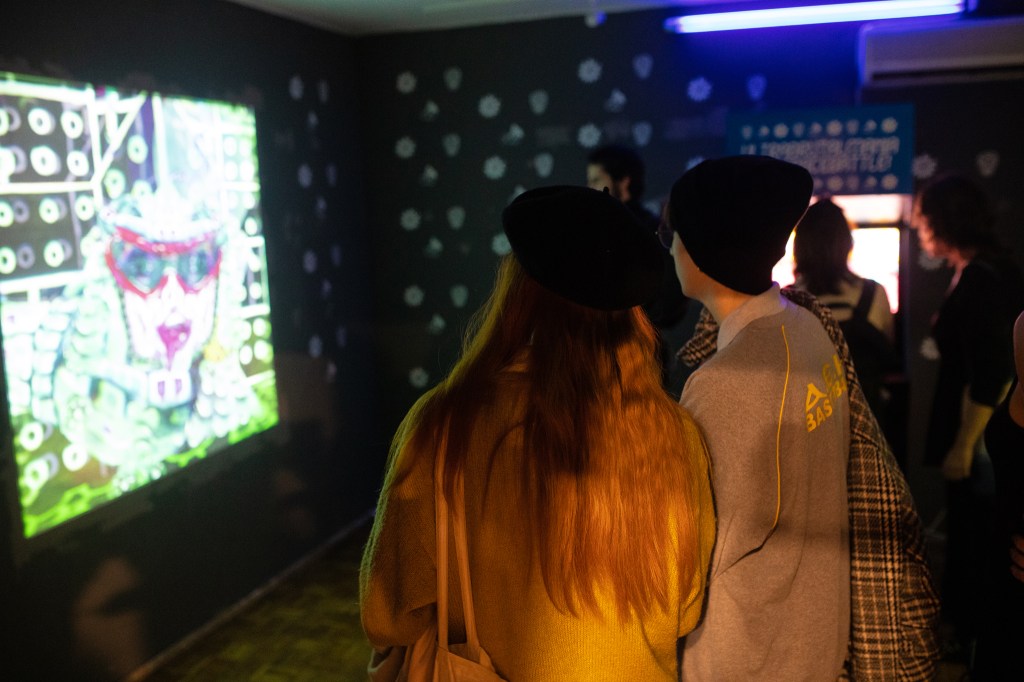
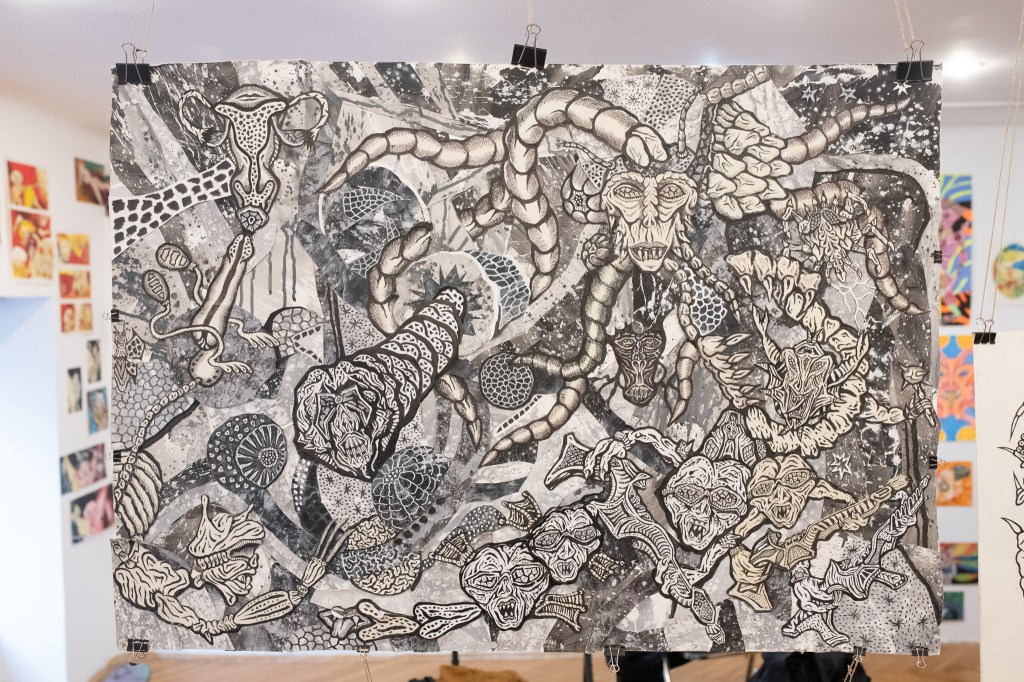
Munster Inquisition – Exhibition in Belgrade, Matrijaršija, Remont Gallery (2022) Photo by Jahvo Joža
Munster Inquisition – Exhibition in Belgrade, Matrijaršija, Remont Gallery (2022) Photo by Jahvo Joža
Munster Inquisition – Exhibition in Belgrade, Matrijaršija, Remont Gallery (2022) Photo by Jahvo Joža
Munster Inquisition – Exhibition in Belgrade, Matrijaršija, Remont Gallery (2022) Photo by Jahvo Joža
Munster Inquisition – Exhibition in Belgrade, Matrijaršija, Remont Gallery (2022) Photo by Jahvo Joža
Munster Inquisition – Exhibition in Belgrade, Matrijaršija, Remont Gallery (2022) Photo by Jahvo Joža
Munster Inquisition – Exhibition in Belgrade, Matrijaršija, Remont Gallery (2022) Photo by Jahvo Joža
Munster Inquisition – Exhibition in Belgrade, Matrijaršija, Remont Gallery (2022) Photo by Jahvo Joža
Munster Inquisition – Exhibition in Belgrade, Matrijaršija, Remont Gallery (2022) Photo by Jahvo Joža
Munster Inquisition – Exhibition in Belgrade, Matrijaršija, Remont Gallery (2022) Photo by Jahvo Joža
Munster Inquisition – Exhibition in Belgrade, Matrijaršija, Remont Gallery (2022) Photo by Jahvo Joža
Munster Inquisition – Exhibition in Belgrade, Matrijaršija, Remont Gallery (2022) Photo by Jahvo Joža
Munster Inquisition – Exhibition in Belgrade, Matrijaršija, Remont Gallery (2022) Photo by Jahvo Joža
Diego Lazzarin is one of the artists I have grown familiar with recently. Clicking my way onto his website I was immediately struck by the raw application of paint’s that created images that looked like the harlequin child of a Marc Chagall painting for the illustrations in his debut Graphic Novel ‘Amino Acid Boy and The Chaos Order’. Lazzarin gives a brief outline of the book which follows Amino Acid Boy a creature sent to earth by his lord a Bio-Architectural-Metal-Meat-Machine that lives in a dark cave in outer space. Whilst on earth Amino Acid Boy’s aim is to understand individual human desires by assimilating in himself the DNA of humans in order to understand their way of thinking outside of basic biological survival instincts which the lord finds incredibly illogical. With this transition of understanding inAmino Acid Boy various interesting scenarios promise to unfold.
Stephen Morton
MicrowavewerewolveS – LA VIOLENZA E’ KATTIVA !
Digging further through the website I came across Lazzarin’s animated videos. The videos stuck firmly in my head as an odd sickly coloured dew biologically infused cyber reality reminiscent of early mid-90’s video game cutscenes but in no way pastiche of retro style graphics but more so a progressive affirmation of this kind of aesthetic that he occupies very well, a world seemingly steeped in a sticky energy drink formula. One of my favourite of his video pieces though is for Lazzarin’s electronic music project Microwavewerewolves, the video and song Hagiography of Porn infuses a hot and frantic piece of electro music with a warped out and rehashed 70’s porno flick watched with bangers and mash, the result is both equally disturbing and hilarious.
Another video for a song Voglio Amore is a short and sweet horror chase involving a young terrified woman being tracked through a forest by a giant flying insect creature that then persists to dismember the women with venomous flames before defecating maggots into her pulped out stubs.
Aminoacid Boy and the Chaos Order on Indiegogo
With the 160 page ‘Amino Acid Boy and The Chaos Order’ Graphic Novel almost complete after three years of work and the aim for a crowd funding in May it would be worth while subscribing for updates on Lazzarin’s website to get involved in the realisation of this project. Also while your there check out his videos, music and other work on instagram.com/diego__lazzarin
2000 yılında yayınlanan bir bilimsel makaleyle ‘Antroposen (insan) Çağı’ terimi dilimize girmiş, tartışılmaya başlanmıştır. 2016 yılında Holosen çağın bittiği, yeniçağın ‘İnsan Çağı‘nın başlamış olduğu resmen açıklandı. Kimileri bu çağı insan cehennemi olarak yorumluyor. Kimileri de insan cenneti…
İnsanın dünya üzerindeki yok edilemez etkisi olarak şimdiden büyük tartışmalara konu olan bu ‘Antroposen (insan) Çağı‘na, acaba insanın sureti, portresi, yüzü nasıl yansıyacak ? Sonsuz bir dolanımla figür, tasvir edildiği şekliyle göze değil de boşlukta açılan oyuğa, ne kadar görünürleşirse o kadar görünmezleşmeye yönelen bir bakış mıdır?
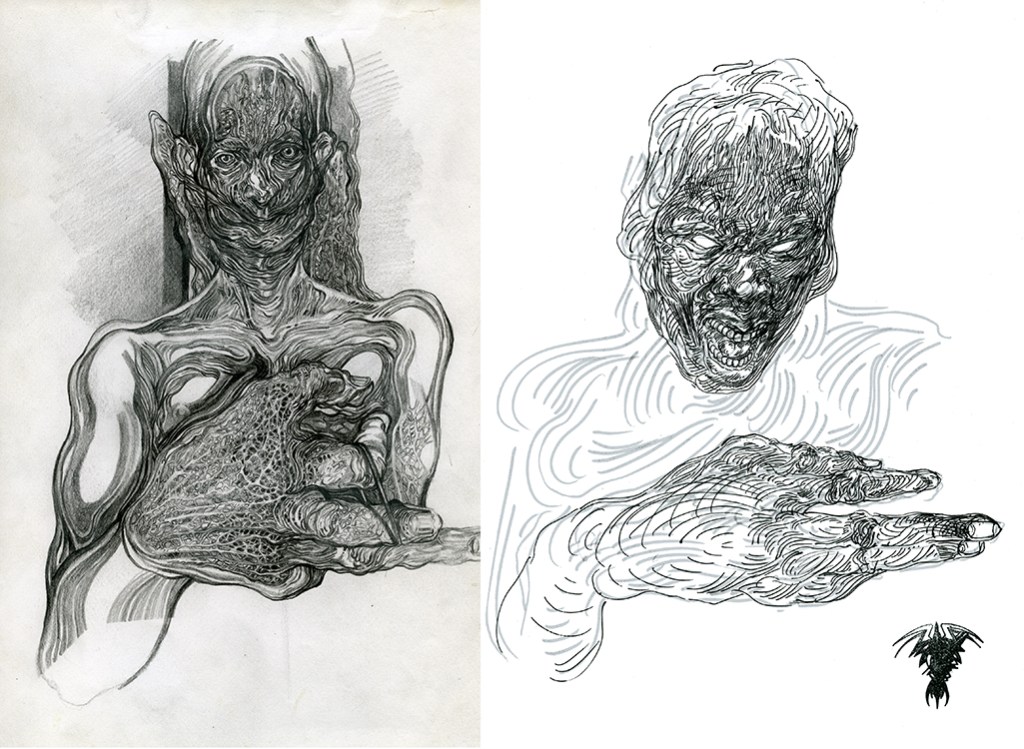
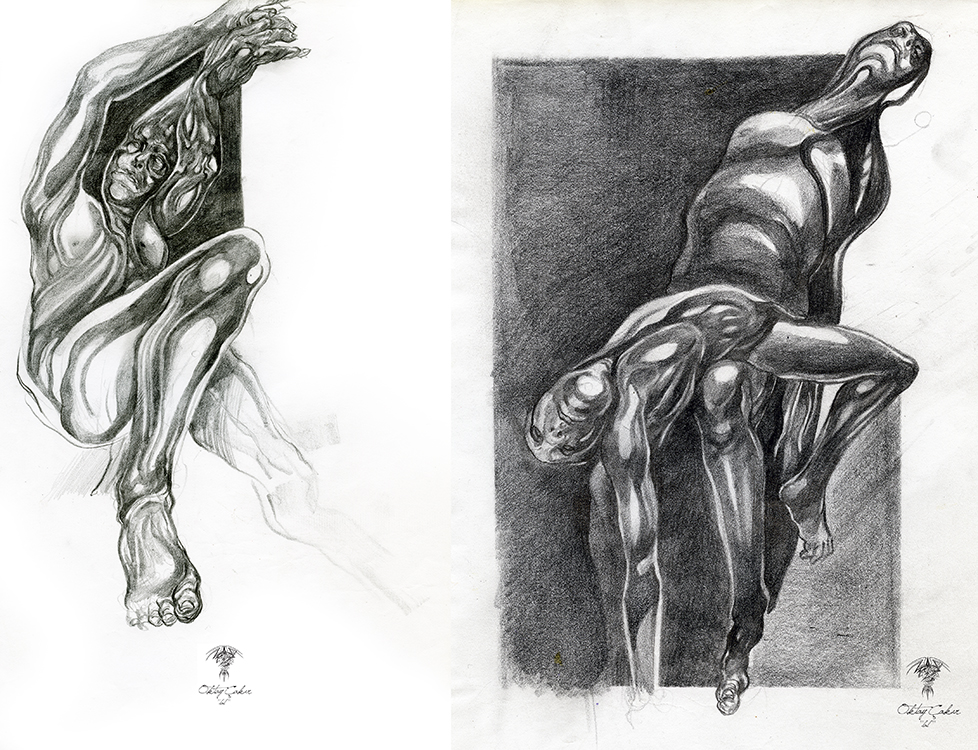
Oktay Çakır’ın portrelerinde, figürü kavrayan, örten, kaplayan deriyi neredeyse hiç hissetmezsiniz. Figürü kaplayan devinimli, kıvrımlı çizgiler, onun sessizliğinin izleri, kendine içkin çığlığıdır. Bu sessiz çığlık sözcüklerin patırtısından, her tanımlanan hikâyeden bir kopuştur. Zaten figürün saklanabileceği bir derisi, kabuğu yoktur. Ürperticidir. Figürler direk ona bakan bakışa yönelir. Duvarda asıldığı yerde sabit durmayan, sürekli canlılığın karmaşasını, varoluşun kaosunu yaşayan figürlerdir bunlar.
Sanatçının ‘Kanın Ete İçkinliği ve Resim’ isimli yazısındaki kendi yorumuyla eserlerine bakmak yerinde olur :
“Kan gecenin içinde eriyerek ete acı vermekte bir tür sağaltım ve ritüel az ileride üstünde incecik bir ışık giyinmiş anımsanamaz bir düş belirlenmekte. İncinmiş kelebek örgüsü kenarında hayli zamandır sırıtan kelimelerin dışarıda kalmış duyumsanamaz çığlıklarından oluşan sevda yalanları… (Tutunmalar)
Şüphesiz resim kendi gerçekliğinin üzerine kapanır. Kaybedilemez ve sürekli tekrarlanması gereken bir ‘beyit’ gibi her söylenişinde farklı bir bedende dirilebilmek için ‘kan’ ‘koku’yu halelendirerek yüzeyde vücut alır…
İçime dökülen bu karmaşık planların anatomisini sizlerle sürekli paylaştım. Parçalanmanın bu kadar esrik ve çılgınca planlanan bir hayatın sahnesinde merkezin kenarında basit pırıltıların onu dışarıda bırakacağını bilemeden. Artık inanılmaz bir sohbetin ortasında art çevrilmiş yüzü olmayan bedenlerin ayak içleriyle beni intihara itmelerine gülümseyerek. Asıl sahnenin kurucusunun ‘Ben’ olduğunu bilmeden… Lambanın titrek alevinde kenardan sarkan o birbirinin üstüne tırmanarak ta içimize gömülen ses benim sesim… Nasıl da gülüyorum nefretle bakan o gözlere ve içerde parça parça bir düş kenti içinde defalarca trajedimi üreterek ters yönde bir oluşu evetlemek adına. Kanın ete, boyanın tuvale emdirilişini. Doğan bir çocuğun memede sağalttığı o süte inanılmaz büyüsel tütsü o koku ve yeniden yeni’den ağlayarak aynı şeyin içime karışmasına izin vermek için parçalıyorum kendimi…
Renklerin bu kadar geriye itilmesi salt duygunun öne çıkarımıyla ilgili aslında rengin verdiği o basit kurutulmuş o incecik altın kabuğun (berrak) kazıyı gerçek kanın ve etin ortaya çıkarılışını sağlamakla ilgili bu ritüel.
Bir çığlığı dikine ikiye kesmek yalnızca…”
Oktay Çakır ‘Lal’ kağıt üzerine mürekkep
“Resim bir başka hale dokunma biçimidir. Bir üst perdeyi aralama hali. Gerçekliklerle değil hakikatle ilgili bir tartışma/ çekişme duruşuyla ilgilenir. Çoğunlukla imge bunu karşılayamadığından sürekli çoğalır.”
Oktay Çakır’ın resimlerindeki figürler, karanlığın derinliklerine kadar inmiş, öznenin şimdiki yerini düşlemleyerek yeniden aydınlatmak için aramıza, yeryüzüne dönmüşlerdir. Burada varoluşsal bir telkinle geçmişten gelen ve yeninin birleşimiyle denge kavramı bütünle özdeşleşir. Çerçeve belirlenebilir bir sınır olmaksızın, algılanan figürün, yani orada olanın (dasein) karşımıza çıkışıdır.
Figürün daha başka yapabileceği tek seçim, bedenin kesintisizliğine uygunluğunu sergilemektir. Böylece oylumlama insan yaşamının yeni biçimlerden üretilmiş yeni biçimiyle sonuçlanır. Figürün yüzü her türlü yüklemeden ve nitelemeden ayrıldığında tarafsızlaşır. ‘Şimdi ve burada’ olur. İnsan onu var eden atmosferin ve dünyanın içine çekilip yokolmaktan ancak eserin ‘şimdi ve burada’lığı tesiriyle kurtulur.
Antroposen (insan) Çağ, nasıl ki insanın atmosferde ve dünya üzerindeki yok edilemez etkisini temsil ediyorsa, Oktay Çakır’ın figürlerinde de insan oluşumu yine insan etkileşiminin (insanın insan içinliğinin) tam kalbinde yer alır. İnsanın geçirdiği evreler (varoluş- yokoluş- kazanış- yitiriş vb.) gerçeklikten koparılmış bir parça olarak değil, hakikatle temas eder. Hakikat; yabancılaşmış bir derinlikten fışkırarak isimsizleşmeye çivilediği bakışı kışkırtır ve mutlak egemenliğini sorgulatır.
Oktay Çakır, Hollanda dosyası ‘Nudity’ klasörü (2008)
Oktay Çakır, Hollanda dosyası ‘Nudity’ klasörü (2008)
Oktay Çakır, Hollanda dosyası ‘Nudity’ klasörü (2008)
Tuzla Sanat Galerisi’de. 24.ŞUBAT. 2014
Oktay Çakır, Hollanda dosyası ‘Nudity’ klasörü (2008)
Oktay Çakır’ın resimlerindeki figür çizgilerin devinimsel hareketiyle süresiz bir çoğalmanın yarattığı evrende saklıdır. Bedeni uyandıran çoğalmanın değil, saflığın yankısıdır. Beden, geçmişte vücut bulan çocukluğun saf an’larını, şimdi’de sadece hayaletimsi izler olarak yakalayabilir. Oradadır çünkü sezilebilir. Yoktur çünkü cisimsizleşmiştir. Bedenden asla koparamayacağımız bir şey varsa o da bu saflığa duyulan özlem, bağlılıktır. İnsan yitirdiği bu saflığa, fiziksel koşul olarak mecbur olduğu mekândan koptuğu anda ancak yeniden kavuşabilir. Bu demektir ki insanın mekânı, saflığın merkezidir.
Figürler unutmamayı canlandırıyorlar. Birlikte hatırlayabilme kabiliyetiyle hakikati ustaca saklı tutuyorlar. Buradaki nefes, soluk, canlılık; kararlılıkla yoğunlaşması imkânsız olanı bedenleştiriyor. Böylelikle figür, bir daha düşünülmeye değer kılıyor kendini.
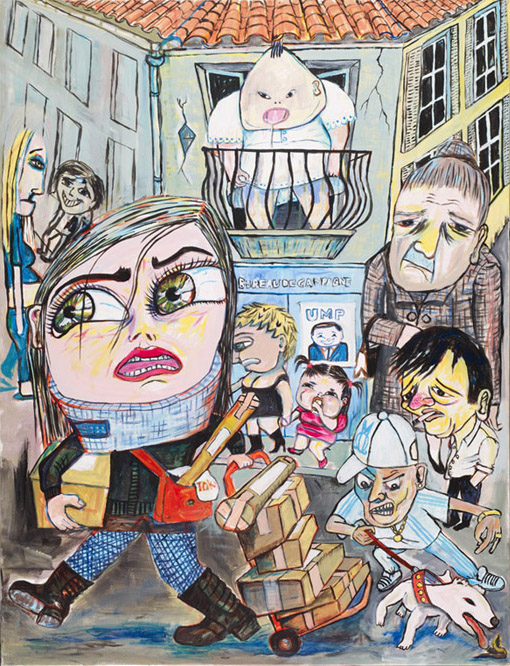
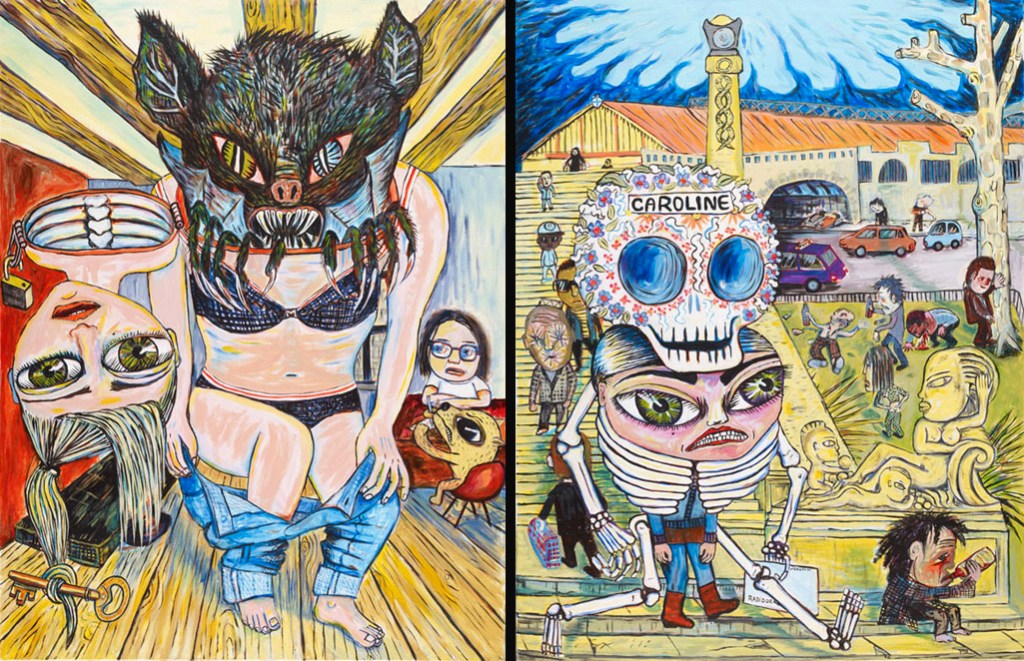
Caroline Sury ‘La belle de mai’ 110 x 96cm, acrylic on canvas (2011)
Marseille est un Théâtre Vivant
Elle le dit elle-même : « Je suis une spectatrice. » Alors qui, mieux que Caroline Sury, qui passe du regard au dessin « presque automatiquement », pouvait donner de Marseille et des Marseillais une vision plus intime et précise ?
Certes elle n’est pas d’ici. Née en 1964 à Laval, c’est une Mayennaise au pays de l’aïoli. Mais voilà plus de vingt ans que son regard s’aiguise au contact de la ville qu’elle s’est choisie, et aujourd’hui, si elle ne se sent pas forcément marseillaise, elle n’a plus envie de changer de décor.
« Je ne me vois pas vivre ailleurs », confie-t-elle, comme si c’était une révélation. « Marseille va très bien avec mon état d’esprit, qui est toujours un peu fébrile. Je suis toujours en train de me poser des questions, je veux toujours autre chose. Marseille est comme ça, un peu fébrile. Il y a du pus, de la cloque, du bubon. C’est le beau paysage bien tourmenté de ma vie tourmentée ! »
Là où d’autres artistes aspirent à la sérénité, à la quiétude, elle a besoin d’une forme de mouvement perpétuel, qu’elle trouve dans son atelier situé entre la Canebière et la Plaine. Mais aussi et surtout dans la rue. « J’aime la campagne, la nature, voir des mésanges, mais au bout d’un moment, c’est un peu chiant. »
Les petites villes n’ont pas plus d’attrait pour elle. Elle sait de quoi elle parle, ayant grandi dans le chef-lieu de la Mayenne avant d’étudier aux Beaux-Arts d’Angers. « Les villes moyennes, c’est juste affreux. Marseille, c’est énorme. Il y a plein de choses différentes, plein de choses bordéli-ques qui se passent. C’est ça qui est intéressant. Dans les petites villes, tout est lissé. Il y a une forme de standardisation », dit-elle.
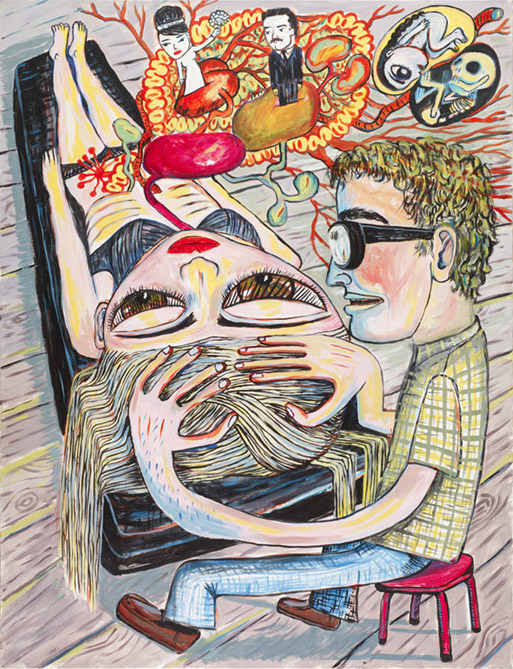
Caroline Sury ‘Souvenir d’organes’ 110 x 96 cm, acrylic on canvas (2011)
Il lui suffit de se rendre de chez elle à son atelier – et ee n’est pas très loin — pour trouver matière à observer, à dessiner. Marseille est un théâtre vivant.
« Dans ma rue, tu as un coiffeur, Lorenzo, où tous les footeux viennent se faire couper les cheveux. Ils viennent et se garent en double file, tu as toujours des embouteillages et tous ces garçons dehors avec des coupes de cheveux pas possibles et leur shampooing, ils sortent dehors avec ça. »
Ce spectacle authentiquement vivant lui donne envie de se promener sans cesse avec un carnet, pour croquer ces tranches de vie qu’elle saisit au bond, chez le boulanger ou au supermarché. « J’essaie souvent de ne pas oublier un personnage, de le reproduire quand je rentre à la maison. Et comme je fais de la BD, j’ai toujours un petit scénario qui se met en place. »
Aussi quand elle part, et elle le fait souvent comme nombre d’artistes marseillais qui réhabilitent le côté port d’attache de la ville pour exposer ailleurs, en province, à l’étranger, ce bouillonnement la rappelle. « Au bout d’un moment, ça me manque, l’effervescence, le côté malade ici, où les choses les plus laides côtoient les choses les plus belles. L’écart qui existe entre les choses, c’est nourrissant, c’est la vie. Marseille est une ville pauvre. Mais c’est pour ça qu’elle est riche. »
Caroline Sury évoque le Marseille du début du xixe siècle, celui de Victor Gelu, qu’elle a lu récemment, ses rues sales où l’on jetait les ordures par la fenêtre, ces quartiers populaires à la lame facile. Elle se demande si la ville a tant changé que ça. Mais c’est ce qui lui plaît.
Son périple a été un peu long pour échouer jusqu’ici. Après Angers, elle s’installe à Bordeaux pendant huit ans et monte enfin à Paris, pour y développer la maison d’édition artistique Le Dernier Cri avec son compagnon d’alors, Pakito Bolino, qui la dirige toujours aujourd’hui. Mais si Paris bouillonne aussi, si le milieu du graphisme et du dessin y est extrêmement vivace, il faut vivre. Le couple descend à Marseille en 1995, autant pour son niveau de vie plus abordable que pour s’ouvrir des horizons nouveaux. « A Paris, quand je travaillais au Dernier Cri, j’étais comme à la cave. Je ne sortais jamais ! »… Marseille va lui apporter de la lumière, de l’espace, un heu de travail aussi. Par chance, Pakito et Caroline, également musiciens, retrouvent, à la Friche la Belle-de-Mai, Ferdinand Richard, un ami croisé sur les scènes musicales. Ils lui montrent leur travail et se voient offrir un atelier dans ce heu culturel encore… en friche. Avec d’autres, ils en essuieront les plâtres.
« Quand nous sommes arrivés, il n’y avait presque rien. Nous avons eu nos machines de sérigraphie avant d’avoir un local. On a construit les cloisons autour des machines ! » À la Friche, qui a ouvert seulement trois ans plus tôt, les deux jeunes trentenaires se dépensent sans compter et éditent à tour de bras ce qu’ils aiment, leurs travaux mais aussi ceux d’autres dessinateurs et illustrateurs inspirés comme eux de l’art brut, de Jean Dubuffet ou du peintre dadaïste allemand Georges Grosz, influences revendiquées par Caroline.
L’installation n’est pas toujours évidente et le contact avec les décideurs locaux parfois surprenant. Un jour, un responsable culturel de la ville débarque dans leur atelier, en manteau de cuir et écharpe blanche, et se félicite de les voir travailler en couple « comme la boulangère et le boulanger ». Et sort sans plus de cérémonie. Un peu plus tard, c’est un article sur Caroline dans le magazine Marseille L’Hebdo qui pousse le patron de la direction générale des affaires culturelles de la ville, Jean Mangion, à leur accorder une subvention.
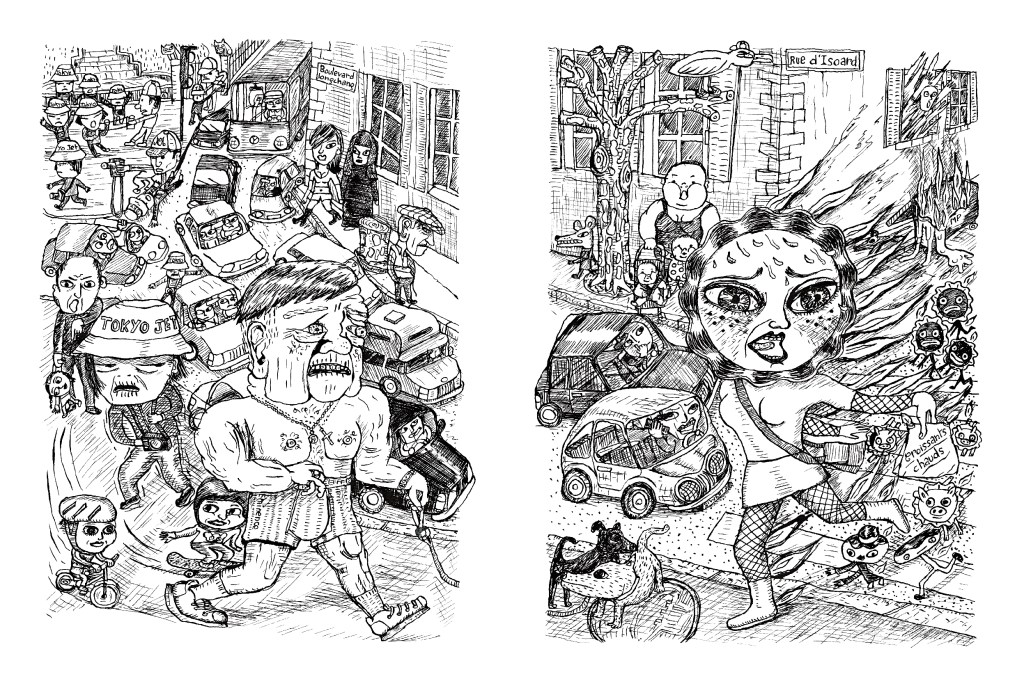
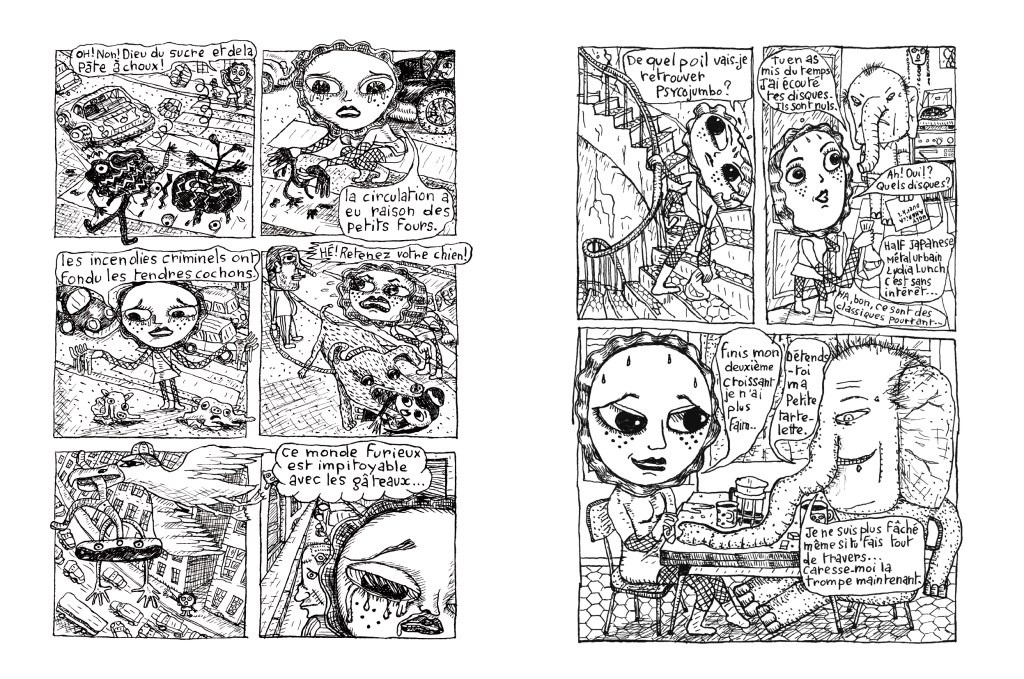
Caroline Sury devient peu à peu une référence marseillaise. Ses dessins un peu trash, aux traits gras, dégoulinants d’humanité, s’imposent dans les colonnes de Marseille L’Hebdo, où elle officie pendant six ans entre 2000 et 2006 avant de poursuivre cette activité de dessinatrice de presse pour CQFD, après avoir également collaboré à Libération, Et elle admet que la ville où elle vit a certainement influencé sa manière de voir et donc sa façon de dessiner.
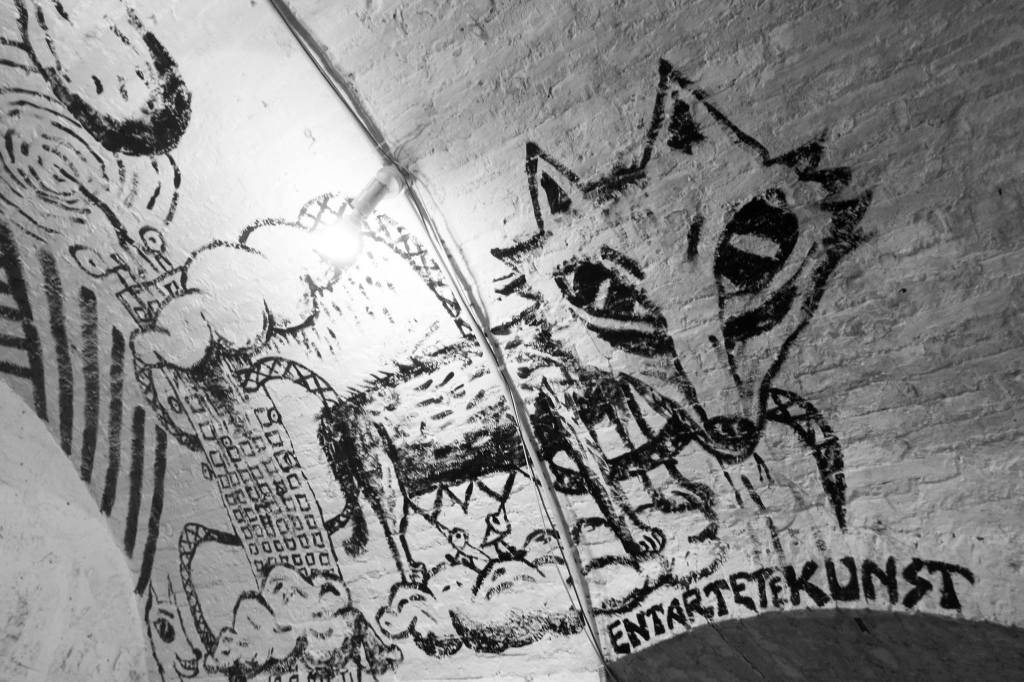
Mural art by Caroline Sury / Crack Festival (2017)
Crack Festival 2017 (3)
« Il y a ici des gueules qu’on ne voit pas ailleurs. C’est unique. Même à Naples, les gens sont plus distingués, ils ont ce côté italien, tu croises toujours des têtes de madones. Ici, c’est n’importe quoi, on a tous les milieux populaires du monde entier qui viennent ici. Il y a des rictus, des manières de faire. Je suis toujours choquée et amusée. C’est du théâtre et j’adore ça. » Mieux encore, pour elle Marseille, « ça grouille » et c’est tant mieux… « J’adore dessiner des foules. C’est ma spécialité, les foules avec des individus qui se détachent. Pour ça, ici, je suis servie. »
La ville, elle l’a aussi découverte autrement, dans ses espaces, son urbanité, son architecture et ses quartiers en participant aux Promenades urbaines initiées par l’artiste-marcheur Nicolas Mérnain. « Ça m’a bien plu, ces promenades, parce que c’est moi qui conduisais. J’adore conduire à Marseille, c’est speed et j’aime le speed, je suis quelqu’un d’énervé, j’aime bien freiner, accélérer, découvrir d’autres quartiers, d’autres architectures. »
Alors, est-elle devenue marseillaise pour autant au bout de vingt-trois ans ? Elle n’en est pas sûre, parce qu’elle fréquente « des réseaux underground très structurés », beaucoup de néo-arrivants accourus à Marseille après l’arrivée du TGV, parce qu’elle a ses adresses, son microcosme, à L’Embobineuse et La Machine à coudre pour les concerts, au Bar à Pain pour la bouffe. Bref, elle se mélange peu. Mais n’est-ce pas très marseillais, justement, ce confinement ?
Elle admet cependant aimer le Gambetta, cette boisson à la figue typiquement d’ici, et aller nager de Malmousque jusqu’aux îles. « La mer, c’est sublime. La côte ici, la côte Bleue, il n’y a rien de plus beau. Ça y est, je deviens chauvine… »
Mural art by Caroline Sury / Crack Festival (2017)
Mural art by Caroline Sury / Crack Festival (2017)
Caroline Sury ‘Drawing as Language’ Talk (2016)
Mural art by Caroline Sury / Crack Festival (2017)
Et celle qui se définit comme « la plus mauvaise des négociatrices », qui n’a jamais sollicité subventions ou faveurs, qui comme la plupart des artistes locaux est « passée complètement à coté de Marseille-Provence 2013 », qui a plus connu le RSA que les allocations chômage, s’inquiète de voir disparaître ce Marseille populaire qu’elle a appris à aimer.
« Je suis un peu inquiète quand je vois ce que devient Eu-roméditerranée, quand j’entends qu’on veut déplacer les petits commerçants du marché de Belsunce ou de la rue Longue-des-Capucins pour les remplacer par des choses qui seront forcément de mauvais goût, quand on veut interdire les marchands à la sauvette de la Plaine chez qui se fournissent les gens qui n’ont pas beaucoup de moyens, sous prétexte qu’ils font de la concurrence aux grandes enseignes du centre-ville. Ce n’est pas à cause d’eux que le centre-ville se paupérise, mais plutôt à cause des grands centres commerciaux comme Les Terrasses du Port. »
En attendant, Caroline Sury déborde de projets que, comme souvent, elle n’a pas sollicités. En mai 2018, elle fournira d’immenses silhouettes pout un spectacle dans les rues de Marseille, où elle pourra enfin décliner son goût pour les jeux d’ombres et de lumières, les formes totémiques, et un penchant encore inassouvi pour l’Asie, Bah, le Cambodge, le Japon, qu’elle rêve de découvrir bientôt. Avant de regagner son port d’attache.
The fragmented vision of the pornographer, a sense of detail sharpened like a butcher’s knife, the cutting of the pork butcher, a precision of biologist and the indecency of the anatomist: the universe of Theo Vonwood is undoubtedly surgical.
In whole or in part, TVW works its bodies with a scalpel. A stall of meaty parts, which we do keep the beautiful pieces with well licked proportions. Bodies with a standardized aesthetic like these female anatomies, udders in front, wasp sizes and curved thighs. The monstrous bodies there are equally weighedare : a real freaks parade. The strangeness of her creatures – if she is monstrous – affirms a disturbing normality, or a conditioning to which nobody escapes. The treatment of the bodies is attached to it : enlarged and fragmented, muscular, detailed, plucked, smoothed and well proportioned… the contours are tirelessly worked, the perfect silhouettes, nothing beyond, except obscenity.
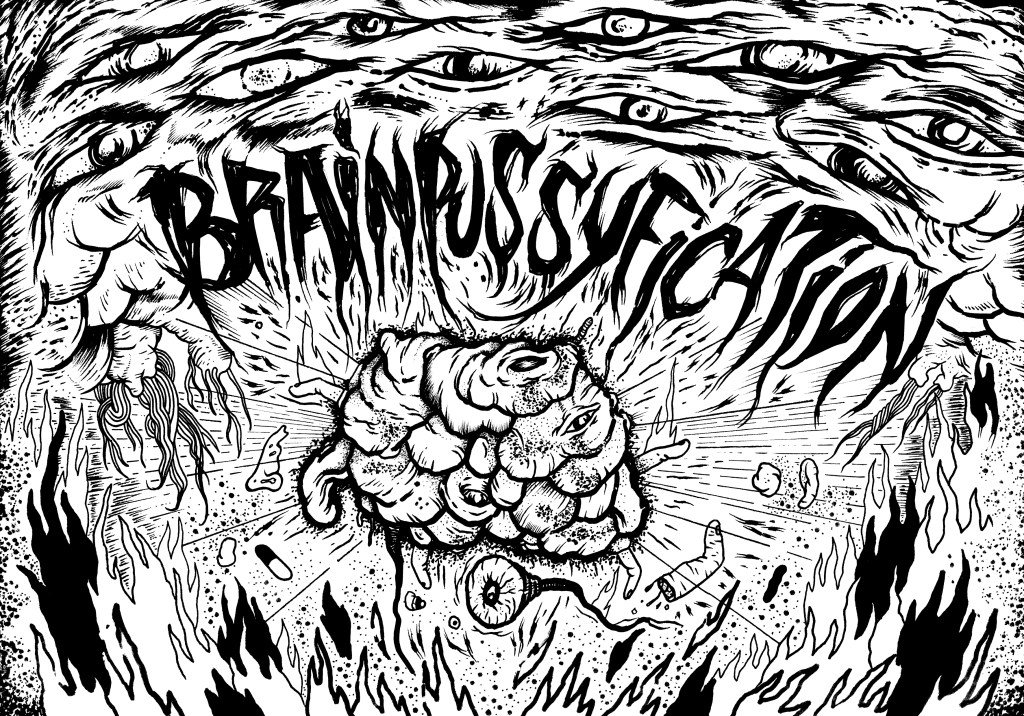
Vincent Pernollet ‘BrainPussyfication’ ink on paper
A normalized monstrosity
or a monstrous normality…
What then makes strangeness ? If the monster is itself “well done”, where is the (a)normality ? The question “Who ?” then come back with the recurrence of the theme of the mask, symbol of a schizophrenic anonymity. Madness stands out as a thread of thought woven from his 1st book Strangers (foreigners), to the last Normal journals(zine), or Twisted.
The (de) structuring of the boxes with which he likes to lose the narration between time and space – with the notorious influence of “abstract comix“ – ultimately refers more to the world of cinema than to BD. The pornographic dimension is also cinematographic: close-ups, tight shots, fragmented shots. A processing of the image and the body (which sometimes are one), which goes so close, so deep, that we reach the organ, the pulpit, the cell, in an immodest molecular vision. We explore the part there, without necessarily evoking everything, each fragment not faking the role of the sign but embodying fully. Tirelessly interwoven, mutated organic, humanoid, robotic or chimeric bodies.
Fragments of bodies, time segments and space cells dance on the page. Interlocking organs tear, spread in uninterrupted flow. Classic three-step scenario, which at TVW takes a SF twist in five dimensions or more, evidenced by the fragmentation of plural cells where the drawing operates. Abstract narration unfolds in the multiplicity of parallel and simultaneous tenses of a same box (didn’t he give himself to heart in a musical project called “multiversal” ?). Long abandoned for the benefit of music, Vincent Pernollet aka TheoVonwood (b.1980 in France)
Returns to drawing in 2016 by working on the exhibition “Printnoiz” of Le Dernier Cri, in Marseille. There follow years of graphic meetings and multiple collaborations for collective editions:
In 2017, he made his first book “Strangers” in screenprinting (4, 3 and 2 colors) with Epox and Botox Editions (created by Aude Carbone), followed by a self-published graphzine “Normal”(monochrome), printed in offset at La Platine in Marseille. In 2018 he released “Twisted” a solo zine, edited by Phantasticump Press, (created by Gabriel Delmas in Paris) and made a residency in Ljubiana, during which his next book, “Vox Clamantis Inferno”, was still being created.
Vincent Pernollet ‘Infected’ ink on paper
At the end of 2018, he exhibited at Siva Galery “AKC MEDIKA” in Zaghreb, then back in Marseille, painted a 4-handed fresco at “L’Embobineuse” with his friend Andy Leuenberger for the Vendetta micro-publishing show organized by Le Dernier Cri. The exhibition “Amours Monstres” proposed at Même Pas Mal Edition in Marseille (may-june 2019) presents its latest experiments with acrylic, oil, china ink, original boards from 2016 to today (including Strangers, Normal and Twisted) and those announcing his next book “Vox Clamantis Inferno” to be released at Epox and Botox in 2020. He is currently working on several different projects, including a painting project with Jaky La Brune. His lines are organic, fine and sexual. Widely dreamers.
Marine Tsr, Entretien de Theo VonWood par Peggy Ann Mourot (Phantasticum Press, 2018)
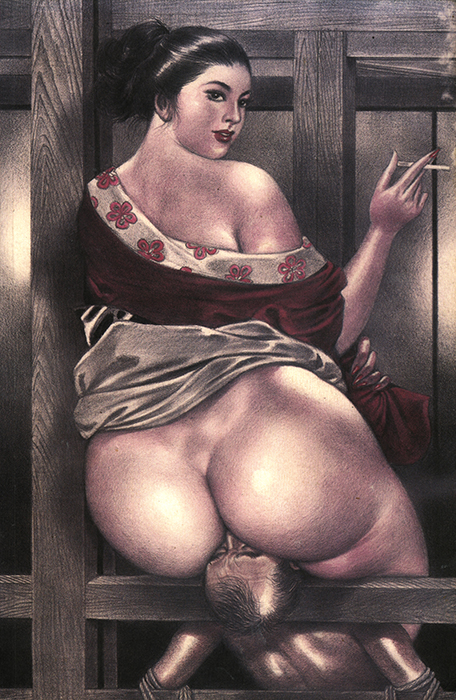
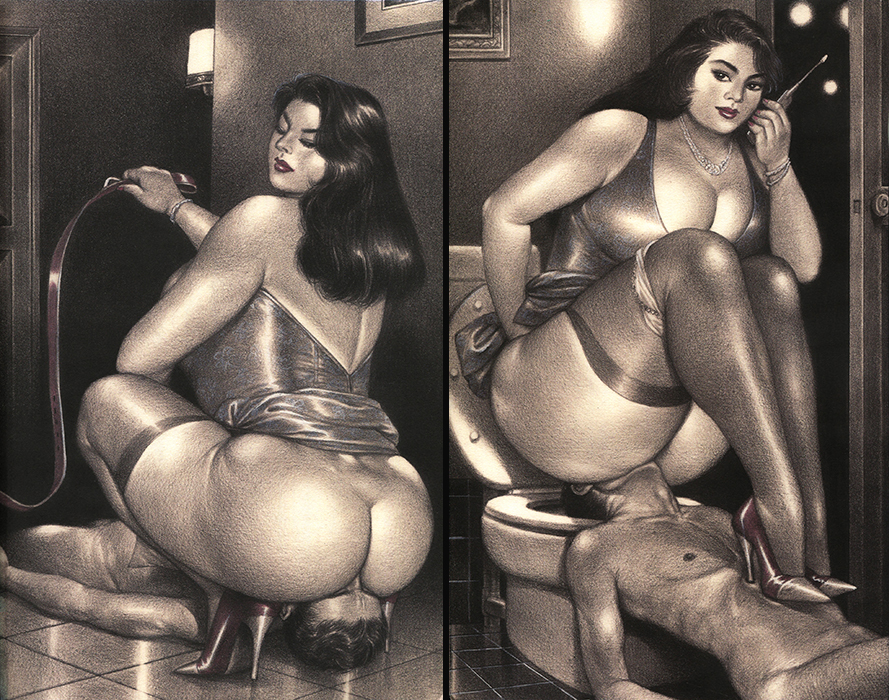
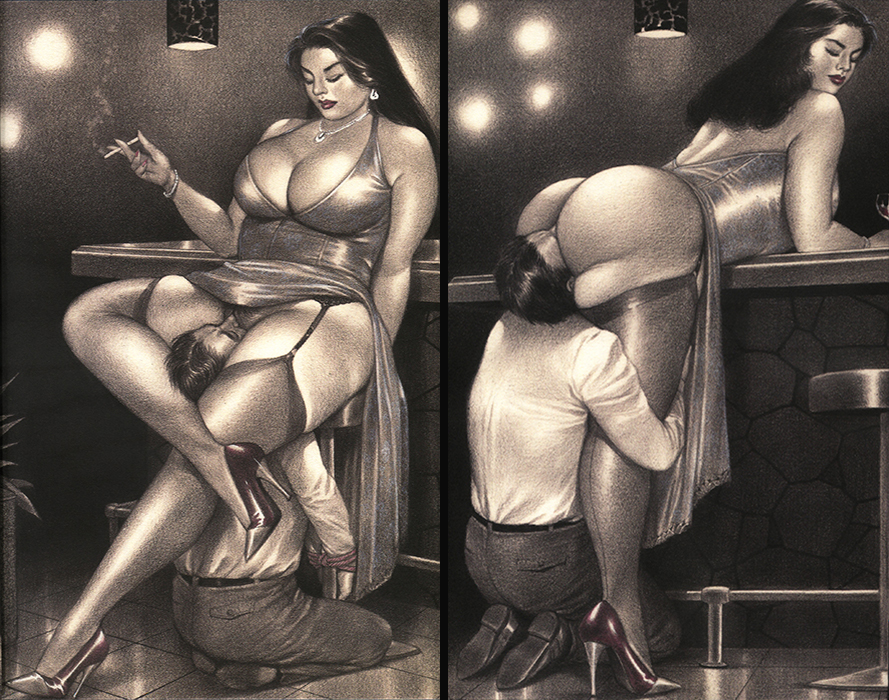
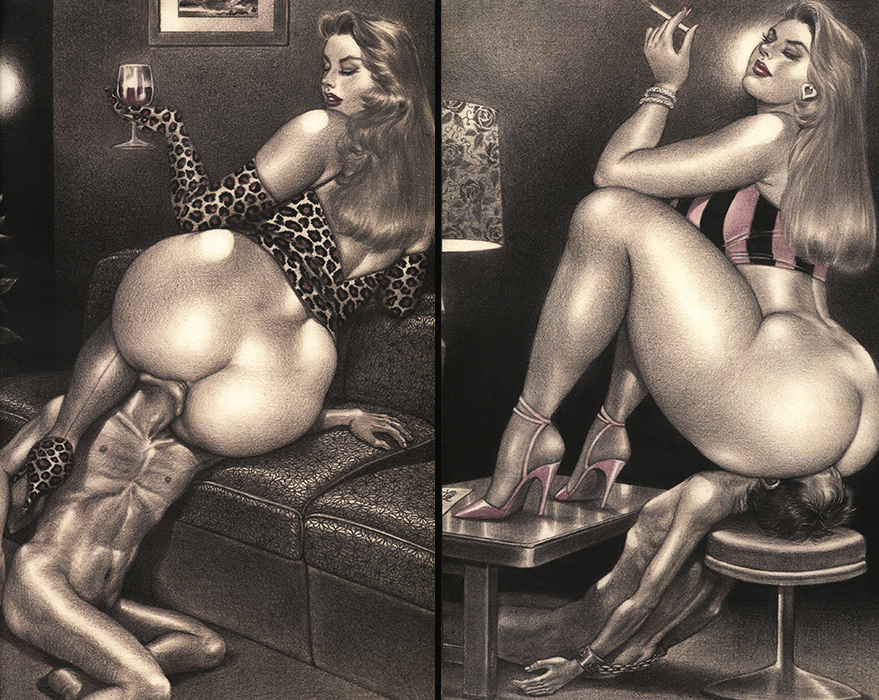
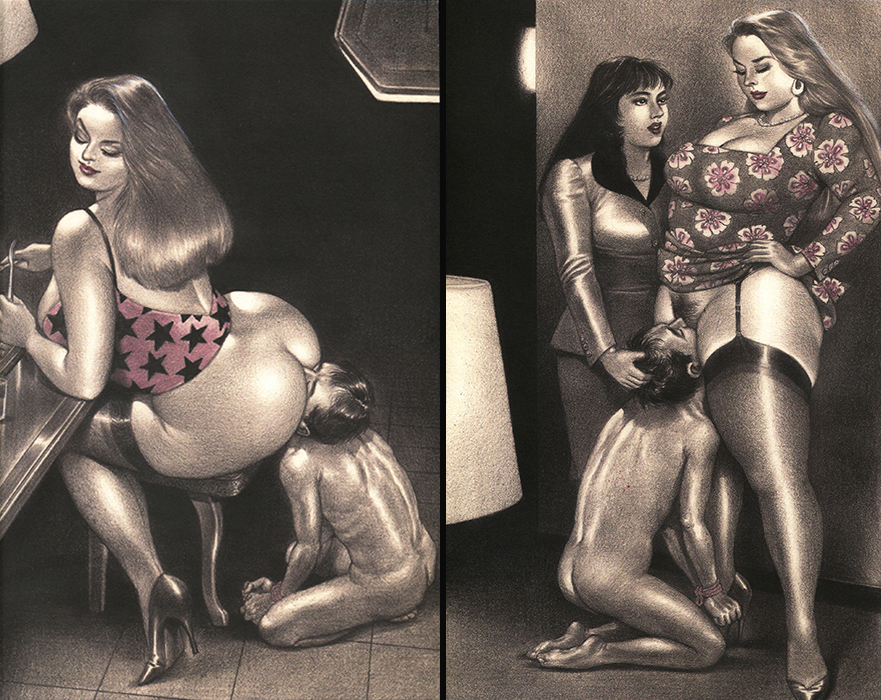
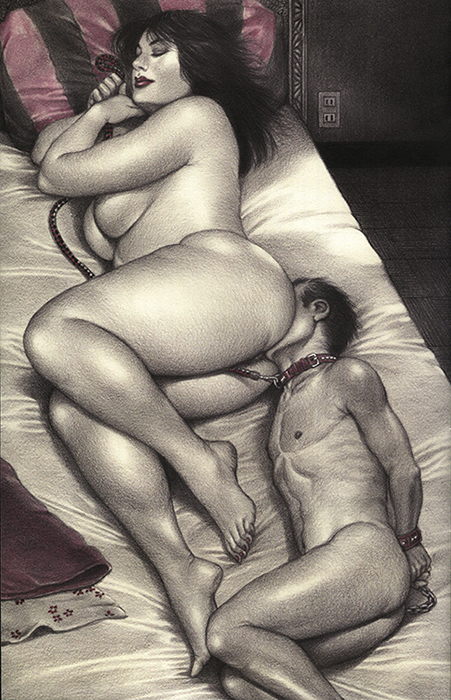
Namio Harukawa (春川 ナミオ) 1947’de Osaka’da doğdu. Gerçekçi femdom erotika çizimleri ile tanınan Japon sanatçı binlerce kendine has çizim üretti. Harukawa’nın çizimlerinin karakteristiği koca memeli, şehvetli kadınlar, geniş ve yuvarlak kalçalar, ufak tefek erkekleri aşağılayıp domine eden kalın bacaklara sahip dominatriks tipler oldu. Hem tipik Asyalı hem de Avrupalı kadınları resmetti. Bu kadınlar uzaklara bakan bakışlarıyla sigara tüttürüp, çay içen gündelik işlerle ilgilenen figürlerdi. En çok kullandığı temalar, kadınlara yapılan oral seks, surata oturma gibi feminen dominasyonun yanında kalçaların ve göğüslerin sıkıştırılması, bağlanma, tasma takma, kırbaçlama, işeme ve dışkılama oldu. Yüze oturma ve oral seks sahnelerinin çoğunda ağız genital organlarla tamamen kapatılır ve vücutsal atık işlemlerinin köleye tam olarak uygulanmasına imkan verilir. Harukawa’nın resimlerinde erkek bir eşya gibi kullanılan bir objeden başka bir şey değildir. Kocasının gözü önünde ilişkiye girme de sanatçının bolca kullandığı temalardandır.
Tercüme: Cemal Akyüz
Namio Harukawa (春川ナミオ )
Namio Harukawa (春川ナミオ )
– ENGLISH –
Namio Harukawa (春川ナミオ)Harukawa Namio, was a pseudonymous Japanese fetish artist best known for his works depicting female domination (femdom), with erotic asphyxiation through facesitting appearing as a frequent subject of his art.
Harukawa was born in 1947 in Osaka Prefecture, Japan. As a high school student he contributed artwork to Kitan Club, a post-war pulp magazine that published sadomasochistic artwork and prose. He developed a career as a fetish artist in the 1960s and 1970s, taking the pen name “Namio Harukawa”: formed from an anagram of “Naomi”, a reference to Jun’ichirō Tanizaki’s novel of the same name, and actress Masumi Harukawa. Though he worked in pornographic magazines for the majority of his career, his work received wider recognition and critical acclaim beginning in the 2000s. His art has earned praise from Oniroku Dan, Shūji Terayama, and Madonna, and favorable comparisons to works by Robert Crumb.
Namio Harukawa (春川ナミオ)
Namio Harukawa (春川ナミオ)
His artwork typically features women with large breasts, hips, legs, and buttocks dominating and humiliating smaller men, typically through facesitting or other forms of sexualized smothering. Bondage and human furniture are depicted frequently in his art.
Kyonyū Katsuai, a two-volume book of Harukawa’s works, has been published in Japan. Two volumes of works by Harukawa have been published by French publishing house United Dead Artists : Callipyge in 2009, the first book of works by Harukawa published outside of Japan, and Maxi Cula in 2012. Works by Harukawa were exhibited at the Museum of Eroticism in Paris in 2013, his first solo exhibition outside of Japan. The exhibition featured 71 works by Harukawa, 59 of which were from his Garden of Domina series. The Incredible Femdom Art of Namio Harukawa, an anthology of Harukawa’s works, was published by Kawade Shobō Shinsha in 2019.
Harukawa died on April 24, 2020. His death was confirmed in a blog post by Yuko Kitagawa, the owner of a video production company who was a longtime associate of Harukawa’s.
Gregory Jacobsen ‘Scavenging Party’ oil on panel, 24″x18″ (2015)
Gregory Jacobsen
Sweety Piles
Stephen Morton reflects over the work of artist Gregory Jacobsen
It was when we first got the internet installed in our home that i first came across the artwork of Gregory Jacobsen. At the time I was in my mid teens and other than the art books my Father had left around the house I had not been exposed to alot of art (that is artwork that I had found out of my own accord). The platform that the Internet provided allowed me to dig through various obscene searches to find new artists of interest and further more artists my insecure spotty self could relate to, this new cybernetic ritual proved to be quite the revelation.
Looking back In hindsight finding Gregory’s website felt illegal, it was themed with a sickly pink provoking a visceral reaction you’d get from stumbling onto a porn site at 14. I wouldn’t say I was appreciating Gregory’s work on the same level as online porn but his work did offer something that lived up to and in a way transcended those early fleshy cravings with images that incorporated the vitality of flesh which come’s with the mashing of human genitals. For me Gregory‘s work cultivated these carnal desires and helped alleviate the intensity of the initial post-pubescent lust flow that was stewing in me by opening up an unconventional beauty.
Gregory Jacobsen ‘Building’ acrylic on panel 15,5″x11,5″ (2008)
One of the first things that stood out to me about Gregory’s work was the sickly bile soaked colors he used in his toxic environments that were transfused into a mise en scene of fleshy blood cum filled wrinkled childhood endeavour. I love his early acrylic paintings because this is where these colors are most prominent. The characters in his paintings are often set in these woodland areas which are saturated by an unhealthy glow which can be contributed to the disposing of uranium ore found in his home town in New Jersey which Gregory cites as an influence on the work. When you invest time in Gregory‘s work you start to set out on a trail through his woodlands where you meet a host of his meaty inhabitants and mounds of glutonous fruity piles. The environment is drenched in an overt sense of optimistic lunacy that never makes you feel uneasy and it is often quite easy to warm to the demented faces and strange abnormal happenings that are always a joy to encounter.
Gregory’s more recent work has seen him move onto oil paintings, a progress of his fleshy constructs, the colors are now more of an artificially glazed sweet much like that of a phallically fruity shaped jolly rancher lathered in a sticky sweet and stinking perfume dew, this and a new emphasis on portraiture paintings of neatly wrapped faces, some direct from life with some having mild deformations and contortions . These paintings still conjures up notions of a sugary gross childhood and early adolescence although less crass in their content than his earlier work it instead reeks itself of a different kind of vitality. It is through his most recent work that once again we see Gregory Jacobsens art maintain to be a masterclass in making the seemingly unsavoury becoming massively delectable. Tasty Jellybeans and all.
Gregory Jacobsen ‘Pickle Face’ oil on panel 13″x10″ (2010)
Gregory Jacobsen ‘Autumn Pinata’ oil on panel 36″x24″ (2009)
‘Middlesex, New Jersey’de dünyaya geldim. Bir Commodore 64 dışında pek bir arkadaşım yoktu. Daha sonraları tavuklara saldıran, yoldan geçen otomobillerin camlarına ıstakoz fırlatan bazı Metalcilerle tanıştım. Yeni arkadaşlarımla birlikte ormanda takılıyor, ateş yakıyorduk. Uyarı: Üzerine Slayer logosu karalanmış bir deri kanepe, göğsüne ‘666’ ve bir Pentagram çiziktirilmiş kafası kopmuş bir oyuncak bebek, her yerde boklar ve ezik bir öğrencinin kafasına süt şişesi yerleştirilmiş kuklası. Neredeyse başvurduğum tüm sanat okullarından reddedildikten sonra, School Of The Art Institute of Chicago’ya başvurmak için lanet olası midwest’e taşınmaya karar verdim. Elimde hiçbir değeri olmayan diplomamla, her ne kadar haz etmesem de hâlâ kıçlarına sopa geçirilmiş avam takımından oluşan Chicago’da yaşıyorum.’ (2006 mollusk #03’den alıntıdır)
Gregory Jacobsen ‘Short Stabbing 50 Pounders’ acrylic on panel (2003)
“I paint figures, focusing on the little bits that obsess me…a little flab hanging over a waistband, ill-fitting shoes, overbites and exciting flags held in dainty orifices. Over the years this work has developed into piles…meat, junk and fruit constructed into heroic yet pathetic towers spattered with gloppy sauce. The work is absurd, grotesque and a bit brutal but I try to bring the viewer in with lush and glowing surfaces. Essentially the work is about human failure and weakness groomed and developed to be an asset.”
Lowbrow Los Angeles, Kaliforniya’da, 1970’lerin sonunda doğmuş bir görsel sanat akımıdır. Bu popülist akımın kökleri çizgi romanlara, punk müziğe, sokak kültürüne ve diğer Kaliforniya alt kültürlerine kadar uzanır. Pop sürrealizm adıyla da bilinir. Lowbrow çalışmaları genelde resimdir, ancak oyuncak ve heykel olarak da lowbrow eserleri üretilmektedir.
İlk lowbrow çizerleri yer altı çizgi roman dünyasından iki isim Robert Williams ve Gary Panter’di. İlk sergilerini Los Angeles’ta alternatif bir galeri olan ve Billy Shire tarafından işletilen La Luz de Jesus’ta açtılar. Böylece bu akım düzenli bir şekilde gelişmeye devam etti ve kısa sürede yüzlerce temsilcisi oldu. Robert Williams tarafından 1994 yılında çıkarılmaya başlanan Juxtapoz dergisi ilk lowbrow sanat dergisi olarak bu akımı daha da geniş kitlelere tanıttı.
Mark Ryden, SHAG (Josh Agle), Marion Peck, Todd Schorr, Elizabeth McGrath, Tim Biskup, Gary Baseman, Gary Taxali,Anthony Ausgang, Camile Rose Garcia ve Raymond Pettibon en iyi tanınan lowbrow temsilcilerinin bazılarıdır.
Robert Williams dergisi Juxtapoz’un 2006 Şubat sayısında lowbrow sanat terimini ilk kez kullandı. Bu terimi neden kullandığını da şöyle açıkladı: 1979 yılında Rip-off yayınevinden Gilbert Sheldon, Williams’ın resimlerinden oluşan bir kitap basmaya karar verir. Williams resimlerini küçümseyen ve geri çeviren galericilere tepki olarak kendi kendini aşağılayan bir terim olan lowbrow (çatık kaşlı, alçak sanat gibisinden bir terim olan lowbrow‘u kullanır) ve kitabına ‘The Lowbrow Art of Robert Williams’ adını verir. Ancak tabii ki bu resimlerde vasat hiçbir yan yoktur.
Bugün Lowbrow terimi bu akımı besleyen kaynakları tanımlamak için ve yüksek sanatı eleştirmek için kullanılan bir terim haline geldi. Pek çok müze, sanat eleştirmeni lowbrowu güzel sanatlar tarihinde nereye yerleştirecekleri konusunda kararsız kaldılar. Bazıları bunun meşru olarak sanat sayılıp sayılamayacağına dahi şüpheyle yaklaştı. Bunun nedeni lowbrow sanatçıların genelde çizgi roman, illüstrasyon, dövme gibi zeminlerden gelmesiydi ve çoğunun güzel sanatlar fakültesi diploması olmamasıydı.
Ancak işlerini lowbrow galerilerde sergileyen Robert Williams, Manuel Ocampo, Georganne Dean, Clayton kardeşler gibi pek çok sanatçı daha sonra ana akım galerilere geçiş yaptı. Gerçekten de son 85 yılda Dadacıların çalışmalarından başlayarak American Regionalism (yöresel, naif) akımına kadar Marcel Duchamp ve Thomas Hart Benton gibi pek çok sanatçı yüksek ve alçak sanat, güzel sanatlar ve halk sanatı, popüler kültür ve yüksek sanat kültür arasındaki farklılıkları tartıştılar. Bir anlamda lowbrow bu farklılıkları araştırmak ve eleştirmek için varolmuştur, bu yönüyle Popart‘la arasında yakın bir benzerlik vardır. Lowbrow tanımı bazen işin düşük nitelikli olduğunu anlatıyor şeklinde yanlış yorumlanabilir ancak gerçekte bu tanım sadece kendilerini küçük gören, yüksek sanat ürünlerinin arasında sınıflandırmayan elitist tavra karşı mücadelelerini sürdüren sanatçıların ironisini yansıtmaktadır.
Lowbrow sanatçıların alt ve üst kültürler arasındaki flu sınırda yer almalarının dışında, daha kabul görmüş ana akım sanatçılar zaman zaman lowbrow sanatçıların stratejilerini uygulamaktadırlar. Lisa Yuskawage, Takashi Murakami, Jim Shaw, John Currin, Mike Kelley, San Francisco’daki Mission School sanatçılarından Barry McGee ve Margaret Kilgallen de bu sanatçılara örnek gösterilebilir.
Creating a New Civilization (Yeni bir Medeniyet Yaratmak) kitabında Alvin Tofflerlowbrows versus highbrows (Alçak sanat yüksek sanata karşı) adlı bir bölüm yazmıştır ve Lowbrow‘un malzeme odaklı olduğunu, Higbrow‘un ise enfermasyon odaklı olduğunu söylemiştir. Mesaj genellikle endüstri toplumunu eleştirmeye yöneliktir ve bu yüzden de yüksek sanat olarak nitelendirilebilir, ancak bu mesajın genellikle t-shirt baskı, çizgiroman ve plastik oyuncaklar yoluyla dile getirilmesi, sahip olma saplantısına odaklanış tarzı tipik olarak lowbrow’dur.
Lowbrow çoğu yerde olarak pop sürrealizm adıyla da anılır. Pop sürrealizm kitabının editörü Kirsten Anderson, lowbrow ve pop sürrealizmin akraba olduğunu ancak farklı akımlar olarak ele alınmaları gerektiğini söyler. Weirdo Delux kitabının yazarı Matt Dukes Jordan ise bu iki terimin aynı şeyler olduğunu ve birbirinden ayrılmasının mümkün olmadığını söyler.
Lowbrow sanat, Amerika, Kanada, Avrupa, Avustralya ve Yeni Zelanda’daki pek çok galeride sergilenmektedir. Lowbrow sanat örnekleri sergileyen yüzden fazla galerinin bazıları sadece lowbrow sanat örnekleri sergilemektedirler. Başlıca Amerikan lowbrow galerileri;
La Luz de Jesus, Thinkspace Gallery, Gallery 1988, the Hive gallery, Copronason Gallery, L’imagerie Gallery ve Merry Karnowsky Gallery’dir.
Robert Williams’ın 1994 yılından beri çıkardığı Juxtapoz, ham sanat ve lowbrow sanat ağırlıklı, renkli resimlerle ana sanat akımları dışındaki sanatçılara adanmış olan Raw Vision, 2005 yılında çıkmaya başlayan özellikle oyuncaklar olmak üzere lowbrow sanata odaklanan Hi-Fructose en önemli lowbrow dergileridir.
Türkçesi Cemal Akyüz
Todd Shorr ‘Atomic Vacation’ 72×84″, acrylic on canvas, 2010
Low Brow Art Movement
Lowbrow, or lowbrow art, describes an underground visual art movement that arose in the Los Angeles, California area in the late 1960s. It is a populist art movement with its cultural roots in underground comix, punk music, tiki culture, graffiti, and hot-rod cultures of the street. It is also often known by the name pop surrealism. Lowbrow art often has a sense of humor – sometimes the humor is gleeful, sometimes impish, and sometimes it is a sarcastic comment. Most lowbrow artworks are paintings, but there are also toys, digital art, and sculpture.
Some of the first artists to create what came to be known as lowbrow art were underground cartoonists like Robert Williams and Gary Panter. Early shows were in alternative galleries in New York and Los Angeles such as Psychedelic Solutions Gallery in Greenwich Village, New York City which was run by Jacaeber Kastor, La Luz de Jesus run by Billy Shire and 01 gallery in Hollywood, run by John Pochna. The movement steadily grew from its beginning, with hundreds of artists adopting this style. As the number of artists grew, so did the number of galleries showing Lowbrow. In 1992 Greg Escalante helped orchestrate the first formal gallery exhibition to take low brow art seriously; painter Anthony Ausgang’s solo show “Looney Virtues” at the Julie Rico Gallery in Santa Monica. The Bess Cutler Gallery also went on to show important artists and helped expand the kind of art that was classified as Lowbrow. The lowbrow magazine Juxtapoz, launched in 1994 by Robert Williams, Greg Escalante, and Eric Swenson, has been a mainstay of writing on lowbrow art and has helped shape and expand the movement.
Writers have noted that there are now distinctions to be drawn between how lowbrow manifests itself in different regions and places. Some see a distinct U.S. “west coast” lowbrow style, which is more heavily influenced by tiki, underground comix and hot rod car-culture than elsewhere. As the lowbrow style has spread around the world, it has been intermingled with the tendencies in the visual arts of those places in which it has established itself. As lowbrow develops, there may be a branching (as there was with previous art movements) into different strands and even whole new art movements.
In an article in the February 2006 issue of his magazine Juxtapoz, Robert Williams took credit for originating the term “lowbrow art.” He stated that in 1979 Gilbert Shelton of the publisher Rip Off Press decided to produce a book featuring Willams’ paintings. Williams said he decided to give the book the self-deprecating title The Lowbrow Art of Robt. Williams, since no authorized art institution would recognize his type of art. “Lowbrow” was thus used by Williams in opposition to “highbrow.” He said the name then stuck, even though he feels it is inappropriate. Williams refers to the movement as “cartoon-tainted abstract surrealism.” Lately, Williams has begun referring to his own work as “Conceptual Realism.”
source: wikipedia
Robert Williams ‘The Appearance of the Emblemata of the Beat Generation’ 1987, oil on canvas, 36×30″
Çok değil, bundan üç dört sene evvel Zeynep Kış ve eşi Şakir ile Kızıltoprak’taki atölyelerinde tanıştığımızda bana yaptıkları baskı resim örneklerini göstermişlerdi, çoğu müzik grupları için üretilmiş, koleksiyon değeri taşıyan serigrafi afişlerdi bunlar; sonrasında Krüw etkinlikleri geldi, genç yeteneklerin özgün işlerinin sahnelendiği sergiler, çağdaş grafik/ illüstrasyon dünyamıza güçlü bir dinamizm kazandırmakta gecikmediler. El emeği göz nuru üretilmiş bu resimler, bizleri Ham Sanatın en renkli ve heyecan verici örnekleriyle buluşturuyordu. Bir çok farklı stilde sanatçının ortaya koyduğu işler kelimenin tam anlamıyla büyüleyiciydi.
Ticari bağlamda üretilen çizimlerin dışında ‘illüstrasyon’u, ‘illüstre olanı’ ciddi bir disiplin ve üslup olarak benimseyen bu genç kuşak sanatçılar, ortaya koydukları eserlerle önceki kuşaklardan, eski mizah dergilerinden ve klasik çizgi-roman anlayışımızdan bir hayli farklı ve özgün işler sergiliyorlar. İki bin sonrası ivme kazanan bilişim ve sibernetik çağın, yabancılaşmanın, köksüz kozmopolitliğin, deliliğin ve sapkınlığın tüm izlerini bu genç çizgilerde yakalamak mümkün. Saykodelik rock posterleri, yeraltı çizgi-romanları, şöhret peşinde koşan gangsterler, grafiti ve manga kültürü, bilgisayar oyunları ve bilumum siberpunk etkileşimin cereyan ettiği devasa bir kültür havuzu.
Bigbaboli’nin kurucusu, serigrafi ustası, sanatçı Zeynep Kış
Geçen kış kapılarını aralayan Bigbaboli Şarküteri, aynı zamanda film gösterimleri, sanatçı konuşmaları gibi farklı etkinliklere de ev sahipliği yapıyor. Ekibin gözde ismi Zezeah ile salgın günlerinde söyleştik, insanın gölgesiyle tanımlandığı bir çağda sanata değer verenler için :
22 Nisan 2020
Zezeah merhaba, salgın günlerindeyiz, karantina altında Napalm Death plak kapaklarını aratmayan günler geçiriyoruz, bu durum sanat piyasasını ne ölçüde etkiledi, bir galerici olarak bu durumdan nasıl etkilendiniz?
Selam Erman, öncelikle halimizi sorduğun için kendi adıma çok teşekkür ederim. Evet içerisinde bulunduğumuz karantina süreci sevgili galerimiz Şarküteri‘nin de derin bir uykuya girmesine sebep oldu. Hali hazırda 2020 yılı için planladığımız bütün pop-up ve ana sergiler, tarihleri havada uçuşan partiküllere dönüştüler. Toplu etkinliklerin yeniden hayatımıza gireceği tarihi kestirememek inan bizi de endişelendiriyor. Kendi yağında kavrulan bağımsız bir galeri için oldukça riskli bir dönemdeyiz.
Sanatseverlerin, koleksiyonerlerin bu karamsar dönemde bireysel ihtiyaçları dışında lüks giderleri kısıtlamaları anlaşılır bir durum. Bizler için de aynı şey geçerli; “Önce sağlık” diyoruz ! Bunun dışında online sergi, söyleşi vb. sanal etkinliklerden pek haz etmediğimiz için bu alanlara da hevesli değiliz.
Geçtiğimiz kış, Bigbaboli Şarküteri sanatseverlerle buluştu; grup sergilerinden sinema gösterimlerine, Hakan Günday, Emre Orhun, Miron Zownir gibi büyük isimlere kadar bir çok farklı etkinliğe ev sahipliği yaptınız, sanatçılıktan galericiliğe geçiş seni nasıl etkiledi?
Evet, işlerini çok sevdiğimiz yıllardır heyecanla takip ettiğimiz sanatçıların işlerini sergileme, paylaşma fırsatımız oldu. Çoğunluğu arkadaşlarımızdan, yakın çevremizden oluşan bir etkinlik takvimiydi bu. Dile getirdiğin üzre ben bir galerici değilim, sanat yönetimi, pazarlama, sergileme konusunda pek deneyimli biri olduğumu da iddia edemem, fakat yaklaşık on yıldır Moklich ve Zezeah mahlaslarıyla kendimize ait Big Baboli Print House sanatsal baskı atölyemizi işletiyor ve kendi işlerimizi üretip satıyoruz.
2019 baharıyla birlikte arkadaşımız Berk Kula ile ortak bir hayalin gerçekleşmesi için güç birliği yaptık ve Şarküteri’nin açılması için hep birlikte adım attık. Berk’in katkıları ve bizim deneyimlerimiz, olanaklarımızı da birleştirerek farklı bir konsept oluşturmak istedik. Bir sanatçı olarak Şarküteri’yi sahip olduğumuz yaratıcı çevremizle besledik. Samimiyetimize güvenen, yeni nesil sanatçılara elinden geldiğince destek olan, meraklı bir kitlemiz varmış; ve onlar sayesinde hiç bir markanın, firmanın desteğine gereksinim duymayan gerçekten bağımsız bir yapı oluşturduk.
Şarküteri, komisyon konusunda öncelikli olarak sanatçıları ön planda tutuyor, ikinci öncelik ise galerinin kendi ayakları üzerinde durabilmesi ve sanatçıların işlerini daha iyi sunabilmesi için gerekli olan reklam, fotoğraf, online satış vb. platformları canlı tutulabilmesidir. Tüm bunları hiç bir çıkar amacı gütmeden özveri ile yapan küçük bir kadroyuz.
Galerimiz dışında hepimizin farklı bir mesleği var, mesailerimizden arta kalan vakitlerde ise Şarküteri’yi hayatta tutabilmek için elimizden geleni yapıyoruz; amacımız bu ortak kullanım alanının hayatta kalabilmesi. Tabi ki şu an için birçok eksiğimiz ve yapılabilecek tonla iş var ancak yukarıda da değindiğim üzere hiçbirimizin asıl mesleği değil bu ve ayırabileceğimiz vakitler de sınırlı. Tüm bunlara rağmen bu yapı, insanlar tarafından heyecanla karşılandı ve umarız şimdiden örnek bir mekan olabilmişizdir.
Audioban Space: Big Baboli Konser Afişleri Söyleşisi, Ekim 2018
Sanatçılarla birlikte açık stüdyo günleri düzenlemeye başladınız.
İlk Open Studio günümüz, ne yazık ki şu an için beklemede olan Bülent Gültek sergimiz ile başladı, güzel bir sergi ile sezona sıkı bir giriş yapacaktık. Open Studio günleriyle birlikte koleksiyonerlerin, Şarküteri‘den satın aldıkları bir posterin hangi aşamalardan geçerek basıldığını ve ellerindeki parçanın niçin bu kadar değerli olduğunu daha iyi gözlemlemeleri, anlamaları için bir sunum oluşturduk. İlk studio deneyimimiz sanatçı ile tanışmak isteyen, serigrafi baskı hakkında hali hazırda ufak tefek bilgi sahibi olan meraklı katılımcılar ile birlikte gerçekleşti. Umarız önümüzdeki studio günlerinde konuya ilişkin hiç bir fikri olmayan daha hevesli ve heyecanlı bir kitleye de erişebiliriz.
Elif Varol Ergen ‘Hecate’ 61×44.5cm, kağıt üzerine 4 renk serigrafi
Elif Varol Ergen:‘Her current artworks content is mostly focused on feminism, divine femininity, mysticism and women’s identity. She illustrates rebel female characters and move away from all kind of definitions and identities of women which has been put by the male dominance. She uses mostly “witch and wicca” metaphors for her rebellion ladies whose behaviours totally against the common thoughts and belief of society. She usually uses digital media, digital imaging and CNC-machined productions also sometimes combines traditional media such as acrylic, ink, silkscreening for the artworks.’
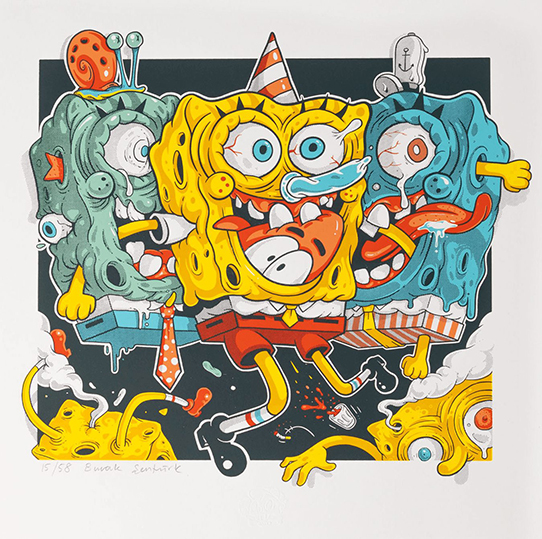
Burak Şentürk ‘Party’ 40x40cm, kağıt üzerine 7 renk serigrafi
Burak Şentürk: Sanırım onu tanımayanımız yok gibi, titiz, ustalığa önem veren, tasarımcılığıyla birlikte profesyonel bir illüstratör.
Dolce Paganne ‘Coculeata’ 49.5×62.5cm, kağıt üzerine giclee baskı
Ceren Aksungur: ‘Also known as Dolce Paganne, is an Antwerp-based Turkish artist who crafts surreal, unsettling drawings and paintings. Her work combines both the strange and the mundane, subverting the everyday. Works such as “Pomegrenade,” implement both acrylics and colored pencil on paper.’
Bir deli ile Şarküteri’de karşılaşma
Grafik, illüstrasyon alanında hem atölye, hem de galeri olarak çığır açıcı işlere imza atıyorsunuz, ayrıca bir çok kaliteli yayını raflarda görüyoruz, bunun dışında sanatçıların çizimlerini giyim tarzlarıyla da bir araya getiriyorsunuz.
Sınırlı sayıdaki ürünler için kafamızdaki fikir : İnsanların, sevdikleri sanatçılara her fiyat skalasından ulaşabilmeleriydi, bunun için birlikte çalıştığımız sanatçılara sınırlı sayıda sticker, tshirt, pin gibi yan ürünler ürettik. Bütün maliyeti Şarküteri üstlendi ve böylece sanatçıların ürün skalalarını çeşitlendirdik ve kataloğumuzu orijinal iş, limitli baskıresim, fanzin, sticker, pin, tshirt gibi birçok farklı seçenek ile doldurduk.
Sanatçılara ve koleksiyonerlere, tüm bu ürünler için limit sözü verilmiştir; bu aynı zamanda sanatları üzerinden sınırsız kazanç elde edilmeyeceğinin de bir garantisidir, dolayısıyla galerimizden alınan her ürün koleksiyon değeri taşımaktadır. Tercihin çoğunlukla serigrafi baskı’lar ve sticker’lardan yanaolması bizi sevindiriyor, çünkü orijinal parçaların rağbet görmesi sanatçılar açısından da her zaman büyük motivasyon kaynağı oluyor.
Şu an için üzerinde kafa patlattığınız projeler var mı, salgın belası olmasaydı bizi neler bekliyordu?
Salgın olmasaydı yaz sezonuna kadar Ucube Mutaf pop-up sergimiz ve Bülent Gültek’in hazırlamış olduğu harika bir konsept sergi bizi bekliyordu. Daha sonra tüm yaz boyu kalacak bir ana sergi ve Eylül itibari ile arada yabancı sanatçıların da serpiştirildiği bir takvimimiz vardı. Umarız en kısa zamanda kaldığımız yerden hızla devam edebiliriz.
Eklemek istediğin bir şeyler varsa, lütfen. Bugüne kadar destekleri, katkıları, iş birlikleriyle bizlerle birlikte olan tüm dostlarımızı çok özledik; en kısa zamanda görüşmek dileğiyle, şimdilik hoşça kalın.
Zeynep ‘Zezeah’, Nisan 2020
Lumineh ‘Black Beauty’ 71×50.5cm kağıt üzerine giclee baskı
Lumineh ‘Wild Swans’ kâğıt üzerine tek renk serigrafi
Elif Varol Ergen x İlker Çelen (Uzay Çöpü)
İlker Çelen (Uzay Çöpü) x Burak Şentürk
İlker Çelen (Uzay Çöpü)
Bıyıkof
Dolce Paganne
Bilge Emir
Uczine
Artemis Günebakanlı, 2018
Zezeah & Güven Erkin Erkal
for more info and details, don’t forget to take a look at



















 LÖPÇÜK