Mattt Konture is a French underground comics author and musician. He is one of the founders of the French publishing house L’Association and is a forerunner of the French autobiographical comics movement. Konture grew up in Lozère, where his influences included Métal Hurlant artists like Marc Caro, Doury, Rita Mercedes, and Moebius.
Konture published his first comics in 1983 (at the age of 18) in magazines such as Viper (“L’ajeun”) and Le Lynx (“Les Exploits de Ted” with Jean-Christophe Menu). When Konture went to Paris he published his first comics, Nerf, on an old Xerox machine. L’Association later reprinted this first book. His first comic book was Ruga Zébo Violent, first volume of the “Pattes de Mouche” collection published by L’ANAAL, to become L’Association.
At this time, Konture’s drawings were very dark and full of strokes and looked like the growing American underground style. Konture later discovered 1960s American underground cartoonists such as R. Crumb and Gilbert Shelton, who inspired him to create psychedelic and autobiographical comics. In 1988, Konture started autobiographical comics such as Krokrodile Comix 1, or Galopu, that was a forerunner of the French underground movement.
Mattt Konture, 1984
In 1989 Konture returned to Lozère. There he drew a few comics and continued Ivan Morve (a pun on “Mort-vivant,” “living dead”). Ivan Morve is a series of half-autobiographical stories published in the pages of Psykopat.
During the same period Konture started “Jambon blindé,” an improvised comix commissioned by his friend Stéphane Blanquet. This new way of telling stories drove Konture to draw a series of “comix” edited by L’Association in the collection Mimolette. “Autopsie d’un mort vivant” (“Autopsy of a living dead”) is a dark retelling of Konture’s life. In these books all his characters reappear: Galopu, Mister VrO, and Ivan Morve — each of them represents the author’s mood.
Mattt often draws with artist friends, publishing works such as Galopinot (L’Association) drawn with Lewis Trondheim, and, more recently, L’Abbé Noir (Arbitraire) drawn with Lilas and Willy Ténia, La Comète à 4 pattes (L’Association), drawn with Lilas, Willy Ténia and Freaky Nasa, and Borrut Popotte (Marseilles based silkscreen and publishing house Le Dernier Cri), drawn with Lilas.
For a long period of his life, Konture worked at home. Now he’s part of a collective artist’s space (workshop, gallery and boutique) En Traits Libres, which is open to the public.
Vidéo réalisée par Sébastien Casino pour l’exposition de Mattt Konture à La Jetée (Janvier 2017)
Konture has also played in many musical groups (Les Tordus, Pumpkin Guts, Cosmogol, Rhinoplastic Démodex…), including his original one-man group Courge, which later changed its name to Lucky and the Courges, and which produces CDs and plays concerts in the Montpellier area where he lives.
Mattt Konture, L’Éthique du souterrain (2012)
attt Konture, L’Éthique du souterrain
Documentaire de 64 minutes réalisé par Francis Vadillo, qui a suivi Mattt Konture pendant plus de deux ans, chez lui, dans différents festivals, et lui offre enfin le portrait qu’il mérite. C’est l’occasion de le voir au travail, dessinant dans ses carnets et réalisant des fanzines, ou jouant sur scène avec son groupe Courge. On pénètre dans son quotidien en l’accompagnant dans sa pratique compulsive du dessin, seul ou entouré de ses nombreux amis fanzineux, mais aussi par l’évocation de la maladie qui l’affecte, la sclérose en plaques. C’est enfin un portrait d’une scène underground musicale et graphique vivace et festive, que Mattt Konture n’a de cesse de parcourir pour apporter sa contribution.
On y croise J.-C. Menu, Pacôme Thiellement et Killoffer, qui se souviennent de leurs rencontres, au début des années 80, et reviennent sur l’importance de son œuvre autobiographique.
Mattt Konture : l’éthique du souterrain 2018
Mattt Konture auteur incontournable de la bande dessinée contemporaine se distingue notamment par ses albums autobiographiques introspectifs et sans concession qu’il écrit et dessine depuis vingt ans. On y croise ses amis son plaisir à dessiner son groupe Courge son univers underground libertaire où l’on se soucie peu du marché de l’art et de l’édition où l’on fait tout soi-même. Ce film est aussi l’histoire d’un homme d’un artiste qui affronte le mal dont il est atteint la sclérose en plaque. Une maladie qui parfois s’exprime par un graphisme sombre et torturé quand elle prend le dessus. Mais ce que l’on retient de cette expérience de vie c’est la capacité de Mattt Konture à répandre autour de lui une forte dose.
Mattt Konture, L’Éthique du souterrain (2012)
64-minutes documentary directed by Francis Vadillo, who followed Mattt Konture for more than two years, at home, in various festivals, and finally offers him the portrait he deserves. This is an opportunity to see him at work, drawing in his notebooks and making fanzines or playing on stage with his group Courge. We enter his daily life by accompanying him in his compulsive practice of drawing, alone or surrounded by his many zinester friends, but also by evoking the disease that affects him, multiple sclerosis. Finally, it is a portrait of a vivacious and festive musical and graphic underground scene which Mattt Konture constantly explores to make his contribution.
We meet J.-C. Menu, Pacôme Thiellement and Killoffer, who remember their meetings in the early 80s, and discuss the importance of his autobiographical work.
Mattt Konture, L’Éthique du souterrain (2012) L’association
During filming, Mattt Konture produced a new “comixture” which accompanies the DVD. This new comix, without possible comparison with a simple making-of, opens a dialogue with the documentary, offers it unexpected extensions and gives all its coherence to the whole.
Animation paréidolique par Mattt Konture et Janko pour le film Mondo DC / production Le Dernier Cri Musique Janko & Mattt Konture, montage Pakito Bolino
Elif Nurşad ‘Aşık Kedi’ Grafik roman, Flaneur Books (2021)
Elime “Âşık Kedi” diye bir kitap geçmişse ondan size bahsetmemem mümkün müdür? Kitabın çizer ve yazarı “Vahşi Kedi” kod adlı Elif Nurşad Atalay. Elif bence çok yetenekli bir ressam. İyi bir illüstratör ve masal anlatıcı. Kalın ve kuşe baskı kitap, bir tasarım ustalığı içeriyor ki sadece sayfa numaralarını unuttukları için eleştirebilirim, size şu kadar sayfa diyemiyorum! Âşık Kedi’de 2015-2021 arasında çizdiği resimlerle anlattığı bir masal-öykü yer alıyor. Şöyle: kedi var, kediler var. Köpek var, köpekler var. Galata, Karaköy, Bodrum, Göztepe Parkı, akvaryumdaki balıklar var. Caddebostan sahili, deniz, ahtapotlar var! Vahşi Kedi’nin umutları, korkuları, aşkı, kâbusları, rüyaları, hayalleri var.
Yazar çizerimiz Bayan Yanı dergisinde 2015-16 yıllarında “İstanbul’un Vahşi Kedisi” başlıklı bir çizgi roman yayımlamış, sonnra bunun bir bölümünü İstanbul ve İtalya’da sergilemiş, ama hikâyeyi bitirmemiş. Ondan kısa episodlar da var bu kitapta.
Elif Nurşad, Suluboya desen, 2019
Kitabı çok sevmemin nedeni, kavuşulamayan bir aşk hikâyesi dışında, sürekli deniz, tekne, bir kedi ve bir köpek olması, bir de yakışıklı !
Sonra aklına esiyor, kuşlar çiziyor. Papağanlar! Kedilerden vazgeçti, tekneyi ziyaret eden değişik kuşlar çiziyor! Onun sevdiği her kediyi çizmek isteyip çizemediklerine hayıflanıyor. Aslında sadece kedileri değil, kadınları da çok güzel, ama çok az var bu kitapta. “En sevdiğim dostluk: Az konuşma çok iletişim. 6 yıldır aynı kayığa gelen leylek ile balıkçının arkadaşlığı…”
Senin içine süzüldüm ben, bir kapı aralığından, omurgasızlığımdan. Seni kopyaladım, bütün hücrelerimle, sen hiç dokunmasan da seninle gizlice seviştim ben! Hâlâ Seni, seni bekliyorum. Hâlâ kapıdaymışsın gibi. Öyle hissediyorum!
Kaynak : Yazgülü Aldoğan, Cumhuriyet Gazetesi (10 Aralık 2021)
Hirnplatzt is an independent record label currently operating from Linz, Austria by Gucci Bauchwho has been producing underground materials for more than ten years, since 2005 established on the experimental/ noise music and publishing super cool underground comix by important artists such as Johannes Stahl, Daniel Cantrell, Andreas Haslauer, Mavado Charon; also combining illustrations produced by the artists with various clothings, patches and skateboards in a very creative d.i.y styles.
Jeg er her for frihed,ærlighed, sårbarhed, gender-fluidity, for kærlighed.
Det var usansynligt at jeg skulle blive en kanal for lyset. Det jeg kommer fra er så mudret, så mørkt – men jeg skulle igennem de dybeste lag for at forstå, at jeg er lys. Hver gang jeg har ramt bunden, er jeg blevet vist at jeg kan gå højere – at vi alle har et valg. At vi kan give slip på frygt og være i tillid til at alt udfolder sig præcis som det skal. Og vide at dét at være i overgivelse – i nuet – er lig med at være i vort højeste selv.
Skyggearbejde handler om at bevidstgøre sig skyggen (de sider af os selv vi ikke kan eller vil se og anerkende) – ikke at skubbe dem væk, løbe fra dem eller lade som om de ikke eksisterer – men i stedet vende os om og integrere mørket. Og dermed erkende at vi er begge dele: både lys og skygge. Jeg kaster min skygge ud i rampelyset for at integrere den i os alle, for at hjælpe os til at forstå at vi ikke behøver at gøre vores skygge forkert og udskamme den – men at vi kan se den for hvad den er – et bange dyr, en ego-skal bygget for at beskytte os. Se at vi er født uskyldige – som ren kærlighed.
Jeg arbejder for at kaste lys ind i den kollektive skygge – for at blotlægge misforhold i den dominerende kultur. For at frisætte os fra den programmering og radikalisering vi er blevet udsat for gennem en opvækst i et kapitalistisk patriarkat. Når jeg ser på kønnene, og mine egne oplevelser som biologisk kvinde – ser jeg en dyb diskrepans. Jeg ser en enorm forskel på begrænsningerne af den ydre og indre frihed der er for kønnene hver især. Jeg er nødt til at pege på dobbeltmoralen og hykleriet i et samfund der systematisk seksualiserer kvinder og som så – når kvinder agerer åbenlyst seksuelt – vender sig om og udskammer dem for det. Et samfund hvor mænd programmeres til at undertrykke følelser, til at lukke ned. Dette systemiske svigt kommer til udtryk som konstante indviduelle kampe om at få det godt, som enten kæmpes eller fortrænges, og som vi ikke kan vinde på et individuelt niveau. Det er et system der fratager os vores evne til at elske frit, og det er på tide vi bliver fri af det.
Jeg er her for frihed, ærlighed, sårbarhed, gender-fluidity, for kærlighed.
Does ceramics and fashion have anything in common? It certainly does for artist and author Matilde Digmann who uses their creativity as a safe space of self expression.
Matilde Digmann (Mat) is a gender fluid artist and author. Mat’s artistic practice is multi-faceted but rooted in two main principles: Work evolving around outing shadow and exposing things we usually try to keep in the dark, thereby calling out biased structures in society and discrepancies in dominant morality. Mat is working on outing shadow (in a Jungian sense) on a personal as well as on a societal level. The second focus of Mat’s artistic practice is in working towards a betterment of the artistic community – in service to particularly blocked artists via the podcast Shadow Work Podcast and in pursuit of healing a generation of men and women who have been radicalised by growing up in capitalist patriarchy – via the graphic novels Pseudo and the upcoming Bad Boys.
As their unique artwork and ceramics, Mat – who’s based in the vibrant neighbourhood of Nørrebro in Copenhagen – primarily uses bright and bold colours in their wardrobe – matched with loads of gold and glitter. Meet the Copenhagen-bases artist here, and get a preview of their unique and personal art as well as their take on personal and great style.
Matilde Digmann (Mat) Bir sanatçı ve yazar olarak çok yönlü sanat pratiğini iki temel ilkeye dayandırmaktadır: Gölgeyi aşmak ve genellikle karanlıkta tutmaya özen gösterdiğimiz yönlerimizi açığa çıkarmak; böylece çizgi-roman dili, çeşitli afişler ve grafik hyper-text’lerden de faydalanarak sanatçı toplumdaki önyargıları ve baskın ahlakın tutarsızlıklarını gözler önüne sermeyi hedefler.
Mat, hem kişisel hem de toplumsal düzeyde gölgeyi (Jungcu anlamda) aşmak için çalışıyor. Onun sanat pratiğinin odaklandığı ikinci alan ise Shadow Work Podcast aracılığıyla özellikle amatör sanatçılara yardım etmek ve kapitalist ataerkil bir ortamda büyüyerek radikalleşmiş günümüz erkek ve kadın nesline şifa olmak amacıyla sanat camiasının iyileştirilmesine yönelik çalışmalar yapmaktır.
Anthropomorphic animals, online dating, drugs, sex, shame, inability to relate to others. In short, the usual old story. Indeed no. Pseudo by Matilde Digmann fits into a genre that is now highly exploited, that of problematic animals that do bad things, but manages to have her say. Mat – this is his stage name, given that he defines himself “a non-binary multidisciplinary artist and author” – first of all he paints and sculpts. He has a studio in Copenhagen full of his creations. Enter the world of comics as an outsider and in this Pseudo, a volume of 366 pages in English with a beautiful mirror cover published by the Danish Forlaget Basilisk, this is evident. The story continues in small episodes, almost by accumulation. There is no great sense of rhythm. The drawings are raw, dark, not at all cute and in any case far from the dominant aesthetic, dropped in a black and white that cannot be blacker. All this allows Mat to get out of the sowing of today’s alternative comics, avoiding ending up in the long list of Simon Hanselmann’s emulators.
The story written by Mat talks about the almost homonymous Cat, an anthropomorphic cat who after 9 years breaks up with her boyfriend and begins a “crazy year” made up of new acquaintances, transgressive evenings and – inevitably – self-harm. Pseudo begins with the protagonist signing up for a dating site, while she spends her days indoors with Ted, a traditional four-legged cat. The first pages of the volume are the weakest and most obvious, with many situations that they already know. Then after a while things take off. Meeting after meeting we witness a gallery of men who are idiots at best, manipulative bastards at worst. In front of them the protagonist is unable to react, on the contrary, most of the time she is satisfied or even submits. The story stops being banal and becomes a psychological crescendo that plumbs Cat’s unconscious search for unhappiness.
Nomineret til Pingprisen 2022: Matilde Digmann – PSEUDO
The plot is inspired by the personal stories of Matilde Digmann, who after nine years of marriage has changed her life in a radical way. For more details, I refer you to this article / interview, which rightly frames Pseudo as a feminist parable. But there is more, for us who are lovers of the strange. For example, there is a talking spider that turns from a threat into the protagonist’s shoulder. In a chapter entitled Bad Trip, the spider enters Cat’s brain to find a wasteland populated only by giant cocks. Towards the end, a flashback shows us the encounter with a sort of “cat god” with a third eye: the same third eye that appears every now and then on Cat’s forehead before a few encounters, making her even more ashamed – if any needed – of his body.
“Pseudo” by Matilde Digmann
The finale sees the final confrontation between Cat and her latest boyfriend, even worse than the former historian. Turns out the guy is married and the father of a little girl, who he hasn’t been able to see since he hit his wife with a metal pipe. Unfortunately the last pages are broom with the initial ones, because – even taking into account that the volume is presented as the first of a trilogy – they close the story in an all too hasty way. Pseudo works fine from p. 70 on p. 341, and in any case 272 pages, so they are enough and advance. What then in these times, when novice authors tend to always look for the “round” comic with all the right ingredients and the graphic novel is a genre rather than a format, making a comic a little wrong can also be a positive thing.
The main merit of Pseudo remains its being an original feminist parable. Mat does not indulge in easy theses or didactic dissertations. With the technique of accumulating characters and situations, he rather tells the tendency to submission of the main character and the pettiness of the male gender, so much so that in some passages he reaches pure misanthropy. Beyond this, the book would be worth the cover price only for the drawings, which in their tarry black and white bring us back to less colorful and certainly more glorious times than today.
In conclusion, here are some useful links, namely Mat’s site, the Instagram page and finally his online shop where you can buy the volume.
It was unlikely that I would become a channel for the light. What I come from is so muddy, so dark – but I had to go through the deepest layers to understand that I am light. Every time I have hit rock bottom, I have It was unlikely that I would become a channel for the light. What I come from is so muddy, so dark – but I had to go through the deepest layers to understand that I am light. Every time I have hit rock bottom, I have been shown that I can go higher – that we all have a choice. That we can let go of fear and be confident that everything unfolds exactly as it should. And knowing that being in surrender – in the now – is equal to being in our highest self.
Shadow work is about becoming aware of the shadow (the sides of ourselves we cannot or will not see and acknowledge) – not pushing them away, running away from them or pretending they do not exist – but instead turning around and integrating the darkness. And thus recognize that we are both: both light and shadow. I cast my shadow into the limelight to integrate it into all of us, to help us understand that we do not have to make our shadow wrong and shame it – but that we can see it for what it is – a scared animal, an ego shell must be built to protect us. See that we are born innocent – as pure love.
A society where men are programmed to suppress emotions, to shut down.
I work to shed light on the collective shadow – to expose disparities in the dominant culture. To free ourselves from the programming and radicalization we have been subjected to through growing up in a capitalist patriarchy. When I look at the sexes, and my own experiences as a biological woman – I see a deep discrepancy. I see a huge difference in the limitations of the outer and inner freedom that exist for the sexes each. I have to point to the double standards and hypocrisy of a society that systematically sexualises women and who then – when women act openly sexually – turns around and shames them for it. A society where men are programmed to suppress emotions, to shut down. This systemic failure manifests itself as constant individual struggles to get the good that is either fought or repressed and that we cannot win on an individual level. It is a system that deprives us of our ability to love freely, and it is time we become free from it.
there´s more and more zinefest being organized in Copenhagen though, and the tables are very diverse. I see it as a sign of people being fed up with mainstream culture.
Hello Zven, would you tell us a little bit about Cult Pump and what you do? I guess you are also distributing different labels besides print limited editions and art-zines.
I am a little of everything, painter, cartoonist, printmaker, editor. I started the Cult Pump label in 2010, but before that I was also making zine and publishing books. At some point I decided only to publish my own stuff but then you meet artists and their art is great and you think: “if I dont publish this, no one else will!” So its a duty, but also a pleasure, and a way of evolving as an artist, by getting input from other artists, learning other approaches. I share my studio with other artists, some of whom I work with, but I manage the label on my own, except for “Radbrækket” a comix anthology that I am editing with Tue Sprogø. I also do a bit of distribution, mostly books related to the ones I publish.
the process of doing stuff together without knowing the final result is just as important as the actual products.
Would you like to talk about your acquaintance with Hilal Can, you worked together at the Cult Pump studio recently, what kind of artist is she, were you satisfied with the work that emerged?
Hilal Can is a bit like myself, a restless soul, working with multiple medias. We met a few times before, and this time there was time to invite her to do prints here! She made a mini-zine/ poster here which turned out really cool. The Cult Pump is a meeting place for artists, as I said, so the process of doing stuff together without knowing the final result is just as important as the actual products.
We see that the graphzine scene is very developed across Europe, especially in France and Germany. What would you say if we asked you to summarize the independent publishing and similar counterculture movements for Denmark ?
Denmark hasn’t got a lot of counterculture movements. I guess you can say that people in Scandinavia are generally satisfied with their government. There use to be a strong squat/ autonomous movement in Copenhagen, particularly in my neighborhood, but I’m not sure where it went. It’s the gentrification, like everywhere else. So historically, the zine culture is mostly tied to those very political, anarchist movements. Recently there´s more and more zinefest being organized in Copenhagen though, and the tables are very diverse. I see it as a sign of people being fed up with mainstream culture.
Contemporary Scandinavian art and design is very plain, gray and boring, and I think I do respond to that by doing the opposite.
Northern Europe has always had a plain graphic world in terms of humor and cartoons, I think you managed to break this atmosphere as Cult Pump. Is there a school or graphic discipline that you take as an example, or are you developing your own style?
We do have very good (and fun) cartoonists in Denmark ! Lesser known (and not translated) cartoonists like Storm P. and Claus Deleuran to name a few. Back when Christianity came to Northern Europe and church were built, locals were asked to decorate the churches with images from the Bible. Some of those paintings still exist, and they are super raw and weird, and very humorous too… Contemporary Scandinavian art and design is very plain, gray and boring, and I think I do respond to that by doing the opposite. And its no secret that I’m strongly influenced byAmerican Underground Comics, French Graph´zines (Dernier Cri, etc.) but also tons of other things like Pulp Art, B-Movies, Manga, Art Brut, etc… Obviously! But also the more conventional and canonized art history is interesting to me. I just came back from the post office, I bought this second hand book by Bonnard, I think his paintings are awesome.
I try to keep Cult Pump open by not “curating” it to strict. My taste can be a restriction. I hope that other people can shape it. That said, most people I work with are working with drawings and graphic art one way or the other. And I publish artists or book projects that other publishers would’nt touch, even with a ten foot pole!
GUNK – ANDY BOLUS
The Cold Fact ft. Zven Balslev, 2018
GUNK – ANDY BOLUS
Re-issue of GUNK
‘GUNK was originally a self-published photocopied zine by Andy Bolus released in 1994 and reissued once in 2008 on the french label Kaugummi books. Some of the stuff from GUNK has been printed in the anthology “Hopital Brut”, in “Deathneyland” and “Group Sex Explosion” from Le Dernier Cri. GUNK is the ultimate punk/situationist comix zine. You get hilarious, defaced romance stories, fake ads, weird collages, and Bolus´ trademark oozing drawing style: If HR Giger was working for Lucio Fulci this might be close to the result. Somehow the visual equivalent of the Boredoms loud, bizarro and abrasive noiserock.’
Zven Balslev at the book fair
the response by the public in general is very positive I must say !
You attended Chart Art Fair recently, how was the fair for Cult Pump, how was the interest in books and the serigraphy examples ? Do limited editions produced in recent years reach qualified collectors or do they appeal to a certain sub-culture?
“Chart” is this commercial art fair, organized by the Copenhagen art galleries with big money. I’ve been avoiding it ever since it started 10 years ago. But this year, they extended with a book fair, and they invited me to take part. I like books, prints, multiples, art books, I like the fact that its popular and affordable – compared to the art market. It won’t cost a gazillion euros just because some rich scumbags needs somewhere to place their blood money. The stuff I am publishing, including the limited edition prints, do not appeal to rich art collectors. But the response by the public in general is very positive I must say! At the art fair, as well as at the comic-con.
Is there a new project you are working on right now?
Right now we are working on the number eight issue of Radbrækket, for the first time we are trying to raise money via kickstarter. There’s also more books to come, one “Leporello” with the Danish artist Anna Stahn. Then I have to take a break from book publishing and work with paintings for an exhibition in January 22.
Thank you very much for the interview Zven, Good Luck !!
How do you evaluate current comics culture as an oldschool artist?
Things are not looking good from where I stand. Obviously, I realize it’s mainly a generation gap thing. My formative years as a comic book fan were the 70’s – early 80’s so that style wil always be nearest to my heart. I also read a lot of 60’s Marvel reprints as well as reprints of the old EC Horror stuff at that time.There are a few decent comics around these days but as far as the overall quality, I don’t think it can compare to that great old stuff.
Are there any comic series you follow?
I don’t follow any monthly comics regularly but there are a few things that I buy sporadically whenever I happen to see them. The Walking Dead is the best thing I’ve read in recent years. Unfortunately, it seems the publishing schedule is fairly unstable so I just get the collections as they come out. Richard Sala’s Evil Eye is a favorite as well. And I like to follow the work of a few favorite artists such as Mike Mignola, Jaime Hernandez and Steve Rude.
I presume that horror comics have a special place for you?
Yeah, I was raised on superhero comics and I love all the old Marvel stuff but these days superhero comics don’t do much for me. I really can’t get enough of the old Horror stuff though. I have a pretty large collection of EC Comics and other pre-code Horror comics as well as a lot of the 70’s black and white magazines (Eerie Publications, Skywald, Warren) from which I draw immeasurable inspiration.
Tony Ferro ‘Splattertown’ 2014
What would you like to say about todays horror culture?
There will always be a lot of old-school Horror freaks out there to keep the flame burning but I’m not really too fond of a lot of the stuff I see. There seems to be a bit too much focus on crappy horror junk like Freddy and Jason and all the serial killer worship that gets mixed up in the horror scene. I’m much more fond of the creepy atmosphere of early horror and the cheesy, over-the-top 50’s-60’s stuff than the grim, reality-based stuff that’s been going on since the 70’s.
Is there any publication continuing the Eerie spirit over there?
Nothing that I’m aware of unfortunately. Like I said earlier, there are some good Horror comics being produced but I haven’t seen anything that really captures the spirit of that great old stuff.
What did you lately seen or what should you recommend us?
If you’re asking about new Horror movies, I really dug Land of the Dead. It didn’t really live up to my expectations but to be fair, my expectations were unreasonably high. As far as non-Horror movies go, Batman Begins and Revenge of the Sith were both excellent.
What do you think about current Asian horror cinema?
I’ve been a fan of Japanese and Chinese cinema for many years so I always keep an eye on the movies coming from that part of the world. There have definitely been a lot of great Horror movies coming from them recently. I think the Horror Movie business in the US had gotten pretty stagnant at the time, focusing on boring slasher movies and the Asian movies gave people a different kind of Horror that they hadn’t seen before. Unfortunately, Hollywood has a habit of trying to suck every ounce of money they can out of a popular concept and proceeded to rape the genre until it’s now on the verge of becoming just as boring and cliched as the stuff that preceded it. I have faith in the Asian filmmakers to keep coming up with fresh ideas for us to enjoy and I have equal faith in Hollywood to continue to give us watered down Hollywood-ized versions of them.
Hi Enzo, can you tell us a little bit about yourself?
Hello. I go by the name Enzo Garza, I create and destroy many things in life. Right now, I’m working on a handful of projects that will manifest in 2016. My main bag is monsters, ghouls and trouble etcetera.
How long have you been active in the comic strips area?
I’ve been working on and off for years now, with only a handful of works currently out there.
What kind of works have you pursued until now?
Honestly, anything I can dig.
You mostly seem to produce independent diy books. Can you tell us about your Sensation BOOM and Mik-Viktor characters?
I love the independent and DIY comics and get a real kick out of seeing people produce them.
As for Sensation BOOM, it’s a mini comic I started in 2010 when I ushered at a local movie theatre. I would always carry scratch paper and sketch. Then one day I folded a paper in half and created a 2 page mini comic called Sensation BOOM. The main idea being on page 1 a monster or ghoul would show up only to be blown apart by Sensation BOOM on page 2. It all carried on and I ended up producing 10 issues of a four page mini comic. 2016 will see Sensation BOOM return with a run of larger mini comics and will flesh out more about the main character. One thing I really like about him is he’s just this homeless drifter with the ability to explode and regenerate. He’s got a short temper and dresses in found clothing. The whole monster and creature brawling is just a small part of it.
Enzo Garza ‘Mik-Viktor’ character illustration (2015)
Mik-Viktor, a warrior leech from the earth’s core, came to be after my wanting to join in Simone Angelini’s Intergalactic Tournament of MAZZATE* (a comic book fight club). Mazzate being a place were creators come together to have their characters fight each other to the death via animation. It was a blast to design such a horrid creature like Mik-Viktor and all the more rewarding seeing the entire fight unfold.”
Are the comic strips of Mik-Viktor going to be published or is it only a character design?
Mik-Viktor is definitely a comic I want to now make, he’s a mean motherfucker and I dig him greatly. I’ll have a Mik-Viktor comic out in early 2016.
As foreign readers, we got to know American comic strips as super heroes except for some examples like CREEPY and EERIE. However, in time, an alternative scene which includes illustrators like Robert Crumb and the visibility of underground comics surfaced. Can you tell us briefly about American underground comic strips?
My introduction to comics outside of Marvel and DC came at an early age from my father’s copies of Creepy and Eerie magazine. I loved all the chaos and horror within the pages and those covers were incredible. Richard Corben was definitely a favorite of mine. Most of my copies had water damage due to my father’s comics being in a flood. Beyond the water damage I would also find these pages all penned up by his ex-wife. Something my father would later tell me was because she didn’t like comics and thought they were stupid. It wasn’t until later in life I discovered the works of Robert Crumb and those in the pages of Zap Comix. I had never seen such freedom, lust, rage, fear and doubt portrayed in such a way. Add to that the copious amounts of sex and perversion, it was all so incredible to behold.
Your favourite artists or favourite comic books?
Right now I’m really enjoying the works of Matthew Allison (Cankor), Ofloda Monstro, Benjamin Marra (Terror Assaulter: O.M.W.O.T.), Pedro Mancini (Alien Triste), Jason (You Can’t Get There From Here), Chuck Forsman (Revenger), Simone Angelini (Anubi), Alexis Ziritt (Space Riders) and Michel Fiffe (Copra) to name a very few.
On what year did you get involved in this movement?
I suppose my beginnings in the movement occurred the moment I created my own comics and photocopied them for distribution. Honestly, I don’t feel I’m bringing anything to the table right now. At least enough to commentate on the medium as a whole. We’ll see how it all goes once I actually put something of worth out there.
I guess you’re into horror and monster movies. I was very surprised when I read and found out that Godzilla which we know from Japanese cinema was actually inspired by a much older American movie “Phantom from 10.000 Leagues”. What do you think? Which one is more successful in monster movies?
Godzilla’s an old friend of the family, I’d say no one really stands a chance against the real King of the Monsters.
Can you tell us your favourite movies in the genre of B-movies and horror movies?
Growing up I have such fond memories of Horror movies and the B-movie as a whole. VHS was big during my youth and I spent lots of time growing my collection. Much in thanks to the ability to record the movies we would rent from our local video store. I’ll always have a special place in my heart for the original Texas Chainsaw Massacre, Evil Dead, Night of the Living Dead (1990), Re-Animator and Child’s Play. I have an early memory as a child being terribly scared of Pet Cemetery.
Enzo Garza,’Sensation Boom’ skecth (2015)
What are you working on now. Are there any books you’re planning to publish in the near future?
I’m currently working on Sensation BOOM with plans to release the first issue in early 2016. As for the near future, that belongs to Mik-Viktor and a comic I’m very pleased with called Kelp. I’m very anxious for that one, it’s certainly something I’ve poured my self into and can’t wait to share with everyone.
Merhaba Enzo, bizlere biraz kendinden bahseder misin?
Merhaba. İsmimle başlamak gerekirse, ben Enzo Garza, hayatta birçok şeyi yıkar ve yaratırım. Şu anda 2016’da ortaya çıkacak bazı projeler üzerinde çalışıyorum. Dosyamda her zaman canavarlar, hortlaklar ve belalı şeyler bulunur.
Ne zamandan beri çizgi roman dünyasındasın, bugüne kadar ne tip çalışmalar yaptın?
Şu sıralar elimin altında olan bir avuç iş üzerinde yıllardır uğraşmaktayım ve dürüstçe söyleyebilirim ki sevdiğim, ilgimi çeken ne varsa yaptım.
Sanırım daha çok bağımsız kitaplar yayımlıyorsun, bizlere biraz Sensation BOOM ve Mik-Viktor karakterlerinden bahseder misin?
Bağımsız ve kendin yap (Do it yourself) formatındaki çizgi romanlara bayılıyorum ve insanların ürettikleri bu işleri görmekten gerçekten zevk alıyorum.
Sensation BOOM’a gelince, 2010 yılında yerel bir sinema salonunda yer göstericiyken başladığım kısa bir çizgi roman. Ben her zaman yanımda karalayabileceğim ve çizim yapabileceğim malzemeler taşırım. Derken bir gün, kağıdın tekini katlayıp adı Sensation BOOM olan iki sayfalık bir kısa çizgi roman yarattım. Ana fikir, birinci sayfadaki canavar ya da yaratığın ikinci sayfadaki Sensation BOOM tarafından yerle bir edilmesi. Tüm bunları bu şekilde süren, on nüshadan oluşan dört sayfalık kısa çizgi romanlar olarak tamamladım. 2016’da Sensation Boom genişletilerek ve ana karakter hakkında ayrıntıları da içerecek şekilde yeniden geri dönecek. Ana karakter hakkında gerçekten sevdiğim şeylerden biri, o yersiz yurtsuz bir serseri ve patlayıp yeniden oluşabilme yeteneğine sahip. Asabi biri ve ne bulursa onu giyiyor. Tüm canavar ve yaratıklarla olan kavgası ise bu durumun sadece ufak bir parçası.
Mik-Viktor, magma tabakasından gelen savaşçı bir sülük, tanınması MAZZATE* Simone Angelini’nin Galaksiler Arası Turnuva’sına (bir çizgi roman dövüş kulübü) katılmak istememden sonra gelişti. Mazzate, yaratıcıların karakterlerini animasyon yoluyla ölümüne dövüştürmek için biraraya geldikleri bir yer. Mik-Viktor gibi feci bir yaratık tasarımı ortalığı kasıp kavurdu ve tüm dövüş boyunca artan bir şekilde ortaya çıkarak kendini gösterdi.
Mik-Viktor’un hikayeleri yayınlanacak mı yoksa sadece bir karakter tasarımı mı?
Mik-Victor kesinlikle şu an yapmak istediğim bir çizgi roman, o aşağılık bir puşt ve onu fazlasıyla geliştirmek istiyorum. Ve sanırım 2016’nın başlarında bir Mik-Viktor çizgi romanı çıkartacağım.
Enzo Garza ‘Mik-Viktor’ character illustrations (2015)
Yabancı okurlar olarak Amerikan çizgiromanlarını CREEPY, EERIE (Süper Korku) gibi örneklerin dışında hep süper kahramanlarla birlikte tanıdık, fakat zamanla Robert Crumb gibi çizerlerin de olduğu alternatif bir sahnenin, yeraltı çizgiromanlarının varlığı su üstüne çıktı. Bizleri biraz Amerikan yeraltı çizgiromanlarından bahsedebilir misin?
Marvel ve DC dışındaki çizgi romanlara başlamam erken yaşta babamın Creppy ve Eerie dergileriyle gerçekleşti. Sayfalardaki kaos ve korkuya bayılırdım ayrıca kapakları inanılmazdı. Richard Corben kesinlikle favorimdir. Elimdeki birçok kopya babamın çizgi romanlarını sel bastığı için hasarlı. Hasarın haricinde bulabildiğim sayfalar da babamın eski eşi tarafından karalanmış durumda. Bunu yapmasının nedeni, sonraları babamın bana anlattığına göre eski eşinin çizgi romanlardan hoşlanmadığı ve aptalca bulduğu içinmiş. Robert Crumb’ın işlerini Zap Comix’te keşfetmemle birlikte, daha önce hiç karşılaşmadığım bir özgürlük dürtüsü, şehvet, korku, şüphe ve öfkenin tasvirleriyle karşılaştım. Tabii ki buna bolca sapkınlık ve seks de eklenmeli, tüm bunları gözlemlemek inanılmazdı.
Favori çizerler veya sevdiğin dergiler?
Bu aralar işlerinden keyif aldığım Matthew Allison (Cankor), Ofloda Monstro, Benjamin Marra (Terror Assaulter: O.M.W.O.T.), Pedro Mancini (Alien Triste), Jason (You Can’t Get There From Here), Chuck Forsman (Revenger), Simone Angelini (Anubi), Alexis Ziritt (Space Riders) ve Michel Fiffe (Copra) gibi bir kaç isim var.
Sen harekete kaç yılında katıldın, şu anki bağımsız çizgi romancılığı nasıl değerlendiriyorsun?
Sanırım kendi çizgi romanlarımı yarattığım ve onları fotokopiyle çoğaltarak dağıttığımda bu harekete girişim gerçekleşmiş oldu. Dürüstçe diyebilirim ki ortaya çok da birşeyler koyabildiğimi hissetmiyorum şu an. En azından yorum yapabilmek için genel beğeniyi yakalayan ortalama bir şeyler gerek. Ben değeceğini düşündüğüm birşeyleri ortaya koydum ve bundan sonra nasıl gidecek göreceğiz.
Godzilla’nın, Amerikan yapımı daha eski bir film olan “Phantom from 10.000 Leagues”den esinlenerek çekildiğini okuduğumda şaşırmıştım. Sen ne düşünüyorsun; Canavar filmlerinde hangi taraf daha başarılı?
Godzilla ailenin en eski dostudur ve ona, Canavarların Kralına karşı kimsenin şansı olmadığını söyleyebilirim.
B-Movie veya korku filmlerini sever misin?
İlk gençliğimde düşkünü olduğum korku filmleri ve B-movie‘lere dair bir kaç anım var. VHS benim gençliğimde gerçekten yaygındı ve zamanımın çoğunu bunların koleksiyonuna harcadım. Yerel video dükkanları sayesinde kiraladığımız filmleri kayıt edebilme durumu vardı. Gönlümde özel yeri her zaman olacak olanlar “Original Texas Chainsaw Massacre”, “Evil Dead”, “Night of the Living Dead” (1990’daki yeniden uyarlaması), “Re-Animator” ve “Child’s Play”’dir. Erken çocukluk anılarımda müthiş korktuğum film ise “Pet Cemetery”.
Şu an üzerinde çalıştığın bir şeyler var mı, yakın zamanda yayınlamayı düşündüğün bir şeyler?
2016’nın başlarında ilk sayısını yayımlamayı planladığım Sensation BOOM üzerinde çalışıyorum. Sonrasında Mik-Viktor ve “Kelp” ismini verdiğim yeni bir çizgi romana geçeceğim. Bunları ortaya çıkarmak için can atıyorum, kesinlikle içimi dökeceğim bir şey bu ve bunu herkesle paylaşmak için sabırsızlanıyorum.
I’ve been making art since 2007 but in 2013 a friend of mine published this independent comic called Pure İnsanity that I and a few other artist contributed too, that was the first publication that showed my work although I guess I’m still relatively new still.
You produce bizarre animations, too and the amateur spirit surrounding your works has rapidly started to gain a powerful style recently. Considering the works you’ve created this far, where within your field of art do you position yourself?
I guess I’d be more of a animator who does art on the side. I personally would not have thought my drawings would get as big as they did, you see originally animation was and still is something that I wanted to do for a living. I had a fascination with cartoons ever since I was little but it was animated films from Bill Plympton, Bruce Bickford and Ralph Bakshi and many other animators that made me realize the great things that animation can do and it really motivated me to make the crazy cartoons I’ve done.
Robert David Elwood ‘Untitled’ drawing (2016)
You enjoy pushing the limits of sarcasm, irony and absurdity to create bizarre worlds; considering the comics market, isn’t the obscenity of the works you create risky in terms of bringing the works to a more professional level?
No, I don’t believe so, I think as art goes it’s just a series of lines on paper, if you are not physically harming anyone, offended people can either learn to laugh at them selves, or continue to complain, and that’s fine. I don’t wish to take anything away from the artist who wishes to draw the clean family friendly cartoons.
What’s going on in the world of American Underground Comics recently; can you inform us a little bit ? What about the artists you follow the most as well as your favorites ? Taking into account also the developments in Europe, which echol do you find your style closer to?
I think that would be a better question for a current person who makes underground comix, from what I’ve seen it boils down to selling yourself and getting your art out there by going to conventions and networking. My favorite artists, where do I start, I really like the early 70’s Zap artist like R. Crumb, S. Clay Wilson, and Spain Rodriguez, and Rory Hayes. outside that there is Mike Diana, Johnny Ryan (who’s art I guess I find my work closer to) and Manga artist from Japan like Junji Ito, Suehiro Maruo, and Hideshi Hino.
“Acid Shark” by Acid Shark (music video) sfw version
Robert David Elwood ‘Untitled’ drawing (2016)
How do you like music ? What do you enjoy listening to?
I listen to mostly Sludge Metal, Black Metal, Death Metal, Grindcore, and Hardcore Punk.
What do you think about GG Allin? He’s one of the craziest guys ever taking place in the rock’n’roll stage that recorded great albums in the 80s but then (I though) flipped because of all the drugs he used. What do you think makes GG so legendary?
I’m a fan, you know I think what made GG Allin legendary was not so much his music but his life style, when we see the crazy things he did on stage I think there is a primal part of us that want’s to do the same, but wouldn’t out of fear of going to prison.
How do you like Antiseen?
There great, they got some awesome songs, and the played with GG Allin which must have been crazy!
Are there any projects you’re working on right now? Like a book you’re planning to publish or something for the S&T Studios that will take place in the future?
I’m trying to finish another cartoon, a little book featuring my art would be ideal in the future, although I don’t have any plans for that now.
Dont forget to visit S&T Studiosfor recent news !!
Robert David Elwood ‘Untitled’ drawing (2016)
Robert David Elwood
Ocak 2016
Robert, Minneapolis’den genç bir çizer, aynı zamanda bir çizgi filmci. Ona, yaptığı tuhaf işler hakkında bazı sorular sorduk.
Robert merhaba, ne zamandan beri çizgi roman dünyasındasın?
2007’den beri sanatla uğraşıyorum. 2013 yılında birkaç farklı sanatçıyla birlikte bağımsız bir çizgiroman dergisi olan “Pure Insanity” için birşeyler çizdim; böylece çalışmalarımı yayınlama şansını yakaladım. Sanatımı sergilediğim ilk yayın bu oldu, bunun dışında yeni olduğumu söyleyebilirim..
Aynı zamanda çizgi filmler de üretiyorsun ve çalışmalarındaki amatör ruh, son zamanlarda gittikçe güçlü bir stil kazanmaya başladı.
Sanırım, ben bir sanatçıdan daha çok animatörüm. Çizimlerimin bu düzeyde ilgi göreceğini hiç düşünmemiştim açıkçası. Hayatımı animasyonla kazanmak istiyordum ve halen de bunda kararlıyım. Çocukluğumdan beri çizgi filmler beni büyülemiştir, aynı zamanda Bill Plympton, Bruce Bickford, Ralph Bakshi ve daha pek çok animatörün filmleri beni çizgi filmlerin muhteşem şeyler yapabileceğine ikna etti ve ben de çılgın animasyonlar yapma motivasyonu uyandırdı.
Hassas bir çizgiyle sarkazm, ironi ve absürdlüğü son raddesine kadar ileri götürerek tuhaf dünyalar kuruyorsun. Çizgiroman piyasasını göz önüne alırsak yaptığın işin müstehcenliğinin riskli olduğunu düşünüyor musun?
Açıkçası pek böyle düşünmüyorum. Yaptıklarımız sadece sayfanın üzerindeki çizimlerden ibaret ve fiziksel olarak kimseye zarar vermiyorsanız rahatsız olan insanlar, ya kendilerine gülmeyi öğrenecekler ya da şikayet etmeye devam edecekler ki bu benim için sorun değil. İyi aile çizgi filmleri yapmak isteyenler istediğini yapabilirler.
Amerikan Yeraltı Çizgiroman dünyasında son zamanlarda neler oluyor, bizleri biraz bilgilendirebilir misin?
Sanırım bu yeraltı çizgiromancıları için daha uygun bir soru olurdu. Kaldı ki, gördüğüm kadarıyla olay tamamen işini ortaya koyup kendini pazarlamaktan ve toplantılara katılıp bağlantılar kurmaktan geçiyor. En sevdiğim sanatçılar, nereden başlasam, 70’lerin Zap Comix sanatçılarını gerçekten severim : R. Crumb, S. Clay Wilson, Spain Rodriguez ve Rory Hayes gibi, bunlara Mike Diana ve sanatını kendime yakın bulduğum Johnny Ryan‘ı ve Japon manga sanatçıları Junji Ito, Suehiro Mauro ve Hideshi Hino da ekleyebilirim.
Müzikle aran nasıl? Neler dinlersin?
Çoğunlukla sludge metal, black metal, grindcore ve hardcore punk dinliyorum.
GG Allin hakkında ne düşünüyorsun, GG’yi bu derece efsane kılan sence nedir?
Hayranı olduğumu biliyorsun. Bence onu efsane yapan müziğinden çok yaşam tarzıydı ve sahnede yaptığı manyak şeyleri gördüğümüzde, ilkel bir yanımız bunlara eşlik etmek istiyor ama kodesi boylama korkusuyla maalesef çekiniyoruz.
Antiseen’i nasıl buluyorsun?
Harika! Muhteşem şarkıları var ve GG Allin ile çaldılar ki bu gerçekten çılgınca!
Şu an üzerinde çalıştığın bir proje var mı?
Şu an üzerinde çalıştığım bir çizgi filmim var; bunun dışında yakın gelecekte işlerimi bir araya getiren ufak bir kitap da hiç fena olmaz.
Caroline Sury ‘La belle de mai’ 110 x 96cm, acrylic on canvas (2011)
Marseille est un Théâtre Vivant
Elle le dit elle-même : « Je suis une spectatrice. » Alors qui, mieux que Caroline Sury, qui passe du regard au dessin « presque automatiquement », pouvait donner de Marseille et des Marseillais une vision plus intime et précise ?
Certes elle n’est pas d’ici. Née en 1964 à Laval, c’est une Mayennaise au pays de l’aïoli. Mais voilà plus de vingt ans que son regard s’aiguise au contact de la ville qu’elle s’est choisie, et aujourd’hui, si elle ne se sent pas forcément marseillaise, elle n’a plus envie de changer de décor.
« Je ne me vois pas vivre ailleurs », confie-t-elle, comme si c’était une révélation. « Marseille va très bien avec mon état d’esprit, qui est toujours un peu fébrile. Je suis toujours en train de me poser des questions, je veux toujours autre chose. Marseille est comme ça, un peu fébrile. Il y a du pus, de la cloque, du bubon. C’est le beau paysage bien tourmenté de ma vie tourmentée ! »
Là où d’autres artistes aspirent à la sérénité, à la quiétude, elle a besoin d’une forme de mouvement perpétuel, qu’elle trouve dans son atelier situé entre la Canebière et la Plaine. Mais aussi et surtout dans la rue. « J’aime la campagne, la nature, voir des mésanges, mais au bout d’un moment, c’est un peu chiant. »
Les petites villes n’ont pas plus d’attrait pour elle. Elle sait de quoi elle parle, ayant grandi dans le chef-lieu de la Mayenne avant d’étudier aux Beaux-Arts d’Angers. « Les villes moyennes, c’est juste affreux. Marseille, c’est énorme. Il y a plein de choses différentes, plein de choses bordéli-ques qui se passent. C’est ça qui est intéressant. Dans les petites villes, tout est lissé. Il y a une forme de standardisation », dit-elle.
Caroline Sury ‘Souvenir d’organes’ 110 x 96 cm, acrylic on canvas (2011)
Il lui suffit de se rendre de chez elle à son atelier – et ee n’est pas très loin — pour trouver matière à observer, à dessiner. Marseille est un théâtre vivant.
« Dans ma rue, tu as un coiffeur, Lorenzo, où tous les footeux viennent se faire couper les cheveux. Ils viennent et se garent en double file, tu as toujours des embouteillages et tous ces garçons dehors avec des coupes de cheveux pas possibles et leur shampooing, ils sortent dehors avec ça. »
Ce spectacle authentiquement vivant lui donne envie de se promener sans cesse avec un carnet, pour croquer ces tranches de vie qu’elle saisit au bond, chez le boulanger ou au supermarché. « J’essaie souvent de ne pas oublier un personnage, de le reproduire quand je rentre à la maison. Et comme je fais de la BD, j’ai toujours un petit scénario qui se met en place. »
Aussi quand elle part, et elle le fait souvent comme nombre d’artistes marseillais qui réhabilitent le côté port d’attache de la ville pour exposer ailleurs, en province, à l’étranger, ce bouillonnement la rappelle. « Au bout d’un moment, ça me manque, l’effervescence, le côté malade ici, où les choses les plus laides côtoient les choses les plus belles. L’écart qui existe entre les choses, c’est nourrissant, c’est la vie. Marseille est une ville pauvre. Mais c’est pour ça qu’elle est riche. »
Caroline Sury évoque le Marseille du début du xixe siècle, celui de Victor Gelu, qu’elle a lu récemment, ses rues sales où l’on jetait les ordures par la fenêtre, ces quartiers populaires à la lame facile. Elle se demande si la ville a tant changé que ça. Mais c’est ce qui lui plaît.
Son périple a été un peu long pour échouer jusqu’ici. Après Angers, elle s’installe à Bordeaux pendant huit ans et monte enfin à Paris, pour y développer la maison d’édition artistique Le Dernier Cri avec son compagnon d’alors, Pakito Bolino, qui la dirige toujours aujourd’hui. Mais si Paris bouillonne aussi, si le milieu du graphisme et du dessin y est extrêmement vivace, il faut vivre. Le couple descend à Marseille en 1995, autant pour son niveau de vie plus abordable que pour s’ouvrir des horizons nouveaux. « A Paris, quand je travaillais au Dernier Cri, j’étais comme à la cave. Je ne sortais jamais ! »… Marseille va lui apporter de la lumière, de l’espace, un heu de travail aussi. Par chance, Pakito et Caroline, également musiciens, retrouvent, à la Friche la Belle-de-Mai, Ferdinand Richard, un ami croisé sur les scènes musicales. Ils lui montrent leur travail et se voient offrir un atelier dans ce heu culturel encore… en friche. Avec d’autres, ils en essuieront les plâtres.
« Quand nous sommes arrivés, il n’y avait presque rien. Nous avons eu nos machines de sérigraphie avant d’avoir un local. On a construit les cloisons autour des machines ! » À la Friche, qui a ouvert seulement trois ans plus tôt, les deux jeunes trentenaires se dépensent sans compter et éditent à tour de bras ce qu’ils aiment, leurs travaux mais aussi ceux d’autres dessinateurs et illustrateurs inspirés comme eux de l’art brut, de Jean Dubuffet ou du peintre dadaïste allemand Georges Grosz, influences revendiquées par Caroline.
L’installation n’est pas toujours évidente et le contact avec les décideurs locaux parfois surprenant. Un jour, un responsable culturel de la ville débarque dans leur atelier, en manteau de cuir et écharpe blanche, et se félicite de les voir travailler en couple « comme la boulangère et le boulanger ». Et sort sans plus de cérémonie. Un peu plus tard, c’est un article sur Caroline dans le magazine Marseille L’Hebdo qui pousse le patron de la direction générale des affaires culturelles de la ville, Jean Mangion, à leur accorder une subvention.
Caroline Sury devient peu à peu une référence marseillaise. Ses dessins un peu trash, aux traits gras, dégoulinants d’humanité, s’imposent dans les colonnes de Marseille L’Hebdo, où elle officie pendant six ans entre 2000 et 2006 avant de poursuivre cette activité de dessinatrice de presse pour CQFD, après avoir également collaboré à Libération, Et elle admet que la ville où elle vit a certainement influencé sa manière de voir et donc sa façon de dessiner.
Mural art by Caroline Sury / Crack Festival (2017)
Crack Festival 2017 (3)
« Il y a ici des gueules qu’on ne voit pas ailleurs. C’est unique. Même à Naples, les gens sont plus distingués, ils ont ce côté italien, tu croises toujours des têtes de madones. Ici, c’est n’importe quoi, on a tous les milieux populaires du monde entier qui viennent ici. Il y a des rictus, des manières de faire. Je suis toujours choquée et amusée. C’est du théâtre et j’adore ça. » Mieux encore, pour elle Marseille, « ça grouille » et c’est tant mieux… « J’adore dessiner des foules. C’est ma spécialité, les foules avec des individus qui se détachent. Pour ça, ici, je suis servie. »
La ville, elle l’a aussi découverte autrement, dans ses espaces, son urbanité, son architecture et ses quartiers en participant aux Promenades urbaines initiées par l’artiste-marcheur Nicolas Mérnain. « Ça m’a bien plu, ces promenades, parce que c’est moi qui conduisais. J’adore conduire à Marseille, c’est speed et j’aime le speed, je suis quelqu’un d’énervé, j’aime bien freiner, accélérer, découvrir d’autres quartiers, d’autres architectures. »
Alors, est-elle devenue marseillaise pour autant au bout de vingt-trois ans ? Elle n’en est pas sûre, parce qu’elle fréquente « des réseaux underground très structurés », beaucoup de néo-arrivants accourus à Marseille après l’arrivée du TGV, parce qu’elle a ses adresses, son microcosme, à L’Embobineuse et La Machine à coudre pour les concerts, au Bar à Pain pour la bouffe. Bref, elle se mélange peu. Mais n’est-ce pas très marseillais, justement, ce confinement ?
Elle admet cependant aimer le Gambetta, cette boisson à la figue typiquement d’ici, et aller nager de Malmousque jusqu’aux îles. « La mer, c’est sublime. La côte ici, la côte Bleue, il n’y a rien de plus beau. Ça y est, je deviens chauvine… »
Mural art by Caroline Sury / Crack Festival (2017)
Mural art by Caroline Sury / Crack Festival (2017)
Caroline Sury ‘Drawing as Language’ Talk (2016)
Mural art by Caroline Sury / Crack Festival (2017)
Et celle qui se définit comme « la plus mauvaise des négociatrices », qui n’a jamais sollicité subventions ou faveurs, qui comme la plupart des artistes locaux est « passée complètement à coté de Marseille-Provence 2013 », qui a plus connu le RSA que les allocations chômage, s’inquiète de voir disparaître ce Marseille populaire qu’elle a appris à aimer.
« Je suis un peu inquiète quand je vois ce que devient Eu-roméditerranée, quand j’entends qu’on veut déplacer les petits commerçants du marché de Belsunce ou de la rue Longue-des-Capucins pour les remplacer par des choses qui seront forcément de mauvais goût, quand on veut interdire les marchands à la sauvette de la Plaine chez qui se fournissent les gens qui n’ont pas beaucoup de moyens, sous prétexte qu’ils font de la concurrence aux grandes enseignes du centre-ville. Ce n’est pas à cause d’eux que le centre-ville se paupérise, mais plutôt à cause des grands centres commerciaux comme Les Terrasses du Port. »
En attendant, Caroline Sury déborde de projets que, comme souvent, elle n’a pas sollicités. En mai 2018, elle fournira d’immenses silhouettes pout un spectacle dans les rues de Marseille, où elle pourra enfin décliner son goût pour les jeux d’ombres et de lumières, les formes totémiques, et un penchant encore inassouvi pour l’Asie, Bah, le Cambodge, le Japon, qu’elle rêve de découvrir bientôt. Avant de regagner son port d’attache.
The uneasy spring of 1988. Under the pretext of drug control suppressive police states have been set up throughout the Western world. The precise programing of thought feeling and apparent sensory impressions by the technology outlined in bulletin 2332 enables the police states to maintain a democratic facade from behind which they loudly denounce as criminals, perverts and drug addicts anyone who opposes the control machine. Underground armies operate in the large cities enturbulating the police with false information through anonymous phone calls and letters. Police with drawn guns irrupt at the Senator ’s dinner party a very special dinner party too that would tie up a sweet thing in surplus planes.
Mavado : A propos de mon travail artistique, je fais des dessins et des bande dessinées depuis que je suis enfant, et aussi longtemps que je me souvienne, j’ai toujours voulu représenter des scènes sexuelles et violentes. Mais pendant des années et des années, je n’étais pas du tout satisfait du résultat! J’ai réalisé des milliers de dessins ratés que je ne montrerai jamais à personne. J’utilisais alors la technique classique des auteurs de BD: d’abord un crayonné, puis l’encrage à la plume, mais je n’étais pas à l’aise avec ce procédé lamentable. Lorsqu’il y a cinq ans, j’ai commencé à improviser mes dessins avec un simple crayon bille sur une bête feuille de papier, j’ai été vraiment épaté par le résultat: le dessin était soudainement devenu vivant! Ha… ça a été le début de la carrière de Mavado Charon!
En ce qui concerne mes publications, j’ai d’abord commencé à montrer mes dessins sur mon blog, et ils ont très vite été repérés par le rédacteur en chef de la mythique revue homo Straight to Hell basée à New-York. Il m’a encouragé à montrer mon travail, et j’ai commencé à être publié à partir de ce moment-là.
Mavado Charon, stylo à bille sur papier, 2013
We been tipped off a nude reefer party is going on here. Take the place apart boys and you folks keep your clothes on or I’ll blow your filthy guts out.
>
Peux-tu me parler des sources d’inspiration qui alimentent ton imagination?
J’ai, bien sûr, de très nombreuses sources d’inspiration pour mon travail, mais tout est un peu mélangé. Il y a les choses de mon enfance, comme le manga post-apocalyptique Hokuto No Ken que je regardais à la télé quand j’étais petit; ou encore des jeux vidéo violents comme Mortal Kombat ou Final Fight, et même le catch! Je peux aussi mentionner les films pornos gays, qui vont des productions extrêmes de Treasure Media Island aux grands classiques du studio Falcon en passant par des œuvres plus expérimentales, comme celles de Bruce LaBruce. En ce qui concerne le cinéma traditionnel j’ajouterai le chef d’œuvre méconnu Singapore Sling (1990) aussi les 3-4 premiers films de John Waters, Pink flamingo en tête! Chose plaisante, Billy Miller a montré mon tout premier fanzine à John Waters, et il m’a dit qu’il avait adoré !
Je dois évidemment mentionner aussi la scène graphique internationale: j’adore les mouvements japonais Heta-Uma et Ero-Guro (avec le très grand Maruo en tête !), les bandes dessinées italiennes ultra-violentes des années 80 comme Ranxerox ou Necron, et bien sûr des fanzines et graphzines, comme ceux produits par Le Dernier Cri de Pakito Bolino ou United Dead Artists de Stéphane Blanquet… pour qui je prépare en ce moment une énorme bande dessinée d’ailleurs! Parmi les dessinateurs que j’aime particulièrement, il y aussi C.F., entre autres !
Une autre de mes sources d’inspiration importante est l’artiste Henry Darger. Bien sûr parce qu’il a dessiné des scènes avec des centaines de personnages qui se torturent et s’entretuent, mais aussi parce que son travail parle de vengeance! Ses Vivian Girls se vengent de tous les adultes qui ont tué et molesté des enfants innocents, et mes dessins sont aussi l’expression d’une vengeance. Celles des gens bizarres, pas conformes, les homos, les trans, les bi, les barjos, les monstres… qui se vengent de la normalité qu’on leur impose.
Mais ma source principale d’inspiration vient de la littérature! Je lis énormément, et je me retrouve complètement dans les œuvres de Williams Burroughs, D.A.F. de Sade, Pierre Guyotat…
J’aime beaucoup l’idée que lorsque vous décrivez quelque chose, avec des mots ou des dessins, vous la rendez présente, vivante. Sans les écrits de Sade, Burroughs, Guyotat, je crois que je me sentirai seul, perdu dans ce monde. S’il y a une place pour moi c’est qu’avec leurs mots, ils ont créé un espace où je peux me réfugier pour vivre. Je ne me vis pas comme un grand artiste, mais je tiens à créer avec mes images pornographiques des espaces pour que d’autres puissent y vivre.
Mavado Charon, stylo à bille sur papier, 2013
We put out false alarms on the police short wave directing patrol cars to nonexistent crimes and riots which enables us to strike somewhere else. Squads of false police search and beat the citizenry. False construction workers tear up streets, rupture water mains, cut power connections. Infra-sound installations set off every burglar alarm in the city. Our aim is total chaos.
>
On peut tracer un chemin logique dans la littérature française,qui va des surréalistes à Bataille, avec Sade comme point de départ. Selon toi, d’où vient toute cette tradition ? Peux-tu l’expliquer comme le produit des religions hétérodoxes sur le territoire français ?
Il me semble juste de dire que, comme pour beaucoup d’autres, la religion a été quelque chose de fondamental dans la culture française, mais je ne pense pas que ce soit toujours aussi vrai. Et je pense que la culture française actuelle est tout autant issue de la libre pensée, des hérétiques. Les Philosophes des Lumières, ainsi que René Descartes ont aussi été très important: ce fut à mon sens le début d’une époque où l’on pouvait concevoir un monde sans dieu. Toute l’œuvre de Sade n’est qu’une violente déclaration de guerre contre l’idée de Dieu, et sa lecture a été fondamentale pour moi. Il a aussi été l’un des premier à parler librement d’homosexualité, de sodomie… mes dessins doivent beaucoup à Sade!
Mavado Charon, stylo à bille sur papier, 2013
Loft room map of the city on the wall. Fifty boys with portable tape recorders record riots from TV. They are dressed in identical grey flannel suits. They strap on the recorders under gabardine topcoats and dust their clothes lightly with tear gas. They hit the rush hour in a flying wedge riot recordings on full blast police whistles, screams, breaking glass crunch of nightsticks tear gas flapping from their clothes. They scatter put on press cards and come back to cover the action. Bearded Yippies rush down a street with hammers breaking every window on both sides leave a wake of screaming burglar alarms strip off the beards, reverse collars and they are fifty clean priests throwing petrol bombs under every car WHOOSH a block goes up behind them. Some in fireman uniforms arrive with axes and hoses to finish the good work.
>
Tu m’as dit que tu te sentais plus proche de la littérature que de l’art graphique. Quand on regarde précisément ton travail, on constate en effet que tu travailles tes scènes chaotiques comme une narration, en racontant une histoire…
Je lis effectivement beaucoup plus de textes que de bande dessinées; Je vais rarement voir des expositions, ou dans les musées, et j’ai vraiment une culture très littéraire. J’ai d’ailleurs commencé à écrire des textes pornographiques quand j’étais adolescent, avant de me consacrer entièrement au dessin, qui est vraiment la façon dont je respire !
Avec mes dessins, j’essaie de rendre une certaine étrangeté, qui est vraiment propre au texte, selon moi. Beaucoup de dessins manquent de mystère, de dimensions… ça ne me produit pas toutes ces pétillantes explosions dans ma tête que me procure la littérature. Les textes me paraissent en général beaucoup plus proches du rêve que les dessins (même si paradoxalement les rêves nous paraissent très visuels). J’ai oublié de mentionner Abe Kobo parmi mes auteurs favoris. Si vous lisez La femme des sables, vous y trouverez différentes focales : des très gros plans (le monde des insectes, les grains de sable…) mais aussi une profondeur, une impression de vertige, avec ce trou que la femme doit faut sans cesse creuser sous peine d’être ensevelie. Je trouve que le film qui a été tiré de cette œuvre littéraire exprime très bien ce que j’essaie de faire en dessin, à partir des images que j’ai en tête !
Dans l’idéal, je voudrais que mes dessins soient assez « proches » pour qu’on puisse distinguer le grain de la peau de mes personnages, mais aussi comme s’ils étaient en même temps très « lointains »… C’est un peu dur à expliquer !
Mavado Charon, stylo à bille sur papier, 2013
In Mexico, South and Central America guerrilla units are forming an army of liberation to free the United States. In North Africa from Tangier to Timbuctu corresponding units prepare to liberate Western Europe and the United Kingdom. Despite disparate aims and personnel of its constituent members the underground is agreed on basic objectives. We intend to march on the police machine everywhere. We intend to destroy the police machine and all its records. We intend to destroy all dogmatic verbal systems. The family unit and its cancerous expansion into tribes, countries, nations we will eradicate at its vegetable roots. We don’t want to hear any more family talk, mother talk, father talk, cop talk, priest talk, country talk or party talk. To put it country simple we have heard enough bullshit.
Mavado Charon, stylo à bille sur papier, 2013
Quels auteurs as-tu lu quand tu étais plus jeune ? Aimes-tu Jean Genet ? Un de tes livres, publié par Re:Surgo, s’intitule “Burroughs on Tumblr”, je suppose donc que tu aimes particulièrement cet auteur ? Que lis-tu en ce moment ?
Une de mes révélations de jeunesse a été “Les 11000 verges” de Guillaume Apollinaire… ce livre est tellement porno, sale et drôle, je n’en reviens toujours pas! Je me le suis procuré quand j’étais très jeune, sans doute vers 12-13ans : il existait dans une version de poche à un prix ridiculement bas, et il n’y avait aucune mention sur la couverture comme quoi il était interdit aux moins de 18 ans ! Je ne sais pas s”il y a quelque chose de grand dans la culture française, mais le fait qu’on puisse acheter librement ce type de texte me semble fabuleux !
J’ai pour le moment assez peu lu Jean Genet, mais je commence à m’y mettre et j’adore. Le monde qu’il décrit, de malfrats, de prostitués et de travestis, toute cette fange et cette trivialité qu’il élève au niveau poétique le plus élevé, cela me parle, bien évidemment !
J’ai un amour immodéré pour les œuvres deBurroughs, même celles qui sont moins connues, comme sa seconde trilogie (Cities of the Red Night, etc.) et j’étais vraiment heureux de pouvoir exprimer cet attachement dans un de mes titres, grâce à Re :Surgo!
En ce moment, je lis deux livres : Prostitution de Pierre Guyotat qui est un fabuleux travail de la langue autour d’un bordel pour garçon dans l’Algérie des années 60, et Héros de Denis Jampen. C’est un auteur français qui n’a écrit qu’un seul livre, dans les années 70, et qui n’a été publié que cette année ! Cela raconte les massacres et les viols commis par quatre soldats sur de jeunes garçons, dans une ville imaginaire… Là encore, le travail de la langue est expérimental et ardu, mais remarquable ! J’aimerais vraiment arriver à un tel résultat avec mes dessins !
La France a été le berceau de bien des avant-gardes. Quelle est la situation aujourd’hui? Que se passe-t ‘il dans les domaines de la littérature, de l’art, du théâtre ? Y’a-t-il des artistes que tu veux nous recommander ? Que penses-tu d’Olivier de Sagazan par exemple ?
Là encore, je ne pense pas être le mieux placé pour en parler, je connais assez peu la nouvelle scène littéraire ou théâtrale. En dessin en revanche, je trouve qu’il se passe énormément de choses passionnantes sur la scène du graphzine et du fanzine! Des gens comme François de Jonge (qui dirige SuperStructure) ou encore le collectif réuni autour de la Revue Collection (qui est en partie à l’origine des fabuleux graphzines Lagon ou Volcan) produisent des choses fabuleuses en ce moment, équivalant à la revue Américaine Kramers Ergot des années 2000! J’aime bien aussi ce que font les anglais de la revue Mould Map… là encore, ce sont des sources d’inspirations importantes pour moi!
C’est amusant, je ne connaissais pas Olivier de Sagazan avant, mais je viens de regarder son site internet, et je trouve ça très fort! Mon travail artistique est essentiellement un travail autour de la représentation en dessin du corps, et ce qu’il fait me parle beaucoup!
The uneasy spring of 1988. Under the pretext of drug control suppressive police states have been set up throughout the Western world. The precise programing of thought feeling and apparent sensory impressions by the technology outlined in bulletin 2332 enables the police states to maintain a democratic facade from behind which they loudly denounce as criminals, perverts and drug addicts anyone who opposes the control machine. Underground armies operate in the large cities enturbulating the police with false information through anonymous phone calls and letters. Police with drawn guns irrupt at the Senator ’s dinner party a very special dinner party too that would tie up a sweet thing in surplus planes.
Mavado Charon: About my artwork, I’m making comics and drawings since I’m a child, and I always wanted to express violent and sexual scenes… but didn’t really succed for many, many years. I’ve got thousands of bad drawings that I won’t show to anybody, because they’re awful. I was using the classical technique teached by comic artists: first you draw with graphit pen, then you ink with china ink and a (plume), but I was not comfortable with this technique. Then, five years ago, I started to (improviser mes dessins) with a rollpoint pen, on small sheets of bad paper. I was very happy with the result that make the drawing much more (vivant)! It was the begining of Mavado Charon’s career!
About publication, I first started to port my drawings on a blog, and was spotted by Billy Miller, the editor of the famous american gay magazine ‘Straight-to-hell’. He encourages me to show my artwork, and then I’ve started to publish here or there.
Mavado Charon, ballpoint pen on paper, 2013
“We been tipped off a nude reefer party is going on here. Take the place apart boys and you folks keep your clothes on or I’ll blow your filthy guts out.”
Could you tell us about the resources feeding this imagination?
I’ve got, of course, numerous ressources of inspiration for my artwork, that are mixed togheter! There is childhood inspiration like Hokuto No Ken, the post-apocalyptic manga i was watching at TV when i was a kid, violent video games like Mortal Kombat or Final Fight, or even pro-wrestling! I can mention all the gay porn that i watch since i’m a teenager: from Treasure Island Media films (bareback movies focused on sperm) to the classical Falcon studios movies. The first John Waters movies!
I can of course mention the international weird graphic i love: the japanese Ero-Guro (the great Maruo) and Uta-Hema styles, italian 80′ violent and porn comics loke Ranxerox or Necron, and of course fanzines and graphzine, Le Dernier Cri and United Dead Artists at the first place!
One of my main graphical ressources is Henry Darger, the fabulous american artist! Of course because he made huge drawings with thousand and thousand characters that kill and torture each others, but also because he is talking about vengeance: the Vivian Girls are avenging themselves against adults, that kill children. I oftent think about this idea of “vengeance”, and my drawings can also express the vengeance of queer people (gay, trans, bi, weirdos, creeps…) against normality.
But my main source of inspiration come from litterature! I read a lot, and (l’oeuvre) of William Burroughs, D.A.F. de Sade, Pierre Guyotat,… this is where i find myself!
I love the idea that when you express something in artwork (drawings, texts…) you make it live, you make it happen. If Sade, Burroughs or Guyotat didn’t write what they write, I would be absolutly lost in this world! There is a place for me to live here because of there words, that create places to live for people like me. I just trying to make differents places where different people can live and (trouver refuge).
Mavado Charon, ballpoint pen on paper, 2013
We put out false alarms on the police short wave directing patrol cars to nonexistent crimes and riots which enables us to strike somewhere else. Squads of false police search and beat the citizenry. False construction workers tear up streets, rupture water mains, cut power connections. Infra-sound installations set off every burglar alarm in the city. Our aim is total chaos.
We trace distinctive a way longing from the Surrealists to Bataille, then to Sade in French Literature. Where do you think this tradition is attached to; can we explain it as results of the effects of heterodoxal religions within that geography?
It’s true that, like many others, religions were very important for French culture, and I don’t know if it’s still that important. I think this tradition is also attached to (l’hérétisme) that mean “freedom of toughs” in Greek. The “Pilosophes des Lumières” form the French 18e centuries, the René Descartes was very important: It was a begining of an era where you can think the world without any god. Of course, the whole oeuvre de Sade was a war declaration against god, and it is fondamental for me. He was also one a the first writer to talk about homosexuality, sodomy… My drawings refer a lot to Sade!
Mavado Charon, ballpoint pen on paper, 2013
Loft room map of the city on the wall. Fifty boys with portable tape recorders record riots from TV. They are dressed in identical grey flannel suits. They strap on the recorders under gabardine topcoats and dust their clothes lightly with tear gas. They hit the rush hour in a flying wedge riot recordings on full blast police whistles, screams, breaking glass crunch of nightsticks tear gas flapping from their clothes. They scatter put on press cards and come back to cover the action. Bearded Yippies rush down a street with hammers breaking every window on both sides leave a wake of screaming burglar alarms strip off the beards, reverse collars and they are fifty clean priests throwing petrol bombs under every car WHOOSH a block goes up behind them. Some in fireman uniforms arrive with axes and hoses to finish the good work.
Mavado Charon, ballpoint pen on paper, 2013
In Mexico, South and Central America guerrilla units are forming an army of liberation to free the United States. In North Africa from Tangier to Timbuctu corresponding units prepare to liberate Western Europe and the United Kingdom. Despite disparate aims and personnel of its constituent members the underground is agreed on basic objectives. We intend to march on the police machine everywhere. We intend to destroy the police machine and all its records. We intend to destroy all dogmatic verbal systems. The family unit and its cancerous expansion into tribes, countries, nations we will eradicate at its vegetable roots. We don’t want to hear any more family talk, mother talk, father talk, cop talk, priest talk, country talk or party talk. To put it country simple we have heardenough bullshit.
Interview with Mavado Charon 09, 2015 / Segments in italics excerpted from WSB ‘Wild Boys’
O huzursuz 1988 baharı. Uyuşturucu kontrolü bahanesiyle bütün Batı dünyasında baskıcı polis devletleri kuruldu. Duyuru 2332’de özetlenen, düşünce duygu ve duyumsal izlenimlerin teknoloji tarafından kesinkes programlanması politikası sayesinde, polis devletleri demokratik bir görünümün ardına gizlenip kontrol makinesine karşı çıkan herkesi yüksek sesle suçlu, sapkın ve uyuşturucu bağımlısı ilan edebiliyor. İsimsiz, sahte telefon ve mektuplar aracılığıyla verdikleri yanlış bilgilerle polisleri şaşırtan yeraltı orduları büyük şehirlerde faaliyet gösteriyor. Polisler silahları ellerinde Senatör’ün akşam yemeği davetini basıyor; ihtiyaç fazlası uçaklara dair ballı bir anlaşmanın yapılacağı çok özel bir parti bu.
Mavado Charon: Sanat eserlerimle ilgili olarak çocukluğumdan beri çizgi roman ve çizimler yaptığımı söyleyebilirim ayrıca şiddet ve cinsel sahneler resimlemek istemişimdir hep. Ancak bu konuda yıllarca pek başarılı olamadım. Kimseye göstermek istemeyeceğim binlerce kötü çizimim var, çünkü berbatlar. Çizgi roman sanatçılarının kullandığı klasik tekniği kullanıyordum: önce karakalemle çizersin, sonra çini mürekkebi ile dolguyu yaparsın, bu teknikten nefret ediyordum. Sonraları, beş yıl önce, basit ve küçük sayfalar üzerine tükenmez kalemle serbest çizimler yapmaya başladım ve çizimi daha ‘canlı’ kılan bu sonuçtan çok memnun kaldım. Mavado Charon hikayesi böyle başladı.
Yayınlarla ilgili olarak, önce çizimlerimi bir blog’a göndermeye başladım, ünlü Amerikan gay dergisi ‘Straight-to-hell’ in editörü Billy Miller’ın dikkatini çektim. Eserlerim konusunda beni cesaretlendirmesinden bu yana çeşitli yerlerde yayınlamaya başladım.
Mavado Charon, Kağıt üzerine tükenmez kalem, 2013
Bize burada çıplak bir esrar partisi yapıldığı ihbarı geldi. Çocuklar şöyle biraz açılın ve siz de üstünüzdekileri çıkarmayın sakın yoksa o pis bağırsaklarınızı havaya uçururum.
Bu imgelemi besleyen kaynaklardan biraz bahseder misin?
Eserlerimde tabii ki birbirine karışmış sayısız ilham kaynağı var! Çocukken televizyonda izlediğim post-apocalyptic anime Hokuto No Ken gibi, Mortal Kombat veya Final Fight gibi oyunlardaki şiddet ve hatta pro-wrestling. Ergenlik dönemimden beri izlediğim tüm gay-porno videolarını da sayabilirim: Sperme odaklı Treasure Island Media filmlerinden klasik Falcon Studios filmlerine kadar. Ve hatta John Waters’ın ilk filmleri.
Tabii ki uluslararası tuhaf grafik sanatlarından da bahsetmeliyim burda: Japon Ero-Guro (yüce Maruo) ve Uta-Hema tarzı, 80’lerin İtalyan şiddet ve porno çizgi romanları Ranxerox veya Necron, ayrıca Le Dernier Cri ve United Dead Artists başta olmak üzere fanzin ve graf-zinler.
Asıl ilham kaynaklarımdan biri de efsanevi Amerikalı sanatçı Henry Darger’dır. Birbirini öldüren, birbirine şiddet uygulayan onlarca karakterli muazzam çizimler yaptığı için ve ayrıca intikamdan bahsettiği için : Vivian Girls, çocukları öldüren yetişkinlerden intikamlarını alır. İntikam kavramını sık sık düşünürüm ve çizimlerimde ibnelerin (gay, trans, ucube, sapık…) normallikten intikamlarını alması anlatılır.
Ama temel kaynağımın edebiyattır; çok okurum ve William S. Burroughs’un l’oeuvre’si, de Sade’in D.A.F’ı, Pierre Guyotat… bunlar kendimi bulduklarım.
Bir sanat eserinde (çizim, metin…) ifade ettiğin bir şeye aynı zamanda hayat verdiğini, onu oldurttuğunu düşünmeye bayılıyorum. Sade, Burroughs ya da Guyotat düşlerini kaleme almamış olsalardı bu dünyada kaybolmuştum ben. Burada yaşayacak bir yerim var çünkü onların kelimeleri benim gibi insanlara yaşayacak alan yarattı. Ben, yalnızca farklı insanların yaşayabileceği ve iltica edebileceği farklı dünyalar yaratmaya çalışıyorum.
Mavado Charon, kağıt üzerine tükenmez kalem, 2013
Polisin kısa dalgasına yanlış alarmlar koyarak devriye arabalarını var olmayan suç ve ayaklanmalara yönlendiriyoruz, bu da başka bir yerden saldırıya geçmemize olanak tanıyor. Sahte polis timleri vatandaşların üstünü arayıp onları dövüyor. Sahte inşaat işçileri caddeleri parçalıyor, su borularını ve elektrik bağlantılarını kesiyor. Ses-altı aygıtları şehirdeki bütün hırsız alarmlarını devreye sokuyor. Amacımız mutlak kaos.
Fransız edebiyatında sürrealistlerden Bataille’ye oradan Sade’a kadar uzanan ayrıksı bir edebiyat okuyoruz. Bu geleneği sen neye bağlıyorsun; heterodox dinlerin bu coğrayadaki etkilerini öne sürebilir miyiz?
Dinin diğer toplumlarda olduğu gibi Fransız kültürü için de önemli olduğu doğru ama bu halen geçerli mi bilmiyorum. Sanırım bu gelenek ayrıca yunancada ‘düşünce özgürlüğü’ anlamına gelen ‘l’hérétisme’ le bağlantılı. 18. yüzyıldan ‘Pilosophes des Lumières’, René Descartes çok önemli: artık Tanrısız bir dünyayı düşünebilme çağının başlangıcıdır. Tabiki de Sade’in tüm eserleri Tanrıya karşı açılmış bir savaş demekti ve bu benim için bir çok şeyin kökenidir. Ayrıca eşcinsellikten, sodomiden bahseden ilk yazardır. Çizimlerimde Sade’a bir sürü gönderme var.
Bir sanatçı olarak kimi zaman kendini edebiyata daha yakın hissettiğinden bahsetmiştin. Eserlerini incelediğimizde karmaşık sahnelere tanıklık ediyoruz, sanırım hikaye ve kurguya dayalı bir sanatçısın?
Gerçekten de çizgi romanlardan daha çok edebiyatla ilgileniyorum. Nadiren sergileri ya da müzeleri gezmeye gidiyorum, ve aslında derin bir edebi kültüre sahibim. Zaten ergenlik dönemimde, kendimi tamamen çizime adamadan önce, pornografik metinler yazmaya başlamıştım, aslına bakarsanız bu benim yaşam tarzım.
Çizimlerimle birlikte, belirli bir yabancılık (tuhaflık) hissi vermeye çalışıyorum, bana göre bu daha çok edebiyata özel bir durum. Bir çok çizim, gizem ve boyuttan yoksun; edebiyatın kafamın içinde oluşturduğu tüm o parlak kıvılcımlara ve parıltılara yol açmıyorlar.
Edebiyat genellikle bana rüyaya, çizimlerden çok daha yakın görünüyor (rüyalar paradoksal olarak bize daha görsel görünse bile). Bu arada, favori yazarlarım arasından Abe Kobo’yu anmayı unuttum. La femme des sables (Kumların Kadını) kitabını okursanız, orada değişik odaklar bulacaksınız: Çok büyük planların (böceklerin dünyası, kum taneleri…) yanında, kadının durmadan kazmak zorunda olduğu çukura gömülmenin acısı altında bir derinlik, bir baş dönmesi etkisi… Bu romandan uyarlanan filmin, kafamdaki görsellere dayanarak, benim çizimde yapmaya çalıştığımı çok iyi ifade ettiğini düşünüyorum. İdeal olarak, çizimlerimin yeteri kadar ‘yakın’ olmalarını isterdim, karakterlerimin tenlerindeki grenler ayırt edilebilsin diye, ama aynı zamanda sanki çok ‘uzakta’ olmalarını… Bunu açıklamak biraz zor.
Mavado Charon, kağıt üzerine tükenmez kalem, 2013
‘Çatı katında bir oda, duvarda şehrin haritası. Elli oğlan taşınabilir ses kayıt cihazlarıyla TV’den ayaklanmaları kaydediyor. Tek tip gri flanel takım elbiseler var üzerlerinde. Kayıt cihazlarını gabardin pardösülerinin altına takıyor ve kıyafetlerinin üzerine birazcık göz yaşartıcı gaz püskürtüyorlar. Kama düzeninde bir grup oluşturup en kalabalık saatte saldırıya geçiyorlar, kayıt cihazları açık: ses patlaması, polis sirenleri, çığlıklar, polis coplarının kırdığı camların sesleri, kıyafetlerinden çevreye yayılan göz yaşartıcı gaz. Etrafa dağılıp basın kartlarını takıyor ve olayları takip etmek için geri dönüyorlar. Sakallı Yippiler caddede ellerinde çekiçlerle koşup her iki yandaki camları kırıyor ve geride çığlık çığlığa öten hırsız alarmları bırakıyor, sonra sakallarını çıkarıp yakalarını ters çeviriyorlar ve elli temiz rahibe dönüşüyorlar ve bütün arabaların altına molotof kokteyli atıyorlar, BUUUMMM, arkalarında bıraktıkları cadde patlıyor. Bazıları işi bitirmek için itfaiyeci üniformaları içinde ellerinde çekiç ve hortumlarla olay yerine geliyor.’
Gençken kimleri okurdun, Jean-Genet’i sever miydin? Ayrıca Re:Surgo!’dan ‘Burroughs on Tumblr’ başlıklı ufak bir kitap yayınladın.
ençlik esinlerimden biri Guillaume Apollinaire’in Les onze milles verges’i (On Bir Bin Kırbaç)… Bu kitap o kadar pornografik, komik ve pisti ki hala atlatamıyorum. Çok gençken, tahminen 12-13 yaşlarındayken edinmiştim: Gülünç derecede düşük fiyatlı bir cep versiyonu vardı ve kapağında, 18 yaşın altındakilere yasak olduğuna ilişkin hiç bir ibare yoktu! Fransız kültüründe büyük bir şey var mı bilmiyorum, ama böyle kitapların özgürce satın alınabilmesi bana inanılmaz geliyor. Şu ana kadar pek fazla Jean Genet okumadım, ama kendimi vermeye başlıyorum ve tapıyorum! Tasvir ettiği dolandırıcıların, fahişelerin ve travestilerin dünyası; en yüksek şiirsel seviyeye çıkarttığı tüm bu çirkeflik ve bayağılığın, açıkçası benim için bir anlamı var!
Burroughs’ın eserleri için değişmeyen bir aşkım var, en az tanınanlara karşı bile, ikinci üçlemesi (Cities of the Red Night vs.) gibi. Ve Re:Surgo sayesinde, kitap başlıklarımdan birinde bu bağlılığı anlatabildiğim için gerçekten de mutlu oldum!
Bu aralar neler okuyorsun?
Şu anda iki kitap okuyorum: Pierre Guyotat’dan Prostitution,harika bir çalışma, 60 yıllarında Cezayir’de bir genelev etrafında geçiyor, ve de Denis Jampen’den Héros. Bu Fransız yazar, 70 senelerinde sadece tek bir kitap yazmış, ve o da sadece bu yılda yayımlanmış! Hayali bir şehirde, dört asker tarafından genç oğlanlara yapılan katliam ve tecavüzleri anlatıyor… Burada da edebiyat deneysel ve gayretli, aynı zamanda dikkat çekici; ben de gerçekten çizimlerimle böyle bir sonuca ulaşmak isterdim.
Mavado Charon, kağıt üzerine tükenmez kalem, 2013
Meksika, Güney ve Orta Amerika’da gerilla birimleri Amerika Birleşik Devletleri’ni özgürleştirmek için bir kurtuluş ordusu kuruyor. Kuzey Afrika’da, Tanca’dan Timbuktu’ya kadar benzer birimler Batı Avrupa ve Britanya’yı özgürleştirmeye hazırlanıyor. Uzlaşmaz amaçlarına ve üyeler arası farklılıklara rağmen yeraltı hareketi temel hedefler konusunda uzlaşıyor. Her yerde polis makinesine karşı yürümek istiyoruz. Polis makinesini ve bütün kayıtlarını yok etmek istiyoruz. Bütün dogmatik sözel sistemleri yok etmek istiyoruz. Aile birimini ve onun kabilelere, ülkelere ve uluslara kanserojen bir madde gibi yayılımını kökünden yok edeceğiz. Ailelerin, annelerin, babaların, polislerin, rahiplerin, ülkelerin ya da partilerin konuşmasını istemiyoruz artık Taşra ağzıyla söyleyecek olursak; yeterince saçmalık duyduk biz.
Fransa erken avangard’ın beşiğiydi. Şu an durum nasıl? Edebiyat, sanat, tiyatro alanlarında neler olup bitiyor, tavsiye edebileceğin bir şeyler var mı?
Burada, bu konu hakkında konuşacak en doğru kişi olduğumu sanmıyorum, yeni edebi ve teatral sahneleri pek az biliyorum. Öte yandan, çizimde, graf-zin ve fanzin sahnelerinde çok tutkulu şeyler olduğunu görüyorum. François de Jonge (SuperStructure yöneticisi) gibi insanlar ya da Revue Collection etrafındaki kolektif (Lagon ya da Volcan kökeninin bir parçası) bu aralar harika graf-zinler, muhteşem çalışmalar üretiyor, tıpkı 2000’lerin Amerikan dergi Kramers Ergot gibi. İngilizlerin yaptığı Mould Map dergisini de seviyorum. Bunlar yine benim için önemli ilham kaynakları!
Olivier de Sagazan hakkında ne düşünüyorsun?
İlginçtir, Olivier de Sagazan’ı daha önceden tanımıyordum, ama internet sitesine baktım, ve çok güçlü buldum! Benim artistik çalışmam, esas olarak bedenin çizimdeki temsili üzerine bir çalışmadır ve bu beni çok konuşturur!
Mavado Charon ile söyleşi 09/ 2015
*italik bölümler: William S. Burrough ‘Vahşi Oğlanlar’. Ayrıntı Yayınları’ndan çıkan Ahmet Ergenç çevirisinden alınmıştır. Özgün Adı: The Wild Boys


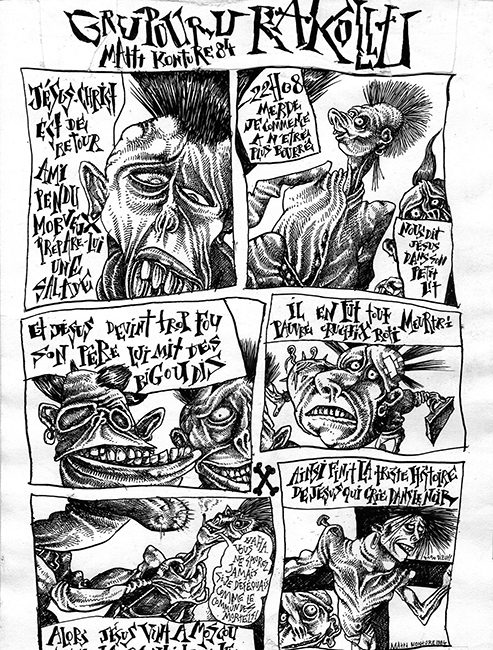

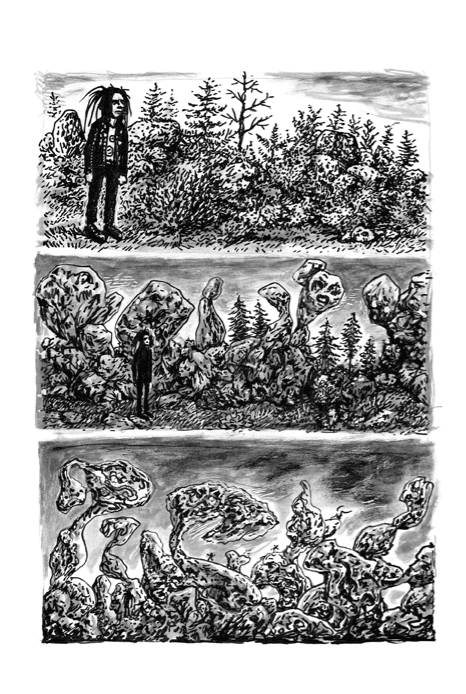


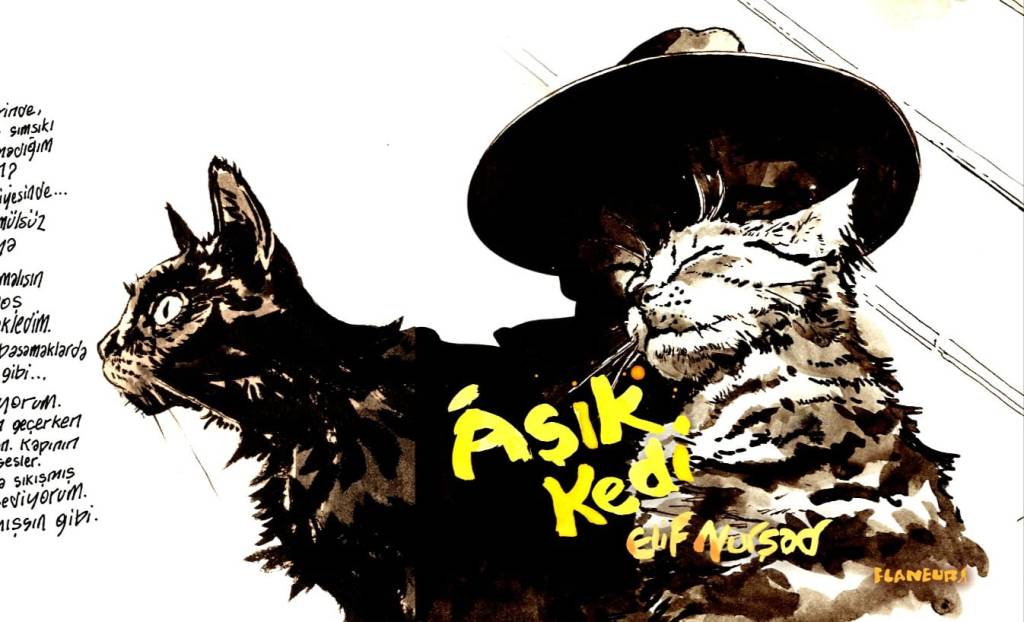


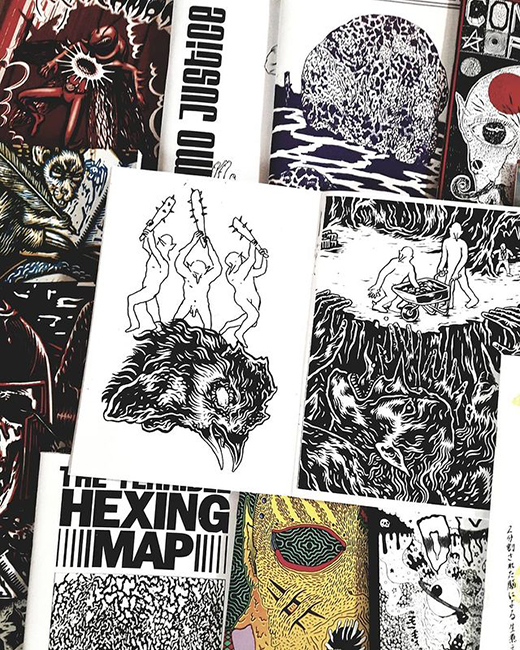
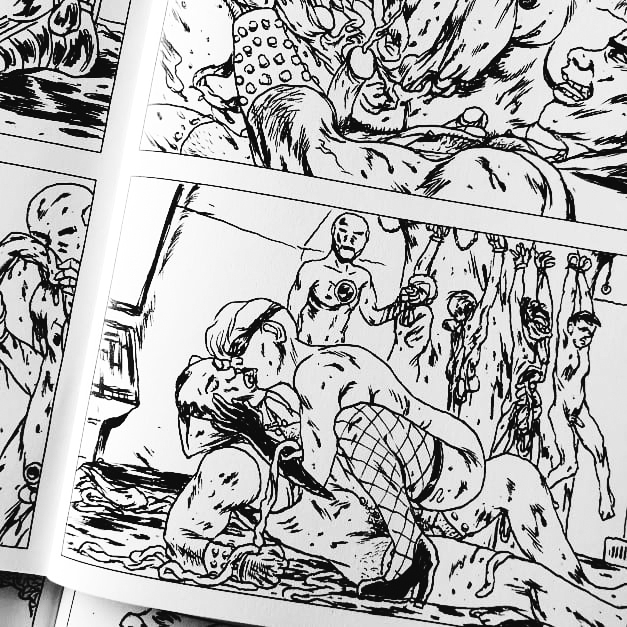
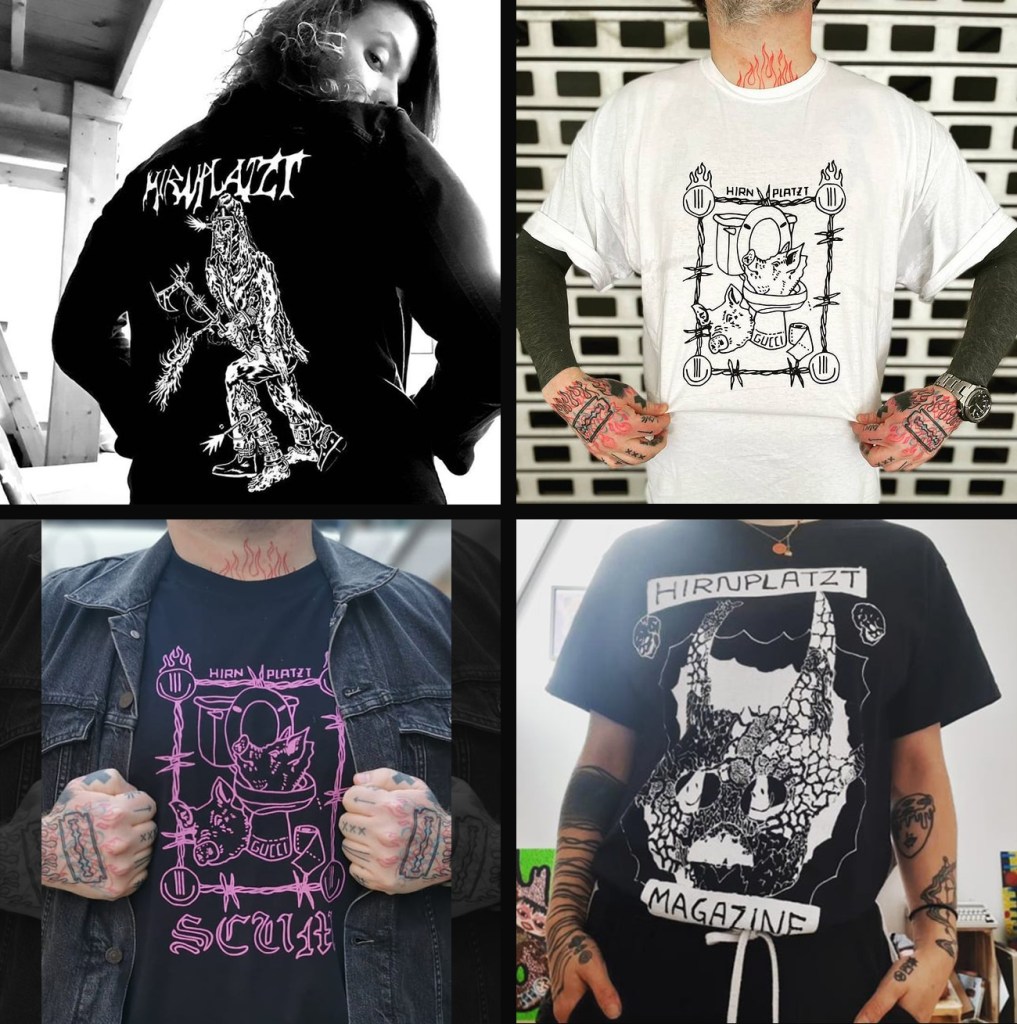
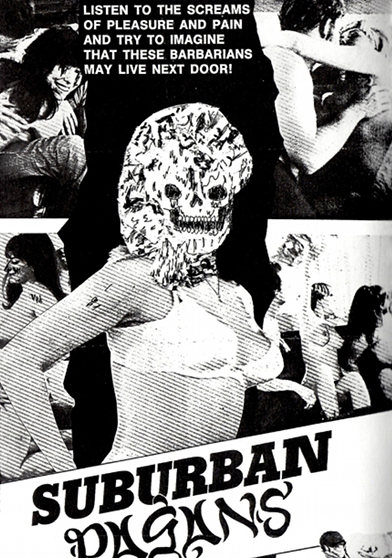

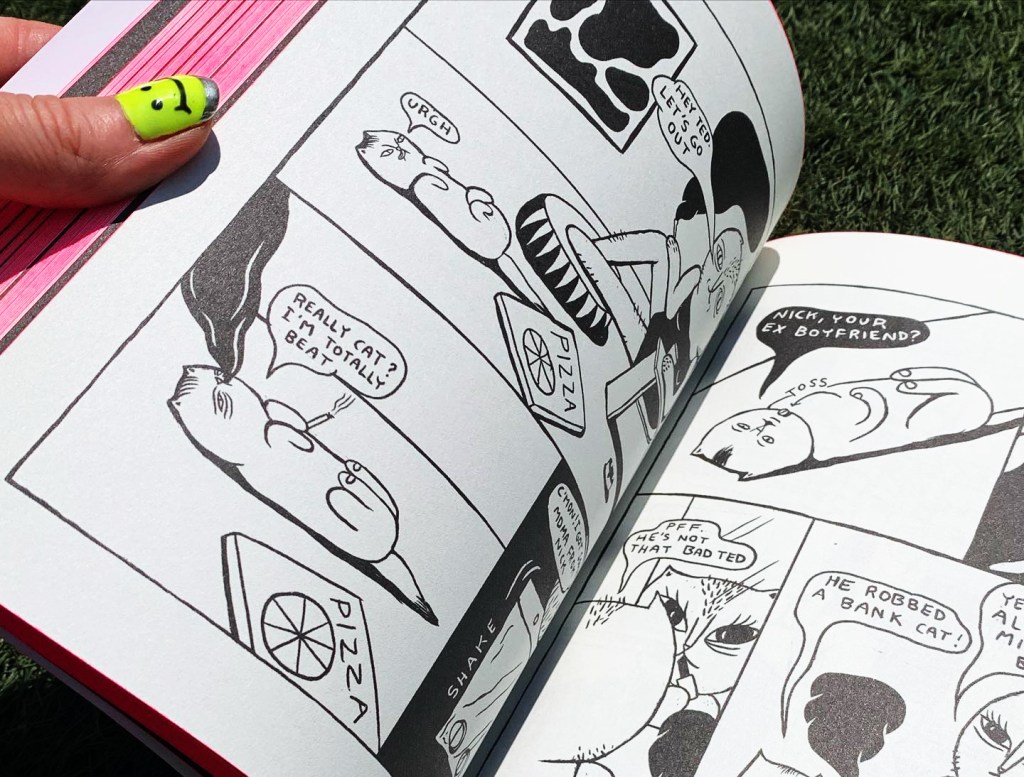
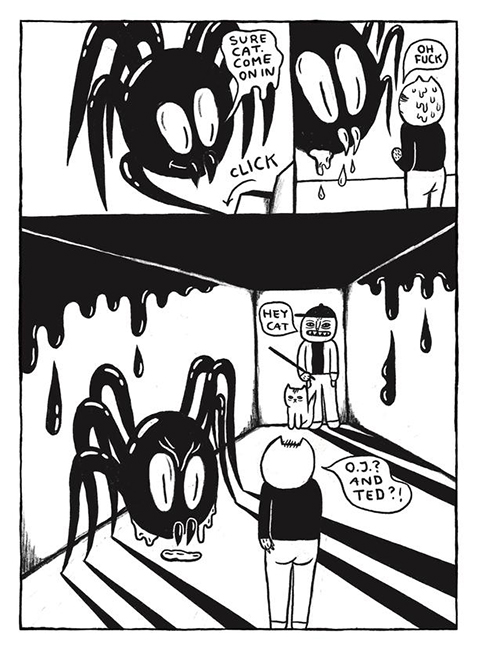
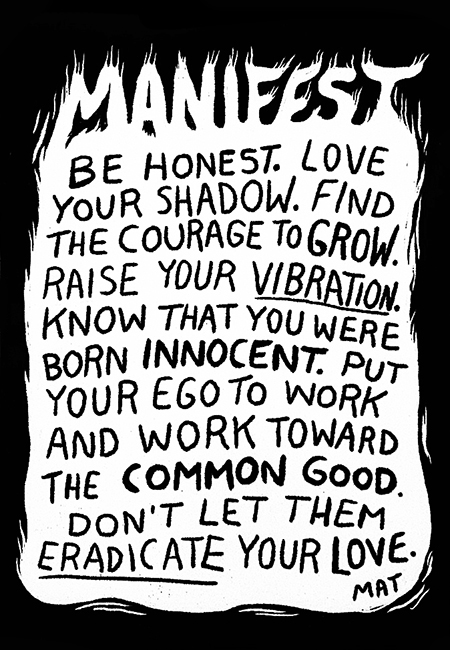
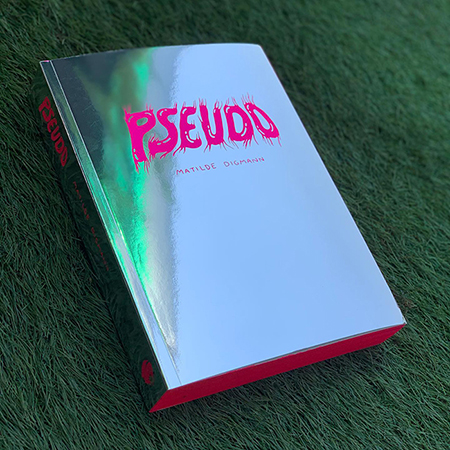
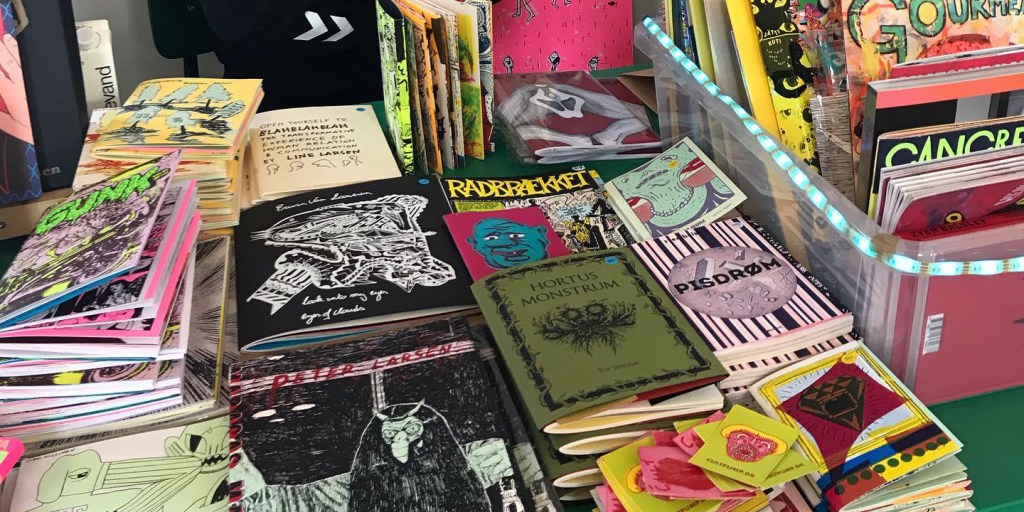
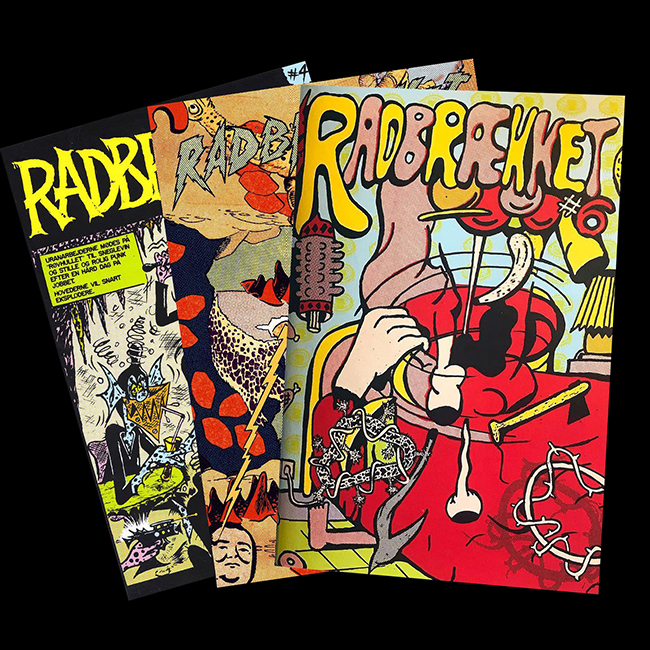


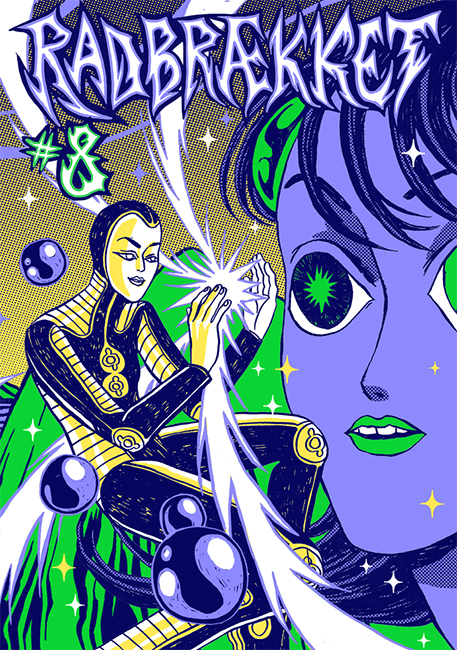


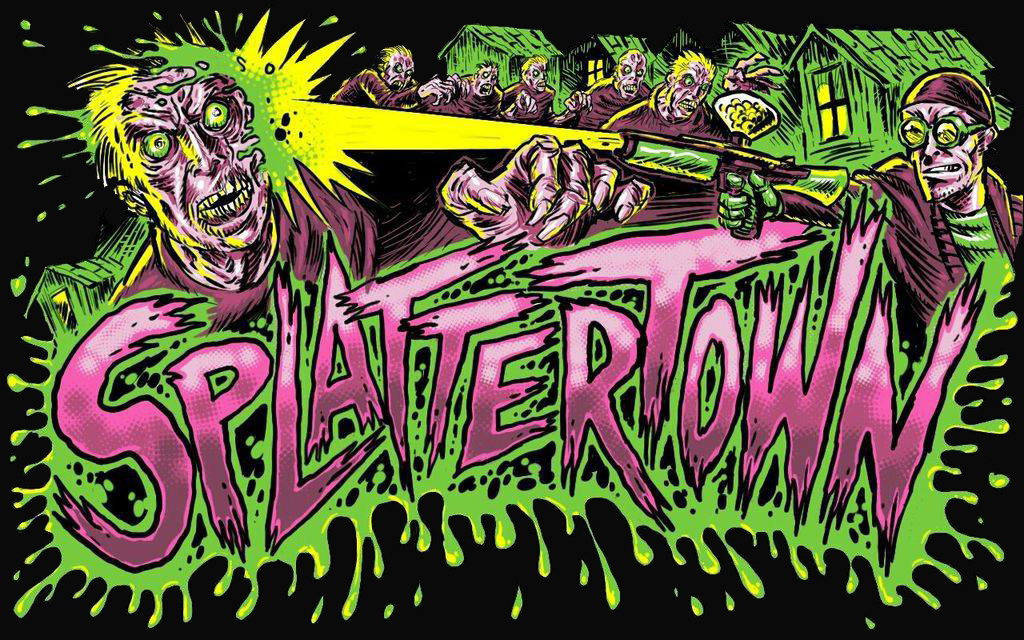
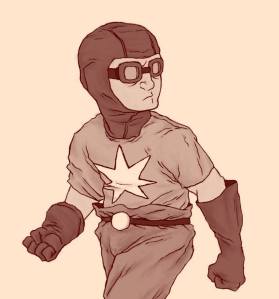
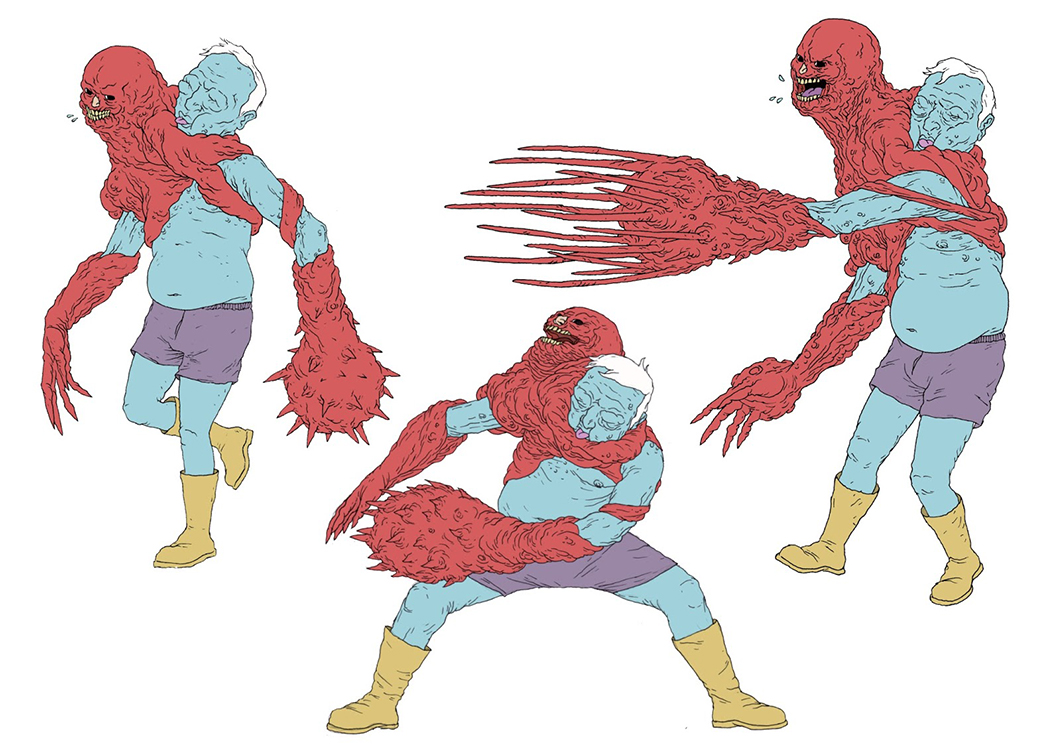

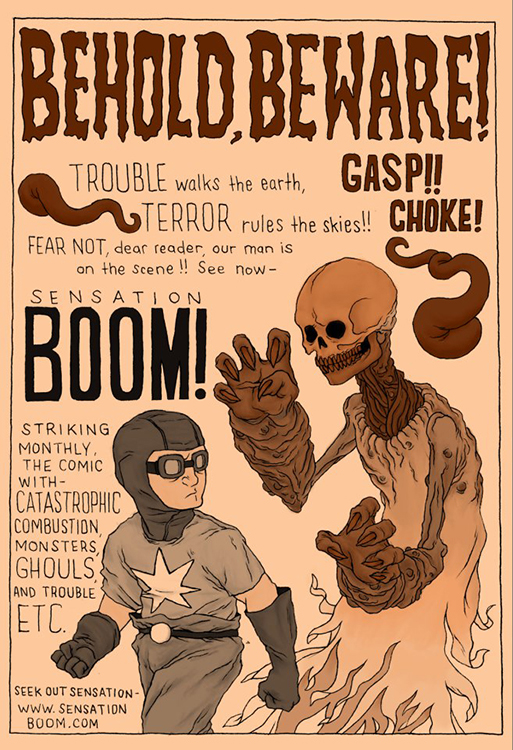

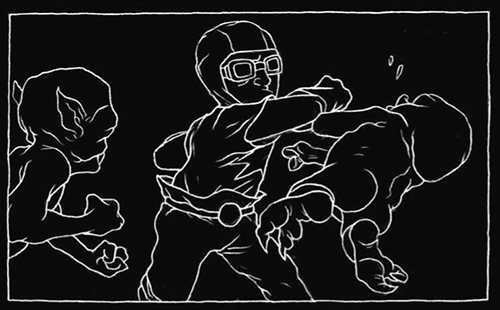
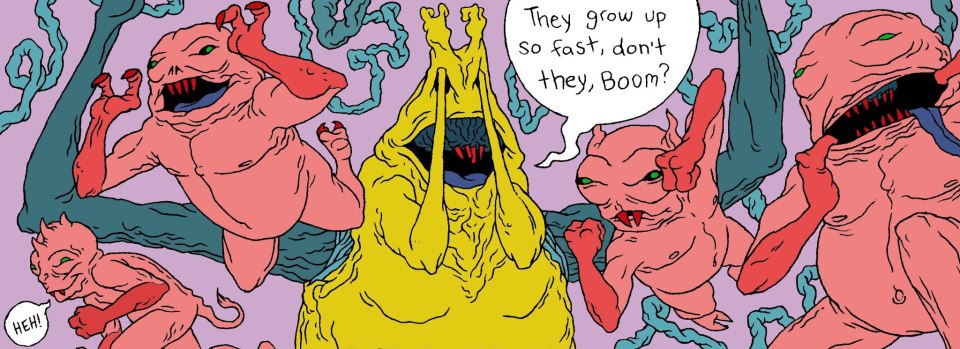


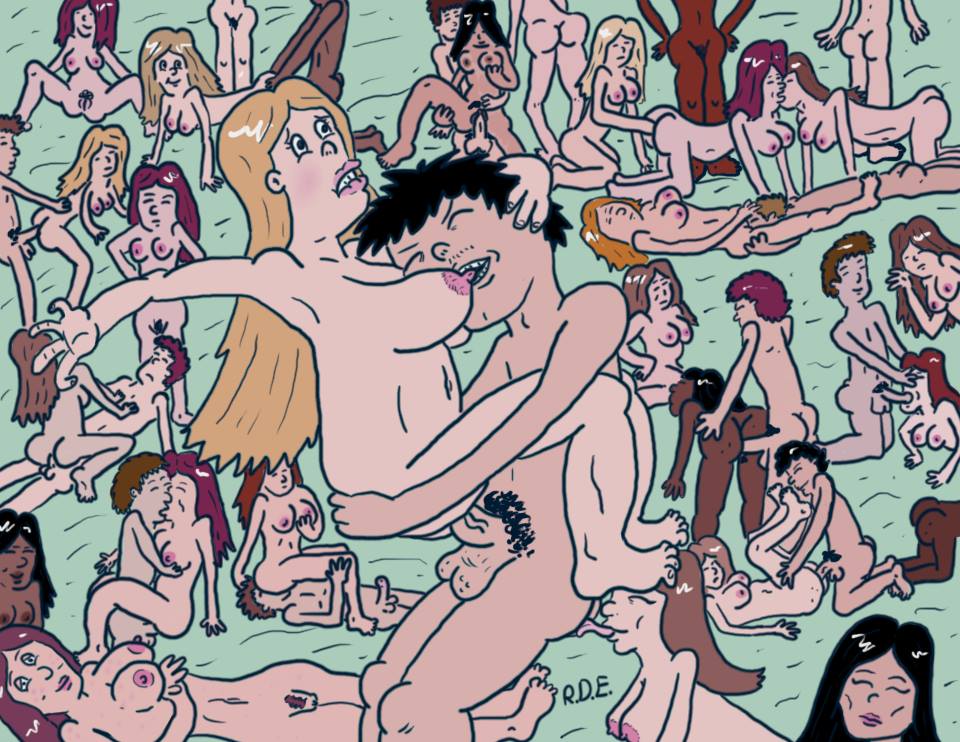
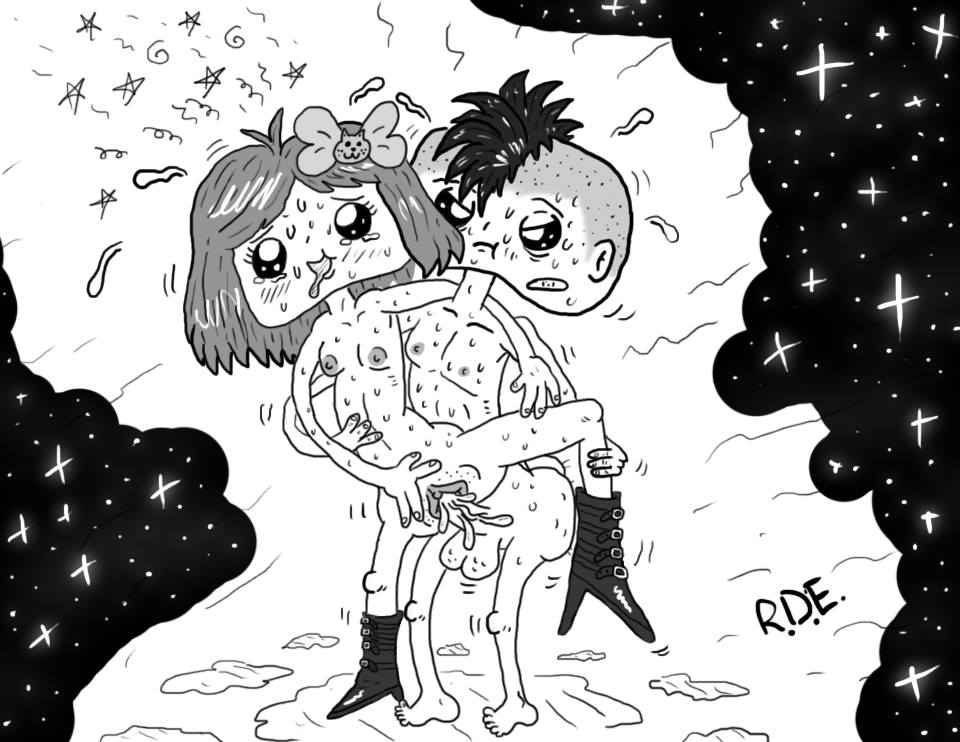
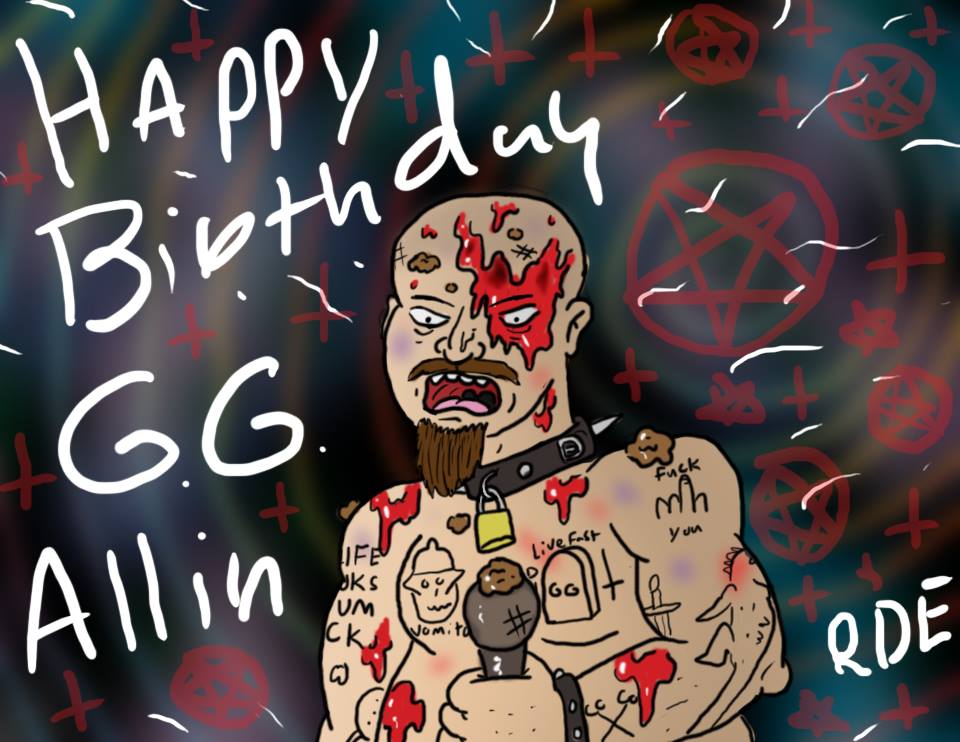

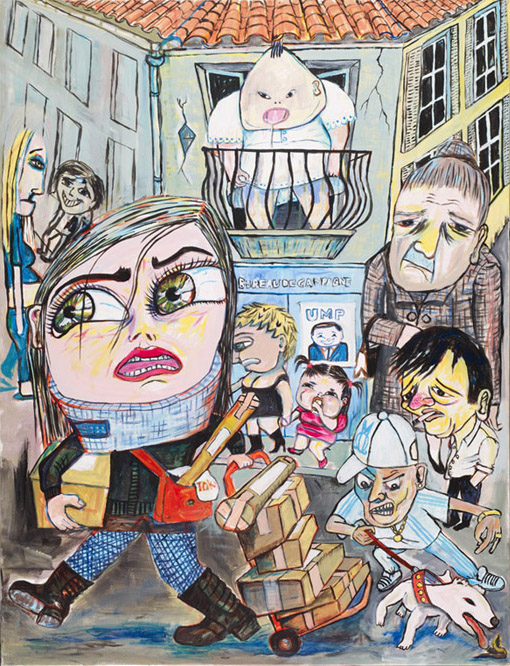
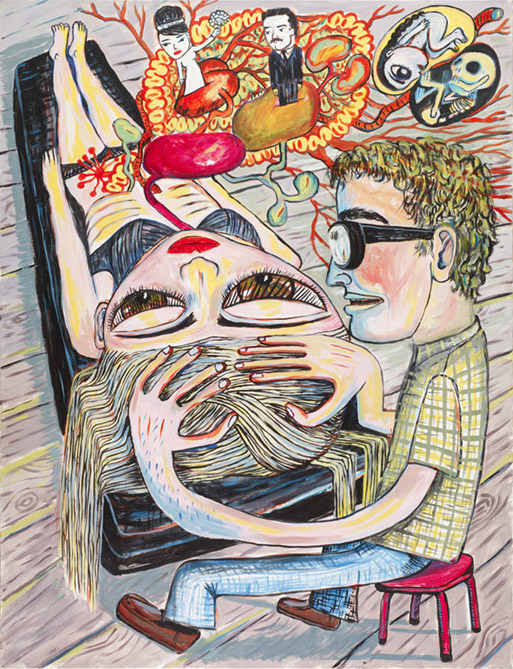
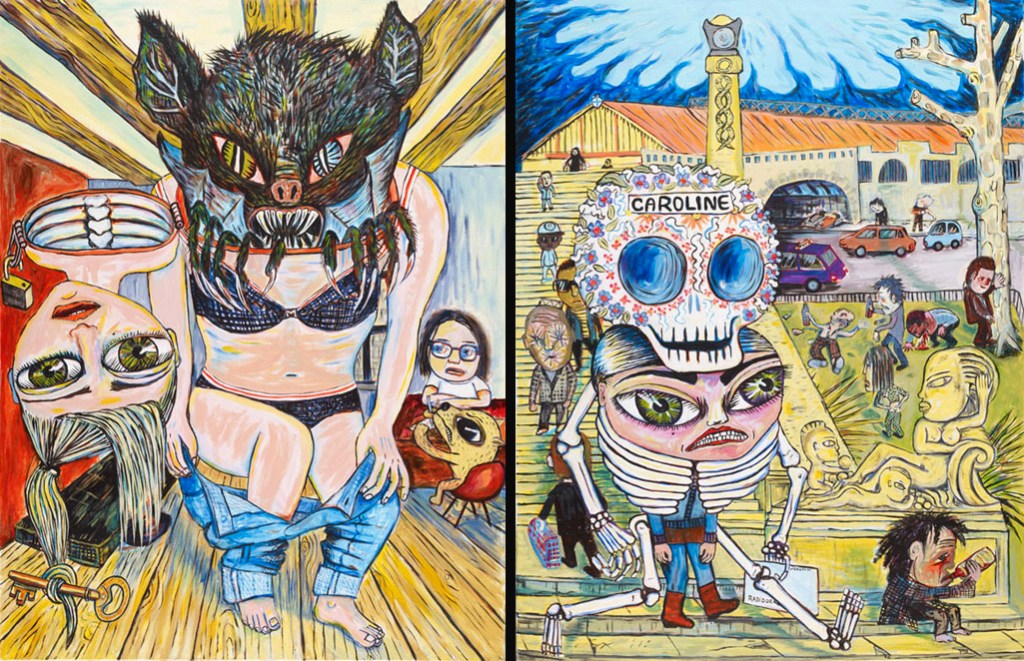
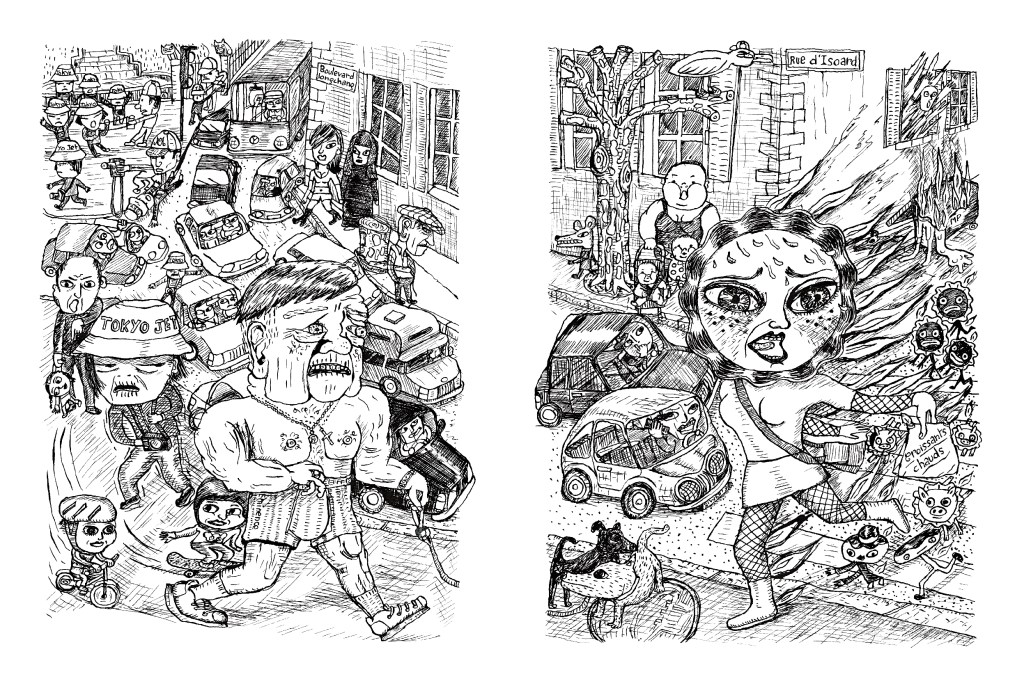
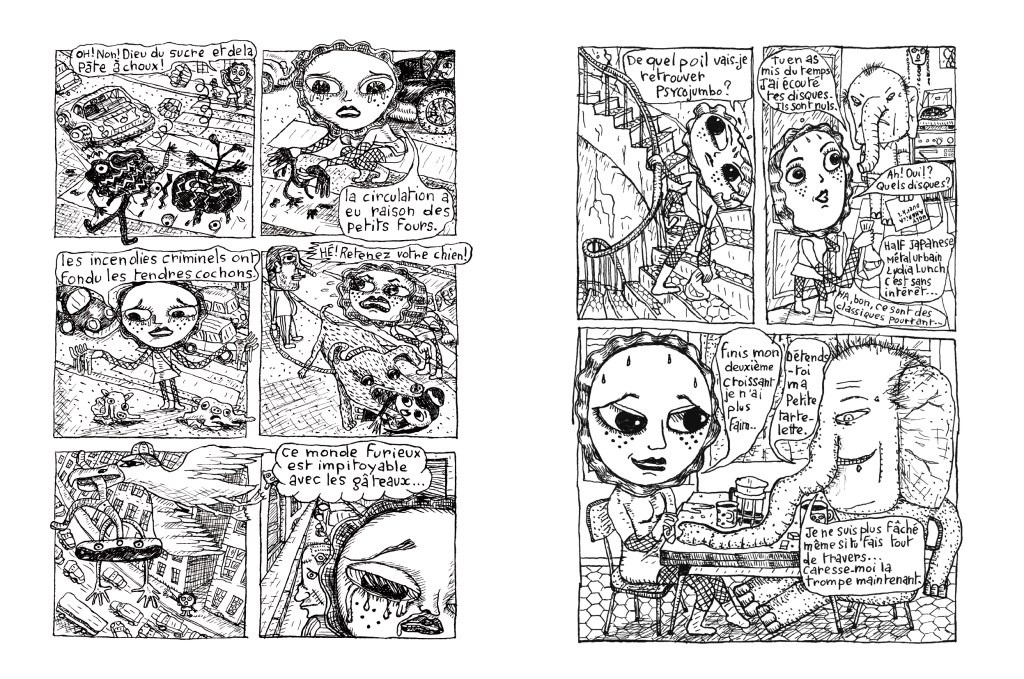


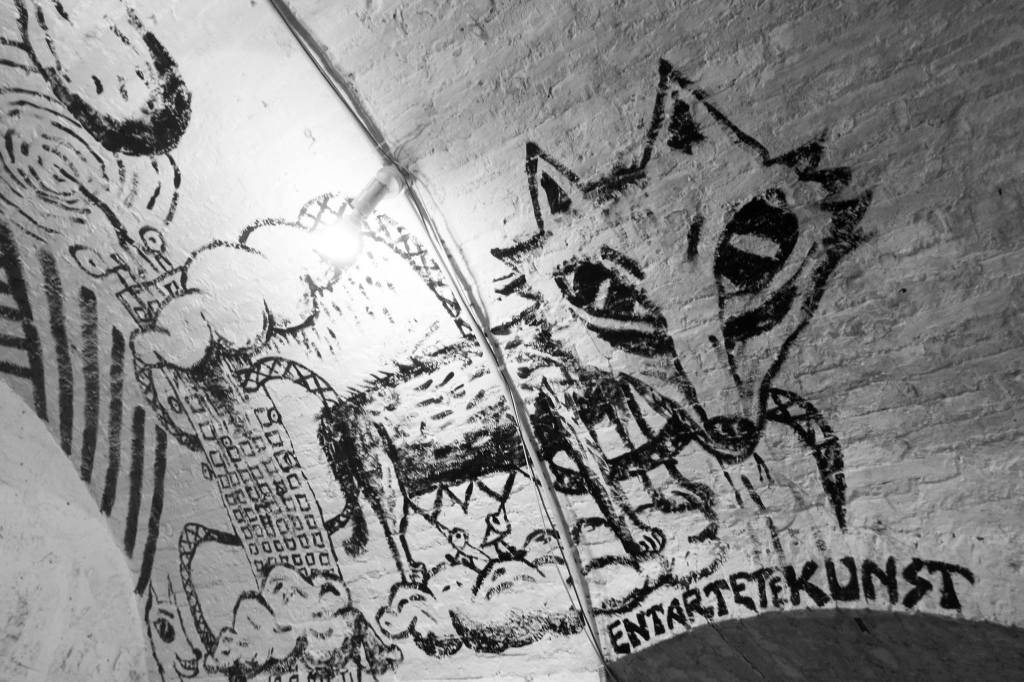
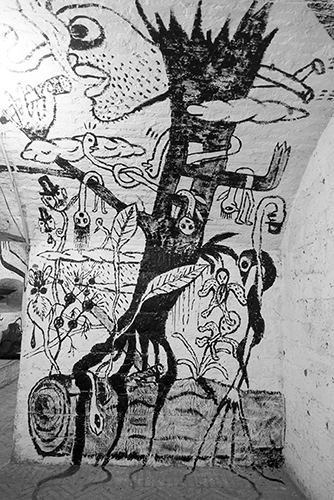
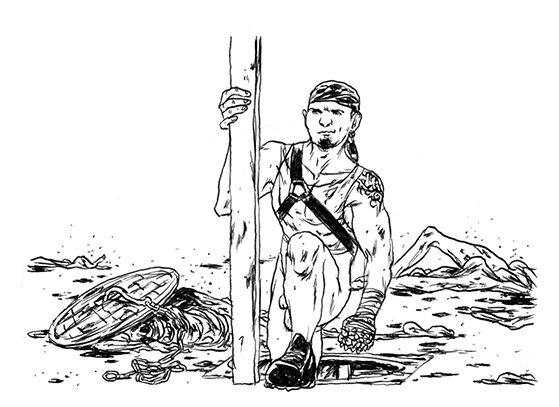


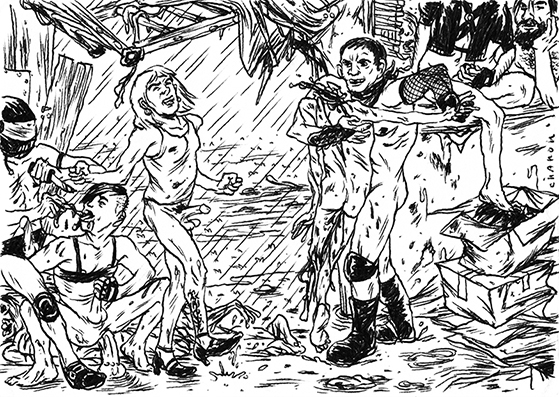


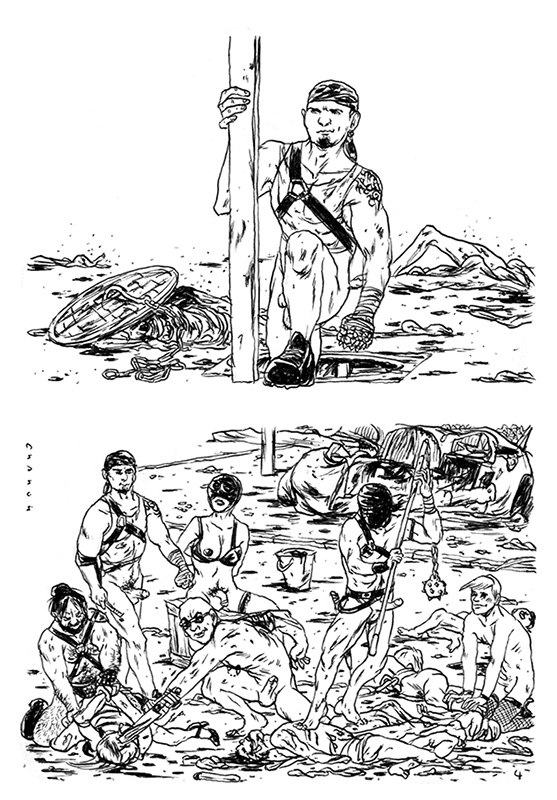
 LÖPÇÜK