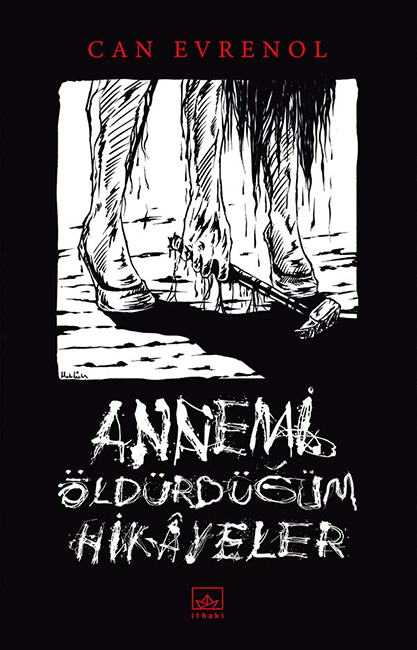
Annemi Öldürdüğüm Hikâyeler gerçekliğin sınırlarında dolaşan ve uçuruma gözlerini dikenlerin ürkütücü anlarına odaklanan sert bir öykü kitabı. Yurtdışı festivallerinde ses getiren Baskın filmi ile Çıplak dizisinin ödüllü yönetmeni ve yazarı Can Evrenol doksanlar Türkiye’sini arka planına alarak tekinsiz köprü altlarında, boş sahil kasabalarında hatta insan beyninin içinde bile en beklenmedik durumlarla yüzleştiriyor okurunu.
Can Evrenol 19 Ağustos 1982, İstanbul doğumlu. Üsküdar Amerikan Lisesi mezunu. University of Kent’ten ‘Sanat Tarihi’ ve ‘Sinema Sanatları’ dallarında çift diploma sahibi. ‘Sinema Sanatları’ gibi teorik bir bölümden mezun olduktan sonra kamerayla tanışmak için NYFA’in 8 haftalık “film yapım” kursuna katıldı. Kursa başladıktan 4 hafta sonra ilk filmi olan Vidalar’ın çekimini tamamladı. Sulhi Dölek’in aynı adlı kısa hikayesinden uyarladığı Vidalar, aynı sene, Boğaziçi Üniversitesi’nin düzenlediği ”Hisar Kısa Film Seçkisi”nde yılın en iyi 10 kısa filmi arasına seçildi. 2007 yazında tamamen kendi imkanlarıyla, doğup büyüdüğü mahallede, arkadaşlarının da yardımıyla çektiği SANDIK adlı kısa film, ”Fantasia Film Festival”, ”BIFFF” ve ”Frightfest” başta olmak üzere, İngiltere, Kanada, Fransa, Avustralya ve Belçika’da, dünyanın en önde gelen korku ve fantastik film festivallerine seçildi. Daha sonra Londra’da Middlesex Üniversitesi’nde ”Moving Image” master’ı yaptıi. 2009 yılında Kanada’da bir dağıtımcı firma ile, Sandık ve My Grandmother adlı kısa filmlerin dünya dağıtım hakları için 3 senelik bir sözleşmeye imza attı. 2009 yılında, ”A Film About Races” adlı Uzun metraj belgeselin montajını üstlendi… (Kaynak: kameraarkasi.org)
Adolf Hibou: Gaël Magnieux, Nils Bertho & Bruno Ducret. Photo by Arbre Payday (2021)
Vous aussi, vous vous complaisez dans vos préjugés ? Vous fuyez comme le Covid les groupes français aux noms à coucher dehors, les pochettes de disques camar-guaises et l’humour franchouillard se propageant dangereusement dans des titres de chansons tels que « Passion Saucisse » ou encore « Indochine, j’ai demandé halal » ?
Ne prenez pas encore vos jambes à votre cou et laissez donc sa chance à ce trio d’hurluberlus surexcités. Non, nous n’avons pas affaire ici à un groupe de rock alternatif. Le plus important, avec Adolf Hibou, c’est d’aller outre les blagues consternantes, d’ignorer les interludes débilisants et d’ouvrir les oreilles en grand. Une fois dépassé le triste constat semblant nous indiquer que « cette musique, c’est avant tout un gros délire entre potes, tu vois ?», force est de constater que non seulement ces mecs ont un sacré niveau technique – le guitariste, en particulier -mais qu’en plus de ça, lorsqu’il s’agit de lâcher la purée, ils ne se font pas prier. Quand le tempo s’élève, Adolf Hibou déclenche la foudre comme un Lighting Bolt partousant avec Boredoms. Ça explose dans tous les sens, ça s’égare pour mieux retomber sur ses pattes. Le groove concassé de « Ladyboys Don’t Cry » (sans surprise, ils brillent également en anglais dès qu’il s’agit de trouver un titre en tout point désolant) impressionne, et si ce long morceau avait été amputé de sa longue et si pénible intro, on l’aurait volontiers comparé à un autre groupe français farfelu et malheureusement quelque peu oublié (même si toujours en activité), j’ai nommé Double Nelson. Dommage, également, que l’on comprenne aussi bien les paroles du refrain de « Va chier dans ta mère », car là encore, la ligne de basse – ou de guitare baryton, plus vraisemblablement – tord le cou, alors que l’envolée free qui suit est digne des plus folles embardées des Molécules, la lourdeur et une louchée de sludge en plus. « Roum Roum Ah » se montre tout aussi euphorique, jovial comme savait l’être le Singe Blanc, un autre adepte de l’onomatopée échevelée. Quand le tempo tombe, Adolf Hibou se montre également capable du meilleur, se vautrant dans un doom dissonant mais tout aussi hypnotique. Le chant, quant à lui, navigue entre le dégueulis le plus total et des vocalises se rapprochant parfois du bramement du grand cerf de Kourgane, comme sur ce « Clodo de Boston » répétitif et prenant. Une reprise finalement pas si inattendue de Sun City Girls, « Dreamland », permet de confirmer que ces types ont baigné dans l’expérimental, la no wave et la freeture des groupes de John Zorn, Marc Ribot et Fred Frith. Et puisqu’on parle de rêve, autant signaler que la fin de cet album volontairement bordélique se montre on ne peut plus cauchemardesque, la mélopée de « dream my dream, my dreamy dream, dream my love, rêve ton rêve, rêve mon amour » pouvant légitimement donner des envies de meurtre. Après un tri sélectif nécessaire, Princess Barely Légal se révèle donc un plutôt bon album pour fouetter le sang et vriller le ciboulot.
Ressource: New Noise Magazine, 2022
Official animated short film directed by Hector Oriol & Thomas Romarin. Drawn collectively by 28 artists at the studio “En Traits Libres” at Montpellier, France, for the band Adolf Hibou. 2024.
ADOLF HIBOU – “Roum Roum Ah” from the album “Princess Barely Legal” – 2021
FREE-DOOM-NOISE
ADOLF HIBOU
‘Princess Barely Legal’
Do you too wallow in your prejudices? Do you shun, like the Covid, French bands with outrageous names, comradely record sleeves and franchouillard humor spreading dangerously through song titles such as “Passion Saucisse” or “Indochine, j’ai demandé halal”?
So don’t get your hopes up just yet, and give this trio of over-excited weirdos a chance. No, this isn’t an alternative rock band. The most important thing with Adolf Hibou is to get past the appalling jokes, ignore the debilitating interludes and open your ears wide. Once you get past the sad fact that “this music is all about friends having a good time together”, you have to admit that not only do these guys have a hell of a technical level – the guitarist, in particular – but when it comes to unleashing the mashed potato, they don’t hold back. When the tempo rises, Adolf Hibou unleashes lightning like a Lighting Bolt mating with Boredoms. It explodes in all directions, goes astray only to land back on its feet. The crushed groove of “Ladyboys Don’t Cry” (unsurprisingly, they also shine in English when it comes to coming up with a title that’s in every way desolate) impresses, and if this long track had been stripped of its long, tiresome intro, we’d have gladly compared it to another wacky and unfortunately somewhat forgotten (though still active) French band, namely Double Nelson. It’s a pity, too, that the lyrics to the chorus of “Va chier dans ta mère” (Shit in your mother) are so well understood, because here again, the bass line – or baritone guitar, more likely – twists the neck, while the free flight that follows is worthy of the wildest flights of Molécules, with the added heaviness and a ladleful of sludge. “Roum Roum Ah” is just as euphoric, as jovial as White Monkey, another adept of disheveled onomatopoeia. When the tempo drops, Adolf Hibou also proves capable of the best, wallowing in dissonant but equally hypnotic doom. As for the vocals, they veer between the most utterly disgusting and vocalizations that sometimes come close to the bellowing of Kurgane’s great stag, as on the repetitive yet captivating “Clodo de Boston”. A not-so-unexpected Sun City Girls cover, “Dreamland”, confirms these guys’ roots in the experimental, no-wave and free-form bands of John Zorn, Marc Ribot and Fred Frith. And while we’re on the subject of dreams, we might as well point out that the end of this deliberately messy album could not be more nightmarish, with the melody of “dream my dream, my dreamy dream, dream my love, rêve ton rêve, rêve mon amour” legitimately giving rise to murderous desires. After a necessary selection process, Princess Barely Légal turns out to be a pretty good album for whipping up the blood and twisting the brain. (Resource: New Noise Magazine, 2022)
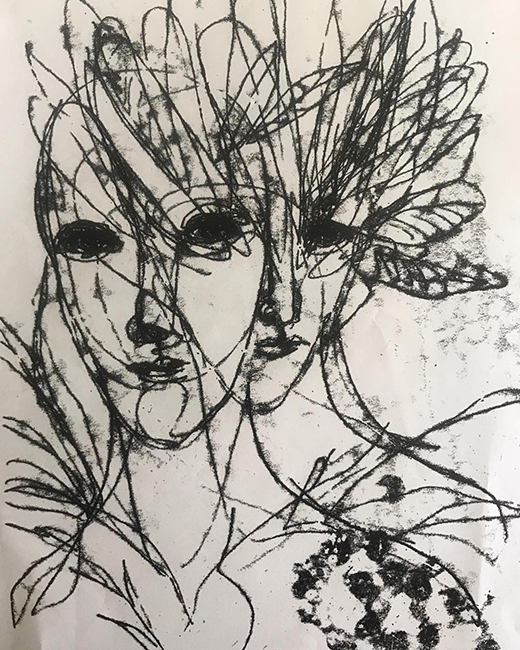
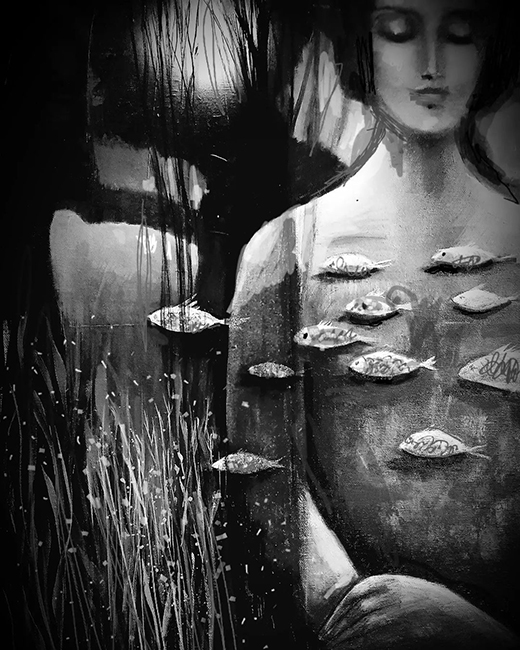
Sanatçılar, tutkulu hatta biraz obsesif kişilikler diye düşünüyorum. Yoksa, kim benzer şeyleri çizip boyayarak bir ömür geçirir? Onları bu uğurda savaşmaya iten ne? Duyguları, farklı bir dünyada yaşama özlemi? Nesnelerin kendi hayal ettikleri biçimde kurgulandığı bir dünya yaratmanın büyüsü? İçinde kaybolacakları gizemli bir dünyanın kapısını açmak? Düşünmek, bazen düşünmeden sadece hissederek, sezerek keşfetmek? Bazen aklın duyguları bazen, duyguların aklı yönetmesi gibi sırlarla dolu bir evrenin dehlizlerinde yol bulmak? Kaybolmak? Sınırların nerede son bulduğunu anlamaya çalışmak? Bütün bildiklerini hem unutmak hem hatırlamak? Zamanın sonsuzluğunda akıp giderken varlığından bir iz bırakma arzusu?
Ne kendine ne de kimseye ait olmayan resimler yapmak. Kendine ve herkese ait olan bir yalnızlığı paylaşmak.
Sema Ilgaz Temel, 2024
Sema Ilgaz Temel ‘Okulda Bir Gün’ Monotype, 2019
Sema Ilgaz Temel, 2019
ÖZGEÇMİŞ
Sema Ilgaz Temel İstanbul’da doğdu. Orta ve Lise Eğitimini Kadıköy Kız Lisesi’nde, Lisans eğitimini İstanbul Devlet Tatbiki Güzel Sanatlar, Grafik Bölümü’nde tamamladı. 1980 yılında açılan sınavı kazanarak aynı okulda Asistan olarak göreve başladı. 1983 ve 1987 yıllarında Avusturya Hükümeti’nin sanat bursuyla Uluslararası Salzburg Yaz Akademisi’ne katıldı. 1986’da Sanatla Yeterliğini ‘Metal Baskıda Anlatım Çeşitliliği Sağlayan Farklı Yöntemler’ konulu tezi ile aldı. 1991 de Amerika’da Simi Valley Career Institute’e devam etti. Aynı yıl Metropolitan Museum of Art ve diğer müzelerde, 1990-1993 ve 1996’da İngiltere’de müze ve sanat kurumlarında inceleme ve araştırmalarda bulundu. 1992’de Doçent, 1996’da Profesör oldu. Akademik hayatı boyunca Lisans ve Lisansüstü programlarında, Yayın Grafiği Tasarımı, Özgün Baskı resim, İllüstrasyon ve Grafik Şekillendirme derslerini verdi. Çeşitli idarî görevlerinin yanı sıra altı dönem (18 yıl) Grafik Sanatlar Bölüm Başkanlığı görevini yürüttü. Temel, asistanlık yıllarından İtibaren devlet sergilerinde yer aldı. Çok sayıda kitap kapağı, sanat dergileri ve çocuklar için illüstrasyonlar yaptı. 1998’de İlk yurt dışı sergisini Roma’da açtı. 100’ün üzerinde karma sergiye katıldı ve 17 kişisel sergi açtı. Uluslararası Plastik Sanatlar Derneği ve İstanbul Exlibris akademisi Derneği kurucu üyesidir. Halen M.Ü Güzel Sanatlar Fakültesi Grafik Bölümü’nde ders vermekte ve sanatsal çalışmalarını İstanbul’da sürdürmektedir.
Sema Ilgaz Temel, 2019
Sema Ilgaz Temel ‘Kendinden Geriye Doğru Say’ 2021
Sema Ilgaz Temel’in eserlerinden bir slideshow, Bilkent University Library Art Gallery
Sema Ilgaz Temel ‘Telph.apl.,34’ 2021
Kişisel Sergiler
1989 Urart Sanat Galerisi, İstanbul 1990 Urart Sanat Galerisi. Ankara 1996 Garanti Bankası, Harbiye, İstanbul. 1997 Vakko Sanat Galerisi, İstanbul 1997 Selçuk Yaşar Sanat Galerisi, İzmir 1998 Falez Sanat Galerisi, Antalya 1999 Galerie Eralov / İtalya 1999 Vakko Sanat Galerisi, İstanbul 2002 Ziraat Sanat Galerisi, İstanbul 2004 Galeri Vinci, İstanbul 2007 Soyut Sanat Galerisi, Ankara 2010 Bilkent Sanat Galerisi, Ankara 2011 CKM Sanat Galerisi, İstanbul. 2011 Vedart Gallery, Sofya / Bulgaristan 2017 CKM Sanat Galerisi, İstanbul 2017 Galeri F, İstanbul 2018 Bilkent Sanat Galerisi, Ankara
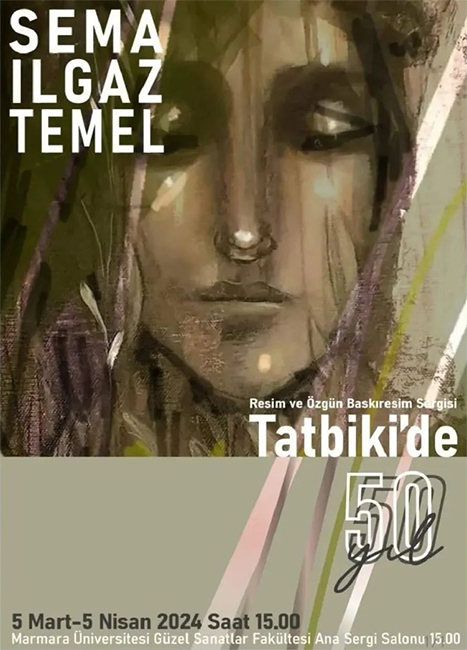
Sema Ilgaz Temel, sergi afiş, 2024
Sema Ilgaz Temel’in resim ve özgün baskı çalışmalarından oluşan kişisel sergisi “Tatbiki’de Elli Yıl” 5 Mart-5 Nisan 2024 tarihleri arasında Marmara Üniversitesi Güzel Sanatlar Fakültesi Ana Sergi Salonu’nda ziyaret edilebilir.
Blood Becomes Water & The Shivas at Mixtape5 in Sofia, Bulgaria (2015) Photo by Robin Renard
Blood Becomes Water is a trio of artists, composed of Raya Boteva, Rosie Eisor and Robin Renard, they are currently active between Sofia and Brussels. The collective works in the field of contemporary art and illustration; graphic design and independent publishing. All of these areas usually merge into a non-periodical, hand-crafted publication that mostly involves a selection of guest artists. The collective also designs limited editions on textiles and sometimes extends their activities to different media, such as murals or installations. The creative approach is characterized by fun and imperfect, yet bold and easy to remember designs, often including optical effects. The themes frequently addressed in their works can vary between symbols and tattoos, hope and failure, future and past, humans and animals with a good touch of nonsense suggesting the viewer’s interpretation. In its hometown of Sofia, Blood Becomes Water’s mission is to contribute to the development of a vibrant arts and music scene, by organizing events and promoting international music groups locally.
Footage from the opening of “Decade Dance” exhibition – 10.IX.2020 at Intro Gallery, Sofia. The exhibition presents the 11th Blood Becomes Water publication “The Bulgarian Issue #2” and original artworks from the artists involved in the occasion of the 10 year anniversary of our collective.
Blood Becomes Water est un trio d’artistes, composé de Raya Boteva, Rosie Eisor et Robin Renard, ils sont actuellement actifs entre Sofia et Bruxelles. Le collectif travaille dans le domaine de l’art contemporain et de l’illustration; du graphisme et de l’édition indépendante. Tous ces domaines se fondent généralement dans une publication non périodique, faite à la main, qui implique la plupart du temps une sélection d’artistes invités. Le collectif conçoit également des éditions limitées sur textile et étend parfois leurs activités sur différents supports, tels que peintures murales ou installations.
L’approche créative se caractérise par des dessins amusants et imparfaits, mais audacieux et faciles à retenir, comprenant souvent des effets d’optiques. Les thèmes fréquemment abordés dans leurs œuvres peuvent varier entre symboles et tatouages, espoir et échec, avenir et passé, humains et animaux avec une bonne touche de non-sens suggérant l’interprétation du spectateur.
BBW zine about the fear of number 4 in Asian countries made during Crystal Ruth Bell / Red Gate Residency in Beijing (2015)
Dans sa ville natale de Sofia, Blood Becomes Water a pour mission de contribuer au développement d’une scène artistique et musicale dynamique, en organisant des événements et en promouvant des groupes de musique internationaux au niveau local.
Kan emici aldı kararı Koparttı attı kalanını Ciğerlerine hava doldu Üfledi yıktı tarafını
Kimse ölümsüz değil Kanadı kırılmaz değil Kanı akmaz gözü çıkmaz Kendine köle değil
Rutubetli oda sancısı Kırk defadan fazla saydın mi Gördüm tanıdım pis çarkını Ezberledim senin adını
Bloodsucker decided Tore off and threw away the rest Air filled his lungs He blew his side
No one is immortal His wings are not unbreakable No blood shed, no eye pops We’re not slaves to him
Damp room pain Have you counted more than forty times I saw your dirty wheel I memorized your name
Die in Vain, Destroy Fest II, 2023
War Machine
War war war machine Take down the enemy War war war machine Save the markets needs
In the name of god And the mighty war machine Exporting building sites Feeding own financial needs
Seeking fresh blood Unstoppable war machine Sucking you alive Exterminate the war machine
Gösteri İçin
Nefes al nefes ver -gösteri için Kandır aldat yoldan çıkar -parası için Kimseyi doğru bilme-gösteri için Sınıftan kaç sınıftan kaç-parası için
Kefenin küçük gelir Kesesini doldurmak için Kanımızı akıtır onlar, onlar mutlu bundan Kaburgamızı saymak için
Tersi değilsin Gösterinin içinde Kaldır kafanı Görmesen de
inhale exhale- for the spectacle fool cheat go astray- for its money don’t get anyone right – for the spectacle escape from class- for its money
shroud small income to fill their purse they make us bleed, they’re happy about it to count our ribs
you are not the opposite inside the spectacle raise your head even if you don’t see
Die In Vain ‘Savage New Times’ E.P. 2023
Savage New Times
where is the wise don’t have to look around where is the trust dont have to look around where is the fair dont have to look around where is the just dont have to look around
savage new times x3 everything is falling apart
where is the sense dont have to look around where is the reason dont have to look around where is the ground dont have to look around where is the route dont have to look around
savage new times x3 everything is falling apart
where is the world dont have to look around where is the class dont have to look around where is defeat dont have to look around where are you now where are you now savage new times x3 everything is falling apart
A new year, new technologies; surviving a pandemic that gripped the world for two years, followed by geopolitic wars and peoples ravaged by the struggle for territory between global powers. Where are we going, are we on the brink of an uncertain age?
To what extent and for what purpose are we using advanced technology in our lives, or is it using us? And where does woman stand in all this chaos? While these feverish debates continue, perhaps it is best to listen to Maria Oosterveen who capture the spirit of the time.
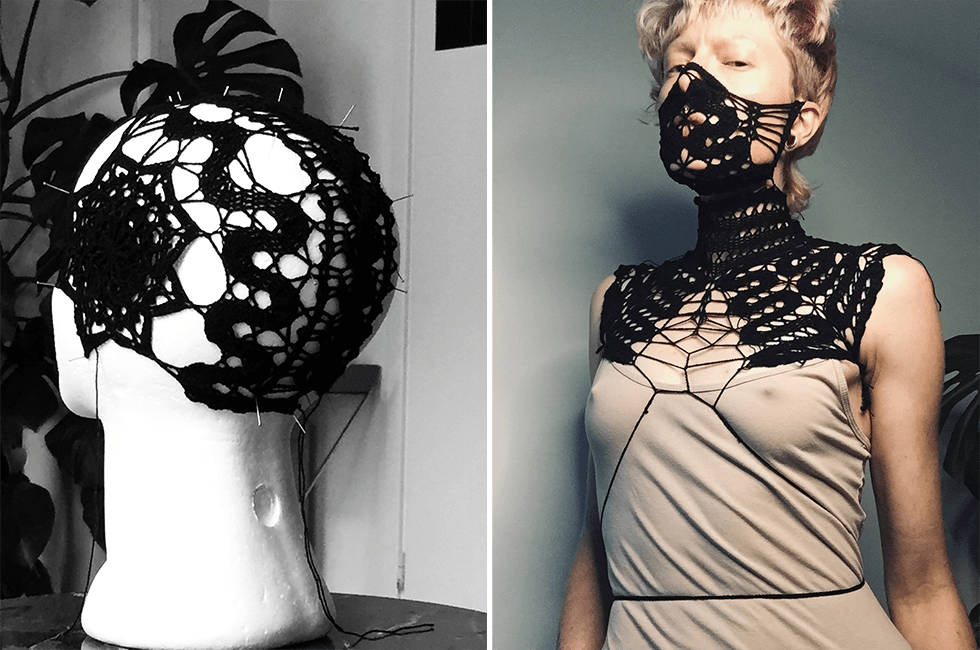
Maria Oosterveen is an artist based in the Hague, Netherlands. Currently she is using spinning, recycled yarn and a touch of technology to make tactile works, that could be touched, be immersed into by wearing or by looking. She is also a part of the iii-workspace, and works as a professional model for special projects.
Her works which are overall scenographic do touch our sense of compassion and conscience, but seen from the perspective of the body without of organs (explained by Deleuze and Guattari) also called the cyborg (Donna Harraway), and the power-plays between us and a structure or object (phenomenology) (Foucault).
Maria Oosterveen ‘Crrrshd 1.1’ 2022
‘When we navigate through life we often only see the hard parts of life. Leaving a trail of growth and beauty behind us. Since every step we make is a beautiful one. How hard it may seem, how exhausting it may seem.’
From Maria Oosterveen’s ‘Subject 0’ interactive performance
“As an artist I feel obliged to make people aware of their own habits in time and space.”
Yuval Noah Harari and similar thinkers argue that homo-sapiens as a species has come to the end of its evolutionary process and that the only way forward is from now on through by bio-engineering works, to what extent do you agree with this idea as a post-modern artist with a degree in chemistry?
Maria Oosterveen: I feel this is true.
Yet the application of bio-engineering is more a trans-humanist view to progress than a post-human. From a Post-humanist perspective changing habits and structures as a concept is more important. In that sense the body can change with the help of bio-engineering. Yet it is also valid to change the way we behave towards political systems. This is beautifully described by Judith Butler in her book “Undoing Gender”. Even if she specified this to the uncloaking of the group dynamics and (unwritten) laws around gender, she also mentions that her concept is also applicable to every political field. If you would do that in all systems.
Trans-humanism is more about the evolution of humans in a more practical sense, less conceptual. So if we want to evolve we have to find (scientific) solutions to our problem. It is more about how we want to evolve from a very human centric point of view. This could be the prolonging of our lives, to the way we added phones to our lives and have become integrated with them. Even the use of machines in a laboratory can be seen as an extension of our own body making things easier for us and therefor in integrates with our lives.
As an artist I feel obliged to make people aware of their own habits in time and space. Creating awareness and therefore change in itself. In a more Post-human way. So I try to work with the concept of consciousness. The way we perceive this is highly influenced by culture which is a system in itself, although some parts of it are instinctual. And this is what usually underlays all, the reasons why we create structures and systems. This is where we can really progress. If we are able to crack the way our instincts work, we would evolve as an entity. To recreate ourselves, or let ourselves be recreated by the (new) surroundings (as this is what evolution is). To accept we are just a product of our environment.
From this philosophical Post-Human perspective Anarchism also makes sense.
Maria Oosterveen ‘van KaNT’ series, 2022
‘My art is philosophical and political. It needs to be immersive and challenging your concept of what is right or wrong, this by the use and choices of my materials + titles but also execution. Not to be judged but to be made conscience.’
A body-art experiment by Maria Oosterveen ‘Nothing more than a Cyborg’
I have to admit that your ‘Nothing More than a Cyborg’ experiment really creeped me out.The most striking thing that struck me while reading your anecdotes is that you define the basic centre, the essence that you can access while peeling back the layers of human beings as ‘conscience’, not ‘soul’ (or spirit). Isn’t this where the whole handicap of positivism, of the (progressive) positivist perspective lies: It is based only on what can be observed. Seeing the soul and similar metaphysical fields as lyrical tales of antiquity; in terms of your artistic works, to which field do you see yourself as an artist?
Perhaps this brings us back to the most basic question “Do you believe in God or not?”Or I have to ask it like this: What is your understanding of the universe, your conception of the universe that you reflect in your art?
My answer to this will be short and long as I want to support my answer. I got no understanding of the universe.
I am only a byproduct of my surroundings. I am a product of how my mother met my father. I am a product of how some chemicals in the body said they were a good match. Which comes from an evolutionary process to prevent the mixing of too similar genes. Why that happened? If there was a reason that this happened? Did something else than a big bang caused our environment to create the right circumstances for us to be created by evolution? I got no clue.
If there is a God? No. I don’t feel like there exists one. We try to find ways to explain that which our consciousness is not able to connect together by itself. It is yet another system to make sense of that which doesn’t make sense for a lot of humans.
I believe humans are more connected than we believe we are. We share more than most think we do. We are already a big network of communal consciouses. It is something most of us experience the moment we use psychotropics. It is that same communal consciousness that finally opens up. Do we understand this communal consciousness? No. Neither do I. I follow where the system leads us as that is what we share. That is what I understand.
There is also one part of this concept of communal conscious that makes understanding the universe even more complex. It could also mean we are sharing a communal believe of reality. What if that communal consciousness breaks apart? Would what we imagined as a world still exist?
So no I got no clue. I take no stance either.
Maria and her usual natural seating style
*Cyberfeminism is a feminist approach which foregrounds the relationship between cyberspace, the Internet, and technology. It can be used to refer to a philosophy, methodology or community. The term was coined in the early 1990s to describe the work of feminists interested in theorizing, critiquing, exploring and re-making the Internet, cyberspace and new-media technologies in general. The foundational catalyst for the formation of cyberfeminist thought is attributed to Donna Haraway’s “A Cyborg Manifesto”, third wave feminism, post-structuralist feminism, riot grrrl culture and the feminist critique of the alleged erasure of women within discussions of technology.
Mariagoth Razor Mode !!
Some pages from Mariagoth’s sketchbook, 2023
“I don’t find it particularly scary for the children growing up. I find it scary for us all.”
If we take a look at the developments in the field of technology and science in the last 10 years, we witness that it has accelerated exponentially, not linearly, and has grown like an avalanche in the face of human beings. Now there is talk of the threat of an out-of-control artificial intelligence taking over the entire system. As a young woman and also modern artist, how do you see this situation, do you ever get worried, do you ever think that this is too much?
To be honest. I don’t find it particularly scary for the children growing up. I find it scary for us all. Our technology progresses faster than what we as communal conscious and human beings at this moment are capable of dealing with. Some of our systems within our bodies (the body without organs), at least the bodies we consciously imagine to exist, have not evolved enough to deal with the new developments. Like the amount of stimuli we get on a daily basis via screens and billboards. Some of us barely understand that we are the cause of climate change. A lot of humans are not capable of dealing with the stream of information that comes in. As most of what is being produced by technology now is not new physical systems, but rather systems created by information. We as human beings have not adapted fast enough, and this is why we get back to new technological adaptations to make us cope (transhumanism). Which is a trap by itself. As we aren’t evolving as a species. We are merely putting a small bandaid on a gaping wound.
Funny how these questions remind me of how Muad’dib (Paul Attreides) in Dune by Frank Herbert also sees the world or ratherLeto IIsees the world. Your comment about Mentat computation is rather well choosen.
Maria Oosterveen ‘Nothing more than a Cyborg’
“We are in the way we move and behave utterly the same as what we were 1000 years ago.”
Or do you think humanity will somehow adapt to this new world order, for better or worse?
In ways I have already explained this above. We adapt by applying even more technology. While we as humans have not changed the way we work. We still follow the same structures and systems. In that sense we still stay human. Even if we would look like robots, or the cyborgs in cyberpunk movies. Which are a terrible example of what a cyborg truly is in the literary sense. I would rather call them Transborgs than Cyborgs… We are in the way we move and behave utterly the same as what we were 1000 years ago.
We have created something we’re barely able to grasp (as a shared consciousness) that actually shows us that everything is communal. That something like copyright is non-existent. It is one of the biggest mirrors we could have created. Most of us are not capable of accepting this fact. Most of us still try to explain the world and what happens by tarot cards and/or a God.
This issue with not being able to deal with the stream of information, and the disability to communally share the same reality, is also why there is a higher percentage of psychoses happening throughout our population. (I don’t see the concept of the psychosis as something negative, just different).
Maria, L.A. Session, 2023
“Both groups are counter culture as they exist opposing each other. Both are right in their own ways. We do communally need to deal with the problems at hand, respecting each other (without violence). Yet the way our system works now isn’t making us progress at all. However I don’t believe we are conscious of how right we all are in our own way.”
In Türkiye, since the 2000s, there has always been a small-scale oppositional voice against globalization. But what about the situation in Europe, in a relatively developed welfare country like the Netherlands, is there a group of people or intellectuals who are at least ideologically or philosophically opposed to the current course of events; what is going on in the field of counter-culture in Europe, what are your observations, we would appreciate it if you could inform us a little bit.
Well to inform you all: The Netherlands is no different. About 30% of the population voted for the PVV. Which lead by an half Indonesian half-Dutch man, named Geert Wilders, in an elite position being part of the Government. There is also the party led by Thierry Baudet: Forum voor Democratie.Baudet grew up pretty rich has been able to study philosophy, of all studies, and is an extreme right wing man who flirts with Nazism. His party won the provincial elections a while ago.
Most of these politicians barely have any knowledge of the issues at hand. Knowing that most of their followers have any knowledge at hand. Yet they do understand that it is too much for a lot to handle. So they try to deny that climate change exists. Having others agreeing with them and therefor voting on them. As it is a lot to grasp for a lot….
This same group often are conspiracy believers. They also see the government as something fundamentally bad (this is something different than believing our political system needs reforming and being critical). There is overlap with some who are connected to far left wing ideologies.
Yet there is also this group of people that do understand the issues at hand and share this communal reality. They also believe that the only way to deal with the issues at hand is by doing it together communally. Even if they might not see it all the same way. Together is the only way to get through this. About 70% of us all still follow this believe.
Both groups are counter culture as they exist opposing each other. Both are right in their own ways. We do communally need to deal with the problems at hand, respecting each other (without violence). Yet the way our system works now isn’t making us progress at all. However I don’t believe we are conscious of how right we all are in our own way.
*The performance in which Mariagoat participated at Museum of Now in Berlin, 2019
“This need for technological development is only a need to deal, via cognitive dissonance, with the mirror we created for ourselves.”
There are some conspiracy theorists, independent journalists and writers who believe that these global financial elites and this corporatocracy are serving the Satanic side, trying to enslave us for their new digital world order they have created by severing our essential connection with ourselves, and therefore with nature and God.Even tech giants like Elon Musk are saying that the human brain can be used as an interface through neurolink and similar technologies in the future, what do you think about these developments; are you optimistic or pessimistic?
I am neither. Will I individually agree with a world that changes towards a highly driven by religious believes? NO I won’t. I would detest the idea. Would I still follow the communal believe that God exists? Yes because even by using the word “God” I acknowledge its existence its presence in our culture and language. If the world communally believes one thing I am to follow (as we all haven’t evolved far enough to break this cycle).
Are they right that by believing we are individuals we loose connection with each other even our surroundings? Yes. Are they right that with the current individualistic mindset dealing with problems is harder to grasp communally? Yes. It would be chaos. It would be anarchy. It would be post-modernism. It would be a psychosis not shared by us all. That idea is scary as it is venturing into the unknown. Can I be optimistic or pessimistic about this…. I can’t know as we have not reached such a state yet.
To be more practical: Am I pessimistic about the technological developments like Neurolink? No. Positive? No. It’s the same as before. This need for technological development is only a need to deal, via cognitive dissonance, with the mirror we created for ourselves.
Maria Oosterveen ‘van KaNT’ 2022
“This is where the answer for change is also to be found. We are the only ones who can oppose a structure of extreme surveillance by corporatocraty. New technological developments itself have nothing to do with a system of oppression they are merely the tool.”
Of course, if we think of this neurolink technology as a development that will bring a paralyzed patient back to his feet and back to life, it is miraculous, but how can we be sure of the other side of the medallion? What if, over time, it turns into a centralized totalitarian form of government, just like the current social media applications? I want to draw attention to the philosophy behind these developments as much as the developments themselves, after all, none of us were born by Bill Gates or Elon Musk!? And if so, where is the devil hiding?
The Devilis a concept created by the communal believe there exists “one”, which is a paradox in itself. We all believe there is “one”. As you mention so beautifully: “None of us…”, the us in this sentence gives the answer back at you. We are the ones believing there is a devil/problem. We are also the ones who made it possible, by communally believing, that we got no control over a situation like this which explains the “none” within that sentence. So the “devil” is within ourselves, it is a communal issue. Not to blame one for it, but all.
This is where the answer for change is also to be found. We are the only ones who can oppose a structure of extreme surveillance by corporatocraty. New technological developments itself have nothing to do with a system of oppression they are merely the tool.
Going back to our original topic, How do you think all these scientific, digital and cybernetic developments mentioned above, (some of which I am skeptical about), will affect the art of this new century?
I can tell you are sceptic by the way you formulate your questions. Yet with scepticism is nothing wrong. It tells us that there is something wrong. It is an instinctual warning signal that tells us something isn’t clear drinkable water. To dispose of it all as bad (as it is still water) is what I would find difficult to deal with.
“The use of technology in art or even the lack of technology where there is plenty. Will create this awareness. Art has always been a great way to make this awareness happen.”
Will artists turn into technicians and art into bio-technologic works free from the romantic, instinctive senses?
No. Not as we are still humans. We are not the tools we use. We created them. They just do not change the fundamentals of the way we act. Art, as it is today, will always find ways to create awareness. The most easiest ways to be aware is via the senses. Via touch, smell, audio, visual and etc. The easiest to make people aware about themselves is via our communally shared instinctual senses. The moment we crack this… The moment we have evolved. Art in the concept we know it now will not exist.
The use of technology in art or even the lack of technology where there is plenty. Will create this awareness. Art has always been a great way to make this awareness happen.
To talk about the senses: I am currently organising/curating an art event around the senses named: Not to be Senseless which will be happening on the 30th of March 2024. As this art-event focusses on our instinctual senses. Trying to make sense of it all, while not forgetting this instinct is communal though different for everybody.
What do you think about the effects of Artificial Intelligence in the near future? Do you use it in your art works?
No, I do not use it in my works yet. I am not opposed to it. As I see it as a tool not the creator. We created AI as a mirror of us. Why not use the mirror to mirror it back at us? We can use this in a more awareness creating tool.
I would use an AI to help me create algorithms to create new knitting patterns. Make the AI calculate it for me. While also absolutely aware that the use of this (and mentioning it) will discard the process of others helping/being paid to help in creating these patterns. Thereby creating awareness what AI does to discard human workers in a field that is rather physical. I would only use AI in my projects if it indeed would be part of my concept to make others aware of those systems of industrialisation.
The art scene of the century we left behind is a colorful century that witnessed early avant-gardes like Nam Jum Paik, many post-60s art movements and vibrant developments, speaking for today, are there any names that interest you in the fields of video art and performance art that you can recommend?
Marco Donnarumma is an amazing performative artist that amazes me every-time I see his works.
Ludmilla Rodrigues focusses a lot on haptics in her work and creates awareness around this topic.
Jaime Del Val a Spanish performative artists that focusses on architectural believes and how this changes the way we move.
Dani Ploeger an artist who focusses on systems like surveillance, but also the less complex ones like sexuality and technology.
There are many more I would like to feature but to be honest the niche I find myself connected to as an artist is rather small. So I keep seeing the same faces over and over again.
Who are the iconic artists from the 60s to today, who are important to you?
I mean writers like Philip K. Dick and Frank Herbert are rather important to me. To be honest. I am terrible with art and remembering names. Especially connected to a specific time.
Do you have a special project you are working on these days? We know that apart from being an artist, you are also a model, and a photographer, isn’t all this tiring for you?
I just wish it all would be paid better and some would be communicative stronger so everything flows more fluently. You can’t have all. Luckily this is what life is about. So I am fine. It is actually really exciting. My life isn’t boring at all!
As mentioned before I am setting up a series of events around the senses called; Not to be Senseless. It is a political wink to how we treat others and how we are more together than we think. Yet it also binds us in something we fundamentally all understand. Our senses. Which is in collaboration with Journey Through the Sense (Journeythroughthesenses.org) and Intstruments Inventors Initiative (instrument inventors.org)
Maria Oosterveen’s installation named (uk) Un-/(nl) On-
Maria Oosterveen ‘Crrrrrrshd’ Performance, 2022
Prototypes of Alumn crystals growing
I am also, with the help and support of the TU Delft, researching a way to create a wearable and performative piece of art that combines handwork with crystal growth. The focus is that not all technology is electronic. While still have this tactile elements to my work as the crystals will break by wearing, can be gathered and regrown making it a piece that also changes over time by wearing.
And I am working on some new designs that people can knit themselves. Where inspiration comes from the body itself. From chemicals like oxytocin to the spine. In case of oxytocin the chemical structure is turned by a self-made algorithm into something that can be translated into a lacework stitch. Which is a wink to how knitting and weaving has been the basis for the binary language in computing and it is a wink to how (mostly) women have sent secret message in knitwear in wars.
When I was looking through your online portfolio, I noticed that you didn’t date any of your works, is there a special reason for this?
I’m an anarchist in ways. I believe that time is irrelevant. It goes about the quality and position of the art in time. Time changes always, so does some elements in culture. This also means my art changes because the time and mentality it is existing in has changed. I could give it a date. But why would I?
Mariagoth’s Secret Projects (WIP)
Creating lace patterns
Which we can wear on our sleeve
out of chemical structures existing in us all
What are your current pursuits and which topics do you plan to focus on more in the coming period?
See earlier comments. I am really busy with a few new projects. Of which one is curating a series of events which are called: Not to be Senseless. Where the focus is more on the senses.
I might actually think about trying to create more algorithms (but now by AI) to create lace patterns out of chemical structures existing in us all. Which we can wear on our sleeve (what a great title btw).
At new year I did a participative intervention performance on sexuality, war and feminism. As I come from a mixed background, which is both Eastern European Jewish (grandfather mothers side) and Dutch Jewish (grandmother mothers side). I am in the middle of 2 wars. One which is all about the former USSR and Putin trying to regain that autocracy back over those pieces of land by invading Ukraine first. The second war with the Palestinians and Zionitic Israelis. In both wars women are still often seen as the damsels in distress. Put in a lesser position, both by those that try to protect us and those who want to hurt the other party the most. At new year I gained my power as a woman back by whipping others. Material from this performance still needs to be added to my website as it is rather recent.
*To correct you I didn’t realise the performance in Berlin. I was merely an actor. A hired entity to play part in someones concept I was just a player. Nothing more.
Mariagoth, 2017
Thank you so much for joining us Maria, it is an honor for us to have a futuristic artist like you on our pages, and I am sure it was equally inspiring and enjoyable for the readers and new-media artists. If you have something you want to share finally with your fans and followers here, please!
If you got the chance to attend my event on the 30th of March called “Not to be Senseless” do it.
Otherwise keep following me. As there will be more being produced the upcoming years.
Эта работа посвящена памяти моего покойного друга Александра Юрченко, – музыканта, художника и великого человека который давно всё послал на хуй
Олександр Юрченко • Лічи до ста • Симфонія №1 • [1994]
Dear friends!
Did you have a great Christmas day?
We are closed for the holidays but we’re not sleeping… And in our wakefulness we became aware of this great article about and interview with the wonderful Ukrainian artist Andrii Strachov (Strachovart) whose work we have the privilege of hosting and promoting.
Andrii Strakhov, 2023
‘A nightmare defending itself from an even bigger nightmare’
Find many of Andrii’s works currently in our care in our online shop – what better way to spend the cash you got from Santa?
Selin Baycan, ‘Kaçışın Yok’ adlı yeni şarkısı Lâl Records etiketiyle yayınlandı. Söz, müzik ve düzenlemesi Selin Baycan’a ait olan şarkı dinleyicileri duygusal bir yolculuğa davet ediyor. Şarkının video klibi Lara Kamhi ve Barış Fert tarafından çekildi. 90’lar Türk sinemasından ilham alan klip, izleyicilere görsel bir şölen sunuyor.
Şarkılarını, cazdan singer-songwriter ekolüne uzanan geniş bir ilham dolabından beslenerek üreten Selin Baycan, kayıtlarını 2019’dan bu yana tekliler hâlinde yayımlamakta. Geçtiğimiz sene Şevket Akıncı’nın Meskûn Mahal albümündeki “Silk Mother” parçasında da katkılarını duyduğumuz müzisyen, bu kez yaklaşmakta olan ilk albümüne dair merakları celbeden nefis bir parçayı önümüze usulca bıraktı. Fakat dikkat: Hazırlıklı olun, az sonra muhtemelen derin bir sızı yoklayacak kalbinizi.
Selin Baycan’s new song ‘Kaçışın Yok’ (No Escape) was released with Lâl Records label. The song, whose lyrics, music and arrangement belong to Selin Baycan, invites listeners to an emotional journey. The video clip of the song was shot by Lara Kamhi and Barış Fert. Inspired by 90s Turkish cinema, the clip offers a visual feast to the audience.
Bir Sır Taşıyıcısı
Bazen olmuyor, sevmek yetmiyor. Biriyle, onu içindeki fırtınada birlikte kaybolmaya mahkum etmeye çalışarak ilişki kuran, hep kaygan zeminlerde tutan kişilere veda edebilmek gerekiyor. Selin Baycan’ın deyimiyle “kendi gibi olmanın dayanılmaz hafifliği”ni seçmek, daima açık kalacak bir yara taşımayı reddetmek, şifayı özünde bulmak gücün ta kendisi. “Unutan mı iyileşirdi yoksa affeden mi?” sorusuyla vazgeçilmiş bir aşkın kıyısından seslenen “Kaybolan Ne Var”, anılarında benzer hikâyeler saklayanların yüzüne buruk bir gülümseme yerleştirecek, henüz “o adım”ı atamamışlara ise cesaret verebilecek bir şarkı.
Büyüsünü müzisyenin duru vokalleri ve Alaca’nın yarısı Mehmet Mutlu’nun dokunuşlarıyla biçimlenmiş sade piyano eşliğinden alan parçanın ortaya çıkış öyküsünü Selin Baycan’dan dinleyelim: “Nakarat melodisi kalbimin düştüğü biriyle yıllar süren bir kopamama süreci boyunca aklımda dönüp durdu. Ve ne tuhaftır ki pandemi dönemi nedeniyle kendisiyle ayrılığımız telefonda olabildi. Son konuşmamız esnasında bu sözler âdeta bir anda içimden döküldü ve telefonu kapattığımda şarkı doğmuştu”
Selin Baycan ‘Kaybolan Ne Var’ 2023
Telefon detayı önemli zira parçanın klibine ilham vermiş. Yönetmenliğini Elif Tekneci’nin, sanat yönetmenliğini Nur Şevval Yılmaz’ın üstlendiği videoda ayrılık ânının ve henüz yanıtlanmamış soruların kederiyle baş başa kalıyoruz. Renkler kaybolmuş, sesler susmuş, bir devir kapanmış. Artık aynaya, kendimize bakıyoruz. “Kaybolan Ne Var”ı şimdiden loop’a aldık bile; özlemle beklediğimiz sonbaharımıza arkadaş olacak gibi görünüyor. Boğmadan, boğulmadan; özgürlükte, nefes aldıran sahici sevgilerde buluşalım.
The purpose of this article is to point out a very simple principle of human conflict, a principle that opponents of the techno-industrial system seem to be overlooking. The principle is that in any form of conflict, if you want to win, you must hit your adversary where it hurts.
I have to explain that when I talk about “hitting where it hurts” I am not necessarily referring to physical blows or to any other form of physical violence. For example, in oral debate, “hitting where it hurts” would mean making the arguments to which your opponents position is most vulnerable. In a presidential election, “hitting where it hurts” would mean winning from your opponent the states that have the most electoral votes. Still, in discussing this principle I will use the analogy of physical combat, because it is vivid and clear.
If a man punches you, you can’t defend yourself by hitting back at his fist, because you can’t hurt the man that way. In order to win the fight, you have to hit him where it hurts. That means you have to go behind the fist and hit the sensitive and vulnerable parts of the man’s body. Suppose a bulldozer belonging to a logging company has been tearing up the woods near your home and you want to stop it. It is the blade of the bulldozer that rips the earth and knocks trees over, but it would be a waste of time to take a sledgehammer to the blade. if you spent a long, hard day working on the blade with the sledge, you might succeed in damaging it enough so that it became useless. But, in comparison with the rest of the bulldozer, the blade is relatively inexpensive and easy to replace. The blade is only the “fist” with which the bulldozer hits the earth. To defeat the machine you must go behind the “fist” and attack the bulldozers vital parts. The engine, for example, can be ruined with very little expenditure of time and effort by means well known to many radicals. At this point I must make clear that I am not recommending that anyone should damage a bulldozer (unless it is his own property). Nor should anything in this article be interpreted as recommending illegal activity of any kind. I am a prisoner, and if I were to encourage illegal activity this article would not even be allowed to leave the prison. I use the bulldozer analogy only because it it clear and vivid and will be appreciated by radicals.
2. Technology Is The Target.
It is widely recognized that “the basic variable which determines the contemporary historic process is provided by technological development” (Celso Furtado*). Technology, above all else, is responsible for the current condition of the world and will control its future development. Thus, the “bulldozer” that we have to destroy is modern technology itself.
Many radicals are aware of this, and therefore realize that there task is to eliminate the entire techno-industrial system. But unfortunately they have paid little attention to the need to hit the system where it hurts.
Smashing up McDonald’s or Starbuck’s is pointless. Not that I give a damn about McDonald’s or Starbuck’s. I don’t care whether anyone smashes them up or not. But that is not a revolutionary activity. Even if every fast-food chain in the world were wiped out the techno-industrial system would suffer only minimal harm as a result, since it could easily survive without fast-food chains. When you attack McDonald’s or Starbuck’s, you are not hitting where it hurts.
Some months ago I received a letter from a young man in Denmark who believed that the techno-industrial system had to be eliminated because, as he put it, “What will happen if we go on this way?” Apparently, however, his form of “revolutionary” activity was raiding fur farms. As a means of eakening the technoindustrial system this activity is utterly useless. Even if animal liberationists succeed in eliminating the fur industry completely they would do no harm at all to the system, because the system can get along perfectly well without furs.
I agree that keeping wild animals in cages is intolerable, and that putting an end to such practices is a noble cause. But there are many other noble causes, such as preventing traffic accidents, providing shelter for the homeless, recycling, or helping old people cross the street. Yet no one if foolish enough to mistake these for revolutionary activities, or to imagine that they do anything to weaken the system.
3. The Timber Industry Is A Side Issue.
To take another example, no one in his right mind believes that anything like real wilderness can survive very long if the techno-industrial system continues to exist. Many environmental radicals agree that this is the case and hope for the collapse of the system. But in practice all they do is attack the timber industry.
I certainly have no objection to their attack on the timber industry. In fact, it’s an issue that is close to my heart and I’m delighted by any successes that radicals may have against the timber industry. In addition, for reasons that I need to explain here, I think that opposition to the timber industry should be one component of the efforts to overthrow the system.
But, by itself, attacking the timber industry is not an effective way of working against the system, for even in the unlikely event that radicals succeeded in stopping all logging everywhere in the world, that would not bring down the system. And it would not permanently save wilderness. Sooner or later the political climate would change and logging would resume. Even if logging never resumed, there would be other venues through which wilderness would be destroyed, or if not destroyed then tamed and domesticated. Mining and mineral exploration, acid rain, climate changes, and species extinction destroy wilderness; wilderness is tamed and domesticated through recreation, scientific study, and resource management, including among other things electronic tracking of animals, stocking of streams with hatchery-bred fish, and planting of genetically-engineered trees.
Wilderness can be saved permanently only by eliminating the techno-industrial system, and you cannot eliminate the system by attacking the timber industry. The system would easily survive the death of the timber industry because wood products, though very useful to the system, can if necessary be replaced with other materials.
Consequently, when you attack the timber industry, you are not hitting the system where it hurts. The timber industry is only the “fist” (or one of the fists) with which the system destroys wilderness, and, just as in a fist-fight, you can’t win by hitting at the fist. You have to go behind the fist and strike at the most sensitive and vital organs of the system. By legal means, of course, such as peaceful protests.
4. Why The System Is Tough.
The techno-industrial system is exceptionally tough due to its so-called “democratic” structure and its resulting flexibility. Because dictatorial systems tend to be rigid, social tensions and resistance can be built up in them to the point where they damage and weaken the system and may lead to revolution. But in a “democratic” system, when social tension and resistance build up dangerously the system backs off enough, it compromises enough, to bring the tensions down to a safe level.
During the 1960s people first became aware that environmental pollution was a serious problem, the more so because the visible and smellable filth in the air over our major cities was beginning to make people physically uncomfortable. Enough protest arose so that an Environmental Protection Agency was established and other measures were taken to alleviate the problem. Of course, we all know that our pollution problems are a long, long way from being solved. But enough was done so that public complaints subsided and the pressure on the system was reduced for a number of years.
Thus, attacking the system is like hitting a piece of rubber. A blow with a hammer can shatter cast iron, because caste iron is rigid and brittle. But you can pound a piece of rubber without hurting it because it is flexible: It gives way before protest, just enough so that the protest loses its force and momentum. Then the system bounces back.
So, in order to hit the system where it hurts, you need to select issues on which the system will not back off, in which it will fight to the finish. For what you need is not compromise with the system but a life-and-death struggle.
5. It Is Useless To Attack The System In Terms Of Its Own Values.
It is absolutely essential to attack the system not in terms of its own technologically-oriented values, but in terms of values that are inconsistent with the values of the system. As long as you attack the system in terms of its own values, you do not hit the system where it hurts, and you allow the system to deflate protest by giving way, by backing off.
For example, if you attack the timber industry primarily on the basis that forests are needed to preserve water resources and recreational opportunities, then the system can give ground to defuse protest without compromising its own values: Water resources and recreation are fully consistent with the values of the system, and if the system backs off, if it restricts logging in the name of water resources and recreation, then it only makes a tactical retreat and does not suffer a strategic defeat for its code of values.
If you push victimization issues (such as racism, sexism, homophobia, or poverty) you are not challenging the system’s values and you are not even forcing the system to back off or compromise. You are directly helping the system. All of the wisest proponents of the system recognize that racism, sexism, homophobia, and poverty are harmful to the system, and this is why the system itself works to combat these and similar forms of victimization.
“Sweatshops,” with their low pay and wretched working conditions, may bring profit to certain corporations, but wise proponents of the system know very well that the system as a whole functions better when workers are treated decently. In making an issue of sweatshops, you are helping the system, not weakening it.
Many radicals fall into the temptation of focusing on non-essential issues like racism, sexism and sweatshops because it is easy. They pick an issue on which the system can afford a compromise and on which they will get support from people like Ralph Nader, Winona La Duke, the labor unions, and all the other pink reformers. Perhaps the system, under pressure, will back off a bit, the activists will see some visible result from their efforts, and they will have the satisfying illusion that they have accomplished something. But in reality they have accomplished nothing at all toward eliminating the techno-industrial system.
The globalization issue is not completely irrelevant to the technology problem. The package of economic and political measures termed “globalization” does promote economic growth and, consequently, technological progress. Still, globalization is an issue of marginal importance and not a wellchosen target of revolutionaries. The system can afford to give ground on the globalization issue. Without giving up globalization as such, the system can take steps to mitigate the negative environmental and economic consequences of globalization so as to defuse protest. At a pinch, the system could even afford to give up globalization altogether. Growth and progress would still continue, only at a slightly lower rate. And when you fight globalization you are not attacking the systems fundamental values. Opposition to globalization is motivated in terms of securing decent wages for workers and protecting the environment, both of which are completely consistent with the values of the system. (The system, for its own survival, can’t afford to let environmental degradation go too far.) Consequently, in fighting globalization you do not hit the system where it really hurts. Your efforts may promote reform, but they are useless for the purpose of overthrowing the technoindustrial system.
6. Radicals Must Attack The System At The Decisive Points.
To work effectively toward the elimination of the techno-industrial system, revolutionaries must attack the system at points at which it cannot afford to give ground. They must attack the vital organs of the system. Of course, when I use the word “attack,” I am not referring to physical attack but only to legal forms of protest and resistance.
Some examples of vital organs of the system are:
A. The electric-power industry. The system is utterly dependent on its electric-power grid.
B. The communications industry. Without rapid communications, as by telephone, radio, television, e-mail, and so forth, the system could not survive.
C. The computer industry. We all know that without computers the system would promptly collapse.
D. The propaganda industry. The propaganda industry includes the entertainment industry, the educational system, journalism, advertising, public relations, and much of politics and of the mental-health industry. The system can’t function unless people are sufficiently docile and conforming and have the attitudes that the system needs them to have. It is the function of the propaganda industry to teach people that kind of thought and behavior.
E. The biotechnology industry. The system is not yet (as far as I know) physically dependent on advanced biotechnology. Nevertheless, the system cannot afford to give way on the biotechnology issue, which is a critically important issue for the system, as I will argue in a moment.
Again: When you attack these vital organs of the system, it is essential not to attack them in terms of the system’s own values but in terms of values inconsistent with those of the system. For example, if you attack the electric-power industry on the basis that it pollutes the environment, the system can defuse protest by developing cleaner methods of generating electricity. If worse came to worse, the system could even switch entirely to wind and solar power. This might do a great deal to reduce environmental damage, but it would not put an end to the techno-industrial system. Nor would it represent a defeat for the system’s fundamental values. To accomplish anything against the system you have to attack all electric-power generation as a matter of principle, on the ground that dependence on electricity makes people dependent on the system. This is a ground incompatible with the system’s values.
7. Biotechnology May Be The Best Target For Political Attack.
Probably the most promising target for political attack is the biotechnology industry. Though revolutions are generally carried out by minorities, it is very useful to have some degree of support, sympathy, or at least acquiescence from the general population. To get that kind of support or acquiescence is one of the goals of political action. If you concentrated your political attack on, for example, the electric-power industry, it would be extremely difficult to get any support outside of a radical minority, because most people resist change to their way of living, especially any change that inconveniences them. For this reason, few would be willing to give up electricity.
But people do not yet feel themselves dependent on advanced biotechnology as they do on electricity. Eliminating biotechnology will not radically change their lives. On the contrary, it would be possible to show people that the continued development of biotechnology will transform their way of life and wipe out age-old human values. Thus, in challenging biotechnology, radicals should be able to mobilize in their own favor the natural human resistance to change.
And biotechnology is an issue on which the system cannot afford to lose. It is an issue on which the system will have to fight to the finish, which is exactly what we need. But – to repeat once more – it is essential to attack biotechnology not in terms of the system’s own values but in terms of values inconsistent with those of the system. For example, if you attack biotechnology, primarily on the basis that it may damage the environment, or that genetically-modified foods may be harmful to health, then the system can and will cushion your attack by giving ground or compromising – for instance, by introducing increased supervision of genetic research and more rigorous testing and regulation of genetically modified crops. People’s anxiety will then subside and protest with wither.
8. All Biotechnology Must Be Attacked As A Matter Of Principle.
So, instead of protesting one or another negative consequence of biotechnology, you have to attack all modern biotechnology on principle, on grounds such as (a) that it is an insult to all living things; (b) that it puts too much power in the hands of the system; (c) that it will radically transform fundamental human values that have existed for thousands of years; and similar grounds that are inconsistent with the values of the system.
In response to this kind of attack the system will have to stand and fight. It cannot afford to cushion your attack by backing off to any great extent, because biotechnology is too central to the whole enterprise of technological progress, and because in backing off the system would not be making only a tactical retreat, but would be taking a major strategic defeat to its code of values. Those values would be undermined and the door would be opened to further political attacks that would hack away at the foundations of the system.
Now it’s true that the U.S. House of Representatives recently voted to ban cloning of human beings, and at least some congressmen even gave the right kinds of reasons for doing so. The reasons I read about were framed in religious terms, but whatever you may think of the religious terms involved, these reasons were not technologically acceptable reasons. And that is what counts.
Thus, the congressmen’s vote on human cloning was a genuine defeat for the system. But it was only a very, very small defeat, because of the narrow scope of the ban – only one tiny part of biotechnology was affected – and because for the near future cloning of human beings would be of little practical use to the system anyway. But the House of Representatives’ action does suggest that this may be a point at which the system is vulnerable, and that a broader attack on all of biotechnology might inflict severe damage on the system and its values.
9. Radicals Are Not Yet Attacking Biotech Effectively.
Some radicals do attack the biotechnology, whether politically or physically, but as far as I know they explain their opposition to biotech in terms of the system’s own values. That is, their main complaints are the risks of environmental damage and of harm to health.
And they are not hitting the biotech industry where it hurts. To use an analogy of physical combat once again, suppose you had to defend yourself against a giant octopus. You would not be able to fight back effectively by hacking at the tips of its tentacles. You have to strike at its head. From what I’ve read of their activities, radicals who work against biotechnology still do no more than hack at the tips of the octopus’s tentacles. They try to persuade ordinary farmers, individually, to r e f r a i n from planting geneticallyengineered seed. But there are many thousands of farms in America, so that persuading farmers individually is an extremely inefficient way to combat genetic engineering. It would be much more effective to persuade research scientists engaged in biotechnological work, or executives of companies like Monsanto, to leave the biotech industry. Good research scientists are people who have special talents and extensive training, so they are difficult to replace. The same is true of top corporate executives. Persuading just a few of these people to get out of biotech would do more damage to the biotechnology industry than persuading a thousand farmers not to plant genetically-engineered seed.
10. Hit Where It Hurts.
It is open to argument whether I am right in thinking that biotechnology is the best issue on which to attack the system politically. But it is beyond argument that radicals today are wasting much of their energy on issues that have little or no relevance to the survival of the technological system. And even when they do address the right issues, radicals do not hit where it hurts. So instead of trotting off to the next world trade summit to have temper tantrums over globalization, radicals ought to put in some time thinking how to hit the system where it really hurts. By legal means, of course.
(Theodore Kaczynski retains copyright to this article)
Who is Ana Mendieta? brings the story of its eponymous central character into the public eye once again as a graphic novel detailing her career as an artist and her unsolved death.
John Reed/ therumpus.net
In 1951, Theodore Adorno asserted that “every work of art is an uncommitted crime.” The claim is powerful, not just in its insight, but in its exclusion of creative works made in the service of normative values. Propaganda, pop culture, are omitted by Adorno’s criteria.
2010’s Girls to the Front: The True Story of the Riot Grrrl Revolution, by Sara Marcus, set the tone for the 2011 documentary !Women Art Revolution (a film by Lynn Hershman) and MOMA’s 2011 rescreening of The Heretics (directed by Joan Braderman). The two films reassert the influence of women artists, ’60s forward, rekindling a revolution—not just feminism but a wholesale social insurgency—that is remembered in the haze of whitewash. Given our own era, heavily dominated by corporation and consumerism, the reminder is life itself: the revolution was going down, it was underway.
The difficulty: bringing radical thinking and radical works of art to the mainstream. Mainstream distribution—the arts are no exception—requires a product that’s market and advertising friendly. If a work of art eludes market value, longevity falls to the discretion of historians, academics, and popular opinion; Sotheby’s has no vested interest.
Anima, Silueta de Cohetes (Firework Piece) Movie • 1976
Caro Caron, Who Is Ana Mendieta? (Blindspot Graphics) 2011
Caro Caron’s drawings do not only illustrate Christine Redfern’s controversial story: they construct a real system of annotations which allow us to feel the indignation that the suspicious death of Ana Mendieta can arouse. The figures of women illuminate the main story and form like footnotes which enrich the text with sensations rather than references and manage to make us take this less and less obvious side step which reveals to what extent paternalism and ordinary sexism are scandalous. Caro Caron’s style creates an atmosphere of carnival nightmare that is ultimately much more adequate to reality than reality itself, filtered by an ideology that we are most often incapable of pinning down.
MSVU Art Gallery, 2012
XIA is a responsive system in which visitor’s presence triggers different emotional stages of a projected virtual character. In a darkened gallery space, on a luscious, luminous carnation ground, a velvety black charcoal bloom is both the setting and the trace of a captive’s struggle.
Body Tracks foregrounds the life and art of Ana Mendieta (1948-1985), whose career exemplifies feminist art practices of the 1970s and the backlash against that movement in the mid 1980s. Curator Christine Redfern shows that issues raised in the 1970s by artists like Mendieta continue to preoccupy contemporary artists. Included are a video, Anima (1976) by Ana Mendieta, an interactive video performance by Philomene Longpre,Xia (2011), and the original drawings from the graphic novel Who is Ano Mendieta? written by Christine Redfern and illustrated by Caro Caron.
Caro Caron ‘Who Is Ana Mendieta?’ 2011
In Who is Ana Mendieta?, the Feminist Press seeks popular opinion through the graphic novel. The newly released title launches a series, Blind Spot, that will invoke (in the words of the press release) “the spirit of revolutions past.” The cleverness of the vehicle is twofold: the use of broadly appealing comic and true crime elements; the direct appeal to a youthful audience seeking alternatives in the limited category of graphic books. Hill & Wang (Macmillan Publishing), with recent graphic biographies of Malcolm X, Trotsky, Ernesto “Che” Guevara, and “The Beats,” paves the way for radicalism in graphic non-fiction. The Blind Spot series, if Who is Ana Mendieta? is representative, brings dynamism and creative kicks to the graphic biography, which is all too often academic and artistically lackluster.
Mendieta, a New York feminist artist native to Cuba, is an obvious standard-bearer. Her prescient “earth-body” works—live sculpture, performance and documentation—feature her own body and the natural world. (New York University hosted an exhibition of Mendieta’s projects, “Where is Ana Mendieta?” in October of 2010.) Mendieta’s concerns and interests—alternative creative modes, the mysticism and magic of close-to-the-soil religions, the biological essence of life—are firmament to today’s arts world; a major retrospective of Mendieta’s 70 films is inevitable.
Mendieta’s ranging, decaying, breathing projects are counterpoint to the works of Carl Andre, with whom she shared a tempestuous six-year relationship. If Mendieta’s maximal projects didn’t quite have a market solution (what to sell?), Andre’s minimalism offered the perfect entrepreneurial explanation: less costs more. In 1985, the couple on the brink of divorce, Mendieta mysteriously fell from the window of Andre’s 34th-floor apartment. While Andre was acquitted of her murder in 1988, Mendieta’s controversial death crystallizes the political position of the Blind Spot series. The question, the history untold—whatever the answer—is where we begin.
Illustrated by Caro Caron, and scripted by Christine Redfern, Who is Ana Mendieta? resists passing judgment on Andre. Rather, the book looks at the death and scandal in the larger context of an art world and culture not nearly self-aware enough. The infuriating failings of the police are indicative of an establishment simultaneously self-righteous and inept. Mendieta, as an artist, had made her own body, prostrate, the subject of her documentary investigations—film and photograph. In a nauseating irony, the performance artist’s scene of death wasn’t photographed by the forensic team.
In this video CamiiW is talking about body artist Ana Mendieta.
Providing salient interview fragments and facts, Who is Ana Mendieta? is unhindered by a reductive “story.” Even Harvey Pekar, in his Hill & Wang graphic treatment of The Beats: a Graphic History, was force-fit into the narrative assumptions of the A&E biography: artist suffers, artist redeemed through recognition, artists suffers, etc. The model is in itself an arm of conservative propaganda: creativity is unhappiness, a sin that must be punished, or relieved through broad cultural acceptance; the artist must conform. The subtle insurgence of Who is Ana Mendieta?, and presumably the Blind Spot series, is the co-option of the pulp journal, which allows for a dissemination of information without a preordained moral.
In last year’s Graphic Woman, Hillary Chute explores 21st century autobiographical comics by women. Chute traces a weave of aesthetics and politics, which, with the dissolution of the American Comics Code in 2010, will only increase in the graphic category. With its considered construction and vivid reportage, Who is Ana Mendieta? heralds a better possible future, for the graphic book, for the arts, for the record of history, and for the revolution.























 LÖPÇÜK