Çellist ve besteci Gülşah Erol‘un projesi Loli, yapay zekâ teknolojilerini kullanarak ürettiği ‘Electric Love‘ adlı yeni eserini müzikseverlerle buluşturdu.
Klasik müzikten rock’a, cazdan deneysel performansa ve film müziğine uzanan geniş yelpazedeki çalışmalarıyla tanınan sanatçı, bu kez elektronik müzik alanında yenilikçi bir projeye imza attı.
Abletonlive ve çeşitli AI yazılımlarının harmonik birlikteliğiyle ortaya çıkan eser, dijital çağın müzik üretimindeki etkisini yansıtıyor. İstanbul Jazz Festival, Sundance Film Festivali gibi prestijli platformlarda yer alan ve Peter Brötzmann, Joe McPhee gibi önemli müzisyenlerle çalışan Gülşah Erol, farklı üretim teknikleriyle bu projede dikkat çekiyor.
Electric Love · Loli Sacred Heart / 2025 Gülşah Erol
“Müzik ve teknolojinin kesişiminde yeni deneyimler yaratmak beni heyecanlandırıyor” açıklamasında bulunan sanatçı, gelecek projelerinde de yapay zekâ ve müzik entegrasyonunu sürdürmeyi hedefliyor. Gülşah Erol’un bu yaklaşımı, müzik endüstrisinde yapay zekâ kullanımının yaratıcı potansiyelini ortaya koyarken, diğer sanatçılara da ilham kaynağı olmayı amaçlıyor. (Kaynak: habereguven.com)
MUTRİB ‘Dünyam’ / Live at ODTU MT Rock Festival 2013
Gülşah Erol / Mutrib Session, 2013
Gülşah Erol / Mutrib Session, 2013
LOLI As A Cyberfeminist Experiment
Sexy & Smart
Cellist and composer Gülşah Erol’s project Loli brought her new work ‘Electric Love’, produced using artificial intelligence technologies, to music lovers.
Known for her works ranging from classical music to rock, jazz, experimental performance and film music, this time she has realized an innovative project in the field of electronic music.
The work, created with the harmonic combination of Abletonlive and various AI software, reflects the impact of the digital age on music production. Gülşah Erol, who has participated in prestigious platforms such as Istanbul Jazz Festival, Sundance Film Festival and worked with important musicians such as Peter Brötzmann and Joe McPhee, draws attention with different production techniques in this project.
“Creating new experiences at the intersection of music and technology excites me,” says the artist, who aims to continue the integration of artificial intelligence and music in her future projects. Gülşah Erol’s approach reveals the creative potential of using artificial intelligence in the music industry and aims to inspire other artists.
Le projet Loli de la violoncelliste et compositrice Gülşah Erol a présenté aux mélomanes sa nouvelle œuvre « Electric Love », produite à l’aide de technologies d’intelligence artificielle.
Connue pour ses œuvres allant de la musique classique au rock, en passant par le jazz, la performance expérimentale et la musique de film, elle a cette fois-ci réalisé un projet innovant dans le domaine de la musique électronique.
L’œuvre, créée par la combinaison harmonieuse d’Abletonlive et de divers logiciels d’intelligence artificielle, reflète l’impact de l’ère numérique sur la production musicale. Gülşah Erol, qui a participé à des plateformes prestigieuses telles que le festival de jazz d’Istanbul, le festival du film de Sundance et a travaillé avec des musiciens importants tels que Peter Brötzmann et Joe McPhee, attire l’attention avec différentes techniques de production dans ce projet.
« Créer de nouvelles expériences à l’intersection de la musique et de la technologie me passionne », déclare l’artiste, qui souhaite poursuivre l’intégration de l’intelligence artificielle et de la musique dans ses futurs projets. L’approche de Gülşah Erol révèle le potentiel créatif de l’utilisation de l’intelligence artificielle dans l’industrie musicale et vise à inspirer d’autres artistes.
“And modern war is a cyborg orgy, coded by C3I, command-control-communication-intelligence, an $84 billion item in 1984’s US defence budget.”
Science, Technology, and Socialist-Feminism in the Late Twentieth Century
Donna Haraway, 1985
A Cyborg Manifesto _ Part 1
This essay is an effort to build an ironic political myth faithful to feminism, socialism, and materialism. Perhaps more faithful as blasphemy is faithful, than as reverent worship and identification. Blasphemy has always seemed to require taking things very seriously. I know no better stance to adopt from within the secular-religious, evangelical traditions of United States politics, including the politics of socialist feminism. Blasphemy protects one from the moral majority within, while still insisting on the need for community. Blasphemy is not apostasy. Irony is about contradictions that do not resolve into larger wholes, even dialectically, about the tension of holding incompatible things together because both or all are necessary and true. Irony is about humour and serious play. It is also a rhetorical strategy and a political method, one I would like to see more honoured within socialist-feminism. At the centre of my ironic faith, my blasphemy, is the image of the cyborg.
A cyborg is a cybernetic organism, a hybrid of machine and organism, a creature of social reality as well as a creature of fiction. Social reality is lived social relations, our most important political construction, a world-changing fiction. The international women’s movements have constructed ‘women’s experience’, as well as uncovered or discovered this crucial collective object. This experience is a fiction and fact of the most crucial, political kind. Liberation rests on the construction of the consciousness, the imaginative apprehension, of oppression, and so of possibility. The cyborg is a matter of fiction and lived experience that changes what counts as women’s experience in the late twentieth century. This is a struggle over life and death, but the boundary between science fiction and social reality is an optical illusion.
Contemporary science fiction is full of cyborgs—creatures simultaneously animal and machine, who populate worlds ambiguously natural and crafted. Modern medicine is also full of cyborgs, of couplings between organism and machine, each conceived as coded devices, in an intimacy and with a power that was not generated in the history of sexuality. Cyborg ‘sex’ restores some of the lovely replicative baroque of ferns and invertebrates (such nice organic prophylactics against heterosexism). Cyborg replication is uncoupled from organic reproduction. Modern production seems like a dream of cyborg colonization work, a dream that makes the nightmare of Taylorism seem idyllic. And modern war is a cyborg orgy, coded by C3I, command-control-communication-intelligence, an $84 billion item in 1984’s US defence budget. I am making an argument for the cyborg as a fiction mapping our social and bodily reality and as an imaginative resource suggesting some very fruitful couplings. Michael Foucault’s biopolitics is a flaccid premonition of cyborg politics, a very open field.
By the late twentieth century, our time, a mythic time, we are all chimeras, theorized and fabricated hybrids of machine and organism; in short, we are cyborgs. This cyborg is our ontology; it gives us our politics. The cyborg is a condensed image of both imagination and material reality, the two joined centres structuring any possibility of historical transformation. In the traditions of ‘Western’ science and politics—the tradition of racist, male-dominant capitalism; the tradition of progress; the tradition of the appropriation of nature as resource for the productions of culture; the tradition of reproduction of the self from the reflections of the other—the relation between organism and machine has been a border war. The stakes in the border war have been the territories of production, reproduction, and imagination. This chapter is an argument for pleasure in the confusion of boundaries and for responsibility in their construction. It is also an effort to contribute to socialistfeminist culture and theory in a postmodernist, non-naturalist mode and in the utopian tradition of imagining a world without gender, which is perhaps a world without genesis, but maybe also a world without end. The cyborg incarnation is outside salvation history. Nor does it mark time on an oedipal calendar, attempting to heal the terrible cleavages of gender in an oral symbiotic utopia or post-oedipal apocalypse. As Zoe Sofoulis argues in her unpublished manuscript on Jacques Lacan, Melanie Klein, and nuclear culture, Lacklein, the most terrible and perhaps the most promising monsters in cyborg worlds are embodied in non-oedipal narratives with a different logic of repression, which we need to understand for our survival.1
The cyborg is a creature in a post-gender world; it has no truck with bisexuality, pre-oedipal symbiosis,unalienated labour, or other seductions to organic wholeness through a final appropriation of all the powers of the parts into a higher unity. In a sense, the cyborg has no origin story in the Western sense – a ‘final’ irony since the cyborg is also the awful apocalyptic telos of the ‘West’s’ escalating dominations of abstract individuation, an ultimate self—untied at last from all dependency, a man in space. An origin story in the ‘Western’, humanist sense depends on the myth of original unity, fullness, bliss and terror, represented by the phallic mother from whom all humans must separate, the task of individual development and of history, the twin potent myths inscribed most powerfully for us in psychoanalysis and Marxism. Hilary Klein has argued that both Marxism and psychoanalysis, in their concepts of labour and of individuation and gender formation, depend on the plot of original unity out of which difference must be produced and enlisted in a drama of escalating domination of woman/nature.2 The cyborg skips the step of original unity, of identification with nature in the Western sense. This is its illegitimate promise that might lead to subversion of its teleology as Star Wars.
The cyborg is resolutely committed to partiality, irony, intimacy, and perversity. It is oppositional, utopian, and completely without innocence. No longer structured by the polarity of public and private, the cyborg defines a technological polls based partly on a revolution of social relations in the oikos, the household. Nature and culture are reworked; the one can no longer be the resource for appropriation or incorporation by the other. The relationships for forming wholes from parts, including those of polarity and hierarchical domination, are at issue in the cyborg world. Unlike the hopes of Frankenstein’s monster, the cyborg does not expect its father to save it through a restoration of the garden; that is, through the fabrication of a heterosexual mate, through its completion in a finished whole, a city and cosmos. The cyborg does not dream of community on the model of the organic family, this time without the oedipal project. The cyborg would not recognize the Garden of Eden; it is not made of mud and cannot dream of returning to dust. Perhaps that is why I want to see if cyborgs can subvert the apocalypse of returning to nuclear dust in the manic compulsion to name the Enemy. Cyborgs are not reverent; they do not re-member the cosmos. They are wary of holism, but needy for connection—they seem to have a natural feel for united front politics, but without the vanguard party. The main trouble with cyborgs, of course, is that they are the illegitimate offspring of militarism and patriarchal capitalism, not to mention state socialism. But illegitimate offspring are often exceedingly unfaithful to their origins. Their fathers, after all, are inessential.
I will return to the science fiction of cyborgs at the end of this chapter, but now I want to signal three crucial boundary breakdowns that make the following political-fictional (political-scientific) analysis possible. By the late twentieth century in United States scientific culture, the boundary between human and animal is thoroughly breached. The last beachheads of uniqueness have been polluted if not turned into amusement parks—language tool use, social behaviour, mental events, nothing really convincingly settles the separation of human and animal. And many people no longer feel the need for such a separation; indeed, many branches of feminist culture affirm the pleasure of connection of human and other living creatures. Movements for animal rights are not irrational denials of human uniqueness; they are a clear-sighted recognition of connection across the discredited breach of nature and culture. Biology and evolutionary theory over the last two centuries have simultaneously produced modern organisms as objects of knowledge and reduced the line between humans and animals to a faint trace re-etched in ideological struggle or professional disputes between life and social science. Within this framework, teaching modern Christian creationism should be fought as a form of child abuse.
Biological-determinist ideology is only one position opened up in scientific culture for arguing the meanings of human animality. There is much room for radical political people to contest the meanings of the breached boundary.3 The cyborg appears in myth precisely where the boundary between human and animal is transgressed. Far from signaling a walling off of people from other living beings, cyborgs signal disturbingly and pleasurably tight coupling. Bestiality has a new status in this cycle of marriage exchange.
Late twentieth-century machines have made thoroughly ambiguous the difference between natural and artificial, mind and body, self-developing and externally designed, and many other distinctions that used to apply to organisms and machines. Our machines are disturbingly lively, and we ourselves frighteningly inert.
The second leaky distinction is between animal-human (organism) and machine. Pre-cybernetic machines could be haunted; there was always the spectre of the ghost in the machine. This dualism structured the dialogue between materialism and idealism that was settled by a dialectical progeny, called spirit or history, according to taste. But basically machines were not self-moving, self-designing, autonomous. They could not achieve man’s dream, only mock it. They were not man, an author to himself, but only a caricature of that masculinist reproductive dream. To think they were otherwise was paranoid. Now we are not so sure. Late twentieth-century machines have made thoroughly ambiguous the difference between natural and artificial, mind and body, self-developing and externally designed, and many other distinctions that used to apply to organisms and machines. Our machines are disturbingly lively, and we ourselves frighteningly inert.
Who cyborgs will be is a radical question; the answers are a matter of survival. Both chimpanzees and artefacts have politics, so why shouldn’t we?
Technological determination is only one ideological space opened up by the reconceptions of machine and organism as coded texts through which we engage in the play of writing and reading the world.4 ’Textualization’ of everything in post-structuralist, postmodernist theory has been damned by Marxists and socialist feminists for its utopian disregard for the lived relations of domination that ground the ‘play’ of arbitrary reading.5 It is certainly true that postmodernist strategies, like my cyborg myth, subvert myriad organic wholes (for example, the poem, the primitive culture, the biological organism). In short, the certainty of what counts as nature—a source of insight and promise of innocence—is undermined, probably fatally. The transcendent authorization of interpretation is lost, and with it the ontology grounding ‘Western’ epistemology. But the alternative is not cynicism or faithlessness, that is, some version of abstract existence, like the accounts of technological determinism destroying ‘man’ by the ‘machine’ or ‘meaningful political action’ by the ‘text’. Who cyborgs will be is a radical question; the answers are a matter of survival. Both chimpanzees and artefacts have politics, so why shouldn’t we (de Waal, 1982; Winner, 1980)?
Modern machines are quintessentially microelectronic devices: they are everywhere and they are invisible. Modern machinery is an irreverent upstart god, mocking the Father’s ubiquity and spirituality.
The third distinction is a subset of the second: the boundary between physical and non-physical is very imprecise for us. Pop physics books on the consequences of quantum theory and the indeterminacy principle are a kind of popular scientific equivalent to Harlequin romances6 as a marker of radical change in American white heterosexuality: they get it wrong, but they are on the right subject. Modern machines are quintessentially microelectronic devices: they are everywhere and they are invisible. Modern machinery is an irreverent upstart god, mocking the Father’s ubiquity and spirituality. The silicon chip is a surface for writing; it is etched in molecular scales disturbed only by atomic noise, the ultimate interference for nuclear scores. Writing, power, and technology are old partners in Western stories of the origin of civilization, but miniaturization has changed our experience of mechanism. Miniaturization has turned out to be about power; small is not so much beautiful as pre-eminently dangerous, as in cruise missiles. Contrast the TV sets of the 1950s or the news cameras of the 1970s with the TV wrist bands or hand-sized video cameras now advertised. Our best machines are made of sunshine; they are all light and clean because they are nothing but signals, electromagnetic waves, a section of a spectrum, and these machines are eminently portable, mobile—a matter of immense human pain in Detroit and Singapore. People are nowhere near so fluid, being both material and opaque. Cyborgs are ether, quintessence.
Would you call yourself a cyborg?
There might be a cyborg Alice taking account of these new dimensions. Ironically, it might be the unnatural cyborg women making chips in Asia and spiral dancing in Santa Rita jail whose constructed unities will guide effective oppositional strategies.
The ubiquity and invisibility of cyborgs is precisely why these sunshine-belt machines are so deadly. They are as hard to see politically as materially. They are about consciousness— or its simulation.7 They are floating signifiers moving in pickup trucks across Europe, blocked more effectively by the witch-weavings of the displaced and so unnatural Greenham women, who read the cyborg webs of power so very well, than by the militant labour of older masculinist politics, whose natural constituency needs defence jobs. Ultimately the ‘hardest’ science is about the realm of greatest boundary confusion, the realm of pure number, pure spirit, C3I, cryptography, and the preservation of potent secrets. The new machines are so clean and light. Their engineers are sun-worshippers mediating a new scientific revolution associated with the night dream of post-industrial society. The diseases evoked by these clean machines are ‘no more’ than the minuscule coding changes of an antigen in the immune system, ‘no more’ than the experience of stress. The nimble fingers of ‘Oriental’ women, the old fascination of little Anglo-Saxon Victorian girls with doll’s houses, women’s enforced attention to the small take on quite new dimensions in this world. There might be a cyborg Alice taking account of these new dimensions. Ironically, it might be the unnatural cyborg women making chips in Asia and spiral dancing in Santa Rita jail8 whose constructed unities will guide effective oppositional strategies.
So my cyborg myth is about transgressed boundaries, potent fusions, and dangerous possibilities which progressive people might explore as one part of needed political work. One of my premises is that most American socialists and feminists see deepened dualisms of mind and body, animal and machine, idealism and materialism in the social practices, symbolic formulations, and physical artefacts associated with ‘high technology’ and scientific culture. From One-Dimensional-Man (Marcuse, 1964) to The Death of Nature (Merchant, 1980), the analytic resources developed by progressives have insisted on the necessary domination of technics and recalled us to an imagined organic body to integrate our resistance. Another of my premises is that the need for unity of people trying to resist world-wide intensification of domination has never been more acute. But a slightly perverse shift of perspective might better enable us to contest for meanings, as well as for other forms of power and pleasure in technologically mediated societies.
‘Butcher Girl’ by Dilara Özden
From one perspective, a cyborg world is about the final imposition of a grid of control on the planet, about the final abstraction embodied in a Star Wars apocalypse waged in the name of defence, about the final appropriation of women’s bodies in a masculinist orgy of war (Sofia, 1984). From another perspective, a cyborg world might be about lived social and bodily realities in which people are not afraid of their joint kinship with animals and machines, not afraid of permanently partial identities and contradictory standpoints. The political struggle is to see from both perspectives at once because each reveals both dominations and possibilities unimaginable from the other vantage point. Single vision produces worse illusions than double vision or many-headed monsters. Cyborg unities are monstrous and illegitimate; in our present political circumstances, we could hardly hope for more potent myths for resistance and recoupling. I like to imagine LAG, the Livermore Action Group, as a kind of cyborg society, dedicated to realistically converting the laboratories that most fiercely embody and spew out the tools of technological apocalypse, and committed to building a political form that actually manages to hold together witches, engineers, elders, perverts, Christians, mothers, and Leninists long enough to disarm the state. Fission Impossible is the name of the affinity group in my town. (Affinity: related not by blood but by choice, the appeal of one chemical nuclear group for another, avidly.)9
Useful references to left and/or feminist radical science movements and theory and to biological/biotechnical issues include Bleier 1984, 1986; Harding 1986; Fausto-Sterling 1985; Gould 1981; Hubbard et al. 1979; Keller 1985; Lewontin et al. 1984. See also Radical Science Journal (which became Science as Culture in 1987): 26 Freegrove Road, London N7 9RQ; and Science for the People, 897 Main Street, Cambridge, Massachusetts 02139. ↩︎
Starting points for left and/or feminist approaches to technology and politics include Cowan 1983, 1986; Rothschild 1983; Traweek 1988; Young and Levidow 1981, 1985; Weisenbaum 1976; Winner 1977, 1986; Zimmerman 1983; Athanasiou 1987; Cohn 1987a, 1987b; Winograd and Flores 1986; Edwards Global Electronics Newsletter, 867 West Dana Street, #204, Mountain View, California 94041; Processed World, 55 Sutter Street, San Francisco, California 94104; ISIS, Women’s International Information and Communication Service, P.O. Box 50 (Cornavin), 1211 Geneva 2, Switzerland; and Via Santa Maria Dell’Anima 30, 00186 Rome, Italy. Fundamental approaches to modern social studies of science that do not continue the liberal mystification that all started with Thomas Kuhn include Knorr-Cetina 1981; Knorr-Cetina and Mulkay 1983; Latour and Woolgar 1979; Young 1979. The 1984 Directory of the Network for the Ethnographic Study of Science, Technology, and Organization lists a wide range of people and projects crucial to better radical analysis, available from NESSTO, P.O. Box 11442, Stanford, California 94305. ↩︎
A provocative, comprehensive argument about the politics and theories of “postmodernism” is made by Fredric Jameson (1984), who argues that postmodernism is not an option, a style among others, but a cultural dominant requiring radical reinvention of left politics from within; there is no longer any place from without that gives meaning to the comforting fiction of critical distance. Jameson also makes clear why one cannot be for or against postmodernism, an essentially moralist move. My position is that feminists (and others) need continuous cultural reinvention, most modernist critique, and historical materialism; only a cyborg would have a chance. The old dominations of white capitalist patriarchy seem nostalgically innocent now: they normalized heterogeneity, into man and woman, white and black, for example. “Advanced Capitalism” and postmodernism release heterogeneity without a norm, and we are flattened, without subjectivity, which requires depth, even unfriendly and drowning depths. It is time to write The Death of the Clinic. The clinic’s methods required bodies and works; we have texts and surfaces. Our dominations don’t work by medicalization and normalization anymore; they work by networking, communications redesign, stress management. Normalization gives way to automation, utter redundancy. Michel Foucault’s Birth of the Clinic (1963), History of Sexuality (1976), and Discipline and Punish (1975) name a form of power at its moment of implosion. The discourse of biopolitics gives way to technobabble, the language of the spliced substantive; no noun is left whole by the multinationals. These are their names, listed from one issue of Science: Tech-Knowledge, Genentech, Allergen, Hybritech, Compupro, Genen-cor, Syntex, Allelix, Agrigenetics Corp., Syntro, Codon, Repligen, Micro/Angelo from Scion Corp., Percom Data, Inter Systems, Cyborg Corp., Statcom Corp., Intertec. If we are imprisoned by language, then escape from that prisonhouse requires language poets, a kind of cultural restriction enzyme to cut the code; cyborg heteroglossia is one form of radical cultural politics. For cyborg poetry see Perloff 1984; Fraser 1984. For feminist modernist/postmodernist cyborg writing, see HOW(ever), 971 Corbett Avenue, San Francisco, California 94131 ↩︎
Baudrillard 1983 and Jameson 1984 (page 66) point out that Plato’s definition of the simulacrum is the copy for which there is no original, i.e., the world of advanced capitalism, of pure exchange. See Discourse 9 (Spring/ Summer 1987) for a special issue on technology (cybernetics, ecology, and the postmodern imagination). ↩︎
A practice at once both spiritual and political that linked guards andarrested antinuclear demonstrators in the Alameda County Jail in California in the early 1980s. ↩︎
For ethnographic accounts and political evaluations, see Epstein1993; Sturgeon 1986. Without explicit irony, adopting the spaceship earth/whole earth logo of the planet photographed from space, set off by the slogan “Love Your Mother,” the May 1987 Mothers and Others Day action at the nuclear weapons testing facility in Nevada nonetheless took account of the tragic contradictions of views of the earth. Demonstrators applied for official permits to be on the land from officers of the Western Shoshone tribe, whose territory was invaded by the U.S. government when it built the nuclear weapons test ground in the 1950s. Arrested for trespassing, the demonstrators argued that the police and weapons facility personnel, without authorization from the proper officials, were the trespassers. One affinity group at the women’s action called themselves the Surrogate Others; and in solidarity with the creatures forced to tunnel in the same ground with the bomb, they enacted a cyborgian emergence from the constructed body of a large, nonheterosexual desert worm. I was a member of that affinity group. ↩︎
“Modern savaş da, C3I kod adını taşıyan ve Amerika Birleşik Devletleri’nin 1984 yılı savunma bütçesinde maliyeti 84 milyar dolara varan bir siborg orjisidir.”
Geç Yirminci Yüzyılda Bilim, Teknoloji ve Sosyalist-Feminizm
Donna Haraway, 1985
SİBORG MANiFESTOSU 1. Bölüm
Bu metin feminizm, sosyalizm ve materyalizme inanan bir ironik siyasal mit kurmaya yönelik bir çabanın ürünüdür. Kurulması amaçlanan bu mit, muhtemelen vecd içinde tapınma ve özdeşleşme kadar olmasa bile, kutsal şeylere dil uzatmak (blasphemy) kadar inanca dayalıdır. Görünüşe bakıldığında, kutsal şeylere dil uzatmanın her koşulda herhangi bir durumu ciddiye almayı gerektirdiğini söyleyebiliriz. Nitekim, sosyalist feminizm siyaseti dahil olmak üzere Amerika Birleşik Devletleri siyasetinin geliştirdiği seküler-dinsel, evanjelik gelenekler içinde kalıp da takınılacak bundan daha iyi bir tutum düşünemiyorum. Kutsal şeylere dil uzatma, insanı, bir taraftan cemaat kurma ihtiyacında ısrar etmeyi sürdürürken, öbür taraftan içerideki ahlaki çoğunluktan korur. Fakat bu, dinden dönmeye eşdeğer bir tavır değildir. lroniyse, büyük ve geniş bütünler şeklinde -hatta diyalektik olarak- büyütülemeyen çelişkilerle, hatta birbirleriyle bağdaşmayan şeyleri hem gerekli hem de doğru olduğu için bir arada tutmaya çalışmanın yarattıgı gerilimle ilgili bir olgudur. lroni, espiri ve ciddi oynama hakkındadır. lroni ayrıca, sosyalist-feminizm saflarında yürekten benimsendiğini görmeyi arzu edecegim bir retorik stratejisi ve bir siyasal yöntemdir. Benim ironik inancımın, benim dil uzatışımının özündeyse ‘siborg’ imgesi yatar.
Bir siborg, bir sibernetik organizma, makine ile organizmanın oluşturduğu bir melez, kurgusal bir yaratık olmanın yanı sıra toplumsal gerçekliğe ait bir yaratıktır. Toplumsal gerçekliğin karşılığı, canlı toplumsal ilişkilerdir; bu da bizim en önemli siyasal kurgumuz, dünyayı değiştiren bir kurgudur. Uluslararası kadın hareketleri ‘kadın deneyimi’ olgusunu hem fiilen kurmuşlar, hem de can alıcı önem taşıyan bu kolektif nesneyi keşfetmiş ya da açığa çıkartmışlardır. Kadın deneyimi, hayati önemde ve siyasal nitelikte bir kurgu ve olgudur. Kurtuluş ise, ezilmişliğin ve buna bağlı olarak ihtimallerin farkında olan bir bilincin, tahayyülü geniş bir kavrayış gücünün kurulmasında yatar. Siborg, yirminci yüzyılın son döneminde ‘kadın deneyimi’ sayılan olguyu değiştiren bir kurgu ve canlı deneyim meselesidir. Bunun bir ölüm kalım mücadelesi olduğuna işaret etmekte, fakat bilim kurgu ile toplumsal gerçeklik arasındaki sınırın da bir göz yanılması olduğunu bilmekte büyük fayda vardır. Çağdaş bilim kurgu siborglarla (aynı anda hem hayvan hem makine olan, doğal mı yoksa insan eliyle mi yaratıldığı pek anlaşılamayan dünyalarda dolanan yaratıklarla) doludur.
Modern tıp da siborglarla, her ikisi de kodlanmış aygıtlar sayılan ve cinsellik tarihinin eseri olmayan bir güç ve yakınlıkla birleşmiş ‘organizma’ ile ‘makineler’in çiftleşmiş halleriyle doludur. Siborg ‘cinselliği’, bir ölçüde, heteroseksizmi önleyici hoş, organik örnekler olan eğreltiotlarıyla omurgasız canlılardan sevimli bir tarzda kopyalanan bir barok türdür. Siborg kopyası, organik üremeden çoğalmamıştır. Modern üretim, anlaşılan bir siborg kolonileştirme eseri hayaliymiş (öyle bir hayal ki, onunla kıyaslandıgında Taylorizm kabusu bile idilik bir cennet gibi görünecektir). Modern savaş da, C3I (Command-control-communication-intelligince: Komuta-kontrol-iletişim-istihbarat.) kod adını taşıyan ve Amerika Birleşik Devletleri’nin 1984 yılı savunma bütçesinde maliyeti 84 milyar dolara varan bir siborg orjisidir. Benim burada siborg için ortaya atacağım argüman, onun, toplumsal ve bedensel gerçekliğimizin haritasını çıkaran bir kurgu ve bazı çok verimli çiftleşmelerakla getiren bir hayali kaynak olduğudur. Michel Foucault’nun biyo-politikası, fiilen çok açık bir alanı oluşturan siborg politikasının henüz bir şekle bürünmemiş önseziden oluşan halidir.
Yirminci yüzyılın sonlarına, bizim çağımıza, bu mitik çağa geldiğimizde, hepimizin bir kimera (Ağzından ateş püsküren mitolojik canavar); makine ile organizmanın teorik bir zeminde ifade edilen ve fabrikasyon misali uydurulmuş birer melez olduğumuzu vurgulamak gerekir; kısacası, hepimiz siborguz. Bu siborg bizim ontolojimizdir; bizim siyasetimizi o şekillendirir. Siborg, köklü tarihsel dönüşüm ihtimallerinin yapıtaşları olan iki birleşik merkezin, hem ‘tahayyül’ün hem de ‘maddi gerçeklik’in yoğunlaşmış bir imgesidir. ‘Batı’nın bilim ve siyaset geleneklerinde (ırkçı, erkek-egemen kapitalizm geleneği, ilerleme geleneği, doğayı kültür ürünleri kaynağı olarak sahiplenme geleneği, benliğin başka benliklerin yansımalarından yeniden üretilmesi geleneği organizma ile makine arasındaki ilişki, hep bir sınır muharebesi şeklinde cereyan etmiştir. Bu türdeki bir sınır muharebesinin paylaşılamayan toprakları da üretim, üreme ve tahayyüldür. Benim argümanım, sınırların karışmasını sevinçle karşılamakta ve bu sınırların oluşturulmasında sorumluluk üstlenmektedir. Benim argümanım ayrıca, sosyalist-feminist kültür ve teoriye, postmodernist, natüralist olmayan bir tarzda ve cinsiyetin (gender) olmadığı bir dünya -belki doğuşun olmadığı, belki sonu da olmayan bir dünya- tahayyül eden ütopik gelenek dahilinde, katkıda bulunma çabasını temsil eder. Siborgun ete kemiğe bürünmüş hali, selamete varma tarihinin (salvation history) dışında bir zamanda yer alır; ayrıca, cinsiyetin (gender) bir oral sembiyotik ütopyada ya da Ödipal-sonrası bir kıyamet vaktinde korkunç şekillerde yarılmasına iyi gelecek şekilde Ödipal takvimin sayfalanndan biri değildir. Zoe Sofoulis’in Jacques Lacan, Melanie Klein ve nükleer kültür hakkında mülahazalarını ifade ettiği yazısı “Lacklein”da ileri sürdüğü üzere, siborg dünyaların en korkunç ve herhalde en vaatkâr canavarları farklı bir baskılama mantığına sahip olan ve hayatta kalmak için mutlaka anlamamız gereken Ödipal-olmayan anlatılarda cisimleşmiştir.
Siborg, toplumsal cinsiyet sonrası (post-gender) dünyanın yaratığıdır; biseksüellikle, Ödipal-öncesi sembiyozla, yabancılaşmamış emekle veya bütün yetilerine, parçalarından daha üst düzeyde bir birlik oluşturacak şekilde sahip çıkılan organik tamlığa ulaşmaya giden başka ayartıcı modellerle herhangi bir alıp veremediği yoktur. Bir anlamıyla da, siborgun Batılı anlamıyla bir köken hikayesi yoktur -siborg aynı zamanda, Batı’nın ‘soyut bireyleşme’nin doğurduğu ve tırmanış halindeki tahakkümlerin mahşeri telosu olduğu için bir ‘son’ ‘ironi; bir bakıma, her türlü bağımlılıktan nihayet kurtulmuş bir nihai benlik, ‘uzamda biri’dir. ‘Batılı’, hümanist anlamıyla bir köken hikayesi, bütün insanların (en güçlü haliyle psikanalize ve Marksizme içkin ikiz kudretli mit olan ‘bireysel gelişim’ ile ‘tarih’e düşen bir görevle) ondan kopması gereken fallik annenin temsil ettiği bir ilk (original) birlik, tamlık, kutsama, korku ve dehşet mitine dayanmaktadır. Hilary Klein, hem Marksizmin hem de psikanalizin (kendi çerçeveleri içinde benimsedikleri ’emek’, ‘bireyleşme’ ve ‘toplumsal cinsiyetin şekillenmesi’ kavramlarıyla), farklılığın sonradan oradan doğması gerektigi ve kadın/doğa üzerinde kurulan tahakkümün sürekli tırmandığı bir dramayla nakledilecegi bir ilk birlik (original unity) kurgusuna dayandıklarını ileri sürmüştü. Siborg, bu ‘ilk birlik’ adımını, Batılı anlamıyla doğayla özdeşleşme adımını atlamaktadır. Bu da siborgun, kendi teleolojisinin yıldız savaşlarıyla yıkılmasına varabilecek olan gayri-meşru vaadidir.
Siborg, kısmiliğe, ironiye, mahremiyete ve sapkınlığa, denebilir ki kararlılıkla bağlanmıştır. Dolayısıyla, siborg muhaliftir, ütopyacıdır ve masumiyetle hiç alakalı değildir. Yapısı artık kamusa özel karşıtlığıyla belirlenmeyen siborg, kısmenoikos, yani hanede gerçekleşen bir toplumsal ilişkiler devrimine dayalı bir teknolojik ‘polis’i tanımlar. Doğa ve kültür yeni baştan derlenmiştir; artık birinin diğeri tarafından kendine dahil edilmesi ya da diğerince bir temellük ilişkisine kaynak yapılması gibi bir durumdan söz edilemez. Siborg dünyasında geçerli olacak olan, kutupluluk ve hiyerarşik tahakküm ilişkileri dahil olmak üzere parçalardan bütünler oluşturan ilişkilerdir. Frankenstein’in canavarının umutlarından farklı olarak siborg, cenneti ayağına getirerek (yani, heteroseksüel bir eş imal edip onu tamamlanmış bir bütün, bir kent ve bir kozmos şeklinde tamamlayarak) babasının onu kurtarmasını beklemez. Siborg, organik aile modeline dayalı (ve bu keresinde, Ödipal tasarısız) bir topluluk hayali kurmaz. Siborg, Cennet Bahçesi bilmez; o, çamurdan yapılmamıştır, dolayısıyla toza geri dönmeyi de düşleyemez. Belki de bu yüzden ben, siborgların Düşman’a isim vermek gibi manik bir zorlamayla nükleer toza geri dönme kıyametinin hakkından gelip gelemeyeceğini görmek istiyorum. Siborglar muhterem degillerdir; hafızalarında bir kozmos yoktur. Ayrıca, bütüncülükten (holism) uzak durur ama temas kurmaya ihtiyaç duyarlar; birleşik cephe politikasına (tabii öncü partisiz şekline) dogal bir egilimleri var gibidir. Siborgların esas derdi, elbette, devlet sosyalizmini bir tarafa bırakırsak, militarizmin ve patriyarkal kapitalizmin gayri-meşru evlatları olmalarıdır. Fakat gayri-meşru evlatların kendi kökenlerine karşı genelde aşırı vefasızca davrandıkları da bilinmektedir. Her şey bir yana, babalarının hayatlarında hiç yeri yoktur çünkü.
Ben bu denemenin sonunda siborglar bilim-kurgusuna yeniden dönecegim, ancak şimdi, siyasal-kurgusal (siyasal-bilimsel) analizi mümkün kılacak şekilde sınırların çöktüğü üç can alıcı noktanın üzerinde durmak istiyorum. Yirminci yüzyılın sonlarına gelindiğinde Amerika Birleşik Devletleri’nin bilimsel kültüründe insan ile hayvan arasındaki sınırın başından sonuna delik deşik olduğunun altını çizmek gerekir. Eşsiz olmanın son köprü başları -eğer birer lunaparka çevrilmedilerse- yıkılmış durumdadır; gerek dil aracının kullanılması, gerek toplumsal davranışlar, gerekse zihinsel olaylar olsun, insan ile hayvan ayrılığını hakikaten inandırıcı bir şekilde bize gösterecek hiçbir şey yoktur. Kaldı ki pek çok insan böyle bir ayrım yapma ihtiyacı da duymamaktadır; doğrusunu söylemek gerekirse, feminist kültürün birçok kolu, insan ile diğer canlı yaratıklar arasında kurulan temasların verdiği hazza olumlu bir gözle bakmaktadır. Hayvan haklarını savunan hareketler, insanın eşsizliğini akıldışı bir temelde inkara yeltenen politikalar gütmezler; bilakis, doğa ile kültür arasındaki bağın istenmeyecek bir şekilde koparılması karşısında hayvanlar ile insanlar arasında doğrudan bir temas kurulmasından yanadırlar. Son ikiyüz yılı aşkın bir sürede gelişen biyoloji ve evrim teorisi, aynı süreçte bilgi nesneleri olarak modern organizmalar da üretmiş ve insanlar ile hayvanlar arasındaki çizgiyi, hayat bilimleri ile sosyal bilimler arasındaki ideolojik mücadelede ya da mesleki tartışmalarda yeniden baş gösterdiği gözlenen zayıf bir iz derecesine düşürmüştür. Bu çerçeveden bakıldığında, modern Hıristiyan yaradışçılık öğretisine karşı çocuk istismarının bir şekli olarak savaş açılması oldukça doğru olacaktır.
Biyolojik-determinist ideoloji, bilimsel kültürde insanın hayvansal yönünün anlamlarını tartışmaya uygun olarak ortaya sürülmüş yaklaşımlardan yalnızca biridir. Radikal siyasal insanların, insan ile hayvan arasındaki delik deşik edilmiş sınırların anlamlarına kafa yorması için fazlasıyla geniş bir alan bulunmaktadır. Siborgun mit halinde göründügü yer, tam da insan ile hayvan arasındaki sınırın çiğnenip aşıldığı yerdir. Siborglar, insanların başka canlı varlıklarla arasına bir duvar çekilmesine işaret etmekten ziyade, hem rahatsız edici hem de haz verici şekilde yakın eşleşmeler olduğuna işaret ederler. Evlilik alışverişinin teşkil ettirdiği bu döngüde hayvanlık etmek yeni bir statüye kavuşmuştur.
Yirminci yüzyılın sonuna gelindiğinde, makineler doğal olan ile yapay (artificial) olan, zihin ile beden, kendi kendini geliştiren şey ile dıştan tasarlanan şey arasındaki farklılığı ve organizmalar ile makineler açısından geçerli olabilecek başka bir sürü ayrımı baştan sona belirsiz bir noktaya getirmiştir. Şöyle ki, bizim makinelerimiz rahatsız edici derecede canlılık sergilerken, kendimiz ürkütücü derecede atalet içindeyiz.
Sınırların delinmesiyle bir nevi ‘kaçak olduğu’nu akla getiren ikinci ayrım, hayvan-insan (organizma) ile makine arasındadır. Sibernetik-öncesi makineler üzerinde bir hayalet gezebilirdi; makinede hayalet heyulasına rastlamak her zaman mümkündü. Materyalizm ile idealizm arasındaki, diyalektik bir soyun (bu ‘soy’a ister tin, isterse tarih diyebilirsiniz) çerçevesini çizdigi diyalogun yapısını belirleyen de bu düalizm, bu ikicilikti. Ancak makineler temelde kendi kendilerini hareket ettiremiyorlar, kendilerini tasarlayamıyorlar ve kendi başlarına özerk olamıyorlardı; dolayısıyla, insanın hayallerini gerçek yapmaları söz konusu degildi, sadece bu hayallerin bir taklidini yansıtabilirlerdi. Çünkü insan değillerdi, kendilerini yazamazlardı, ancak o eril üreme hayalinin bir karikatürü olabilirlerdi. Onları başka türlü tasavvur etmek paranoidçe bir çabayı temsil ederdi. Yine de bundan artık o kadar emin olmadığımızı söyleyebilirim ben. Yirminci yüzyılın sonuna gelindiğinde, makineler doğal olan ile yapay (artificial) olan, zihin ile beden, kendi kendini geliştiren şey ile dıştan tasarlanan şey arasındaki farklılığı ve organizmalar ile makineler açısından geçerli olabilecek başka bir sürü ayrımı baştan sona belirsiz bir noktaya getirmiştir. Şöyle ki, bizim makinelerimiz rahatsız edici derecede canlılık sergilerken, kendimiz ürkütücü derecede atalet içindeyiz.
Siborgların kimler olacağı esaslı bir sorudur; bu soruya verilecek cevaplar da bir ölüm-kalım meselesi ayarındadır. Ne var ki, hem şempanzelerin hem de yapıntıların (artefacts) siyasetleri varsa neden bizim bir siyasetimiz olmasın ki?
Teknolojik belirlenim, makine ile organizmanın, dünyayı yazma ve okuma etkinliğine dahil edilerek kodlanmış metinler şeklinde yeniden tasavvur edilmesiyle açılan ideolojik alanlardan biridir sadece. Marksistler ve sosyalist feministler, post-yapısalcı, post-modernist teoride her şeyin metinleştirilmesi’ni, keyfince okuma ‘oyunu’na temellenen canlı tahakküm ilişkilerini ütopyacı bir yorumla görmezlikten gelmekle itham etmişlerdir. Post-modernist stratejilerin -benim siborg mitim gibi- sayısız organik bütünü (sözgelimi şiiri, ilkel kültürü, biyolojik organizmayı) yıkıp parçaladıkları kesinlikle doğrudur. Kısacası, doğa (bir içgörü kaynağı ve masumiyet vaadi) sayılan şeyin kesinliği -herhalde sonsuza dek- paramparça edilmiştir. Yorumlamanın aşkın nitelik taşıyan yetkinliği (ve onunla beraber, ‘Batı’ epistemolojisinin temelini meydana getiren ontolojisi) kaybolmuş durumdadır. Yine de bunun alternatifi sinisizm ya da inançsızlık, yani ‘makine’nin ‘insan’ı, ‘metin’in ‘anlamlı siyasal eylem’i yok ettiğini ileri süren teknolojik determinist anlayışlar türünden bir soyut varoluş hali değildir. Siborgların kimler olacağı esaslı bir sorudur; bu soruya verilecek cevaplar da bir ölüm-kalım meselesi ayarındadır. Ne var ki, hem şempanzelerin hem de yapıntıların (artefacts) siyasetleri varsa neden bizim bir siyasetimiz olmasın ki (de Waal, 1982; Winner, 1980)?
Modern makineler, özleri itibariyle mikro-elektronik cihazlardır: hem her yerde hem de görünmezdirler. Modern makineler, Baba’nın her yerde hazır ve nazırlığıyla ve tinselliğiyle alay edercesine, kutsal şeylere hürmet göstermeyen, terbiyesiz birer tanrıdır.
İnsan ile hayvan arasındaki sınırların delindiğini gösteren üçüncü ayrım, yukarıda değindiğimiz ikinci ayrımın bir alt-kümesidir: Fiziksel olan ile fiziksel-olmayan arasındaki sınır bizim gözümüzde çok belirsizdir. Kuantum teorisinin sonuçları ve belirlenimsizlik ilkesi hakkında kaleme alınmış pop fizik kitapları, Amerikan beyaz heteroseksüelliğindeki radikal bir değişime damgasını vuran gösterge olarak Harlequin romanslarının popüler bilimdeki karşılığıdır bir tür: Bu tür kitaplar söz konusu değişimi yanlış kavramaktadırlar, ama doğru bir izlek üzerindedirler. Modern makineler, özleri itibariyle mikro-elektronik cihazlardır: hem her yerde hem de görünmezdirler. Modem makineler, Baba’nın her yerde hazır ve nazırlığıyla ve tinselliğiyle alay edercesine, kutsal şeylere hürmet göstermeyen, terbiyesiz birer tanrıdır. Silikon çip, üzerine yazı yazılacak bir yüzeydir; ancak atomik gürültülerin, nükleer sinyallere bulaşan parazitlerin olumsuz etki edebileceği moleküler ölçeklerle işlenmektedir. Yazı, güç ve teknoloji, uygarlığın kökeniyle ilgili Batı hikayelerinde rastlanan eski yoldaşlardır, ancak minyatürleşme bizim mekanizmayla tecrübe ettiğimiz deneyimi değiştirmiştir. Minyatürleşmenin ‘güç’le ilgili olduğu da rtaya çıkmıştır; küçük pek öyle güzel bir şey değildir, hatta Cruise füzelerinde rastladığımız gibi özellikle tehlikeli bir şeydir. 1950’lerin televizyon cihazlarını ya da 1970’lerin haber kameralarını, şimdilerde bolca reklamı yapılan televizyon bileklikleri ve el büyüklüğündeki video kameralarla karşılaştırırsanız aradaki farkı anlarsınız. Bizim en iyi makinelerimiz güneş ışığından yapılmıştır; istisnasız hepsi hafif ve temizdir, zira hepsi de sinyallerden, elektromanyetik dalgalardan, bir tayf kesitinden başka bir şeyden teşekkül etmez. Üstelik bu makineler kolaylıkla taşınabiİir ve seyyardırlar (bu özelliğin bedeli de, Detroit’te ve Singapur’da bu aletlerin imalatında çalışan insanların çektiği muazzam acılardır). İnsanlar hem maddi hem de saydam-olmayan varlıklar olduklarından, hiçbir yerde bu kadar akışkanlığın yanına bile yaklaşamazlar. Siborglarsa eter gibidir.
Yaşar Çabuklu’nun Günümüzde Aşk başlıklı Encore Kitabevindeki konuşması. 2018
Öyle ki, bu yeni boyutları dikkate alan bir siborg Alice’inden bile söz edilebilir. İronik bir durum olarak, Asya’da çip imal eden, Santa Rija hapishanesinde sarmal dans eden ve kuracakları birliklerle etkili muhalefet stratejilerine ön ayak olabilecek, doğal-olmayan siborg kadınlarına bile rastlayabiliriz.
Siborgların her yerde bulunma ve görünmez olma nitelikleri, bu güneş ışığı eseri makinelerin son derece ölümcül bir yapıda olmalarının esas sebebidir. Siborgları görmek, maddi açıdan olduğu kadar siyasal bakımdan da oldukça zordur. Siborglar bilinçle (ya da, onun simülasyonuyla) ilgilidirler. Siborglar, Avrupa’da pikap kamyonlar gibi dolaşan uçucu gösterenlerdir (floating signifiers); dolayısıyla, siborg iktidar ağlarını çok çok iyi okuyan, yurtlarından kopmuş ve hiç doğal olmayan Greenham kadınlarının büyüleriyle engellenme ihtimalleri, eski erilci siyasetin militan (ve doğal tabanları savunma işlerine ihtiyaç duyan) emektarlarınca önlerinin kesilme ihtimalinden daha fazladır. Nihayetinde ‘en sert’ bilim, sınır karışıklığının en fazla olduğu bölge hakkında, saf sayılar alemi, saf tin, C3I , kriptografi ve kudretli sırların muhafaza edilmesi hakkındadır. Yeni makineler son derece temiz ve hafiftirler. Yeni makineleri yapan mühendisler, post-endüstriyel toplumun gece düşüyle beraber gelen yeni bir bilimsel devrime aracılık eden güneşe tapınıcılardır. Bu temiz makinelerin sebep olduğu hastalıklar da, bir antijenin bağışıklık sisteminde doğurduğu ufacık kodlama değişikliklerinden ya da stres deneyiminden ‘öteye gitmez’. ‘Doğulu’ kadınların hünerli parmakları, Anglo-Sakson Viktoryen dönemlerdeki küçük kızların bebek evlerine düşkünlükleri, kadınların küçük olan şeylere dikkat etmeye zorlanmaları; bunların hepsi bu dünyada oldukça yeni boyutlar kazanmaktadır. Öyle ki, bu yeni boyutları dikkate alan bir siborg Alice’inden bile söz edilebilir. İronik bir durum olarak, Asya’da çip imal eden, Santa Rija hapishanesinde sarmal dans eden ve kuracakları birliklerle etkili muhalefet stratejilerine ön ayak olabilecek, doğal-olmayan siborg kadınlarına bile rastlayabiliriz.
Toparlarsam, benim siborg mitim, ilerici insanların gerekli siyasal çalışmanın bir parçası olarak irdeleyebilecekleri ihlal edilmiş sınırlar, kudretli kaynaşmalar ve tehlikeli ihtimallerle ilgilidir. Bu noktada benimsediğim öncüllerden birisi, Amerikalı sosyalistlerle feministlerin çoğunun, toplumsal pratikler, simgesel formülasyonlar ve -ileri teknoloji ve bilimsel kültürün beraberinde getirdiği- fiziksel yapıntılarda (artefacts) zihin ile beden, hayvan ile makine, idealizm ile materyalizm arasındaki derin(leşmiş) ikilikleri görmeleridir. İlerici kesimlerin geliştirdiği ve Tek Boyutlu İnsan’dan (Marcuse, 1964) Doğa’nın Ölümü’ne (Merchant, 1980) uzanan analitik kaynaklar, tekniğin (technics) zorunlu olarak kurduğu tahakkümü vurgulamışlar ve direnişimizi bütünleştirecek şekilde bizi hayali bir organik bedene dönmeye çağırmışlardır. Benim benimsediğim öncüllerden bir başkası, tahakkümün dünya çapında yoğunlaştırılmasına karşı direnmeye çalışan insanların birlik olma ihtiyaçlarının bugüne dek asla olmadığı denli keskin bir hal almasıdır. Gelgelelim, perspektifin birazcık saptırılarak kaydırılması da bizim teknolojik düzlemde dolayı rolanmış toplumlarda hem anlamlar, hem de başka iktidar ve haz formları için mücadele etmemizi daha kolaylaştırabilecektir.
Bir perspektiften bakıldığında, siborg dünyası, bir kontrol ağının gezegene nihai olarak dayatılması hakkında, savunma adına sürdürülen bir Yıldız Savaşları kıyametinde somutlaşmış nihai soyutlamalar hakkında, eril bir savaş orjisinde kadın bedeninin nihai olarak zaptedilmesi hakkındadır (Sofia, 1984). Başka bir perspektiften bakıldıgında da siborg dünyası, insanların hayvanlar ve makinelerle akraba olmaktan korkmadıkları, yine sürekli parçalı kimlikler taşımaktan ve çelişkili konumlarda durmaktan çekinmedikleri canlı toplumsal ve bedensel gerçekliklerle ilgili olabilir. Siyasal mücadele, aynı anda iki perspektiften birden bakmak demektir; zira bu perspektiflerin ikisi de, başka bir gözlem noktasından bakıldığında tasavvur edilemeyecek şekilde hem tahakküm bağlarını hem de imkanları yüzeye çıkaracaktır. Tekli bir ufka sahip olmak, çifte ufuktan ya da çok başlı canavarlardan daha berbat yanılsamalar doğurur. Siborg birlikleri (cyborg unities) canavarca ve gayri-meşrudur; şu anki siyasal koşullarımızda, direniş ve yeniden eşleşme için daha kuvvetli mitler bulmayı pek umamayız. Aslında bu çerçevede, Livermore Eylem Grubu’nu, gerek teknolojik kıyametin araçlarını en yoğun haliyle somutlaştırıp dışarı püskürten laboratuarları gerçekçi bir şekilde dönüştürmeye kararlı, gerekse cadıları, mühendisleri, ihtiyarları, sapkınları, Hıristiyanları, anneleri ve Leninistleri devleti silahsızlandırmayı başaracak denli uzun bir süre fiilen bir arada tutabilecek bir siyasal form inşa etmeyi hedefleyen bir tür siborg toplumu olarak tahayyül etmeyi seviyorum. ‘Fission Impossible’ benim şehrimdeki bir ortak ilgi grubunun adıdır mesela.
‘Butcher Girl’ by Dilara Özden
Kaynak: Siborg Manifestosu ‘Geç Yirminci Yüzyılda Bilim, Teknoloji ve Sosyalist-Feminizm’ Donna Haraway / İngilizce’den çeviren: Osman Akınhay / Agora Kitaplığı
DONNA HARAWAY 1944, Denver (ABD) doğumlu. Halen California Üniversitesi’nde öğretim üyesi. Doktorasını zooloji ve felsefe dallannda yapan Haraway, feminist teori ve tekno-bilim konularında çeşitli üniversitelerde dersler veriyor. “Tanrıça olmaktansa siborg olmayı yeğlerim,” diyerek primatoloji, felsefe ve biyoloji alanlarında tartışmalar yaratan ve siborg metaforunu bilim, teknoloji ve sosyalist-feminizm arasındaki ilişkiyi tartışmakta kullanan Harraway’in Crystals, Fabrics, and Fields: Metaphors of Organicism in 20th Century Devdopmental Biology (1976), Primate Visions: Gender, Race, and Nature in the World of Modem Science (1989), Simians, Cyborgs, and Women: The Reinvention of Nature (1991), Modest_Witness@Second_Millennium(1997) ve The Companian Species Manifesto: Dogs, People, and Significant Othemess (2003) adlı kitapları vardır.
YAŞAR ÇABUKLU 1955’te İstanbul’da doğdu. Boğaziçi Üniversitesi’nden siyaset bilimi yüksek lisans derecesi aldı (1983). Türk ve Dünya Ünlüleri Ansiklopedisi’nde metin yazarlığı yaptı. Kitapları: Kovulanın İzi (2001), Özgürlükçü Düşüncenin Peşinde (2003), Postmodern Toplumda Kriz ve Siyaset (2004), Toplumsalın Sınırındaki Beden (2004), Uzam ve Kötülük (2005), Bedenin Farklı Halleri (2006), Toplumsal Kurgular ve Cinsiyetçilik (2007), Toplumsal Performanslar (2009), Postmodern Toplumdan Kesitler (2010), Kültürün Karanlığı (2012)
Özge Ürer’in 2022 yılında tamamladığı Urbanist albümünün remix projesi olarak yayımlanan URA (Urbanist Remix Album) İstanbul, Londra, Berlin temelli 9 farklı prodüktörün 10 farklı rework’lerinden oluşan Drum and Bass, Electro House, Dub, Reggae, Bass Beat, Indie Pop, Jungle, Ambient, Experimental Jungle, Minimal Techno, Experimental Techno tarzlarını barındırıyor.
Ürer’in üçüncü stüdyo albümü URA, Nuhado Records etiketiyle geçtiğimiz kışın en uzun gecesi olan 21 Aralık’ta müzikseverlerle buluştu. 2022 yılında bölümler şeklinde yayınlanmaya başlayan albüm Emre Malikler, Genjah ve Golem aka human scum rework’lerinin eklenmesiyle final yapıyor.
Özge Ürer’in bu albümde amaçladığı ana fikir; şarkıları yeniden düzenleyen prodüktörlerin özgür, janr bağımsız, sınırsız hayal güçleriyle müzik üretimlerini yapması olmuş. Sanatçılar diledikleri şarkıyı seçmiş ve istedikleri gibi yorumlamışlar.
Özge Ürer X Da Frogg / Live in Utero, 2024
URA (Urbanist Remix Album), which was released as a remix project of Özge Ürer’s Urbanist album released in 2022, contains Drum and Bass, Electro House, Dub, Reggae, Bass Beat, Indie Pop, Jungle, Ambient, Experimental Jungle, Minimal Techno, Experimental Techno styles consisting of 10 different reworks by 9 different producers based in Istanbul, London and Berlin.
Özge Ürer’s third studio album URA was released on December 21, the longest night of last winter, with the label Nuhado Records. The album, which started to be released in 2022 in sections, ends with the addition of Emre Malikler, Genjah and Golem aka human scum reworks.
The main idea Özge Ürer aimed for in this album was that the producers who reworked the songs should produce music with their free, genre-independent, unlimited imagination. The artists chose the songs they wanted and interpreted them as they wished.
“URA bir remix albümünden ziyade, çok farklı bakış açılarının bir araya geldiği yepyeni bir albüm.” diyor Ürer ve ekliyor “Şarkı sıralamasına dikkat edin; tuhaf, sürükleyici bir yolculuk sizleri bekliyor.”
Bu özellikler doğrultusunda Türkiye’de muadiline az rastlanan bir albüm URA; farklılaşmış, yenilikçi ve internasyonel karakteriyle sıradışı bir derleme olarak dinleyiciyle buluşuyor. Prodüktörler: Da Frogg , Elif Dikeç, Emre Malikler, Genjah, Golem, Güneş Özgeç, Major Town, NitroKIDD, Philamelian. Mix-mastering Emre Malikler’e, yapım ve yaratıcı yönetmenlik Özge Ürer’e ait. Albüm kapağı ise İstanbul yeraltı sanat camiasında kendine özgü ve kışkırtıcı tarzıyla tanınan Tuba Girgiç imzası taşıyor.
Özge Ürer ‘Özgür Ol / Be Free’ written & performed by Özge Ürer
Duyanlara, Duymayanlara
Türkiye’de alternatif sahnenin üretken ve özgün, reggae sahnesinin ise önde gelen isimlerinden Özge Ürer çok yönlü müzik üretimleri ve sahne performanslarıyla tanındı. Müzik kariyerine 3 solo albüm ve çok sayıda EP ve single sığdırmış olan sanatçı farklı gruplarla, sanatçılarla ve bireysel olarak yurtiçi ve yurtdışında festivallere katıldı, albümlerde yer aldı, collab işler yayınladı. Türkiye’nin önemli sahnelerinde ve şehirlerinde konserler verdi.
Müzik kariyerinin geldiği son noktada sanatçı kendine “Özge Ürer Stili” adını verdiği özel bir konsept yarattı. Özge Ürer Stili, farklı türleri ustalıkla harmanlayan, yüksek enerji ve tempoyla karakterize edilen benzersiz bir performans tarzıdır. Her seferinde şaşırtan, dansla dolu performans, zihnin sınırlarını zorluyor ve bağımlılık düzeyi çok yüksek.
Özge Ürer’in sahnede ne yapacağını tahmin etmek zor. Dinleyicilerine elektronik dans müziğinden synth-pop’a, reggae’den drum and bass’e, trip-hop’tan R&B’ye ve hip-hop’a kadar çok çeşitli bir müzik deneyimi sunuyor. Özge’nin ateşli bir sosla harmanlanan yetenekli vokalleri tarzını özel kılıyor ve dinleyicilerin dikkatini çekiyor. Özge Ürer’in eşsiz bir deneyim yaşattığı bu renkli performansın sloganı “Bilenler bilmeyenlere anlatsın.”
Özge Ürer ‘Kartallar’ Human Scum Remix, 2023
All Rounder Fire Starter !!
ÖZGE ÜRER STYLE
Özge Ürer, one of the productive and all-rounder figures of the alternative scene and one of the leading names of the reggae scene in Turkey, is known for her versatile musical productions and stage performances. The artist, who has put together 3 solo albums and many EPs & singles in her musical career, has participated in festivals in Turkey and abroad with different groups and individually. She has performed on leading stages of Turkey.
The artist created herself a special concept which called “Özge Ürer Style”.
Özge Ürer Style is a unique performance style characterized by high energy and tempo, skillfully blending different genres. Filled with dance, the performance surprises every time, pushing the boundaries of the mind, and boasting a very high addiction level.
It’s a performance where it’s hard to predict what the artist Özge Ürer will do on stage. She offers her listeners a diverse musical experience ranging from electronic dance music to synth-pop, reggae to drum’n bass, trip-hop to R&B and hip-hop. Her skilled vocals blended with a fierce Anatolian flavor make her style special and grab audience attention. The slogan of this colorful performance, where Özge Ürer provides a unique experience, is “Let those who know tell those who don’t.” She continues to work nonstop with her singer, songwriter & producer & creative director hats.
Ruff & Tuff Gecesi, KargaArt 2024
Devil on the stage
Kadın müzisyen, şarkıcı, DJ ve sanatçılardan oluşan müzik kolektifi Sista Sound’tan Özge Ürer, Melissa Lara Clissold ve Hatice Arıcı, kolektifin çalışmalarını ve müzik sahnesindeki güncel kadın meselelerini konuşmak üzere Sonsuz Çilek Tarlaları’na konuk oluyor.
Bizlere dayatılan ‘başarı toplumu’nun özgüvenimizi yerle bir eden ‘ilerici’, istilacı yaklaşımına ve aydınlanma geleneğinin iç karartıcı mükemmelik yanılsamasına boyun eğmeyen çoğunluğun ezici gücüne karşı azınlığın coşkusundan yana olmak, dayanışmayı, gerektiğinde tek başına direnmeyi bilmek ve tüm bunları gerçekleştirmek adına bir savaş makinesine dönüşmek.
Deleuze ve Guattari’ nin ‘Bin Yayla’sından bir kavram.
Panzer’in oluş sebebi. Estetik ve politik bir muhalefet biçimi.
Devlet Aygıtı’nın karşısında, ona ait olmayan.
İhtimalleri çoğaltarak genişleten ve dönüşümü mümkün kılan bir araç.
Değişim için saf potansiyel.
İhtimalleri dumura uğratmak ve sınırlamak isteyen devlet aygıtının ele geçirmeye çalıştığı bir oluş-hali.
Devletin, kapitalizmin, totaliter sistemler ruhsuzdur. Bu sistemlerin kendilerine uyarlama yoluyla çeşitli topluluklarla değiş tokuş ettikleri bir yeni aygıt.
Savaş makinesi gibi soyut ve yoruma açık bu kavramı okumalar ve yanlış okumalarla kendince yeniden yorumlama potansiyeli.
Öngörülemezliği, Çoğulluğu, İlhamı, Yaratıcılığı ve Coşkuyu içeren, teşvik eden bir versiyonu Pembe Panzer olarak kurgulamak.
Askeri savaş makinesi panzeri, punk pembesine boyayan bir neşe.
Baskıcı egemen güçlerin hayatlarımıza sızan görünmez elleriyle, patriyarkal güç politikası aracılığıyla tüm renkleri solduran kötü niyetli tutumu, bizlere dayatılan ‘başarı toplumu’nun özgüvenimizi yerle bir eden ‘ilerici’, istilacı yaklaşımına ve aydınlanma geleneğinin iç karartıcı mükemmelik yanılsamasına boyun eğmeyen çoğunluğun ezici gücüne karşı azınlığın coşkusundan yana olmak, dayanışmayı, gerektiğinde tek başına direnmeyi bilmek ve tüm bunları gerçekleştirmek için bir savaş makinesine dönüşmek.
A new year, new technologies; surviving a pandemic that gripped the world for two years, followed by geopolitic wars and peoples ravaged by the struggle for territory between global powers. Where are we going, are we on the brink of an uncertain age?
To what extent and for what purpose are we using advanced technology in our lives, or is it using us? And where does woman stand in all this chaos? While these feverish debates continue, perhaps it is best to listen to Maria Oosterveen who capture the spirit of the time.
Maria Oosterveen is an artist based in the Hague, Netherlands. Currently she is using spinning, recycled yarn and a touch of technology to make tactile works, that could be touched, be immersed into by wearing or by looking. She is also a part of the iii-workspace, and works as a professional model for special projects.
Her works which are overall scenographic do touch our sense of compassion and conscience, but seen from the perspective of the body without of organs (explained by Deleuze and Guattari) also called the cyborg (Donna Harraway), and the power-plays between us and a structure or object (phenomenology) (Foucault).
Maria Oosterveen ‘Crrrshd 1.1’ 2022
‘When we navigate through life we often only see the hard parts of life. Leaving a trail of growth and beauty behind us. Since every step we make is a beautiful one. How hard it may seem, how exhausting it may seem.’
From Maria Oosterveen’s ‘Subject 0’ interactive performance
“As an artist I feel obliged to make people aware of their own habits in time and space.”
Yuval Noah Harari and similar thinkers argue that homo-sapiens as a species has come to the end of its evolutionary process and that the only way forward is from now on through by bio-engineering works, to what extent do you agree with this idea as a post-modern artist with a degree in chemistry?
Maria Oosterveen: I feel this is true.
Yet the application of bio-engineering is more a trans-humanist view to progress than a post-human. From a Post-humanist perspective changing habits and structures as a concept is more important. In that sense the body can change with the help of bio-engineering. Yet it is also valid to change the way we behave towards political systems. This is beautifully described by Judith Butler in her book “Undoing Gender”. Even if she specified this to the uncloaking of the group dynamics and (unwritten) laws around gender, she also mentions that her concept is also applicable to every political field. If you would do that in all systems.
Trans-humanism is more about the evolution of humans in a more practical sense, less conceptual. So if we want to evolve we have to find (scientific) solutions to our problem. It is more about how we want to evolve from a very human centric point of view. This could be the prolonging of our lives, to the way we added phones to our lives and have become integrated with them. Even the use of machines in a laboratory can be seen as an extension of our own body making things easier for us and therefor in integrates with our lives.
As an artist I feel obliged to make people aware of their own habits in time and space. Creating awareness and therefore change in itself. In a more Post-human way. So I try to work with the concept of consciousness. The way we perceive this is highly influenced by culture which is a system in itself, although some parts of it are instinctual. And this is what usually underlays all, the reasons why we create structures and systems. This is where we can really progress. If we are able to crack the way our instincts work, we would evolve as an entity. To recreate ourselves, or let ourselves be recreated by the (new) surroundings (as this is what evolution is). To accept we are just a product of our environment.
From this philosophical Post-Human perspective Anarchism also makes sense.
Maria Oosterveen ‘van KaNT’ series, 2022
‘My art is philosophical and political. It needs to be immersive and challenging your concept of what is right or wrong, this by the use and choices of my materials + titles but also execution. Not to be judged but to be made conscience.’
A body-art experiment by Maria Oosterveen ‘Nothing more than a Cyborg’
I have to admit that your ‘Nothing More than a Cyborg’ experiment really creeped me out.The most striking thing that struck me while reading your anecdotes is that you define the basic centre, the essence that you can access while peeling back the layers of human beings as ‘conscience’, not ‘soul’ (or spirit). Isn’t this where the whole handicap of positivism, of the (progressive) positivist perspective lies: It is based only on what can be observed. Seeing the soul and similar metaphysical fields as lyrical tales of antiquity; in terms of your artistic works, to which field do you see yourself as an artist?
Perhaps this brings us back to the most basic question “Do you believe in God or not?”Or I have to ask it like this: What is your understanding of the universe, your conception of the universe that you reflect in your art?
My answer to this will be short and long as I want to support my answer. I got no understanding of the universe.
I am only a byproduct of my surroundings. I am a product of how my mother met my father. I am a product of how some chemicals in the body said they were a good match. Which comes from an evolutionary process to prevent the mixing of too similar genes. Why that happened? If there was a reason that this happened? Did something else than a big bang caused our environment to create the right circumstances for us to be created by evolution? I got no clue.
If there is a God? No. I don’t feel like there exists one. We try to find ways to explain that which our consciousness is not able to connect together by itself. It is yet another system to make sense of that which doesn’t make sense for a lot of humans.
I believe humans are more connected than we believe we are. We share more than most think we do. We are already a big network of communal consciouses. It is something most of us experience the moment we use psychotropics. It is that same communal consciousness that finally opens up. Do we understand this communal consciousness? No. Neither do I. I follow where the system leads us as that is what we share. That is what I understand.
There is also one part of this concept of communal conscious that makes understanding the universe even more complex. It could also mean we are sharing a communal believe of reality. What if that communal consciousness breaks apart? Would what we imagined as a world still exist?
So no I got no clue. I take no stance either.
Maria and her usual natural seating style
*Cyberfeminism is a feminist approach which foregrounds the relationship between cyberspace, the Internet, and technology. It can be used to refer to a philosophy, methodology or community. The term was coined in the early 1990s to describe the work of feminists interested in theorizing, critiquing, exploring and re-making the Internet, cyberspace and new-media technologies in general. The foundational catalyst for the formation of cyberfeminist thought is attributed to Donna Haraway’s “A Cyborg Manifesto”, third wave feminism, post-structuralist feminism, riot grrrl culture and the feminist critique of the alleged erasure of women within discussions of technology.
Mariagoth Razor Mode !!
Some pages from Mariagoth’s sketchbook, 2023
“I don’t find it particularly scary for the children growing up. I find it scary for us all.”
If we take a look at the developments in the field of technology and science in the last 10 years, we witness that it has accelerated exponentially, not linearly, and has grown like an avalanche in the face of human beings. Now there is talk of the threat of an out-of-control artificial intelligence taking over the entire system. As a young woman and also modern artist, how do you see this situation, do you ever get worried, do you ever think that this is too much?
To be honest. I don’t find it particularly scary for the children growing up. I find it scary for us all. Our technology progresses faster than what we as communal conscious and human beings at this moment are capable of dealing with. Some of our systems within our bodies (the body without organs), at least the bodies we consciously imagine to exist, have not evolved enough to deal with the new developments. Like the amount of stimuli we get on a daily basis via screens and billboards. Some of us barely understand that we are the cause of climate change. A lot of humans are not capable of dealing with the stream of information that comes in. As most of what is being produced by technology now is not new physical systems, but rather systems created by information. We as human beings have not adapted fast enough, and this is why we get back to new technological adaptations to make us cope (transhumanism). Which is a trap by itself. As we aren’t evolving as a species. We are merely putting a small bandaid on a gaping wound.
Funny how these questions remind me of how Muad’dib (Paul Attreides) in Dune by Frank Herbert also sees the world or ratherLeto IIsees the world. Your comment about Mentat computation is rather well choosen.
Maria Oosterveen ‘Nothing more than a Cyborg’
“We are in the way we move and behave utterly the same as what we were 1000 years ago.”
Or do you think humanity will somehow adapt to this new world order, for better or worse?
In ways I have already explained this above. We adapt by applying even more technology. While we as humans have not changed the way we work. We still follow the same structures and systems. In that sense we still stay human. Even if we would look like robots, or the cyborgs in cyberpunk movies. Which are a terrible example of what a cyborg truly is in the literary sense. I would rather call them Transborgs than Cyborgs… We are in the way we move and behave utterly the same as what we were 1000 years ago.
We have created something we’re barely able to grasp (as a shared consciousness) that actually shows us that everything is communal. That something like copyright is non-existent. It is one of the biggest mirrors we could have created. Most of us are not capable of accepting this fact. Most of us still try to explain the world and what happens by tarot cards and/or a God.
This issue with not being able to deal with the stream of information, and the disability to communally share the same reality, is also why there is a higher percentage of psychoses happening throughout our population. (I don’t see the concept of the psychosis as something negative, just different).
Maria, L.A. Session, 2023
“Both groups are counter culture as they exist opposing each other. Both are right in their own ways. We do communally need to deal with the problems at hand, respecting each other (without violence). Yet the way our system works now isn’t making us progress at all. However I don’t believe we are conscious of how right we all are in our own way.”
In Türkiye, since the 2000s, there has always been a small-scale oppositional voice against globalization. But what about the situation in Europe, in a relatively developed welfare country like the Netherlands, is there a group of people or intellectuals who are at least ideologically or philosophically opposed to the current course of events; what is going on in the field of counter-culture in Europe, what are your observations, we would appreciate it if you could inform us a little bit.
Well to inform you all: The Netherlands is no different. About 30% of the population voted for the PVV. Which lead by an half Indonesian half-Dutch man, named Geert Wilders, in an elite position being part of the Government. There is also the party led by Thierry Baudet: Forum voor Democratie.Baudet grew up pretty rich has been able to study philosophy, of all studies, and is an extreme right wing man who flirts with Nazism. His party won the provincial elections a while ago.
Most of these politicians barely have any knowledge of the issues at hand. Knowing that most of their followers have any knowledge at hand. Yet they do understand that it is too much for a lot to handle. So they try to deny that climate change exists. Having others agreeing with them and therefor voting on them. As it is a lot to grasp for a lot….
This same group often are conspiracy believers. They also see the government as something fundamentally bad (this is something different than believing our political system needs reforming and being critical). There is overlap with some who are connected to far left wing ideologies.
Yet there is also this group of people that do understand the issues at hand and share this communal reality. They also believe that the only way to deal with the issues at hand is by doing it together communally. Even if they might not see it all the same way. Together is the only way to get through this. About 70% of us all still follow this believe.
Both groups are counter culture as they exist opposing each other. Both are right in their own ways. We do communally need to deal with the problems at hand, respecting each other (without violence). Yet the way our system works now isn’t making us progress at all. However I don’t believe we are conscious of how right we all are in our own way.
*The performance in which Mariagoat participated at Museum of Now in Berlin, 2019
“This need for technological development is only a need to deal, via cognitive dissonance, with the mirror we created for ourselves.”
There are some conspiracy theorists, independent journalists and writers who believe that these global financial elites and this corporatocracy are serving the Satanic side, trying to enslave us for their new digital world order they have created by severing our essential connection with ourselves, and therefore with nature and God.Even tech giants like Elon Musk are saying that the human brain can be used as an interface through neurolink and similar technologies in the future, what do you think about these developments; are you optimistic or pessimistic?
I am neither. Will I individually agree with a world that changes towards a highly driven by religious believes? NO I won’t. I would detest the idea. Would I still follow the communal believe that God exists? Yes because even by using the word “God” I acknowledge its existence its presence in our culture and language. If the world communally believes one thing I am to follow (as we all haven’t evolved far enough to break this cycle).
Are they right that by believing we are individuals we loose connection with each other even our surroundings? Yes. Are they right that with the current individualistic mindset dealing with problems is harder to grasp communally? Yes. It would be chaos. It would be anarchy. It would be post-modernism. It would be a psychosis not shared by us all. That idea is scary as it is venturing into the unknown. Can I be optimistic or pessimistic about this…. I can’t know as we have not reached such a state yet.
To be more practical: Am I pessimistic about the technological developments like Neurolink? No. Positive? No. It’s the same as before. This need for technological development is only a need to deal, via cognitive dissonance, with the mirror we created for ourselves.
Maria Oosterveen ‘van KaNT’ 2022
“This is where the answer for change is also to be found. We are the only ones who can oppose a structure of extreme surveillance by corporatocraty. New technological developments itself have nothing to do with a system of oppression they are merely the tool.”
Of course, if we think of this neurolink technology as a development that will bring a paralyzed patient back to his feet and back to life, it is miraculous, but how can we be sure of the other side of the medallion? What if, over time, it turns into a centralized totalitarian form of government, just like the current social media applications? I want to draw attention to the philosophy behind these developments as much as the developments themselves, after all, none of us were born by Bill Gates or Elon Musk!? And if so, where is the devil hiding?
The Devilis a concept created by the communal believe there exists “one”, which is a paradox in itself. We all believe there is “one”. As you mention so beautifully: “None of us…”, the us in this sentence gives the answer back at you. We are the ones believing there is a devil/problem. We are also the ones who made it possible, by communally believing, that we got no control over a situation like this which explains the “none” within that sentence. So the “devil” is within ourselves, it is a communal issue. Not to blame one for it, but all.
This is where the answer for change is also to be found. We are the only ones who can oppose a structure of extreme surveillance by corporatocraty. New technological developments itself have nothing to do with a system of oppression they are merely the tool.
Going back to our original topic, How do you think all these scientific, digital and cybernetic developments mentioned above, (some of which I am skeptical about), will affect the art of this new century?
I can tell you are sceptic by the way you formulate your questions. Yet with scepticism is nothing wrong. It tells us that there is something wrong. It is an instinctual warning signal that tells us something isn’t clear drinkable water. To dispose of it all as bad (as it is still water) is what I would find difficult to deal with.
“The use of technology in art or even the lack of technology where there is plenty. Will create this awareness. Art has always been a great way to make this awareness happen.”
Will artists turn into technicians and art into bio-technologic works free from the romantic, instinctive senses?
No. Not as we are still humans. We are not the tools we use. We created them. They just do not change the fundamentals of the way we act. Art, as it is today, will always find ways to create awareness. The most easiest ways to be aware is via the senses. Via touch, smell, audio, visual and etc. The easiest to make people aware about themselves is via our communally shared instinctual senses. The moment we crack this… The moment we have evolved. Art in the concept we know it now will not exist.
The use of technology in art or even the lack of technology where there is plenty. Will create this awareness. Art has always been a great way to make this awareness happen.
To talk about the senses: I am currently organising/curating an art event around the senses named: Not to be Senseless which will be happening on the 30th of March 2024. As this art-event focusses on our instinctual senses. Trying to make sense of it all, while not forgetting this instinct is communal though different for everybody.
What do you think about the effects of Artificial Intelligence in the near future? Do you use it in your art works?
No, I do not use it in my works yet. I am not opposed to it. As I see it as a tool not the creator. We created AI as a mirror of us. Why not use the mirror to mirror it back at us? We can use this in a more awareness creating tool.
I would use an AI to help me create algorithms to create new knitting patterns. Make the AI calculate it for me. While also absolutely aware that the use of this (and mentioning it) will discard the process of others helping/being paid to help in creating these patterns. Thereby creating awareness what AI does to discard human workers in a field that is rather physical. I would only use AI in my projects if it indeed would be part of my concept to make others aware of those systems of industrialisation.
The art scene of the century we left behind is a colorful century that witnessed early avant-gardes like Nam Jum Paik, many post-60s art movements and vibrant developments, speaking for today, are there any names that interest you in the fields of video art and performance art that you can recommend?
Marco Donnarumma is an amazing performative artist that amazes me every-time I see his works.
Ludmilla Rodrigues focusses a lot on haptics in her work and creates awareness around this topic.
Jaime Del Val a Spanish performative artists that focusses on architectural believes and how this changes the way we move.
Dani Ploeger an artist who focusses on systems like surveillance, but also the less complex ones like sexuality and technology.
There are many more I would like to feature but to be honest the niche I find myself connected to as an artist is rather small. So I keep seeing the same faces over and over again.
Who are the iconic artists from the 60s to today, who are important to you?
I mean writers like Philip K. Dick and Frank Herbert are rather important to me. To be honest. I am terrible with art and remembering names. Especially connected to a specific time.
Do you have a special project you are working on these days? We know that apart from being an artist, you are also a model, and a photographer, isn’t all this tiring for you?
I just wish it all would be paid better and some would be communicative stronger so everything flows more fluently. You can’t have all. Luckily this is what life is about. So I am fine. It is actually really exciting. My life isn’t boring at all!
As mentioned before I am setting up a series of events around the senses called; Not to be Senseless. It is a political wink to how we treat others and how we are more together than we think. Yet it also binds us in something we fundamentally all understand. Our senses. Which is in collaboration with Journey Through the Sense (Journeythroughthesenses.org) and Intstruments Inventors Initiative (instrument inventors.org)
Maria Oosterveen’s installation named (uk) Un-/(nl) On-
Maria Oosterveen ‘Crrrrrrshd’ Performance, 2022
Prototypes of Alumn crystals growing
I am also, with the help and support of the TU Delft, researching a way to create a wearable and performative piece of art that combines handwork with crystal growth. The focus is that not all technology is electronic. While still have this tactile elements to my work as the crystals will break by wearing, can be gathered and regrown making it a piece that also changes over time by wearing.
And I am working on some new designs that people can knit themselves. Where inspiration comes from the body itself. From chemicals like oxytocin to the spine. In case of oxytocin the chemical structure is turned by a self-made algorithm into something that can be translated into a lacework stitch. Which is a wink to how knitting and weaving has been the basis for the binary language in computing and it is a wink to how (mostly) women have sent secret message in knitwear in wars.
When I was looking through your online portfolio, I noticed that you didn’t date any of your works, is there a special reason for this?
I’m an anarchist in ways. I believe that time is irrelevant. It goes about the quality and position of the art in time. Time changes always, so does some elements in culture. This also means my art changes because the time and mentality it is existing in has changed. I could give it a date. But why would I?
Mariagoth’s Secret Projects (WIP)
Creating lace patterns
Which we can wear on our sleeve
out of chemical structures existing in us all
What are your current pursuits and which topics do you plan to focus on more in the coming period?
See earlier comments. I am really busy with a few new projects. Of which one is curating a series of events which are called: Not to be Senseless. Where the focus is more on the senses.
I might actually think about trying to create more algorithms (but now by AI) to create lace patterns out of chemical structures existing in us all. Which we can wear on our sleeve (what a great title btw).
At new year I did a participative intervention performance on sexuality, war and feminism. As I come from a mixed background, which is both Eastern European Jewish (grandfather mothers side) and Dutch Jewish (grandmother mothers side). I am in the middle of 2 wars. One which is all about the former USSR and Putin trying to regain that autocracy back over those pieces of land by invading Ukraine first. The second war with the Palestinians and Zionitic Israelis. In both wars women are still often seen as the damsels in distress. Put in a lesser position, both by those that try to protect us and those who want to hurt the other party the most. At new year I gained my power as a woman back by whipping others. Material from this performance still needs to be added to my website as it is rather recent.
*To correct you I didn’t realise the performance in Berlin. I was merely an actor. A hired entity to play part in someones concept I was just a player. Nothing more.
Mariagoth, 2017
Thank you so much for joining us Maria, it is an honor for us to have a futuristic artist like you on our pages, and I am sure it was equally inspiring and enjoyable for the readers and new-media artists. If you have something you want to share finally with your fans and followers here, please!
If you got the chance to attend my event on the 30th of March called “Not to be Senseless” do it.
Otherwise keep following me. As there will be more being produced the upcoming years.
Siberfeministler 90’lı yıllarda ortaya çıkan, teknolojiyi cinsiyet ayrımlarını bozacak bir yol olarak gören, öfkeli ve bol şamatalı, tekno-ütopist bir gruptu.
‘We Are the Future Cunt’:
CyberFeminism in the 90s
Çeviren: Öykü Kaptan
Siberfeminizm: 90’larda ortaya çıkan, Dot-com balonuyla beraber sönmesinden önce bir nesil feministi harekete geçiren düşünce, eleştiri ve sanat akımı. Siberfeminizm terimi 1991’de, siberkültürün atak yaptığı, internetin kamuda yaygınlaşmaya başladığı dönemde, İngiliz kültür teorisyeni Sadie Plant ve Avustralyalı sanat kolektifi VNS Matrix tarafından eşzamanlı olarak ortaya atıldı.
Siberfeminizm aşağı yukarı şöyle görünüyordu:
The Cyberfeminist Manifesto for the 21st Century by VNS Matrix
“biz modern amcıklarız mantık karşıtı sınırsız, bağımsız, merhametsiz sanata amımızla bakar, amımızla sanat yaparız mutluluğa deliliğe kutsallığa şiire inanırız “yeni dünya düzensizliğinin” virüsüyüz sembolleri içeriden bitirenleriz kodaman işlemcisinin sabotajcıları klitoris matrikse giden direkt yoldur VNS MATRIX ahlaki kodların terminatörü çamurun askerleri sefilliğin sunaklarına inen içeri sızan, bozan, yok eden biz gelecek amcıklarıyız”
Siberfeministler teknolojiyi cinsiyet ayrımcılığını bitirecek bir araç olarak gören tekno-ütopik düşünürlerdi. Elbette dijital dünyanın ve ondan doğan kültürlerin spekülatif olduğunu ve en az reel dünya kadar cinsiyet-güç dinamiği içerdiğini biliyorlardı. “Siberfeminist” kelimesinin kendisi bir bakıma 80’lerdeki siber-punk edebiyatının mizojinist eğilimlerinin bir eleştirisiydi. Yine de siberfeministler, interneti feminist özgürleşme için bir araç olarak görüyorlardı.
O dönemlerde internette sevilesi çok şey vardı. Çizgisel olmayan bir edebiyattan ve sanat pratiklerinden gelen feministler anlatısal olmayan hiper-metinleri birer iletişim aracı olarak gördüler. Feminist eleştirmenler internet bağlantılarını 70lerin kadınların bir araya gelerek benzerlik ve farklılıklarını konuştuğu farkındalık yaratıcı üçüncü nesil feminizmiyle karşılaştırdılar.
“Mevzu makinelerle iktidar veya teslimiyet ilişkisi kurmakta değil; bilakis, kadınlar ve teknoloji arasında muhtemel ittifaklar, ilişkiler ve birlikte evrimleşebilen imkanlar keşfetmekte.”
(MIT’nin sanat dergisi Leonardo, 1998.)
Siberfeminizmin net bir tanımını yapmak neredeyse imkansız. Aslında, 1997’de, Birinci Siberfeminist Enternasyonal’de katılımcılar bu terimi tanımlamamakta karar kıldılar, bunun yerine siberfeminizmin ne olmadığı üzerine 100 “Antitez” kaleme aldılar. Listeye göre siberfeminizm : satılık değildi, postmodern değildi, bir moda ifadesi değildi, piknik değildi, medya balonu değildi, bilimkurgu değildi –ve bence en iyisi- “sıkıcı oğlanlar için sıkıcı bir oyuncak değildi.”
Gerçekten de hiç sıkıcı değildi. Siberfeministler için, siber alan yaratıcı deneyimler için dolambaçlı bir alternatif evrendi. Devrim niteliğinde CD’ler yaptılar, (Linda Dement’in “Cyberflesh Girlmonster”ı) web tabanlı multimedya sanat eserleri ürettiler, Sanal Gerçeklik Modelleme Dili ile oynayıp ataerkisiz bir dünya inşa ettiler, istedikleri her şekli alıp zevk ve bilgi arayarak internette gezdiler. Video oyunları bile yaptılar. En bilinenlerinden biri bir başka VNS Matrix projesi olan All New Gen’di.
VNS Matrix
Yukarıdaki 1995 tarihli resimde, Toronto YYZ Gallery’deki All New Gen görülüyor. All New Gen’de kadın “siberorospular” ve “anarko siber-teröristler”, tekno-endüstriyel kompleksin Ödipal somutlaşması olan Big Daddy Mainframe’i hackleyerek Yeni Dünya Düzensizliği’nin tohumlarını ekiyor ve fallik gücün hükmünü sona erdiriyor.
All New Gen’e giriş yaptığında oyuncuya ilk olarak : “Cinsiyetiniz? Kadın, Erkek, Hiçbiri.” diye soruluyor. Tek doğru cevap “Hiçbiri” – çünkü diğer tüm cevaplar oyuncuyu oyunu sonlandıran sonsuz bir döngüye atıyor. All New Gen’de enerji “G-slime” ölçüsüyle ölçülüyor, Mainframe’e ve tetikçilerine karşı olan savaşta (“Circuit Boy, Streetfighter ve tüm diğer sikkafalar”) oyuncu “mutant she-ro DNA sürtükleri”nden yardım alıyor. Düşünebiliyor musunuz?
The DNA Sluts, All New Gen’den bir kare. Kaynak: Virginia Barratt
Klitoris Matrikse Giden Direkt Yoldur
Siberfeminizmi 2014’te tekrar incelemek bir zevk. Öncelikle, çok eğlenceli. Bomba gibi bir dili var. İnternet’te “klitoris matrikse giden direkt yoldur” veya “biz gelecek amcıklarıyız” gibi cümleler barındıran manifestolar yazan feministler artık yok, en azından benim okuduğum bloglarda. Ve internetin yeni imkanlarına olan ilgi hızla yayılıyor.
Romancı Beryl Fletcher, Cyberfeminism : Connectivity, Critique + Creativity için yazdığı 1999 tarihli makalesinde,
“Siber alanın hayal gücünün ve dilin sınırlarını zorlama potansiyeli var. Siber alan büyük bir kütüphane, dedikodu seansı ve politik, duygusal bir alan. Kısacası, feministler için harika bir yer.”
diye yazmıştı.
Donna Haraway, 1991 tarihli makalesi A Cyborg Manifesto: Science, Technology, and Socialist-Feminism in the Late Twentieth Century’de, “Tanrıça olmaktansa cyborg olmayı yeğlerim.” diyordu.
Elbette ki bu tekno-ütopik umutlar gerçekleşmedi. Siberfeminist düşünür ve sanatçılar interneti kadın düşüncesi ve ifadesi için bir oyun alanı olarak gördüler, fakat 2014’te kadınlar internette, fiziksel alanda yaşadıkları tehdit ve anksiyeteyi yaşamaya devam ediyorlar. Susturulma, tehdit edilme, zorbalığa uğrama korkusu gerçek hayatta olduğu kadar dijital dünyada da geçerli. Anita Sarkeesian gibi video oyunu eleştirmenleri medyada kadınların daha iyi temsil edilebileceğini söylediği için düzenli olarak taciz ediliyor.
Ve elbette anonimlik! Siberfeministlerin cinsiyet sınırlarını aşmak için güzel bir yöntem olarak gördüğü anonimlik, şimdi internette vahşi mizojinist düşünceleri gerçekleştiren temel araç durumunda. YouTube yorumlarında, forumlarda, e posta kutularında ve Twitter’da kadınlara yöneltilen @yanıtlarda… Sorun, siberfeminizmde değil. Sorun, dijital ve gerçek dünyanın neredeyse tamamen kesişmesinde. Gerçek dünyanın problemleri artık dijital dünyanın problemleri oldu. İnternet artık ayrı bir alan değil, bizler de internetten ayrı düşünülemeyiz.
Yine de umut var. VNS Matrix’in kurucu üyelerinden Virginia Barratt’ın 2014’te yazdığı gibi,
“siberfeminizm katalitik bir andı, geek kızları harekete geçiren, makineleri zevkli ve ıslak kılan, küfürlü tekno-porno kodunu serbest bırakan kolektif bir memetik zihin virüsü idi… Feminist isyanın “temiz ve düzgün” bedenlere kirli bir şekilde dönüşmesini izlerken, cyborg feminist neslin zaman ve mekanı büküşünü hissediyorum.”
Yakın zamanda, hatta seneye, VNS Matrix’in 21.Yüzyıl Siberfeminist Manifestosu Forever Now isimli bir sanat projesi için uzaya gönderilecek.
Dünyaya geri dönmemiz gerekirse… Kadınlar, cinsiyet, güç ve teknoloji hakkında internette esaslı tartışmalar dönüyor. Fakat tartışma platformları Siberfeministlerin tahmin ettiğinden farklı. CD’ler aracılığıyla farkındalık yaratmıyoruz, Amazon kılığına girmiyoruz ya da hiper-romanlar yazmıyoruz. Bunlar yerine, Facebook gruplarında fikir paylaşıyor, online dergiler çıkarıyor ve sorunlara ışık tutmak için hashtagler oluşturuyoruz.
Daha az karşıkültür, daha çok alıcı. Jian Ghameshi tacizi, Gamergate,Ray Rice’ın eşini yumruklaması gibi korkunç mihenk taşlarına rağmen, gelen ilgiyle bir şeyler yapmaya çalışıyoruz: Konuşmak, eğitmek, sinirlenmek gibi.
Gamergate’in kültürel sonuçlarından sonra, Siberfeminizm’e ve meyvelerine daha makul bir paralel evren totemi olarak tutunuyorum. Teknoloji her zaman cinsiyetçi olsa da, her zaman başka ihtimaller de olduğunu bilmek beni rahatlatıyor. Teknolojik araçları var olan gerçekliğimizin bir devamı olarak kullanmak yerine, hayallerimizi düzenlemek için kullanabiliriz. Hiçbir şey için geç değil. Geçmişin başarısız ütopik fikirleri ne olabileceğini gösterirken, aynı zamanda hala neler yapabileceğimizi de gösteriyor.
“Matriks hizmetçiler video oyununda pis işler çeviriyor” Avustralyalı gazete The Age’in VNS Matrix başlığı, 1995.
Birinci dalga internet siberkültürünün aktivistlerinden, entelektüellerinden, peygamberleri ve ucubelerinden ne öğrenebiliriz? Stewart Brand, Lawrence Lessig ve daha nicelerinin ününe katkı sağlıyor olsak da, sonradan demode kalan tavırlar takınanları, yanlış tahminlerde bulunanları, internette karşılık bulamayan sesleri unutmuş gibiyiz.
Siberfeminizmi unutmamalıyız. VNS Matrix’i derinlerden çıkarıp damarlarımıza bir parça enjekte etmeliyiz. İyi gelecektir. Bu kadınların sesleri –kimi tuhaf, kimi sinirli, kimi komik ama kesinlikle Big Daddy Mainframe karşıtı- günümüzün online feminizm üzerine olan tartışmalarından oldukça uzak kaldı. Her “oyun gazeteciliği ahlakı” tartışmasında, kadınların oyunlarda temsil edilişi ve online yorumlardaki tutumlara haklı karşı çıkışları görmezden gelindiğinde, her online ölüm tehdidinde ya da ifşa girişiminde, Geleceğin Amcıkları’nın gelip sunuculara bir tutam mantık katmasını özlemle bekliyorum.
Bu yazı, internetteki feminist tarihi inceleyen bir serinin bir parçasıdır.
İkinci kısım: “İlk Siberfeministlerin Sözlü Tarihi”.
‘We Are the Future Cunt’: CyberFeminism in 90s / Claire L. Evans, Vice Media, 2014


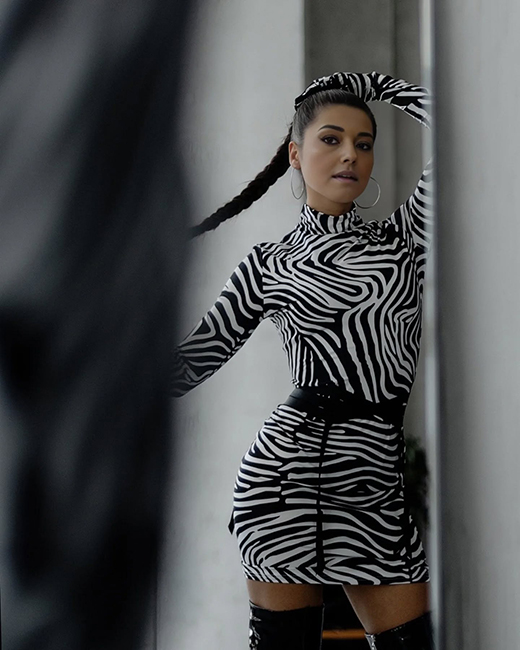






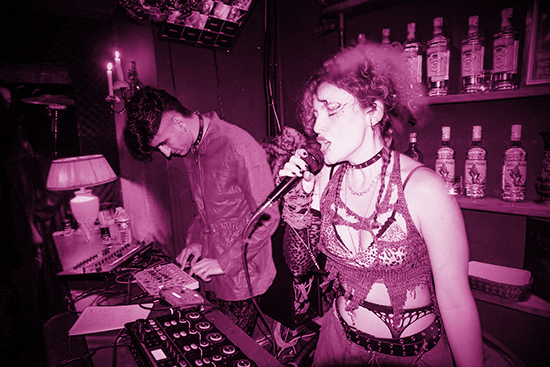
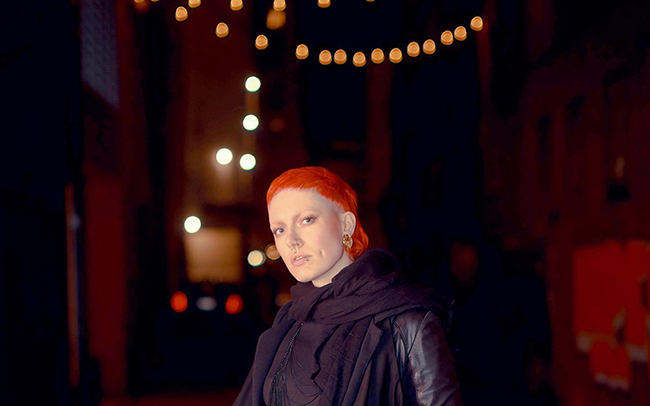


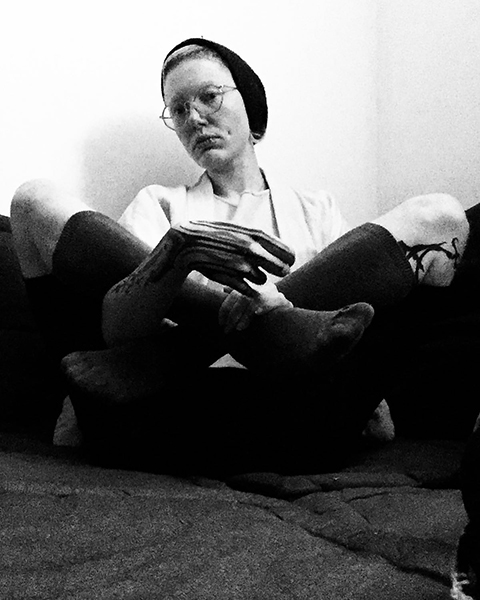
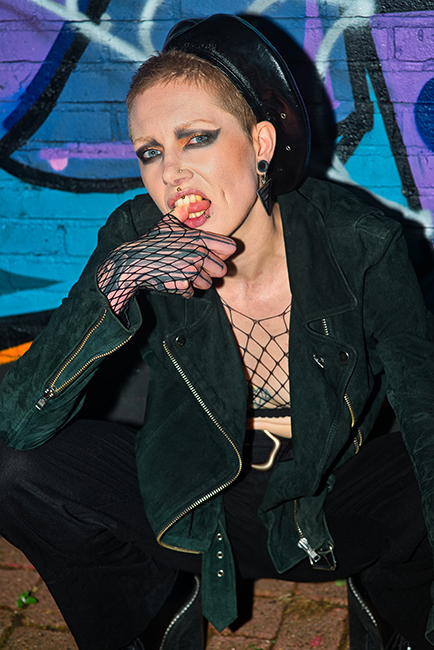

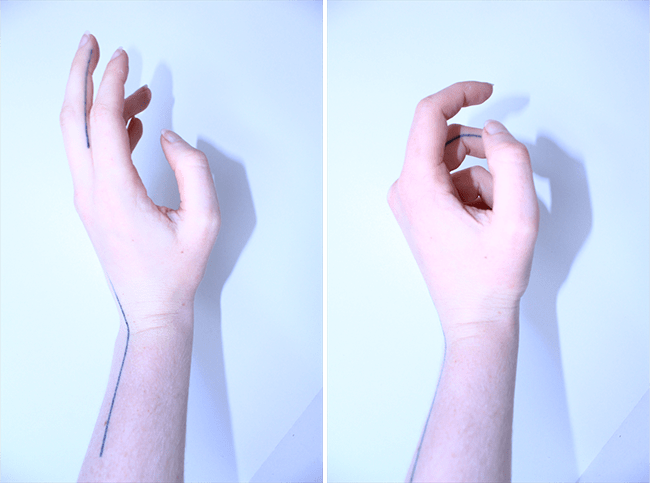


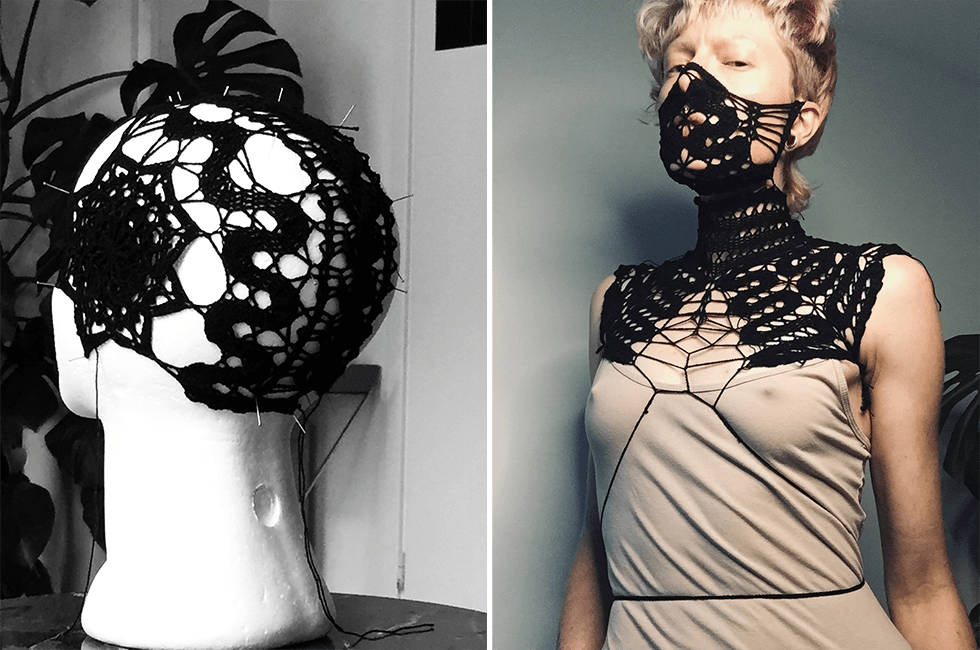
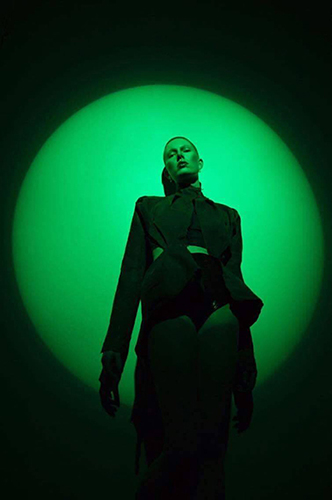

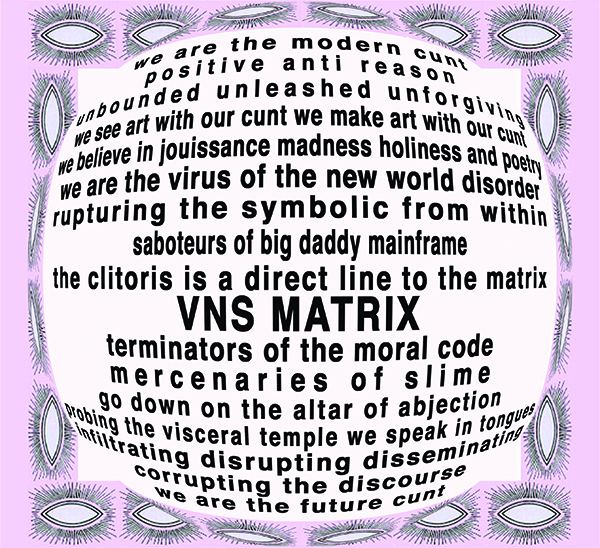
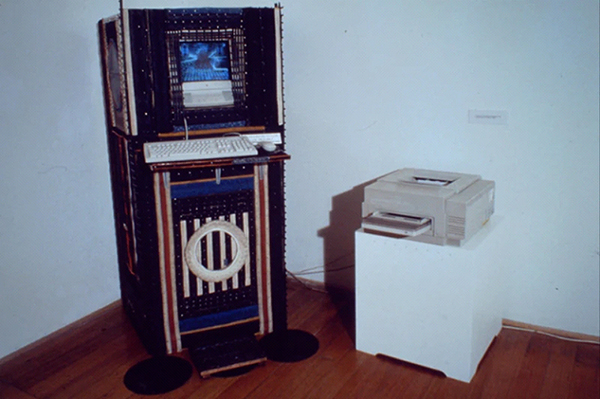
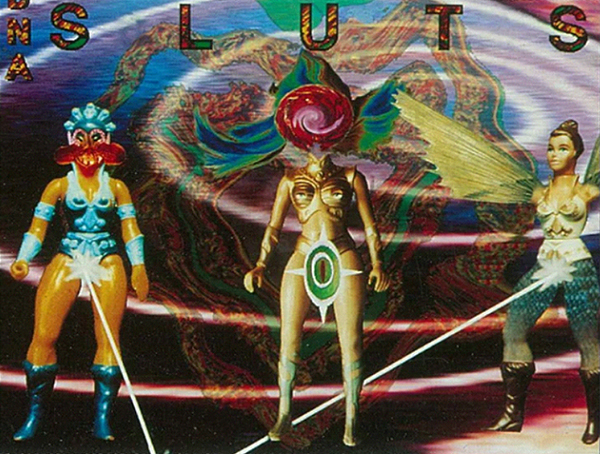

 LÖPÇÜK