
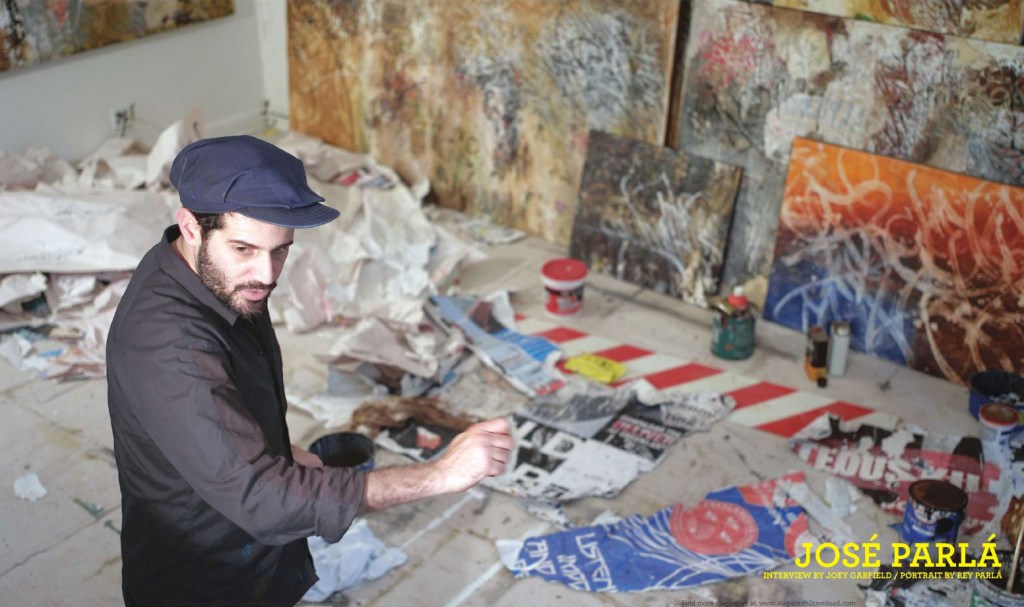
THERE’S AN ENERGY THAT EXISTS INSIDE JOSE PARLA BOTH CAPTIVATING AND INVITING. IT’S EVIDENT IN HIS EVERYDAY MANNER AS HE MEETS AND GREETS THE NEIGHBORHOOD PEEPS. AND IT’S METICULOUSLY SPLATTERED ACROSS HIS PAINTINGS WITH A HAND STYLE SO TIGHT IT’LL SNAP A CALLIGRAPHER’S QUILL.
It’s an energy that developed in the streets of Miami in the 1980s when hip-hop was also captivating and inviting. Now this energy’s internalized and thankfully materialized in Jose’s artwork as an elevated sense of an era both still here and long gone. If you were to succeed in deciphering the geography of his work, you would unleash a maze of memories linked to a Spanish-speaking kid growing up in Miami, running the name Ease across its walls, and dedicating his craft to bringing the outside in.—Joey Garfield
Interview by Joey Garfield / Portrait by Rey Parlá, Juxtapoz Dec. 09 / Video additional by IST’74
Joey Garfield: First off, tell me about your new show, Reading through Seeing.
José Parlá: That’s the title of my latest exhibition that took place in May in Hong Kong at the Ooi Botos Gallery in the Wan Chai district. The new paintings use calligraphic words to carry the meaning hidden within the gestural components in my work. The tangled words aren’t easily understood, even legible, most of the time. With the concept of Reading through Seeing I’m inviting the viewer to read the works through feeling, a different type of seeing, rather than just reading something literally.
I get what you’re saying. On a literal level reading is done through seeing, but personally as someone who’s a more visual learner, I feel I would have done much better in school if there was an emphasis on seeing more than reading.
We assume that all reading is done by following and interpreting the words in front of us, but in the language of visual arts the rules change, especially when a vernacular semi-abstract language is what we’re looking at.
It’s like looking at art by reading between the lines. I remember in art school my professor said that there’s a higher percentage of art students, more than business students for example, who are more likely to fail math classes like algebra and calculus because artists think geometrically.

“Looking back I feel we did everything right by doing it wrong.”
Aha! That makes perfect sense. Geometry was the class I sucked at the least. When you were a kid were you a good student, what was hard for you? The academics or the hallways?
I was a good student when I wasn’t breaking rules, but I enjoyed breaking rules so much that I spent a lot of time hanging out in the hallways. Looking back I feel we did everything right by doing it wrong.
Oooh. I got to write that one down. When did you come here trom Puerto Rico?
My family moved to Miami from Puerto Rico in 1983.
Why has your work been described as being abstract novels?
In my paintings I write about subjects that have meaning from my own life. Like one of my pieces, Brothers Back to Back, is about my brother and I growing up in the 80s in the cily of Miami.

Break down a painting like Brothers Back to Back.
I made Brothers Back to Back in 2006 and it took me a few months to make it. After a year of recollecting stones and experiences about the times that were most influential to me and my brother for making art, I decided to write or paint the piece like I’m writing in a diary. From left to right I began to write in a chronological manner the memories of growing up in Miami.
The words and sentences are layered over and over in order to privatize the words written similar to how a diary is pnvate of one’s thoughts. I think the painting has this intimacy in its locked, interwoven palimpsest of stories.
There are stories in it from how we got started doing art to how many times we came close to death.
My brother and I have been making art since we were kids, and while I painted Rey Parlá took photos of everything around us. We formed a lot of ideas together that come from good times and hard times alike. One day a gang from around my area surrounded our small crew while we were hanging out at their park drawing In our black books. When we looked up, we saw they had weapons.
It was at least 30 people, and one guy was ready lo jump us when his leader said, “Stop, these guys are artists.” From that point on the gang allowed us to use their park to do our art, as long as we didn’t bring any other gangs around.
They even offered us protection in exchange for art, like painting denim jackets or their girlfriend’s names or whatever. So there are stories like that in the painting, and also a story about me getting shot one night…

Huh?
There’s a story about police dogs attacking me. and the whole painting I made while playing a loop of a soundtrack I compiled of the music I grew up with.
Wait, Jose—wait—pause. You got shot? Who’d That’s a brother back to back, shoot you?
When I was 15 years old, one night my parents were going to a wedding and asked my brother and me to stay home. “Don’t go out,” they said, but did we listen? Hell no! Tuff Cew from Philly was playing a concert that night and we couldn’t miss that.
Actually, I never found out who did it, but I’m sure the people I caught a bullet from weren’t aiming at me. I was coming out of the concert that night and there was already chaos in the parking lot of the Hot Wheels Roller Skating center and things got out of control; fights, broken windows, people running, and the next thing I know my shoe looked like it exploded!
Where did you get shot?
In my foot.
That’s a low bullet path.
Yeah, well, I was running. I didn’t realize I was shot until I got far enough away to stop running so fast. Then they put me in a car, my brother put his Adidas jacket around me, and we went to the hospital. I remember telling him, “Yo, you’re going to ruin the jacket.” because I was bleeding everywhere.
That’s a brother back to back.
Yeah. That’s one of many episodes in the Parlá brothers story; it’s layers of stories for years.
Some aren’t so dramatic, some are about chilling, but sometimes I focus on the really cazy ones that stand out more in my mind.
ONE: Union of the Senses, a powerful and timely short experimental documentary film about painting with the same title: ONE: Union of the Senses by Cuban American artist José Parlá.
The film is inspired by Parlá’s centerpiece mural that now spans a staggering 27 meters in length and 4 meters high at the World Trade Center. Starring the people of New York as well as the painter himself, the film was screened at the 6th Annual Istanbul International Arts & Culture Festival (IST. Festival).
The film documents the painter’s gestures, ideas of unity, and creative process on location in his studio, as well as the artist traversing the city of New York and on-site, as he adds the final touches before concluding the painting’s installation.
This documentary evokes a combination of memories, history and a sense of place, yet looks towards the future by celebrating the diversity of the five boroughs of New York. Parlá states that it is his personal love letter to the city where he uses the full spectral abilities of the lens to view the daily life of New Yorkers, their resilience, and the strength to constantly create new meanings for the future.

It’s great you can remember stuff so vividly with dates and being able to look back and document visually. Is that what you mean by segmented realities?
One ot my shows m 1999 in Atlanta, Georgia, was titled An Experimental Introduction to a Segmented Reality. The name comes trom a Super 8 experimental film my brother Rey made in 1991.
I later made Segmented Realities a concept tor my paintings. I would photograph walls and use the viewfinder to crop a section ot wall.
From those photos I’d make paintings. Not photorealist replications, but just use them as inspirations. By framing a part of the wall you can see that the image goes way beyond the frame. My paintings don’t only exist within the rectangle or square of the frame, the composition goes beyond that.
So it keeps going and going?
It’s saying it’s part of something much larger. It isn’t confined. Each story’s connected to another. Some are mine; some are the world’s stories that I’m experiencing.
I know you like to use corroding material and actual pieces of walls, but are you using it as reference only or using it actually in your work?
Both. I’m looking at a pile of posters right now that I’ve been collecting over Ihe years. Some of it ends up reused onto my painting after I manipulate it and some I keep as I find them and frame them as ready-mades. I once collected a bunch of tiles I found in the Canal Street subway station in Chinatown and brought all those tiles back to the studio and made a huge installation to exhibit along with Italian artist Mlmmo Rotella (RIP).
What’s a corroded element that you like to recreate? Like say rust?
Rust or the color of rust? I’ll paint it with acrylic or oils and mixed media. A lot of the sluff I recreate I didn’t learn from art school or any other artist or anything. I’ve been panting for a long time so I’m familiar with all kinds of materials from just being around paint. You can play around a lot to get the colors of rust in many different ways, as well as textures to make colors work together in ways I could never imagine.
At the end of the day what I’m doing is painting what may look like weather damage or deterioration by using paint, sometimes using elements of real pieces from walls that also carry the maamng of its location. As in a painting I made in 1999 titled Pell Street.
A mini-documentary on the renowned Cuban-American artist José Parlá’s residency at ISTANBUL’74, which has culminated in his first-ever exhibition in Turkey, inspired by the word “ISTHMUS,” and consisting of a new body of works on paper, paintings, sculptures and ceramics that pay homage to a culture of masterful calligraphers in world history.
I wanted to give some attention to the scribe part or calligraphy style, that’s the flavor. Well, it’s all flavor, but it’s a very unique part of the painting.
I tell stories with my calligraphy style and sometimes I’m working with stream of consciousness metamorphosis. It’s a sort of a loose abstract poetic line, sometimes musical and lyrical as I paint with very loud music around me. I’m using the linear form of writing and the emotion of the story as a gesture that carries meaning inside of a painting that can be viewed as abstract or hyperreal; either way it’s up to the viewer. It’s an element of what happens. You know when you write your signature, sign a check, or a letter? Within the penmanship is a lot of personality and attitude. You know psychologists try to analyze a signature and can tell if you feel proud, sad. or schizophrenic.
What would people say of you?
I don’t know. I change up the style depending on the mood I’m in. I paint in every kind of mood I’m in because I feel each must be recorded. The signature as gesture is what gives it the flavor that you were just talking about. Whether you are a photographer or a sculptor, a painter or a filmmaker like yourself, your life experience will give the particular signature ot the slyle to your body of work.

Since this is The Barnstormer Issue, how was your experience with the crew painting collaboratively?
Painting collaboratively for me started way before the Barnstormers because writers collaborate. You go out with, like, four or five guys. One guy is a lookout, you may be standing on one guy’s shoulders, and he’s filling in the bottom while you’re filling up the top. You collaborate in sketchbooks, etc. Collaborating has been a part of my artwork from the beginning of becoming an artist.
The first time I met the Barnstormers was at the Smack Mellon space in DUMBO, Brooklyn. Wo Condition is Permanent was being filmed. David Ellis was there with Mike Ming. Che Jen, Rostarr, and a few people. I walked in with Chris Mendoza while we were pushing my old bike with a flat tire. They invited us to paint, and the next day we were in there as part ot the project. It was the year 2001 and it was an incredible time. This was just before 9/11. It was prophetic somehow. Everyone was making great stuff on that project from Jest, Steven Powers to Faile and many more.
The collaboration was only just starting at that point in a heavy way. We made trips together from New York to Puerto Rico to Los Angeles and Japan.
Parlá and Erden discussed everything from the beginnings of the artist’s practice with the writing crews of Miami and his multi-layered approach involving a dialogue with the cities and urban spaces he works in, to being inspired by calligraphy and various scripts, symbols and glyphs as well as dance and music.
I think the first time we officialy met was working on that wall up in Binghamton, New York.
I had jusl gotten back from Japan and flew like 14 hours. I got home and jumped on the bus with the rest of the guys. The work had already started so I painted a little bit. but chose to hangout more and sleep under a tree. A lot of people were pretty drunk and getting crazier every minute. That was an insane trip! Good meeting you, man.
What’s up with you now and what are you looking forward to?
These days I’m working harder than ever. Things are very busy so I’m painting everyday to prepare a solo show at London’s Elms Lesters Painting Rooms for 2010. I’m happy to be experimenting with sculpture and ceramics like The Japanese Bizen-yaki or making thirteenth century English slipware. I’m having fun with my colors, the paintings are changing and growing the more I travel to places like Tibet or Colombia, which really inspire changes in my painting process.
Coming up in the next few months I’m part of a group show during Art Basel with OHWOW Gallery in Miami. I’m also taking part in the Stages exhibition in New York wilh the Lance Armstrong’s LIVESTRONG Foundaton and Nike to fight cancer. That’s happening at Deitch Projects in Soho, and also with OHWOW at a downtown Miami location.
The New Grand Tour exhibition, which I was a part of in Hong Kong and Beijing, is also coming to NY this summer at the Bryce Wolkowitz Gallery in Chelsea. The show will feature Deanne Cheuk, Rey Parlá, Davi Russo, Suitman, Rostarr, and myself.
For more information about Jose Parlá, contact Joseparla.com / Juxtapoz
 LÖPÇÜK