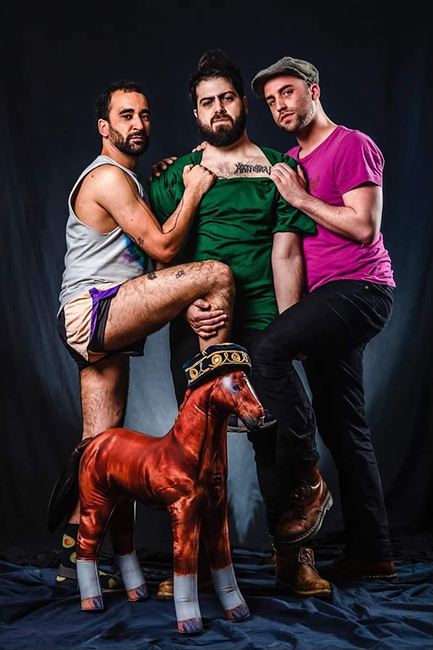
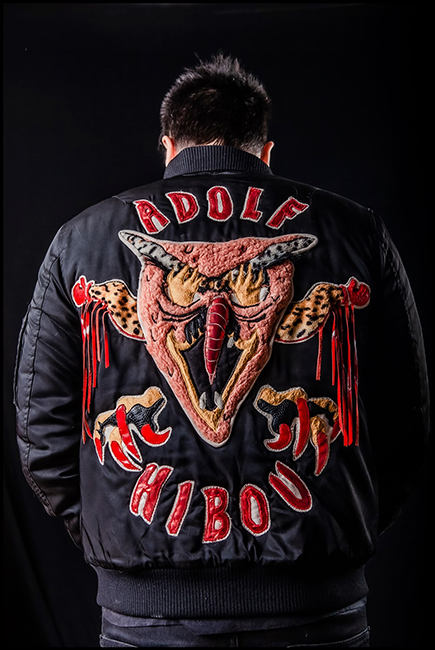
Adolf Hibou: Gaël Magnieux, Nils Bertho & Bruno Ducret. Photo by Arbre Payday (2021)
Vous aussi, vous vous complaisez dans vos préjugés ? Vous fuyez comme le Covid les groupes français aux noms à coucher dehors, les pochettes de disques camar-guaises et l’humour franchouillard se propageant dangereusement dans des titres de chansons tels que « Passion Saucisse » ou encore « Indochine, j’ai demandé halal » ?
Ne prenez pas encore vos jambes à votre cou et laissez donc sa chance à ce trio d’hurluberlus surexcités. Non, nous n’avons pas affaire ici à un groupe de rock alternatif. Le plus important, avec Adolf Hibou, c’est d’aller outre les blagues consternantes, d’ignorer les interludes débilisants et d’ouvrir les oreilles en grand. Une fois dépassé le triste constat semblant nous indiquer que « cette musique, c’est avant tout un gros délire entre potes, tu vois ?», force est de constater que non seulement ces mecs ont un sacré niveau technique – le guitariste, en particulier -mais qu’en plus de ça, lorsqu’il s’agit de lâcher la purée, ils ne se font pas prier. Quand le tempo s’élève, Adolf Hibou déclenche la foudre comme un Lighting Bolt partousant avec Boredoms. Ça explose dans tous les sens, ça s’égare pour mieux retomber sur ses pattes. Le groove concassé de « Ladyboys Don’t Cry » (sans surprise, ils brillent également en anglais dès qu’il s’agit de trouver un titre en tout point désolant) impressionne, et si ce long morceau avait été amputé de sa longue et si pénible intro, on l’aurait volontiers comparé à un autre groupe français farfelu et malheureusement quelque peu oublié (même si toujours en activité), j’ai nommé Double Nelson. Dommage, également, que l’on comprenne aussi bien les paroles du refrain de « Va chier dans ta mère », car là encore, la ligne de basse – ou de guitare baryton, plus vraisemblablement – tord le cou, alors que l’envolée free qui suit est digne des plus folles embardées des Molécules, la lourdeur et une louchée de sludge en plus. « Roum Roum Ah » se montre tout aussi euphorique, jovial comme savait l’être le Singe Blanc, un autre adepte de l’onomatopée échevelée. Quand le tempo tombe, Adolf Hibou se montre également capable du meilleur, se vautrant dans un doom dissonant mais tout aussi hypnotique. Le chant, quant à lui, navigue entre le dégueulis le plus total et des vocalises se rapprochant parfois du bramement du grand cerf de Kourgane, comme sur ce « Clodo de Boston » répétitif et prenant. Une reprise finalement pas si inattendue de Sun City Girls, « Dreamland », permet de confirmer que ces types ont baigné dans l’expérimental, la no wave et la freeture des groupes de John Zorn, Marc Ribot et Fred Frith. Et puisqu’on parle de rêve, autant signaler que la fin de cet album volontairement bordélique se montre on ne peut plus cauchemardesque, la mélopée de « dream my dream, my dreamy dream, dream my love, rêve ton rêve, rêve mon amour » pouvant légitimement donner des envies de meurtre. Après un tri sélectif nécessaire, Princess Barely Légal se révèle donc un plutôt bon album pour fouetter le sang et vriller le ciboulot.
Ressource: New Noise Magazine, 2022
Official animated short film directed by Hector Oriol & Thomas Romarin. Drawn collectively by 28 artists at the studio “En Traits Libres” at Montpellier, France, for the band Adolf Hibou. 2024.
ADOLF HIBOU – “Roum Roum Ah” from the album “Princess Barely Legal” – 2021
FREE-DOOM-NOISE
ADOLF HIBOU
‘Princess Barely Legal’
Do you too wallow in your prejudices? Do you shun, like the Covid, French bands with outrageous names, comradely record sleeves and franchouillard humor spreading dangerously through song titles such as “Passion Saucisse” or “Indochine, j’ai demandé halal”?
So don’t get your hopes up just yet, and give this trio of over-excited weirdos a chance. No, this isn’t an alternative rock band. The most important thing with Adolf Hibou is to get past the appalling jokes, ignore the debilitating interludes and open your ears wide. Once you get past the sad fact that “this music is all about friends having a good time together”, you have to admit that not only do these guys have a hell of a technical level – the guitarist, in particular – but when it comes to unleashing the mashed potato, they don’t hold back. When the tempo rises, Adolf Hibou unleashes lightning like a Lighting Bolt mating with Boredoms. It explodes in all directions, goes astray only to land back on its feet. The crushed groove of “Ladyboys Don’t Cry” (unsurprisingly, they also shine in English when it comes to coming up with a title that’s in every way desolate) impresses, and if this long track had been stripped of its long, tiresome intro, we’d have gladly compared it to another wacky and unfortunately somewhat forgotten (though still active) French band, namely Double Nelson. It’s a pity, too, that the lyrics to the chorus of “Va chier dans ta mère” (Shit in your mother) are so well understood, because here again, the bass line – or baritone guitar, more likely – twists the neck, while the free flight that follows is worthy of the wildest flights of Molécules, with the added heaviness and a ladleful of sludge. “Roum Roum Ah” is just as euphoric, as jovial as White Monkey, another adept of disheveled onomatopoeia. When the tempo drops, Adolf Hibou also proves capable of the best, wallowing in dissonant but equally hypnotic doom. As for the vocals, they veer between the most utterly disgusting and vocalizations that sometimes come close to the bellowing of Kurgane’s great stag, as on the repetitive yet captivating “Clodo de Boston”. A not-so-unexpected Sun City Girls cover, “Dreamland”, confirms these guys’ roots in the experimental, no-wave and free-form bands of John Zorn, Marc Ribot and Fred Frith. And while we’re on the subject of dreams, we might as well point out that the end of this deliberately messy album could not be more nightmarish, with the melody of “dream my dream, my dreamy dream, dream my love, rêve ton rêve, rêve mon amour” legitimately giving rise to murderous desires. After a necessary selection process, Princess Barely Légal turns out to be a pretty good album for whipping up the blood and twisting the brain. (Resource: New Noise Magazine, 2022)
Yüksek enerjili sahne performanslarıyla dikkatlari üzerine çeken Hipersona’nın temelleri 2018 yılının Nisan ayında Ankara’da atıldı. Önceki gruplarının 2018 yılının başlarında dağılmasından sonra pes etmeden müziğe devam etmek isteyen ikiz kız kardeşler Bilgesu Ünalan (Vokal-Gitar) ve Bengisu Ünalan’ın (Bas gitar-Geri vokal) yeni grup kurma fikirleriyle Hipersona kuruldu. Sonrasında davula Burak Cengiz geçti. Birçok festivalde sahne alan Hipersona, albüm kayıtları için 2018 Temmuz ayında İstanbul’da stüdyoya girdi. Burak Yıldırım prodüktörlüğünde kayıtları tamamlanan şarkıların mix ve mastering’i ünlü prodüktör ve davulcu Alen Konakoğlu tarafından Los Angeles’da yapıldı.
Hipersona – Satellite
Grup, Arpej Yapım etiketi altında yayınladıkları Uyan Artık isimli EP’si ve Geri Dön isimli parçası ile iyi bir çıkış yakaladı. 2019’da Milyon Fest ve 21. Rock Station Fest dahil birçok festivalde ve konserde sahne alan grup, Ağustos ayında İstanbul’da tekrar stüdyoya girdi ve 3 yeni parça kaydetti.
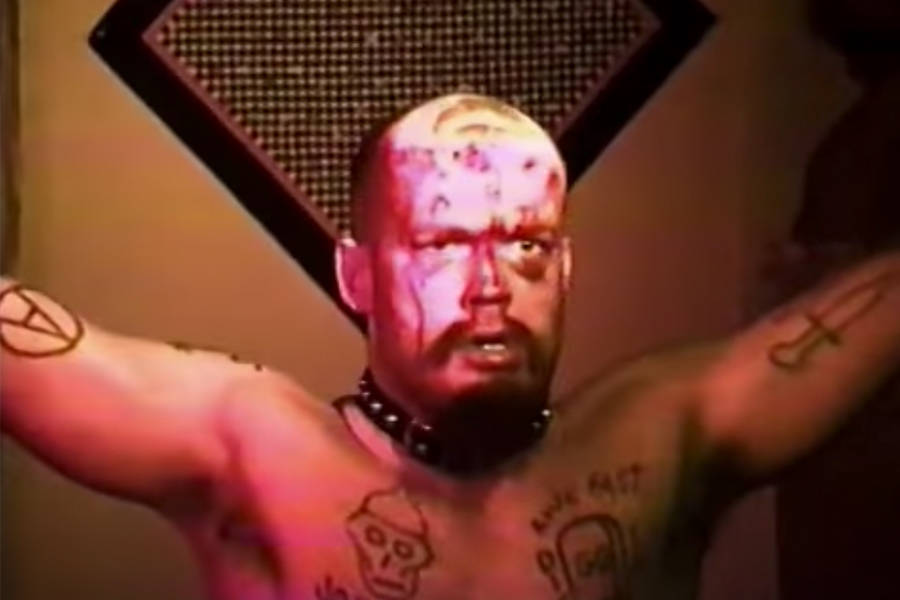
GG Allin in one of his controversial performances.
“I hate you motherfuckers”
Introduction
This essay will focus on an American Punk that both enlighted the spirit of rebellion which anarchy would take place in but also brought up a huge cinism: GG Allin who manifested himself as a part of an “image” throughout his body and the “hate” he possessed. GG Allin in The USA was a popular phenomenon with a non-discoursive punk attitute which included speeches of both self-awareness that turned into a cinism and self-reputation by using his own bodily rejections such as urine and feces. “I hate you motherfuckers” began to officialize his state of self-manipulation and he became one -or maybe the first- of the most hated artists of all time. It’s been officially heard from his own speech that the day he met rock’n’roll was a salvation which prevented him from becoming a serial killer. It is no coincidence that he received fan letters from the infamous serial killers whose positions within societies were highly related to the industrialization and idolization of the “other” as the modern day anti-heroes. GG Allin borrowed the same cultural influence by sloganising “legalize murder”. Still a hate against the members of a society would never prepare an enough space for a legitimate homicide in any sense GG Allin believed in. Was it a flashpoint when he started to reflect the anger to himself and the hate to his body?
GG Allin concerts were full of “artistically” self-mutilation that both affected himself and the audience. The throwing of his own feces to the face of an audience simply resulted with a lawsuit which has been lowered as killing rock’n’roll if he ever was sentenced. He simply declared that all his actions were licit as long as he really believed in that. Thus, his lowering continued as avoiding an artist to be put in a political context since “socio” was eliminated by self-oriented, lucid behaviours. That’s why GG Allin should be evaluated as a “body image” through the visual methodology of Panofsky which consists of pre-iconography, iconography and iconology. This method will contextualise the Punk attitutes which turned into a body image rather than a political discoursive commune.
Dr. Burak Bayülgen
GG Allin & the Holy Men ‘You Give Love A Bad Name’ LP cover
WHEN JUNKIES LEGALIZE MURDER
Pre-Iconography
Hated: GG Allin and The Murder Junkies (Todd Phillips, 1993) presented GG Allin from the public eye rather than judging his actions. The film stripped GG Allin from the comments which metaphorically covered up his body. Almost the whole film presents GG Allin in performance, naked and uncovered from the accusers. Phillips depanded on fans, long time drinking buddies and audience. The film saved GG Allin’s phenomena for the pre-iconography as if no over-voice has been dubbed onto his career. This leads the way from an undubbed representment to a critically approached “body image” in which GG Allin shall be deduced. This is an approach to see GG Allin through a reasonable eye, yet this structure makes his actions apparent to lead the way to iconology. Phillips’ film focused on representations of his artistic reality while avoiding the apprehensions of his hate against everything that were reflected and cinically submerged. The reflection of GG Allin as a non-discoursive artist will stick to Phillips’ film but the first part of this reading necessitates avoiding an over-voice.
Phillips structured his film from “what he did in front of people” rather than “how he is accepted”. As pre-iconography, GG Allin was nothing more than he artistically thought. Since GG Allin behaved in the name of rock’n’roll, he became a cornerstone that rather changed himself instead of his time and space. He did not offer a salvation but his short life submitted a kind-of-joy for the eyes of his fans, apoliticized from all the rules and regulations.
“He kept threatening to kill himself, yet he poured every ounce of himself into living his life to the fullest and doing it his way. He was committed to his art. Over the course of his life, he made numerous recordings, overcoming lack of money, lack of consistent collaborators, lack of anything even close to record label support. He recorded output ranges from catchy as hell songs like “I Wanna Fuck Myself” to sinister dirges like “Snakeman’s Dance.” He was unrepentant about everything he did. He was on a mission. And it ended too soon”.(Johnson, Richard, 2015: 5)
According to some of his fans, GG Allin was totally an idol that was on a mission. Nevertheless, even Phillips’ film does not determine the motivation of a fanhood and agglomerate a GG Allin fan with a punk music fan. That’s why the iconography should focus on how GG Allin treated himself and his body in terms of “hate”, “rock’n’roll” and “mission”.
The most significant part of iconography is the assumption of a discourse as an out-of-discourse. In other words, how did GG Allin extinguish the signs of a discourse into none? It requires 2 steps in which his lyrical themes are included.
The first step is to look at his body as an “image” which has been seen through the eyes of fans. He’s been treated as a fictious character who could be adapted into anything that is “other” than a leading artist. The anthology called Blood For You managed to do that:
“It’s not meant to aggrandize the man of apologize for the shit he did in his life. It’s designed to put this character that had no place in the real world into worlds where he makes sense, and maybe to make sence out of who he was”. (2015: 5)
The Second Step is to attribute a fantasy that refers to any other arts. The image is so loaded with fantasy that his licit attitutes make sense as if they were fictious. GG Allin’s image is not only the rejection of urine and feces but a rejection and apoliticization of real-time/space. GG Allin’s image becomes fictious if the punk attitute has been drawn out of a political context which brings out toleration and endurance of his stage acts.
Iconography’s schematics lead their ways to look at GG Allin in terms of visual methodologies such as artist-artwork-audience relationship in which the audience take part in both iconography and iconology. As Greenberg stated for Pollock paintings, the kitsch was where there was no other explanation beyond the viewing or every viewers would feel the same. Out of his performative characteristics, GG Allin’s visual body was kitsch that could not complete itself to a camp behaviour. He broke his teeth with the microphone, hurt and cut himself with razors, injected microphones and bananas to his anus. He intended to rape his female audiences. He shit and smeared. All these actions were beyond an explanation and were self-mutilations of a body image that was viewed but not interpreted as if reading a newspaper by hearingly repeating the slangs “who cares?” or “suck it then”.
Iconography is also related with the context of his music. Since most of his recordings were poorly produced in audio quality, he performed music from punk to spoken word, from rock’n’roll to country. He gave stand-up shows and most of them resulted with brutality. He stood as if he convinced to say something to his audience, but he only burned newspapers which he read and attacked his female audience which resulted with being attacked by her boyfriend. The repetition of words “hate”, “fuck”, “scum”, “die”, “myself”, “ass”, “cock”, “suck”, “shit” in almost all of his songs still make no sense out of slang, self-mutilation and cinism. These songs refer to end his own self rather than ending a society or a commune. Whenever he had a message to convey, it consisted the words “fuck it, suck my cock, die” as a formulation. His disbelief in any authorities applied every outlaw casts to himself and only left a few of them to the audience. His defense against “killing rock’n’roll” prevented him from flapping and as much as he flapped, rock’n’roll survived beyond authorities.
“GG Allin is like a cartoon character – a horrible, obscene cartoon character with a rich history of fucked up behaviour and a messiah complex, not to mention all the cum, shit, self abuse and abuse of others. He’s got an army of obsessive fans that is balanced out by those who hate and deride him”. (2015: 4)
Iconology
Iconology strips GG Allin from the time/space of a fantasy in which the toleration of a devoted fan took place both artistically and visually. To give him an extra-diagetic life brought him an utopian safety to ensure his extreme actions. That was the moment when punk attitutes made sense in GG Allin’s context. His lyrics made sense unless they were not applied to a fantasy. Then, he became a flashpoint of where and when everything had possibilities like “legalizing murder”. His fans stated that GG was their God, yet, it was still the fantasy which was applied to their self, rather than a consciously focus on politics. Hated did a great work which apoliticized GG Allin from his fans’ discourse. The film did not bring out a determinist basis for becoming a fan who wanted to be apoliticised from the discourses they have been embarked. That was how the audience perceived GG Allin as if as much as they see GG Allin and apoliticize them from a discourse, they see themselves away from the politics of the environment that sorround them and dominantly embarked on them by governments, states and nations.
“As GG Allin stated in the mass media’s populer phenomenia on serial killers, he is a cartoon character to whom mass audiences follow, like and enjoy. He preached violence, but was almost always polite and respectful offstage. In some interviews he was soft spoken and thoughtful, while in others he was clearly putting on a show. He happily invited as many punches as he threw”. (2015: 4)
Hated: GG Allin and The Murder Junkies (1993) documentary
Conclusion
This essay has evaluated GG Allin as a non-discoursive artist despite his actions meant much for his fans. In order to determine a “non-discoursive” statement, GG Allin has been taken as a “body image” that required perspectives of pre-iconograpy, iconography and iconology. Pre-iconography followed Hated: GG Allin and The Murder Junkies’ structure to present him as the object of an eye without an over-voice. Iconography part took his actions and his lyrical themes to a level of fantasy which staged him to a fantastical view rather than politically acquired. The artist-artwork-audience framework has been given in terms of artist-message-receiver but the body image of GG Allin has only been what it was seen without an interpretation. Finally, iconology stripped GG Allin from all the real time/space to create him in a world of cartoon in which the toleration for his actions took place.
RESOURCES:
Bal, Mieke (1996) “Reading Art?” In Generations and Geographies in the Visual Arts: Feminist Readings, G. Pollock (ed). London: Routledge, pp. 29-52.
Barthes, Roland (1977) “The Rhetoric of the Image.” in Image-Music-Text, S. Heath (trans.) Glasgow: William and Collins and Sons, pp. 32-51.
Blood For You; A Literary Tribute to GG Allin (2015) Ed. Johnson, MP, Sam Richard, Weirdpunk Books.
Foucault, Michel (1978) “The Incitement to Discourse.” In The History of Sexuailty, Vol. 1. New York: Pantheon Books, pp. 17-35.
Rose, Gillian (2001) “Discourse Analysis I-II.” In Visual Methodologies. London: Sage, pp. 135-186.
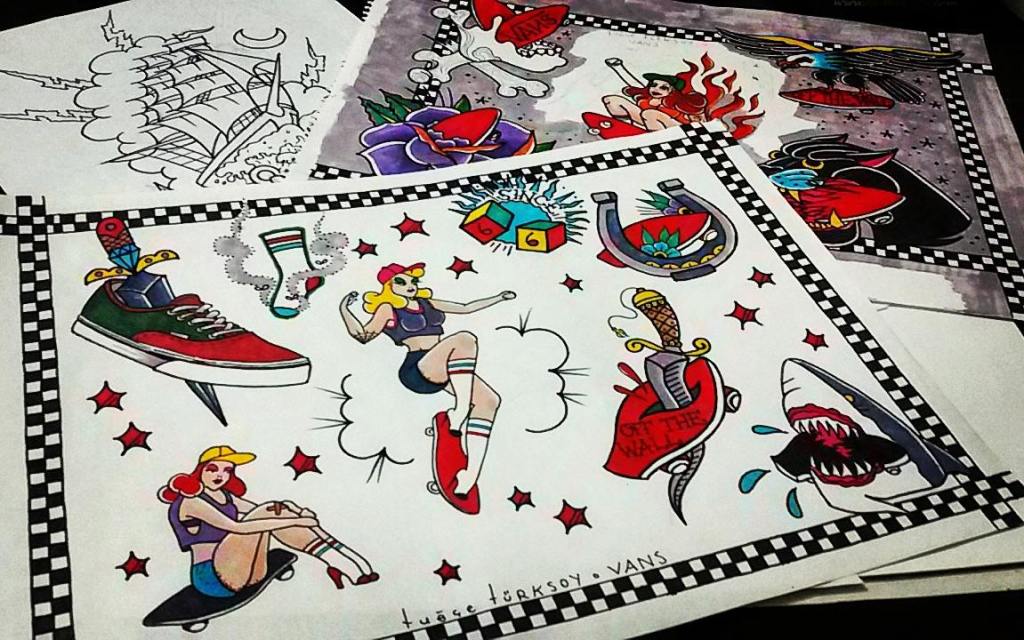
Tuğçe Türksoy, King of Ink Tattoo Studio, İstanbul (2016)
“Müşteriler bizim daha hijyenik olduğumuzu, elimizin daha hafif olduğunu, daha hassas çalıştığımızı görüyorlar ve dolayısıyla daha rahat davranıyorlar. Bu işe ilk başladığımda ülkemizde kadın dövmeci pek yoktu, sanıyorum ben de sektördeki ilk kadın dövmecilerden biriyim. Geçtiğimiz senelerde kadın dövmecilerin sayısı gittikçe arttı ve bu durum bizleri gerçekten sevindiriyor.”
Love Hurts
King of Ink dövme stüdyosunun sahibi Tuğçe Türksoy, 1989 Ankara doğumlu; Hacettepe Üniversitesi Güzel Sanatlar Fakültesi mezunu. Dövmeye olan tutkusu ve arkadaşlarının da ısrarına dayanamayarak 2007 yılında dövme makinesini eline alıyor ve 2010 senesinden bu yana profesyonel olarak bu işle uğraşıyor. Tuğçe, bir kadın olarak dövme sektöründe çalışmanın zorluklarından ziyade faydası olduğunu dile getiriyor.
Tuğçe Türksoy, King of Ink Tattoo Studio – İstanbul (2015)
Dövme Stilleri
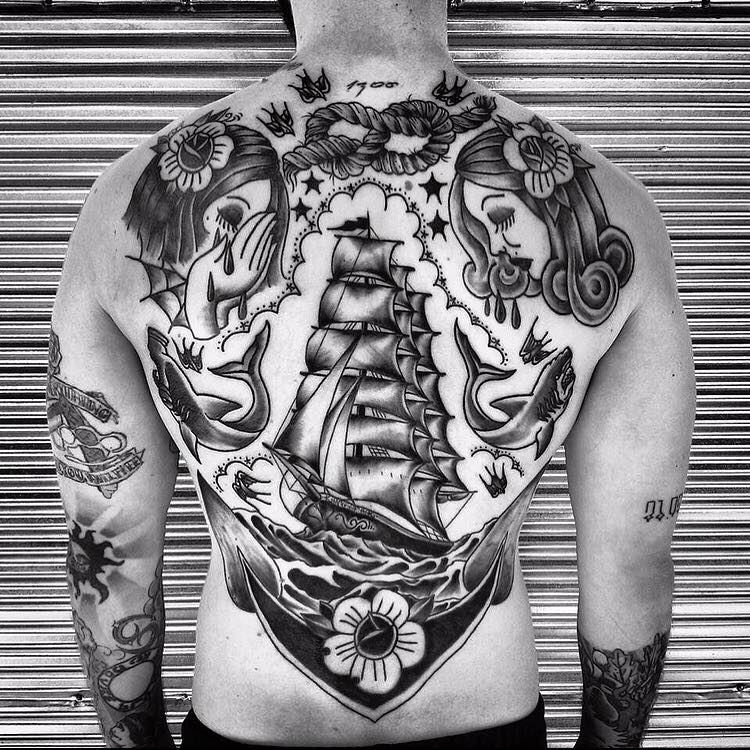
Geleneksel Amerikan dövmeleri olan oldschooldenizci dövmelerinde çapalar, kırlangıçlar, gemiler, boks yapan erkekler, güzel çingene kızları gibi klasik figürler kullanılıyor ve kalın çizgilerle işleniyor (ince tercih edenler de olabilir). Bu dövmeler denizcilerin hayatlarını anlatıyorlar: Örneğin ‘kırlangıç’ figürü, geminin karaya yaklaştığı günü, kırlangıçların görünmesi ve eve dönüşü, ‘çapa’ ise sadakati sembolize ediyor. Bunun dışında neo-traditional dediğimiz bir tarz var. Bunun için oldschool‘un yeni versiyonu diyebiliriz fakat daha karmaşık ve karanlık formlar barındırıyor. Ayrıca ön planda kalın çizgilerle figürün, ardında sulu boya lekelerin uygulandığı Sulu Boya dövmeleri de bu sıralar çok moda.
Trash Polka denilen tarzda ise figürlerin arkasına daha çok fırça darbesi uygulanıyor. Üstünde daktilo yazıları veya karanlık figürler tercih ediliyor. Çoğunlukla Kırmızı-Siyah veya Mavi-Siyah gibi çift renkler tercih ediliyor. Yine 90’ların modası Tribal dövmeler‘imiz var: Sert ve siyah dövmeler bunlar; özel bir anlam taşımayan estetik modeller. Bunun dışında noktalama dot-work ve çizgileme ‘linework’ dediğimiz yeni nesil dövme tarzları da mevcut. Bu tarz dövmelerde daha çok doğa manzaraları yapılıyor; geometrik bir şeklin içine dağlar, ormanlar, nehirler gibi çizimler yapılıyor. Bunların dışında klasik dövmeler var: Çok tercih edilen Atatürk imzası gibi. Yazılar, sonsuzluk işareti, kanatlar, kelebekler, melekler ve periler insanların en çok tercih ettiği figürler arasında ve bunlar hiç bir zaman eskimeyecek gibi; ama birer klişe olduklarını da unutmamalıyız.
“Ülkemizde dövme sektörü gittikçe gelişiyor, genişliyor; son yıllarda çok yetenekli dövmeciler gün yüzüne çıkıyor, sektörün önünü açıyorlar, insanlar dövme sanatına daha bilinçli yaklaşmaya başladılar. Her yıl çeşitlenenen bu organizasyonlar sayesinde daha da güzel şeyler olacağına inannıyorum.”
Ayça Ay Anlatıyor:
İlk gençliğimde dövmelerim dikkat çektiği zaman insanların bakışlarından rahatsız olurdum, sonra kendim gibi doğal davranmaya başladım ve hiç dikkat çekmediğimi farkettim. Hepimiz aynıyız, ben de bahçe suluyorum, yemek yapıyorum, ağlıyorum vs… 2012 yılında amatör olarak dövmeciliğe adım attım; dövmeciliğin yaşam tarzımdan ödün vermeden kendim olabileceğim bir meslek olduğunu farkedince zamanla ciddi anlamda çalışmaya koyuldum. Güzel sanatlar lisesi mezunuyum, üniversitede iç mimarlık okudum ve resim bölümünde öğrenciliğe devam ediyorum.
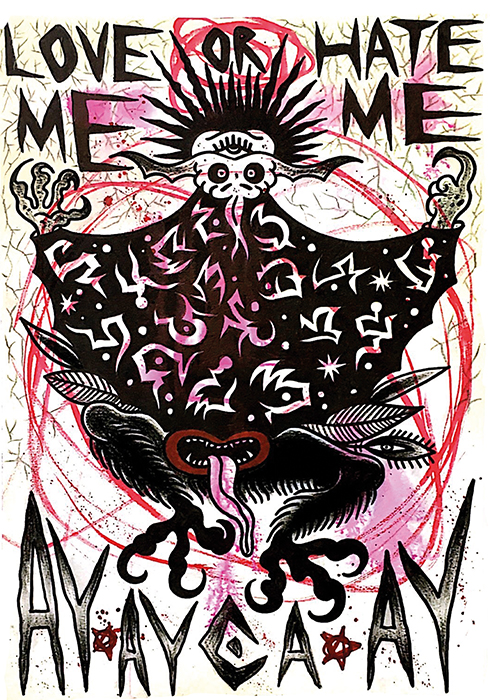
Ayça Ay ‘Love or Hate’ 2020
Dövmeciler olarak farklı dertlerimiz var ve bunları çözmeye, yansıtmaya, anlatmaya çalışıyoruz.
İnanılmaz detayları olan bir iş, ve yaptığın işi iyi yapmak istiyorsan her şeye hakim olman gerekiyor. Ben usta-çırak ilişkisinden yanayım. Eli biraz boyayla pislenmiş, kağıtlardan kesikler yemiş ya da kafası farklı çalışan yaratıcı insanların bir çok şeyi becereceğine inanıyorum.
Temiz ve steril olmak öncelikli prensibimdir, bunun dışında insanlarla olan iletişim var. Bir çok insanla yakınlık kuruyoruz, özel bir iletişim halindeyiz ve bu çoğu zaman ciddi bir yakınlık oluyor. Eminim her dövmeci, kendisi için farklı prensipler geliştirmiştir. Benim prensibim iletişim kuramayacağım, anlaşamayacağım bir kimseyle asla çalışmamak. Dövmelerimde renk kullanmaktan ve stil olarak gerçekçi, hiperrealist üsluptan uzağım; Bunun yerine kendinden emin, sade çizgiler, savaşçı, büyücü ve şifacı özelliklerimizi gösteren tribal modelleri tercih ediyorum. Herkese hitap eden bir tarzım olmadığının da farkındayım ve dolayısıyla seçkin bir azınlığa hitap ediyorum.
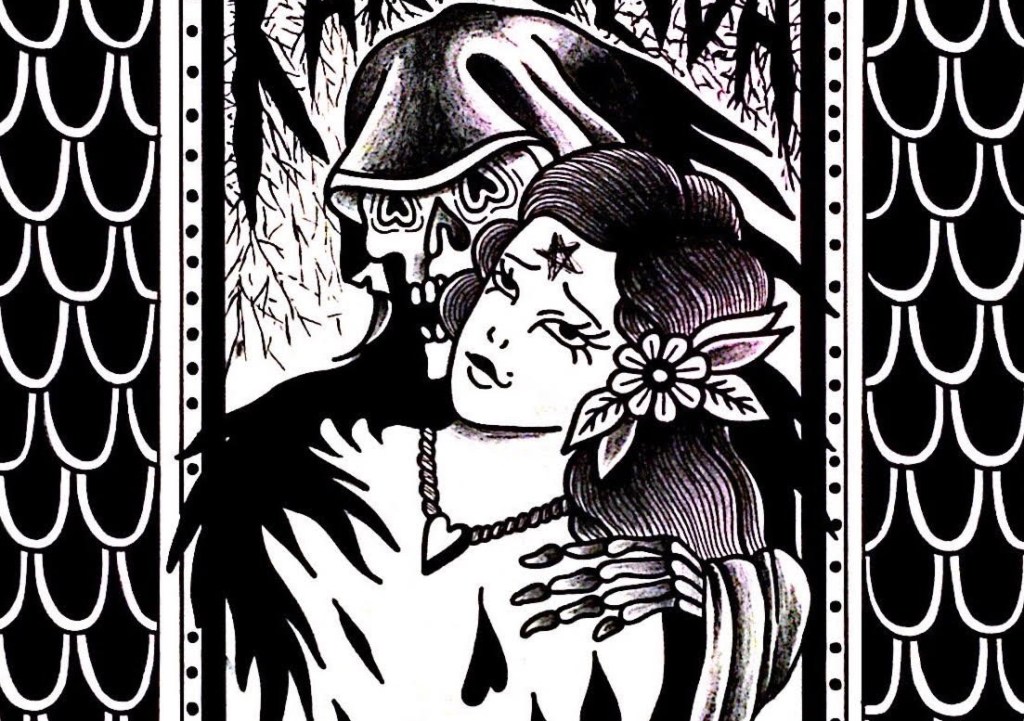
Ayça Ay ‘Devil’, ‘Kara Sevda’
Ülkemizde dövme sektörü gittikçe gelişiyor, genişliyor; son yıllarda çok yetenekli dövmeciler gün yüzüne çıkıyor, sektörün önünü açıyorlar, insanlar dövme sanatına daha bilinçli yaklaşmaya başladılar. Her yıl çeşitlenenen bu organizasyonlar sayesinde daha da güzel şeyler olacağına inannıyorum.
ADOLF HIBOU : Gaël Magnieux, Bruno Ducret & Nils Bertho. Photo by Arbre Payday (2021)
Here is the occasion to discover Bertho’s monstrous bestiary, his hybrid world in which he enjoys playing with a confusing humour.
Based in Montpellier, France, Nils Bertho is a young artist exploring the confines of artistic expression around drawing, painting, comics, illustration, collage and music.
Nils Bertho’s paintings and illustrations are packed with information: each piece created by the artist simoultaneously display different plots, references and characters. Although both expressive and spontaneous, the work pays great attention to detail and the spaces of each work are meticulously worked. Thematically we see a universe populated by fabulous beings, with equal doses of tenderness and repellency, if we look more carefully these creatures are in the middle of some dialogue, an adventure. Different interactions seem to be happening simultaneously and intertwining. In the referential field of Nils, television characters and mythological figures occupy the same space of alchemical energy, after all the electronic monsters of today come to fulfill the same expectations and emotional effects that the gargoyles, the dragons or the mermaids played at their respective genesis and time. In addition to addressing a wide iconographic universe, Nils Bertho expands his vision to different supports and media. For example the “Passion Cheval” series, where the artist plays with the Dada principle of embarrasment: posters and printed images of horses are covered with paint, word games and clichéd thoughts reinforcing its own absurdity. Music also occupies a significant place in the world of Nils Bertho. Adolf Hibou, formed along other individuals is noise emsemble described by the artist himself as “a noise punk powerful tender and brutal boys-band”. In the following conversation the artist tells us about his beginnings, interests and A.H.
Resource: Leonardo Casas / TINYSTAR Nº2 oct 2020
Nils Bertho ‘Mascotte Celebration Futur Trepas’ ink on paper, 2016
Nils Bertho ‘Yokai Arena’ 2021
In his drawing work, representing his own themes and obsessions. The artist shows us in different sizes and supports various things, switching from a style to another through graphic improvisations with meticulous and mastered lines with the finest Rotring pen or big felt pen that stains. The pleasure of surprising leads Nils Bertho, and for him, artworks bring about pure emotions. Punk, underground comics, raw art, cinema bis, all in reference to bad taste make the net of his own universe. Here is the occasion to discover his monstrous bestiary, his hybrid world in which he enjoys playing with a confusing humour.
Nils Bertho, ink on paper, 2016
Genç Fransız sanatçı Nils Bertho, Güney Fransa’da, Montpellier’de işlettiği galeri Le Mat’ın yanı sıra Rifuel-Fanglant dergisinin de yaratıcısıdır. Bertho aynı zamanda şarkı söylüyor, erkeklerden oluşan gürültülü rock’n roll grubu Adolf Hibou’nın bir parçası olarak performanslar sergiliyor ve farklı sanatsal disiplinlerde aktif. Bertho, çizimlerinde kendi temalarının ve saplantılarının peşinden gidiyor. Sanatçı, bizlere farklı ebatlarda eserler sunuyor ve farklı sanatsal disiplinlerle ilgileniyor. Grafik doğaçlamalar üzerinden Rotring kalemlerle ya da fırçayla yarattığı dikkatli ve ustalıklı çizgilerle stilden stile geçen Bertho’yu, izleyicileri şaşırtma güdüsü yönlendiriyor ve Bertho için sanat, saf duyguların aktarımı anlamına geliyor. Punk müzik, yeraltı çizgi romanları, ham sanat, cinema bis, her kanaldan ‘kötü zevk’e referansta bulunarak Bertho’nun kişisel evreninin yekününü oluşturuyor.
ADOLF HIBOU “Roum Roum Ah” 2021
Meetings with other artists who have chosen the same way since we often speak the same language and collaborations are a way to meet and share our passion.
Drawing the Rock’n Roll
TINYSTAR: How did you get involved into the arts? Could you describe a little the context where you created your first pieces?
NILS BERTHO: I’ve been drawing since I was a kid, from what I remember I always kept in mind that I wanted to do this. There are a lot of things to discover in this world and sometimes it’s strange to think that I follow my way just drawing all night long in a cave, but to be a cave draftman it’s basically the thing that makes me the happiest. My father was a scenographer and my brother was interested in comics, graffitti and 3D, it probably played a role. My passage through the School of Fine Arts confirmed this feeling that I wanted to live from my passion. That’s where I created my first pieces which were spotted and exhibited by galleries and I exhibited in France and abroad. When I got my diploma and I opened a gallery-concert space: “Le Mat”, that’s where I started in this way.
At your website there are so many art pieces displayed. You put a lot of attention to detail and there are many references to pop culture and current affairs can be seen besides I have seen videos, performances, How do you describe your artistic process?
I work essentially on feeling in everything I do and I chose to go in all directions, all at the service of a creative energy and drawing is the backbone in all that.
How do you define “underground art” in these days?
I think it will always be defined by the concept of DIY.
How important to you is the collaborative creation process?
Fanzine art, silkscreen printing, illustration or punk rock are not the easiest ways to earn money, but living from what you love remains a luxury for me and one of the positive points of this life is the meetings with other artists who have chosen the same way since we often speak the same language and collaborations are a way to meet and share our passion.
Is there any particular artist that deserves your attention these days?
Yes a lot. I particularly admire the compulsive artists whose profusion of practice is steadily like the French artist Stephane Blanquet or the Japanese Shintaro Kago and I take this opportunity to pay tribute to the work of Daniel Johnston who died this year.
Tell us about the witchcraft tutorials codex
“Les Tutos Sorcellerie, Le Codex” (witchcraft tutorials, the codex) is a project started last year. The starting idea is to create drawings “with 2 hands” in collaboration with cartoonists and artists that I like, some known, some not, some are also friends. The goal is to develop an artistic collaboration and a meeting around the esoteric theme. The codex compiles 66 artists: 66 collaborations: 66 pages. The book will take the form of a large ancient grimoire, beautiful paper, a leather cover… It will be released in January 2021 edited by Sarah Fisthole and Le Mat.
ADOLF HIBOU – “Indochine j’ai demandé halal” (Official Music Video) 2022
AxHx photo : Arbre Payday
From Jazz to Noise
With Bertho: ADOLF HIBOU
TINYSTAR: What about Adolf Hibou, how long you been playing? Who are the band members?
I scream in Rock bands since I’m 20. With the guitar player Bruno Ducret, we’ve been playing together for ten years now, in various bands, but Adolf Hibou as it is with the drummer Maël Gagnieux exists since 2014.
Describe Adolf Hibou musical approach? How many recordings do you have?
Adolf Hibou is a noise punk powerful tender and brutal boys-band We’ve put out our first joke album in 2015, entitled “Deep inside your eyes”, with Linge records. Some of it can still be found on Youtube, and the label’s page, but all that’s left of it are mainly jokes. After that we made à 3 track LP with Ascèce Records in 2018 called “Satan II”, that is still available on tapes and vinyls. The first real Adolf Hibou’s record “Princess Barely Legal” will be out next fall, thanks to Head Records. It will be about 12 tracks long, with a few jokes left in it. Videoclips are on the way too!
Is there any concept of the band linked to your artistic approach? If any would explain it?
In the end, this band is a merger between our 3 different universes. We mostly want to play loud walls of sound, and have a whole lotta fun. We all met in fine arts school, this band’s identity is thought through as an artistical concept that unites all of our savoir-faire and medium: Bruno has a lot of bands, maybe 15.. from jazz to grindcore.
Maël is a contemporary performer, a video editor and a musician in traditional music ( Medieval and Cajun) and me, I have absolutely no musical education, but who cares. For the band it kind of works, Bruno takes care of sound, band practice and logistics, Maël takes care of vidéo clips and trailers, and I’m in charge of booking and visual identity. And with all of this organisation, we still manage to fuck up everything we do.
ADOLF HIBOU – “Dreamland” (Official Music Video) 2021
“J’ai aimé (et aime toujours) cette fin des 70’s parce que je découvrais la pop le rock en même temps que la révolution des punks, et j’ai plongé dans cette frénésie qui m’a accompagné longtemps. J’ai eu beaucoup d’émotions avec ces musiques, ces groupes, la presse rock, et j’ai découvert ces drôles de petits livres, ces revues bizarres d’images. Et surtout : moi aussi, je pouvais faire des dessins dans ce qui ressemblait à des livres.”
Comment nous expliquerais-tu le début de ton aventure de l’art? Comment cela a-t-il commencé?
Bonjour, Erman, j’ai commencé à dessiner quand j’étais petit, faisant des bandes dessinées de Tarzan, des dessins d’humour, sur du papier jaune que mon père rapportait de son bureau. Je n’ai jamais arrêté. Je lisais des bandes dessinées, des livres de contes, et des romans, plus tard : ça m’a nourri pour dessiner.
Tu as étudié à l’Académie ou bien tu as tout appris toi-même?
Aucune académie pour ça : j’ai eu des dessinateurs-fétiches (Serge Clerc, à travers Métal Hurlant, Bazooka Productions, Mark Beyer plus tard, Daniel Clowes bien plus tard, Kerozen, Colas Meulien, Raymond Pettibon, Loustal, Pyon, les gens de Krapaud Baveux, Pigassou, Y5P5, Caro, Swarte, Ever Meulen, Koechlin, Charlie Schlingo, il y en a trop, Munoz & SAmpayo, Placid & Muzo, Captain Cavern, Windsor Mac Kay pour les plus mainstream, hohoho…). Je n’ai jamais « appris » à dessiner, je n’apprends pas comme ça. Dans ma vie (ma tête), les dessinateurs en question sont des rockers, des postiers, des bibliothécaires, sans style vestimentaire, souvent : leur intérêt est dans leurs dessins, mais ils pourraient être musiciens (dans le genre de ceux qui pullulaient dans les 70’s/ 80’s, à travers le rock et ses dérivés, hybrides, ses mutations) et leur vie est banale ET fantasque. J’ai intégré une fac d’arts en 83-84, où j’ai absorbé beaucoup de choses nouvelles et excitantes pour moi, mais peu travaillé : on s’amusait beaucoup, les retombées du punk n’en finissaient pas, le rock était partout, de pleins de couleurs bizarres. On écoutait plein de rock 60’s, 70’s, Punk, tout, du Blues, Throbbing Gristle, Donovan… Scott Walker… Radio Birdman…
Une illustration de Daniel Azélie
“Mais aujourd’hui, il est difficile de travailler pour la presse (bien que j’aie travaillé pour le quotidien Le Monde pendant 6 ans, par exemple, illustrant des articles sur des musiques, des questions de société, cinéma, littérature… entre 1995 et 2001 : ça, c’était intéressant !! Je recevais un fax avec l’article du journaliste, j’écoutais les musiques en question, et dessinais, sans brouillon comme toujours, et je gagnais, à l’époque, la valeur de mon loyer mensuel avec 2 dessins par mois !), me semble-t-il.”
Comment tu travailles en général? Comment est ton style ? Est-ce que tu distingues tes oeuvres comme « des dessins de style libre » et « des illustrations professionnelles »?
Je dessine « à volonté », mais aussi par entrainement à dessiner. Je ne fais les choses que je fais que par instinct. Je travaille comme ça. Je dessine ce que j’ai en tête, ce que j’ai envie de dessiner : des situations ou des objets, des collisions de choses, d’idées, de mots, des associations, des prétextes à dessiner. Des pseudo-histoires. Ce qui m’importe, c’est dessiner > j’invente des prétextes.
Mon style ? Je ne sais pas du tout répondre, là. Mes dessins sont libres, et j’ai aussi dessiné pour des magazines, des journaux, des agences de communication, des éditions. Mais aujourd’hui, il est difficile de travailler pour la presse (bien que j’aie travaillé pour le quotidien Le Monde pendant 6 ans, par exemple, illustrant des articles sur des musiques, des questions de société, cinéma, littérature… entre 1995 et 2001 : ça, c’était intéressant !! Je recevais un fax avec l’article du journaliste, j’écoutais les musiques en question, et dessinais, sans brouillon comme toujours, et je gagnais, à l’époque, la valeur de mon loyer mensuel avec 2 dessins par mois !), me semble-t-il.
Une illustration de Daniel Azélie
“Internet permet la circulation instantanée des créations, partout, tout le temps, mais/et beaucoup d’apathie se crée via les réseaux sociaux (par une surabondance de livres, musiques, arts, textes, informations, produits à vendre, états d’âmes : tout est mis au même niveau, le désir s’émousse). L’absence de désir, c’est ça, le problème : on regarde et commente plutôt que faire des choses. Personnellement, je préfère m’amuser, monter sur les toits, faire le mur la nuit, courir dans les rues.”
Ainsi tu es dedans la musique, peux-tu nous parler de tes travaux dans des autres matières comme la musique et le théâtre?
Oui : j’ai depuis longtemps aimé avoir des instruments, j’en joue comme je dessine : pour jouer ! J’adore les instruments, vraiment. Mon rêve est de former une fanfare d’amateurs, des débutants enthousiastes qui composent et jouent des choses inventées comme des dessins, pour le plaisir de jouer. Des musiques joyeuses, intriguantes, mystérieuses, épiques ou minuscules. Le théâtre, je n’ai jamais été formé pour ça non plus : avec ma sœur d’adoption, nous avons une compagnie de théâtre « documentaire », où j’a appris à travailler « sur le tas » : faire des images sur scène avec des systèmes bricolés ou numériques, des caméras, imaginer les scénographie, les réaliser, travailler avec des comédiens, circassiens, acrobates, danseurs, conteurs. On met en scène des spectacles après des « enquêtes de terrain », interviews, prises de vues, sur des questions humaines, sociales. Voilà, pour faire court. J’adore cette activité et l’élaboration de langages scéniques, visuels, sonores. Les sons m’accompagnent depuis longtemps, les machines, l’électricité, la puissance sonore.
“…mais je ne suis pas au courant de tout, bien sûr, et tant mieux : j’aime pouvoir ignorer les choses nouvelles, je rattraperai peut-être plus tard.”
Tu m’as introduit des publications très interessantes comme ORTIE et tu parles de la culture souterraine an France et tu penses qu’elle plus vivante et active pendant les années quatre-vingt dix ? Quelle est la raison selon toi?
Non, je ne pense pas en terme de « plus active », ou moins active : j’apprends lentement parfois, des choses existent sans moi. Question de circonstances : j’ai souvent traversé (par chance, par « hasard ») des situations curieuses, excitantes pour l’imagination, depuis l’adolescence. Dans les 90’s, j’ai « creusé » des choses qui m’intéressaient déjà, et découvert d’autres, plus récentes, avec du retard sur l’actualité aussi. Alors qu’à l’âge du lycée, sortaient plein de 45 rpm de PIL, Clash, BAsement 5, etc. Dans les 90’s, des gens plus jeunes me faisaient découvrir des choses plus « radicales » du moment, à travers la techno hardcore, la noise, et d’autres musiques, baroques, improvisées, funk, dub, free, speedcore, japanoise… Aujourd’hui ça continue, mais je ne suis pas au courant de tout, bien sûr, et tant mieux : j’aime pouvoir ignorer les choses nouvelles, je rattraperai peut-être plus tard. J’ai des livres de Beckett que je lirai plus tard, si je veux.
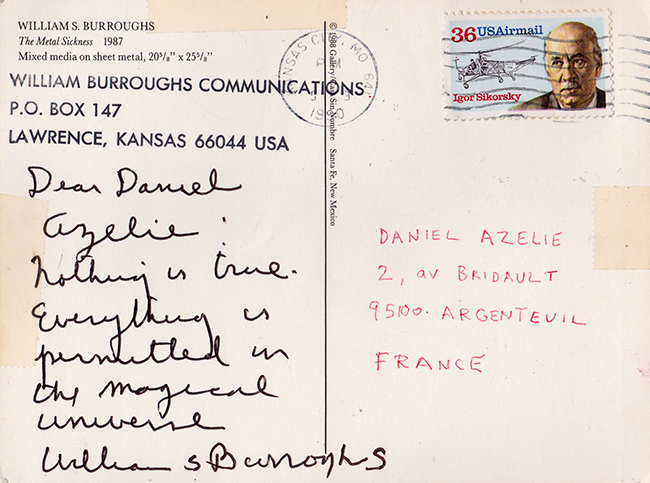
Une lettre mystérieuse de William S. Burroughs à Daniel Azélie
“J’ai toujours aimé ce que raconte Jello Biafra (dans un N° de RE/SEARCH) à propos de la spécificité des Dead Kennedys, musicalement : ils écoutaient beaucoup de choses curieuses, comme des « interprétations » de heavy metal par des brésiliens, des versions chinoises du punk rock, des folklores d’Europe Centrale, et cette nourriture leur a permis d’introduire des clarinettes dans leur punk des formes de chansons étranges, saugrenues.”
Est-ce que c’est comme ça seulement en Europe ou dirais-tu la même chose pour le monde entier?
J’ai toujours aimé ce que raconte Jello Biafra (dans un N° de RE/SEARCH) à propos de la spécificité des Dead Kennedys, musicalement : ils écoutaient beaucoup de choses curieuses, comme des « interprétations » de heavy metal par des brésiliens, des versions chinoises du punk rock, des folklores d’Europe Centrale, et cette nourriture leur a permis d’introduire des clarinettes dans leur punk des formes de chansons étranges, saugrenues. Aujourd’hui, j’ai un ami berlinois voyageur, qui fait connaître (par son label et son site, ainsi que la réalisation de compilations) les diverses musiques NOISE d’Asie du Sud-Est, il y a des punks en Afrique de l’Ouest et du Sud, des touaregs électriques, le Wild Classical Music Ensemble (check them out !), DJ SPOOKY qui traite les enregistrements comme de la mémoire virale… Internet permet la circulation instantanée des créations, partout, tout le temps, mais/et beaucoup d’apathie se crée via les réseaux sociaux (par une surabondance de livres, musiques, arts, textes, informations, produits à vendre, états d’âmes : tout est mis au même niveau, le désir s’émousse). L’absence de désir, c’est ça, le problème : on regarde et commente plutôt que faire des choses. Personnellement, je préfère m’amuser, monter sur les toits, faire le mur la nuit, courir dans les rues. Je dîne rarement chez des amis, parce que si j’ai le choix, je préfère aller me balader dehors. J’affectionne aussi les drogues, j’essaie des choses pour voir comment ça marche, comment on peut s’en servir « au mieux ».
La malédiction continue…
“Burroughs était, par sa stature anti-establishment et criminel, junkie, lié au rock, à la « contreculture » des 60’s/70’s. Il a défendu le 45 rpm « God Save The Queen » des Sex Pistols attaqué en justice, censuré : pour moi ça disait tout (il aimait les garçons très sauvages, et n’aimait pas qu’on empêche ces jeunes de s’exprimer, surtout s’ils gueulaient contre la monarchie en prenant du speed.”
Est-ce qu’on s’est ennuyé des possibilités permises par les ordis et la technologie?
Sûrement, parce qu’internet a permis aux humains de paraître plutôt que faire des choses, et de collectionner plein de choses de leur jeunesse (ou du passé, en tous cas), de s’occuper sans but. Mais c’est comme ça avec chaque media nouveau, peut-être. J’aime bien l’entropie, le chaos total, c’est excitant; mais aussi le sens qu’on donne à des actes.
Lorsqu’il s’agit de littérature et d’édition indépendante, la France est au premier plan ; de nombreux artistes y installent leurs ateliers. Quelle est, selon vous, la raison de cette tradition et de ce potentiel ?
Il y a une, des histoires de l’image « imprimée » en France, et beaucoup d’artistes d’hier et d’aujourd’hui se tournent à un moment vers d’anciennes techniques de reproduction d’image (divers types de gravure, sur tous supports, risographie, litho). Ces formes d’arts par la publication, l’image imprimée, la traduction d’un trait, sont très populaires, signe vivant de l’expression et de la confrontation passé/ présent, aussi : Blanquet réalise de splendides lithographies, tel un ogre). J’aime les images imprimées. Loulou Picasso disait que certaines images de Bazooka ne tenaient que pour le moment de l’impression (et pouvaient se désintégrer après, ne tenant que par du scotch). J’aime ça. Le chaos, l’émiettement (l’atomisation) sont des terrains de jeu.
« Est-ce que vous avez un avenir ? Ouais, il est derrière moi ! »
“J’ai aimé les Sex Pistols parce qu’ils voulaient vraiment détruire la crédibilité du jeu des rockstars et de tous ses parasites bien au chaud, confortables.”
Est-ce que tu peux nous parler de ton amitié avec William S. Burroughs? Qaund et sous quel pretexte vous avez commencé à correspondre ? de quoi vous parliez? Nous serions très contents d’écouter…
Amitié, c’est exagéré : Burroughs aimait de toutes façon connaitre de jeunes hommes (pas trop jeunes), et nous avons échangé des cartes postales à un moment, parce que je réalisais qui il était, ce qu’il portait d’histoireS, d’histoirE, sa vie et le récit de sa vie se confondaient, j’adore ces menteurs/artistes, voleurs, escrocs, intoxiqués, dealers. Il a ouvert mon imaginaire dès que j’ai rencontré « the wild boys » : j’ai ri, beaucoup, en le lisant, dans le métro, partout. On s’en lisait mutuellement des passages, avec un ami rocker. Burroughs était, par sa stature anti-establishment et criminel, junkie, lié au rock, à la « contreculture » des 60’s/70’s. Il a défendu le 45 rpm « God Save The Queen » des Sex Pistols attaqué en justice, censuré : pour moi ça disait tout (il aimait les garçons très sauvages, et n’aimait pas qu’on empêche ces jeunes de s’exprimer, surtout s’ils gueulaient contre la monarchie en prenant du speed. Ballard aussi disait que le PUNK a été le dernier grand vent culturel de révolte puissant et intéressant, créatif, en Angleterre. Le chaos m’a toujours donné la chair de poule. J’ai aimé les Sex Pistols parce qu’ils voulaient vraiment détruire la crédibilité du jeu des rockstars et de tous ses parasites bien au chaud, confortables. Burroughs : un écrivain unique, une vraie vie de fiction, il jouait des rôles, sans prétention, mais quel comique ! À un moment, avec un ami, on s’est dit que ces personnages qu’on admirait étaient juste des gens : j’ai ainsi communiqué avec Monte Cazzazza, Vale (de Re/Search books & graphics), COIL (John Balance), et donc William Burroughs. J’étais un « fan », il était un « écrivain » de la contre-culture, un outlaw avec ses chats. J’ai écrit à propos de ses livres, ses idées (pour l’université), j’ai beaucoup lu ses divers écrits (entretiens, romans, essais, articles, préfaces), vu des films. Quand il est mort, ce fut pour moi un détachement, je n’étais pas plus triste. Comme Fellini, il manque à l’imaginaire du monde. Comme plein d’autres. Mais il continue de vivre à travers ceux qui le portent en eux. William Burroughs était un clown, aussi. Je suis heureux d’avoir connu son œuvre de son vivant, je suis heureux d’avoir connu la Terre depuis les 60’s. Jusqu’aujourd’hui.
Passionnants jours !
Merci beaucoup pour l’interview, n’hésite pas si tu veux ajouter quelque chose?
Merci pour ces questions, qui me permettent de tracer des lignes entre les choses qui me touchent. J’aime cette vie depuis le début, cette Terre. On disparaîtra, mais on aura pu faire connaissance, lire des livres, écouter des chansons, toutes ces choses. I love being alive in this world (it’s revolving, stimulating, it’s awful and wonderful). I love people, I hate people. I hate love, I need love. I’m out of it, anyway.
Bye, Erman
Une affiche de rock provenant des archives de Daniel Azélie
N’hésitez pas à vous joindre aux actions de cet extraordinaire anarchiste français !















 LÖPÇÜK